REVIEW 5 minor 16 references
Dynamics and dose response in scaffold ligand binding
T0 review · 0 major / 5 minor · reviewed 2026-08-05 · deepseek-v4-flash
Pith's one-line read This paper proves that under independent binding, the fully bound scaffold complex rises to a unique maximum and then falls as total scaffold increases, for any number of ligand types greater than one.
desk verdict A rigorous, parameter-free proof that the fully bound scaffold complex is biphasic in total scaffold for any number of independently binding ligands, plus a surprising multiphasic caveat for partial complexes. read the letter →
The pith
A machine-rendered reading of the paper's core claim, the machinery that carries it, and where it could break.
The reading
What carries the argument
The load-bearing machinery is the detailed-balance product form $y_I = y_\emptyset \prod_{j\in I} K_j a_j$, which turns the conservation laws into $m$ decoupled quadratic equations for $U_i=1+K_i a_i$. The scalar function $S(X)=\sum_{i=1}^m T_i(X)$ with $T_i(X)=K_iX/(U_i(X)^2+K_iX)$ then carries the entire argument: each $T_i$ is strictly increasing in $X$, the sum runs from $0$ to $m$, and the unique solution of $S(X)=1$ gives the unique maximizer of the fully bound complex.
What would settle it
Search the parameter space of the $m=2$ mass-action model, or run a well-mixed in vitro binding assay with two ligands and a scaffold satisfying independent binding, for a case where the fully bound complex has two distinct local maxima as total scaffold varies; Theorem 2 says none exists, so a single such numerical or experimental curve would refute the central claim.
Extended reading notes
Core claim
The central discovery is Theorem 2. Fix $m\ge 2$ ligands with positive totals $A_{1,\mathrm{tot}},\dots,A_{m,\mathrm{tot}}$; under independent binding, for each total scaffold concentration $X=Y_{\mathrm{tot}}$ there is a unique positive steady state. The concentration $F(X)$ of the fully bound complex $Y_{[m]}$ is differentiable and has exactly one critical point $X^*$, with $F'(X)>0$ before and $F'(X)<0$ after. The proof reduces the steady-state equations to decoupled quadratics for $U_i=1+K_i a_i$ and expresses $F$ as $X\prod_j (U_j-1)/U_j = (\prod_j \alpha_j)X\big/\prod_j (U_j+K_jX)$. Its logarithmic derivative is $(1-S(X))/X$, where $S(X)=\sum_i K_i X/(U_i^2+K_iX)$; each summand is stri
Load-bearing premise
The result rests on independent binding—each ligand's binding and unbinding rates are the same no matter what else is already on the scaffold—and on a closed system with no production, degradation, or dilution; if binding is context-dependent or the system is open, the unique-maximum conclusion is not guaranteed.
Editorial extensions
If this is right
- For bispecific antibody drugs ($m=2$), this is a rigorous proof that a unique optimal antibody concentration exists, justifying dosing strategies aimed at maximizing the fully bound ternary complex.
- For any $m\ge 2$, adding scaffold beyond the optimum is guaranteed to reduce the fully bound complex, so overdosing trispecific antibodies or CRISPRa scaffolds is mathematically certain to be counterproductive.
- Intermediate partially bound complexes can have two or more local maxima, so dose-response experiments should measure the fully bound complex rather than a partial complex when looking for the unique optimum.
- Free scaffold and singly bound complexes increase monotonically with total scaffold, while free ligand concentrations decrease; singly bound complexes act like capture curves approaching $A_{i,\mathrm{tot}}$.
- For a single ligand ($m=1$) there is no finite optimal scaffold dose; the fully bound complex increases monotonically to a limiting value.
Reading between the lines
- Testable extension: if binding is made cooperative or allosteric, the product form breaks, and the predicted signature is loss of the single peak; a scaffold titration with a ligand that changes another ligand's affinity could distinguish the independence regime.
- The paper's mechanism for partial complexes suggests a design heuristic for synthetic scaffolds: partial complexes can show multiple peaks whenever omitted ligands are abundant on separated scales, so using the fully bound complex as the readout avoids this ambiguity.
- Because the model is closed, applying the theorem to live cells requires the additional assumption that production, degradation, and dilution are slow relative to binding; the paper leaves open how those processes reshape the curve.
- A natural mathematical extension is time-varying scaffold input: the monotonic crossing function $S(X)$ may also control transient ordering of dose responses, but the paper does not address dynamics.
Signed reviews
Editorial analysis
A structured set of objections, weighed in public.
Referee Report
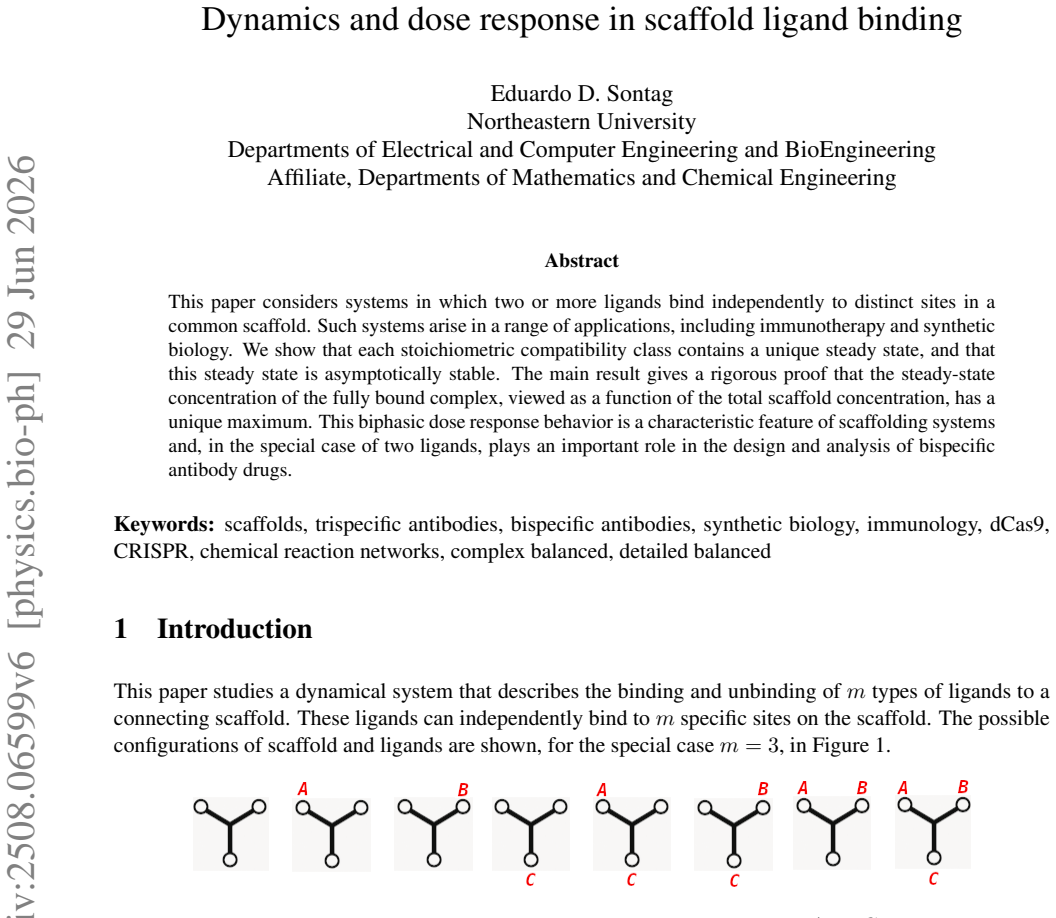
Summary. This paper analyzes a reversible mass-action model in which m ligand types bind independently to a common scaffold, with species Y_I for I ⊆ [m]. The authors prove (Theorem 1) that each positive stoichiometric compatibility class contains a unique positive steady state that is globally asymptotically stable, using detailed balance and the absence of critical siphons. The central result (Theorem 2) shows that, for fixed positive ligand totals and m ≥ 2, the steady-state concentration of the fully bound complex Y_[m] is a differentiable function of total scaffold X = Y_tot with a unique maximizer: it increases strictly up to X* and decreases after. The proof derives a quadratic equation for U_i = 1 + K_i a_i, establishes monotonicity of T_i = K_i X / (U_i^2 + K_i X), and applies the intermediate value theorem to S(X) = Σ T_i. Theorem 3 gives monotonicity of free scaffold (increasing), free ligands (decreasing), and singly bound complexes (increasing). The paper also shows that partially bound complexes can have multiple maxima, with explicit numerical examples for m = 3 and m = 4. The main theorem is conditional on the independent-binding assumption and the closed-system conservation framing, both clearly stated in Remark 9.
Significance. If accepted, this paper provides a rigorous, parameter-free explanation of biphasic dose-response in scaffold systems, directly relevant to bispecific/trispecific antibody design and CRISPRa synthetic biology. The proof is unusually self-contained: the key derivative computation (Eq. (14)) is transparent, and the uniqueness argument via a strictly increasing S(X) is elegant. The paper also contributes a useful cautionary result: intermediate partial complexes need not be uniquely biphasic, with reproducible numerical examples. The explicit correction to a published formula (Remark 8) is a small but concrete contribution. The assumptions are clearly delimited, no data fitting is involved, and the central theorem is a falsifiable prediction of the model.
minor comments (5)
- [Remark 9] The limitations of the model are explicitly acknowledged: independent binding may fail (e.g., facilitated promoter binding) and the closed-system framework omits production, degradation, and dilution. This is a scope limitation, not an internal inconsistency; the conditional claim in Theorem 2 is unaffected. The authors should keep this remark, as it correctly prevents overgeneralization.
- [Abstract and Section 1] The phrase 'each stoichiometric compatibility class contains a unique steady state' is imprecise. Theorem 1 concerns 'each positive stoichiometric compatibility class' and its positive steady state. The abstract and introduction should be aligned with the formal statement to avoid confusion about boundary behavior.
- [Remark 6] Typo: 'intutively' should be 'intuitively'.
- [Figure 10 caption] The caption states that the vertical axis is scaled to the largest local maximum but does not give the scale factor. Adding the factor would aid reproducibility of the numerical example.
- [Section 5, proof of Theorem 2] In the endpoint-limit argument as X → 0+, the boundedness of U_i is established via U_i - 1 < α_i. This step is correct but slightly compressed; a parenthetical reminder that (U_i + K_i X)/U_i > 1 would improve readability.
Circularity Check
No significant circularity: Theorem 2 is a parameter-free consequence of the model equations and is not reduced to its inputs by construction.
full rationale
The central claim, Theorem 2, is a purely mathematical consequence of the steady-state equations (7)–(8), which are derived from the mass-action network and the explicitly stated independent-binding assumption. No parameter is fitted to data, and the conclusion holds for arbitrary positive K_i and A_i,tot. The proof constructs the unique positive steady state via the quadratic equation (10), derives sign-definite monotonicity of U_i, and proves exactly one crossing of S(X)=1; this is an internal derivation, not an imported uniqueness theorem. The uniqueness and stability results in Theorem 1 rely on standard, externally available CRN theory: detailed balance is verified directly in Section 4, the Feinberg textbook [7] and Anderson [3] provide the global-stability criterion, and the persistence result [4] is used as a lemma with proof provided (Lemma 1). The self-citations [14] and [11] are contextual or supply standard background theorems that are also supported by external references such as [13]; they are not load-bearing in the sense of being the sole justification for the paper's main result. The m=2 explicit formulas are cross-checked against the external reference [5], not assumed from it. The only substantive limitation, stated in Remark 9, is that independent binding and closed-system conservation may fail in some applications; this restricts applicability but does not make the derivation circular. No step in the derivation chain reduces to its own inputs by definition, and no fitted quantity is renamed as a prediction. Hence the paper merits a circularity score of 0.
Assumptions & free parameters
free parameters (2)
- Figure 8 parameters (K1=K2=K3=1, A1,tot=A2,tot=0.1, A3,tot=100) =
K_i=1; A1,tot=A2,tot=0.1; A3,tot=100
- Figure 10 parameters (m=4, K_i=1, A1,tot=A2,tot=0.01, A3,tot=10, A4,tot=1000) =
K_i=1; A1,tot=A2,tot=0.01; A3,tot=10; A4,tot=1000
assumptions (7)
- standard math Detailed-balanced mass-action systems have a unique positive equilibrium in each positive compatibility class, locally asymptotically stable (Feinberg, Theorems 14.2.1 and 14.2.3).
- standard math For complex-balanced mass-action systems, every positive trajectory either converges to the unique positive equilibrium in its class or has an omega-limit point on the boundary (Sontag 2001; Anderson 2008).
- standard math A network with no nonempty critical siphons is persistent (Angeli, de Leenheer, Sontag 2007).
- domain assumption Mass-action kinetics: the rate of Y_I + A_i -> Y_{I∪{i}} equals k_on,i y_I a_i, and reverse rate equals k_off,i y_{I∪{i}}.
- domain assumption Independent binding: k_on,i and k_off,i do not depend on which other ligands are already bound.
- domain assumption Closed system with conserved totals: no production, degradation, or dilution of scaffold or ligands.
- standard math Implicit function theorem is applicable to the quadratic (10) because ∂g_i/∂U = U + K_i X / U > 0 at the root.
Cite this review
Pith. "Pith review of Dynamics and dose response in scaffold ligand binding." pith.science (2026). https://pith.science/paper/AHN552XR
@misc{pith2026250806599,
  author       = {Pith},
  title        = {Pith review of: Dynamics and dose response in scaffold ligand binding},
  year         = {2026},
  howpublished = {\url{https://pith.science/paper/AHN552XR}},
  note         = {Machine review of arXiv:2508.06599}
}
read the original abstract
This paper considers systems in which two or more ligands bind independently to a common scaffold. Such systems arise in a range of applications, including immunotherapy and synthetic biology. We show that each stoichiometric compatibility class contains a unique steady state, and that this steady state is asymptotically stable. The main result gives a rigorous proof that the steady-state concentration of the fully bound complex, viewed as a function of the total scaffold concentration, has a unique maximum. This biphasic dose response is a characteristic feature of scaffolding systems and, in the special case of two ligands, plays an important role in the design and analysis of bispecific antibody drugs.
Figures


Figures from the paper (7 more)





Reference graph
Works this paper leans on
-
[5]
E. F. Douglass Jr, C. J. Miller, G. Sparer, H. Shapiro, and D. A. Spiegel. A comprehensive mathe- matical model for three-body binding equilibria.Journal of the American Chemical Society, 135(16): 6092–6099, 2013. doi: 10.1021/ja311795d
-
[1]
https://www.genscript.com/bispecific-antibody.html
-
[2]
M. A. Al-Radhawi, K. Manoj, D. Jatkar, A. Duvall, D. Del Vecchio, and E. Sontag. Competition for binding targets results in paradoxical effects for simultaneous activator and repressor action. InProc. 63rd IEEE Conference on Decision and Control (CDC), pages 5579–5585, 2024
work page 2024
-
[3]
D. F. Anderson. Global asymptotic stability for a class of nonlinear chemical equations.SIAM Journal on Applied Mathematics, 68(5):1464–1476, 2008
work page 2008
- [4]
-
[6]
T. Dunlap and Y . Cao. Physiological considerations for modeling in vivo antibody-target in- teractions.Frontiers in Pharmacology, V olume 13 - 2022, 2022. ISSN 1663-9812. doi: 10.3389/fphar.2022.856961
-
[7]
M. Feinberg.Foundations of Chemical Reaction Network Theory, volume 202 ofApplied Mathemati- cal Sciences. Springer, Cham, 2019
work page 2019
-
[8]
M. C. Good, J. G. Zalatan, and W. A. Lim. Scaffold proteins: hubs for controlling the flow of cellular information.Science, 332(6030):680–686, May 2011. doi: 10.1126/science.1198701
Show all 16 references
-
[9]
Manoj and D
K. Manoj and D. D. Vecchio. Emergent interactions due to resource competition in CRISPR-mediated genetic activation circuits. In2022 IEEE 61st Conference on Decision and Control (CDC), pages 1300–1305. IEEE, 2022
2022
-
[10]
Manoj, D
K. Manoj, D. Jatkar, M. A. Al-Radhawi, E. Sontag, and D. Del Vecchio. Paradoxical gene regu- lation explained by competition for genomic sites. 2026. Submitted. Preprint available at bioRxiv 10.1101/2025.11.27.691022
2026 doi
-
[11]
Sadeghi, I
M. Sadeghi, I. Kareva, G. Pogudin, and E. D. Sontag. Quantitative pharmacology methods for bispe- cific T cell engagers.Bulletin of Mathematical Biology, 87:85, 2025
2025
-
[12]
Shaw and E
A. Shaw and E. Filbert. Scaffold proteins and immune-cell signalling.Nature Reviews Immunology, 9 (1):47–56, January 2009. doi: 10.1038/nri2473
2009 doi
-
[13]
Siegel and D
D. Siegel and D. MacLean. Global stability of complex balanced mechanisms.Journal of Mathemati- cal Chemistry, 27(1–2):89–110, October 2000. doi: 10.1023/A:1019183206064
-
[14]
E. D. Sontag. Structure and stability of certain chemical networks and applications to the kinetic proofreading model of T-cell receptor signal transduction.IEEE Trans. Automat. Control, 46(7):1028– 1047, 2001. ISSN 0018-9286
2001
-
[15]
L. Wu, E. Seung, L. Xu, E. Rao, D. M. Lord, R. R. Wei, V . Cortez-Retamozo, B. Ospina, V . Posternak, G. Ulinski, P. Piepenhagen, E. Francesconi, N. El-Murr, C. Beil, P. Kirby, A. Li, J. Fretland, R. Vicente, G. Deng, T. Dabdoubi, B. Cameron, T. Bertrand, P. Ferrari, S. Pouzie...
2020
-
[16]
Yang and W
J. Yang and W. Hlavacek. Scaffold-mediated nucleation of protein signaling complexes: Elementary principles.Mathematical Biosciences, 232:164–173, 2011. 23
2011
Reviewed August 5, 2026 · model on record in the stance chip above.
Discussion (0). Continue with ORCID to comment.