REVIEW 3 major objections 6 minor 3 cited by
At $z=5.85$, the MAMBO-9 pair's baryonic mass budget closes only if the CO-to-H$_2$ conversion factor is near unity, implying its gas was already metal-rich within the first billion years.
Reviewed by Pith at T0; open to challenge. T0 means a machine referee read the full paper against a public rubric. the ladder, T0–T4 →
ALMA and JWST resolve two merging dusty galaxies at z=5.85, measure a 1:5 mass ratio, find star formation hidden in A_V>10 clouds, and infer metal-rich gas inside a possible protocluster.
T0 review reviewed 2026-08-05 challenge →
load-bearing objection Solid new ALMA+JWST data and careful kinematics, but the alpha_CO ~1 / super-solar metallicity punchline doesn't survive the SLED uncertainty, and the overdensity claim lacks a statistical baseline. the 3 major comments →
JWST+ALMA reveal the ISM kinematics and stellar structure of MAMBO-9, a merging pair of DSFGs in an overdense environment at $z=5.85$
The pith
A machine-rendered reading of the paper's core claim, the machinery that carries it, and where it could break.
The reading
Core claim
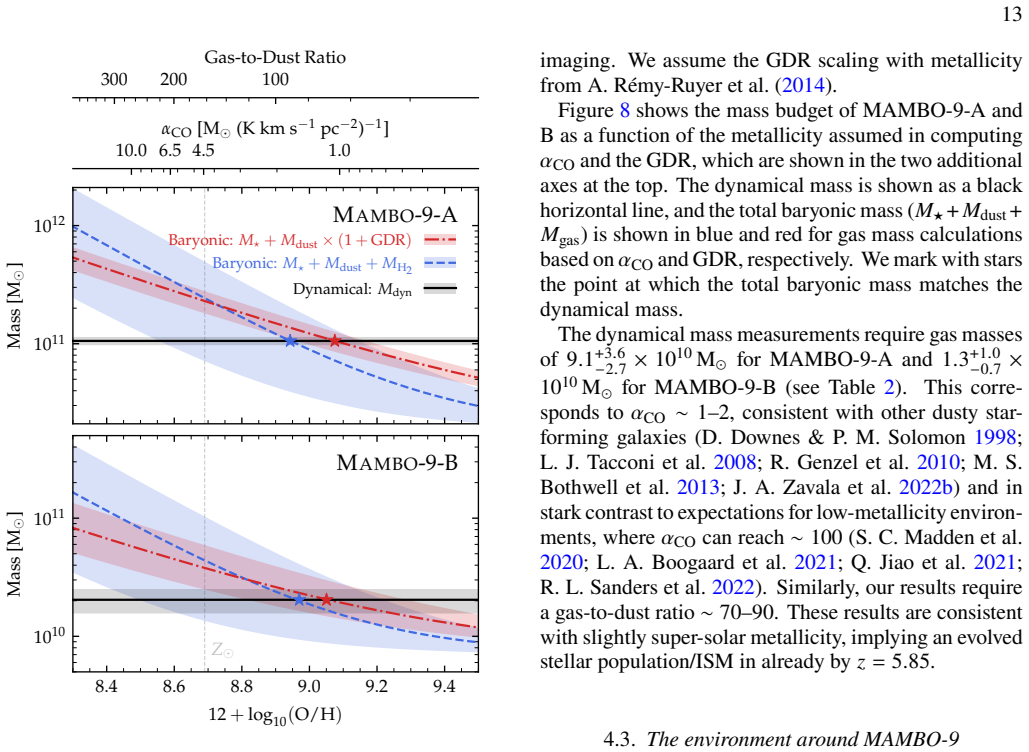
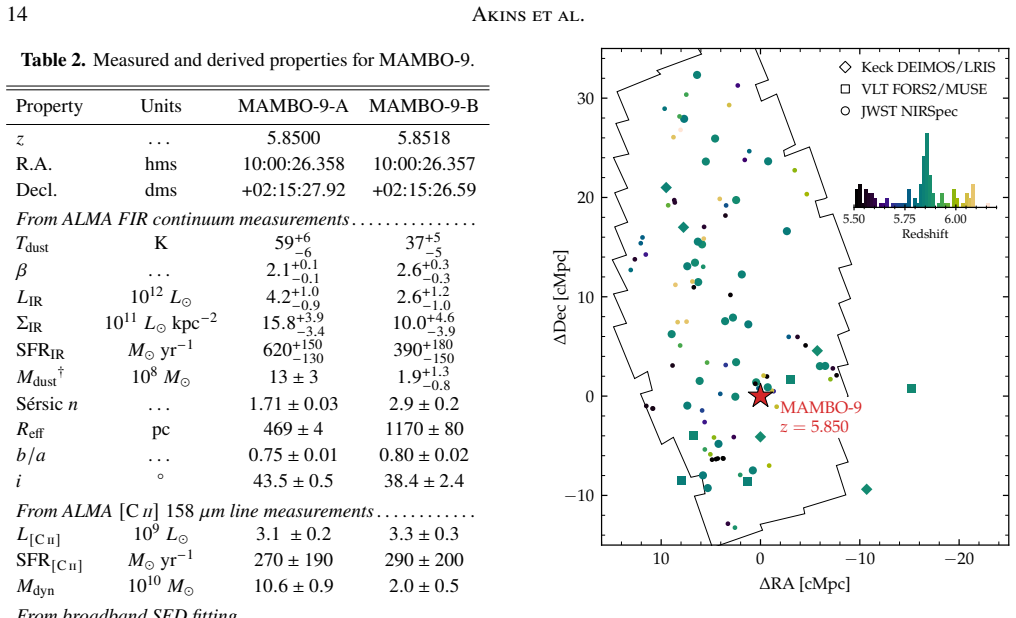
The paper claims that MAMBO-9 is a minor merger (mass ratio ~1:5) of two massive galaxies at $z=5.85$ whose combined baryonic mass budget is closed only with a low CO-to-H$_2$ conversion factor. The dynamical masses, $M_{\rm dyn}=V_{\max}^2\,R_{\max}/G$, from tilted-ring fits to the [CII] cubes are roughly $1.1\times10^{11}\ M_\odot$ for component A and $2.0\times10^{10}\ M_\odot$ for component B. Stellar masses from spatially resolved energy-balance SED fits are $\log M_\star/M_\odot\sim10.2$ and $\sim9.8$. With gas masses inferred from CO(6-5) luminosities and dust masses from 3 mm continuum, the baryonic sum equals the dynamical mass only if $\alpha_{\rm CO}\sim1$-$2$ (or the gas-to-dust
What carries the argument
The load-bearing comparison is the baryonic mass budget. Dynamical masses are measured from the [CII] 158 micron rotation curves using tilted-ring forward modeling ($M_{\rm dyn}=V_{\max}^2\,R_{\max}/G$), stellar masses come from spatially resolved JWST SED fitting, and gas masses come from previous CO(6-5) observations scaled by $\alpha_{\rm CO}$ through an assumed CO spectral line energy distribution (SLED)---the relative brightness of the CO rotational ladder. The paper then requires the baryonic sum (stars plus gas plus dust) to match the dynamical mass; that closure condition fixes $\alpha_{\rm CO}\sim1$ and a gas-to-dust ratio near 80, and metallicity-dependent calibrations translate th
Load-bearing premise
The argument hinges on the CO spectral line energy distribution of MAMBO-9 matching the average high-redshift DSFG ratio $I_{\rm CO(6-5)}/I_{\rm CO(1-0)} = 10^{+30}_{-5}$, so the low-J CO luminosity is inferred rather than measured; a different SLED would change the required $\alpha_{\rm CO}$ and therefore the metal-rich conclusion.
What would settle it
Measure CO(1-0) or CO(2-1) emission from MAMBO-9 directly. The $\alpha_{\rm CO}\sim1$ result assumes $L'_{\rm CO(1-0)}\approx3.6\,L'_{\rm CO(6-5)}$; a direct low-J detection giving a larger CO(1-0)/CO(6-5) ratio would raise the inferred gas mass and could erase the super-solar metallicity conclusion. Alternatively, a direct gas-phase metallicity measurement from the existing NIRSpec spectrum (e.g., [OIII]/H$\beta$) would independently test the near-solar oxygen abundance implied by the mass budget.
If this is right
- The required $\alpha_{\rm CO}\sim1$ places MAMBO-9's ISM at roughly solar to slightly super-solar metallicity by $z=5.85$, showing that massive galaxies could be chemically enriched within the first billion years.
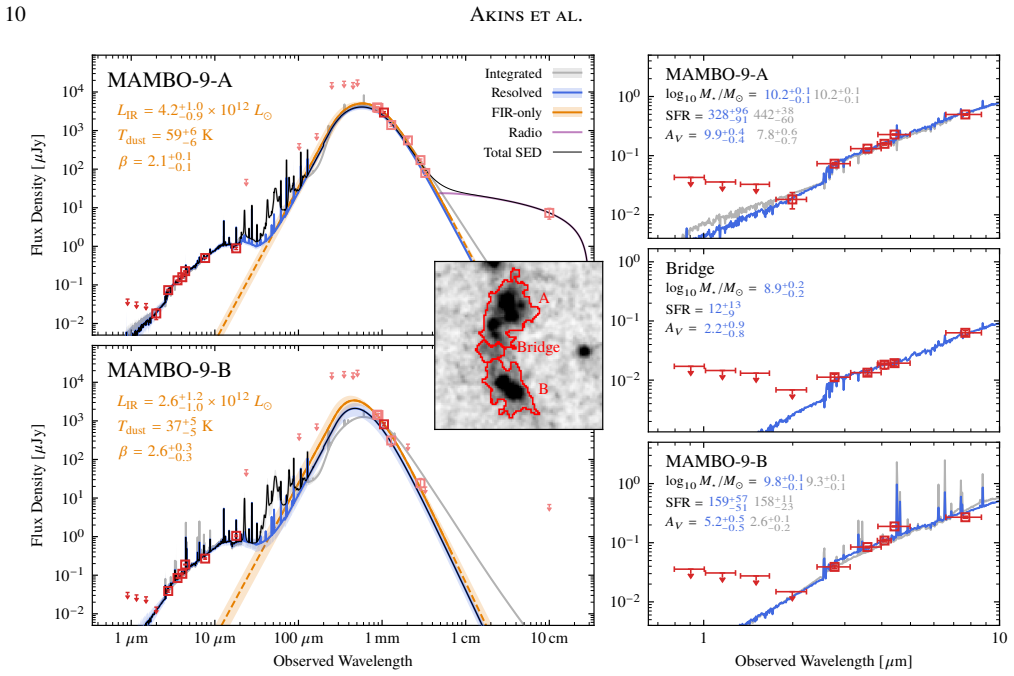
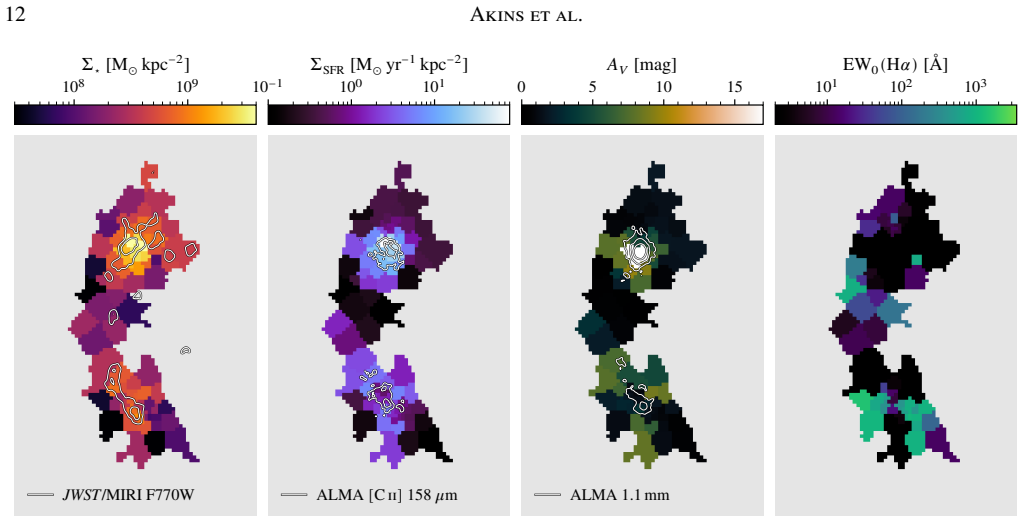
- The resolved SED results imply that integrated SEDs of high-redshift DSFGs can hide the sites of most star formation: the bulk of recent star formation sits in $A_V>10$ clouds, while the visible rest-optical light comes from $A_V\sim1$-$5$ regions.
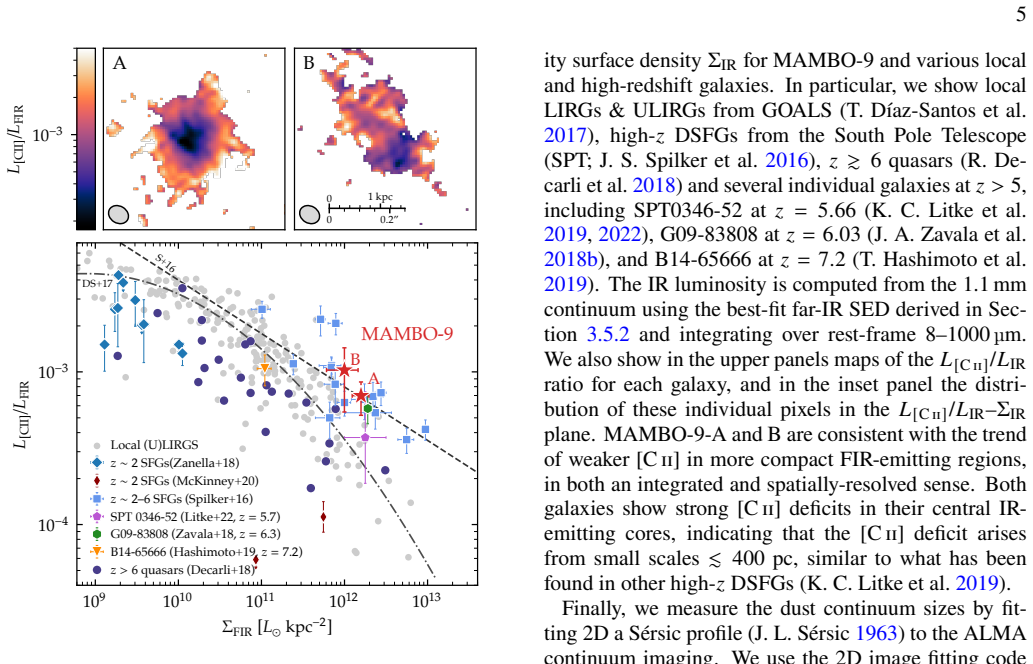
- The [CII] deficit operates on sub-kpc scales within MAMBO-9, so it is set by compact, IR-bright cores rather than by the global galaxy-averaged FIR surface density.
- MAMBO-9 is a roughly 1:5 minor merger in progress, with a red tidal bridge of a few $\times10^9\ M_\odot$ of stellar mass connecting the components, placing it among the highest-redshift tidal features known.
- The surrounding overdensity includes 39 spectroscopically confirmed galaxies within roughly 25 cMpc of MAMBO-9, supporting the picture of MAMBO-9 as a protocluster core and a candidate progenitor of a present-day brightest cluster galaxy.
Where Pith is reading between the lines
- If $\alpha_{\rm CO}\sim1$ is typical of massive $z>5$ DSFGs, gas masses and gas fractions in the early Universe may be systematically lower than assumed by studies adopting Milky Way-like conversion factors, and population-level depletion times would need revision.
- The paper's resolved [CII]-deficit maps suggest that unresolved observations mix very different ISM phases; sub-kpc ALMA/JWST-matched studies of other $z>5$ DSFGs could test whether $A_V>10$ starburst cores always coincide with the deepest [CII] deficits.
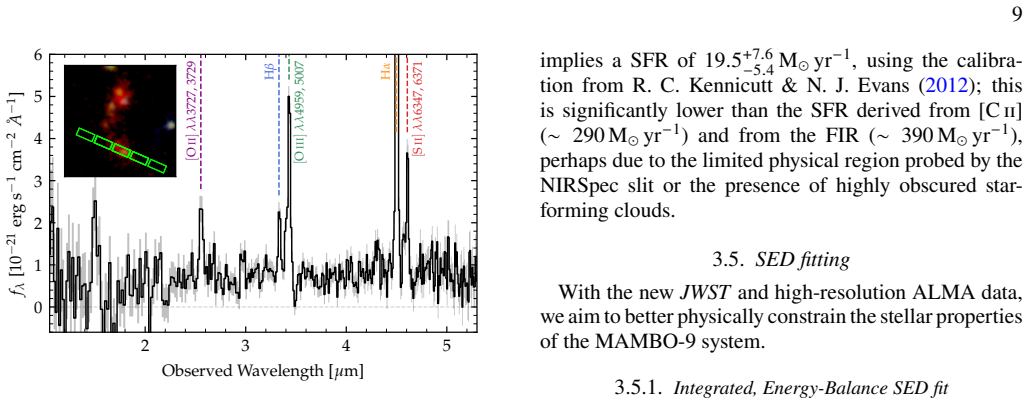
- The NIRSpec H$\alpha$-derived SFR for MAMBO-9-B is an order of magnitude below the FIR-derived SFR; if the obscured clouds are truly optically thick, deep rest-frame near-IR spectroscopy or radio free-free measurements may be needed to avoid missing the dominant star formation in such systems.
- The claimed overdensity spanning much of the COSMOS field could connect MAMBO-9 to the tentative $z\sim6$ structure found in the same region; wide-area H$\alpha$ mapping with NIRCam slitless spectroscopy should reveal whether this is one coherent protocluster or several filaments along the line of sight.
Editorial analysis
A structured set of objections, weighed in public.
Referee Report
Summary. This paper presents new ALMA [CII] 158 μm and dust continuum observations (≈400 pc resolution) and JWST/NIRCam+MIRI imaging of MAMBO-9, a pair of dusty star-forming galaxies at z=5.85. The authors detect clear velocity gradients in both components, fit tilted-ring models with 3DBarolo, and derive dynamical masses of (10.6±0.9)×10^10 M_sun (A) and (2.0±0.5)×10^10 M_sun (B), implying a 1:5 minor merger. The JWST data reveal a red tidal bridge between the components, and spatially-resolved SED fitting suggests that the most recent star formation is heavily obscured (A_V>10) while rest-optical light emerges from A_V~1-5 regions. Combining the new stellar and dynamical masses with previous CO(6-5) and dust measurements, the authors argue that the mass budget requires a low CO-to-H2 conversion factor α_CO~1-2 (or gas-to-dust ratio ~70-90), indicating high ISM enrichment at z~5.85. Finally, they identify a spectroscopic overdensity of 39 galaxies within Δz=0.03 of MAMBO-9, spanning ~40 cMpc across the PRIMER-COSMOS field. The paper's central quantitative claim is that the baryonic mass budget requires α_CO ~ 1-2, and the abstract states this implies a 'highly metal-enriched ISM.'
Significance. If the α_CO result is robust, this is an important data point: a massive, gas-rich DSFG at z≈6 with an ISM already near solar or super-solar metallicity would challenge simple chemical-enrichment timescales and would strengthen the case that the brightest cluster galaxy progenitors form early in extremely dense environments. The kinematic analysis is careful: the authors use forward modeling with 3DBarolo, include explicit caveats about inclination, merger disturbance, and the possibility that MAMBO-9-B is not a relaxed rotator. The spatially resolved JWST+ALMA comparison is also valuable, as is the spectroscopic confirmation of a large overdensity around the system. The paper ships a set of measured fluxes, derived maps, and model comparisons that will be useful to the community. The main weakness is the CO SLED assumption in the mass-budget argument, which is not fully propagated into the headline α_CO value; this weakens the 'highly metal-enriched' conclusion as stated. The resolved SED results also rely on an ad hoc birth-cloud attenuation parameter. Neither issue invalidates the kinematic or environmental results, but they affect the paper's most prominent physical claims.
major comments (3)
- [§4.2 and Fig. 8] The CO SLED uncertainty is not fully propagated into the α_CO conclusion. The text adopts I_CO(6-5)/I_CO(1-0)=10^{+30}_{-5}, i.e. L'_CO(1-0)~3.6 L'_CO(6-5). Combining the quoted SLED range with the CO(6-5) luminosity error (L'_CO(6-5)=(1.4±0.9)×10^10 K km/s pc^2 for component A) yields L'_CO(1-0) from roughly 0.4×10^10 to 17×10^10 K km/s pc^2. The required gas mass of ~9×10^10 M_sun then corresponds to α_CO~0.5-20, fully consistent with the Milky Way value α_CO~4.5. The caption of Fig. 8 states that 'the CO-based gas mass includes the uncertainty on the CO SLED,' but the text's 'requires α_CO~1-2' is not the result of a full propagation. Please provide a Monte Carlo propagation of the SLED ratio and the CO(6-5) luminosity error, and quote the resulting α_CO range. If that range remains broad, the abstract and §4.2 should be tempered to 'consistent with solar to slightly super-solar metal
- [§3.5.3 and abstract] The claim that 'the majority of recent star formation is concentrated in extremely obscured (A_V>10) clouds' is based on spatially-resolved SED fits that fix T_dust and β to values from the integrated FIR-only fit and use the birth-cloud attenuation factor η introduced in §3.5.1 with a uniform prior 1-10. The paper states that η was added 'to reproduce the extreme SFRs implied by the FIR without significant flux boosting from strong emission lines in the NIRCam bands' and that it allows mass-weighted A_V to exceed the nominal prior maximum of 8. With only one spatially-resolved FIR point per Voronoi bin, the resulting A_V>10 values in the compact cores are not independently constrained by the data. Please show a sensitivity test in which η is fixed to a fiducial value (e.g., η=1 or η=3) and in which T_dust/β are varied within their uncertainties, and demonstrate that the 'majority of rec
- [§4.2] The text in §4.2 concludes 'These results are consistent with slightly super-solar metallicity, implying an evolved stellar population/ISM in already by z=5.85.' This is notably more cautious than the abstract's 'highly metal-enriched ISM.' Given the propagation issue above, the abstract should match the discussion-level claim. If the authors intend to retain the stronger statement, they need to justify why the central α_CO value should be preferred over the full allowed range, for example by appealing to external priors on α_CO in DSFGs or by using the GDR as the primary constraint.
minor comments (6)
- [§3.2] Typo: 'The the ALMA [CII] and dust continuum measurements' should be 'The ALMA...'.
- [§3.2] The description of how the morphological and kinematic inclination estimates are combined is somewhat vague. The text says 'we incorporate systematic effects by combining the morphological and kinematic inclinations' but then 'we adopt the approximate mean'; it would be clearer to state exactly how the adopted inclinations and their uncertainties were derived (e.g., weighted mean, quadrature sum of systematic errors).
- [§3.1] When describing the double-peaked [CII] spectrum, 'separated by≈500 km/s' could be clarified as 'the two peaks are separated by≈500 km/s.' Also, the units in §3.4 for line fluxes are given as erg s^-1 cm^-2 Å^-1, but for Gaussian-fitted line fluxes the correct unit is erg s^-1 cm^-2; please check.
- [§3.5.1] The introduction of the birth-cloud attenuation parameter η is an important modeling choice, but the text does not discuss the degeneracy between η and the stellar mass/SFR. A sentence on the posterior behavior of η (e.g., whether it peaks at the prior boundary) would help the reader assess the robustness of the derived physical parameters.
- [§4.3] The sentence 'as compiled by ; A. A. Khostovan et al. (2025)' contains a stray semicolon and likely a missing citation; please fix.
- [§4.3] The claim that the structure 'would be among the largest protoclusters known' is speculative given the MSA incompleteness and the limited area; this should be phrased more cautiously or supported with a quantitative overdensity significance estimate.
Circularity Check
No significant circularity: alpha_CO is inferred from independent dynamical, stellar, and CO constraints, not fitted to the target conclusion.
full rationale
The central quantitative claim—that the baryonic mass budget requires alpha_CO ~1–2—is derived by comparing independent measurements: the dynamical mass from [CII] kinematics (Eq. 1), the stellar mass from SED fitting, and the CO luminosity from prior ALMA observations (Casey et al. 2019). The paper solves for alpha_CO by equating M_dyn to M_star + M_dust + alpha_CO * L'_CO(1-0); this is an algebraic inference from observables, not a fit of the target parameter to the data that defines it. The CO SLED ratio I_CO(6-5)/I_CO(1-0)=10(+30,-5) is adopted from an empirical review (Casey et al. 2014) and is explicitly stated with a large uncertainty; propagating that uncertainty would broaden the alpha_CO range, but that is a robustness/uncertainty concern, not circularity. The self-citations to Casey et al. (2014, 2019) provide external data and calibrations (line fluxes, dust masses, empirical SLED averages) that are not outputs of the present analysis. No equation in the paper reduces to another by construction, and the 'prediction' of a metal-enriched ISM is a posterior interpretation of the inferred alpha_CO, not an input. Therefore the derivation is self-contained against the quoted external measurements, and no circular step is identified.
Axiom & Free-Parameter Ledger
free parameters (4)
- Dust temperature T_dust =
A: 59(+6,-6) K; B: 37(+5,-5) K
- Dust emissivity index beta =
A: 2.1(+0.1,-0.1); B: 2.6(+0.3,-0.3)
- MIR power-law slope alpha_MIR =
4.0
- Birth-cloud attenuation factor eta =
Uniform prior 1-10
axioms (6)
- domain assumption The [CII] kinematics trace a rotating disk such that M_dyn = V_max^2 R_max / G is a valid mass estimator
- domain assumption The CO SLED of MAMBO-9 matches the average high-z DSFG, I_CO(6-5)/I_CO(1-0) = 10(+30,-5), so L'_CO(1-0) ~ 3.6 L'_CO(6-5)
- domain assumption Energy balance in SED fitting: absorbed stellar light is fully reradiated in the FIR within each spatial bin
- domain assumption Dust attenuation follows the Salim et al. (2018) curve with a birth-cloud component
- domain assumption Gas-to-dust ratio scales with metallicity as in Remy-Ruyer et al. (2014) and alpha_CO scales as in Accurso et al. (2017)
- domain assumption Intrinsic edge-on axis ratio of 0.25 for disks (Wuyts et al. 2016) is used to convert Sersic b/a to inclination
Cite this review
Pith. "Pith review of JWST+ALMA reveal the ISM kinematics and stellar structure of MAMBO-9, a merging pair of DSFGs in an overdense environment at $z=5.85$." pith.science (2026). https://pith.science/paper/IHIIGBU2
@misc{pith2026250806607,
  author       = {Pith},
  title        = {Pith review of: JWST+ALMA reveal the ISM kinematics and stellar structure of MAMBO-9, a merging pair of DSFGs in an overdense environment at $z=5.85$},
  year         = {2026},
  howpublished = {\url{https://pith.science/paper/IHIIGBU2}},
  note         = {Machine review of arXiv:2508.06607}
}
abstract
We present high-resolution ALMA [CII] 158 micron observations and JWST/NIRCam+MIRI imaging of MAMBO-9, a pair of optically-dark, dusty star-forming galaxies at $z=5.85$. MAMBO-9 is among the most massive, gas-rich, and actively star-forming galaxies at this epoch, when the Universe was less than 1 Gyr old. The new, 400 pc-resolution [CII] observations reveal velocity gradients in both objects; we estimate dynamical masses and find a relative mass ratio of 1:5. The kinematics of both objects suggest both rotation and strong tidal interaction, suggesting that the pair has already experienced a close encounter. Indeed, the new JWST imaging reveals a continuous bridge of moderately dust-obscured material between the two. We perform spatially-resolved SED fitting using the high-resolution ALMA+JWST imaging, finding that the majority of recent star-formation is concentrated in extremely obscured ($A_V > 10$) clouds, while the majority of rest-optical light (stellar continuum and H$\alpha$ emission) is emergent from moderate-to-highly obscured ($A_V\sim 1$-$5$) regions on the outskirts. Combining our new stellar and dynamical mass measurements with previous CO observations, we find that the mass budget of MAMBO-9 requires a CO-to-H$_2$ conversion factor ($\alpha_{\rm CO}$) of roughly unity, indicative of a highly metal-enriched ISM. Finally, we show that MAMBO-9 resides in a large overdensity spanning the PRIMER-COSMOS field, with 39 galaxies spectroscopically confirmed within $\sim 25$ cMpc. With a total baryonic mass $\sim 10^{11}\,M_\odot$, MAMBO-9 can be considered a prototype of massive galaxy formation and likely progenitor of the brightest cluster galaxies (BCGs) in the lower-redshift Universe.
Figures



Forward citations
Cited by 3 Pith papers
-
An almost NIRCam-dark dusty star-forming galaxy at z=6.63
A blindly detected, nearly NIRCam-dark dusty galaxy at z=6.631 implies a space density of such hidden galaxies that may match the abundance of massive quiescent galaxies at z~4-5.
-
Mass--size evolution and the emerging passive--density relation revealed by JWST/NIRCam in the Spiderweb protocluster
In the Spiderweb protocluster, passive fraction rises with local density to ~60% while passive mass–size intercepts sit between field and cluster values, indicating advanced quenching but ongoing size growth.
-
Investigating the role of turbulence in the interstellar medium in $z\sim3$ dusty star-forming galaxies using kpc-resolution ALMA dust and gas maps
Kpc-resolution ALMA CO and dust maps of three z~3 dusty galaxies are consistent with gravo-turbulent star-formation models rather than non-turbulent predictions.
Reference graph
Works this paper leans on
-
[1]
2017, Monthly Notices of the Royal Astronomical Society, 470, 4750, doi: 10.1093/mnras/stx1556
Accurso, G., Saintonge, A., Catinella, B., et al. 2017, Monthly Notices of the Royal Astronomical Society, 470, 4750, doi: 10.1093/mnras/stx1556
-
[2]
Algera, H. S. B., Inami, H., Oesch, P. A., et al. 2023, Monthly Notices of the Royal Astronomical Society, 518, 6142, doi: 10.1093/mnras/stac3195
-
[4]
Bagley, M. B., Finkelstein, S. L., Koekemoer, A. M., et al. 2022, arXiv, 2211.02495, doi: 10.48550/arXiv.2211.02495
-
[5]
Barrufet, L., Oesch, P. A., Weibel, A., et al. 2022, arXiv e-prints, 2207.14733
Pith/arXiv arXiv 2022
-
[6]
2024, arXiv e-prints, 2404.08052, doi: 10.48550/arXiv.2404.08052
Barrufet, L., Oesch, P., Marques-Chaves, R., et al. 2024, arXiv e-prints, 2404.08052, doi: 10.48550/arXiv.2404.08052
-
[7]
2007, The Astrophysical Journal Supplement Series, 172, 132, doi: 10.1086/520511
Bertoldi, F., Carilli, C., Aravena, M., et al. 2007, The Astrophysical Journal Supplement Series, 172, 132, doi: 10.1086/520511
doi:10.1086/520511 2007
-
[8]
Blain, A. W., Smail, I., Ivison, R. J., Kneib, J. P., & Frayer, D. T. 2002, Physics Reports, 369, 111, doi: 10.1016/S0370-1573(02)00134-5
-
[9]
Boogaard, L. A., Bouwens, R. J., Riechers, D., et al. 2021, The Astrophysical Journal, 916, 12, doi: 10.3847/1538-4357/ac01d7
-
[10]
Bothwell, M. S., Smail, I., Chapman, S. C., et al. 2013, Monthly Notices of the Royal Astronomical Society, 429, 3047, doi: 10.1093/mnras/sts562
-
[11]
J., Smit, R., Schouws, S., et al
Bouwens, R. J., Smit, R., Schouws, S., et al. 2022, The Astrophysical Journal, 931, 160, doi: 10.3847/1538-4357/ac5a4a
-
[12]
Brinch, M., Greve, T. R., Weaver, J. R., et al. 2023, The Astrophysical Journal, 943, 153, doi: 10.3847/1538-4357/ac9d96
-
[13]
Brinch, M., Greve, T. R., Sanders, D. B., et al. 2024, Monthly Notices of the Royal Astronomical Society, 527, 6591, doi: 10.1093/mnras/stad3409
-
[14]
2023, Zenodo, doi: 10.5281/zenodo.8380331
Bushouse, H., Eisenhamer, J., Dencheva, N., et al. 2023, Zenodo, doi: 10.5281/zenodo.8380331
-
[15]
2001, Publications of the Astronomical Society of the Pacific, 113, 1449, doi: 10.1086/324269
Calzetti, D. 2001, Publications of the Astronomical Society of the Pacific, 113, 1449, doi: 10.1086/324269
doi:10.1086/324269 2001
-
[16]
Calzetti, D., Armus, L., Bohlin, R. C., et al. 2000, The Astrophysical Journal, 533, 682, doi: 10.1086/308692
doi:10.1086/308692 2000
-
[17]
Carnall, A. C., McLure, R. J., Dunlop, J. S., & Davé, R. 2018, Monthly Notices of the Royal Astronomical Society, 480, 4379, doi: 10.1093/mnras/sty2169
-
[18]
Casey, C. M. 2012, Monthly Notices of the Royal Astronomical Society, 425, 3094, doi: 10.1111/j.1365-2966.2012.21455.x
arXiv 2012
-
[19]
Casey, C. M. 2016, The Astrophysical Journal, 824, 36, doi: 10.3847/0004-637X/824/1/36
-
[20]
M., Narayanan, D., & Cooray, A
Casey, C. M., Narayanan, D., & Cooray, A. 2014, Physics Reports, 541, 45, doi: 10.1016/j.physrep.2014.02.009
-
[21]
Casey, C. M., Chen, C.-C., Cowie, L. L., et al. 2013, Monthly Notices of the Royal Astronomical Society, 436, 1919, doi: 10.1093/mnras/stt1673
-
[22]
Casey, C. M., Zavala, J. A., Aravena, M., et al. 2019, The Astrophysical Journal, 887, 55, doi: 10.3847/1538-4357/ab52ff
-
[23]
Casey, C. M., Zavala, J. A., Manning, S. M., et al. 2021, The Astrophysical Journal, 923, 215, doi: 10.3847/1538-4357/ac2eb4
-
[24]
C., Neri, R., Bertoldi, F., et al
Chapman, S. C., Neri, R., Bertoldi, F., et al. 2008, The Astrophysical Journal, 689, 889, doi: 10.1086/592137
-
[25]
2022, The Astrophysical Journal, 929, 159, doi: 10.3847/1538-4357/ac61df
Chen, C.-C., Liao, C.-L., Smail, I., et al. 2022, The Astrophysical Journal, 929, 159, doi: 10.3847/1538-4357/ac61df
-
[26]
Cheng, Y., Giavalisco, M., Backhaus, B. E., et al. 2025, ApJ, 979, 71, doi: 10.3847/1538-4357/ad9909
-
[27]
A., Gebhardt, K., & Henriques, B
Chiang, Y.-K., Overzier, R. A., Gebhardt, K., & Henriques, B. 2017, The Astrophysical Journal, 844, L23, doi: 10.3847/2041-8213/aa7e7b
-
[28]
Chworowsky, K., Finkelstein, S. L., Boylan-Kolchin, M., et al. 2023, Evidence for a Shallow Evolution in the Volume Densities of Massive Galaxies at $z=4$ to $8$ from CEERS, doi: 10.48550/arXiv.2311.14804
-
[29]
2023, Astronomy and Astrophysics, 673, L6, doi: 10.1051/0004-6361/202346535
Colina, L., Crespo Gómez, A., Álvarez-Márquez, J., et al. 2023, Astronomy and Astrophysics, 673, L6, doi: 10.1051/0004-6361/202346535
-
[30]
E., Cornwell, T
Conway, J. E., Cornwell, T. J., & Wilkinson, P. N. 1990, Monthly Notices of the Royal Astronomical Society, 246, 490
1990
-
[31]
Cooper, O. R., Casey, C. M., Zavala, J. A., et al. 2022, The Astrophysical Journal, 930, 32, doi: 10.3847/1538-4357/ac616d
-
[32]
Cornwell, T. J. 2008, IEEE Journal of Selected Topics in Signal Processing, 2, 793, doi: 10.1109/JSTSP.2008.2006388 Crespo Gómez, A., Colina, L., Álvarez-Márquez, J., et al. 2024, arXiv e-prints, 2402.18672, doi: 10.48550/arXiv.2402.18672 da Cunha, E., Groves, B., Walter, F., et al. 2013, The Astrophysical Journal, 766, 13, doi: 10.1088/0004-637X/766/1/13
arXiv 2008
-
[33]
Dannerbauer, H., Kurk, J. D., De Breuck, C., et al. 2014, Astronomy and Astrophysics, 570, A55, doi: 10.1051/0004-6361/201423771 17 De Looze, I., Cormier, D., Lebouteiller, V., et al. 2014, Astronomy & Astrophysics, 568, A62, doi: 10.1051/0004-6361/201322489
-
[34]
Decarli, R., Walter, F., Venemans, B. P., et al. 2018, The Astrophysical Journal, 854, 97, doi: 10.3847/1538-4357/aaa5aa Di Teodoro, E. M., & Fraternali, F. 2015, Monthly Notices of the Royal Astronomical Society, 451, 3021, doi: 10.1093/mnras/stv1213 Díaz-Santos, T., Armus, L., Charmandaris, V., et al. 2017, The Astrophysical Journal, 846, 32, doi: 10.38...
-
[35]
Donnan, C. T., McLure, R. J., Dunlop, J. S., et al. 2024, arXiv e-prints, 2403.03171, doi: 10.48550/arXiv.2403.03171
-
[36]
Donnan, C. T., Dickinson, M., Taylor, A. J., et al. 2025, arXiv e-prints, arXiv:2507.10518, doi: 10.48550/arXiv.2507.10518
-
[37]
Downes, D., & Solomon, P. M. 1998, The Astrophysical Journal, 507, 615, doi: 10.1086/306339
doi:10.1086/306339 1998
-
[38]
Draine, B. T., & Li, A. 2007, The Astrophysical Journal, 657, 810, doi: 10.1086/511055
doi:10.1086/511055 2007
-
[39]
Drew, P. M., & Casey, C. M. 2022, The Astrophysical Journal, 930, 142, doi: 10.3847/1538-4357/ac6270
-
[40]
J., Willott, C., Alberts, S., et al
Eisenstein, D. J., Willott, C., Alberts, S., et al. 2023, arXiv e-prints, 2306.02465, doi: 10.48550/arXiv.2306.02465
-
[41]
Eldridge, J. J., Stanway, E. R., Xiao, L., et al. 2017, Publications of the Astronomical Society of Australia, 34, e058, doi: 10.1017/pasa.2017.51
-
[42]
Engel, H., Davies, R. I., Genzel, R., et al. 2011, The Astrophysical Journal, 729, 58, doi: 10.1088/0004-637X/729/1/58
-
[43]
2024, Astronomy and Astrophysics, 683, A205, doi: 10.1051/0004-6361/202348038
Epinat, B., Contini, T., Mercier, W., et al. 2024, Astronomy and Astrophysics, 683, A205, doi: 10.1051/0004-6361/202348038
-
[44]
2015, The Astrophysical Journal, 799, 226, doi: 10.1088/0004-637X/799/2/226
Erwin, P. 2015, The Astrophysical Journal, 799, 226, doi: 10.1088/0004-637X/799/2/226
-
[45]
Franco, M., Casey, C. M., Koekemoer, A. M., et al. 2025, arXiv e-prints, arXiv:2506.03256, doi: 10.48550/arXiv.2506.03256
-
[46]
Fudamoto, Y., Oesch, P. A., Schouws, S., et al. 2021, Nature, 597, 489, doi: 10.1038/s41586-021-03846-z
-
[47]
Fujimoto, S., Finkelstein, S. L., Burgarella, D., et al. 2023, The Astrophysical Journal, 955, 130, doi: 10.3847/1538-4357/aceb67 Gaia Collaboration. 2018, Astronomy & Astrophysics, 616, A1, doi: 10.1051/0004-6361/201833051
-
[48]
Gentile, F., Casey, C. M., Akins, H. B., et al. 2024, The Astrophysical Journal, 973, L2, doi: 10.3847/2041-8213/ad738a
-
[49]
Genzel, R., Tacconi, L. J., Gracia-Carpio, J., et al. 2010, Monthly Notices of the Royal Astronomical Society, 407, 2091, doi: 10.1111/j.1365-2966.2010.16969.x
arXiv 2010
-
[50]
Grogin, N. A., Kocevski, D. D., Faber, S. M., et al. 2011, The Astrophysical Journal Supplement Series, 197, 35, doi: 10.1088/0067-0049/197/2/35
-
[51]
Haas, M., Klaas, U., Müller, S. A. H., Chini, R., & Coulson, I. 2001, Astronomy and Astrophysics, 367, L9, doi: 10.1051/0004-6361:20010065
-
[52]
COSMOS-Web: MIRI Data Reduction and Number Counts at 7.7$\mu$m using JWST
Harikane, Y., Ouchi, M., Inoue, A. K., et al. 2020, The Astrophysical Journal, 896, 93, doi: 10.3847/1538-4357/ab94bd Harish,S.,Kartaltepe,J.S.,Liu,D.,etal.2025,arXive-prints, arXiv:2506.03306, doi: 10.48550/arXiv.2506.03306
work page internal anchor Pith review Pith/arXiv arXiv doi:10.48550/arxiv.2506.03306 2020
-
[53]
Hashimoto, T., Inoue, A. K., Mawatari, K., et al. 2019, Publications of the Astronomical Society of Japan, 71, 71, doi: 10.1093/pasj/psz049
-
[54]
2018, The Astrophysical Journal, 858, 77, doi: 10.3847/1538-4357/aabacf
Hasinger, G., Capak, P., Salvato, M., et al. 2018, The Astrophysical Journal, 858, 77, doi: 10.3847/1538-4357/aabacf
-
[55]
Herard-Demanche, T., Bouwens, R. J., Oesch, P. A., et al. 2023, arXiv e-prints, 2309.04525, doi: 10.48550/arXiv.2309.04525
work page internal anchor Pith review Pith/arXiv arXiv doi:10.48550/arxiv.2309.04525 2023
-
[56]
A., da Cunha, E., Kendrew, S., et al
Hodge, J. A., da Cunha, E., Kendrew, S., et al. 2025, The Astrophysical Journal, 978, 165, doi: 10.3847/1538-4357/ad9a52
-
[57]
H., Serjeant, S., Dunlop, J., et al
Hughes, D. H., Serjeant, S., Dunlop, J., et al. 1998, Nature, 394, 241, doi: 10.1038/28328
doi:10.1038/28328 1998
-
[58]
Hung, C.-L., Casey, C. M., Chiang, Y.-K., et al. 2016, The Astrophysical Journal, 826, 130, doi: 10.3847/0004-637X/826/2/130
-
[59]
Ivison, R. J., Greve, T. R., Serjeant, S., et al. 2004, The Astrophysical Journal Supplement Series, 154, 124, doi: 10.1086/423249
-
[60]
2021, Monthly Notices of the Royal Astronomical Society, 504, 2360, doi: 10.1093/mnras/stab1035
Jiao, Q., Gao, Y., & Zhao, Y. 2021, Monthly Notices of the Royal Astronomical Society, 504, 2360, doi: 10.1093/mnras/stab1035
-
[61]
Jin, S., Daddi, E., Magdis, G. E., et al. 2019, The Astrophysical Journal, 887, 144, doi: 10.3847/1538-4357/ab55d6
-
[62]
C., Vergani, D., Romano, M., et al
Jones, G. C., Vergani, D., Romano, M., et al. 2021, Monthly Notices of the Royal Astronomical Society, 507, 3540, doi: 10.1093/mnras/stab2226
-
[63]
Jones, G. C., Bunker, A. J., Telikova, K., et al. 2024, arXiv e-prints, 2405.12955, doi: 10.48550/arXiv.2405.12955
-
[64]
Kamieneski, P. S., Frye, B. L., Windhorst, R. A., et al. 2024, arXiv e-prints, 2404.08058, doi: 10.48550/arXiv.2404.08058 18Akins et al
-
[65]
Kennicutt, R. C., & Evans, N. J. 2012, Annual Review of Astronomy and Astrophysics, vol. 50, p.531-608, 50, 531, doi: 10.1146/annurev-astro-081811-125610
-
[66]
Kepley, A. A., Tsutsumi, T., Brogan, C. L., et al. 2020, Publications of the Astronomical Society of the Pacific, 132, 024505, doi: 10.1088/1538-3873/ab5e14
-
[67]
Khostovan, A. A., Kartaltepe, J. S., Salvato, M., et al. 2025, arXiv e-prints, arXiv:2503.00120, doi: 10.48550/arXiv.2503.00120
-
[68]
2023, Monthly Notices of the Royal Astronomical Society, 521, 2526, doi: 10.1093/mnras/stad687
Killi, M., Watson, D., Fujimoto, S., et al. 2023, Monthly Notices of the Royal Astronomical Society, 521, 2526, doi: 10.1093/mnras/stad687
-
[69]
M., Aussel, H., Calzetti, D., et al
Koekemoer, A. M., Aussel, H., Calzetti, D., et al. 2007, The Astrophysical Journal Supplement Series, 172, 196, doi: 10.1086/520086
doi:10.1086/520086 2007
-
[70]
Koekemoer, A. M., Faber, S. M., Ferguson, H. C., et al. 2011, The Astrophysical Journal Supplement Series, 197, 36, doi: 10.1088/0067-0049/197/2/36
-
[71]
2019, Monthly Notices of the Royal Astronomical Society, 487, 3007, doi: 10.1093/mnras/stz1486
Kohandel, M., Pallottini, A., Ferrara, A., et al. 2019, Monthly Notices of the Royal Astronomical Society, 487, 3007, doi: 10.1093/mnras/stz1486
-
[72]
Kokorev, V., Jin, S., Magdis, G. E., et al. 2023, The Astrophysical Journal, 945, L25, doi: 10.3847/2041-8213/acbd9d
-
[73]
2002, Science, 295, 82, doi: 10.1126/science.1067524
Kroupa, P. 2002, Science, 295, 82, doi: 10.1126/science.1067524
-
[74]
Kuiper, E., Hatch, N. A., Miley, G. K., et al. 2011, Monthly Notices of the Royal Astronomical Society, 415, 2245, doi: 10.1111/j.1365-2966.2011.18852.x
arXiv 2011
-
[75]
Speagle, J. S. 2019, The Astrophysical Journal, 876, 3, doi: 10.3847/1538-4357/ab133c
-
[76]
Litke, K. C., Marrone, D. P., Spilker, J. S., et al. 2019, The Astrophysical Journal, 870, 80, doi: 10.3847/1538-4357/aaf057
-
[77]
Litke, K. C., Marrone, D. P., Aravena, M., et al. 2022, The Astrophysical Journal, 928, 179, doi: 10.3847/1538-4357/ac58f9
-
[78]
Litke, K. C., Marrone, D. P., Aravena, M., et al. 2023, The Astrophysical Journal, 949, 87, doi: 10.3847/1538-4357/acc93a
-
[79]
2014, Annual Review of Astronomy and Astrophysics, 52, 415, doi: 10.1146/annurev-astro-081811-125615
Madau, P., & Dickinson, M. 2014, Annual Review of Astronomy and Astrophysics, 52, 415, doi: 10.1146/annurev-astro-081811-125615
-
[80]
C., Cormier, D., Hony, S., et al
Madden, S. C., Cormier, D., Hony, S., et al. 2020, Astronomy & Astrophysics, 643, A141, doi: 10.1051/0004-6361/202038860
-
[81]
Manning, S. M., Casey, C. M., Zavala, J. A., et al. 2022, The Astrophysical Journal, 925, 23, doi: 10.3847/1538-4357/ac366a
This paper was first reviewed by deepseek-v4-flash on August 5, 2026.
discussion (0)
Sign in with ORCID, Apple, or X to comment. Anyone can read and Pith papers without signing in.