ClusterMark: Towards Robust Watermarking for Autoregressive Image Generators with Visual Token Clustering
Pith reviewed 2026-05-18 23:44 UTC · model grok-4.3
The pith
Clustering similar visual tokens into shared color sets creates a watermark signal that survives perturbations in autoregressive image generators.
A machine-rendered reading of the paper's core claim, the machinery that carries it, and where it could break.
Core claim
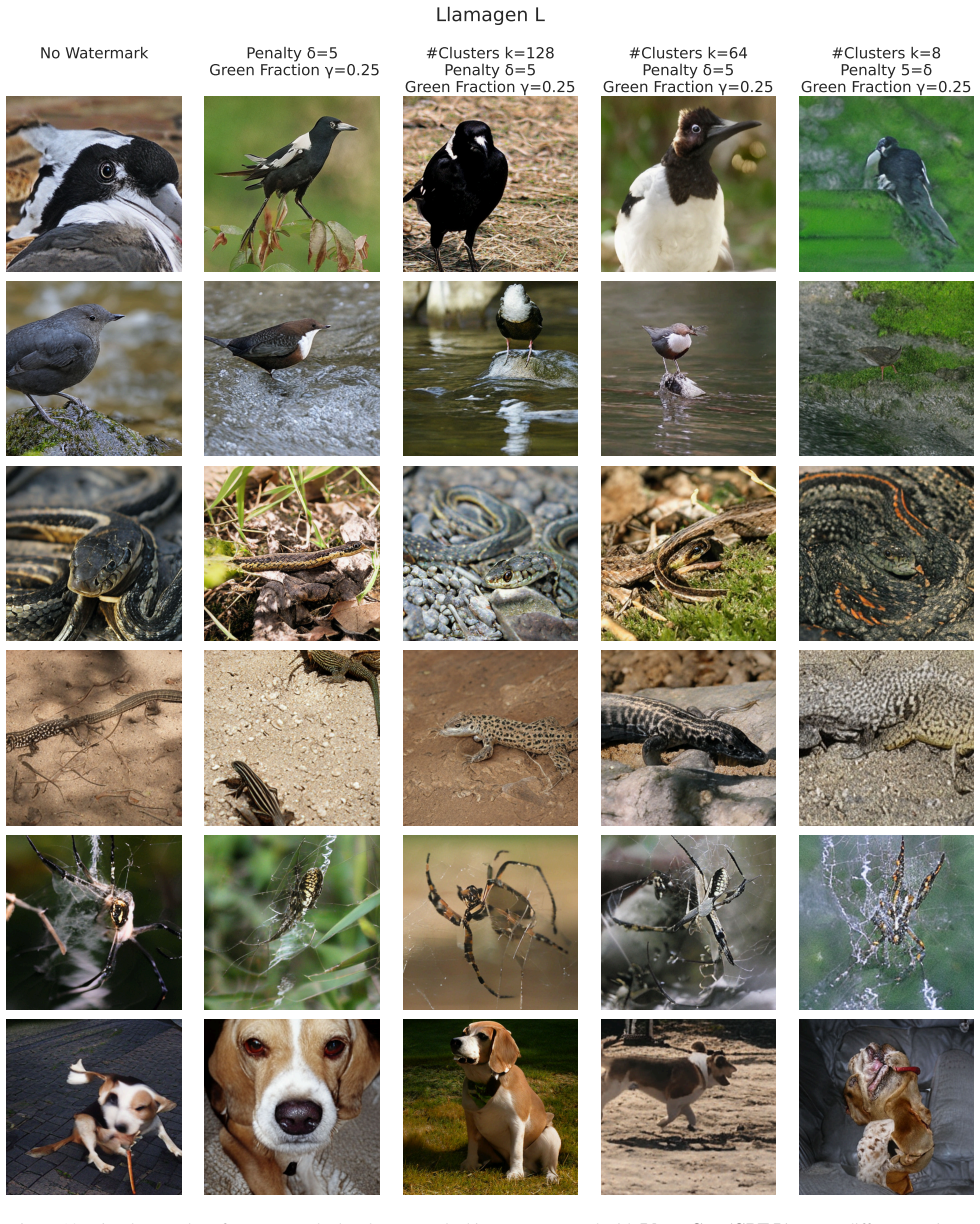
By clustering visual tokens produced by the VQ-VAE and assigning entire clusters to the same watermark color set, the next-token prediction bias creates a persistent signal that remains detectable after perturbations and regeneration attacks, unlike direct per-token schemes.
What carries the argument
Visual token clustering that places similar tokens into the same red or green set to bias autoregressive prediction toward the watermark color.
If this is right
- Watermarked autoregressive images remain attributable after standard perturbations and regeneration attempts.
- Image quality metrics stay comparable to unmarked outputs.
- Verification time matches lightweight post-hoc methods.
- Both training-free clustering and fine-tuned predictors outperform direct token watermarking and concurrent baselines.
- The method applies across different VQ-VAE tokenizers without retraining the generator.
Where Pith is reading between the lines
- The clustering principle could transfer to watermarking other token-sequence generators such as video or audio models.
- Examining how cluster stability interacts with different attack strengths might reveal further robustness limits.
- Integrating this approach into existing image forensics pipelines could strengthen attribution for mixed generation sources.
Load-bearing premise
Grouping similar visual tokens into the same color set keeps the watermark bias detectable under perturbations even when the clustering is imperfect or varies across tokenizers.
What would settle it
A statistical test showing no excess of one color cluster in watermarked images after Gaussian noise or JPEG compression, compared with unmarked images, would show the robustness gain does not hold.
Figures



read the original abstract
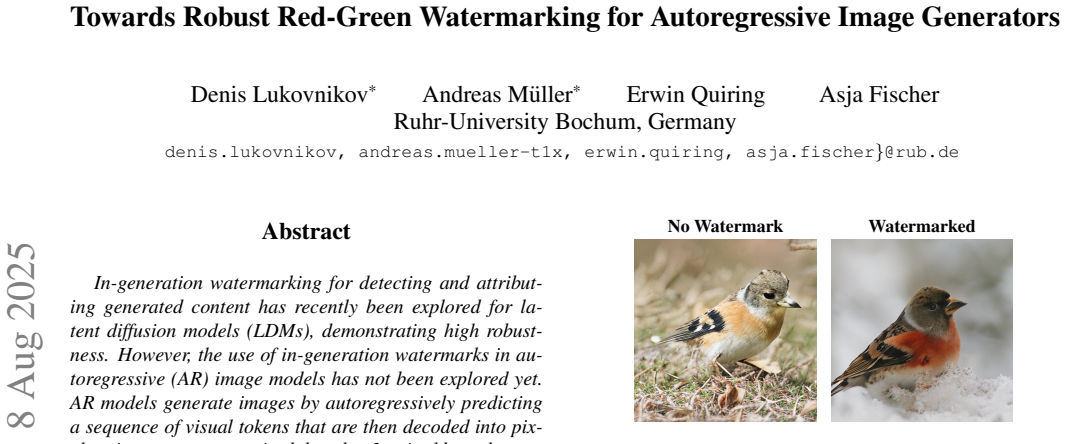
In-generation watermarking for latent diffusion models has recently shown high robustness in marking generated images for easier detection and attribution. However, its application to autoregressive (AR) image models is underexplored. Autoregressive models generate images by autoregressively predicting a sequence of visual tokens that are then decoded into pixels using a VQ-VAE decoder. Inspired by KGW watermarking for large language models, we examine token-level watermarking schemes that bias the next-token prediction based on prior tokens. We find that a direct transfer of these schemes works in principle, but the detectability of the watermarks decreases considerably under common image perturbations. As a remedy, we propose a watermarking approach based on visual token clustering, which assigns similar tokens to the same set (red or green). We investigate token clustering in a training-free setting, as well as in combination with a more accurate fine-tuned token or cluster predictor. Overall, our experiments show that cluster-based watermarks greatly improve robustness against perturbations and regeneration attacks while preserving image quality, outperforming a set of baselines and concurrent works. Moreover, our methods offer fast verification runtime, comparable to lightweight post-hoc watermarking techniques.
Editorial analysis
A structured set of objections, weighed in public.
Referee Report
Summary. The manuscript proposes ClusterMark, a token-level watermarking scheme for autoregressive image generators that groups similar visual tokens into the same red or green set (via training-free or fine-tuned clustering) to bias next-token sampling, extending KGW-style methods from LLMs. It claims that this clustering yields substantially higher robustness to common image perturbations and regeneration attacks than direct per-token watermarking or baselines, while preserving generation quality and enabling fast verification.
Significance. If the robustness gains hold under the reported conditions, the work would address an underexplored gap in in-generation watermarking for AR image models (as opposed to latent diffusion). The empirical demonstration of improved detectability via cluster-based partitioning could inform practical attribution techniques, particularly if the method generalizes across VQ-VAE tokenizers.
major comments (1)
- [Experiments / robustness evaluation] The central claim of markedly improved robustness rests on the premise that tokens assigned to the same cluster remain sufficiently consistent after pixel-space perturbations and re-encoding. The manuscript does not report any direct measurement of cluster-label agreement (e.g., fraction of tokens retaining the same red/green assignment) on original versus perturbed images passed back through the VQ-VAE, nor does it ablate whether the observed gains survive when cluster assignments are recomputed on the perturbed image. Without such verification, the advantage over naïve per-token schemes cannot be isolated from potential confounds in cluster stability.
minor comments (2)
- [§4 / experimental setup] The experimental section should specify the exact perturbation strengths (e.g., noise variance, compression quality factors) and report statistical significance (p-values or confidence intervals) for the robustness metric improvements over baselines.
- [Method / clustering variants] Clarify whether the fine-tuned cluster predictor is trained on the same VQ-VAE tokenizer used at inference or on a held-out set, and include an ablation on clustering accuracy versus watermark detectability.
Simulated Author's Rebuttal
We thank the referee for their thoughtful and constructive review. We address the single major comment below and will incorporate the suggested analysis into the revised manuscript to strengthen the empirical support for our claims.
read point-by-point responses
-
Referee: The central claim of markedly improved robustness rests on the premise that tokens assigned to the same cluster remain sufficiently consistent after pixel-space perturbations and re-encoding. The manuscript does not report any direct measurement of cluster-label agreement (e.g., fraction of tokens retaining the same red/green assignment) on original versus perturbed images passed back through the VQ-VAE, nor does it ablate whether the observed gains survive when cluster assignments are recomputed on the perturbed image. Without such verification, the advantage over naïve per-token schemes cannot be isolated from potential confounds in cluster stability.
Authors: We agree that directly quantifying cluster stability under perturbations would provide valuable additional evidence and help isolate the contribution of our clustering approach. In the revised manuscript we will add (i) measurements of the fraction of tokens that retain the same red/green cluster assignment after common perturbations followed by re-encoding through the VQ-VAE, and (ii) an ablation in which cluster assignments are recomputed on the perturbed images before watermark detection. These results will be reported alongside the existing robustness tables to clarify whether the observed gains derive primarily from cluster consistency. revision: yes
Circularity Check
No circularity: empirical validation of clustering-based watermarking stands independently
full rationale
The paper introduces a visual token clustering approach for watermarking autoregressive image generators, drawing inspiration from KGW but implementing and testing the method directly. The central claims rest on experimental results comparing robustness under perturbations and regeneration attacks, with no equations, derivations, or self-citations that reduce the reported gains to fitted parameters, self-definitions, or prior author results by construction. Cluster assignment is presented as a design choice validated empirically rather than assumed or fitted in a way that forces the outcome. The derivation chain is self-contained against external benchmarks and does not invoke uniqueness theorems or ansatzes from self-citations as load-bearing premises.
Axiom & Free-Parameter Ledger
axioms (1)
- domain assumption Visual tokens produced by the VQ-VAE decoder exhibit sufficient similarity structure to allow meaningful clustering into red/green sets.
Lean theorems connected to this paper
-
IndisputableMonolith/Cost/FunctionalEquation.leanwashburn_uniqueness_aczel unclear?
unclearRelation between the paper passage and the cited Recognition theorem.
We propose a watermarking approach based on visual token clustering, which assigns similar tokens to the same set (red or green).
-
IndisputableMonolith/Foundation/RealityFromDistinction.leanreality_from_one_distinction unclear?
unclearRelation between the paper passage and the cited Recognition theorem.
During generation, the hash oi is computed based on the cluster of the preceding token: oi = hash(κ, C[qi−1])
What do these tags mean?
- matches
- The paper's claim is directly supported by a theorem in the formal canon.
- supports
- The theorem supports part of the paper's argument, but the paper may add assumptions or extra steps.
- extends
- The paper goes beyond the formal theorem; the theorem is a base layer rather than the whole result.
- uses
- The paper appears to rely on the theorem as machinery.
- contradicts
- The paper's claim conflicts with a theorem or certificate in the canon.
- unclear
- Pith found a possible connection, but the passage is too broad, indirect, or ambiguous to say the theorem truly supports the claim.
Reference graph
Works this paper leans on
-
[1]
Combined dwt-dct digital image watermarking
Ali Al-Haj. Combined dwt-dct digital image watermarking. Journal of computer science, 3(9):740–746, 2007. 5, 7
work page 2007
-
[2]
Huiwen Chang, Han Zhang, Lu Jiang, Ce Liu, and William T. Freeman. Maskgit: Masked generative image transformer. In Proc. of IEEE Conference on Computer Vi- sion and Pattern Recognition (CVPR), pages 11315–11325, June 2022. 1, 2
work page 2022
-
[3]
Freeman, Michael Ru- binstein, Yuanzhen Li, and Dilip Krishnan
Huiwen Chang, Han Zhang, Jarred Barber, Aaron Maschinot, Jose Lezama, Lu Jiang, Ming-Hsuan Yang, Kevin Patrick Murphy, William T. Freeman, Michael Ru- binstein, Yuanzhen Li, and Dilip Krishnan. Muse: Text- to-image generation via masked generative transformers. In Andreas Krause, Emma Brunskill, Kyunghyun Cho, Bar- bara Engelhardt, Sivan Sabato, and Jonat...
work page 2023
-
[4]
Undetectable watermarks for language models
Miranda Christ, Sam Gunn, and Or Zamir. Undetectable watermarks for language models. In Proc. of the An- nual ACM Workshop on Computational Learning Theory (COLT), volume 210 of Proceedings of Machine Learning Research, pages 1125–1139. PMLR, 2024. URL https: //proceedings.mlr.press/v210/christ24a. html. 2
work page 2024
-
[6]
WMAdapter: Adding watermark control to latent dif- fusion models, 2024
Hai Ci, Yiren Song, Pei Yang, Jinheng Xie, and Mike Zheng Shou. WMAdapter: Adding watermark control to latent dif- fusion models, 2024. 7
work page 2024
-
[7]
RingID: Rethinking tree-ring watermarking for enhanced multi-key identification
Hai Ci, Pei Yang, Yiren Song, and Mike Zheng Shou. RingID: Rethinking tree-ring watermarking for enhanced multi-key identification. In Aleˇs Leonardis, Elisa Ricci, Ste- fan Roth, Olga Russakovsky, Torsten Sattler, and G¨ul Varol, editors, Proc. of the European Conference on Computer Vi- sion (ECCV), pages 338–354, Cham, 2024. Springer Nature Switzerland....
work page 2024
-
[8]
Digital Watermarking and Steganography
Ingemar Cox, Matthew Miller, Jeffrey Bloom, Jessica Fridrich, and Ton Kalker. Digital Watermarking and Steganography. Morgan Kaufmann Publishers Inc., San Francisco, CA, USA, 2 edition, 2007. 7
work page 2007
-
[9]
Fluid: Scaling autoregressive text-to-image gen- erative models with continuous tokens
Lijie Fan, Tianhong Li, Siyang Qin, Yuanzhen Li, Chen Sun, Michael Rubinstein, Deqing Sun, Kaiming He, and Yong- long Tian. Fluid: Scaling autoregressive text-to-image gen- erative models with continuous tokens. InInternational Con- ference on Learning Representations (ICLR), 2025. 1, 2
work page 2025
-
[10]
The stable signature: Rooting watermarks in latent diffusion models
Pierre Fernandez, Guillaume Couairon, Herv ´e J ´egou, Matthijs Douze, and Teddy Furon. The stable signature: Rooting watermarks in latent diffusion models. In Proc. of IEEE Conference on Computer Vision and Pattern Recogni- tion (CVPR), 2023. 1, 7
work page 2023
-
[11]
An unde- tectable watermark for generative image models
Sam Gunn, Xuandong Zhao, and Dawn Song. An unde- tectable watermark for generative image models. In Inter- national Conference on Learning Representations (ICLR) ,
-
[12]
Gans trained by a two time-scale update rule converge to a local nash equilib- rium
Martin Heusel, Hubert Ramsauer, Thomas Unterthiner, Bernhard Nessler, and Sepp Hochreiter. Gans trained by a two time-scale update rule converge to a local nash equilib- rium. In I. Guyon, U. V on Luxburg, S. Bengio, H. Wallach, R. Fergus, S. Vishwanathan, and R. Garnett, editors, Ad- vances in Neural Information Proccessing Systems (NIPS) , volume 30, 2017. 5
work page 2017
-
[13]
Watermarking autoregressive image generation, 2025
Nikola Jovanovi ´c, Ismail Labiad, Tom ´aˇs Sou ˇcek, Martin Vechev, and Pierre Fernandez. Watermarking autoregressive image generation, 2025. 8
work page 2025
-
[14]
A watermark for large language models
John Kirchenbauer, Jonas Geiping, Yuxin Wen, Jonathan Katz, Ian Miers, and Tom Goldstein. A watermark for large language models. In Proc. of Int. Conference on Machine Learning (ICML), pages 17061–17084. PMLR, 2023. 1, 2
work page 2023
-
[15]
On the reliabil- ity of watermarks for large language models
John Kirchenbauer, Jonas Geiping, Yuxin Wen, Manli Shu, Khalid Saifullah, Kezhi Kong, Kasun Fernando, Aniruddha Saha, Micah Goldblum, and Tom Goldstein. On the reliabil- ity of watermarks for large language models. InInternational Conference on Learning Representations (ICLR), 2024. 2
work page 2024
-
[16]
Robust distortion-free watermarks for lan- guage models
Rohith Kuditipudi, John Thickstun, Tatsunori Hashimoto, and Percy Liang. Robust distortion-free watermarks for lan- guage models. Transactions on Machine Learning Research (TMLR), 2024. 2
work page 2024
-
[17]
Fu, Christopher Re, and David W
Hermann Kumbong, Xian Liu, Tsung-Yi Lin, Ming-Yu Liu, Xihui Liu, Ziwei Liu, Daniel Y . Fu, Christopher Re, and David W. Romero. Hmar: Efficient hierarchical masked auto-regressive image generation. In Proc. of IEEE Confer- ence on Computer Vision and Pattern Recognition (CVPR) , pages 2535–2544, June 2025. 1, 2
work page 2025
-
[18]
Robust watermarking using generative pri- ors against image editing: From benchmarking to advances
Shilin Lu, Zihan Zhou, Jiayou Lu, Yuanzhi Zhu, and Adams Wai-Kin Kong. Robust watermarking using generative pri- ors against image editing: From benchmarking to advances. In International Conference on Learning Representations (ICLR), 2025. URL https : / / openreview . net / forum?id=16O8GCm8Wn. 7
work page 2025
-
[19]
Generative ai misuse: A taxonomy of tactics and insights from real-world data, 2024
Nahema Marchal, Rachel Xu, Rasmi Elasmar, Iason Gabriel, Beth Goldberg, and William Isaac. Generative ai misuse: A taxonomy of tactics and insights from real-world data, 2024. 1
work page 2024
-
[20]
K. A. Navas, Mathews Cheriyan Ajay, M. Lekshmi, Tampy S. Archana, and M. Sasikumar. Dwt-dct-svd based watermarking. In 2008 3rd International Conference on Communication Systems Software and Middleware and Workshops (COMSWARE ’08), pages 271–274, 2008. doi: 10.1109/COMSW A.2008.4554423. 5 9
-
[21]
A robust semantics- based watermark for large language model against para- phrasing
Jie Ren, Han Xu, Yiding Liu, Yingqian Cui, Shuaiqiang Wang, Dawei Yin, and Jiliang Tang. A robust semantics- based watermark for large language model against para- phrasing. In Findings of the Association for Computational Linguistics: NAACL, pages 613–625, 2024. 2, 8
work page 2024
-
[22]
High-resolution image syn- thesis with latent diffusion models
Robin Rombach, Andreas Blattmann, Dominik Lorenz, Patrick Esser, and Bj¨orn Ommer. High-resolution image syn- thesis with latent diffusion models. In Proc. of IEEE Confer- ence on Computer Vision and Pattern Recognition (CVPR) , pages 10684–10695, June 2022. 5, 11
work page 2022
-
[23]
ImageNet Large Scale Visual Recognition Challenge
Olga Russakovsky, Jia Deng, Hao Su, Jonathan Krause, San- jeev Satheesh, Sean Ma, Zhiheng Huang, Andrej Karpathy, Aditya Khosla, Michael Bernstein, Alexander C. Berg, and Li Fei-Fei. ImageNet large scale visual recognition chal- lenge. International Journal of Computer Vision (IJCV), 115 (3):211–252, 2015. doi: 10.1007/s11263-015-0816-y. 4
-
[24]
Autoregressive model beats diffusion: Llama for scalable image generation, 2024
Peize Sun, Yi Jiang, Shoufa Chen, Shilong Zhang, Bingyue Peng, Ping Luo, and Zehuan Yuan. Autoregressive model beats diffusion: Llama for scalable image generation, 2024. 1, 2, 4
work page 2024
-
[25]
Stegastamp: Invisible hyperlinks in physical photographs
Matthew Tancik, Ben Mildenhall, and Ren Ng. Stegastamp: Invisible hyperlinks in physical photographs. In Proc. of IEEE Conference on Computer Vision and Pattern Recog- nition (CVPR), pages 2117–2126, 2020. 7
work page 2020
-
[26]
HART: Efficient visual generation with hybrid autoregressive transformer
Haotian Tang, Yecheng Wu, Shang Yang, Enze Xie, Junsong Chen, Junyu Chen, Zhuoyang Zhang, Han Cai, Yao Lu, and Song Han. HART: Efficient visual generation with hybrid autoregressive transformer. In International Conference on Learning Representations (ICLR), 2025. 1, 2
work page 2025
-
[27]
Visual autoregressive modeling: Scalable im- age generation via next-scale prediction
Keyu Tian, Yi Jiang, Zehuan Yuan, BINGYUE PENG, and Liwei Wang. Visual autoregressive modeling: Scalable im- age generation via next-scale prediction. InAdvances in Neu- ral Information Proccessing Systems (NeurIPS), 2024. 1, 2
work page 2024
-
[28]
Training-free watermarking for autoregressive image gener- ation, 2025
Yu Tong, Zihao Pan, Shuai Yang, and Kaiyang Zhou. Training-free watermarking for autoregressive image gener- ation, 2025. 5, 8, 11
work page 2025
-
[29]
Emu3: Next-token prediction is all you need, 2024
Xinlong Wang, Xiaosong Zhang, Zhengxiong Luo, Quan Sun, Yufeng Cui, Jinsheng Wang, Fan Zhang, Yueze Wang, Zhen Li, Qiying Yu, Yingli Zhao, Yulong Ao, Xuebin Min, Tao Li, Boya Wu, Bo Zhao, Bowen Zhang, Liangdong Wang, Guang Liu, Zheqi He, Xi Yang, Jingjing Liu, Yonghua Lin, Tiejun Huang, and Zhongyuan Wang. Emu3: Next-token prediction is all you need, 2024. 1, 2
work page 2024
-
[30]
Bridging continuous and discrete tokens for autoregressive visual generation
Yuqing Wang, Zhijie Lin, Yao Teng, Yuanzhi Zhu, Shuhuai Ren, Jiashi Feng, and Xihui Liu. Bridging continuous and discrete tokens for autoregressive visual generation. InProc. of the IEEE/CVF International Conference on Computer Vi- sion (ICCV), 2025. 1, 2
work page 2025
-
[31]
Tree-Ring watermarks: Invisible fingerprints for diffusion images
Yuxin Wen, John Kirchenbauer, Jonas Geiping, and Tom Goldstein. Tree-Ring watermarks: Invisible fingerprints for diffusion images. In Advances in Neural Information Proc- cessing Systems (NeurIPS), 2023. 1, 6, 7, 8
work page 2023
-
[32]
A resilient and accessible distribution- preserving watermark for large language models
Yihan Wu, Zhengmian Hu, Junfeng Guo, Hongyang Zhang, and Heng Huang. A resilient and accessible distribution- preserving watermark for large language models. In Proc. of Int. Conference on Machine Learning (ICML), pages 53443– 53470. PMLR, 2024. 2
work page 2024
-
[33]
A watermark for auto-regressive image gener- ation models, 2025
Yihan Wu, Xuehao Cui, Ruibo Chen, Georgios Milis, and Heng Huang. A watermark for auto-regressive image gener- ation models, 2025. 8
work page 2025
-
[34]
Flexible and secure watermarking for latent diffusion model
Cheng Xiong, Chuan Qin, Guorui Feng, and Xinpeng Zhang. Flexible and secure watermarking for latent diffusion model. In Proc. ACM Internation Conference on Multime- dia (ACM MM), MM ’23, page 1668–1676, New York, NY , USA, 2023. Association for Computing Machinery. ISBN 9798400701085. doi: 10.1145/3581783.3612448. 7
-
[35]
Gpt-imgeval: A comprehensive benchmark for diagnosing gpt4o in image generation, 2025
Zhiyuan Yan, Junyan Ye, Weijia Li, Zilong Huang, Sheng- hai Yuan, Xiangyang He, Kaiqing Lin, Jun He, Conghui He, and Li Yuan. Gpt-imgeval: A comprehensive benchmark for diagnosing gpt4o in image generation, 2025. 1
work page 2025
-
[36]
Gaussian Shading: Prov- able performance-lossless image watermarking for diffusion models
Zijin Yang, Kai Zeng, Kejiang Chen, Han Fang, Weim- ing Zhang, and Nenghai Yu. Gaussian Shading: Prov- able performance-lossless image watermarking for diffusion models. In Proc. of IEEE Conference on Computer Vision and Pattern Recognition (CVPR), 2024. 1, 7, 8
work page 2024
-
[37]
Robust multi-bit natural language watermarking through in- variant features
KiYoon Yoo, Wonhyuk Ahn, Jiho Jang, and Nojun Kwak. Robust multi-bit natural language watermarking through in- variant features. In Proc. of the Annual Meeting of the As- sociation for Computational Linguistics (ACL), pages 2092– 2115, 2023. 2
work page 2092
-
[38]
Scaling autoregressive models for content-rich text-to-image generation
Jiahui Yu, Yuanzhong Xu, Jing Yu Koh, Thang Luong, Gun- jan Baid, Zirui Wang, Vijay Vasudevan, Alexander Ku, Yin- fei Yang, Burcu Karagol Ayan, Ben Hutchinson, Wei Han, Zarana Parekh, Xin Li, Han Zhang, Jason Baldridge, and Yonghui Wu. Scaling autoregressive models for content-rich text-to-image generation. Transactions on Machine Learn- ing Research, 202...
work page 2022
-
[39]
Randomized autoregressive visual generation,
Qihang Yu, Ju He, Xueqing Deng, Xiaohui Shen, and Liang- Chieh Chen. Randomized autoregressive visual generation,
-
[40]
Robust invisible video watermark- ing with attention, 2019
Kevin Alex Zhang, Lei Xu, Alfredo Cuesta-Infante, and Kalyan Veeramachaneni. Robust invisible video watermark- ing with attention, 2019. 5, 7
work page 2019
-
[41]
Invisible image watermarks are provably removable using generative AI
Xuandong Zhao, Kexun Zhang, Zihao Su, Saastha Vasan, Ilya Grishchenko, Christopher Kruegel, Giovanni Vigna, Yu-Xiang Wang, and Lei Li. Invisible image watermarks are provably removable using generative AI. In Advances in Neural Information Proccessing Systems (NeurIPS) ,
-
[42]
URL https://openreview.net/forum?id= 7hy5fy2OC6. 5, 11
-
[43]
Hidden: Hiding data with deep networks
Jiren Zhu, Russell Kaplan, Justin Johnson, and Li Fei-Fei. Hidden: Hiding data with deep networks. In Proc. of the Eu- ropean Conference on Computer Vision (ECCV), pages 657– 672, 2018. 7 10 A. Full Experimental Setup and Results A.1. Image Generation Settings Table 3 shows detailed generation settings for the models (LlamaGen2 and RAR3) used in this pape...
work page 2018
discussion (0)
Sign in with ORCID, Apple, or X to comment. Anyone can read and Pith papers without signing in.