REVIEW 4 major objections 7 minor 1 cited by
MultiRef: Controllable Image Generation with Multiple Visual References
T0 review · 4 major / 7 minor · reviewed 2026-08-05 · deepseek-v4-flash
Pith's one-line read Current image generators fail to combine multiple visual references, a new 1,990-sample benchmark shows.
desk verdict Real multi-reference benchmark and dataset, but the judge choice and headline numbers contradict the paper's own tables. read the letter →
The pith
A machine-rendered reading of the paper's core claim, the machinery that carries it, and where it could break.
The reading
What carries the argument
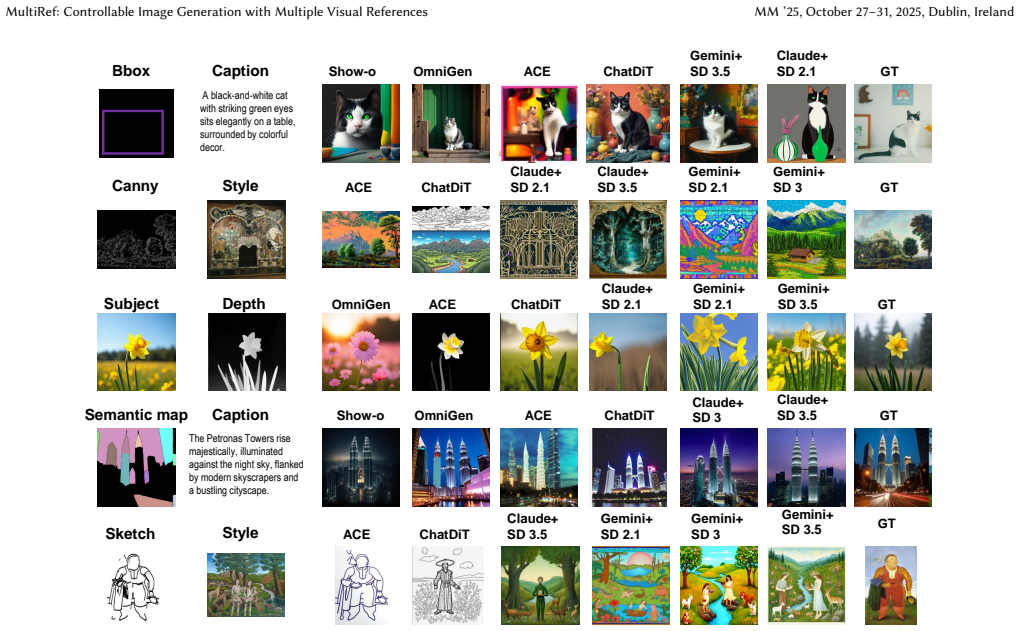
The argument is carried by a two-part measurement apparatus. RefBlend is the synthetic data engine: it extracts ten reference types (depth, Canny edges, masks, bounding boxes, poses, sketches, semantic maps, captions, subjects, styles) from source images and combines them under a reference compatibility graph that forbids contradictory pairings, yielding 33 valid reference combinations and a filtered dataset of 38,076 samples. MultiRef-bench then pairs this synthetic test split with 1,000 human-filtered Reddit editing tasks, and evaluates outputs through rule-based metrics (IoU, MSE, mAP, CLIP scores) plus a fine-tuned MLLM-as-a-judge that the paper validates against human scores for instruc
What would settle it
Re-run human scoring on the benchmark's spatial-condition subsets—pose and bounding box—where the fine-tuned judge's Pearson correlation is only around 0.26 and 0.40; if human rankings of the tested models on those subsets differ from the GPT-4o-mini-based rankings, the claimed performance ordering would not hold on the conditions the benchmark most emphasizes.
Extended reading notes
Core claim
The central claim is that no currently available generator reliably integrates content from multiple visual references, and that this failure can be observed and quantified. On the synthetic half of MultiRef-bench, the best unified model, ACE, averages 0.553 reference fidelity against a ground-truth average of 0.709, while OmniGen averages 0.464; on the real-world half, OmniGen scores 0.496 instruction following and 0.421 source fidelity, far below the golden answer's 0.767 and 0.706. Compositional pipelines such as Claude + SD3.5 produce competitive image quality but degrade instruction adherence and source fidelity, suggesting that separating a perceiver from a generator fundamentally hurt
Load-bearing premise
The reported model rankings rest on trusting the MLLM judge's correlation with human judgment for instruction following and source fidelity, and on treating each Reddit output image as the single correct answer to its editing request.
Editorial extensions
If this is right
- MultiRef-bench gives any claimed general-purpose generator a concrete test: 1,990 multi-reference tasks with per-condition metrics for spatial, semantic, and style control.
- Unified end-to-end architectures are the more promising direction for multi-reference generation, since separated perceiver-plus-generator frameworks consistently lose instruction following and source fidelity.
- Captions are load-bearing for current models: removing a caption degrades depth fidelity and aesthetics across models, while sometimes improving sketch and semantic-map fidelity.
- Input reference order is not commutative: changing the order of reference images shifts condition-specific fidelity more than global image quality, so prompt or input design has real effects on multi-reference success.
- Spatial constraints are the weakest reference types across nearly all models, making bounding-box and pose fidelity a natural first target for future multi-reference training.
Reading between the lines
- If the judge-based ordering is sound, the 38k synthetic RefBlend samples become a ready training resource: a model fine-tuned on multi-reference pairings could close a large share of the reported gap, and MultiRef-bench's synthetic/real split would directly measure that gain.
- The paper's own judge validation shows low human correlation on pose (Pearson 0.257) and bounding boxes (0.404) in its fine-tuned model; model rankings on those spatial conditions may be noisier than rankings on style or subject, and a human re-scoring of those subsets would be a cheap robustness test.
- Because the real-world ground truth is a single selected Reddit output, tasks with multiple valid edits may underestimate model ability; a version of the benchmark that scores against several accepted outputs would be a natural extension.
- The task taxonomy—replacement, addition, style, spatial manipulation, attribute transfer—could transfer to video or 3D editing, where multi-source conditioning is similarly untested.
Editorial analysis
A structured set of objections, weighed in public.
Referee Report
Summary. The paper introduces MultiRef, a benchmark and dataset for multi-reference image generation. It combines 990 synthetically generated samples produced by the RefBlend engine (10 reference types, 33 reference combinations) with 1,000 real-world tasks sampled from Reddit's r/PhotoshopRequest community. The authors evaluate three open-source unified models (OmniGen, ACE, Show-o) and six agentic frameworks (e.g., ChatDiT, LLM+SD) using rule-based metrics for spatial conditions and an MLLM-based judge for semantic-level assessments. They report that even the best existing system, OmniGen, performs far below the golden answer, with, e.g., 0.496 instruction-following on real-world tasks, and they release a 38k-image synthetic dataset.
Significance. The contribution is potentially valuable. A reproducible benchmark targeting multi-reference conditioning is missing, and the paper assembles a large dataset, a data engine, detailed reference definitions, and publicly available materials. The rule-based spatial metrics (IoU, MSE, mAP) are well matched to the conditions they measure. However, the quantitative headline results are not currently trustworthy: the choice of primary judge contradicts the paper's own validation tables, and the abstract's aggregate percentages are not derivable from the reported tables. The real-world part also assumes a single golden output for edits that often admit multiple valid solutions. If these issues are addressed, the benchmark could become a useful community resource.
major comments (4)
- [§2.3, Table 3, Appendix C.3] The stated reason for choosing GPT-4o-mini as the primary judge is contradicted by the paper's own validation. Section 2.3 says GPT-4o-mini is selected for 'superior alignment with human judgment shown in Table 3', but Table 3 reports GPT-4o as having higher Pearson correlation than GPT-4o-mini on IF and SF (Realistic: 0.624 vs 0.530 for IF, 0.613 vs 0.514 for SF; Synthetic: 0.668 vs 0.632, 0.659 vs 0.616). Appendix C.3 repeats the claim, contrary to Table 10. Since the IF/SF scores in Tables 4 and 11 are produced by GPT-4o-mini, the reported model ordering and performance gaps are not numerically supported by the criterion the paper itself states. Re-evaluation with GPT-4o, or an explicit justification based on the dimensions where GPT-4o-mini actually wins, is needed before the central conclusions can be relied upon.
- [Abstract and Section 2.3/Tables 4 and 11] The headline numbers 66.6% and 79.0% have no stated aggregation. OmniGen's scores in Table 4 (Synthetic: IQ 0.730, IF 0.532, SF 0.438) and Table 11 (Real-world: IQ 0.555, IF 0.496, SF 0.421) do not directly produce 0.666 or 0.790 under any formula described in Section 2.3. If these are ratios to the golden answer, the conversion is not specified. Please provide the exact computation or remove the percentages from the abstract and Section 1.
- [§2.1, §C.1, Table 11] The real-world benchmark treats one selected Reddit output as the unique golden answer. Section 2.1 and C.1 say that when multiple outputs exist, annotators select only one, and Table 11 computes IF/SF against this single ground truth. But many editing requests admit several valid output images; a model producing a different but correct result is scored as failing. This can inflate reported failure rates and may reorder models on the real-world subset. The paper should include multiple accepted outputs per task, or report reference-free / rule-based metrics alongside the comparison to the single gold.
- [§2.2 Step 4, §2.3, Appendix B.4/B.5] The evaluation pipeline has a self-referential component and the human-alignment correlations are moderate. The fine-tuned judge (Qwen-2.5-VL-7B-FT) is trained on the authors' own human annotations (B.5), used to filter MultiRef in Step 4, and used in evaluation, while GPT-4o-mini is used for overall IF/SF. Table 3 shows human-human agreement is 0.665 (Realistic IF) and 0.721 (Synthetic IF), versus 0.530 and 0.632 for GPT-4o-mini. The score differences between evaluated systems are comparable to the judge-human disagreement (Table 11: OmniGen IF 0.496 vs Claude+SD3.5 0.589). The reported ordering could therefore change with a different validated judge. Please report confidence intervals, a human-evaluated subset for the main comparisons, or a robustness analysis across judges.
minor comments (7)
- [§2.2 vs §C.2] Section 2.2 says RefBlend produces samples 'across 34 reference combinations', while the abstract and C.2 say 33 combinations. Please correct the discrepancy.
- [§2.1] Section 2.1 reports collecting 2,300 queries and keeping 45% (1,000 examples), but 45% of 2,300 is approximately 1,035. Clarify the quality-control criterion or the exact counts.
- [Table 1] The legend lists 'Semantic Content Specification' twice (Green and Pink); one of these categories is presumably different. Also define the symbols (✓, ➞, and the blank/other marker) in the caption.
- [Table 4] Several metrics are labeled '↓' (lower better), but the AVG column seems to combine them with '↑' metrics. State the normalization formula (e.g., 1 - normalized error) so that AVG is interpretable.
- [Appendix C.3] The appendix says the judge validation used 'a selected test set of 300 samples for either Realistic and Synthetic dataset'. Report the exact test-set sizes and whether Table 3 and Table 10 are based on the same sets, ideally with confidence intervals.
- [References] Reference [2] is titled 'Claude 3.5: A Sonnet', but the text mentions 'Claude-3.7-Sonnet' in the experimental setup. Please align the reference and the model version.
- [Abstract/Introduction] The phrase 'state-of-the-art systems' is broader than the evaluated set (three open-source unified models and six agentic frameworks). Recommend scoping the claim to the evaluated models, since Emu2-Gen was omitted and proprietary generators are not exhaustive.
Circularity Check
No construction-level circularity: the benchmark is an empirical evaluation, not a derivation; minor self-citations are not load-bearing.
full rationale
The central claim is an empirical benchmark result: nine systems are run on 1,990 held-out examples and compared to golden outputs via rule-based metrics (IoU, MSE, CLIP) and judge-based scores (IQ/IF/SF). No reported score is obtained by fitting a parameter to the target outcome; the golden outputs (original images for the synthetic split, selected Reddit edits for the real-world split) are external to the evaluated systems. The fine-tuned Qwen-2.5-VL judge is used for data filtering and for supplementary qualitative reference-fidelity comments, while the headline IQ/IF/SF numbers in Tables 4 and 11 come from GPT-4o-mini; both judge models are validated against human annotations, so the filter/evaluator overlap is a methodological self-reference rather than a definitional reduction. The self-citations to [5] (MLLM-as-a-Judge) and [51] (RealEdit) are to methods rather than to a uniqueness theorem, and the paper reports independent human validation, so they are not load-bearing. I therefore find no step where a prediction is equivalent to its input by construction. Two non-circular correctness risks are worth flagging in the verdict: Section 2.3 says GPT-4o-mini was chosen for superior alignment with human judgment, but Table 3/10 shows GPT-4o has higher IF/SF Pearson correlations on both realistic and synthetic data; and the abstract's 66.6% and 79.0% figures are not derivable from Tables 4/11 in the text. These affect evidentiary weight, not circularity.
Assumptions & free parameters
free parameters (4)
- IoU filtering threshold 0.8 =
0.8
- Judge score filtering threshold 3 =
3
- 30 samples per reference combination =
30
- Judge training set sizes 16,590 and 1,750 =
16,590 and 1,750
assumptions (4)
- domain assumption The fine-tuned MLLM judge's scores approximate human judgment on all 10 reference types.
- domain assumption A unique golden output exists for each real-world Reddit request.
- domain assumption Rule-based references (depth, edges, masks) are generated accurately by existing extractors.
- ad hoc to paper The reference compatibility rules correctly define all valid multi-reference combinations.
invented entities (3)
-
RefBlend
independent evidence
-
Fine-tuned judge model (Qwen-2-VL-7B-FT)
-
MultiRef-bench
independent evidence
Cite this review
Pith. "Pith review of MultiRef: Controllable Image Generation with Multiple Visual References." pith.science (2026). https://pith.science/paper/3ZVIK2U6
@misc{pith2026250806905,
  author       = {Pith},
  title        = {Pith review of: MultiRef: Controllable Image Generation with Multiple Visual References},
  year         = {2026},
  howpublished = {\url{https://pith.science/paper/3ZVIK2U6}},
  note         = {Machine review of arXiv:2508.06905}
}
read the original abstract
Visual designers naturally draw inspiration from multiple visual references, combining diverse elements and aesthetic principles to create artwork. However, current image generative frameworks predominantly rely on single-source inputs -- either text prompts or individual reference images. In this paper, we focus on the task of controllable image generation using multiple visual references. We introduce MultiRef-bench, a rigorous evaluation framework comprising 990 synthetic and 1,000 real-world samples that require incorporating visual content from multiple reference images. The synthetic samples are synthetically generated through our data engine RefBlend, with 10 reference types and 33 reference combinations. Based on RefBlend, we further construct a dataset MultiRef containing 38k high-quality images to facilitate further research. Our experiments across three interleaved image-text models (i.e., OmniGen, ACE, and Show-o) and six agentic frameworks (e.g., ChatDiT and LLM + SD) reveal that even state-of-the-art systems struggle with multi-reference conditioning, with the best model OmniGen achieving only 66.6% in synthetic samples and 79.0% in real-world cases on average compared to the golden answer. These findings provide valuable directions for developing more flexible and human-like creative tools that can effectively integrate multiple sources of visual inspiration. The dataset is publicly available at: https://multiref.github.io/.
Figures


Figures from the paper (12 more)




Forward citations
Cited by 1 Pith paper
-
Emu3.5: Native Multimodal Models are World Learners
Emu3.5 is a native multimodal world model pre-trained on over 10 trillion vision-language tokens with next-token prediction, post-trained via reinforcement learning, and accelerated by Discrete Diffusion Adaptation fo...
Reference graph
Works this paper leans on
-
[1]
Namhyuk Ahn, Junsoo Lee, Chunggi Lee, Kunhee Kim, Daesik Kim, Seung-Hun Nam, and Kibeom Hong. 2024. Dreamstyler: Paint by style inversion with text- to-image diffusion models. In Proceedings of the AAAI Conference on Artificial Intelligence, Vol. 38. 674–681
2024
-
[2]
Anthropic. 2024. Claude 3.5: A Sonnet. https://www.anthropic.com/news/claude- 3-5-sonnet. Accessed: 2024-09-04
2024
-
[3]
Arpit Bansal, Hong-Min Chu, Avi Schwarzschild, Soumyadip Sengupta, Micah Goldblum, Jonas Geiping, and Tom Goldstein. 2023. Universal guidance for diffusion models. In Proceedings of the IEEE/CVF Conference on Computer Vision and Pattern Recognition. 843–852
2023
-
[4]
Caroline Chan, Frédo Durand, and Phillip Isola. 2022. Learning to generate line drawings that convey geometry and semantics. In Proceedings of the IEEE/CVF Conference on Computer Vision and Pattern Recognition . 7915–7925
2022
-
[5]
Dongping Chen, Ruoxi Chen, Shilin Zhang, Yaochen Wang, Yinuo Liu, Huichi Zhou, Qihui Zhang, Yao Wan, Pan Zhou, and Lichao Sun. 2024. Mllm-as-a- judge: Assessing multimodal llm-as-a-judge with vision-language benchmark. In Forty-first International Conference on Machine Learning
2024
-
[6]
Wenhu Chen, Hexiang Hu, Yandong Li, Nataniel Ruiz, Xuhui Jia, Ming-Wei Chang, and William W Cohen. 2024. Subject-driven text-to-image generation via apprenticeship learning. Advances in Neural Information Processing Systems 36 (2024)
work page 2024
-
[7]
Xi Chen, Lianghua Huang, Yu Liu, Yujun Shen, Deli Zhao, and Hengshuang Zhao
-
[8]
Xi Chen, Zhifei Zhang, He Zhang, Yuqian Zhou, Soo Ye Kim, Qing Liu, Yijun Li, Jianming Zhang, Nanxuan Zhao, Yilin Wang, et al. 2024. UniReal: Universal Image Generation and Editing via Learning Real-world Dynamics. arXiv preprint arXiv:2412.07774 (2024)
arXiv 2024
Show all 84 references
-
[9]
Zhaorun Chen, Yichao Du, Zichen Wen, Yiyang Zhou, Chenhang Cui, Zhenzhen Weng, Haoqin Tu, Chaoqi Wang, Zhengwei Tong, Qinglan Huang, et al. 2024. MJ- Bench: Is Your Multimodal Reward Model Really a Good Judge for Text-to-Image Generation? arXiv preprint arXiv:2407.04842 (2024)
2024 arXiv
-
[10]
Seunghwan Choi, Sunghyun Park, Minsoo Lee, and Jaegul Choo. 2021. VITON- HD: High-Resolution Virtual Try-On via Misalignment-Aware Normalization. In Proc. of the IEEE conference on computer vision and pattern recognition (CVPR)
2021
-
[11]
Dave Epstein, Allan Jabri, Ben Poole, Alexei Efros, and Aleksander Holynski
-
[12]
Patrick Esser, Sumith Kulal, Andreas Blattmann, Rahim Entezari, Jonas Müller, Harry Saini, Yam Levi, Dominik Lorenz, Axel Sauer, Frederic Boesel, et al. 2024. Scaling rectified flow transformers for high-resolution image synthesis. In Forty- first International Conference on M...
2024
-
[13]
Flux. 2024. Black Forest Labs. https://blackforestlabs.ai/
2024
-
[14]
Ziqi Gao, Weikai Huang, Jieyu Zhang, Aniruddha Kembhavi, and Ranjay Krishna
-
[15]
Tao Ge, Xin Chan, Xiaoyang Wang, Dian Yu, Haitao Mi, and Dong Yu. 2024. Scaling synthetic data creation with 1,000,000,000 personas. arXiv preprint arXiv:2406.20094 (2024)
2024 arXiv
-
[16]
GeminiTeam. 2023. Gemini: A Family of Highly Capable Multimodal Models. arXiv:2312.11805 [cs.CL]
2023 arXiv
-
[17]
arXiv preprint arXiv:2412.08221 (2024)
Generate Any Scene: Evaluating and Improving Text-to-Vision Generation with Scene Graph Programming. arXiv preprint arXiv:2412.08221 (2024)
2024
-
[18]
Ziyu Guo, Renrui Zhang, Chengzhuo Tong, Zhizheng Zhao, Peng Gao, Hongsheng Li, and Pheng-Ann Heng. 2025. Can We Generate Images with CoT? Let’s Verify and Reinforce Image Generation Step by Step. arXiv preprint arXiv:2501.13926 (2025)
2025 arXiv
-
[19]
Zhen Han, Zeyinzi Jiang, Yulin Pan, Jingfeng Zhang, Chaojie Mao, Chenwei Xie, Yu Liu, and Jingren Zhou. 2024. ACE: All-round Creator and Editor Following Instructions via Diffusion Transformer. arXiv preprint arXiv:2410.00086 (2024)
2024 arXiv
-
[20]
Dhruba Ghosh, Hannaneh Hajishirzi, and Ludwig Schmidt. 2023. Geneval: An object-focused framework for evaluating text-to-image alignment. Advances in Neural Information Processing Systems 36 (2023), 52132–52152
2023
-
[21]
Jack Hessel, Ari Holtzman, Maxwell Forbes, Ronan Le Bras, and Yejin Choi. 2021. Clipscore: A reference-free evaluation metric for image captioning.arXiv preprint arXiv:2104.08718 (2021)
2021 arXiv
-
[22]
Martin Heusel, Hubert Ramsauer, Thomas Unterthiner, Bernhard Nessler, and Sepp Hochreiter. 2017. Gans trained by a two time-scale update rule converge to a local nash equilibrium. Advances in neural information processing systems 30 (2017)
2017
-
[23]
Zhen Han, Chaojie Mao, Zeyinzi Jiang, Yulin Pan, and Jingfeng Zhang. 2024. StyleBooth: Image Style Editing with Multimodal Instruction. arXiv preprint arXiv:2404.12154 (2024)
2024 arXiv
-
[24]
Yushi Hu, Benlin Liu, Jungo Kasai, Yizhong Wang, Mari Ostendorf, Ranjay Kr- ishna, and Noah A Smith. 2023. Tifa: Accurate and interpretable text-to-image faithfulness evaluation with question answering. In Proceedings of the IEEE/CVF International Conference on Computer Vision...
2023
-
[25]
Kaiyi Huang, Kaiyue Sun, Enze Xie, Zhenguo Li, and Xihui Liu. 2023. T2i- compbench: A comprehensive benchmark for open-world compositional text-to- image generation. Advances in Neural Information Processing Systems 36 (2023), 78723–78747
2023
-
[26]
Hexiang Hu, Kelvin CK Chan, Yu-Chuan Su, Wenhu Chen, Yandong Li, Kihyuk Sohn, Yang Zhao, Xue Ben, Boqing Gong, William Cohen, et al. 2024. Instruct- Imagen: Image generation with multi-modal instruction. In Proceedings of the IEEE/CVF Conference on Computer Vision and Pattern ...
2024
-
[27]
Chengyou Jia, Changliang Xia, Zhuohang Dang, Weijia Wu, Hangwei Qian, and Minnan Luo. 2024. ChatGen: Automatic Text-to-Image Generation From FreeStyle Chatting. arXiv preprint arXiv:2411.17176 (2024)
2024 arXiv
-
[28]
Xuan Ju, Ailing Zeng, Jianan Wang, Qiang Xu, and Lei Zhang. 2023. Human- art: A versatile human-centric dataset bridging natural and artificial scenes. In Proceedings of the IEEE/CVF Conference on Computer Vision and Pattern Recognition. 618–629
2023
-
[29]
Lianghua Huang, Wei Wang, Zhi-Fan Wu, Yupeng Shi, Chen Liang, Tong Shen, Han Zhang, Huanzhang Dou, Yu Liu, and Jingren Zhou. 2024. ChatDiT: A Training-Free Baseline for Task-Agnostic Free-Form Chatting with Diffusion Transformers. arXiv preprint arXiv:2412.12571 (2024)
2024 arXiv
-
[30]
Ming Li, Taojiannan Yang, Huafeng Kuang, Jie Wu, Zhaoning Wang, Xuefeng Xiao, and Chen Chen. 2025. ControlNet++: Improving Conditional Controls with Efficient Consistency Feedback. In European Conference on Computer Vision . Springer, 129–147
2025
-
[31]
Tianle Li, Max Ku, Cong Wei, and Wenhu Chen. 2023. Dreamedit: Subject-driven image editing. arXiv preprint arXiv:2306.12624 (2023)
2023 arXiv
-
[32]
Nupur Kumari, Bingliang Zhang, Richard Zhang, Eli Shechtman, and Jun-Yan Zhu
-
[33]
In Proceedings of the IEEE/CVF Conference on Computer Vision and Pattern Recognition
Multi-concept customization of text-to-image diffusion. In Proceedings of the IEEE/CVF Conference on Computer Vision and Pattern Recognition . 1931–1941
1931
-
[34]
Zhiqiu Lin, Deepak Pathak, Baiqi Li, Jiayao Li, Xide Xia, Graham Neubig, Pengchuan Zhang, and Deva Ramanan. 2024. Evaluating text-to-visual gen- eration with image-to-text generation. In European Conference on Computer Vision. Springer, 366–384
2024
-
[35]
Xiaoyu Liu, Yuxiang Wei, Ming Liu, Xianhui Lin, Peiran Ren, Xuansong Xie, and Wangmeng Zuo. 2024. Smartcontrol: Enhancing controlnet for handling rough visual conditions. In European Conference on Computer Vision . Springer, 1–17
2024
-
[36]
Yuheng Li, Haotian Liu, Qingyang Wu, Fangzhou Mu, Jianwei Yang, Jianfeng Gao, Chunyuan Li, and Yong Jae Lee. 2023. Gligen: Open-set grounded text-to-image generation. In Proceedings of the IEEE/CVF Conference on Computer Vision and Pattern Recognition. 22511–22521
2023
-
[37]
Chen Liang, Lianghua Huang, Jingwu Fang, Huanzhang Dou, Wei Wang, Zhi- Fan Wu, Yupeng Shi, Junge Zhang, Xin Zhao, and Yu Liu. 2024. IDEA-Bench: How Far are Generative Models from Professional Designing? arXiv preprint arXiv:2412.11767 (2024)
2024 arXiv
-
[38]
Nithin Gopalakrishnan Nair, Jeya Maria Jose Valanarasu, and Vishal M Patel
-
[39]
OpenAI. 2024. GPT-4O Mini: Advancing Cost-Efficient Intelligence. https:// openai.com/index/gpt-4o-mini-advancing-cost-efficient-intelligence/. Accessed: 2024-09-04
2024
-
[40]
Sicheng Mo, Fangzhou Mu, Kuan Heng Lin, Yanli Liu, Bochen Guan, Yin Li, and Bolei Zhou. 2024. Freecontrol: Training-free spatial control of any text-to-image diffusion model with any condition. In Proceedings of the IEEE/CVF Conference on Computer Vision and Pattern Recognitio...
2024
-
[41]
Chong Mou, Xintao Wang, Liangbin Xie, Yanze Wu, Jian Zhang, Zhongang Qi, and Ying Shan. 2024. T2i-adapter: Learning adapters to dig out more controllable ability for text-to-image diffusion models. In Proceedings of the AAAI Conference on Artificial Intelligence, Vol. 38. 4296–4304
2024
-
[42]
Can Qin, Shu Zhang, Ning Yu, Yihao Feng, Xinyi Yang, Yingbo Zhou, Huan Wang, Juan Carlos Niebles, Caiming Xiong, Silvio Savarese, et al. 2024. UniControl: A Unified Diffusion Model for Controllable Visual Generation In the Wild.Advances in Neural Information Processing Systems...
2024
-
[43]
In European Conference on Computer Vision
Maxfusion: Plug&play multi-modal generation in text-to-image diffusion models. In European Conference on Computer Vision . Springer, 93–110
-
[44]
Tianhe Ren, Shilong Liu, Ailing Zeng, Jing Lin, Kunchang Li, He Cao, Jiayu Chen, Xinyu Huang, Yukang Chen, Feng Yan, et al. 2024. Grounded sam: Assembling open-world models for diverse visual tasks. arXiv preprint arXiv:2401.14159 (2024)
2024 arXiv
-
[45]
OpenAI. 2024. Hello GPT-4o. https://openai.com/index/hello-gpt-4o/ Accessed: 2024-06-06
2024
-
[46]
Xichen Pan, Li Dong, Shaohan Huang, Zhiliang Peng, Wenhu Chen, and Furu Wei
-
[47]
arXiv preprint arXiv:2310.02992 (2023)
Kosmos-g: Generating images in context with multimodal large language models. arXiv preprint arXiv:2310.02992 (2023)
2023 arXiv
-
[48]
Christoph Schuhmann, Romain Beaumont, Richard Vencu, Cade Gordon, Ross Wightman, Mehdi Cherti, Theo Coombes, Aarush Katta, Clayton Mullis, Mitchell Wortsman, et al. 2022. Laion-5b: An open large-scale dataset for training next generation image-text models. Advances in neural i...
2022
-
[49]
Nikhila Ravi, Valentin Gabeur, Yuan-Ting Hu, Ronghang Hu, Chaitanya Ryali, Tengyu Ma, Haitham Khedr, Roman Rädle, Chloe Rolland, Laura Gustafson, Eric Mintun, Junting Pan, Kalyan Vasudev Alwala, Nicolas Carion, Chao-Yuan Wu, Ross Girshick, Piotr Dollár, and Christoph Feichtenh...
2024 arXiv
-
[50]
Quan Sun, Yufeng Cui, Xiaosong Zhang, Fan Zhang, Qiying Yu, Yueze Wang, Yongming Rao, Jingjing Liu, Tiejun Huang, and Xinlong Wang. 2024. Genera- tive multimodal models are in-context learners. In Proceedings of the IEEE/CVF Conference on Computer Vision and Pattern Recognitio...
2024
-
[51]
Robin Rombach, Andreas Blattmann, Dominik Lorenz, Patrick Esser, and Björn Ommer. 2022. High-resolution image synthesis with latent diffusion models. In MM ’25, October 27–31, 2025, Dublin, Ireland Chen et al. Proceedings of the IEEE/CVF conference on computer vision and patte...
2022
-
[52]
Nataniel Ruiz, Yuanzhen Li, Varun Jampani, Yael Pritch, Michael Rubinstein, and Kfir Aberman. 2023. Dreambooth: Fine tuning text-to-image diffusion models for subject-driven generation. In Proceedings of the IEEE/CVF conference on computer vision and pattern recognition . 22500–22510
2023
-
[53]
Babak Saleh and Ahmed Elgammal. 2015. Large-scale classification of fine- art paintings: Learning the right metric on the right feature. arXiv preprint arXiv:1505.00855 (2015)
2015 arXiv
-
[54]
Zhizhong Wang, Lei Zhao, and Wei Xing. 2023. Stylediffusion: Controllable disentangled style transfer via diffusion models. In Proceedings of the IEEE/CVF International Conference on Computer Vision . 7677–7689
2023
-
[55]
Shelly Sheynin, Adam Polyak, Uriel Singer, Yuval Kirstain, Amit Zohar, Oron Ashual, Devi Parikh, and Yaniv Taigman. 2024. Emu edit: Precise image editing via recognition and generation tasks. In Proceedings of the IEEE/CVF Conference on Computer Vision and Pattern Recognition ...
2024
-
[56]
Shitao Xiao, Yueze Wang, Junjie Zhou, Huaying Yuan, Xingrun Xing, Ruiran Yan, Shuting Wang, Tiejun Huang, and Zheng Liu. 2024. Omnigen: Unified image generation. arXiv preprint arXiv:2409.11340 (2024)
2024 arXiv
-
[57]
Peter Sushko, Ayana Bharadwaj, Zhi Yang Lim, Vasily Ilin, Ben Caffee, Dong- ping Chen, Mohammadreza Salehi, Cheng-Yu Hsieh, and Ranjay Krishna. 2025. REALEDIT: Reddit Edits As a Large-scale Empirical Dataset for Image Transfor- mations. arXiv:2502.03629 [cs.CV] https://arxiv.o...
2025 arXiv
-
[58]
Zhenxiong Tan, Songhua Liu, Xingyi Yang, Qiaochu Xue, and Xinchao Wang
-
[59]
arXiv preprint arXiv:2411.15098 (2024)
OminiControl: Minimal and Universal Control for Diffusion Transformer. arXiv preprint arXiv:2411.15098 (2024)
2024 arXiv
-
[60]
Zhenyu Wang, Aoxue Li, Zhenguo Li, and Xihui Liu. 2024. Genartist: Multimodal llm as an agent for unified image generation and editing. Advances in Neural Information Processing Systems 37 (2024), 128374–128395
2024
-
[61]
Kai Zhang, Lingbo Mo, Wenhu Chen, Huan Sun, and Yu Su. 2024. Magicbrush: A manually annotated dataset for instruction-guided image editing. Advances in Neural Information Processing Systems 36 (2024)
2024
-
[62]
Cong Wei, Zheyang Xiong, Weiming Ren, Xinrun Du, Ge Zhang, and Wenhu Chen
-
[63]
arXiv:2411.07199 [cs.CV] https://arxiv.org/abs/2411.07199
OmniEdit: Building Image Editing Generalist Models Through Specialist Supervision. arXiv:2411.07199 [cs.CV] https://arxiv.org/abs/2411.07199
-
[64]
Guangcong Zheng, Xianpan Zhou, Xuewei Li, Zhongang Qi, Ying Shan, and Xi Li. 2023. Layoutdiffusion: Controllable diffusion model for layout-to-image generation. In Proceedings of the IEEE/CVF Conference on Computer Vision and Pattern Recognition. 22490–22499. 5 Acknowledgments...
2023
-
[65]
Jinheng Xie, Weijia Mao, Zechen Bai, David Junhao Zhang, Weihao Wang, Kevin Qinghong Lin, Yuchao Gu, Zhijie Chen, Zhenheng Yang, and Mike Zheng Shou. 2024. Show-o: One Single Transformer to Unify Multimodal Understanding and Generation. arXiv preprint arXiv:2408.12528 (2024)
2024 arXiv
-
[66]
Xingqian Xu, Zhangyang Wang, Gong Zhang, Kai Wang, and Humphrey Shi
-
[67]
In Proceedings of the IEEE/CVF International Conference on Computer Vision
Versatile diffusion: Text, images and variations all in one diffusion model. In Proceedings of the IEEE/CVF International Conference on Computer Vision . 7754– 7765
-
[68]
Lihe Yang, Bingyi Kang, Zilong Huang, Zhen Zhao, Xiaogang Xu, Jiashi Feng, and Hengshuang Zhao. 2024. Depth Anything V2. arXiv:2406.09414 (2024)
2024 arXiv
-
[69]
Zhengyuan Yang, Jianfeng Wang, Zhe Gan, Linjie Li, Kevin Lin, Chenfei Wu, Nan Duan, Zicheng Liu, Ce Liu, Michael Zeng, et al. 2023. Reco: Region-controlled text-to-image generation. In Proceedings of the IEEE/CVF Conference on Computer Vision and Pattern Recognition . 14246–14255
2023
-
[71]
Lvmin Zhang, Anyi Rao, and Maneesh Agrawala. 2023. Adding conditional con- trol to text-to-image diffusion models. InProceedings of the IEEE/CVF International Conference on Computer Vision . 3836–3847
2023
-
[72]
Shihao Zhao, Dongdong Chen, Yen-Chun Chen, Jianmin Bao, Shaozhe Hao, Lu Yuan, and Kwan-Yee K Wong. 2024. Uni-controlnet: All-in-one control to text-to- image diffusion models. Advances in Neural Information Processing Systems 36 (2024)
2024
-
[74]
Canny edge
to generate the depth map with default parameters. Canny edge. A Canny edge map is a binary image that shows the boundaries and edges detected in an original image using the Canny edge detection algorithm. It identifies edges by looking for areas of rapid intensity change in t...
2025
-
[75]
Element Replacement - Face swaps - Object substitutions - Background replacements - Text replacements - Component swaps (wheels, screens, etc.)
-
[76]
Element Addition - Adding people to scenes - Adding objects to environments - Adding details or elements to objects - Adding text or graphics - Adding visual effects
-
[77]
Style and Appearance Modifications - Color adjustments - Lighting modifications - Artistic style transfers - Texture changes - Visual quality enhancements
-
[78]
Spatial/Environment Manipulations - Repositioning ele- ments - Combining multiple images into layouts - Changing scale or proportion - Adjusting orientation or alignment - Creating composite images
-
[79]
category
Attribute Transfers - Transferring expressions between faces - Applying visual characteristics across images - Main- taining specific features while changing others - Matching visual properties (lighting, color) - Transferring specific de- tails while preserving context MultiR...
2025
-
[80]
First, the INPUT IMAGE(S) that the user wants to edit
-
[81]
Then, the user’s ORIGINAL INSTRUCTION (which might be noisy or unclear)
-
[82]
Based on comparing these, please:
Finally, the OUTPUT IMAGE after editing. Based on comparing these, please:
-
[83]
Infer what specific edit was performed
-
[84]
Edit image <image1> by [specific editing instruction using clear terminology]
Write a clear, precise prompt that would help an AI model achieve this exact edit Your prompt should follow this format: "Edit image <image1> by [specific editing instruction using clear terminology]" Here are some examples of good output prompts: - "Edit image <image1> by tak...
2025
-
[2023]
Advances in Neural Information Processing Systems 36 (2023), 16222–16239
Diffusion self-guidance for controllable image generation. Advances in Neural Information Processing Systems 36 (2023), 16222–16239
2023
-
[2024]
In Proceedings of the IEEE/CVF Conference on Computer Vision and Pattern Recognition
Anydoor: Zero-shot object-level image customization. In Proceedings of the IEEE/CVF Conference on Computer Vision and Pattern Recognition . 6593–6602
Reviewed August 5, 2026 · model on record in the stance chip above.
Discussion (0). Sign in to comment.