REVIEW 3 major objections 4 minor 2 cited by
Proactive scene-graph imagination raises zero-shot object-goal navigation to 65.4% success on HM3D and 66.8% on HSSD, exceeding prior zero-shot and training-required methods.
Reviewed by Pith at T0; open to challenge. T0 means a machine referee read the full paper against a public rubric. the ladder, T0–T4 →
SGImagineNav uses an imagined hierarchical scene graph, filled in by an LLM, that guides a robot to unseen objects and achieves 65.4% and 66.8% success on HM3D and HSSD.
T0 review reviewed 2026-08-05 challenge →
load-bearing objection A useful, honest systems result: LLM imagination over hierarchical scene graphs helps zero-shot object navigation and adds multi-floor planning, but the headline gains need error bars and a prior-mismatch stress test. the 3 major comments →
Imaginative World Modeling with Scene Graphs for Embodied Agent Navigation
The pith
A machine-rendered reading of the paper's core claim, the machinery that carries it, and where it could break.
The reading
Core claim
The central claim is that proactive symbolic imagination—not better perception, planning, or more training—is the missing ingredient in zero-shot object-goal navigation. SGImagineNav builds an evolving hierarchical scene graph from RGB-D observations, then uses a vision-language model to label unobserved regions on a bird's-eye view before acting. The completed graph supplies semantic shortcuts: seeing stairs and a kitchen on the main floor suggests a bedroom upstairs, so the agent heads for the staircase. The authors report 65.4% success on HM3D and 66.8% on HSSD, surpassing zero-shot and training-required imaginative-navigation baselines; an oracle variant reaches 72.25%, and ablations att
What carries the argument
The central object is the completed hierarchical scene graph $\hat{g}_t = \psi(g_t, I_t)$: a tree over object nodes, region nodes, and floor nodes, where $g_t$ is the observed graph and $I_t$ is a bird's-eye projection of known nodes and unknown region centers. A vision-language model fills in the unknown regions by applying indoor-layout priors, turning the graph from a record of what has been seen into a hypothesis about what exists. The second load-bearing mechanism is the frontier-selection rule $l^*_t = \arg\max_k (S_t^{s,k} \text{ if } S_t^{s,k} > \lambda \text{ else } S_t^{g,k})$: the exploitation score $S_t^{s,k}$ measures semantic relevance of nearby scene-graph nodes to the target,
Load-bearing premise
The load-bearing premise is that indoor spaces are laid out according to the commonsense patterns a vision-language model knows—bedrooms near bathrooms, kitchens near dining rooms, bedrooms on upper floors—so imagined regions are trustworthy guides for choosing where to search; in environments that violate these priors, imagined labels could mislead the agent and reverse the reported gains.
What would settle it
Compare SGImagineNav against its own observation-only variant on episodes where the environment violates layout priors, such as single-floor layouts or mixed-use buildings. The paper's oracle variant (ground-truth scene graph) reaches 72.25% on HM3D; if VLM-predicted graphs do not beat observation-only exploration on such episodes, or if replacing VLM labels with random region labels yields the same success rate, the claim that proactive imagination drives the gain is falsified. A direct check is to compare predicted scene-graph labels against ground-truth labels for unexplored regions: the cl
If this is right
- If SGImagineNav's results hold, zero-shot navigation can beat supervised methods on multi-floor benchmarks because the hierarchical graph captures cross-floor semantics that single-floor imitation or reinforcement-learning policies miss.
- The 6.75-point ablation gain from scene-graph prediction supports a design principle: completing the world model with cheap symbolic guesses can contribute more than refining planning or perception on observed data.
- The floor node is load-bearing: removing it hurts success more than removing object nodes, so multi-floor planning—stair detection plus a 2.5D traversable map—is the right unit of generality for indoor search.
- Semantic relevance scoring by a language model beats distance-based frontier selection, so target search should prioritize semantically plausible regions even when they are not adjacent to the current position.
Where Pith is reading between the lines
- The paper leaves implicit that the same scene-graph imagination could support open-vocabulary instruction following beyond object search, since the graph already labels rooms and objects; a 'bring the mug from the kitchen' task could reuse the same completed graph without retraining.
- The fixed fallback threshold suggests a natural scalability test: letting the exploration/exploitation balance depend on scene size or graph uncertainty would likely reduce the redundant back-and-forth failures the error analysis attributes to greedy planning.
- The reliance on a small set of region captions implies a testable ceiling: expanding the caption list beyond residential room types, or letting the vision-language model propose novel labels, would show whether the method generalizes to offices, labs, or warehouses where the priors are weaker.
- The paper's own error analysis puts an upper bound near 88.84% on HM3D due to annotation and mesh noise, so part of the remaining gap to perfect navigation is benchmark imperfection rather than a reasoning failure; a cleaner synthetic benchmark with programmatic labels would isolate the imagination module's true headroom.
Editorial analysis
A structured set of objections, weighed in public.
Referee Report
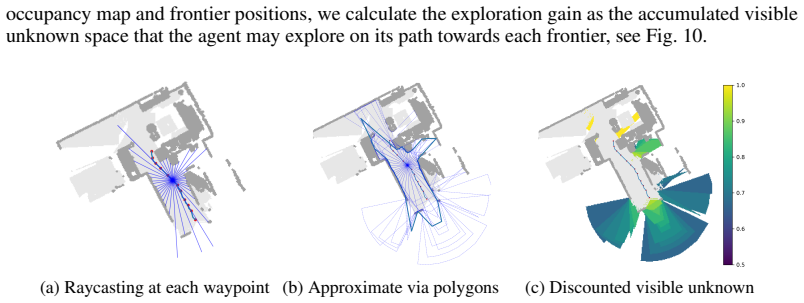
Summary. The paper presents SGImagineNav, a zero-shot object-goal navigation system that constructs a hierarchical 3D scene graph (objects, regions, floors) online and uses a VLM/LLM to hallucinate labels for unknown regions from semantic-layout priors. An adaptive frontier-selection module scores frontiers with a semantic exploitation gain and a raycast-based exploration gain, switching via Eq. (3), and a 2.5D FMM planner handles multi-floor traversal. Experiments report SR 65.4/66.8 on HM3D/HSSD, ablations on 400 HM3D episodes, scene-graph prediction precision/recall, and real-robot cross-room/cross-floor demonstrations.
Significance. If the results hold, the paper makes a useful contribution by showing that symbolic imagination can be zero-shot and global, in contrast to learned pixel/map imagination, and the hierarchical scene graph plus 3D planner extends prior single-floor symbolic methods. The strongest features are the modular system, the independent evaluation of scene-graph prediction against ground truth, the oracle ablation, and the real-robot deployment. However, the central claim rests on VLM priors and single-run point estimates, and the paper's own error analysis acknowledges that those priors are imperfect, so the robustness of the claimed improvement is not yet established.
major comments (3)
- [Sec. 5.1 / Table 1] The success distance threshold is reported as 0.1 m, whereas many prior ObjectNav results cited in Table 1 use the standard threshold of 1.0 m. Because the baseline numbers are taken from external papers, a different threshold would make the headline SR/SPL comparisons incommensurable. The authors must state the threshold used for every listed baseline or rerun/caveat the comparisons. This is load-bearing for the central claim of outperforming prior methods.
- [Sec. 5.3 / Table 2] The ablations are single runs on 400 episodes. With 400 Bernoulli trials, the standard error of a success rate is about 2.4 percentage points, so the imagination gain (62.50 vs 57.25, +5.25) is only about two standard errors and the goal-verification gain (67.00 vs 65.25, +1.75) is within one standard error. No seeds, confidence intervals, or significance tests are provided. This is not enough to establish the module-level contributions that the paper's claims rest on. Please report multi-seed variance or a paired significance test.
- [Sec. 4.1 / Eq. (3) / Sec. 7.7] The exploitation gain uses the same VLM commonsense priors both to label unknown regions and to score semantic relevance. If a scene violates those priors, a confidently wrong predicted label can produce S_s > lambda and actively mislead frontier selection, since the fallback to exploration only triggers when S_s <= lambda. Section 7.7 explicitly concedes that 'semantic priors do not perfectly align with real-world object arrangements,' yet no experiment varies or corrupts the prior. The authors should include a stress test (e.g., scrambled/anti-prior prompts, or scene subsets grouped by layout-prior agreement) to show that the reported gains are not an artifact of the HM3D/HSSD scenes incidentally matching the prompt's adjacency lists.
minor comments (4)
- [Sec. 5.2] The sentence 'pixel-level map prediction [21] ... and image-based imagination [19]' appears to swap the references: [21] is the image-based method (ImagineNav) and [19] is the map-based method (SGM). Please correct.
- [Sec. 7.4 / Sec. 7.6] Typos: '2 × 2 meteres local map window', 'the it relative height', and 'it's behavior' should read 'meters', 'its relative height', and 'its behavior'.
- [Sec. 4.3 / Eq. (3)] The fallback threshold lambda and the discount factor gamma in Eq. (4) are free parameters but their values are not reported, and no sensitivity analysis is given. Since the balance between exploitation and exploration is central to the method, please state the values and test robustness to at least one of these parameters.
- [Sec. 7.2] The scene-graph prediction prompt and output format contain Python-style boilerplate ('dict(...)', 'REMOVE spaces in the JSON string') that are implementation details; consider moving the exact prompt to source code and keeping a cleaned version in the appendix.
Circularity Check
No significant circularity: the framework is evaluated against external benchmarks and ground-truth scene graphs, with no fitted parameters or self-citation chain.
full rationale
The derivation chain does not reduce to its inputs. The claimed result (navigation success) is measured against external benchmarks (HM3D/HSSD) and real-world deployment; no parameter is fitted to these outcomes. The world-modeling and imagination module is evaluated separately against ground-truth scene graphs (Tab. 3a), which is an independent check of prediction quality. The exploitation gain in Eq. (3) uses semantic relevance scores over the observed and imagined scene graph; although the imagination prompt in Sec. 7.2 is target-conditioned ("can help find **bed**"), this does not make the prediction equivalent to the navigation outcome—it is a design choice that biases predictions toward target-relevant room types, which is precisely the commonsense prior the paper claims. The paper's own error analysis concedes that these priors do not perfectly align with real-world arrangements (Sec. 7.7), which is a robustness limitation, not circularity. There are no self-citations that are load-bearing: the cited prior work (SG-Nav, VLFM, etc.) is external. No uniqueness theorem or ansatz is imported from the authors' own prior work. The central ablation (c vs b in Tab. 2) shows a real empirical difference, and the oracle variant (f) provides an upper bound; these are not forced by construction. Thus the derivation is self-contained and the circularity score is 0.
Axiom & Free-Parameter Ledger
free parameters (5)
- fallback threshold lambda (Eq. 3)
- exploration discount gamma (Eq. 4)
- stair gradient threshold =
0.3 m
- region grouping parameters (k, dmax, wmax, nmin) =
5, 2.5 m, 15, 3
- raycasting parameters (20 rays, waypoint cap 12) =
20 rays, n < 12
axioms (4)
- domain assumption Indoor floor plans follow semantic priors such as bedroom near bathroom, kitchen near dining room, bedrooms upstairs.
- domain assumption The VLM/LLM prior used for imagination is applicable to unseen regions when given a BEV image and nearby scene graph context.
- domain assumption Clustering geometrically close objects not separated by walls yields meaningful room-level regions.
- domain assumption Stair regions can be made traversable by thresholding a gradient map and by the simulator's climb limit.
Cite this review
Pith. "Pith review of Imaginative World Modeling with Scene Graphs for Embodied Agent Navigation." pith.science (2026). https://pith.science/paper/AGAE4VJS
@misc{pith2026250806990,
  author       = {Pith},
  title        = {Pith review of: Imaginative World Modeling with Scene Graphs for Embodied Agent Navigation},
  year         = {2026},
  howpublished = {\url{https://pith.science/paper/AGAE4VJS}},
  note         = {Machine review of arXiv:2508.06990}
}
read the original abstract
Semantic navigation requires an agent to navigate toward a specified target in an unseen environment. Employing an imaginative navigation strategy that predicts future scenes before taking action, can empower the agent to find target faster. Inspired by this idea, we propose SGImagineNav, a novel imaginative navigation framework that leverages symbolic world modeling to proactively build a global environmental representation. SGImagineNav maintains an evolving hierarchical scene graphs and uses large language models to predict and explore unseen parts of the environment. While existing methods solely relying on past observations, this imaginative scene graph provides richer semantic context, enabling the agent to proactively estimate target locations. Building upon this, SGImagineNav adopts an adaptive navigation strategy that exploits semantic shortcuts when promising and explores unknown areas otherwise to gather additional context. This strategy continuously expands the known environment and accumulates valuable semantic contexts, ultimately guiding the agent toward the target. SGImagineNav is evaluated in both real-world scenarios and simulation benchmarks. SGImagineNav consistently outperforms previous methods, improving success rate to 65.4 and 66.8 on HM3D and HSSD, and demonstrating cross-floor and cross-room navigation in real-world environments, underscoring its effectiveness and generalizability.
Figures







Forward citations
Cited by 2 Pith papers
-
NavVerse: Benchmarking Indoor-to-Outdoor Embodied Navigation in Continuous Robot Simulation
A new physics-enabled benchmark with 10,000 indoor, outdoor, and indoor-to-outdoor navigation episodes shows current zero-shot agents fail most when crossing the indoor-outdoor boundary, especially on the new PlaceNav task.
-
3D Scene Graphs: Open Challenges and Future Directions
A survey that formalizes 3D Scene Graphs under a common definition, analyzes modeling choices, reviews construction from sensory data, examines applications and evaluations, and highlights open challenges with a suppo...
Reference graph
Works this paper leans on
-
[1]
Semantic visual navigation by watching youtube videos
Matthew Chang, Arjun Gupta, and Saurabh Gupta. Semantic visual navigation by watching youtube videos. Advances in Neural Information Processing Systems , 33:4283–4294, 2020
work page 2020
-
[2]
Object goal navigation using data regularized q-learning
Nandiraju Gireesh, DA Sasi Kiran, Snehasis Banerjee, Mohan Sridharan, Brojeshwar Bhowmick, and Mad- hava Krishna. Object goal navigation using data regularized q-learning. In 2022 IEEE 18th International Conference on Automation Science and Engineering (CASE) , pages 1092–1097. IEEE, 2022
work page 2022
-
[3]
Procthor: Large-scale embodied ai using procedural generation, 2022
Matt Deitke, Eli VanderBilt, Alvaro Herrasti, Luca Weihs, Jordi Salvador, Kiana Ehsani, Winson Han, Eric Kolve, Ali Farhadi, Aniruddha Kembhavi, and Roozbeh Mottaghi. Procthor: Large-scale embodied ai using procedural generation, 2022
2022
-
[4]
Habitat-web: Learning embodied object-search strategies from human demonstrations at scale
Ram Ramrakhya, Eric Undersander, Dhruv Batra, and Abhishek Das. Habitat-web: Learning embodied object-search strategies from human demonstrations at scale. In Proceedings of the IEEE/CVF Conference on Computer Vision and Pattern Recognition (CVPR) , pages 5173–5183, June 2022
work page 2022
-
[5]
Pirlnav: Pretraining with imitation and rl finetuning for objectnav
Ram Ramrakhya, Dhruv Batra, Erik Wijmans, and Abhishek Das. Pirlnav: Pretraining with imitation and rl finetuning for objectnav. In Proceedings of the IEEE/CVF Conference on Computer Vision and Pattern Recognition, pages 17896–17906, 2023
2023
-
[6]
Sg-nav: Online 3d scene graph prompting for llm-based zero-shot object navigation
Hang Yin, Xiuwei Xu, Zhenyu Wu, Jie Zhou, and Jiwen Lu. Sg-nav: Online 3d scene graph prompting for llm-based zero-shot object navigation. arXiv preprint arXiv:2410.08189, 2024
Pith/arXiv arXiv 2024
-
[7]
Vlfm: Vision- language frontier maps for zero-shot semantic navigation
Naoki Yokoyama, Sehoon Ha, Dhruv Batra, Jiuguang Wang, and Bernadette Bucher. Vlfm: Vision- language frontier maps for zero-shot semantic navigation. In 2024 IEEE International Conference on Robotics and Automation (ICRA) , pages 42–48. IEEE, 2024
work page 2024
-
[8]
Instructnav: Zero-shot system for generic instruction navigation in unexplored environment
Yuxing Long, Wenzhe Cai, Hongcheng Wang, Guanqi Zhan, and Hao Dong. Instructnav: Zero-shot system for generic instruction navigation in unexplored environment. arXiv preprint arXiv:2406.04882, 2024
Pith/arXiv arXiv 2024
-
[9]
Esc: Exploration with soft commonsense constraints for zero-shot object navigation
Kaiwen Zhou, Kaizhi Zheng, Connor Pryor, Yilin Shen, Hongxia Jin, Lise Getoor, and Xin Eric Wang. Esc: Exploration with soft commonsense constraints for zero-shot object navigation. In International Conference on Machine Learning, pages 42829–42842. PMLR, 2023
work page 2023
-
[10]
Object goal navigation using goal-oriented semantic exploration
Devendra Singh Chaplot, Dhiraj Prakashchand Gandhi, Abhinav Gupta, and Russ R Salakhutdinov. Object goal navigation using goal-oriented semantic exploration. Advances in Neural Information Processing Systems, 33:4247–4258, 2020
work page 2020
-
[11]
Poni: Potential functions for objectgoal navigation with interaction-free learning
Santhosh Kumar Ramakrishnan, Devendra Singh Chaplot, Ziad Al-Halah, Jitendra Malik, and Kristen Grauman. Poni: Potential functions for objectgoal navigation with interaction-free learning. In Proceedings of the IEEE/CVF Conference on Computer Vision and Pattern Recognition , pages 18890–18900, 2022
work page 2022
-
[12]
Cows on pasture: Baselines and benchmarks for language-driven zero-shot object navigation
Samir Yitzhak Gadre, Mitchell Wortsman, Gabriel Ilharco, Ludwig Schmidt, and Shuran Song. Cows on pasture: Baselines and benchmarks for language-driven zero-shot object navigation. In Proceedings of the IEEE/CVF Conference on Computer Vision and Pattern Recognition , pages 23171–23181, 2023
work page 2023
-
[13]
A. Dubey et al. The llama 3 herd of models. arXiv preprint arXiv:2407.21783, 2024
Pith/arXiv arXiv 2024
-
[14]
Visual instruction tuning, 2023
Haotian Liu, Chunyuan Li, Qingyang Wu, and Yong Jae Lee. Visual instruction tuning, 2023
2023
-
[15]
Uncertainty-driven planner for exploration and navigation
Georgios Georgakis, Bernadette Bucher, Anton Arapin, Karl Schmeckpeper, Nikolai Matni, and Kostas Daniilidis. Uncertainty-driven planner for exploration and navigation. In 2022 International Conference on Robotics and Automation (ICRA) , pages 11295–11302. IEEE, 2022
work page 2022
-
[16]
Gamap: Zero-shot object goal navigation with multi-scale geometric-affordance guidance
Hao Huang, Yu Hao, Congcong Wen, Anthony Tzes, Yi Fang, et al. Gamap: Zero-shot object goal navigation with multi-scale geometric-affordance guidance. Advances in Neural Information Processing Systems, 37:39386–39408, 2024
work page 2024
-
[17]
Open scene graphs for open world object-goal navigation
Joel Loo, Zhanxin Wu, and David Hsu. Open scene graphs for open world object-goal navigation. arXiv preprint arXiv:2407.02473, 2024
Pith/arXiv arXiv 2024
-
[18]
Clio: Real-time task-driven open-set 3d scene graphs
Dominic Maggio, Yun Chang, Nathan Hughes, Matthew Trang, Dan Griffith, Carlyn Dougherty, Eric Cristofalo, Lukas Schmid, and Luca Carlone. Clio: Real-time task-driven open-set 3d scene graphs. IEEE Robotics and Automation Letters, 2024
work page 2024
-
[19]
Imagine before go: Self- supervised generative map for object goal navigation
Sixian Zhang, Xinyao Yu, Xinhang Song, Xiaohan Wang, and Shuqiang Jiang. Imagine before go: Self- supervised generative map for object goal navigation. In Proceedings of the IEEE/CVF Conference on Computer Vision and Pattern Recognition, pages 16414–16425, 2024. 21
work page 2024
-
[20]
ForesightNav: Learning Scene Imagination for Efficient Exploration
Hardik Shah, Jiaxu Xing, Nico Messikommer, Boyang Sun, Marc Pollefeys, and Davide Scaramuzza. Foresightnav: Learning scene imagination for efficient exploration. arXiv preprint arXiv:2504.16062 , 2025
work page internal anchor Pith review Pith/arXiv arXiv 2025
-
[21]
Imaginenav: Prompting vision-language models as embodied navigator through scene imagination
Xinxin Zhao, Wenzhe Cai, Likun Tang, and Teng Wang. Imaginenav: Prompting vision-language models as embodied navigator through scene imagination. arXiv preprint arXiv:2410.09874, 2024
Pith/arXiv arXiv 2024
-
[22]
Mapex: Indoor structure exploration with probabilistic information gain from global map predictions
Cherie Ho, Seungchan Kim, Brady Moon, Aditya Parandekar, Narek Harutyunyan, Chen Wang, Katia Sycara, Graeme Best, and Sebastian Scherer. Mapex: Indoor structure exploration with probabilistic information gain from global map predictions. arXiv preprint arXiv:2409.15590, 2024
Pith/arXiv arXiv 2024
-
[23]
Habitat-matterport 3d dataset (hm3d): 1000 large-scale 3d environments for embodied ai
Santhosh K Ramakrishnan, Aaron Gokaslan, Erik Wijmans, Oleksandr Maksymets, Alex Clegg, John Turner, Eric Undersander, Wojciech Galuba, Andrew Westbury, Angel X Chang, et al. Habitat-matterport 3d dataset (hm3d): 1000 large-scale 3d environments for embodied ai. arXiv preprint arXiv:2109.08238, 2021
Pith/arXiv arXiv 2021
-
[24]
Mukul Khanna*, Yongsen Mao*, Hanxiao Jiang, Sanjay Haresh, Brennan Shacklett, Dhruv Batra, Alexan- der Clegg, Eric Undersander, Angel X. Chang, and Manolis Savva. Habitat Synthetic Scenes Dataset (HSSD-200): An Analysis of 3D Scene Scale and Realism Tradeoffs for ObjectGoal Navigation. arXiv preprint, 2023
work page 2023
-
[25]
Dd-ppo: Learning near-perfect pointgoal navigators from 2.5 billion frames
Erik Wijmans, Abhishek Kadian, Ari Morcos, Stefan Lee, Irfan Essa, Devi Parikh, Manolis Savva, and Dhruv Batra. Dd-ppo: Learning near-perfect pointgoal navigators from 2.5 billion frames. arXiv preprint arXiv:1911.00357, 2019
Pith/arXiv arXiv 1911
-
[26]
Visual representations for semantic target driven navigation
Arsalan Mousavian, Alexander Toshev, Marek Fišer, Jana Košecká, Ayzaan Wahid, and James Davidson. Visual representations for semantic target driven navigation. In 2019 International Conference on Robotics and Automation (ICRA), pages 8846–8852. IEEE, 2019
work page 2019
-
[27]
Visual semantic navigation using scene priors
Wei Yang, Xiaolong Wang, Ali Farhadi, Abhinav Gupta, and Roozbeh Mottaghi. Visual semantic navigation using scene priors. arXiv preprint arXiv:1810.06543, 2018
Pith/arXiv arXiv 2018
-
[28]
Zson: Zero-shot object-goal navigation using multimodal goal embeddings
Arjun Majumdar, Gunjan Aggarwal, Bhavika Devnani, Judy Hoffman, and Dhruv Batra. Zson: Zero-shot object-goal navigation using multimodal goal embeddings. Advances in Neural Information Processing Systems, 35:32340–32352, 2022
work page 2022
-
[29]
Thda: Treasure hunt data augmentation for semantic navigation
Oleksandr Maksymets, Vincent Cartillier, Aaron Gokaslan, Erik Wijmans, Wojciech Galuba, Stefan Lee, and Dhruv Batra. Thda: Treasure hunt data augmentation for semantic navigation. In Proceedings of the IEEE/CVF International Conference on Computer Vision , pages 15374–15383, 2021
work page 2021
-
[30]
Simple but effective: Clip embeddings for embodied ai
Apoorv Khandelwal, Luca Weihs, Roozbeh Mottaghi, and Aniruddha Kembhavi. Simple but effective: Clip embeddings for embodied ai. In CVPR, pages 14829–14838, 2022
work page 2022
-
[31]
OpenAI. Gpt-4 technical report. arXiv preprint arXiv:2303.08774, 2023
Pith/arXiv arXiv 2023
-
[32]
Gemini 1.5: Unlocking multimodal understanding across millions of tokens of context
Gemini Team, Petko Georgiev, Ving Ian Lei, Ryan Burnell, Libin Bai, Anmol Gulati, Garrett Tanzer, Damien Vincent, Zhufeng Pan, Shibo Wang, et al. Gemini 1.5: Unlocking multimodal understanding across millions of tokens of context. arXiv preprint arXiv:2403.05530, 2024
Pith/arXiv arXiv 2024
- [33]
-
[34]
Xiao Bi, Deli Chen, Guanting Chen, Shanhuang Chen, Damai Dai, Chengqi Deng, Honghui Ding, Kai Dong, Qiushi Du, Zhe Fu, Huazuo Gao, Kaige Gao, Wenjun Gao, Ruiqi Ge, Kang Guan, Daya Guo, Jianzhong Guo, Guangbo Hao, Zhewen Hao, Ying He, Wenjie Hu, Panpan Huang, Erhang Li, Guowei Li, Jiashi Li, Yao Li, Y . K. Li, Wenfeng Liang, Fangyun Lin, A. X. Liu, Bo Liu,...
Pith/arXiv arXiv 2024
-
[35]
L3mvn: Leveraging large language models for visual target navigation
Bangguo Yu, Hamidreza Kasaei, and Ming Cao. L3mvn: Leveraging large language models for visual target navigation. In 2023 IEEE/RSJ International Conference on Intelligent Robots and Systems (IROS) , pages 3554–3560. IEEE, 2023. 22
work page 2023
-
[36]
Ryo Sakagami, Florian S. Lay, Andreas Dömel, Martin J. Schuster, Alin Albu-Schäffer, and Freek Stulp. Robotic world models—conceptualization, review, and engineering best practices. Frontiers in Robotics and AI, V olume 10 - 2023, 2023
work page 2023
-
[37]
Recurrent world models facilitate policy evolution
David Ha and Jürgen Schmidhuber. Recurrent world models facilitate policy evolution. In S. Bengio, H. Wallach, H. Larochelle, K. Grauman, N. Cesa-Bianchi, and R. Garnett, editors, Advances in Neural Information Processing Systems, volume 31. Curran Associates, Inc., 2018
work page 2018
-
[38]
Tadahiro Taniguchi, Shingo Murata, Masahiro Suzuki, Dimitri Ognibene, Pablo Lanillos, Emre Ugur, Lorenzo Jamone, Tomoaki Nakamura, Alejandra Ciria, Bruno Lara, and Giovanni Pezzulo and. World models and predictive coding for cognitive and developmental robotics: frontiers and challenges.Advanced Robotics, 37(13):780–806, 2023
work page 2023
-
[39]
A frontier-based approach for autonomous exploration
Brian Yamauchi. A frontier-based approach for autonomous exploration. In Proceedings 1997 IEEE International Symposium on Computational Intelligence in Robotics and Automation CIRA’97. ’Towards New Computational Principles for Robotics and Automation’ , pages 146–151. IEEE, 1997
work page 1997
-
[40]
Fast marching methods
James A Sethian. Fast marching methods. SIAM review, 41(2):199–235, 1999
1999
-
[41]
Santhosh K. Ramakrishnan, Aaron Gokaslan, Erik Wijmans, Oleksandr Maksymets, Alex Clegg, John Turner, Eric Undersander, Wojciech Galuba, Andrew Westbury, Angel X. Chang, Manolis Savva, Yili Zhao, and Dhruv Batra. Habitat-matterport 3d dataset (hm3d): 1000 large-scale 3d environments for embodied ai, 2021
work page 2021
-
[42]
Pengying Wu, Yao Mu, Bingxian Wu, Yi Hou, Ji Ma, Shanghang Zhang, and Chang Liu. V oronav: V oronoi-based zero-shot object navigation with large language model.arXiv preprint arXiv:2401.02695, 2024
Pith/arXiv arXiv 2024
-
[43]
Openfmnav: Towards open-set zero-shot object navigation via vision-language foundation models
Yuxuan Kuang, Hai Lin, and Meng Jiang. Openfmnav: Towards open-set zero-shot object navigation via vision-language foundation models. arXiv preprint arXiv:2402.10670, 2024
Pith/arXiv arXiv 2024
-
[44]
Multi-floor zero-shot object navigation policy
Lingfeng Zhang, Hao Wang, Erjia Xiao, Xinyao Zhang, Qiang Zhang, Zixuan Jiang, and Renjing Xu. Multi-floor zero-shot object navigation policy. arXiv preprint arXiv:2409.10906, 2024
Pith/arXiv arXiv 2024
-
[45]
Integrat- ing egocentric localization for more realistic point-goal navigation agents
Samyak Datta, Oleksandr Maksymets, Judy Hoffman, Stefan Lee, Dhruv Batra, and Devi Parikh. Integrat- ing egocentric localization for more realistic point-goal navigation agents. CoRL, 2020
work page 2020
-
[46]
Grounded sam: Assembling open-world models for diverse visual tasks, 2024
Tianhe Ren, Shilong Liu, Ailing Zeng, Jing Lin, Kunchang Li, He Cao, Jiayu Chen, Xinyu Huang, Yukang Chen, Feng Yan, Zhaoyang Zeng, Hao Zhang, Feng Li, Jie Yang, Hongyang Li, Qing Jiang, and Lei Zhang. Grounded sam: Assembling open-world models for diverse visual tasks, 2024. 23
work page 2024
This paper was first reviewed by deepseek-v4-flash on August 5, 2026.
discussion (0)
Sign in with ORCID, Apple, or X to comment. Anyone can read and Pith papers without signing in.