Block encoding the 3D heterogeneous Poisson equation with application to fracture flow
Pith reviewed 2026-05-19 00:20 UTC · model grok-4.3
The pith
Quantum linear solvers solve 3D heterogeneous Poisson equations for fracture flow in O(N to the two-thirds) runtime, beating classical scaling.
A machine-rendered reading of the paper's core claim, the machinery that carries it, and where it could break.
Core claim
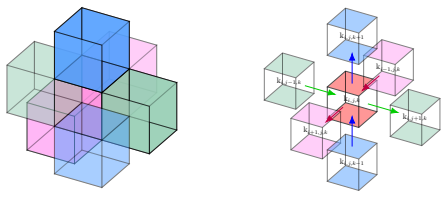
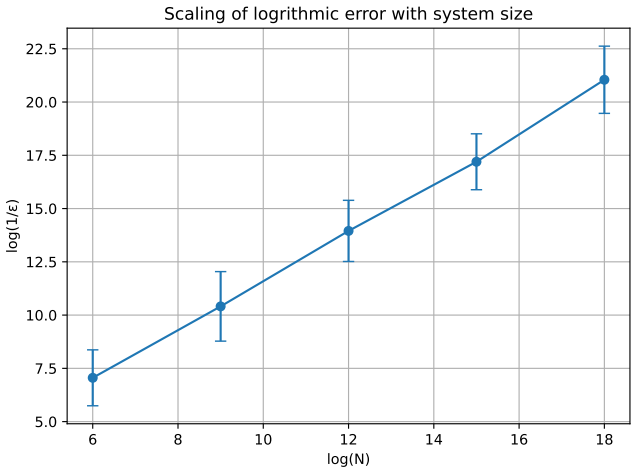
We explicitly construct a block encoding for the 3D heterogeneous Poisson matrix by leveraging the sparse local structure of the discretized operator. While classical solvers benefit from preconditioning, we show that block encoding the system matrix and preconditioner separately does not improve the effective condition number that dominates the QLS runtime. This differs from classical approaches where the preconditioner and the system matrix can often be implemented independently. Nevertheless, due to the structure of the problem in three dimensions, the quantum algorithm achieves a runtime of O(N^{2/3} polylog N · log(1/ε)), outperforming the best classical methods (with runtimes of O(N ·
What carries the argument
The block encoding of the discretized 3D heterogeneous Poisson matrix, built from its sparse local grid structure to represent the linear operator as a quantum unitary.
If this is right
- Fracture networks with far more grid points than classical computers can store become simulable because the quantum method uses exponentially less memory.
- The runtime grows only with the surface-like scaling of three dimensions rather than the full volume, extending the advantage to other 3D grid problems.
- Reducing the effective condition number stays the central remaining obstacle to larger quantum speed-ups in these applications.
- The same block-encoding construction can be reused for other heterogeneous linear systems that arise from local 3D discretizations.
Where Pith is reading between the lines
- If future quantum preconditioners can be block-encoded without destroying the three-dimensional scaling, the runtime could drop closer to polylog N.
- The approach may transfer directly to other 3D heterogeneous equations such as variable-coefficient diffusion or elasticity models.
- Running the encoding circuit on small 3D test grids on current hardware would expose any constant-factor overheads hidden in the asymptotic analysis.
Load-bearing premise
The costs of building the block encoding for the matrix and preconditioner stay low enough that the overall quantum runtime advantage from three-dimensional scaling is not erased by overheads from variable coefficients or fracture geometry.
What would settle it
A gate-count or circuit-depth calculation for the block encoding on a 3D grid of size N that shows total cost growing at least as fast as N log N would show the claimed runtime advantage does not materialize.
Figures




read the original abstract
Quantum linear system (QLS) algorithms offer the potential to solve large-scale linear systems exponentially faster than classical methods. However, applying QLS algorithms to real-world problems remains challenging due to issues such as state preparation, data loading, and efficient information extraction. In this work, we study the feasibility of applying QLS algorithms to solve discretized three-dimensional heterogeneous Poisson equations, with specific examples relating to groundwater flow through geologic fracture networks. We explicitly construct a block encoding for the 3D heterogeneous Poisson matrix by leveraging the sparse local structure of the discretized operator. While classical solvers benefit from preconditioning, we show that block encoding the system matrix and preconditioner separately does not improve the effective condition number that dominates the QLS runtime. This differs from classical approaches where the preconditioner and the system matrix can often be implemented independently. Nevertheless, due to the structure of the problem in three dimensions, the quantum algorithm achieves a runtime of $O(N^{2/3} \ \text{polylog } N \cdot \log(1/\epsilon))$, outperforming the best classical methods (with runtimes of $O(N \log N \cdot \log(1/\epsilon))$) and offering exponential memory savings. These results highlight both the promise and limitations of QLS algorithms for practical scientific computing, and point to effective condition number reduction as a key barrier in achieving quantum advantages.
Editorial analysis
A structured set of objections, weighed in public.
Referee Report
Summary. The manuscript presents an explicit block encoding construction for the matrix from the finite-difference discretization of the three-dimensional heterogeneous Poisson equation, motivated by applications to flow in geologic fracture networks. Using this, it analyzes the complexity of quantum linear system solvers, notes that separately block-encoding a preconditioner does not reduce the effective condition number (unlike in classical methods), and concludes that the quantum runtime is O(N^{2/3} polylog N · log(1/ε)), which is asymptotically superior to classical solvers' O(N log N · log(1/ε)) while providing exponential savings in memory.
Significance. If the claimed polylogarithmic block-encoding cost holds, this constitutes a concrete step toward quantum advantage for a practically relevant class of 3D PDE problems with highly variable coefficients. The explicit construction and the clarification on the limitations of quantum preconditioning are notable strengths. The work is grounded in standard QLS complexity and provides falsifiable runtime predictions.
major comments (1)
- The skeptic's concern that the block encoding cost for position-dependent heterogeneous coefficients may exceed polylog(N) does not actually land on the manuscript, because the authors explicitly construct the block encoding by leveraging the sparse local structure of the 7-point stencil, which allows the variable coefficients to be incorporated without additional asymptotic overhead beyond polylog N.
minor comments (2)
- The LaTeX for the runtime bound in the abstract contains an extraneous space before 'polylog'.
- Notation for the condition number and block-encoding cost could be defined earlier to improve readability for readers unfamiliar with QLS.
Simulated Author's Rebuttal
We thank the referee for their positive assessment of the manuscript and for the recommendation of minor revision. The referee's comment helpfully addresses a potential point of confusion regarding our block-encoding construction, and we respond to it below.
read point-by-point responses
-
Referee: The skeptic's concern that the block encoding cost for position-dependent heterogeneous coefficients may exceed polylog(N) does not actually land on the manuscript, because the authors explicitly construct the block encoding by leveraging the sparse local structure of the 7-point stencil, which allows the variable coefficients to be incorporated without additional asymptotic overhead beyond polylog N.
Authors: We agree with the referee's assessment. Our explicit construction in Section 3 of the manuscript indeed relies on the local sparsity of the 7-point finite-difference stencil to incorporate the spatially varying coefficients with only polylog(N) overhead. This is achieved by preparing a block encoding of the coefficient field on a per-stencil basis rather than loading the full heterogeneous data structure. We have added a short clarifying sentence in the revised version to make this distinction more prominent for readers unfamiliar with the construction. revision: partial
Circularity Check
No circularity: runtime follows from explicit block-encoding construction plus standard QLS bounds
full rationale
The paper states an explicit construction of the block encoding for the 3D heterogeneous Poisson matrix that leverages the sparse local 7-point stencil. The claimed runtime O(N^{2/3} polylog N · log(1/ε)) is obtained by substituting the grid-induced condition number κ ∼ N^{2/3} and the polylog(N) block-encoding cost T into the known QLS complexity. No equation or claim reduces to a fitted parameter, self-definition, or self-citation chain that is itself unverified. The separate discussion of preconditioner block encoding is shown not to improve effective κ, but this observation is independent of the runtime derivation. The result is therefore self-contained against external QLS theorems and classical complexity benchmarks.
Axiom & Free-Parameter Ledger
axioms (1)
- standard math Standard block encoding and quantum linear system algorithm complexity results apply directly to the constructed operator.
Lean theorems connected to this paper
-
IndisputableMonolith/Foundation/AlexanderDuality.leanalexander_duality_circle_linking echoes?
echoesECHOES: this paper passage has the same mathematical shape or conceptual pattern as the Recognition theorem, but is not a direct formal dependency.
We explicitly construct a block encoding for the 3D heterogeneous Poisson matrix by leveraging the sparse local structure of the discretized operator... D = O((F^2)^6) = O(F^{12})
-
IndisputableMonolith/Cost/FunctionalEquation.leanwashburn_uniqueness_aczel unclear?
unclearRelation between the paper passage and the cited Recognition theorem.
the quantum algorithm achieves a runtime of O(N^{2/3} polylog N · log(1/ε))
What do these tags mean?
- matches
- The paper's claim is directly supported by a theorem in the formal canon.
- supports
- The theorem supports part of the paper's argument, but the paper may add assumptions or extra steps.
- extends
- The paper goes beyond the formal theorem; the theorem is a base layer rather than the whole result.
- uses
- The paper appears to rely on the theorem as machinery.
- contradicts
- The paper's claim conflicts with a theorem or certificate in the canon.
- unclear
- Pith found a possible connection, but the passage is too broad, indirect, or ambiguous to say the theorem truly supports the claim.
Reference graph
Works this paper leans on
-
[1]
Optimal scaling quantum linear-systems solver via discrete adiabatic theorem,
P. C. Costa, D. An, Y. R. Sanders, Y. Su, R. Babbush, and D. W. Berry, “Optimal scaling quantum linear-systems solver via discrete adiabatic theorem,” PRX Quantum, vol. 3, p. 040303, Oct 2022
work page 2022
-
[2]
A shortcut to an optimal quantum linear system solver,
A. Dalzell, “A shortcut to an optimal quantum linear system solver,” 2024
work page 2024
-
[3]
Y. Tong, D. An, N. Wiebe, and L. Lin, “Fast inversion, preconditioned quantum linear system solvers, fast green’s-function computation, and fast evaluation of matrix functions,” Phys. Rev. A , vol. 104, p. 032422, Sep 2021
work page 2021
-
[4]
Quantum realization of the finite element method,
M. Deiml and D. Peterseim, “Quantum realization of the finite element method,” arXiv preprint arXiv:2403.19512, 2024
-
[5]
D. Orsucci and V. Dunjko, “On solving classes of positive-definite quantum linear systems with quadrat- ically improved runtime in the condition number,” arXiv preprint arXiv:2101.11868 , 2021
-
[6]
Preconditioned block encodings for quantum linear systems,
L. Lapworth and C. S¨ underhauf, “Preconditioned block encodings for quantum linear systems,” arXiv preprint arXiv:2502.20908, 2025
-
[7]
Strang, Computational science and engineering
G. Strang, Computational science and engineering . No. Sirsi i9780961408817, 2007
work page 2007
-
[8]
dfnworks: A discrete fracture network framework for modeling subsurface flow and transport,
J. D. Hyman, S. Karra, N. Makedonska, C. W. Gable, S. L. Painter, and H. S. Viswanathan, “dfnworks: A discrete fracture network framework for modeling subsurface flow and transport,” Computers & Geosciences, vol. 84, pp. 10–19, 2015
work page 2015
-
[9]
Quantum computing and preconditioners for hydrological linear systems,
J. Golden, D. O’Malley, and H. Viswanathan, “Quantum computing and preconditioners for hydrological linear systems,” Scientific Reports, vol. 12, Dec. 2022
work page 2022
-
[10]
Quantum algorithm for linear systems of equations,
A. W. Harrow, A. Hassidim, and S. Lloyd, “Quantum algorithm for linear systems of equations,” Physical review letters, vol. 103, no. 15, p. 150502, 2009
work page 2009
-
[11]
J. M. Henderson, J. Kath, J. K. Golden, A. G. Percus, and D. O’Malley, “Addressing quantum’s ”fine print”: State preparation and information extraction for quantum algorithms and geologic fracture networks,” 2023
work page 2023
-
[12]
Block-encoding structured matrices for data input in quantum computing,
C. S¨ underhauf, E. Campbell, and J. Camps, “Block-encoding structured matrices for data input in quantum computing,” Quantum, vol. 8, p. 1226, Jan. 2024. 11
work page 2024
-
[13]
J. Hyman, G. Aldrich, H. Viswanathan, N. Makedonska, and S. Karra, “Fracture size and transmissivity correlations: Implications for transport simulations in sparse three-dimensional discrete fracture net- works following a truncated power law distribution of fracture size,” Water Resources Research, vol. 52, no. 8, pp. 6472–6489, 2016
work page 2016
-
[14]
Flow in multiscale fractal fracture networks,
P. Davy, O. Bour, J.-R. De Dreuzy, and C. Darcel, “Flow in multiscale fractal fracture networks,” Geological Society, London, Special Publications, vol. 261, no. 1, pp. 31–45, 2006
work page 2006
-
[15]
A. Jafari and T. Babadagli, “Estimation of equivalent fracture network permeability using fractal and statistical network properties,” Journal of Petroleum Science and Engineering , vol. 92, pp. 110–123, 2012. Acknowledgements AP and DO gratefully acknowledge support from the Department of Energy, Office of Science, Office of Basic Energy Sciences, Geosci...
work page 2012
-
[16]
dind = 00 and mhi = 1
-
[17]
dind = 01 and mlo = 0 (mod N1/3)
-
[18]
dind = 10 and j mlo (mod N 2/3) N 1/3 k = 0
-
[19]
dind = 11 and mlo < N 2/3
-
[20]
(dind, mhi, mlo) does not satisfy any of the above conditions,
dval > D ′ and (dind, mhi, mlo) does not satisfy any of the above conditions The constraint on condition five that “(dind, mhi, mlo) does not satisfy any of the above conditions,” is added so all five conditions are dependent on each other. We need to ensure this so there is not a case where we accidentally flip the delete qubit twice. To simplify the imp...
discussion (0)
Sign in with ORCID, Apple, or X to comment. Anyone can read and Pith papers without signing in.