Queue Replacement Approach to Dynamic User Equilibrium Assignment with Route and Departure Time Choice
Pith reviewed 2026-05-19 00:09 UTC · model grok-4.3
The pith
The generalized queue replacement principle equates the equilibrium queueing-delay pattern to the solution of a relaxed linear program.
A machine-rendered reading of the paper's core claim, the machinery that carries it, and where it could break.
Core claim
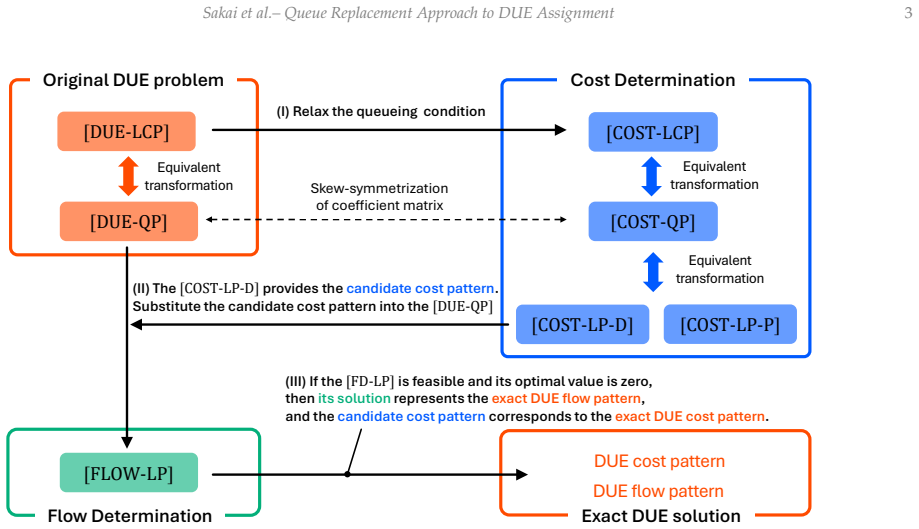
The generalized queue replacement principle (GQRP) establishes an equivalence between the equilibrium queueing-delay pattern and the solution to a linear programming (LP) problem obtained by relaxing some conditions in the original DUE-RDTC problem. Based on the GQRP, the paper develops a systematic procedure to obtain an exact DUE solution by sequentially solving two LPs: one for the equilibrium cost pattern, including queueing delays, and the other for the corresponding equilibrium flow pattern. A preliminary method is given for determining whether the GQRP holds for any given network and demand pattern.
What carries the argument
The generalized queue replacement principle (GQRP), which relaxes selected conditions of the DUE-RDTC problem so that the equilibrium queueing-delay pattern becomes the optimum of a linear program.
If this is right
- When the GQRP is verified, the equilibrium cost pattern (including queueing delays) is recovered directly as the solution of one linear program.
- The equilibrium flow pattern is then recovered by solving a second linear program that uses the costs from the first step.
- The two-step procedure yields an exact solution to the original DUE-RDTC problem for homogeneous users.
- The approach remains computationally feasible on networks of increasing size, as confirmed by the reported numerical tests.
Where Pith is reading between the lines
- The same replacement idea might be tested on networks that include signal controls or heterogeneous users if analogous relaxations can be defined.
- Because the method produces both costs and flows from linear programs, it could be embedded inside larger optimization frameworks that treat equilibrium as a constraint.
- Automated verification of the GQRP for arbitrary networks would further reduce the need for manual checks before applying the two-LP procedure.
Load-bearing premise
The generalized queue replacement principle must hold for the network and demand pattern being studied.
What would settle it
Solving the same DUE-RDTC instance by an independent iterative method and finding that the resulting queueing-delay pattern differs from the one produced by the first linear program would disprove the claimed equivalence.
Figures






read the original abstract
This study develops a hybrid analytical and numerical approach for dynamic user equilibrium (DUE) assignment with simultaneous route and departure time choice (RDTC) for homogeneous users. The core concept of the proposed approach is the generalized queue replacement principle (GQRP), which establishes an equivalence between the equilibrium queueing-delay pattern and the solution to a linear programming (LP) problem obtained by relaxing some conditions in the original DUE-RDTC problem. We first present a method for determining whether the GQRP holds. Based on the GQRP, we then develop a systematic procedure to obtain an exact DUE solution by sequentially solving two LPs: one for the equilibrium cost pattern, including queueing delays, and the other for the corresponding equilibrium flow pattern. Computational results on networks of varying scales confirm the effectiveness of the proposed method.
Editorial analysis
A structured set of objections, weighed in public.
Referee Report
Summary. The manuscript develops a hybrid analytical-numerical method for dynamic user equilibrium (DUE) with simultaneous route and departure time choice (RDTC) for homogeneous users. The central contribution is the generalized queue replacement principle (GQRP), which claims an equivalence between the equilibrium queueing-delay pattern and the optimal solution of a linear program obtained by relaxing selected conditions from the original DUE-RDTC formulation. The authors describe a procedure to test whether GQRP holds for a given instance and then solve two sequential LPs to recover the equilibrium cost pattern (including delays) and the corresponding flow pattern. Computational experiments on networks of varying scales are presented to illustrate effectiveness.
Significance. If the GQRP equivalence can be shown to hold rigorously without admitting delay patterns inconsistent with dynamic network loading, the approach would provide an exact, LP-based solution method for a class of DUE-RDTC problems that are otherwise solved iteratively or via simulation. This would be a notable advance in transportation network optimization, particularly for its potential to avoid heuristic convergence issues while scaling to moderate-sized networks.
major comments (2)
- [Section defining the GQRP and the LP relaxation] The core claim that relaxing conditions in the DUE-RDTC formulation yields an LP whose optimum is exactly the equilibrium queueing-delay pattern (via GQRP) is load-bearing for the entire solution procedure. The manuscript should supply an explicit proof or independent verification that the relaxation preserves time-dependent flow conservation and the complementarity between queue lengths and delays, especially on networks containing multiple interacting bottlenecks; without this, the equivalence risks being an approximation rather than an identity.
- [Section describing the GQRP validity check] The method presented for determining whether GQRP holds for a given network and demand pattern appears to rely on the same relaxed LP structure used in the solution procedure. This creates a potential circularity that undermines the check; an independent test (e.g., comparison against an analytical benchmark or a small-scale simulation with known interacting bottlenecks) is needed to confirm validity before claiming exact DUE solutions.
minor comments (2)
- [Computational results section] The abstract states that results confirm effectiveness on networks of varying scales, but the main text should include a table or figure summarizing network sizes, number of bottlenecks, and run times to allow readers to assess scalability.
- [Formulation sections] Notation for the relaxed LP objective and constraints should be cross-referenced explicitly to the original DUE-RDTC formulation to improve readability.
Simulated Author's Rebuttal
We thank the referee for their detailed and constructive comments on our manuscript. We have reviewed the major comments and provide point-by-point responses below, indicating where revisions will be made to address the concerns.
read point-by-point responses
-
Referee: [Section defining the GQRP and the LP relaxation] The core claim that relaxing conditions in the DUE-RDTC formulation yields an LP whose optimum is exactly the equilibrium queueing-delay pattern (via GQRP) is load-bearing for the entire solution procedure. The manuscript should supply an explicit proof or independent verification that the relaxation preserves time-dependent flow conservation and the complementarity between queue lengths and delays, especially on networks containing multiple interacting bottlenecks; without this, the equivalence risks being an approximation rather than an identity.
Authors: We agree that a rigorous proof is essential to establish the GQRP as an exact equivalence rather than an approximation. In the current manuscript, the GQRP is motivated and illustrated through the relaxation of the DUE-RDTC formulation, with supporting arguments based on queue replacement properties. However, to fully address this, we will add an explicit proof in the revised manuscript. This proof will demonstrate that the LP relaxation preserves time-dependent flow conservation and the complementarity conditions for queue lengths and delays. We will extend the analysis to networks with multiple interacting bottlenecks by considering the sequential nature of the queue replacement and showing consistency with dynamic network loading. revision: yes
-
Referee: [Section describing the GQRP validity check] The method presented for determining whether GQRP holds for a given network and demand pattern appears to rely on the same relaxed LP structure used in the solution procedure. This creates a potential circularity that undermines the check; an independent test (e.g., comparison against an analytical benchmark or a small-scale simulation with known interacting bottlenecks) is needed to confirm validity before claiming exact DUE solutions.
Authors: We recognize the concern regarding potential circularity in the validity check procedure. The check in the manuscript involves solving the relaxed LP and then verifying the resulting delay pattern against the original DUE conditions through a separate evaluation step. To eliminate any ambiguity, we will revise the description to emphasize the independence of the verification process. Additionally, we will include numerical validations on small-scale networks with known analytical solutions or simulation benchmarks to confirm that the GQRP holds in cases with interacting bottlenecks. revision: partial
Circularity Check
No significant circularity; GQRP equivalence derived independently via relaxation and verification method
full rationale
The paper introduces the generalized queue replacement principle (GQRP) as an equivalence between equilibrium queueing-delay patterns and the solution to an LP obtained by relaxing selected conditions from the original DUE-RDTC formulation. It then supplies an explicit method to determine whether GQRP holds for a given network and demand, followed by a two-LP procedure to recover the exact equilibrium cost and flow patterns. No step reduces a claimed prediction or result to a fitted input, self-citation chain, or definitional identity by construction; the verification method and LP relaxations constitute independent mathematical content that can be checked against the original complementarity and conservation conditions. This satisfies the default expectation that most papers are non-circular, with the central claim retaining external falsifiability through the GQRP check.
Axiom & Free-Parameter Ledger
axioms (2)
- domain assumption Users are homogeneous
- ad hoc to paper GQRP holds for the instance
invented entities (1)
-
Generalized Queue Replacement Principle (GQRP)
no independent evidence
Lean theorems connected to this paper
-
IndisputableMonolith/Cost/FunctionalEquation.leanwashburn_uniqueness_aczel unclear?
unclearRelation between the paper passage and the cited Recognition theorem.
The GQRP is an equivalence between the equilibrium queueing delay pattern and the solution to a linear programming (LP) problem obtained by relaxing certain conditions in the original DUE-RDTC problem.
-
IndisputableMonolith/Foundation/RealityFromDistinction.leanreality_from_one_distinction unclear?
unclearRelation between the paper passage and the cited Recognition theorem.
formulated the DUE-RDTC problem as a mixed linear complementarity problem (LCP)... transformed into an equivalent quadratic program
What do these tags mean?
- matches
- The paper's claim is directly supported by a theorem in the formal canon.
- supports
- The theorem supports part of the paper's argument, but the paper may add assumptions or extra steps.
- extends
- The paper goes beyond the formal theorem; the theorem is a base layer rather than the whole result.
- uses
- The paper appears to rely on the theorem as machinery.
- contradicts
- The paper's claim conflicts with a theorem or certificate in the canon.
- unclear
- Pith found a possible connection, but the passage is too broad, indirect, or ambiguous to say the theorem truly supports the claim.
Reference graph
Works this paper leans on
-
[1]
TransportationResearchPartB:Methodological , 34(6):515–531
Akamatsu,T.(2000).Adynamictrafficequilibriumassignmentparadox. TransportationResearchPartB:Methodological , 34(6):515–531
work page 2000
-
[2]
Akamatsu, T. (2001). An efficient algorithm for dynamic traffic equilibrium assignment with queues.Transportation Science, 35(4):389–404
work page 2001
-
[3]
Akamatsu, T. and Wada, K. (2017). Tradable network permits: A new scheme for the most efficient use of network capacity. Transportation Research Part C: Emerging Technologies, 79:178–195
work page 2017
-
[4]
Akamatsu, T., Wada, K., and Hayashi, S. (2015). The corridor problem with discrete multiple bottlenecks.Trans- portation Research Part B: Methodological, 81(3):808–829
work page 2015
-
[5]
Akamatsu, T., Wada, K., Iryo, T., and Hayashi, S. (2021). A new look at departure time choice equilibrium models with heterogeneous users.Transportation Research Part B: Methodological, 148:152–182
work page 2021
-
[6]
Arnott, R., de Palma, A., and Lindsey, R. (1990). Departure time and route choice for the morning commute. Transportation Research Part B: Methodological, 24(3):209–228. Cottle,R.W.,Pang,J.S.,andStone,R.E.(2009). Thelinearcomplementarityproblem . SocietyforIndustrialandApplied Mathematics. Sakai et al.– Queue Replacement Approach to DUE Assignment 29 Daga...
work page 1990
-
[7]
Friesz, T. L., Bernstein, D., Smith, T. E., Tobin, R. L., and Wie, B. W. (1993). A variational inequality formulation of the dynamic network user equilibrium problem.Operations research, 41(1):179–191. Friesz,T.L.andHan,K.(2019). Themathematicalfoundationsofdynamicuserequilibrium. TransportationResearch Part B: Methodological, 126:309–328
work page 1993
-
[8]
L., Kim, T., Kwon, C., and Rigdon, M
Friesz, T. L., Kim, T., Kwon, C., and Rigdon, M. A. (2011). Approximate network loading and dual-time-scale dynamic user equilibrium.Transportation Research Part B: Methodological, 45(1):176–207. Friesz,T.L.andMookherjee,R.(2006).Solvingthedynamicnetworkuserequilibriumproblemwithstate-dependent time shifts.Transportation Research Part B: Methodological, 4...
work page 2011
-
[9]
Fu, H., Akamatsu, T., Satsukawa, K., and Wada, K. (2022). Dynamic traffic assignment in a corridor network: Optimum versus equilibrium.Transportation Research Part B: Methodological, 161:218–246
work page 2022
-
[10]
Computingdynamicuserequilibriaonlarge-scalenetworkswithsoftware implementation
Han, K., Eve, G., andFriesz, T.L.(2019). Computingdynamicuserequilibriaonlarge-scalenetworkswithsoftware implementation. Networks and spatial economics, 19(3):869–902
work page 2019
-
[11]
Hendrickson, C. and Kocur, G. (1981). Schedule delay and departure time decisions in a deterministic model. Transportation Science, 15(1):62–77
work page 1981
-
[12]
Huang, H.-J. and Lam, W. H. K. (2002). Modeling and solving the dynamic user equilibrium route and departure time choice problem in network with queues.Transportation Research Part B: Methodological, 36(3):253–273. Iryo,T.andYoshii,T.(2007). Equivalentoptimizationproblemforfindingequilibriuminthebottleneckmodelwith departure time choices. In4th IMA Intern...
work page 2002
-
[13]
Kuwahara, M. and Akamatsu, T. (1993). Dynamic equilibrium assignment with queues for a one-to-many OD pattern. volume 12, pages 185–204. In: Daganzo, C.F. (Ed.), Proceedings of the 12th International Symposium on Transportation and Traffic Theory. Elsevior, Berkeley. Kuwahara,M.andNewell,G.F.(1987). Queueevolutiononfreewaysleadingtoasinglecorecityduringth...
work page 1993
-
[14]
Lindsey, R. (2004). Existence, uniqueness, and trip cost function properties of user equilibrium in the bottleneck model with multiple user classes.Transportation Science, 38(3):293–314
work page 2004
-
[15]
Sakai, T., Satsukawa, K., and Akamatsu, T. (2022). Non-existence of queues for system optimal departure patterns in tree networks.arXiv [math.OC]
work page 2022
-
[16]
Szeto, W. Y. and Lo, H. K. (2004). A cell-based simultaneous route and departure time choice model with elastic demand. Transportation Research Part B: Methodological, 38(7):593–612. Sakai et al.– Queue Replacement Approach to DUE Assignment 30 Transportation Networks for Research Core Team (Accessed: September 22, 2024). Transportation networks for resea...
work page 2004
-
[17]
Vickrey, W. S. (1969). Congestion theory and transport investment.American Economic Review, 59(2):251–260. Wada,K.andAkamatsu,T.(2013). Ahybridimplementationmechanismoftradablenetworkpermitssystemwhich obviates path enumeration: An auction mechanism with day-to-day capacity control.Transportation Research Part E: Logistics and Transportation Review, 60:94–112
work page 1969
discussion (0)
Sign in with ORCID, Apple, or X to comment. Anyone can read and Pith papers without signing in.