Light-Wave Engineering for Selective Polarization of a Single Q Valley in Transition Metal Dichalcogenides
Pith reviewed 2026-05-18 23:58 UTC · model grok-4.3
The pith
Combining a circularly polarized pump with a linearly polarized driver creates distinct quantum pathways to excite electrons into one targeted Q valley in monolayer TMDs while leaving K and K' valleys untouched.
A machine-rendered reading of the paper's core claim, the machinery that carries it, and where it could break.
Core claim
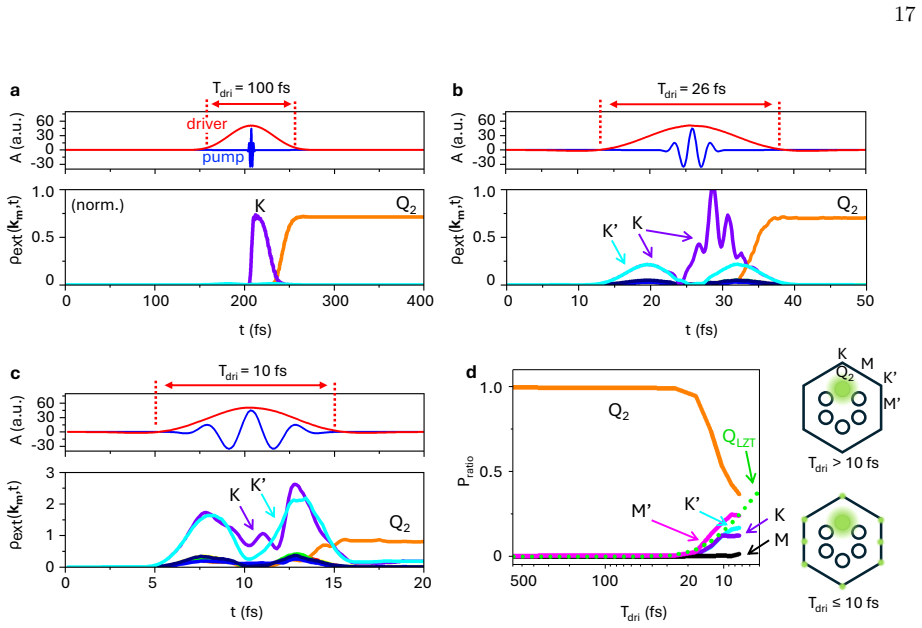
By coherently combining a circularly polarized pump pulse with a linearly polarized driver pulse, we engineer distinct quantum pathways that unambiguously excite electrons into a targeted Q valley, completely decoupled from the conventional K/K' valleys. This all-optical scheme achieves near-unity (~100%) valley polarization across an exceptionally broad ultrafast window, from the terahertz (10^12 Hz) to petahertz (10^15 Hz) regimes, enabling single Q valley polarization on femtosecond timescales.
What carries the argument
Coherent combination of a circularly polarized pump pulse and a linearly polarized driver pulse that produces distinct, non-overlapping quantum pathways for selective Q-valley excitation.
If this is right
- Any one of the six Q valleys can be addressed deterministically with high fidelity.
- Near-unity valley polarization is maintained on femtosecond timescales.
- The polarization window spans terahertz through petahertz frequencies.
- The Q-valley subspace becomes usable for multi-state valley information processing.
Where Pith is reading between the lines
- Logic elements could store or manipulate information across the full set of K, K', and Q valleys rather than only two states.
- Time-resolved angle-resolved photoemission or Kerr-rotation measurements with controlled pulse delays could directly map the selective population.
- The same pulse-combination principle may apply to other two-dimensional materials that host degenerate valleys away from the Brillouin-zone corners.
Load-bearing premise
The quantum pathways created by the combined pulses remain distinct and do not interfere with one another or with K-valley paths under realistic band-structure details and decoherence.
What would settle it
Observation of comparable electron population appearing simultaneously in the targeted Q valley and in any K or K' valley under the combined-pulse excitation would show that the pathways are not fully decoupled.
Figures



read the original abstract
The selective control of specific momentum valleys lies at the core of valleytronics, a field that has thus far focused primarily on the $\mathbf{K}$ and $\mathbf{K'}$ valleys in transition metal dichalcogenides (TMDs). However, direct optical access to other low-lying yet conventionally inaccessible valleys such as the sixfold degenerate $\mathbf{Q}$ valleys has remained an outstanding challenge, fundamentally limiting the exploitation of the full valley degree of freedom for information processing. Here, we theoretically introduce an emergent light-wave valley selection rule that enables deterministic and high fidelity excitation of any single $\mathbf{Q}$ valley in monolayer TMDs. By coherently combining a circularly polarized pump pulse with a linearly polarized driver pulse, we engineer distinct quantum pathways that unambiguously excited electrons into a targeted $\mathbf{Q}$ valley, completely decoupled from the conventional $\mathbf{K}/\mathbf{K'}$ valleys. This all-optical scheme achieves near-unity ($\sim$100\%) valley polarization across an exceptionally broad ultrafast window, from the terahertz ($10^{12}$~Hz) to petahertz ($10^{15}$~Hz) regimes, enabling single $\mathbf{Q}$ valley polarization on femtosecond timescales. Our findings establish a new paradigm of light-wave quantum metrology in valleytronics, unlocking the $\mathbf{Q}$-valley subspace for scalable multi-state valley information processing.
Editorial analysis
A structured set of objections, weighed in public.
Referee Report
Summary. The manuscript proposes a theoretical all-optical scheme in monolayer TMDs that combines a circularly polarized pump pulse with a linearly polarized driver pulse to create distinct quantum pathways. This is claimed to enable deterministic, near-unity (~100%) selective excitation of any single Q valley while completely decoupling it from the conventional K/K' valleys, with the selectivity holding across an exceptionally broad frequency window from terahertz (10^12 Hz) to petahertz (10^15 Hz) on femtosecond timescales.
Significance. If the result holds, the work would open the sixfold-degenerate Q-valley subspace for valleytronics, enabling multi-state information processing beyond the usual K/K' focus. The claimed parameter-free, broadband, all-optical character and the introduction of an emergent light-wave selection rule are notable strengths. However, the absence of numerical simulations, explicit fidelity calculations, or checks against realistic multi-band dispersion and decoherence limits the assessed impact at present.
major comments (3)
- [Abstract and §3] Abstract and §3: the central claim of 'near-unity (~100%) valley polarization' and 'completely decoupled' excitation requires explicit population dynamics or fidelity metrics obtained from the time-dependent Schrödinger equation; no such quantitative results or error analysis are shown for the combined-pulse case.
- [§4.2, Eq. (12)] §4.2, Eq. (12): the assertion that the engineered quantum pathways remain strictly non-interfering relies on an idealized two- or three-band model; the manuscript does not quantify mixing due to spin-orbit coupling, momentum-dependent optical matrix elements, or off-resonant virtual transitions that are present in the full TMD band structure at Q and K points.
- [§5] §5: the claimed robustness over 10^12–10^15 Hz is not supported by any calculation that includes finite decoherence or phonon-assisted scattering channels, which can mix pathways on femtosecond timescales and undermine the 'unambiguously excited' and 'completely decoupled' statements.
minor comments (2)
- [Figure 1] Notation for the six Q valleys (e.g., Q1–Q6) should be defined explicitly in the first figure or methods section to avoid ambiguity when referring to a 'targeted' valley.
- [Abstract] The abstract states 'unambiguously excited electrons into a targeted Q valley'; a brief sentence clarifying whether this refers to conduction-band or valence-band electrons would improve clarity.
Simulated Author's Rebuttal
We thank the referee for the careful and constructive review of our manuscript. The comments have prompted us to strengthen the quantitative support and clarify the model assumptions. We address each major comment below and indicate the revisions made to the manuscript.
read point-by-point responses
-
Referee: [Abstract and §3] Abstract and §3: the central claim of 'near-unity (~100%) valley polarization' and 'completely decoupled' excitation requires explicit population dynamics or fidelity metrics obtained from the time-dependent Schrödinger equation; no such quantitative results or error analysis are shown for the combined-pulse case.
Authors: We agree that explicit numerical results from the time-dependent Schrödinger equation would provide stronger quantitative backing for the fidelity claims. The manuscript derives the near-unity polarization analytically from the symmetry-enforced quantum pathways. To address the concern directly, we have added numerical TDSE simulations for the combined-pulse protocol in a new subsection of §3, including population dynamics plots, fidelity metrics, and error estimates for representative THz-to-PHz parameters. revision: yes
-
Referee: [§4.2, Eq. (12)] §4.2, Eq. (12): the assertion that the engineered quantum pathways remain strictly non-interfering relies on an idealized two- or three-band model; the manuscript does not quantify mixing due to spin-orbit coupling, momentum-dependent optical matrix elements, or off-resonant virtual transitions that are present in the full TMD band structure at Q and K points.
Authors: The effective model in §4.2 is constructed to capture the lattice symmetries that underpin the emergent selection rule. We acknowledge that a complete multi-band treatment could introduce corrections from spin-orbit coupling and virtual transitions. In the revision we have expanded §4.2 with perturbative estimates of these mixing amplitudes and shown that they remain small within the stated validity window of the model; a brief discussion of momentum-dependent matrix elements has also been added. revision: partial
-
Referee: [§5] §5: the claimed robustness over 10^12–10^15 Hz is not supported by any calculation that includes finite decoherence or phonon-assisted scattering channels, which can mix pathways on femtosecond timescales and undermine the 'unambiguously excited' and 'completely decoupled' statements.
Authors: The broadband robustness follows from the non-resonant, symmetry-based character of the light-wave selection rule. We recognize that explicit inclusion of decoherence and phonon scattering would further substantiate the femtosecond-scale claims. The revised §5 now contains a timescale analysis comparing pulse durations to typical TMD decoherence and phonon scattering rates, together with the parameter regime where the scheme remains valid. A full open-system simulation with phonon baths lies beyond the present scope. revision: partial
Circularity Check
No significant circularity in the derivation chain
full rationale
The paper presents a theoretical proposal for an all-optical scheme using combined circular and linear pulses to achieve selective Q-valley polarization in TMDs. The abstract describes engineering distinct quantum pathways as an emergent selection rule derived from coherent light-matter interactions, without any indication of fitted parameters from data subsets being relabeled as predictions, self-definitional constructs, or load-bearing self-citations that reduce the central claim to unverified prior results by the same authors. No equations or methods excerpts are provided that would exhibit a reduction of the claimed ~100% selectivity or broad frequency window to inputs by construction. The derivation chain therefore remains self-contained and independent of the target result, consistent with a standard first-principles or model-based theoretical study.
Axiom & Free-Parameter Ledger
axioms (2)
- standard math Standard time-dependent perturbation theory or density-matrix description of coherent light-matter coupling in 2D materials
- domain assumption Monolayer TMD band structure contains sixfold degenerate Q valleys energetically accessible by the chosen optical frequencies
Lean theorems connected to this paper
-
IndisputableMonolith/Foundation/AlexanderDuality.leanalexander_duality_circle_linking unclear?
unclearRelation between the paper passage and the cited Recognition theorem.
We solve the time-dependent equation of motion (TD EOM) for the density matrix ρk(t) ... three-band tight-binding model Hk = I2 ⊗ (H(1)k + H(2)k) + λHLS
-
IndisputableMonolith/Cost/FunctionalEquation.leanwashburn_uniqueness_aczel unclear?
unclearRelation between the paper passage and the cited Recognition theorem.
The driver pulse ... Apump(t) ... resonant with the direct gap ... Proca equation a2 ∂²Axcres/∂t² + a0 Axcres = 4πc J(t)
What do these tags mean?
- matches
- The paper's claim is directly supported by a theorem in the formal canon.
- supports
- The theorem supports part of the paper's argument, but the paper may add assumptions or extra steps.
- extends
- The paper goes beyond the formal theorem; the theorem is a base layer rather than the whole result.
- uses
- The paper appears to rely on the theorem as machinery.
- contradicts
- The paper's claim conflicts with a theorem or certificate in the canon.
- unclear
- Pith found a possible connection, but the passage is too broad, indirect, or ambiguous to say the theorem truly supports the claim.
Reference graph
Works this paper leans on
-
[2]
S. A. Vitale, D. Nezich, J. O. Varghese, P. Kim, N. Gedik, P. Jarillo-H errero, D. Xiao, and M. Roth- schild, Valleytronics: Opportunities, challenges, and paths forwar d, Small 14, 1801483 (2018). 10
work page 2018
-
[4]
K. F. Mak, K. He, J. Shan, and T. F. Heinz, Control of valley polarization i n monolayer mos 2 by optical helicity, Nat. Nanotechnol. 7, 494–498 (2012)
work page 2012
- [5]
-
[6]
X. Xu, W. Yao, D. Xiao, and T. F. Heinz, Spin and pseudospins in layered tr ansition metal dichalco- genides, Nature Physics 10, 343–350 (2014)
work page 2014
- [8]
-
[10]
H. Zeng, J. Dai, W. Yao, D. Xiao, and X. Cui, Valley polarization in mos 2 monolayers by optical pumping, Nat. Nanotechnol. 7, 490–493 (2012)
work page 2012
-
[16]
W. Feng, Y. Yao, W. Zhu, J. Zhou, W. Yao, and D. Xiao, Intrinsic spin hall eff ect in monolayers of group-vi dichalcogenides: A first-principles study, Physical Rev iew B 86, 165108 (2012)
work page 2012
-
[18]
H. Yuan, X. Wang, B. Lian, H. Zhang, X. Fang, B. Shen, G. Xu, Y. Xu, S.-C. Zhang, H. Y. Hw ang, and Y. Cui, Generation and electric control of spin–valley-coupled circ ular photogalvanic current in wse2, Nature Nanotechnology 9, 851–857 (2014). 11
work page 2014
-
[19]
Z. Wu, S. Xu, H. Lu, A. Khamoshi, G.-B. Liu, T. Han, Y. Wu, J. Lin, G. Long, Y. He, Y. Cai, Y. Yao, F. Zhang, and N. Wang, Even–odd layer-dependent magnetotransport of hi gh-mobility q-valley electrons in transition metal disulfides, Nature Communications 7, 12955 (2016)
work page 2016
-
[22]
A. Schiffrin, T. Paasch-Colberg, N. Karpowicz, V. Apalkov, D. Gerster , S. M¨ uhlbrandt, M. Korbman, J. Reichert, M. Schultze, S. Holzner, J. V. Barth, R. Kienberger, R . Ernstorfer, V. S. Yakovlev, M. I. Stockman, and F. Krausz, Optical-field-induced current in diele ctrics, Nature 493, 70–74 (2013)
work page 2013
-
[25]
T. Higuchi, C. Heide, K. Ullmann, H. B. Weber, and P. Hommelhoff, Light-fie ld-driven currents in graphene, Nature 550, 224–228 (2017)
work page 2017
-
[26]
T. Boolakee, C. Heide, A. Garz´ on-Ram ´ ırez, H. B. Weber, I. Franco, and P. Hommelhoff, Light-field control of real and virtual charge carriers, Nature 605, 251–255 (2022)
work page 2022
-
[27]
M. Lucchini, S. A. Sato, G. D. Lucarelli, B. Moio, G. Inzani, R. Borrego-V arillas, F. Frassetto, L. Po- letto, H. H¨ ubener, U. De Giovannini, A. Rubio, and M. Nisoli, Unravelli ng the intertwined atomic and bulk nature of localised excitons by attosecond spectroscopy, Nature Com munications 12, 1021 (2021)
work page 2021
-
[30]
R. E. F. Silva, M. Ivanov, and ´A. Jim´ enez-Gal´ an, All-optical valley switch and clock of electronic dephasing, Opt. Express 30, 30347–30355 (2022)
work page 2022
- [32]
- [33]
- [35]
-
[36]
M. S. Mrudul, ´A. Jim´ enez-Gal´ an, M. Ivanov, and G. Dixit, Light-induced valleytr onics in pristine graphene, Optica 8, 422–427 (2021)
work page 2021
-
[37]
´A. Jim´ enez-Gal´ an, R. E. F. Silva, O. Smirnova, and M. Ivanov, Lightwave control of topological proper- ties in 2d materials for sub-cycle and non-resonant valley manipulation, Nature Photonics 14, 728–732 (2020)
work page 2020
-
[39]
I. Tyulnev, ´A. Jim´ enez-Gal´ an, J. Poborska, L. Vamos, P. S. J. Russell, F. Tani, O. Smirnova, M. Ivanov, R. E. F. Silva, and J. Biegert, Valleytronics in bulk mos 2 with a topologic optical field, Nature 628, 746–751 (2024)
work page 2024
- [40]
-
[44]
S. A. Sato, P. Tang, M. A. Sentef, U. D. Giovannini, H. H¨ ubener, and A. Ru bio, Light-induced anoma- lous hall effect in massless dirac fermion systems and topological insulat ors with dissipation, New J. Phys. 21, 093005 (2019)
work page 2019
-
[47]
L. D. Landau, Zur theorie der energieubertragung. ii, Physikalische Zeitschrift der Sowjetunion 2, 46–51 (1932)
work page 1932
-
[48]
Zener, Non-adiabatic crossing of energy levels, Proc
C. Zener, Non-adiabatic crossing of energy levels, Proc. R. Soc. A 137, 696–702 (1932)
work page 1932
-
[49]
S. Kitamura, N. Nagaosa, and T. Morimoto, Nonreciprocal landau-zener tunneli ng, Communications Physics 3, 63 (2020)
work page 2020
-
[52]
D. Gill, S. Shallcross, W. Chen, J. K. Dewhurst, and S. Sharma, Cou pled femtoexcitons, free carriers, 13 and light, Nano Letters 25, 33, 12439–12445 (2025)
work page 2025
-
[54]
generalized gradient approximation made si mple
Y. Zhang and W. Yang, Comment on “generalized gradient approximation made si mple”, Physical Review Letters 80, 890 (1998). 14 Driver pulse Pump pulse MoS2 momentum space Q1 Q2 Q3 Q4 Q5 Q6 K K’ single Q valley polarization 15 Energy (eV) 0 40 80 120 160 K’ Q5 G Q2 K 3 2 1 0 -1 0.2 0 -0.2 E. field (V/nm)60 30 0 -30 A (a.u.) (i) (ii) (iii) t (fs) kx ky kx k...
work page 1998
-
[55]
J. R. Schaibley, H. Yu, G. Clark, P. Rivera, J. S. Ross, K. L. Seyler , W. Yao, and X. Xu, Valleytronics in 2d materials, Nature Reviews Materials 1, 16055 (2016)
work page 2016
-
[56]
S. A. Vitale, D. Nezich, J. O. Varghese, P. Kim, N. Gedik, P. Jarillo-H errero, D. Xiao, and M. Roth- schild, Valleytronics: Opportunities, challenges, and paths forwar d, Small 14, 1801483 (2018)
work page 2018
-
[57]
D. Xiao, G.-B. Liu, W. Feng, X. Xu, and W. Yao, Coupled spin and valley physi cs in monolayers of mos2 and other group-vi dichalcogenides, Phys. Rev. Lett. 108, 196802 (2012)
work page 2012
-
[58]
K. F. Mak, K. He, J. Shan, and T. F. Heinz, Control of valley polarization in monolayer mos2 by optical helicity, Nat. Nanotechnol. 7, 494498 (2012)
work page 2012
- [59]
-
[60]
X. Xu, W. Yao, D. Xiao, and T. F. Heinz, Spin and pseudospins in layered tr ansition metal dichalco- genides, Nature Physics 10, 343350 (2014)
work page 2014
-
[61]
W. Yao, D. Xiao, and Q. Niu, Valley-dependent optoelectronics from in version symmetry breaking, Physical Review B 77, 235406 (2008)
work page 2008
- [62]
-
[63]
T. Cao, G. Wang, W. Han, H. Ye, C. Zhu, J. Shi, Q. Niu, P. Tan, E. Wang, B. Liu, and J. Feng, Valley-selective circular dichroism of monolayer molybdenum disu lphide, Nat. Commun. 3, 887 (2012)
work page 2012
-
[64]
H. Zeng, J. Dai, W. Yao, D. Xiao, and X. Cui, Valley polarization in mos 2 monolayers by optical pumping, Nat. Nanotechnol. 7, 490493 (2012)
work page 2012
-
[65]
H. Park and J. D. Lee, Floquet engineering of excitons in monolayer mos 2, Phys. Rev. B 111, 184318 (2025)
work page 2025
-
[66]
G. Bae, Y. Kim, and J. D. Lee, Revealing berry curvature of the unocc upied band in high harmonic generation, Phys. Rev. B 106, 205422 (2022)
work page 2022
-
[67]
L. Du, T. Zhang, M. Liao, G. Liu, S. Wang, R. He, Z. Ye, H. Yu, R. Yang, D. Shi, Y. Yao, and G. Zhang, Temperature-driven evolution of critical points, interla yer coupling, and layer polarization in bilayer mos 2, Physical Review B 97, 165410 (2018)
work page 2018
-
[68]
Y. Tatsumi and R. Saito, Interplay of valley selection and helicity e xchange of light in raman scattering for graphene and mos 2, Physical Review B 97, 115407 (2018)
work page 2018
-
[69]
L. Du, Q. Zhang, T. Zhang, Z. Jia, J. Liang, G.-B. Liu, R. Yang, D. Shi, J. Xian g, K. Liu, Z. Sun, Y. Yao, Q. Zhang, and G. Zhang, Robust circular polarization of indirect q-k tr ansitions in bilayer 3r-ws2, Physical Review B 100, 161404(R) (2019)
work page 2019
-
[70]
W. Feng, Y. Yao, W. Zhu, J. Zhou, W. Yao, and D. Xiao, Intrinsic spin hall eff ect in monolayers of 6 group-vi dichalcogenides: A first-principles study, Physical Rev iew B 86, 165108 (2012)
work page 2012
-
[71]
H. Liu, J. Chen, H. Yu, F. Yang, L. Jiao, G.-B. Liu, W. Ho, C. Gao, J. Jia, W. Yao, an d M. Xie, Observation of intervalley quantum interference in epitaxial monola yer tungsten diselenide, Nature Communications 6, 8180 (2015)
work page 2015
-
[72]
H. Yuan, X. Wang, B. Lian, H. Zhang, X. Fang, B. Shen, G. Xu, Y. Xu, S.-C. Zhang, H. Y. Hw ang, and Y. Cui, Generation and electric control of spinvalley-coupled circul ar photogalvanic current in wse 2, Nature Nanotechnology 9, 851857 (2014)
work page 2014
-
[73]
Z. Wu, S. Xu, H. Lu, A. Khamoshi, G.-B. Liu, T. Han, Y. Wu, J. Lin, G. Long, Y. He, Y. Cai, Y. Yao, F. Zhang, and N. Wang, Evenodd layer-dependent magnetotransport of high-m obility q-valley electrons in transition metal disulfides, Nature Communications 7, 12955 (2016)
work page 2016
-
[74]
C. E. M. Nielsen, F. Fischer, and G. Bester, Beyond the k-valley : exploring unique trion states in indirect band gap monolayer wse 2, npj 2D Materials and Applications 9, 11 (2025)
work page 2025
-
[75]
R. Perea-Causin, S. Brem, O. Schmidt, and E. Malic, Trion photolum inescence and trion stability in atomically thin semiconductors, Phys. Rev. Lett. 132, 036903 (2024)
work page 2024
-
[76]
A. Schiffrin, T. Paasch-Colberg, N. Karpowicz, V. Apalkov, D. Gerster , S. Mhlbrandt, M. Korbman, J. Reichert, M. Schultze, S. Holzner, J. V. Barth, R. Kienberger, R . Ernstorfer, V. S. Yakovlev, M. I. Stockman, and F. Krausz, Optical-field-induced current in diele ctrics, Nature 493, 7074 (2013)
work page 2013
-
[77]
S. Y. Kruchinin, F. Krausz, and V. S. Yakovlev, Colloquium: Strong- field phenomena in periodic systems, Rev. of Mod. Phys. 90, 021002 (2018)
work page 2018
- [78]
-
[79]
T. Higuchi, C. Heide, K. Ullmann, H. B. Weber, and P. Hommelhoff, Light-fie ld-driven currents in graphene, Nature 550, 224228 (2017)
work page 2017
-
[80]
T. Boolakee, C. Heide, A. Garzn-Ramrez, H. B. Weber, I. Franco, and P. Hom melhoff, Light-field control of real and virtual charge carriers, Nature 605, 251255 (2022)
work page 2022
-
[81]
M. Lucchini, S. A. Sato, G. D. Lucarelli, B. Moio, G. Inzani, R. Borrego-V arillas, F. Frassetto, L. Po- letto, H. Hbener, U. De Giovannini, A. Rubio, and M. Nisoli, Unravelling t he intertwined atomic and bulk nature of localised excitons by attosecond spectroscopy, Nature Com munications 12, 1021 (2021)
work page 2021
- [82]
-
[83]
Y. Kim, Pseudospins revealed through the giant dynamical franz-keld ysh effect in massless dirac ma- terials, npj Quantum Materials 9, 86 (2024)
work page 2024
-
[84]
R. E. F. Silva, M. Ivanov, and ´A. Jimnez-Galn, All-optical valley switch and clock of electronic dep has- ing, Opt. Express 30, 3034730355 (2022)
work page 2022
- [85]
- [86]
- [87]
-
[88]
N. Rana and G. Dixit, All-optical ultrafast valley switching in two-d imensional materials, Phys. Rev. Applied 19, 034056 (2023)
work page 2023
- [89]
-
[90]
M. S. Mrudul, ´A. Jimnez-Galn, M. Ivanov, and G. Dixit, Light-induced valleytronic s in pristine graphene, Optica 8, 422427 (2021)
work page 2021
-
[91]
´A. Jimnez-Galn, R. E. F. Silva, O. Smirnova, and M. Ivanov, Lightwave c ontrol of topological properties in 2d materials for sub-cycle and non-resonant valley manipulation, Nature Photonics 14, 728732 (2020)
work page 2020
- [92]
-
[93]
I. Tyulnev, ´A. Jimnez-Galn, J. Poborska, L. Vamos, P. S. J. Russell, F. Tani, O. Smir nova, M. Ivanov, R. E. F. Silva, and J. Biegert, Valleytronics in bulk mos 2 with a topologic optical field, Nature 628, 746751 (2024)
work page 2024
- [94]
- [95]
-
[96]
D. Gill, S. Sharma, J. K. Dewhurst, and S. Shallcross, Ultrafast all- optical generation of pure spin and valley currents, npj 2D Materials and Applications 9, 49 (2025)
work page 2025
-
[97]
S. A. Sato, H. Hirori, Y. Sanari, Y. Kanemitsu, and A. Rubio, High-order harmonic generation in graphene: Nonlinear coupling of intraband and interband transitions, Phy sical Review B 103, L041408 (2021)
work page 2021
-
[98]
S. A. Sato, P. Tang, M. A. Sentef, U. D. Giovannini, H. Hbener, and A. Rubio, Light-induced anomalous hall effect in massless dirac fermion systems and topological insulators w ith dissipation, New J. Phys. 21, 093005 (2019)
work page 2019
- [99]
- [100]
-
[101]
L. D. Landau, Zur theorie der energieubertragung. ii, Physikalische Zeitschrift der Sowjetunion 2, 4651 (1932)
work page 1932
-
[102]
Zener, Non-adiabatic crossing of energy levels, Proc
C. Zener, Non-adiabatic crossing of energy levels, Proc. R. Soc. A 137, 696702 (1932)
work page 1932
-
[103]
S. Kitamura, N. Nagaosa, and T. Morimoto, Nonreciprocal landau-zener tunneli ng, Communications Physics 3, 63 (2020). 8
work page 2020
-
[104]
J. K. Dewhurst, D. Gill, S. Shallcross, and S. Sharma, Kohn-sham-p roca equations for ultrafast exciton dynamics, Physical Review B 111, L060302 (2025)
work page 2025
- [105]
-
[106]
D. Gill, S. Shallcross, W. Chen, J. K. Dewhurst, and S. Sharma, Cou pled femtoexcitons, free carriers, and light, Nano Letters 25, 33, 1243912445 (2025)
work page 2025
-
[107]
https://elk.sourceforge.io
discussion (0)
Sign in with ORCID, Apple, or X to comment. Anyone can read and Pith papers without signing in.