REVIEW 5 major objections 5 minor 126 references
Consistent and Controllable Image Animation with Motion Linear Diffusion Transformers
T0 review · 5 major / 5 minor · reviewed 2026-08-05 · deepseek-v4-flash
Pith's one-line read MiraMo claims image animation can be made faster and more consistent by replacing quadratic attention with a RoPE-compatible cosine linear attention, learning motion residuals rather than frames, and initializing inference noise with low-fr
desk verdict Solid engineering paper with a useful linear-attention recipe, but the central quality-parity claim lacks a controlled ablation and the synthetic-data section has a clear internal contradiction. read the letter →
The pith
A machine-rendered reading of the paper's core claim, the machinery that carries it, and where it could break.
The reading
What carries the argument
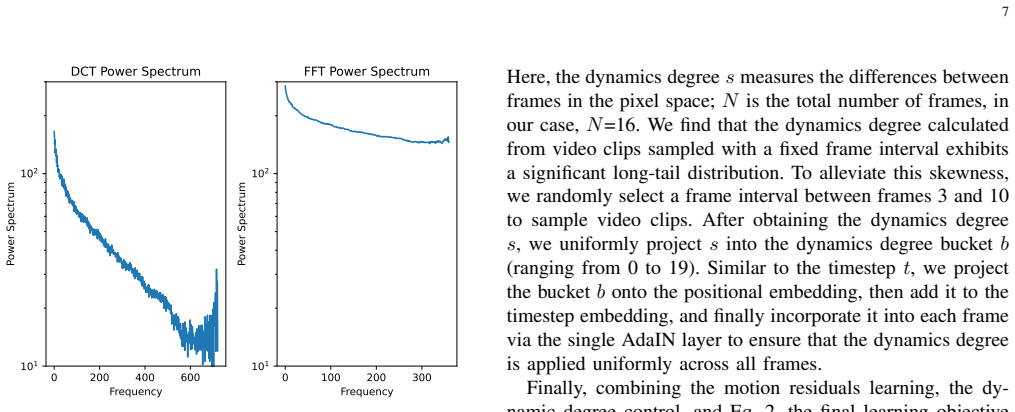
The core mechanism is a RoPE-compatible cosine linear attention (Eq. 8–9), where the similarity between query $q_i$ and key $k_j$ is $1 + (q_i/\|q_i\|)(k_j/\|k_j\|)^T$, allowing shared sums over keys/values to be computed once per sequence and reducing attention cost from $O(N^2)$ to $O(N)$. This attention is inserted as a temporal-attention layer in each SANA transformer block to capture frame-to-frame relationships. Two supporting mechanisms carry the consistency claim: motion residual learning, which subtracts the first frame's latent from all subsequent latents so the model predicts only inter-frame differences, and DCTInit, which replaces the low-frequency part of the inference noise wi
What would settle it
Replace MiraMo's temporal linear attention with vanilla quadratic attention under identical training and inference; if the full-attention variant scores strictly better on temporal consistency and motion smoothness at comparable compute on the VBench I2V suite, the paper's core efficiency-quality tradeoff claim is refuted.
Extended reading notes
Core claim
The central claim is that image animation does not need to trade quality for speed. By adapting the SANA linear-attention text-to-image architecture into a text-to-video model with a new temporal linear attention (Eqs. 8–9) that stays compatible with RoPE, then fine-tuning it to predict latent motion residuals (differences from the first frame) rather than full frames, and finally refining the inference-time noise with low-frequency DCT components of the input image, MiraMo produces videos that hold the input image's appearance across frames, move smoothly, and follow the prompt, all at O(N) attention cost with a 0.74B-parameter model. In the reported comparisons it achieves the best or near
Load-bearing premise
The whole efficiency-without-quality-loss claim rests on the premise that the cosine-kernel temporal linear attention captures video temporal relationships as well as full quadratic attention, a comparison the paper asserts but does not quantitatively demonstrate.
Editorial extensions
If this is right
- Image animation can be built on linear-attention transformers, closing the architectural gap with text-to-video models at a fraction of the compute.
- Motion residual learning becomes a viable alternative to direct frame prediction for appearance preservation in I2V generation.
- DCT-based noise initialization can replace FFT-based FreeInit-style injection to avoid color drift and abrupt motion artifacts.
- Synthetic video data can substitute for carefully curated real data in post-training, lowering the cost of high-quality fine-tuning.
- The residual representation supports motion transfer and video editing via flow inversion, as the paper's applications demonstrate.
Reading between the lines
- Editorial inference: The same cosine-kernel attention could be dropped into the spatial attention of existing video diffusion transformers, since RoPE compatibility already exists there, potentially cutting memory for high-resolution and long-video generation.
- Editorial inference: The paper's residual representation suggests a general recipe for training-free motion transfer: invert motion residuals from any source video and apply them to a modified first frame, a protocol that could extend to other animators beyond MiraMo.
- Editorial inference: DCTInit's rationale predicts that other energy-compacting transforms, such as wavelets, would show similar or better suppression of abrupt motion; a simple ablation could test whether DCT is optimal or merely sufficient.
- Editorial inference: If synthetic post-training data routinely beats small curated real data, it suggests that SFT gains depend more on distribution coverage and prompt diversity than on pixel-level realism, a hypothesis the paper does not directly test.
Editorial analysis
A structured set of objections, weighed in public.
Referee Report
Summary. MiraMo is an image-to-video (I2V) framework built by extending the SANA linear-attention text-to-image model into a text-to-video model with a new cosine-kernel temporal linear attention compatible with RoPE, then adapting it to I2V via motion-residual learning (predicting z_i - z_1), DCT-based low-frequency noise initialization during inference, and a dynamics-degree control based on MS-SSIM buckets. The T2V backbone is trained on roughly 2M Vimeo25M videos and post-trained on about 150k synthetic videos; I2V is evaluated on UCF-101/MSR-VTT and VBench against U-Net and DiT baselines, with throughput/memory comparisons against vanilla attention. The paper claims high appearance consistency, smooth controllable motion, and O(N) attention complexity with no quality loss.
Significance. If substantiated, this would be a useful demonstration that linear attention can support video diffusion, with orthogonal contributions (motion-residual learning and DCTInit) that could transfer to other backbones. The paper's strengths include a focused ablation in Table V supporting MRL over direct frame prediction and DCTInit over FFT initialization, a quantitative dynamics-control analysis in Fig. 10, and a user study component. However, the load-bearing claim of linear-attention parity with vanilla attention is not directly tested, and some reported results conflict with the text (Table VI). The authors also state a self-admitted limitation (image-level VAE may cause flickering) that tempers the consistency claim.
major comments (5)
- [Sec. III-B, Fig. 3; Table II] The claim that linear attention 'preserves generation quality' is not established by a controlled experiment. Fig. 3 shows throughput/memory and a '+4.76% VBench' number but does not specify the vanilla-attention baseline's architecture, training data, or compute, so it cannot isolate the attention mechanism. Table I compares external T2V models with different data and budgets. Moreover, the statement that frame-dimension temporal attention 'outperforms' the full 3D variant is given without quantitative comparison. Without a same-cost linear-vs-vanilla ablation, the central O(N)-without-quality-loss conclusion is unsupported. Table II further shows Ours FVD 201.90 vs Cinemo 168.16 on UCF-101, so external comparisons do not supply the missing parity evidence.
- [Sec. IV-C, Table VI] The synthetic-data claim is contradicted by the table. The text states that the model fine-tuned on synthetic data achieves 'over a 3% improvement' over real data, but Table VI reports Sync data values (45.50, 88.40, 88.40, 35.50) that are all lower than Real data (52.91, 92.00, 90.55, 37.18). If the table rows are swapped or the metrics mislabeled, this must be corrected; as written, Sec. III-F and Sec. IV-C's central claim about post-training data selection has no support.
- [Sec. I, Sec. IV-B, Tables II-III] The abstract/introduction claim of 'best appearance consistency and motion smoothness' is stronger than the evidence. In Table II, MiraMo's FVD is worse than Cinemo on UCF-101 (201.90 vs 168.16) and marginally worse on MSR-VTT (93.91 vs 93.51); in Table III, Cinemo has higher Motion Smoothness (98.21 vs 96.93) and Camera Motion (30.68 vs 21.57). The user study (Table IV) only includes SVD and SEINE, not Cinemo or PIA. The defensible claim is 'comparable FVD/CLIPSIM with better aesthetic quality and dynamic degree at lower compute.' The text should be revised to that claim, or additional experiments provided.
- [Sec. III-B, Eq. (9)] Eq. (9) as written does not have a non-negative denominator: D_i = n + (q_i/||q_i||) Σ_j (k_j/||k_j||)^T can approach zero because the sum of unit vectors has no lower bound. The paper's justification for rejecting Eq. (7) is that RoPE may make inner products negative, but the same concern applies to the denominator of Eq. (9). No empirical stability analysis is given. Since this attention is load-bearing for the efficiency claim, the authors should either provide a proof or regularizer ensuring D_i is bounded away from zero, or report numerical safeguards and a stability ablation.
- [Sec. III-C, Algorithm 1] The motion-residual training formulation is underspecified. The notation z1 is used both for the first-frame latent and for the Gaussian endpoint in the flow-matching interpolation z_t = t z1 + (1-t) z0 (Sec. III-A). In Algorithm 1, M = {z_i - z_1} is computed, then 'noised Mt via the diffusion process' and input X_t = cat([z_1, M_t + z_1]) are defined, but the flow-matching latent variables z_0 and z_1 for the residual distribution are never defined, nor is the velocity target v_t in Eq. (14) expressed in terms of M. This makes the training objective ambiguous and prevents reproducibility. Please define the noising schedule and target for residuals explicitly and reconcile the notation.
minor comments (5)
- [Eq. (3)] The text says 'σ is the sigmoid function', but the scaled dot-product attention in Eq. (3) uses softmax, not sigmoid. This typo is confusing in a central equation.
- [Sec. III-B] Typo: 'Finlay' should be 'Finally'. Also the phrase 'increase both training and inference efficiency' should likely be 'increase computational cost'.
- [Sec. IV-A] The implementation details state 'MiraMo is identical to SANA [9]' but the SANA reference is [38], not [9]. Please correct the citation.
- [Sec. IV-A] The inference-speed claim would be stronger with wall-clock generation times per video, not only throughput/memory plots. The current ablation reports no end-to-end latency for the I2V pipeline.
- [Sec. IV-C] Table V reports 'Average' and 'Average Consistency' without defining their composition beyond a parenthetical in the text. Please specify exactly which VBench dimensions are averaged and the number of prompts/videos used.
Circularity Check
No significant circularity: MiraMo's components are validated by fresh ablations and external benchmarks; self-citations are contextual, not load-bearing.
full rationale
I walked the claimed derivation chain and found no step where a prediction or first-principles result is equivalent to its inputs by construction. The linear attention mechanism (Eq. 8-9) is an architectural choice with an analytical O(N) complexity claim, and its quality parity is tested empirically in Fig. 3 against a vanilla attention Transformer (throughput, memory, VBench), not merely asserted as a consequence of its definition. Motion residual learning (Sec. III-C) is a supervised learning objective on frame differences, validated by ablations in Table V (DPF vs MRL) and Fig. 11; the target residuals are computed from training videos and are not fitted to the test outputs. DCTInit (Sec. III-D) is an inference-time noise initialization method compared against FFT and no-refinement baselines, again empirically. Dynamics degree control (Sec. III-E) uses an MS-SSIM-based bucket conditioned via AdaIN and is validated by Fig. 9 and the control experiments in Sec. IV-C. The paper does cite the authors' own prior work [37] as the basis for the extension, but the new experiments (Tables II-V, user study, ablations) are fresh evaluation runs on external benchmarks, so the self-citation is not load-bearing. The main identifiable weaknesses—e.g., the lack of a fully described controlled swap for the linear-vs-vanilla attention comparison and the asserted superiority of frame-only temporal attention over 3D temporal attention—are absent experimental details, not circular reasoning. No equation reduces to its own input, and no fitted parameter is renamed as a prediction. Hence the circularity score is 0.
Assumptions & free parameters
free parameters (5)
- dynamics degree bucket count =
20 buckets
- training clip frame interval =
3 to 10 frames
- DCT low-pass filter H =
not specified
- inference solver steps and CFG scale =
25 steps, guidance 5.5
- synthetic post-training dataset size =
150,000 videos
assumptions (5)
- standard math Flow-matching objective (Eq. 2) with logit-normal timestep schedule (Stable Diffusion 3)
- domain assumption SANA's ReLU linear attention and Mix-FFN blocks, with pretrained weights, transfer to video with only added temporal layers
- domain assumption A frame-wise image-level VAE is an adequate video latent encoder
- standard math RoPE preserves cosine similarity because it does not change vector magnitudes, making Eq. 8 RoPE-compatible
- ad hoc to paper Flow-matching training with logit-normal timesteps creates a train/inference noise discrepancy fixable by injecting input-image low-frequency DCT content
Cite this review
Pith. "Pith review of Consistent and Controllable Image Animation with Motion Linear Diffusion Transformers." pith.science (2026). https://pith.science/paper/QDGZXO7X
@misc{pith2026250807246,
  author       = {Pith},
  title        = {Pith review of: Consistent and Controllable Image Animation with Motion Linear Diffusion Transformers},
  year         = {2026},
  howpublished = {\url{https://pith.science/paper/QDGZXO7X}},
  note         = {Machine review of arXiv:2508.07246}
}
read the original abstract
Image animation has seen significant progress, driven by the powerful generative capabilities of diffusion models. However, maintaining appearance consistency with static input images and mitigating abrupt motion transitions in generated animations remain persistent challenges. While text-to-video (T2V) generation has demonstrated impressive performance with diffusion transformer models, the image animation field still largely relies on U-Net-based diffusion models, which lag behind the latest T2V approaches. Moreover, the quadratic complexity of vanilla self-attention mechanisms in Transformers imposes heavy computational demands, making image animation particularly resource-intensive. To address these issues, we propose MiraMo, a framework designed to enhance efficiency, appearance consistency, and motion smoothness in image animation. Specifically, MiraMo introduces three key elements: (1) A foundational text-to-video architecture replacing vanilla self-attention with efficient linear attention to reduce computational overhead while preserving generation quality; (2) A novel motion residual learning paradigm that focuses on modeling motion dynamics rather than directly predicting frames, improving temporal consistency; and (3) A DCT-based noise refinement strategy during inference to suppress sudden motion artifacts, complemented by a dynamics control module to balance motion smoothness and expressiveness. Extensive experiments against state-of-the-art methods validate the superiority of MiraMo in generating consistent, smooth, and controllable animations with accelerated inference speed. Additionally, we demonstrate the versatility of MiraMo through applications in motion transfer and video editing tasks.
Figures


Figures from the paper (10 more)




Reference graph
Works this paper leans on
-
[1]
Pia: Your personalized image animator via plug-and-play modules in text-to- image models,
Y . Zhang, Z. Xing, Y . Zeng, Y . Fang, and K. Chen, “Pia: Your personalized image animator via plug-and-play modules in text-to- image models,” in Computer Vision and Pattern Recognition , 2024
2024
-
[2]
Seine: Short-to-long video diffusion model for generative transition and prediction,
X. Chen, Y . Wang, L. Zhang, S. Zhuang, X. Ma, J. Yu, Y . Wang, D. Lin, Y . Qiao, and Z. Liu, “Seine: Short-to-long video diffusion model for generative transition and prediction,” in International Conference on Learning Representations, 2023
2023
-
[3]
High- resolution image synthesis with latent diffusion models,
R. Rombach, A. Blattmann, D. Lorenz, P. Esser, and B. Ommer, “High- resolution image synthesis with latent diffusion models,” in Computer Vision and Pattern Recognition , 2022, pp. 10 684–10 695
2022
-
[4]
Pixart- α: Fast training of diffusion transformer for photorealistic text-to-image synthesis,
J. Chen, J. Yu, C. Ge, L. Yao, E. Xie, Y . Wu, Z. Wang, J. Kwok, P. Luo, H. Lu et al., “Pixart- α: Fast training of diffusion transformer for photorealistic text-to-image synthesis,” in International Conference on Learning Representations , 2024
2024
-
[5]
Sdxl: Improving latent diffusion models for high-resolution image synthesis,
D. Podell, Z. English, K. Lacey, A. Blattmann, T. Dockhorn, J. M ¨uller, J. Penna, and R. Rombach, “Sdxl: Improving latent diffusion models for high-resolution image synthesis,” in International Conference on Learning Representations, 2024
2024
-
[6]
Magic3d: High-resolution text- to-3d content creation,
C.-H. Lin, J. Gao, L. Tang, T. Takikawa, X. Zeng, X. Huang, K. Kreis, S. Fidler, M.-Y . Liu, and T.-Y . Lin, “Magic3d: High-resolution text- to-3d content creation,” in Computer Vision and Pattern Recognition , 2023, pp. 300–309
2023
-
[7]
Dreamfusion: Text- to-3d using 2d diffusion,
B. Poole, A. Jain, J. T. Barron, and B. Mildenhall, “Dreamfusion: Text- to-3d using 2d diffusion,” in International Conference on Learning Representations, 2023
2023
-
[8]
Instant3d: Fast text-to-3d with sparse- view generation and large reconstruction model,
J. Li, H. Tan, K. Zhang, Z. Xu, F. Luan, Y . Xu, Y . Hong, K. Sunkavalli, G. Shakhnarovich, and S. Bi, “Instant3d: Fast text-to-3d with sparse- view generation and large reconstruction model,” in International Conference on Learning Representations , 2024
2024
Show all 126 references
-
[9]
Lavie: High-quality video generation with cascaded latent diffusion models,
Y . Wang, X. Chen, X. Ma, S. Zhou, Z. Huang, Y . Wang, C. Yang, Y . He, J. Yu, P. Yanget al., “Lavie: High-quality video generation with cascaded latent diffusion models,” International Journal of Computer Vision, pp. 1–20, 2024
2024
-
[10]
Latte: Latent diffusion transformer for video generation,
X. Ma, Y . Wang, X. Chen, G. Jia, Z. Liu, Y .-F. Li, C. Chen, and Y . Qiao, “Latte: Latent diffusion transformer for video generation,” Transactions on Machine Learning Research , 2025
2025
-
[11]
Align your latents: High-resolution video synthesis with latent diffusion models,
A. Blattmann, R. Rombach, H. Ling, T. Dockhorn, S. W. Kim, S. Fidler, and K. Kreis, “Align your latents: High-resolution video synthesis with latent diffusion models,” in Computer Vision and Pattern Recognition , 2023, pp. 22 563–22 575
2023
-
[12]
Videofusion: Decomposed diffusion models for high-quality video generation,
Z. Luo, D. Chen, Y . Zhang, Y . Huang, L. Wang, Y . Shen, D. Zhao, J. Zhou, and T. Tan, “Videofusion: Decomposed diffusion models for high-quality video generation,” in Computer Vision and Pattern Recognition, 2023, pp. 10 209–10 218
2023
-
[13]
Make-a-video: Text-to-video generation without text-video data,
U. Singer, A. Polyak, T. Hayes, X. Yin, J. An, S. Zhang, Q. Hu, H. Yang, O. Ashual, O. Gafni et al. , “Make-a-video: Text-to-video generation without text-video data,” in International Conference on Learning Representations, 2023
2023
-
[14]
Animatediff: Animate your personalized text-to-image diffusion mod- els without specific tuning,
Y . Guo, C. Yang, A. Rao, Y . Wang, Y . Qiao, D. Lin, and B. Dai, “Animatediff: Animate your personalized text-to-image diffusion mod- els without specific tuning,” in International Conference on Learning Representations, 2024
2024
-
[15]
Animateanything: Fine-grained open domain image animation with motion guidance,
Z. Dai, Z. Zhang, Y . Yao, B. Qiu, S. Zhu, L. Qin, and W. Wang, “Animateanything: Fine-grained open domain image animation with motion guidance,” arXiv e-prints, pp. arXiv–2311, 2023
2023
-
[16]
Dynamicrafter: Animating open-domain images with video diffusion priors,
J. Xing, M. Xia, Y . Zhang, H. Chen, W. Yu, H. Liu, G. Liu, X. Wang, Y . Shan, and T.-T. Wong, “Dynamicrafter: Animating open-domain images with video diffusion priors,” in European Conference on Computer Vision. Springer, 2024, pp. 399–417
2024
-
[17]
I2vgen-xl: High-quality image-to-video synthe- sis via cascaded diffusion models,
S. Zhang, J. Wang, Y . Zhang, K. Zhao, H. Yuan, Z. Qin, X. Wang, D. Zhao, and J. Zhou, “I2vgen-xl: High-quality image-to-video synthe- sis via cascaded diffusion models,” arXiv preprint arXiv:2311.04145 , 2023
2023 arXiv
-
[18]
Consisti2v: Enhancing visual consistency for image-to-video genera- tion,
W. Ren, H. Yang, G. Zhang, C. Wei, X. Du, S. Huang, and W. Chen, “Consisti2v: Enhancing visual consistency for image-to-video genera- tion,” Transactions on Machine Learning Research , 2024
2024
-
[19]
Motionstone: Decoupled motion intensity modulation with diffusion transformer for image-to-video generation,
S. Shi, B. Gong, X. Chen, D. Zheng, S. Tan, Z. Yang, Y . Li, J. He, K. Zheng, J. Chen et al. , “Motionstone: Decoupled motion intensity modulation with diffusion transformer for image-to-video generation,” in Computer Vision and Pattern Recognition Conference , 2025, pp. 22 864–22 874
2025
-
[20]
Through-the-mask: Mask-based motion trajectories for image-to-video generation,
G. Yariv, Y . Kirstain, A. Zohar, S. Sheynin, Y . Taigman, Y . Adi, S. Benaim, and A. Polyak, “Through-the-mask: Mask-based motion trajectories for image-to-video generation,” in Computer Vision and Pattern Recognition Conference, June 2025, pp. 18 198–18 208. 13
2025
-
[21]
Extrapolating and decoupling image-to-video generation models: Motion modeling is easier than you think,
J. Tian, X. Qu, Z. Lu, W. Wei, S. Liu, and Y . Cheng, “Extrapolating and decoupling image-to-video generation models: Motion modeling is easier than you think,” in Computer Vision and Pattern Recognition Conference, 2025, pp. 12 512–12 521
2025
-
[22]
I2vguard: Safeguarding images against misuse in diffusion-based image-to-video models,
D. Gui, X. Guo, W. Zhou, and Y . Lu, “I2vguard: Safeguarding images against misuse in diffusion-based image-to-video models,” in Computer Vision and Pattern Recognition Conference , 2025, pp. 12 595–12 604
2025
-
[23]
Mo- tionpro: A precise motion controller for image-to-video generation,
Z. Zhang, F. Long, Z. Qiu, Y . Pan, W. Liu, T. Yao, and T. Mei, “Mo- tionpro: A precise motion controller for image-to-video generation,” in Computer Vision and Pattern Recognition Conference , 2025, pp. 27 957–27 967
2025
-
[24]
Levitor: 3d trajectory oriented image-to-video synthesis,
H. Wang, H. Ouyang, Q. Wang, W. Wang, K. L. Cheng, Q. Chen, Y . Shen, and L. Wang, “Levitor: 3d trajectory oriented image-to-video synthesis,” in Computer Vision and Pattern Recognition Conference , 2025, pp. 12 490–12 500
2025
-
[25]
Osv: One step is enough for high-quality image to video generation,
X. Mao, Z. Jiang, F.-Y . Wang, J. Zhang, H. Chen, M. Chi, Y . Wang, and W. Luo, “Osv: One step is enough for high-quality image to video generation,” in Computer Vision and Pattern Recognition Conference , 2025, pp. 12 585–12 594
2025
-
[26]
Motif: Making text count in image animation with motion focal loss,
S. Wang, S. Azadi, R. Girdhar, S. Rambhatla, C. Sun, and X. Yin, “Motif: Making text count in image animation with motion focal loss,” in Computer Vision and Pattern Recognition Conference , 2025, pp. 7773–7783
2025
-
[27]
Hunyuanvideo: A systematic framework for large video generative models,
W. Kong, Q. Tian, Z. Zhang, R. Min, Z. Dai, J. Zhou, J. Xiong, X. Li, B. Wu, J. Zhang et al., “Hunyuanvideo: A systematic framework for large video generative models,” arXiv preprint arXiv:2412.03603 , 2024
2024 arXiv
-
[28]
Wan: Open and advanced large-scale video generative models,
T. Wan, A. Wang, B. Ai, B. Wen, C. Mao, C.-W. Xie, D. Chen, F. Yu, H. Zhao, J. Yang et al. , “Wan: Open and advanced large-scale video generative models,” arXiv preprint arXiv:2503.20314 , 2025
2025 arXiv
-
[29]
Cogvideox: Text-to-video diffu- sion models with an expert transformer,
Z. Yang, J. Teng, W. Zheng, M. Ding, S. Huang, J. Xu, Y . Yang, W. Hong, X. Zhang, G. Feng et al., “Cogvideox: Text-to-video diffu- sion models with an expert transformer,” in International Conference on Learning Representations , 2025
2025
-
[30]
Open-sora plan: Open-source large video generation model,
B. Lin, Y . Ge, X. Cheng, Z. Li, B. Zhu, S. Wang, X. He, Y . Ye, S. Yuan, L. Chen et al. , “Open-sora plan: Open-source large video generation model,” arXiv preprint arXiv:2412.00131 , 2024
2024 arXiv
-
[31]
Open-sora: Democratizing efficient video production for all,
Z. Zheng, X. Peng, T. Yang, C. Shen, S. Li, H. Liu, Y . Zhou, T. Li, and Y . You, “Open-sora: Democratizing efficient video production for all,” arXiv preprint arXiv:2412.20404 , 2024
2024 arXiv
-
[32]
Ltx-video: Realtime video latent diffusion,
Y . HaCohen, N. Chiprut, B. Brazowski, D. Shalem, D. Moshe, E. Richardson, E. Levin, G. Shiran, N. Zabari, O. Gordon et al. , “Ltx-video: Realtime video latent diffusion,” arXiv preprint arXiv:2501.00103, 2024
2024 arXiv
-
[33]
Roformer: En- hanced transformer with rotary position embedding,
J. Su, M. Ahmed, Y . Lu, S. Pan, W. Bo, and Y . Liu, “Roformer: En- hanced transformer with rotary position embedding,” Neurocomputing, vol. 568, p. 127063, 2024
2024
-
[34]
Freeu: Free lunch in diffusion u-net,
C. Si, Z. Huang, Y . Jiang, and Z. Liu, “Freeu: Free lunch in diffusion u-net,” in Computer Vision and Pattern Recognition , 2024
2024
-
[35]
Freeinit: Bridging initialization gap in video diffusion models,
T. Wu, C. Si, Y . Jiang, Z. Huang, and Z. Liu, “Freeinit: Bridging initialization gap in video diffusion models,” in European Conference on Computer Vision . Springer, 2024, pp. 378–394
2024
-
[36]
Input perturbation reduces exposure bias in diffusion models,
M. Ning, E. Sangineto, A. Porrello, S. Calderara, and R. Cucchiara, “Input perturbation reduces exposure bias in diffusion models,” in International Conference on Machine Learning , 2023
2023
-
[37]
Consistent and controllable image animation with motion diffusion models,
X. Ma, Y . Wang, G. Jia, X. Chen, T.-T. Wong, Y .-F. Li, and C. Chen, “Consistent and controllable image animation with motion diffusion models,” in Computer Vision and Pattern Recognition Conference , 2025, pp. 7288–7298
2025
-
[38]
Sana: Efficient high-resolution image synthesis with linear diffusion transformers,
E. Xie, J. Chen, J. Chen, H. Cai, H. Tang, Y . Lin, Z. Zhang, M. Li, L. Zhu, Y . Lu et al., “Sana: Efficient high-resolution image synthesis with linear diffusion transformers,” in International Conference on Learning Representations, 2025
2025
-
[39]
Denoising diffusion probabilistic models,
J. Ho, A. Jain, and P. Abbeel, “Denoising diffusion probabilistic models,” in Neural Information Processing Systems, vol. 33, 2020, pp. 6840–6851
2020
-
[40]
Denoising diffusion implicit mod- els,
J. Song, C. Meng, and S. Ermon, “Denoising diffusion implicit mod- els,” in International Conference on Learning Representations , 2021
2021
-
[41]
Score-based generative modeling through stochastic differential equations,
Y . Song, J. Sohl-Dickstein, D. P. Kingma, A. Kumar, S. Ermon, and B. Poole, “Score-based generative modeling through stochastic differential equations,” in International Conference on Learning Rep- resentations, 2021
2021
-
[42]
Scaling rectified flow transformers for high-resolution image synthesis,
P. Esser, S. Kulal, A. Blattmann, R. Entezari, J. M ¨uller, H. Saini, Y . Levi, D. Lorenz, A. Sauer, F. Boesel et al. , “Scaling rectified flow transformers for high-resolution image synthesis,” in International Conference on Machine Learning , 2024
2024
-
[43]
Flow matching for generative modeling,
Y . Lipman, R. T. Chen, H. Ben-Hamu, M. Nickel, and M. Le, “Flow matching for generative modeling,” in International Conference on Learning Representations, 2023
2023
-
[44]
Zero-shot text-to-image generation,
A. Ramesh, M. Pavlov, G. Goh, S. Gray, C. V oss, A. Radford, M. Chen, and I. Sutskever, “Zero-shot text-to-image generation,” in International Conference on Machine Learning . Pmlr, 2021, pp. 8821–8831
2021
-
[45]
Photorealistic text-to-image diffusion models with deep language understanding,
C. Saharia, W. Chan, S. Saxena, L. Li, J. Whang, E. L. Denton, K. Ghasemipour, R. Gontijo Lopes, B. Karagol Ayan, T. Salimanset al., “Photorealistic text-to-image diffusion models with deep language understanding,” Neural Information Processing Systems , vol. 35, pp. 36 479–36...
2022
-
[46]
Scaling autoregressive models for content-rich text-to-image generation,
J. Yu, Y . Xu, J. Y . Koh, T. Luong, G. Baid, Z. Wang, V . Vasudevan, A. Ku, Y . Yang, B. K. Ayan et al. , “Scaling autoregressive models for content-rich text-to-image generation,” Transactions on Machine Learning Research, vol. 2, no. 3, p. 5, 2022
2022
-
[47]
Hierarchi- cal text-conditional image generation with clip latents,
A. Ramesh, P. Dhariwal, A. Nichol, C. Chu, and M. Chen, “Hierarchi- cal text-conditional image generation with clip latents,” arXiv preprint arXiv:2204.06125, vol. 1, no. 2, p. 3, 2022
2022 arXiv
-
[48]
Visual autoregres- sive modeling: Scalable image generation via next-scale prediction,
K. Tian, Y . Jiang, Z. Yuan, B. Peng, and L. Wang, “Visual autoregres- sive modeling: Scalable image generation via next-scale prediction,” Neural Information Processing Systems , vol. 37, pp. 84 839–84 865, 2024
2024
-
[49]
Infinity: Scaling bitwise autoregressive modeling for high-resolution image synthesis,
J. Han, J. Liu, Y . Jiang, B. Yan, Y . Zhang, Z. Yuan, B. Peng, and X. Liu, “Infinity: Scaling bitwise autoregressive modeling for high-resolution image synthesis,” in Computer Vision and Pattern Recognition Confer- ence, 2025, pp. 15 733–15 744
2025
-
[50]
Training-free stylized text-to-image generation with fast inference,
X. Ma, Y . Wang, X. Chen, T.-T. Wong, and C. Chen, “Training-free stylized text-to-image generation with fast inference,” arXiv preprint arXiv:2505.19063, 2025
2025 arXiv
-
[51]
Tune-a-video: One-shot tuning of image diffusion models for text-to-video generation,
J. Z. Wu, Y . Ge, X. Wang, S. W. Lei, Y . Gu, Y . Shi, W. Hsu, Y . Shan, X. Qie, and M. Z. Shou, “Tune-a-video: One-shot tuning of image diffusion models for text-to-video generation,” in International Conference on Computer Vision , 2023, pp. 7623–7633
2023
-
[52]
Preserve your own correlation: A noise prior for video diffusion models,
S. Ge, S. Nah, G. Liu, T. Poon, A. Tao, B. Catanzaro, D. Jacobs, J.-B. Huang, M.-Y . Liu, and Y . Balaji, “Preserve your own correlation: A noise prior for video diffusion models,” in International Conference on Computer Vision, 2023, pp. 22 930–22 941
2023
-
[53]
Magicvideo: Efficient video generation with latent diffusion models,
D. Zhou, W. Wang, H. Yan, W. Lv, Y . Zhu, and J. Feng, “Magicvideo: Efficient video generation with latent diffusion models,” arXiv preprint arXiv:2211.11018, 2022
2022 arXiv
-
[54]
Latent video dif- fusion models for high-fidelity long video generation,
Y . He, T. Yang, Y . Zhang, Y . Shan, and Q. Chen, “Latent video dif- fusion models for high-fidelity long video generation,” arXiv preprint arXiv:2211.13221, 2022
2022 arXiv
-
[55]
Phenaki: Variable length video generation from open domain textual descriptions,
R. Villegas, M. Babaeizadeh, P.-J. Kindermans, H. Moraldo, H. Zhang, M. T. Saffar, S. Castro, J. Kunze, and D. Erhan, “Phenaki: Variable length video generation from open domain textual descriptions,” in International Conference on Learning Representations , 2022
2022
-
[56]
Movie gen: A cast of media foun- dation models, 2025,
A. Polyak, A. Zohar, A. Brown, A. Tjandra, A. Sinha, A. Lee, A. Vyas, B. Shi, C. Ma, C. Chuang et al., “Movie gen: A cast of media foun- dation models, 2025,” URL https://arxiv. org/abs/2410.13720 , p. 51, 2024
2025 arXiv
-
[57]
Autoregressive video generation without vector quantiza- tion,
H. Deng, T. Pan, H. Diao, Z. Luo, Y . Cui, H. Lu, S. Shan, Y . Qi, and X. Wang, “Autoregressive video generation without vector quantiza- tion,” in International Conference on Learning Representations , 2025
2025
-
[58]
Pyramidal flow matching for efficient video generative modeling,
Y . Jin, Z. Sun, N. Li, K. Xu, H. Jiang, N. Zhuang, Q. Huang, Y . Song, Y . Mu, and Z. Lin, “Pyramidal flow matching for efficient video generative modeling,” in International Conference on Learning Representations, 2025
2025
-
[59]
Spatial- temporal graph mamba for music-guided dance video synthesis,
H. Tang, L. Shao, Z. Zhang, L. Van Gool, and N. Sebe, “Spatial- temporal graph mamba for music-guided dance video synthesis,” IEEE Transactions on Pattern Analysis and Machine Intelligence , 2025
2025
-
[60]
Magictime: Time-lapse video generation models as metamorphic simulators,
S. Yuan, J. Huang, Y . Shi, Y . Xu, R. Zhu, B. Lin, X. Cheng, L. Yuan, and J. Luo, “Magictime: Time-lapse video generation models as metamorphic simulators,” IEEE Transactions on Pattern Analysis and Machine Intelligence , 2025
2025
-
[61]
Cascaded dynamic memory refinement and semantic alignment for exo-to-ego cross-view video generation,
W. Hu, J. T. Hoe, J. Li, H. Hu, X. Jiang, and Y .-P. Tan, “Cascaded dynamic memory refinement and semantic alignment for exo-to-ego cross-view video generation,” IEEE Transactions on Pattern Analysis and Machine Intelligence , 2025
2025
-
[62]
Efficient diffusion models: A comprehensive survey from principles to practices,
Z. Ma, Y . Zhang, G. Jia, L. Zhao, Y . Ma, M. Ma, G. Liu, K. Zhang, N. Ding, J. Li et al. , “Efficient diffusion models: A comprehensive survey from principles to practices,” IEEE Transactions on Pattern Analysis and Machine Intelligence , 2025
2025
-
[63]
Video diffusion models,
J. Ho, T. Salimans, A. Gritsenko, W. Chan, M. Norouzi, and D. J. Fleet, “Video diffusion models,” Neural Information Processing Systems , vol. 35, pp. 8633–8646, 2022. 14
2022
-
[64]
Imagen video: High definition video generation with diffusion models,
J. Ho, W. Chan, C. Saharia, J. Whang, R. Gao, A. Gritsenko, D. P. Kingma, B. Poole, M. Norouzi, D. J. Fleet et al. , “Imagen video: High definition video generation with diffusion models,” arXiv preprint arXiv:2210.02303, 2022
2022 arXiv
-
[65]
Cascaded diffusion models for high fidelity image generation,
J. Ho, C. Saharia, W. Chan, D. J. Fleet, M. Norouzi, and T. Salimans, “Cascaded diffusion models for high fidelity image generation,” Jour- nal of Machine Learning Research , vol. 23, no. 47, pp. 1–33, 2022
2022
-
[66]
Stable video diffusion: Scaling latent video diffusion models to large datasets,
A. Blattmann, T. Dockhorn, S. Kulal, D. Mendelevitch, M. Kilian, D. Lorenz, Y . Levi, Z. English, V . V oleti, A. Lettset al., “Stable video diffusion: Scaling latent video diffusion models to large datasets,”arXiv preprint arXiv:2311.15127, 2023
2023 arXiv
-
[67]
Automatic animation of hair blowing in still portrait photos,
W. Xiao, W. Liu, Y . Wang, B. Ghanem, and B. Li, “Automatic animation of hair blowing in still portrait photos,” in International Conference on Computer Vision , 2023, pp. 22 963–22 975
2023
-
[68]
Warp-guided gans for single-photo facial animation,
J. Geng, T. Shao, Y . Zheng, Y . Weng, and K. Zhou, “Warp-guided gans for single-photo facial animation,” ACM Transactions on Graphics , vol. 37, no. 6, pp. 1–12, 2018
2018
-
[69]
Imaginator: Conditional spatio-temporal gan for video generation,
Y . Wang, P. Bilinski, F. Bremond, and A. Dantcheva, “Imaginator: Conditional spatio-temporal gan for video generation,” in Winter Con- ference on Applications of Computer Vision , 2020, pp. 1160–1169
2020
-
[70]
Latent image animator: Learning to animate images via latent space navigation,
Y . Wang, D. Yang, F. Bremond, and A. Dantcheva, “Latent image animator: Learning to animate images via latent space navigation,” in International Conference on Learning Representations , 2022
2022
-
[71]
Hallo3: Highly dynamic and realistic portrait image animation with video diffusion transformer,
J. Cui, H. Li, Y . Zhan, H. Shang, K. Cheng, Y . Ma, S. Mu, H. Zhou, J. Wang, and S. Zhu, “Hallo3: Highly dynamic and realistic portrait image animation with video diffusion transformer,” in Computer Vision and Pattern Recognition Conference , 2025, pp. 21 086–21 095
2025
-
[72]
Zero-1-to-a: Zero-shot one image to animatable head avatars using video diffusion,
Z. Zhou, F. Ma, H. Fan, and T.-S. Chua, “Zero-1-to-a: Zero-shot one image to animatable head avatars using video diffusion,” in Computer Vision and Pattern Recognition Conference , 2025, pp. 15 941–15 952
2025
-
[73]
Blowing in the wind: Cyclenet for human cinemagraphs from still images,
H. Bertiche, N. J. Mitra, K. Kulkarni, C.-H. P. Huang, T. Y . Wang, M. Madadi, S. Escalera, and D. Ceylan, “Blowing in the wind: Cyclenet for human cinemagraphs from still images,” in Computer Vision and Pattern Recognition, 2023, pp. 459–468
2023
-
[74]
Under- standing object dynamics for interactive image-to-video synthesis,
A. Blattmann, T. Milbich, M. Dorkenwald, and B. Ommer, “Under- standing object dynamics for interactive image-to-video synthesis,” in Computer Vision and Pattern Recognition , 2021, pp. 5171–5181
2021
-
[75]
Motion representations for articulated animation,
A. Siarohin, O. J. Woodford, J. Ren, M. Chai, and S. Tulyakov, “Motion representations for articulated animation,” in Computer Vision and Pattern Recognition, 2021, pp. 13 653–13 662
2021
-
[76]
Leo: Generative latent image animator for human video synthesis,
Y . Wang, X. Ma, X. Chen, C. Chen, A. Dantcheva, B. Dai, and Y . Qiao, “Leo: Generative latent image animator for human video synthesis,” International Journal of Computer Vision , pp. 1–13, 2024
2024
-
[77]
Lia: Latent image animator,
Y . Wang, D. Yang, F. Bremond, and A. Dantcheva, “Lia: Latent image animator,” IEEE Transactions on Pattern Analysis and Machine Intelligence, 2024
2024
-
[78]
Stableanimator: High-quality identity-preserving human image anima- tion,
S. Tu, Z. Xing, X. Han, Z.-Q. Cheng, Q. Dai, C. Luo, and Z. Wu, “Stableanimator: High-quality identity-preserving human image anima- tion,” in Computer Vision and Pattern Recognition Conference , 2025, pp. 21 096–21 106
2025
-
[79]
X-dyna: Expressive dynamic human image animation,
D. Chang, H. Xu, Y . Xie, Y . Gao, Z. Kuang, S. Cai, C. Zhang, G. Song, C. Wang, Y . Shi, Z. Chen, S. Zhou, L. Luo, G. Wetzstein, and M. Soleymani, “X-dyna: Expressive dynamic human image animation,” in Computer Vision and Pattern Recognition Conference , June 2025, pp. 5499–5509
2025
-
[80]
Animating pictures with stochastic motion textures,
Y .-Y . Chuang, D. B. Goldman, K. C. Zheng, B. Curless, D. H. Salesin, and R. Szeliski, “Animating pictures with stochastic motion textures,” ACM Transactions on Graphics, vol. 24, no. 3, p. 853–860, Jul. 2005
2005
-
[81]
Animating animal motion from still,
X. Xu, L. Wan, X. Liu, T.-T. Wong, L. Wang, and C.-S. Leung, “Animating animal motion from still,” ACM Transactions on Graphics, vol. 27, no. 5, 2008
2008
-
[82]
Stochastic image-to-video synthesis using cinns,
M. Dorkenwald, T. Milbich, A. Blattmann, R. Rombach, K. G. Derpa- nis, and B. Ommer, “Stochastic image-to-video synthesis using cinns,” in Computer Vision and Pattern Recognition , 2021, pp. 3742–3753
2021
-
[83]
A phase-based approach for animating images using video examples,
E. Prashnani, M. Noorkami, D. Vaquero, and P. Sen, “A phase-based approach for animating images using video examples,” in Computer Graphics Forum, vol. 36. Wiley Online Library, 2017, pp. 303–311
2017
-
[84]
F 3a-gan: Facial flow for face animation with generative adversarial networks,
X. Wu, Q. Zhang, Y . Wu, H. Wang, S. Li, L. Sun, and X. Li, “F 3a-gan: Facial flow for face animation with generative adversarial networks,” IEEE Transactions on Image Processing, vol. 30, pp. 8658–8670, 2021
2021
-
[85]
Animegan: A novel lightweight gan for photo animation,
J. Chen, G. Liu, and X. Chen, “Animegan: A novel lightweight gan for photo animation,” in Artificial Intelligence Algorithms and Applications. Springer, 2020, pp. 242–256
2020
-
[86]
Ganimation: Anatomically-aware facial animation from a single image,
A. Pumarola, A. Agudo, A. M. Martinez, A. Sanfeliu, and F. Moreno- Noguer, “Ganimation: Anatomically-aware facial animation from a single image,” in European Conference on Computer Vision, 2018, pp. 818–833
2018
-
[87]
Videocomposer: Compositional video synthesis with motion controllability,
X. Wang, H. Yuan, S. Zhang, D. Chen, J. Wang, Y . Zhang, Y . Shen, D. Zhao, and J. Zhou, “Videocomposer: Compositional video synthesis with motion controllability,” Neural Information Processing Systems , vol. 36, 2024
2024
-
[88]
Videocrafter1: Open diffusion models for high-quality video generation,
H. Chen, M. Xia, Y . He, Y . Zhang, X. Cun, S. Yang, J. Xing, Y . Liu, Q. Chen, X. Wang et al. , “Videocrafter1: Open diffusion models for high-quality video generation,” arXiv preprint arXiv:2310.19512, 2023
2023 arXiv
-
[89]
Learning transferable visual models from natural language supervision,
A. Radford, J. W. Kim, C. Hallacy, A. Ramesh, G. Goh, S. Agarwal, G. Sastry, A. Askell, P. Mishkin, J. Clark et al., “Learning transferable visual models from natural language supervision,” in International Conference on Machine Learning . PMLR, 2021, pp. 8748–8763
2021
-
[90]
Animatelcm: Accelerating the animation of personalized diffusion models and adapters with decoupled consistency learning,
F.-Y . Wang, Z. Huang, X. Shi, W. Bian, G. Song, Y . Liu, and H. Li, “Animatelcm: Accelerating the animation of personalized diffusion models and adapters with decoupled consistency learning,” in ACM Special Interest Group for Computer Graphics and Interactive Tech- niques Asia, 2024
2024
-
[91]
Dreamvideo: High-fidelity image-to-video generation with image retention and text guidance,
C. Wang, J. Gu, P. Hu, S. Xu, H. Xu, and X. Liang, “Dreamvideo: High-fidelity image-to-video generation with image retention and text guidance,” arXiv preprint arXiv:2312.03018 , 2023
2023 arXiv
-
[92]
Vdt: General-purpose video diffusion transformers via mask modeling,
H. Lu, G. Yang, N. Fei, Y . Huo, Z. Lu, P. Luo, and M. Ding, “Vdt: General-purpose video diffusion transformers via mask modeling,” in International Conference on Learning Representations , 2023
2023
-
[93]
I2v-adapter: A general image-to-video adapter for diffusion models,
X. Guo, M. Zheng, L. Hou, Y . Gao, Y . Deng, P. Wan, D. Zhang, Y . Liu, W. Hu, Z. Zha et al., “I2v-adapter: A general image-to-video adapter for diffusion models,” in ACM Special Interest Group on Computer Graphics, 2024, pp. 1–12
2024
-
[94]
LoRA: Low-rank adaptation of large language models,
E. J. Hu, Y . Shen, P. Wallis, Z. Allen-Zhu, Y . Li, S. Wang, L. Wang, and W. Chen, “LoRA: Low-rank adaptation of large language models,” in International Conference on Learning Representations , 2022
2022
-
[95]
Animate anyone: Consistent and controllable image-to-video synthesis for character animation,
L. Hu, “Animate anyone: Consistent and controllable image-to-video synthesis for character animation,” in Proceedings of the IEEE/CVF Conference on Computer Vision and Pattern Recognition , 2024, pp. 8153–8163
2024
-
[96]
Magicanimate: Temporally consistent human image animation using diffusion model,
Z. Xu, J. Zhang, J. H. Liew, H. Yan, J.-W. Liu, C. Zhang, J. Feng, and M. Z. Shou, “Magicanimate: Temporally consistent human image animation using diffusion model,” in Computer Vision and Pattern Recognition, 2024
2024
-
[97]
Snapfusion: Text-to-image diffusion model on mobile devices within two seconds,
Y . Li, H. Wang, Q. Jin, J. Hu, P. Chemerys, Y . Fu, Y . Wang, S. Tulyakov, and J. Ren, “Snapfusion: Text-to-image diffusion model on mobile devices within two seconds,” in Neural Information Pro- cessing Systems, vol. 36, 2023, pp. 20 662–20 678
2023
-
[98]
Mobilediffusion: Instant text-to-image generation on mobile devices,
Y . Zhao, Y . Xu, Z. Xiao, H. Jia, and T. Hou, “Mobilediffusion: Instant text-to-image generation on mobile devices,” in European Conference on Computer Vision . Springer, 2024, pp. 225–242
2024
-
[99]
Bitsfusion: 1.99 bits weight quantization of diffusion model,
Y . Sui, Y . Li, A. Kag, Y . Idelbayev, J. Cao, J. Hu, D. Sagar, B. Yuan, S. Tulyakov, and J. Ren, “Bitsfusion: 1.99 bits weight quantization of diffusion model,” in International Conference on Learning Represen- tations, 2024
2024
-
[100]
Linfusion: 1 gpu, 1 minute, 16k image,
S. Liu, W. Yu, Z. Tan, and X. Wang, “Linfusion: 1 gpu, 1 minute, 16k image,” arXiv preprint arXiv:2409.02097 , 2024
2024 arXiv
-
[101]
Snapgen: Taming high- resolution text-to-image models for mobile devices with efficient ar- chitectures and training,
J. Chen, D. Hu, X. Huang, H. Coskun, A. Sahni, A. Gupta, A. Goyal, D. Lahiri, R. Singh, Y . Idelbayev et al. , “Snapgen: Taming high- resolution text-to-image models for mobile devices with efficient ar- chitectures and training,” in Computer Vision and Pattern Recognition Con...
2025
-
[102]
Matten: Video generation with mamba-attention,
Y . Gao, J. Huang, X. Sun, Z. Jie, Y . Zhong, and L. Ma, “Matten: Video generation with mamba-attention,” arXiv preprint arXiv:2405.03025 , 2024
2024 arXiv
-
[103]
Lingen: Towards high-resolution minute-length text-to-video generation with linear computational com- plexity,
H. Wang, C.-Y . Ma, Y .-C. Liu, J. Hou, T. Xu, J. Wang, F. Juefei- Xu, Y . Luo, P. Zhang, T. Hou et al., “Lingen: Towards high-resolution minute-length text-to-video generation with linear computational com- plexity,” in Computer Vision and Pattern Recognition Conference , 202...
2025
-
[104]
Mamba: Linear-time sequence modeling with selective state spaces,
A. Gu and T. Dao, “Mamba: Linear-time sequence modeling with selective state spaces,” in Conference on Language Modeling , 2024
2024
-
[105]
Transformers are ssms: Generalized models and efficient algorithms through structured state space duality,
T. Dao and A. Gu, “Transformers are ssms: Generalized models and efficient algorithms through structured state space duality,” in International Conference on Machine Learning , 2024
2024
-
[106]
Scalable diffusion models with transformers,
W. Peebles and S. Xie, “Scalable diffusion models with transformers,” in International Conference on Computer Vision, 2023, pp. 4195–4205
2023
-
[107]
Auto-encoding variational bayes,
D. P. Kingma and M. Welling, “Auto-encoding variational bayes,”arXiv preprint arXiv:1312.6114, 2013
2013 arXiv
-
[108]
An introduction to variational autoencoders,
D. P. Kingma, M. Welling et al. , “An introduction to variational autoencoders,” Foundations and Trends® in Machine Learning, vol. 12, no. 4, pp. 307–392, 2019. 15
2019
-
[109]
Non-local neural networks,
X. Wang, R. Girshick, A. Gupta, and K. He, “Non-local neural networks,” in Computer Vision and Pattern Recognition , 2018, pp. 7794–7803
2018
-
[110]
S. Jianlin. (2020, Jul) Exploring linear attention: Does attention really need a softmax? [Online]. Available: https://kexue.fm/archives/7546
2020
-
[111]
Common diffusion noise schedules and sample steps are flawed,
S. Lin, B. Liu, J. Li, and X. Yang, “Common diffusion noise schedules and sample steps are flawed,” in Winter Conference on Applications of Computer Vision, 2024, pp. 5404–5411
2024
-
[112]
Videofusion: Decomposed diffusion models for high-quality video generation,
Z. Luo, D. Chen, Y . Zhang, Y . Huang, L. Wang, Y . Shen, D. Zhao, J. Zhou, and T. Tan, “Videofusion: Decomposed diffusion models for high-quality video generation,” in Computer Vision and Pattern Recognition, June 2023
2023
-
[113]
Videocrafter2: Overcoming data limitations for high-quality video diffusion models,
H. Chen, Y . Zhang, X. Cun, M. Xia, X. Wang, C. Weng, and Y . Shan, “Videocrafter2: Overcoming data limitations for high-quality video diffusion models,” in Computer Vision and Pattern Recognition , 2024, pp. 7310–7320
2024
-
[114]
Cogvideo: Large-scale pretraining for text-to-video generation via transformers,
W. Hong, M. Ding, W. Zheng, X. Liu, and J. Tang, “Cogvideo: Large-scale pretraining for text-to-video generation via transformers,” in International Conference on Learning Representations , 2022
2022
-
[115]
Hierarchical spatio-temporal decoupling for text-to-video generation,
Z. Qing, S. Zhang, J. Wang, X. Wang, Y . Wei, Y . Zhang, C. Gao, and N. Sang, “Hierarchical spatio-temporal decoupling for text-to-video generation,” in Computer Vision and Pattern Recognition , 2024
2024
-
[116]
Vbench: Comprehensive benchmark suite for video generative models,
Z. Huang, Y . He, J. Yu, F. Zhang, C. Si, Y . Jiang, Y . Zhang, T. Wu, Q. Jin, N. Chanpaisit et al. , “Vbench: Comprehensive benchmark suite for video generative models,” in Computer Vision and Pattern Recognition, 2024, pp. 21 807–21 818
2024
-
[117]
Follow-your-click: Open-domain regional image animation via short prompts,
Y . Ma, Y . He, H. Wang, A. Wang, C. Qi, C. Cai, X. Li, Z. Li, H.- Y . Shum, W. Liu et al. , “Follow-your-click: Open-domain regional image animation via short prompts,” in AAAI Conference on Artificial Intelligence, 2025
2025
-
[118]
Msr-vtt: A large video description dataset for bridging video and language,
J. Xu, T. Mei, T. Yao, and Y . Rui, “Msr-vtt: A large video description dataset for bridging video and language,” in Computer Vision and Pattern Recognition, 2016, pp. 5288–5296
2016
-
[119]
A dataset of 101 human action classes from videos in the wild,
K. Soomro, A. R. Zamir, and M. Shah, “A dataset of 101 human action classes from videos in the wild,” Center for Research in Computer Vision, vol. 2, no. 11, pp. 1–7, 2012
2012
-
[120]
Fvd: A new metric for video generation,
T. Unterthiner, S. van Steenkiste, K. Kurach, R. Marinier, M. Michalski, and S. Gelly, “Fvd: A new metric for video generation,” inInternational Conference on Learning Representations Workshop , 2019
2019
-
[121]
Temporal generative adversarial nets with singular value clipping,
M. Saito, E. Matsumoto, and S. Saito, “Temporal generative adversarial nets with singular value clipping,” in International Conference on Computer Vision, 2017, pp. 2830–2839
2017
-
[122]
On buggy resizing li- braries and surprising subtleties in fid calculation,
G. Parmar, R. Zhang, and J.-Y . Zhu, “On buggy resizing li- braries and surprising subtleties in fid calculation,” arXiv preprint arXiv:2104.11222, vol. 5, p. 14, 2021
2021 arXiv
-
[123]
Godiva: Generating open-domain videos from natural descriptions,
C. Wu, L. Huang, Q. Zhang, B. Li, L. Ji, F. Yang, G. Sapiro, and N. Duan, “Godiva: Generating open-domain videos from natural descriptions,” arXiv preprint arXiv:2104.14806 , 2021
2021 arXiv
-
[124]
Raft: Recurrent all-pairs field transforms for optical flow,
Z. Teed and J. Deng, “Raft: Recurrent all-pairs field transforms for optical flow,” in European Conference on Computer Vision. Springer, 2020, pp. 402–419
2020
-
[125]
Stable flow: Vital layers for training- free image editing,
O. Avrahami, O. Patashnik, O. Fried, E. Nemchinov, K. Aberman, D. Lischinski, and D. Cohen-Or, “Stable flow: Vital layers for training- free image editing,” in Computer Vision and Pattern Recognition Conference, 2025, pp. 7877–7888
2025
-
[126]
Plug-and-play diffu- sion features for text-driven image-to-image translation,
N. Tumanyan, M. Geyer, S. Bagon, and T. Dekel, “Plug-and-play diffu- sion features for text-driven image-to-image translation,” in Computer Vision and Pattern Recognition , 2023, pp. 1921–1930
2023
Reviewed August 5, 2026 · model on record in the stance chip above.
Discussion (0). Sign in to comment.