REVIEW 2 major objections 6 minor 19 references
Channel Charting in Smart Radio Environments
T0 review · 2 major / 6 minor · reviewed 2026-08-05 · deepseek-v4-flash
Pith's one-line read Adding passive electromagnetic skins to a city base station can cut the worst-case channel-charting localization error from over 60 m to under 25 m.
desk verdict A genuinely new application of static EMS to channel charting, with a credible qualitative result but a headline number that is an in-sample optimum. read the letter →
The pith
A machine-rendered reading of the paper's core claim, the machinery that carries it, and where it could break.
The reading
What carries the argument
The central object is the electromagnetic skin (EMS): a passive metasurface modeled by a diagonal phase-shift matrix $\Phi_j$, with each element's phase given by a sampled linear ramp. The design machinery is a codebook $\mathcal{C}$ of DFT-based horizontal phase gradients; Eq. (23) minimizes the $\alpha$-quantile of the target metric over the Cartesian product of per-panel codewords. This machinery connects a physically manufacturable phase profile to a channel dissimilarity change: the reflected paths add structured diversity to the covariance features, and semi-supervised t-SNE (St-SNE) anchors labeled points to make the latent chart usable for localization. The quantile objective is what
What would settle it
Run the same urban scenario with a strict train/test split over user positions: choose the EMS codeword on half the points, then measure the 90th-percentile localization error on the other half, repeating across several t-SNE initializations. If the held-out error stays near the no-EMS level (above 60 m), the reported <25 m result is an artifact of evaluating on the same points used for codebook selection.
Extended reading notes
Core claim
On its own terms, the paper's central discovery is that EMS phase-profile design can be posed as a codebook-based quantile optimization: choose the finite set of linear phase gradients on each panel that minimizes the upper quantile of localization error (or negative trustworthiness/continuity) over all test points. The optimized static configuration, not the active reconfiguration of the surface, carries the gain. Because the phases obey generalized Snell's law, each codeword corresponds to a particular reflected wave direction; the chosen directions are enough, in the 3D ray-traced city scenario, to lift NLoS points out of embedding collapse and recover the spatial geometry. The paper also
Load-bearing premise
The headline improvement rests on the assumption that the codebook configuration minimizing the 90th-percentile error on the evaluated test points will also perform well for unseen user positions, building layouts, and t-SNE initializations; if selection does not generalize, the sub-25 m figure is an in-sample artifact.
Editorial extensions
If this is right
- If the result holds, worst-case positioning in dense urban NLoS improves dramatically without active hardware: a fixed, preconfigured surface does the work.
- Operators can treat EMS placement and codebook selection as an offline planning problem rather than an online control problem.
- The quantile-based evaluation protocol makes hard-to-localize users the design target, so reported gains are not driven by easy LoS points.
- Specular mirrors are not enough: only codewords tuned to the scenario recover the full spatial structure, so direction-selective surfaces are the useful regime.
- Larger codebooks beyond 121 combinations give no significant gain in the tested scenario, suggesting the discretization is not the bottleneck.
Reading between the lines
- If the codebook selection generalizes to unseen positions, a natural deployment recipe is to optimize phase gradients from a one-time ray-tracing or drive-test survey and then freeze them—localization becomes a byproduct of network planning.
- The same upper-quantile codebook objective could be extended to joint EMS placement and building-coating design, which the paper explicitly leaves to future work.
- A direct comparison with active reconfigurable surfaces under identical ray-traced conditions would separate the benefit of static multipath enrichment from the benefit of reconfigurability itself.
- A sharper testable prediction is that the winning codeword is tied to the geometry of the sector; moving an EMS by a wavelength or changing the building map should change the optimal codeword and degrade a fixed configuration.
Signed reviews
Editorial analysis
A structured set of objections, weighed in public.
Referee Report
Summary. The paper proposes to use static electromagnetic skins (EMSs) to improve channel-charting-based localization in dense urban Non-Line-of-Sight (NLoS) scenarios. The authors model the EMS phase profiles as a codebook of linear phase gradients, search over 121 two-panel configurations, and select the one minimizing a quantile of an embedding metric (localization error, trustworthiness, or continuity) over all test points. Using 3D ray-traced simulations (Sionna RT) of an OSM-derived urban scene with t-SNE-based semi-supervised channel charting, they report that a codebook-optimized EMS configuration reduces the 90th-percentile localization error from above 60 m to below 25 m, with qualitative improvements in the chart structure.
Significance. If the quantitative result were robust, this would be a useful contribution: it is, to my knowledge, a plausible first application of static EMSs to channel charting, and it targets a real problem (NLoS localization in mmWave urban deployments). The paper's strengths include the use of a realistic ray-tracing simulator and open urban-map data, the explicit quantile-based objective for worst-case users, and the exhaustive evaluation over the codebook. The qualitative envelope across all 121 configurations (Figs. 3–5) supports the direction that EMSs can help, and the visual charts in Fig. 6 are suggestive. However, the headline quantitative claim is not established because of the in-sample selection methodology described above.
major comments (2)
- [Sec. V, Eq. (23)] The selected configuration \hat S is defined as the minimizer of Q_m(α|S) over the codebook, where Q_m is evaluated over the full test-point set U (Sec. IV-A). The very same U is then used to compute the reported 90th-percentile localization error in Fig. 5 and the Abstract's 'less than 25 m' claim. This is in-sample selection: the headline is the best of 121 correlated estimates, not an unbiased prediction for unseen positions. The gray envelope supports a qualitative benefit of EMS, but the magnitude of the gain is not established. Please add a held-out validation split for codebook selection and a separate test set, or use repeated random partitions and report the mean/variance of the resulting performance.
- [Sec. III-B, Eq. (11)] t-SNE is stochastic: Eq. (11) defines an argmin that is not unique, and the gradient dynamics in Eq. (12) depend on random initialization. The manuscript reports a single embedding and does not provide seeds, repeated runs, or any measure of dispersion across initializations. A different t-SNE run could meaningfully change the latent coordinates and hence the localization-error CDF, making the quoted 90th-percentile numbers fragile. Please report statistics over multiple t-SNE initializations (e.g., median with 5th–95th percentile bands) or use a deterministic embedding method. This is needed to separate the effect of the EMS from embedding randomness.
minor comments (6)
- [Abstract, Sec. I] Use 'Non-Line-of-Sight' instead of 'None-Line-of-Sight'.
- [Sec. IV-A] Typo: 'L′ = U \ Ithe unlabeled points' should read 'L′ = U \ I, the unlabeled points'.
- [Sec. VI] The conclusion contains 'decrease the taio of the localization error'; 'taio' should be 'ratio' (or 'error').
- [References] Reference [15] (Sionna RT) appears to have an incorrect author list; please verify against the original publication.
- [Sec. V] Table I is referenced but not visible in the manuscript; please ensure the table is included and its caption and entries are complete.
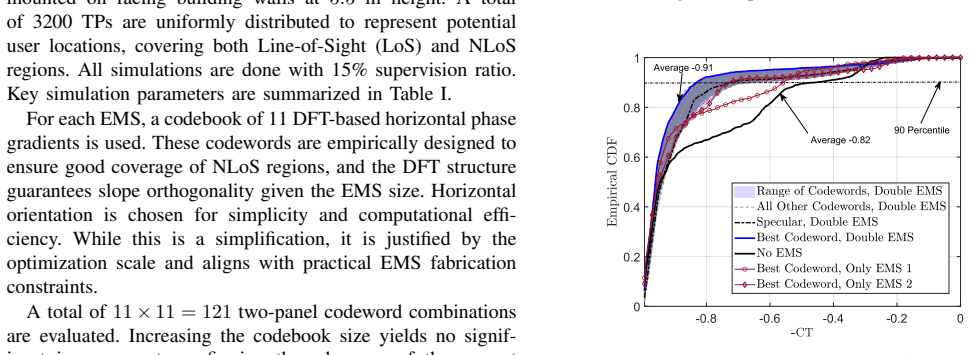
- [Sec. V] The phrase 'No configuration performs worse than the baseline' is supported by the gray envelope if that envelope is the pointwise minimum across the 121 configurations. Please clarify in the caption how the envelope is computed (e.g., min–max across codewords per CDF level) so the reader can interpret the statement.
Circularity Check
Headline 90th-percentile localization gain is the in-sample optimum of the same objective used to select the EMS codebook (Eq. 23), not an independent prediction.
-
fitted input called prediction
[Sec. IV-C (Eq. 23) and Sec. V (CDF discussion)]
"The goal is to find the EMS phase configuration S that minimizes the α-quantile of the LE, negative TW, or negative CT evaluated over all test points. Explicitly, ˆS = arg min_{S∈C} Q_m(α|S). ... With the best codeword, the 90-th percentile of localization error can be decrease from above 60 meters, to less than 25 meters."
Selection and evaluation use the same test points U: Eq. (23) picks S* as the minimizer of Q_m(α|S) over the codebook, and Q_m is computed over 'all test points' with no validation split (Secs. IV-A, IV-C, V). The reported 90th-percentile LE for the 'best codebook' is therefore Q_{0.9}(LE|S*) evaluated on the same data that defined S*, i.e., the optimized objective value, not an out-of-sample prediction. Choosing the best of 121 correlated configurations and then reporting its metric on the same data is textbook in-sample selection; the 'reduction' to <25 m is a fitted optimum by construction. The qualitative envelope claim (no EMS configuration performs worse than baseline) is independent, but the headline magnitude is not.
full rationale
The core circular step is Eq. (23) combined with Sec. V: the EMS codebook configuration is selected by minimizing the α-quantile of LE (among other metrics) over all test points, and the same α-quantile of LE for the selected configuration is then presented as the paper's headline result. This reduces the quantitative 'prediction' to the objective value at its in-sample argmin, a textbook case of fitted-input-called-prediction. I do not find load-bearing self-citation circularity: the cited self-works ([10], [17], [18]) are used for standard channel/noise models, radiation-pattern parameters, or the well-known generalized Snell's law, none of which is invoked as an external uniqueness theorem to force the EMS design. The qualitative claim that EMSs can improve channel charting in NLoS conditions retains independent content via the full envelope of all 121 configurations and the visual chart comparison; however, the specific '>60 m to <25 m' improvement is not a robust out-of-sample prediction. The score of 6 reflects partial circularity: the central quantitative result reduces by construction, while the qualitative directional claim does not.
Assumptions & free parameters
free parameters (4)
- EMS codebook phase gradients =
11 DFT-based horizontal gradients; exact slopes not specified
- Selected EMS codebook configuration =
Best of 11x11=121 combinations
- t-SNE perplexity =
Not stated
- Supervision ratio =
15%
assumptions (4)
- domain assumption EMS behaves as a diagonal phase-only reflection surface with no inter-element coupling or amplitude variation
- domain assumption Generalized Snell's law gives the phase gradient for desired reflection
- domain assumption Ray tracing with Sionna produces a sufficiently accurate deterministic multipath channel
- standard math t-SNE optimization converges to a representative embedding
Cite this review
Pith. "Pith review of Channel Charting in Smart Radio Environments." pith.science (2026). https://pith.science/paper/O2CRFSEH
@misc{pith2026250807305,
  author       = {Pith},
  title        = {Pith review of: Channel Charting in Smart Radio Environments},
  year         = {2026},
  howpublished = {\url{https://pith.science/paper/O2CRFSEH}},
  note         = {Machine review of arXiv:2508.07305}
}
read the original abstract
This paper introduces the use of static electromagnetic skins (EMSs) to enable robust device localization via channel charting (CC) in realistic urban environments. We develop a rigorous optimization framework that leverages EMS to enhance channel dissimilarity and spatial fingerprinting, formulating EMS phase profile design as a codebook-based problem targeting the upper quantiles of key embedding metric, localization error, trustworthiness, and continuity. Through 3D ray-traced simulations of a representative city scenario, we demonstrate that optimized EMS configurations, in addition to significant improvement of the average positioning error, reduce the 90th-percentile localization error from over 60 m (no EMS) to less than 25 m, while drastically improving trustworthiness and continuity. To the best of our knowledge, this is the first work to exploit Smart Radio Environment (SRE) with static EMS for enhancing CC, achieving substantial gains in localization performance under challenging None-Line-of-Sight (NLoS) conditions.
Figures


Figures from the paper (3 more)


Reference graph
Works this paper leans on
-
[1]
Wireless channel charting: Theory, practice, and applications,
P. Ferrand, M. Guillaud, C. Studer, and O. Tirkkonen, “Wireless channel charting: Theory, practice, and applications,” IEEE Communications Magazine, vol. 61, no. 6, pp. 124–130, 2023
2023
-
[2]
A. Shastri, N. Valecha, E. Bashirov, H. Tataria, M. Lentmaier, F. Tufves- son, M. Rossi, and P. Casari, “A review of millimeter wave device-based localization and device-free sensing technologies and applications,” IEEE Communications Surveys & Tutorials , vol. 24, no. 3, pp. 1708–1749, 2022
work page 2022
-
[3]
A survey of 5g network: Architecture and emerging technologies,
A. Gupta and R. K. Jha, “A survey of 5g network: Architecture and emerging technologies,” IEEE access, vol. 3, pp. 1206–1232, 2015
work page 2015
-
[4]
A global geometric framework for nonlinear dimensionality reduction,
J. B. Tenenbaum, V . d. Silva, and J. C. Langford, “A global geometric framework for nonlinear dimensionality reduction,” science, vol. 290, no. 5500, pp. 2319–2323, 2000
2000
-
[5]
Beam snr prediction using channel charting,
P. Kazemi, H. Al-Tous, T. Ponnada, C. Studer, and O. Tirkkonen, “Beam snr prediction using channel charting,” IEEE Transactions on Vehicular Technology, 2023
work page 2023
-
[6]
Channel charting: Locating users within the radio environment using channel state information,
C. Studer, S. Medjkouh, E. Gonultas ¸, T. Goldstein, and O. Tirkkonen, “Channel charting: Locating users within the radio environment using channel state information,” IEEE Access, vol. 6, pp. 47 682–47 698, 2018
work page 2018
-
[7]
Channel charting in real-world coordinates with distributed mimo,
S. Taner, V . Palhares, and C. Studer, “Channel charting in real-world coordinates with distributed mimo,” IEEE Transactions on Wireless Communications, 2025
work page 2025
-
[8]
Semi-supervised learning for channel charting- aided iot localization in millimeter wave networks,
Q. Zhang and W. Saad, “Semi-supervised learning for channel charting- aided iot localization in millimeter wave networks,” in 2021 IEEE Global Communications Conference (GLOBECOM) . IEEE, 2021, pp. 1–6
work page 2021
Show all 19 references
-
[9]
Position and orientation estimation through millimeter- wave mimo in 5g systems,
A. Shahmansoori, G. E. Garcia, G. Destino, G. Seco-Granados, and H. Wymeersch, “Position and orientation estimation through millimeter- wave mimo in 5g systems,” IEEE Transactions on Wireless Communica- tions, vol. 17, no. 3, pp. 1822–1835, 2017
2017
-
[10]
Network-controlled repeaters vs. reconfigurable intelligent surfaces for 6g mmw coverage extension: A simulative comparison,
R. A. Ayoubi, M. Mizmizi, D. Tagliaferri, D. D. Donno, and U. Spagno- lini, “Network-controlled repeaters vs. reconfigurable intelligent surfaces for 6g mmw coverage extension: A simulative comparison,” in 2023 21st Mediterranean Communication and Computer Networking Conferenc...
2023
-
[11]
Wave-controlled metasurface-based reconfigurable intelligent surfaces,
E. Ayanoglu, F. Capolino, and A. L. Swindlehurst, “Wave-controlled metasurface-based reconfigurable intelligent surfaces,” IEEE Wireless Communications, vol. 29, no. 4, pp. 86–92, 2022
2022
-
[12]
Ris phase optimization via generative flow networks,
C. Bou Chaaya and M. Bennis, “Ris phase optimization via generative flow networks,” IEEE Wireless Communications Letters , vol. 13, no. 7, pp. 1988–1992, 2024
1988
-
[13]
Generalized analysis and unified design of em skins,
G. Oliveri, M. Salucci, and A. Massa, “Generalized analysis and unified design of em skins,” IEEE Transactions on Antennas and Propagation , pp. 1–1, 2023
2023
-
[14]
Low-profile and low-visual impact smart electromagnetic curved passive skins for enhancing connectivity in urban scenarios,
A. Freni, M. Beccaria, A. Mazzinghi, A. Massaccesi, and P. Pirinoli, “Low-profile and low-visual impact smart electromagnetic curved passive skins for enhancing connectivity in urban scenarios,” Electronics, vol. 12, no. 21, 2023. [Online]. Available: https://www.mdpi.com/2079...
2023
-
[15]
Sionna RT: A gpu-accelerated 3d ray tracing library for efficient and accurate channel modeling in 5G and 6G wireless research,
F. A. A. Kienle, T. J. O’Shea, O. Y . Bursali, S. Cammerer, S. Zeisberg, and J. Hoydis, “Sionna RT: A gpu-accelerated 3d ray tracing library for efficient and accurate channel modeling in 5G and 6G wireless research,” arXiv preprint arXiv:2305.08852 , 2023. [Online]. Available...
2023 arXiv
-
[16]
Study on channel model for frequency spectrum above 6 GHz (version 14.2.0 Release 14),
3GPP ETSI TR 138 900, “Study on channel model for frequency spectrum above 6 GHz (version 14.2.0 Release 14),” Jun 2017
2017
-
[17]
Conformal metasurfaces: a novel solution for vehicular communications,
M. Mizmizi, R. A. Ayoubi, D. Tagliaferri, K. Dong, G. G. Gentili, and U. Spagnolini, “Conformal metasurfaces: a novel solution for vehicular communications,” IEEE Transactions on Wireless Communications, 2022
2022
-
[18]
Wireless communications with space–time modulated metasurfaces,
M. Mizmizi, D. Tagliaferri, and U. Spagnolini, “Wireless communications with space–time modulated metasurfaces,” IEEE Journal on Selected Areas in Communications , vol. 42, no. 6, pp. 1534–1548, 2024
2024
-
[19]
Beamforming training and quantization codebook for intelligent reconfigurable surface aided mmwave massive mimo systems,
L. Dai, X. Wang, and J. Wang, “Beamforming training and quantization codebook for intelligent reconfigurable surface aided mmwave massive mimo systems,” IEEE Transactions on Vehicular Technology , vol. 69, no. 8, pp. 9286–9290, 2020
2020
Reviewed August 5, 2026 · model on record in the stance chip above.
Discussion (0). Continue with ORCID to comment.