Estimating classical mutual information between quantum subsystems with neural networks
Pith reviewed 2026-05-19 00:08 UTC · model grok-4.3
The pith
Neural networks reconstruct classical mutual information from limited projective measurements in quantum systems.
A machine-rendered reading of the paper's core claim, the machinery that carries it, and where it could break.
Core claim
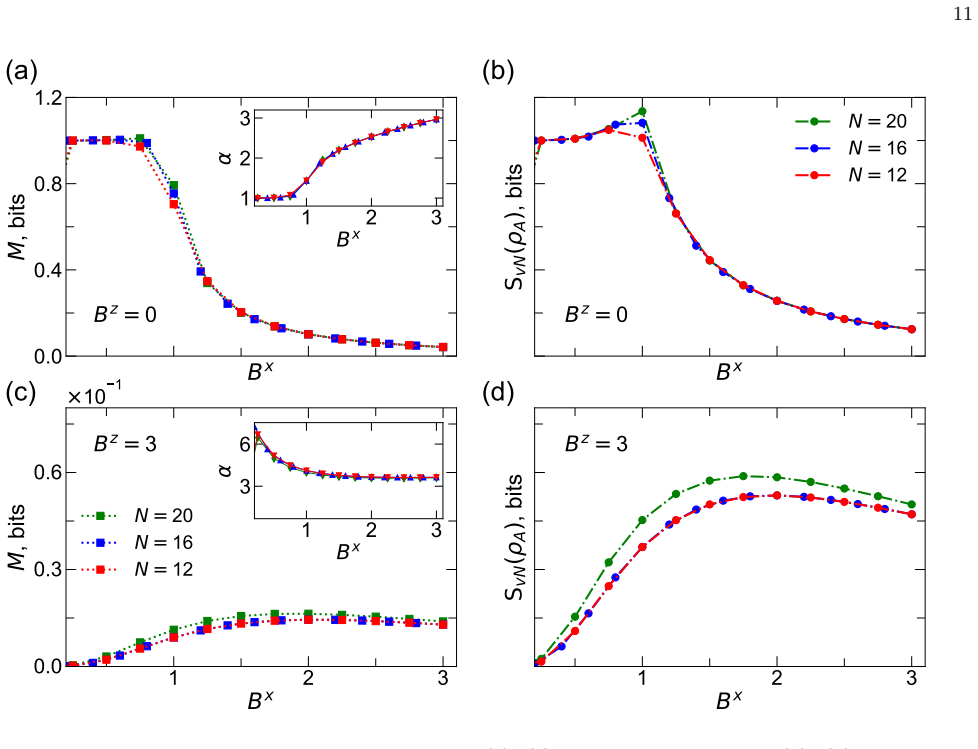
A neural network trained on a limited number of projective measurements can accurately reconstruct the classical mutual information and specific entropy for the antiferromagnetic quantum Ising model, including for delocalized paramagnetic wave functions, and this enables reconstruction of the phase diagram with emphasis on disordered states.
What carries the argument
Neural network that maps partial projective measurement data to estimates of classical mutual information and entropy.
If this is right
- Reliable mutual information estimates become possible without enumerating all system states.
- The phase diagram of the quantum Ising model can be recovered while separating distinct disordered phases.
- The method applies to systems studied in both condensed matter physics and quantum computing.
- Delocalized states do not prevent the neural network from producing accurate information estimates.
Where Pith is reading between the lines
- Fewer measurements could suffice in future quantum experiments to extract correlation information.
- The technique may extend to other many-body models where full tomography is costly.
- Training on synthetic data from one model could inform analysis of real-device measurements in quantum simulators.
Load-bearing premise
A neural network trained on limited projective measurements can accurately reconstruct the full classical mutual information without needing complete state statistics or failing on delocalized wave functions.
What would settle it
Compare the neural network output directly to the exact classical mutual information computed from full state probabilities for the Ising model in the paramagnetic regime.
Figures


read the original abstract
Characterizing correlations in a quantum system on the basis of the results of the projective measurements can be performed with different means including the calculation of the classical mutual information. Generally, estimating such information-entropy-based quantities requires having complete statistics of the system's states. Here we explore the possibility to reconstruct the classical mutual information and specific entropy of a quantum system with neural network approach on the basis of limited number of projective measurements. As a prominent example we consider the antiferromagnetic quantum Ising model in transverse and longitudinal magnetic fields which is in demand in both condensed matter physics and quantum computing. We show that the neural network approach gives reliable estimates of the classical mutual information even in the case of paramagnetic wave functions delocalized in the state space. In addition, the phase diagram of the considered quantum system is reconstructed with a special focus on discriminating various types of disordered states.
Editorial analysis
A structured set of objections, weighed in public.
Referee Report
Summary. The paper claims that neural networks can be used to reconstruct classical mutual information and specific entropy from a limited number of projective measurements in quantum systems. Using the antiferromagnetic quantum Ising model as an example, the authors show reliable estimates even for delocalized paramagnetic wave functions and reconstruct the phase diagram with focus on disordered states.
Significance. This method could be significant for practical characterization of quantum correlations in systems where complete measurement statistics are unavailable, offering a scalable alternative for information entropy calculations in quantum many-body physics and quantum computing applications. The success on delocalized states highlights its potential robustness.
minor comments (3)
- Include explicit details on the neural network architecture, training dataset size, loss function, and validation strategy in the methods section to support reproducibility of the reported estimates.
- The figures showing phase diagram reconstruction should include error bars or uncertainty estimates derived from the neural network predictions.
- Consider discussing potential overfitting issues or generalization challenges when applying the trained network to states with different degrees of delocalization.
Simulated Author's Rebuttal
We thank the referee for their positive summary of our work and for recommending minor revision. We are pleased that the potential significance for practical characterization of quantum correlations via neural networks is recognized, particularly the robustness for delocalized paramagnetic states in the antiferromagnetic quantum Ising model.
Circularity Check
No significant circularity detected in neural network estimation approach
full rationale
The paper applies a neural network as an external approximator to reconstruct classical mutual information and entropy from a limited set of projective measurements on the antiferromagnetic quantum Ising model. This is a standard supervised learning setup on measurement data rather than a closed mathematical derivation. No load-bearing steps reduce by the paper's own equations to fitted inputs by construction, nor do self-citations or ansatzes form the central claim. The numerical demonstrations for delocalized paramagnetic states rely on the network's generalization capability, which is independent of the target quantities and does not create self-referential loops. The derivation chain remains self-contained against external benchmarks.
Axiom & Free-Parameter Ledger
axioms (2)
- domain assumption The antiferromagnetic quantum Ising model in transverse and longitudinal fields accurately represents the target quantum system for testing the method.
- standard math Projective measurements on the system produce statistics from which classical mutual information can be defined.
Reference graph
Works this paper leans on
-
[1]
H.D. Ursell, The evaluation of Gibbs’ phase-integral for imperfect gases, in Mathematical Proceedings of the Cambridge Philosophical Society, Vol. 23 (Cambridge University Press, 1927) pp. 685-697
work page 1927
-
[2]
Andrea Cavagna, Alessio Cimarelli, Irene Giardina, Gior- gio Parisi, Raffaele Santagati, Fabio Stefanini, and Mas- similiano Viale, Scale-free correlations in starling flocks, PNAS 107, 11865 (2010)
work page 2010
-
[3]
S.F. Edwards and P.W. Anderson, Theory of spin glasses, J. Phys. F: Met. Phys. 5, 965 (1975)
work page 1975
-
[4]
S. Aaronson and A. Arkhipov, The computational com- plexity of linear optics, Theory of Computing 9, 143 (2013)
work page 2013
-
[5]
H. Wang et al., Boson sampling with 20 input pho- tons and a 60-mode interferometer in a 10 14-dimensional Hilbert space, Phys. Rev. Lett. 123, 250503 (2019). 12
work page 2019
-
[6]
Yusuke Nomura and Masatoshi Imada, Dirac-type nodal spin liquid revealed by re ned quantum many-body solver using neural-network wave function, correlation ratio, and level spectroscopy Phys. Rev. X 11, 031034 (2021)
work page 2021
-
[7]
O. M. Sotnikov, V. V. Mazurenko, J. Colbois, F. Mila, M. I. Katsnelson, E. A. Stepanov, Probing the topology of the quantum analog of a classical skyrmion, Phys. Rev. B 103, L060404 (2021)
work page 2021
-
[8]
M. Ippoliti, K. Kechedzhi, R. Moessner, S. L. Sondhi, and V. Khemani, Many-body physics in the NISQ era: Quan- tum programming a discrete time crystal, PRX Quant. 2, 030346 (2021)
work page 2021
-
[9]
E. A. Maletskii, I. A. Iakovlev, and V. V. Mazurenko, Quantifying spatiotemporal patterns in classical and quantum systems out of equilibrium, Phys. Rev. E 109, 024105 (2024)
work page 2024
-
[10]
C. E. Shannon, A Mathematical Theory of Communi- cation, The Bell System Technical Journal 27, 379–423, 623–656 (1948)
work page 1948
-
[11]
Luisa Ramirez, William Bialek, Stephanie E. Palmer, and David J. Schwab, Probabilistic models, compressible in- teractions, and neural coding, arXiv:2112.14334
-
[12]
R. T. Wicks, S. C. Chapman, R. O. Dendy, Mutual infor- mation as a tool for identifying phase transitions in dy- namical complex systems with limited data, Phys. Rev. E 75, 051125 (2007)
work page 2007
-
[13]
J. Dong, D. Huang, Y. Yang, Mutual information, quan- tum phase transition, and phase coherence in Kondo sys- tems, Phys. Rev. B 104, L081115 (2021)
work page 2021
-
[14]
M. Tajik et al, Experimental verification of the area law of mutual information in quantum field simulator, Nature Physics 19, 1022–1026 (2023)
work page 2023
-
[15]
Elizabeth G. Ryan, Christopher C. Drovandi, James M. McGree and Anthony N. Pettitt, A Review of Modern Computational Algorithms for Bayesian Optimal Design, International Statistical Review 84, 128–154 (2016)
work page 2016
-
[16]
J. Tomczak, M. Welling, VAE with a VampPrior, Proceedings of the Twenty-First International Confer- ence on Artificial Intelligence and Statistics, PMLR 84, 1214–1223 (2018)
work page 2018
- [17]
-
[18]
H. Matsuda, K. Kudo, R. Nakamura, O. Yamakawa, T. Murata, Mutual Information of Ising Systems, Int. J. Theor. Phys. 35, 839 (1996)
work page 1996
-
[19]
M. Wolf, F. Verstraete, M. Hastings, J. Cirac, Area Laws in Quantum Systems: Mutual Information and Correla- tions, Phys. Rev. Lett. 100, 070502 (2008)
work page 2008
- [20]
- [21]
-
[22]
Meurice, Experimental lower bounds on entanglement entropy without twin copy, arXiv:2404.09935
Y. Meurice, Experimental lower bounds on entanglement entropy without twin copy, arXiv:2404.09935
-
[23]
A. Kaufman, J. Corona, Z. Ozzello, M. Asaduzzaman, Y. Meurice, Improved entanglement entropy estimates from filtered bitstring probabilities, arXiv:2411.07092
-
[24]
B. Zeng, X. Chen, D.-L. Zhou, X.-G. Wen, Quantum Information Meets Quantum Matter: From Quantum Entanglement to Topological Phases of Many-Body Sys- tems, Springer (NY), (2019)
work page 2019
-
[25]
M. I. Belghazi, A. Baratin, S. Rajeshwar, S. Ozair, Y. Bengio, D. Hjelm, A. Courville, Mutual information neural estimation, International Conference on Machine Learning, 530-539 (2018)
work page 2018
- [26]
-
[27]
D. McAllester, K. Stratos, Formal Limitations on the Measurement of Mutual Information, International Con- ference on Artificial Intelligence and Statistics, 875-884 (2020)
work page 2020
-
[28]
P. ˇStelmachoviˇ c, V. Buˇ zek, Quantum-information ap- proach to the Ising model: Entanglement in chains of qubits, Phys. Rev. A 70, 032313 (2004)
work page 2004
-
[29]
H. W. Lau, P. Grassberger, Information theoretic aspects of the two-dimensional Ising model, Phys. Rev. E 87, 022128 (2013)
work page 2013
-
[30]
M. Donsker, and S. Varadhan, Asymptotic evaluation of certain markov process expectations for large time, iv. Communications on Pure and Applied Mathematics 36, 183-212 (1983)
work page 1983
- [31]
-
[32]
A. Nir, E. Sela, R. Beck, Y. Bar-Sinai, Machine-learning iterative calculation of entropy for physical systems, PNAS 117, 30234-30240 (2020)
work page 2020
-
[33]
D. E. G¨ okmen, Z. Ringel, S. D. Huber, M. Koch-Janusz, Statistical Physics through the Lens of Real-Space Mu- tual Information, Phys. Rev. Lett. 127, 240603 (2021)
work page 2021
-
[34]
D. E. G¨ okmen, Z. Ringel, S. D. Huber, M. Koch-Janusz, Symmetries and phase diagrams with real-space mutual information neural estimation, Phys. Rev. E 104, 064106 (2021)
work page 2021
- [35]
- [36]
-
[37]
Pfeuty, The one-dimensional Ising model with a trans- verse field, Ann
P. Pfeuty, The one-dimensional Ising model with a trans- verse field, Ann. Phys. (NY) 57, 79 (1970)
work page 1970
-
[38]
A. A. Ovchinnikov, D. V. Dmitriev, V. Ya. Krivnov, V.O. Cheranovskii. The antiferromagnetic Ising chain in a mixed transverse and longitudinal magnetic field, Phys. Rev. B 68, 214406 (2003)
work page 2003
-
[39]
V. S. Okatev, O. M. Sotnikov, V. V. Mazurenko, Explor- ing entanglement in finite-size quantum systems with de- generate ground state, Phys. Rev. B 111, 054443 (2025)
work page 2025
-
[40]
O. F. de A. Bonfim, B. Boechat, J. Florencio, Ground- state properties of the one-dimensional transverse Ising model in a longitudinal magnetic field, Phys. Rev. E 99, 012122 (2019)
work page 2019
-
[41]
S. Czischek, M. G¨ arttner, T. Gasenzer, Quenches near Ising quantum criticality as a challenge for artificial neu- ral networks, Phys. Rev. B 98, 024311 (2018)
work page 2018
-
[42]
V. Herr´ aiz-L´ opez, S. Roca, M. Gallego, R. Ferr´ andez, J. Carrete, D. Zueco, J. Rom´ an-Roche, First- and second- order quantum phase transitions in the long-range un- frustrated antiferromagnetic Ising chain, Phys. Rev. B 111, 014425 (2025)
work page 2025
- [43]
- [44]
-
[45]
M. Lewenstein, A. Sanpera, V. Ahufinger, B. Damski, U. Sen et al, Ultracold atomic gases in optical lattices: Mimicking condensed matter physics and beyond, Adv. Phys. 56, 243 (2006)
work page 2006
- [46]
-
[47]
T. Xiao, J. Huang, H. Li, et al, Intelligent certification for quantum simulators via machine learning. npj Quantum Information 8, 138 (2022)
work page 2022
-
[48]
Westerhout, Lattice-symmetries: A package for work- ing with quantum many-body bases, J
T. Westerhout, Lattice-symmetries: A package for work- ing with quantum many-body bases, J. Open Source Softw. 6, 3537 (2021)
work page 2021
- [49]
-
[50]
J. Y. Khoo and M. Heyl, Quantum entanglement recog- nition. Phys. Rev. Res. 3, 033135 (2021)
work page 2021
- [51]
-
[52]
K. J. Satzinger et al., Realizing topologically ordered states on a quantum processor, Science 374, 1237-1241 (2021)
work page 2021
-
[53]
Dmitry A. Abanin and Eugene Demler, Measuring en- tanglement entropy of a generic many-body system with a quantum switch, Phys. Rev. Lett. 109, 020504 (2012)
work page 2012
- [54]
-
[55]
A. M. Kaufman, M. E. Tai, A. Lukin, M. Rispoli, R. Schittko, P. M. Preiss, and M. Greiner, Quantum ther- malization through entanglement in an isolated many- body system, Science 353, 794 (2016)
work page 2016
-
[56]
O. M. Sotnikov, I. A. Iakovlev, A. A. Iliasov, M. I. Kat- snelson, A. A. Bagrov and V. V. Mazurenko, Certifica- tion of quantum states with hidden structure of their bitstrings, npj Quantum Information 8, 41 (2022)
work page 2022
-
[57]
M.K. Kurmapu, V.V. Tiunova, E.S. Tiunov, M. Ring- bauer, C. Maier, R. Blatt, T. Monz, A.K. Fedorov, and A.I. Lvovsky, Reconstructing complex states of a 20-qubit quantum simulator, PRX Quantum 4, 040345 (2023)
work page 2023
-
[58]
E.S. Tiunov, V.V. Tiunova, A.E. Ulanov, A.I. Lvovsky, and A.K. Fedorov, Experimental quantum homodyne to- mography via machine learning, Optica 7, 448 (2020)
work page 2020
-
[59]
Y.A. Kharkov, V.E. Sotskov, A.A. Karazeev, E.O. Kik- tenko, and A.K. Fedorov, Revealing quantum chaos with machine learning, Phys. Rev. B 101, 064406 (2020)
work page 2020
-
[60]
M. A. Nielsen and I. L. Chuang, Quantum Computation and Quantum Information (Cambridge University Press, Cambridge, 2000)
work page 2000
-
[61]
L. Wang, Y. H. Liu, J. Imriˇ ska, P. N. Ma, M. Troyer, Fidelity Susceptibility Made Simple: A Unified Quantum Monte Carlo Approach, Phys. Rev. X 5, 031007 (2015)
work page 2015
-
[62]
S. Gu, Fidelity approach to quantum phase transitions, International Journal of Modern Physics B 24, 4371-4458 (2008)
work page 2008
-
[63]
F. Arute, et al. Quantum supremacy using a pro- grammable superconducting processor, Nature 574, 505 (2019)
work page 2019
-
[64]
J. Choi, A. L. Shaw, I. S. Madjarov, X. Xie, R. Finkel- stein, J. P. Covey, J. S. Cotler, D. K. Mark, H.-Y. Huang, A. Kale, H. Pichler, F. G. S. L. Brand˜ ao, S. Choi and M. Endres, Preparing random states and benchmarking with many-body quantum chaos, Nature 613, 468 (2023)
work page 2023
-
[65]
B. Villalonga, M. Y. Niu, L. Li, H. Neven, J. C. Platt, V. N. Smelyanskiy, and S. Boixo, Efficient ap- proximation of experimental gaussian boson sampling, arXiv:2109.11525
-
[66]
L. S. Madsen et al., Quantum computational advantage with a programmable photonic processor, Nature (Lon- don) 606, 75 (2022)
work page 2022
-
[67]
M. Walschaers, J. Kuipers, J.-D. Urbina, K. Mayer, M. C. Tichy, K. Richter, and A. Buchleitner, Statistical benchmark for boson sampling, New J. Phys. 18, 032001 (2016)
work page 2016
- [68]
-
[69]
A. A. Mazanik, A. N. Rubtsov, Boson sampling vali- dation approach by examining the sample space filling, Phys. Rev. A 112, 012619 (2025)
work page 2025
- [70]
-
[71]
I. A. Iakovlev, O. M. Sotnikov, I. V. Dyakonov, E. O. Kiktenko, A. K. Fedorov, S. S. Straupe, and V. V. Mazurenko, Benchmarking a boson sampler with Ham- ming nets, Phys. Rev. A 108, 062420 (2023)
work page 2023
-
[72]
https://github.com/sungyubkim/MINE-Mutual- Information-Neural-Estimation-.git
- [73]
discussion (0)
Sign in with ORCID, Apple, or X to comment. Anyone can read and Pith papers without signing in.