REVIEW 4 major objections 5 minor 86 references
TAP: Parameter-efficient Task-Aware Prompting for Adverse Weather Removal
T0 review · 4 major / 5 minor · reviewed 2026-08-05 · deepseek-v4-flash
Pith's one-line read This paper claims that a parameter-efficient All-in-One restoration framework, using only about 2.75 million trainable parameters, achieves state-of-the-art performance on four adverse-weather removal tasks by augmenting a frozen pretrained
desk verdict A sensible prompt-based restoration idea undermined by internally inconsistent tables and an unclear parameter count. read the letter →
The pith
A machine-rendered reading of the paper's core claim, the machinery that carries it, and where it could break.
The reading
What carries the argument
Attention-level soft prompts $P_i = P_i^s \times P_g$ inserted into the key and value of multi-head self-attention. The low-rank decomposition separates a task-general prompt tail $P_g$ from task-specific prompt heads $P_i^s$, and a multi-positive contrastive loss (Eq. 5) aligns prompt similarity with the t-SNE-derived relatedness graph {snow ≈ raindrop, rain ≈ haze}. This carries the argument by showing how task-relatedness and task-specificity can be encoded in very few parameters on a frozen backbone.
What would settle it
A pairwise transfer experiment would settle it: fine-tune the pretrained backbone on one task only and measure PSNR on the other three. If the most transferable pair is not snow–raindrop or rain–haze, or if removing the contrastive term barely changes results, the hand-defined graph driving Eq. 5 is not load-bearing.
Extended reading notes
Core claim
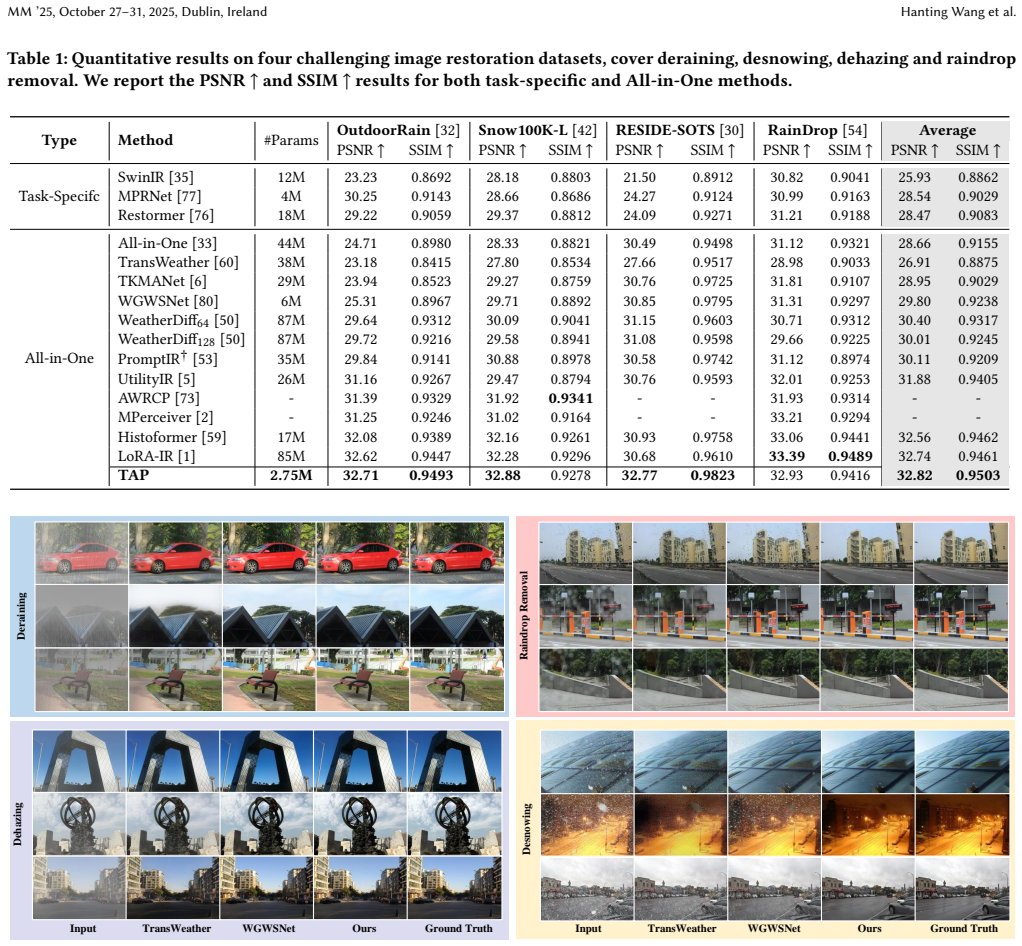
On the paper's own terms: TAP is an All-in-One adverse weather removal model built on a SwinIR-style U-Net. The first stage trains the whole backbone on a mix of four degradation datasets using L1 and perceptual loss; the second stage freezes it and trains only small soft prompts inserted into the key/value of self-attention. Each prompt is decomposed as a task-specific head times a shared low-rank tail, and a supervised contrastive loss enforces that prompt similarities match the inter-task relatedness observed in t-SNE of VGG16 residual features. With 2.75M prompt parameters, the paper reports an average PSNR of 32.82 dB and SSIM of 0.9503 across OutdoorRain, Snow100K-L, RESIDE-SOTS, and R
Load-bearing premise
The load-bearing premise is that the inter-task relatedness graph used to supervise the prompts — snow with raindrops, rain with haze — is a true and transferable property of the four degradation types, even though it is inferred from t-SNE on VGG16 features of the training datasets and never externally validated.
Editorial extensions
If this is right
- Adding or removing a weather task during deployment may require training only a small prompt head rather than retraining the shared network.
- The contrastive constraint offers a way to transfer inter-task structure: if two degradations share feature patterns, their prompts are pulled together, potentially improving performance on tasks with little data.
- The two-stage training recipe provides a template for other multi-task restoration settings where joint training suffers task conflicts.
- The reported low-rank analysis (top-4 singular values ≈ 100% energy) suggests the prompt matrices are intrinsically low-rank, so an effective rank of 4 suffices.
- Real-world no-reference gains indicate that the prompt adaptation generalizes beyond the synthetic training distributions used in the benchmarks.
Reading between the lines
- The fixed t-SNE-derived relatedness graph could be replaced with data-driven task relations, e.g., learned from task gradients or feature statistics, potentially improving transfer on unseen degradations; this is an extension, not something the paper tests.
- The same prompting scheme may apply to other multi-task low-level vision problems, such as deblurring or low-light enhancement, or to continual learning where new tasks arrive sequentially without retraining the backbone.
- A testable consequence: if the relatedness graph is correct, pairwise prompt cosine similarity should predict pairwise positive-transfer magnitude; measuring that would externally validate the assumption.
- The 2.75M-parameter count suggests the approach could run on resource-constrained devices, but the paper does not report latency or FLOPs to confirm practical efficiency.
Editorial analysis
A structured set of objections, weighed in public.
Referee Report
Summary. The paper proposes TAP, a parameter-efficient all-in-one adverse weather restoration framework. The method freezes a SwinIR-based backbone after a supervised pretraining stage and adapts it to four degradation tasks (deraining, desnowing, dehazing, raindrop removal) with task-specific soft prompts inserted into attention key/value inputs. Prompts are enhanced via low-rank decomposition into a shared tail and task-specific heads (implicit interaction) and via a supervised contrastive loss that enforces a hand-defined inter-task relation graph (explicit interaction). The paper reports state-of-the-art average PSNR of 32.82 dB with only 2.75M trainable parameters, along with ablations, t-SNE visualizations, and real-world generalization results.
Significance. If the reported numbers are reliable, the work is a meaningful step toward parameter-efficient task-adaptive all-in-one restoration: it avoids task-specific modules, mitigates task conflicts through two-stage training, and explicitly models inter-task relatedness with a contrastive constraint. The core idea of low-rank decomposed, relation-constrained soft prompts is well motivated and reasonably novel. The paper also includes a useful ablation structure and attempts a real-world generalization study. However, the manuscript's central empirical claim rests on quantitative tables that contain internal inconsistencies, so the significance can only be assessed after those data are corrected and reconciled.
major comments (4)
- [Table 1] The Average PSNR column is arithmetically inconsistent with the per-task PSNR values for several methods. For example, WGWSNet per-task values average to 29.30, not 29.80; PromptIR to 30.61, not 30.11; UtilityIR to 30.85, not 31.88; Histoformer to 32.06, not 32.56; LoRA-IR to 32.24, not 32.74. These errors change the claimed advantage over LoRA-IR from 0.12 dB (as stated in §4.3) to either 0.58 dB using corrected averages or 0.08 dB using the printed averages. Since the SOTA claim is the paper's central result, the table must be recomputed and all affected text revised.
- [Tables 1 and 3] The final configuration in Table 3, '+P_attn-E', is described as the full task-aware enhanced prompt model with prompt length 12 and rank 4, and it reports an average PSNR of 31.39 dB. Table 1 reports the same TAP method at 32.82 dB average PSNR. This 1.43 dB gap is not explained anywhere in the manuscript. The reader cannot determine which number corresponds to the actual final model, and the claim of SOTA performance is directly affected.
- [Tables 3 and 4] The no-low-rank length-12 entry in Table 4 is 29.458 dB, whereas Table 3's '+P_attn' row—same prompt length, no low-rank decomposition—reports 30.86 dB. These two configurations appear identical except for naming, yet differ by 1.40 dB. Moreover, Table 4's length-12/rank-0 value is almost the same as Table 3's 'Base' (29.44), which would imply the attention-level prompt itself gives no gain, contradicting Table 3's +0.79 dB improvement over '+P_full'. These discrepancies must be resolved before the ablations can support the design choices.
- [Section 3.3, Eq. (5), and Figure 5(a)] The explicit interaction enhancement uses a task-relation graph (snow-raindrop similar, rain-haze similar) derived from t-SNE on VGG16 residual features of the same benchmark datasets used for training and testing. This graph is then enforced as a contrastive constraint and evaluated only on those datasets. There is no external validation of whether this relation structure transfers to other degradation types or datasets, and the hand-defined graph is not compared against alternatives. I recommend adding a robustness test (e.g., varying the graph, removing the contrastive term, or evaluating on held-out degradation types) to establish that the benefit is not an artifact of the particular dataset family.
minor comments (5)
- [Section 4.3, Table 2] The reported 'average improvement of approximately 16.33%' across MUSIQ, BRISQUE, and NIQE is not defined. Since MUSIQ is higher-is-better while BRISQUE and NIQE are lower-is-better, a single percentage is ambiguous and should be replaced by per-metric deltas or a clearly specified normalization.
- [Eq. (6)] The perceptual loss term is written as a sum over j in S with a squared L2 norm, but the text does not define the layer set S beyond referring to VGG16 layers {3,8,15}. Please state the feature extraction explicitly.
- [Section 4.2 / Claim of 2.75M] The 2.75M parameter count is not broken down. Since the two-stage training freezes the backbone in the second stage, it would be helpful to report the backbone size, prompt parameters, and low-rank decomposition parameters separately.
- [Table 4] Only PSNR averages are reported. Adding SSIM or standard deviations would improve confidence, especially given the small differences among some rank/length settings.
- [References] Some references are incomplete (e.g., '[38] Wang Lin et al. [n. d.]', '[39]' with only arXiv ID, and several 'et al.' entries without author lists). Please complete them for the camera-ready version.
Circularity Check
No significant circularity: the paper's main SOTA claim rests on external benchmark PSNR comparisons, not on a self-derived result. The only circularity-adjacent element is the t-SNE-based validation of the contrastive task-relation graph, which is not load-bearing.
-
other
[Section 3.3 (Explicit Interaction Enhancement, Eq. 5) and Section 5.2 (Explicit interaction enhanced prompts, Figure 5)]
"In Figure 5(a), we visualize the interactions between the residual features of different weather degradation image pairs using t-SNE [61]. The visualization shows that snow and raindrop degradations are more similar to each other, while rain and haze also exhibit a degree of similarity. ... The comparison between (c) and (d) in Figure 5 reveals that the intermediate features with the enhanced prompts align more closely with the t-SNE distribution among the degradations shown in Figure 5(a), which validates the effectiveness of the proposed contrastive constraint."
The contrastive loss in Eq. (5) is built from the inter-task relatedness graph read off Figure 5(a): T+(i) treats snow-raindrop as similar and rain-haze as similar. The same Figure 5(a) distribution is then used in Section 5.2 as the criterion for validating the enhanced prompts: the model's intermediate features are checked for alignment with that same t-SNE distribution. Thus the validation confirms that the model reproduces the supervision signal it was trained to match; it is a self-consistency check rather than an independent test of the relatedness graph or of its transfer to unseen task relationships. This loop is not load-bearing for the paper's central empirical claim, because the SOTA claim is supported by external benchmark PSNR/SSIM comparisons in Tables 1 and 2 and by the inde
full rationale
The paper is an empirical image-restoration paper, not a formal derivation, so there is no Eq. X = Eq. Y by construction at the core. The prompt decomposition P_i = P_i_s x P_g (Eq. 4) is a definition, and the two-stage training loss (Eqs. 6-7) is a standard objective; neither reduces the reported PSNR gains to an input. The inter-task relatedness graph is hand-defined from a t-SNE visualization of VGG16 features on the same training benchmarks and then imposed via the contrastive loss (Eq. 5). This is a data-driven modeling choice, not a fitted parameter renamed as a prediction. The main SOTA claim is checked against external baselines on standard synthetic and real benchmarks (Tables 1-2), giving independent content. The numeric internal inconsistencies noted in Table 1 and the 1.43 dB gap between Tables 1 and 3 are reproducibility/correctness concerns, not circularity. No load-bearing self-citation or imported uniqueness theorem appears; the same-group references are peripheral. The single circularity-adjacent element is the t-SNE self-validation loop described above, which is minor and non-load-bearing, hence score 2.
Assumptions & free parameters
free parameters (5)
- prompt_length_m =
12
- low_rank_lr =
4
- contrastive_weight_lambda_cont =
0.1
- perceptual_loss_weight_lambda_per =
0.1
- task_relation_graph_T_plus =
{(snow,raindrop),(rain,haze)}
assumptions (3)
- domain assumption The soft reconstruction model X_hq = K*X_lq + R + X_lq with K = 1/T - 1 and R = (1 - 1/T)A + r is an adequate decomposition for all four weather types.
- domain assumption VGG16 feature-space t-SNE of residual images is a reliable measure of inter-task relatedness for deciding contrastive positives.
- ad hoc to paper A frozen pretrained backbone retains general restoration knowledge and task-specific prompts can adapt it to each degradation without updating the backbone.
Cite this review
Pith. "Pith review of TAP: Parameter-efficient Task-Aware Prompting for Adverse Weather Removal." pith.science (2026). https://pith.science/paper/QGJKTFX6
@misc{pith2026250807878,
  author       = {Pith},
  title        = {Pith review of: TAP: Parameter-efficient Task-Aware Prompting for Adverse Weather Removal},
  year         = {2026},
  howpublished = {\url{https://pith.science/paper/QGJKTFX6}},
  note         = {Machine review of arXiv:2508.07878}
}
read the original abstract
Image restoration under adverse weather conditions has been extensively explored, leading to numerous high-performance methods. In particular, recent advances in All-in-One approaches have shown impressive results by training on multi-task image restoration datasets. However, most of these methods rely on dedicated network modules or parameters for each specific degradation type, resulting in a significant parameter overhead. Moreover, the relatedness across different restoration tasks is often overlooked. In light of these issues, we propose a parameter-efficient All-in-One image restoration framework that leverages task-aware enhanced prompts to tackle various adverse weather degradations.Specifically, we adopt a two-stage training paradigm consisting of a pretraining phase and a prompt-tuning phase to mitigate parameter conflicts across tasks. We first employ supervised learning to acquire general restoration knowledge, and then adapt the model to handle specific degradation via trainable soft prompts. Crucially, we enhance these task-specific prompts in a task-aware manner. We apply low-rank decomposition to these prompts to capture both task-general and task-specific characteristics, and impose contrastive constraints to better align them with the actual inter-task relatedness. These enhanced prompts not only improve the parameter efficiency of the restoration model but also enable more accurate task modeling, as evidenced by t-SNE analysis. Experimental results on different restoration tasks demonstrate that the proposed method achieves superior performance with only 2.75M parameters.
Figures


Figures from the paper (3 more)


Reference graph
Works this paper leans on
-
[1]
Yuang Ai, Huaibo Huang, and Ran He. 2024. Lora-ir: taming low-rank experts for efficient all-in-one image restoration. arXiv preprint arXiv:2410.15385
arXiv 2024
-
[2]
Yuang Ai, Huaibo Huang, Xiaoqiang Zhou, Jiexiang Wang, and Ran He. 2024. Multimodal prompt perceiver: empower adaptiveness generalizability and fi- delity for all-in-one image restoration. InProceedings of the IEEE/CVF Conference on Computer Vision and Pattern Recognition , 25432–25444
2024
-
[3]
Sixiang Chen, Tian Ye, Yun Liu, Erkang Chen, Jun Shi, and Jingchun Zhou
-
[4]
Sixiang Chen, Tian Ye, Kai Zhang, Zhaohu Xing, Yunlong Lin, and Lei Zhu
-
[5]
Yu-Wei Chen and Soo-Chang Pei. 2025. Always clear days: degradation type and severity aware all-in-one adverse weather removal. IEEE Access
2025
-
[6]
Wei-Ting Chen, Zhi-Kai Huang, Cheng-Che Tsai, Hao-Hsiang Yang, Jian-Jiun Ding, and Sy-Yen Kuo. 2022. Learning multiple adverse weather removal via two-stage knowledge learning and multi-contrastive regularization: toward a unified model. In Proceedings of the IEEE/CVF Conference on Computer Vision and Pattern Recognition, 17653–17662
2022
-
[7]
Xiang Chen, Hao Li, Mingqiang Li, and Jinshan Pan. 2023. Learning a sparse transformer network for effective image deraining. InProceedings of the IEEE/CVF Conference on Computer Vision and Pattern Recognition , 5896–5905
work page 2023
-
[8]
Xize Cheng et al. 2023. Mixspeech: cross-modality self-learning with audio- visual stream mixup for visual speech translation and recognition. In Proceed- ings of the IEEE/CVF International Conference on Computer Vision , 15735–15745
work page 2023
Show all 86 references
-
[9]
Marcos V Conde, Gregor Geigle, and Radu Timofte. 2024. Instructir: high- quality image restoration following human instructions. In Proceedings of the European Conference on Computer Vision (ECCV)
2024
-
[10]
Yuning Cui, Syed Waqas Zamir, Salman Khan, Alois Knoll, Mubarak Shah, and Fahad Shahbaz Khan. 2024. Adair: adaptive all-in-one image restoration via frequency mining and modulation. arXiv preprint arXiv:2403.14614
2024 arXiv
-
[11]
Dongjie Fu, Xize Cheng, Xiaoda Yang, Wang Hanting, Zhou Zhao, and Tao Jin. 2024. Boosting speech recognition robustness to modality-distortion with contrast-augmented prompts. In Proceedings of the 32nd ACM International Conference on Multimedia, 3838–3847
2024
-
[12]
Xueyang Fu, Jiabin Huang, Delu Zeng, Yue Huang, Xinghao Ding, and John Paisley. 2017. Removing rain from single images via a deep detail network. In Proceedings of the IEEE conference on computer vision and pattern recognition , 3855–3863
2017
-
[13]
Zirun Guo, Shulei Wang, Wang Lin, Weicai Yan, Yangyang Wu, and Tao Jin
-
[14]
Wenkang Han, Wang Lin, Liya Hu, Zhenlong Dai, Yiyun Zhou, Mengze Li, Zemin Liu, Chang Yao, and Jingyuan Chen. 2025. Contrastive cross-course knowledge tracing via concept graph guided knowledge transfer.arXiv preprint arXiv:2505.13489
2025 arXiv
-
[15]
Wenkang Han, Wang Lin, Yiyun Zhou, Qi Liu, Shulei Wang, Chang Yao, and Jingyuan Chen. 2025. Show and polish: reference-guided identity preservation in face video restoration. arXiv preprint arXiv:2507.10293
2025 arXiv
-
[16]
Jonathan Ho, Ajay Jain, and Pieter Abbeel. 2020. Denoising diffusion proba- bilistic models. Advances in neural information processing systems , 33, 6840– 6851
2020
-
[17]
Edward J Hu, Yelong Shen, Phillip Wallis, Zeyuan Allen-Zhu, Yuanzhi Li, Shean Wang, Lu Wang, and Weizhu Chen. 2022. LoRA: low-rank adaptation of large language models. In International Conference on Learning Representations . https://openreview.net/forum?id=nZeVKeeFYf9
2022
-
[18]
JiaKui Hu, Lujia Jin, Zhengjian Yao, and Yanye Lu. 2025. Universal image restora- tion pre-training via degradation classification. arXiv preprint arXiv:2501.15510
2025 arXiv
-
[19]
Hai Huang, Yan Xia, Shulei Wang, Hanting Wang, Minghui Fang, Shengpeng Ji, Sashuai Zhou, Tao Jin, and Zhou Zhao. 2025. Open-set cross modal generaliza- tion via multimodal unified representation. arXiv preprint arXiv:2507.14935
2025 arXiv
-
[20]
Hai Huang, Yan Xia, Sashuai Zhou, Hanting Wang, Shulei Wang, and Zhou Zhao. 2025. Bridging domain generalization to multimodal domain generaliza- tion via unified representations. arXiv preprint arXiv:2507.03304
2025 arXiv
-
[21]
Hai Huang et al. 2024. Enhancing multimodal unified representations for cross modal generalization. arXiv preprint arXiv:2403.05168
2024 arXiv
-
[22]
Shirui Huang, Keyan Wang, Huan Liu, Jun Chen, and Yunsong Li. 2023. Con- trastive semi-supervised learning for underwater image restoration via reliable bank. In Proceedings of the IEEE/CVF conference on computer vision and pattern recognition, 18145–18155
2023
-
[23]
Shengpeng Ji, Minghui Fang, Jialong Zuo, Ziyue Jiang, Dingdong Wang, Hant- ing Wang, Hai Huang, and Zhou Zhao. 2024. Language-codec: bridging discrete codec representations and speech language models.arXiv preprint arXiv:2402.12208
2024 arXiv
-
[24]
Shengpeng Ji, Ziyue Jiang, Hanting Wang, Jialong Zuo, and Zhou Zhao. 2024. Mobilespeech: a fast and high-fidelity framework for mobile zero-shot text-to- speech. arXiv preprint arXiv:2402.09378
2024 arXiv
-
[25]
Junjun Jiang, Zengyuan Zuo, Gang Wu, Kui Jiang, and Xianming Liu. 2024. A survey on all-in-one image restoration: taxonomy, evaluation and future trends. arXiv preprint arXiv:2410.15067
2024 arXiv
-
[26]
Bahjat Kawar, Michael Elad, Stefano Ermon, and Jiaming Song. 2022. Denoising diffusion restoration models. Advances in neural information processing systems, 35, 23593–23606
2022
-
[27]
Junjie Ke, Qifei Wang, Yilin Wang, Peyman Milanfar, and Feng Yang. 2021. Musiq: multi-scale image quality transformer. In Proceedings of the IEEE/CVF international conference on computer vision , 5148–5157
2021
-
[28]
Prannay Khosla, Piotr Teterwak, Chen Wang, Aaron Sarna, Yonglong Tian, Phillip Isola, Aaron Maschinot, Ce Liu, and Dilip Krishnan. 2020. Supervised contrastive learning. Advances in neural information processing systems , 33, 18661–18673
2020
-
[29]
Brian Lester, Rami Al-Rfou, and Noah Constant. 2021. The power of scale for parameter-efficient prompt tuning. arXiv preprint arXiv:2104.08691
2021 arXiv
-
[30]
Boyi Li, Wenqi Ren, Dengpan Fu, Dacheng Tao, Dan Feng, Wenjun Zeng, and Zhangyang Wang. 2018. Benchmarking single-image dehazing and beyond. IEEE Transactions on Image Processing , 28, 1, 492–505
2018
-
[31]
Pengyue Li, Jiandong Tian, Yandong Tang, Guolin Wang, and Chengdong Wu
-
[32]
Ruoteng Li, Loong-Fah Cheong, and Robby T Tan. 2019. Heavy rain image restoration: integrating physics model and conditional adversarial learning. In Proceedings of the IEEE/CVF conference on computer vision and pattern recogni- tion, 1633–1642
2019
-
[33]
Ruoteng Li, Robby T Tan, and Loong-Fah Cheong. 2020. All in one bad weather removal using architectural search. In Proceedings of the IEEE/CVF conference on computer vision and pattern recognition , 3175–3185
2020
-
[34]
Wei Li, Qiming Zhang, Jing Zhang, Zhen Huang, Xinmei Tian, and Dacheng Tao. 2022. Toward real-world single image deraining: a new benchmark and beyond. arXiv preprint arXiv:2206.05514
2022 arXiv
-
[35]
Jingyun Liang, Jiezhang Cao, Guolei Sun, Kai Zhang, Luc Van Gool, and Radu Timofte. 2021. Swinir: image restoration using swin transformer. InProceedings of the IEEE/CVF international conference on computer vision , 1833–1844
2021
-
[36]
Wang Lin, Tao Jin, Wenwen Pan, Linjun Li, Xize Cheng, Ye Wang, and Zhou Zhao. 2023. Tavt: towards transferable audio-visual text generation. InProceed- ings of the 61st Annual Meeting of the Association for Computational Linguistics (Volume 1: Long Papers), 14983–14999
2023
-
[37]
Wang Lin, Tao Jin, Ye Wang, Wenwen Pan, Linjun Li, Xize Cheng, and Zhou Zhao. 2023. Exploring group video captioning with efficient relational approxi- mation. In Proceedings of the IEEE/CVF International Conference on Computer Vision, 15281–15290
2023
-
[38]
Wang Lin et al. [n. d.] Action imitation in common action space for customized action image synthesis. In The Thirty-eighth Annual Conference on Neural Information Processing Systems
-
[39]
Wang Lin et al. 2024. Non-confusing generation of customized concepts in diffusion models. arXiv preprint arXiv:2405.06914
2024 arXiv
-
[40]
Jiawei Liu, Qiang Wang, Huijie Fan, Yinong Wang, Yandong Tang, and Liangqiong Qu. 2024. Residual denoising diffusion models. In Proceedings of the IEEE/CVF Conference on Computer Vision and Pattern Recognition , 2773–2783
2024
-
[41]
Xingchao Liu, Chengyue Gong, and Qiang Liu. 2022. Flow straight and fast: learning to generate and transfer data with rectified flow. arXiv preprint arXiv:2209.03003
2022 arXiv
-
[42]
Yun-Fu Liu, Da-Wei Jaw, Shih-Chia Huang, and Jenq-Neng Hwang. 2018. Desnownet: context-aware deep network for snow removal. IEEE Transac- tions on Image Processing , 27, 6, 3064–3073
2018
-
[43]
Ze Liu, Yutong Lin, Yue Cao, Han Hu, Yixuan Wei, Zheng Zhang, Stephen Lin, and Baining Guo. 2021. Swin transformer: hierarchical vision transformer using shifted windows. In Proceedings of the IEEE/CVF international conference on computer vision, 10012–10022
2021
-
[44]
Ziwei Luo, Fredrik K Gustafsson, Zheng Zhao, Jens Sjölund, and Thomas B Schön. 2023. Controlling vision-language models for multi-task image restora- tion. arXiv preprint arXiv:2310.01018
2023 arXiv
-
[45]
Ziwei Luo, Fredrik K Gustafsson, Zheng Zhao, Jens Sjölund, and Thomas B Schön. 2023. Image restoration with mean-reverting stochastic differential equations. arXiv preprint arXiv:2301.11699. MM ’25, October 27–31, 2025, Dublin, Ireland Hanting Wang et al
2023 arXiv
-
[46]
Jiaqi Ma, Tianheng Cheng, Guoli Wang, Qian Zhang, Xinggang Wang, and Lefei Zhang. 2023. Prores: exploring degradation-aware visual prompt for universal image restoration. arXiv preprint arXiv:2306.13653
2023 arXiv
-
[47]
Anish Mittal, Anush Krishna Moorthy, and Alan Conrad Bovik. 2012. No- reference image quality assessment in the spatial domain. IEEE Transactions on image processing, 21, 12, 4695–4708
2012
-
[48]
com- pletely blind
Anish Mittal, Rajiv Soundararajan, and Alan C Bovik. 2012. Making a “com- pletely blind” image quality analyzer. IEEE Signal processing letters , 20, 3, 209– 212
2012
-
[49]
Samet Oymak, Ankit Singh Rawat, Mahdi Soltanolkotabi, and Christos Thram- poulidis. 2023. On the role of attention in prompt-tuning. In International Conference on Machine Learning . PMLR, 26724–26768
2023
-
[50]
Ozan Özdenizci and Robert Legenstein. 2023. Restoring vision in adverse weather conditions with patch-based denoising diffusion models. IEEE Trans- actions on Pattern Analysis and Machine Intelligence
2023
-
[51]
Kaihang Pan, Wang Lin, Zhongqi Yue, Tenglong Ao, Liyu Jia, Wei Zhao, Juncheng Li, Siliang Tang, and Hanwang Zhang. 2025. Generative multimodal pretraining with discrete diffusion timestep tokens. In Proceedings of the Com- puter Vision and Pattern Recognition Conference , 26136–26146
2025
-
[52]
Yanwei Pang, Yazhao Li, Jianbing Shen, and Ling Shao. 2019. Towards bridging semantic gap to improve semantic segmentation. InProceedings of the IEEE/CVF International Conference on Computer Vision , 4230–4239
2019
-
[53]
Vaishnav Potlapalli, Syed Waqas Zamir, Salman Khan, and Fahad Shahbaz Khan. 2023. Promptir: prompting for all-in-one blind image restoration. arXiv preprint arXiv:2306.13090
2023 arXiv
-
[54]
Rui Qian, Robby T Tan, Wenhan Yang, Jiajun Su, and Jiaying Liu. 2018. Attentive generative adversarial network for raindrop removal from a single image. In Proceedings of the IEEE conference on computer vision and pattern recognition , 2482–2491
2018
-
[55]
Zhengxiang Shi and Aldo Lipani. 2023. Dept: decomposed prompt tuning for parameter-efficient fine-tuning. arXiv preprint arXiv:2309.05173
2023 arXiv
-
[56]
Karen Simonyan and Andrew Zisserman. 2014. Very deep convolutional net- works for large-scale image recognition. arXiv preprint arXiv:1409.1556
2014 arXiv
-
[57]
Yang Song, Jascha Sohl-Dickstein, Diederik P Kingma, Abhishek Kumar, Ste- fano Ermon, and Ben Poole. 2020. Score-based generative modeling through stochastic differential equations. arXiv preprint arXiv:2011.13456
2020 arXiv
-
[58]
Yuda Song, Zhuqing He, Hui Qian, and Xin Du. 2023. Vision transformers for single image dehazing. IEEE Transactions on Image Processing , 32, 1927–1941
2023
-
[59]
Shangquan Sun, Wenqi Ren, Xinwei Gao, Rui Wang, and Xiaochun Cao. 2024. Restoring images in adverse weather conditions via histogram transformer. In European Conference on Computer Vision . Springer, 111–129
2024
-
[60]
Jeya Maria Jose Valanarasu, Rajeev Yasarla, and Vishal M Patel. 2022. Tran- sweather: transformer-based restoration of images degraded by adverse weather conditions. In Proceedings of the IEEE/CVF Conference on Computer Vision and Pattern Recognition, 2353–2363
2022
-
[61]
Laurens Van der Maaten and Geoffrey Hinton. 2008. Visualizing data using t-sne. Journal of machine learning research , 9, 11
2008
-
[62]
Ashish Vaswani, Noam Shazeer, Niki Parmar, Jakob Uszkoreit, Llion Jones, Aidan N Gomez, Łukasz Kaiser, and Illia Polosukhin. 2017. Attention is all you need. Advances in neural information processing systems , 30
2017
-
[63]
Bohan Wang et al. 2025. Selftok: discrete visual tokens of autoregression, by diffusion, and for reasoning. arXiv preprint arXiv:2505.07538
2025 arXiv
-
[64]
Dongsheng Wang, Jiequan Cui, Miaoge Li, Wang Lin, Bo Chen, and Hanwang Zhang. 2024. Instruction tuning-free visual token complement for multimodal llms. In European Conference on Computer Vision . Springer, 446–462
2024
-
[65]
Hanting Wang, Tao Jin, Wang Lin, Shulei Wang, Hai Huang, Shengpeng Ji, and Zhou Zhao. 2025. Irbridge: solving image restoration bridge with pre-trained generative diffusion models. arXiv preprint arXiv:2505.24406
2025 arXiv
-
[66]
Shulei Wang et al. 2025. Towards transformer-based aligned generation with self-coherence guidance. In Proceedings of the Computer Vision and Pattern Recognition Conference, 18455–18464
2025
-
[67]
Ye Wang et al. 2024. Eager: two-stream generative recommender with behavior- semantic collaboration. In Proceedings of the 30th ACM SIGKDD Conference on Knowledge Discovery and Data Mining , 3245–3254
2024
-
[68]
Haiyan Wu, Yanyun Qu, Shaohui Lin, Jian Zhou, Ruizhi Qiao, Zhizhong Zhang, Yuan Xie, and Lizhuang Ma. 2021. Contrastive learning for compact single image dehazing. In Proceedings of the IEEE/CVF Conference on Computer Vision and Pattern Recognition, 10551–10560
2021
-
[69]
Yao Xiao, Lu Xu, Jiaxi Li, Wei Lu, and Xiaoli Li. 2023. Decomposed prompt tuning via low-rank reparameterization. arXiv preprint arXiv:2310.10094
2023 arXiv
-
[70]
Qiuhai Yan, Aiwen Jiang, Kang Chen, Long Peng, Qiaosi Yi, and Chunjie Zhang
-
[71]
Weicai Yan, Wang Lin, Zirun Guo, Ye Wang, Fangming Feng, Xiaoda Yang, Zehan Wang, and Tao Jin. 2025. Diff-prompt: diffusion-driven prompt generator with mask supervision. arXiv preprint arXiv:2504.21423
2025 arXiv
-
[72]
Hao Yang, Liyuan Pan, Yan Yang, and Wei Liang. 2024. Language-driven all- in-one adverse weather removal. In Proceedings of the IEEE/CVF conference on computer vision and pattern recognition , 24902–24912
2024
-
[73]
Tian Ye, Sixiang Chen, Jinbin Bai, Jun Shi, Chenghao Xue, Jingxia Jiang, Junjie Yin, Erkang Chen, and Yun Liu. 2023. Adverse weather removal with codebook priors. In Proceedings of the IEEE/CVF international conference on computer vision, 12653–12664
2023
-
[74]
Shaodi You, Robby T Tan, Rei Kawakami, Yasuhiro Mukaigawa, and Katsushi Ikeuchi. 2015. Adherent raindrop modeling, detection and removal in video. IEEE transactions on pattern analysis and machine intelligence , 38, 9, 1721–1733
2015
-
[75]
Engineering Applications of Artificial Intelligence, 155, 110981
Textual prompt guided image restoration. Engineering Applications of Artificial Intelligence, 155, 110981
-
[76]
Syed Waqas Zamir, Aditya Arora, Salman Khan, Munawar Hayat, Fahad Shah- baz Khan, and Ming-Hsuan Yang. 2022. Restormer: efficient transformer for high-resolution image restoration. In Proceedings of the IEEE/CVF conference on computer vision and pattern recognition , 5728–5739
2022
-
[77]
Syed Waqas Zamir, Aditya Arora, Salman Khan, Munawar Hayat, Fahad Shah- baz Khan, Ming-Hsuan Yang, and Ling Shao. 2021. Multi-stage progressive image restoration. In Proceedings of the IEEE/CVF conference on computer vision and pattern recognition, 14821–14831
2021
-
[78]
He Zhang and Vishal M Patel. 2018. Density-aware single image de-raining using a multi-stream dense network. In Proceedings of the IEEE conference on computer vision and pattern recognition , 695–704
2018
-
[79]
Kaihao Zhang, Rongqing Li, Yanjiang Yu, Wenhan Luo, and Changsheng Li
-
[80]
Xiaoyan Yu, Shen Zhou, Huafeng Li, and Liehuang Zhu. 2024. Multi-expert adaptive selection: task-balancing for all-in-one image restoration.arXiv preprint arXiv:2407.19139
2024 arXiv
-
[86]
Yurui Zhu, Tianyu Wang, Xueyang Fu, Xuanyu Yang, Xin Guo, Jifeng Dai, Yu Qiao, and Xiaowei Hu. 2023. Learning weather-general and weather-specific features for image restoration under multiple adverse weather conditions. In Proceedings of the IEEE/CVF Conference on Computer Vi...
2023
-
[2020]
IEEE Transactions on Image Processing, 30, 1100–1115
Deep retinex network for single image dehazing. IEEE Transactions on Image Processing, 30, 1100–1115
-
[2021]
IEEE Transactions on Image Processing , 30, 7419–7431
Deep dense multi-scale network for snow removal using semantic and depth priors. IEEE Transactions on Image Processing , 30, 7419–7431
-
[2022]
arXiv preprint arXiv:2208.09703
Snowformer: scale-aware transformer via context interaction for single image desnowing. arXiv preprint arXiv:2208.09703
-
[2024]
In European Conference on Computer Vision
Teaching tailored to talent: adverse weather restoration via prompt pool and depth-anything constraint. In European Conference on Computer Vision . Springer, 95–115
-
[2025]
arXiv preprint arXiv:2503.00528
Efficient prompting for continual adaptation to missing modalities. arXiv preprint arXiv:2503.00528
Reviewed August 5, 2026 · model on record in the stance chip above.
Discussion (0). Sign in to comment.