REVIEW 4 major objections 3 minor 1 cited by
CObL: Toward Zero-Shot Ordinal Layering without User Prompting
T0 review · 4 major / 3 minor · reviewed 2026-08-05 · deepseek-v4-flash
Pith's one-line read CObL is a diffusion-based model that, trained only on a few thousand synthetic tabletop scenes, zero-shot decomposes a single real photograph into an occlusion-ordered stack of amodally completed object layers, with no user prompting and no
desk verdict A genuinely new task and a cleverly engineered diffusion pipeline, but the evaluation doesn't yet nail the amodal-semantics claim because the supplement concedes the decomposition is non-identifiable from the image alone. read the letter →
The pith
A machine-rendered reading of the paper's core claim, the machinery that carries it, and where it could break.
The reading
What carries the argument
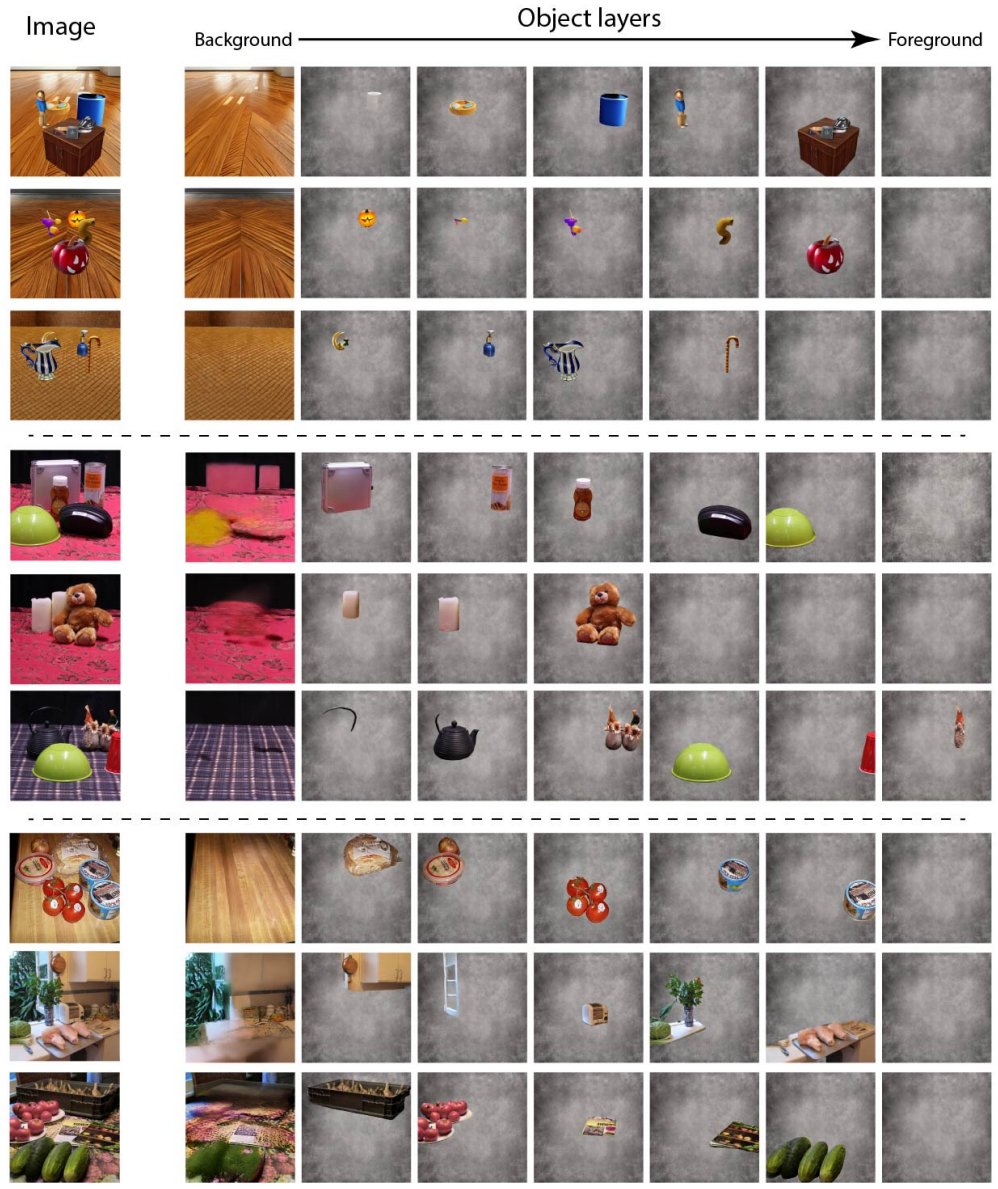
The central device is a bank of N concurrently denoising latent diffusion UNets: N frozen copies of Stable Diffusion 2.1, each responsible for one object layer, connected by learnable lateral cross-attention so layers can communicate while being generated together. The other load-bearing mechanism is the guidance loss $L_g = L_c + \lambda L_{\mathrm{psm}}$, where $L_c$ is the compositing loss forcing the decoded layers, composited back-to-front, to match the input image, and $L_{\mathrm{psm}}$ is the prior score matching loss that keeps each layer close to Stable Diffusion's native distribution. The fixed-size stack with empty layers is what lets the model handle unknown object counts.
What would settle it
Run CObL many times on the same real tabletop photo from different random noise initializations, keep only the runs whose composited output matches the input nearly perfectly, and have human raters judge whether the extracted layers correspond to actual objects and occlusion order. If equally-compositing outputs disagree on object boundaries, object counts, or stacking order at a rate near chance, then the compositing constraint alone is satisfied by arbitrary stacks and the learned prior is not resolving the underdetermination.
Extended reading notes
Core claim
The central claim is that an occlusion-ordered stack of amodal object layers—not just visible segmentation—can be inferred from a single image by a concurrent diffusion process. CObL instantiates N frozen Stable Diffusion UNets, one per layer, coupled by trainable lateral attention and conditioned on the input image through a lightweight adapter that first estimates depth with MiDaS. Training uses only 2,250 synthetic tabletop scenes assembled from 600 3D assets, with 2,000 for training; the layers are padded with empty layers so the stack has fixed size. During DDIM sampling, the model applies compositional guidance, which measures the $\ell^2$ error between the input and the composite of t
Load-bearing premise
The central claim depends on the guidance and learned prior picking out a human-plausible object decomposition, since many different layer stacks can composite to the exact same input image and the paper acknowledges that its layers will generally recomposite correctly even when the decomposition is wrong.
Editorial extensions
If this is right
- Amodal completion can be performed for all objects in a scene at once, without user-provided masks or prompts, whereas current alternatives complete one object at a time and require an oracle mask.
- A model trained only on synthetic tabletop renders transfers to real photographs with novel objects and variable object counts, indicating that a generative prior plus compositing guidance can bridge a substantial sim-to-real gap.
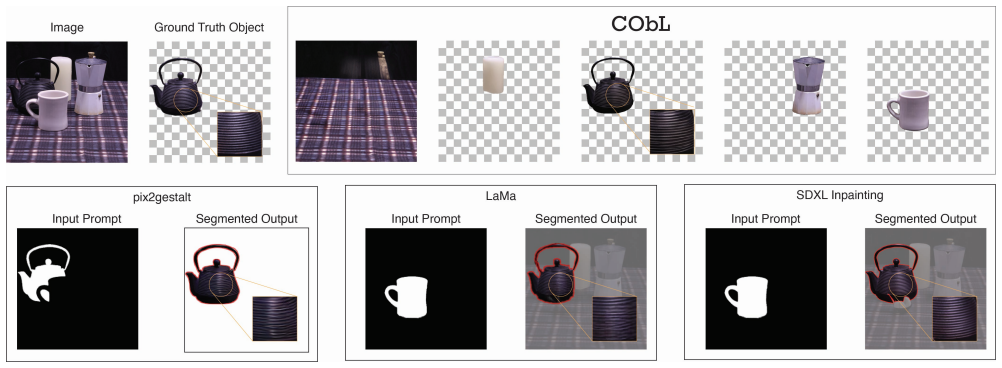
- Because output layers composite back to the input by construction, visible regions such as text and fine texture are preserved instead of hallucinated, a property the paper demonstrates against inpainting baselines.
- Performance degrades when scenes contain more than four objects, so the method's practical range is limited by clutter and by the memory cost of running many UNets.
- The model also produces a valid visible panoptic segmentation as a by-product, reaching a top-1 ARI of 83.5% on the introduced TABLETOP dataset without finetuning.
Reading between the lines
- Because the paper itself notes in Sec. S3 that different layer stacks can composite to the same image, the real test of 'correct' layering is whether the prior-score-matching term, not the compositing loss, picks human-plausible objects; an experiment that varies random seeds and asks human raters to choose among equally-compositing stacks would separate those two effects.
- The fixed-size stack with empty layers effectively lets the model discover object count from the image; a natural extension is to read off a count from the alpha channels and to evaluate count accuracy separately from shape accuracy.
- The synthetic-data pipeline decouples geometry from texture, so the same machinery should transfer to other scene geometries such as shelves or ground scenes as long as a matching depth-conditioned generator is available; the paper explicitly says the idea extends beyond tabletops.
- Merging and splitting failures suggest the unit of decomposition is dictated as much by the Stable Diffusion prior as by the image; using a prior trained on objects rather than scenes might reduce these failures, and measuring the rate of merge/split errors directly would be a sharper metric than LPIPS.
Editorial analysis
A structured set of objections, weighed in public.
Referee Report
Summary. The paper introduces CObL, a diffusion-based architecture that takes a single image and jointly generates an occlusion-ordered stack of amodally-completed object layers (RGBA with binary alpha), without user prompting and without prior knowledge of the number of objects. The model consists of several frozen Stable Diffusion UNets tied by learnable lateral attention and an input-conditioning adapter. It is trained on 2000 synthetic tabletop scenes generated via a novel pipeline combining Blender geometry, ControlNet-depth textures, and composited shadows. At inference, compositional guidance (Eq. 7) forces the stack to composite back to the input, and a prior-score-matching loss (Eq. 8) keeps each layer within the SD natural-image distribution. The authors evaluate on a new real-world dataset, TABLETOP (100 images), reporting LPIPS/CLIP scores against prior amodal-completion/inpainting models and ARI against Mask2Former. The central claim is that the model zero-shot generalizes to real tabletop photographs containing novel objects and variable object counts.
Significance. If the central claim is upheld, CObL is a meaningful step toward open-world perceptual organization: it addresses the full amodal, multiple-object, occlusion-ordered decomposition problem without any per-image prompting, and it demonstrates a practical way to adapt a large pretrained generative prior to a structured scene representation with limited synthetic data. The paper's strengths include a concrete and reproducible pipeline, a new benchmark (TABLETOP) with ground-truth layers, explicit reporting of both best and average runs in some comparisons, and a candid discussion of non-uniqueness and failure modes in the supplementary material. The central risk is that the evaluation does not cleanly separate 'true' amodal object decomposition from arbitrary compositing-equivalent stacks, and the use of best-of-seeds selection for headline numbers tempers confidence.
major comments (4)
- [§5.1, Eq. (7), Sec. S3] The LPIPS/CLIP metrics on the full layer images do not isolate amodal semantic correctness. Because the compositional loss Lc only enforces equality of the composite, and Sec. S3 explicitly states that many layer stacks composite to the same input (Fig. S3), a model could produce arbitrary occluded-region content while scoring well on visible-region fidelity. Table 1 therefore does not establish that the inferred layers are the true amodally-completed objects rather than some other compositing-consistent stack. The authors should add amodal-mask IoU (e.g., comparing alpha masks over occluded regions), separate visible/occluded-region metrics, or a human perceptual study of completion correctness.
- [§5.1, §5.2, Sec. S5] The paper reports best-of-four-seed results as the primary numbers (Table 1) and uses top-1 for the ARI claim (Sec. 5.2). Sec. S5 acknowledges that CObL's outputs are highly initialization-dependent and non-convex, and that in practice the authors 'choose the most likely output' without specifying a formal selection rule. This best-run selection can systematically overstate the method's reliability, which is load-bearing for the zero-shot generalization claim. The authors should report the full distribution over seeds (with variance or box plots) and define and validate a selection criterion (e.g., lowest compositional loss) that is shown to correlate with human quality.
- [§3.3, Eq. (3), Sec. S3] The inference-time guidance terms Lc and PSM do not themselves prefer the ground-truth object structure: Lc is invariant to merging/splitting and occlusion-order changes within the equivalence class, and PSM only encourages each layer to be a natural image. The only signal that prefers the true decomposition is the synthetic training objective (Eq. 3). Given the acknowledged non-uniqueness, the paper should directly quantify how often the learned decomposition transfers to real data: e.g., report merging/splitting rates on TABLETOP (as in Sec. S4) and show that they are not the dominant mode, and ideally provide a per-scene analysis across object counts, especially for the 5-6 object cases where performance degrades (Fig. 7). Without this, aggregate LPIPS/CLIP may hide a model that composites well but groups pixels arbitrarily.
- [§5.1, Table 1] The comparison to inpainting/amodal-completion baselines is asymmetric: CObL is specifically trained on synthetic tabletop scenes, while baselines are frozen generic models, even though the baselines receive oracle masks. This asymmetry makes the quantitative comparison hard to interpret as a measure of the full task. At minimum, the paper should also compare against an unsupervised object-centric learning baseline (e.g., a slot-attention or DINO-based method) on the same TABLETOP benchmark, or ablate CObL's own components (as in Sec. 6) to isolate the contribution of the synthetic training prior. The current Table 1 does not let a reader assess whether the advantage comes from the architecture, the training data, or the evaluation protocol.
minor comments (3)
- [Sec. 2, references [5] and [6]] The arXiv identifier for Stable Video Diffusion is mistyped as 'arXiv:311.15127' (should be 2311.15127), and reference [6] contains a stray page number '1' at the end. Please correct these bibliographic entries.
- [Sec. 5.3 and Sec. 6] There are minor typos: 'We we find' in Sec. 5.3, 'LPIPs' in Sec. 6, and inconsistent capitalization 'CoBL' vs 'CObL' in Sec. 5.2. These should be fixed in a final polish.
- [Abstract and Sec. 7] The abstract claims CObL is 'not limited to the world it was trained in,' but the evaluation is confined to tabletop scenes. This is acceptable given the paper's scope, but the wording should be softened to avoid overclaiming, especially since Sec. 7 itself restricts the conclusions to tabletops.
Circularity Check
No significant circularity: the paper's central zero-shot claim is tested against a held-out real-image benchmark, and no fitted parameter or self-citation is repackaged as a prediction.
full rationale
The paper's derivation chain is not circular. CObL is trained on 2000 synthetic tabletop scenes with ground-truth object layers generated by the pipeline of Sec. 3.1, and its zero-shot claim is evaluated on TABLETOP, a separately captured real-world dataset whose ground-truth layers were obtained by placing objects one at a time (Sec. 4.2). The training loss in Eq. (3) is a standard diffusion denoising objective against synthetic ground-truth latents; the inference-time guidance losses in Eqs. (7) and (8) enforce compositing consistency and naturalness, but these are constraints on the generated stack, not redefinitions of the ground truth. The paper explicitly acknowledges in Sec. S3 that many decompositions composite back to the same image; this is an identifiability limitation of the compositing loss, not a circular derivation, because the model's learned prior from synthetic data is the mechanism intended to select among compositing-equivalent stacks, and the empirical claim is that this transfers to novel real objects. No load-bearing step relies on a self-citation: the authors cite external prior work for Stable Diffusion, ControlNet, MiDaS, U2-Net, and lateral attention, and none of these citations is authored by the present paper's authors. The quantitative evaluation is against externally captured ground-truth layers and external baselines (Mask2Former, pix2gestalt, LaMa, SDXL inpaint), so the reported numbers are not forced by construction. The acknowledged non-convexity and best-of-seeds reporting (Sec. S5) are correctness/robustness concerns, not circularity. Overall, the derivation is self-contained and the central claim is an empirical zero-shot generalization result, so the circularity score is 0.
Assumptions & free parameters
free parameters (5)
- N (number of object layers) =
7
- guidance weight w =
1e4
- balance parameter lambda =
1e-7
- erase threshold =
1%
- sort threshold =
0.1%
assumptions (5)
- domain assumption Stable Diffusion 2.1 provides a strong prior for natural objects and can generate natural object layers from depth cues.
- domain assumption MiDaS depth estimation provides reliable relative depth for a single image.
- domain assumption U2-Net foreground segmentation provides correct masks for decoded layers during guidance.
- domain assumption Synthetic tabletop scenes generated with 3D assets and ControlNet textures are representative of real tabletop photographs.
- standard math The diffusion denoising objective (Eq. 2-3) is differentiable w.r.t. adapters and cross-attention parameters, allowing end-to-end training.
Cite this review
Pith. "Pith review of CObL: Toward Zero-Shot Ordinal Layering without User Prompting." pith.science (2026). https://pith.science/paper/LOSYOVYH
@misc{pith2026250808498,
  author       = {Pith},
  title        = {Pith review of: CObL: Toward Zero-Shot Ordinal Layering without User Prompting},
  year         = {2026},
  howpublished = {\url{https://pith.science/paper/LOSYOVYH}},
  note         = {Machine review of arXiv:2508.08498}
}
read the original abstract
Vision benefits from grouping pixels into objects and understanding their spatial relationships, both laterally and in depth. We capture this with a scene representation comprising an occlusion-ordered stack of "object layers," each containing an isolated and amodally-completed object. To infer this representation from an image, we introduce a diffusion-based architecture named Concurrent Object Layers (CObL). CObL generates a stack of object layers in parallel, using Stable Diffusion as a prior for natural objects and inference-time guidance to ensure the inferred layers composite back to the input image. We train CObL using a few thousand synthetically-generated images of multi-object tabletop scenes, and we find that it zero-shot generalizes to photographs of real-world tabletops with varying numbers of novel objects. In contrast to recent models for amodal object completion, CObL reconstructs multiple occluded objects without user prompting and without knowing the number of objects beforehand. Unlike previous models for unsupervised object-centric representation learning, CObL is not limited to the world it was trained in.
Figures


Figures from the paper (4 more)


Forward citations
Cited by 1 Pith paper
-
An abstract criterion on the existence and global stability of stationary solutions for random dynamical systems and its applications
A new criterion guarantees existence and global stability of stationary solutions of random dynamical systems, and its application shows omega-limit sets of SDE trajectories are nontrivial random equilibria.
Reference graph
Works this paper leans on
-
[1]
http: //www.blender.org, Accessed: 2025
Blender – a 3d modelling and rendering package. http: //www.blender.org, Accessed: 2025. Version 4.2. 5
work page 2025
-
[2]
Adil Kaan Akan and Yucel Yemez. Slot-guided adaptation of pre-trained diffusion models for object-centric learning and compositional generation. arXiv preprint arXiv:2311.15127,
-
[3]
Un- seen object amodal instance segmentation via hierarchical occlusion modeling
Seunghyeok Back, Joosoon Lee, Taewon Kim, Sangjun Noh, Raeyoung Kang, Seongho Bak, and Kyoobin Lee. Un- seen object amodal instance segmentation via hierarchical occlusion modeling. In 2022 International Conference on Robotics and Automation (ICRA). IEEE, 2022. 2
work page 2022
-
[4]
Multidiffusion: Fusing diffusion paths for controlled image generation
Omer Bar-Tal, Lior Yariv, Yaron Lipman, and Tali Dekel. Multidiffusion: Fusing diffusion paths for controlled image generation. arXiv preprint arXiv:2302.08113, 2023. 2, 4
arXiv 2023
-
[5]
Stable video diffusion: Scaling la- tent video diffusion models to large datasets
Andreas Blattmann, Tim Dockhorn, Sumith Kulal, Daniel Mendelevitch, Maciej Kilian, Dominik Lorenz, Yam Levi, Zion English, Vikram V oleti, Adam Letts, Varun Jampani, and Robin Rombach. Stable video diffusion: Scaling la- tent video diffusion models to large datasets. arXiv preprint arXiv:311.15127, 2023. 2
work page 2023
-
[6]
Align your latents: High-resolution video synthesis with la- tent diffusion models
Andreas Blattmann, Robin Rombach, Huan Ling, Tim Dock- horn, Seung Wook Kim, Sanja Fidler, and Karsten Kreis. Align your latents: High-resolution video synthesis with la- tent diffusion models. In Proceedings of the IEEE/CVF con- ference on computer vision and pattern recognition, 2023. 2, 3, 1
work page 2023
-
[7]
In- structpix2pix: Learning to follow image editing instructions
Tim Brooks, Aleksander Holynski, and Alexei A Efros. In- structpix2pix: Learning to follow image editing instructions. In CVPR, 2023. 2
2023
-
[8]
MONet: Unsupervised scene decomposition and representation
Christopher P Burgess, Loic Matthey, Nicholas Watters, Rishabh Kabra, Irina Higgins, Matt Botvinick, and Alexan- der Lerchner. MONet: Unsupervised scene decomposition and representation. arXiv preprint arXiv:1901.11390, 2019. 2
arXiv 1901
Show all 61 references
-
[9]
Emerg- ing properties in self-supervised vision transformers
Mathilde Caron, Hugo Touvron, Ishan Misra, Herv ´e J´egou, Julien Mairal, Piotr Bojanowski, and Armand Joulin. Emerg- ing properties in self-supervised vision transformers. In ICCV, 2021. 2
2021
-
[10]
Mask2former for video instance segmentation
Bowen Cheng, Anwesa Choudhuri, Ishan Misra, Alexan- der Kirillov, Rohit Girdhar, and Alexander G Schwing. Mask2former for video instance segmentation. arXiv preprint arXiv:2112.10764, 2021. 8
2021 arXiv
-
[11]
Latentpaint: Image inpainting in latent space with diffusion models
Ciprian Corneanu, Raghudeep Gadde, and Aleix M Mar- tinez. Latentpaint: Image inpainting in latent space with diffusion models. In Proceedings of the IEEE/CVF winter conference on applications of computer vision, 2024. 2, 8
2024
-
[12]
Object- driven multi-layer scene decomposition from a single image
Helisa Dhamo, Nassir Navab, and Federico Tombari. Object- driven multi-layer scene decomposition from a single image. In ICCV, 2019. 2
2019
-
[13]
Reduce, reuse, recycle: Compositional generation with energy-based diffusion models and mcmc
Yilun Du, Conor Durkan, Robin Strudel, Joshua B Tenen- baum, Sander Dieleman, Rob Fergus, Jascha Sohl-Dickstein, Arnaud Doucet, and Will Sussman Grathwohl. Reduce, reuse, recycle: Compositional generation with energy-based diffusion models and mcmc. In International conference...
2023
-
[14]
Learning to see the invisible: End-to-end trainable amodal instance segmen- tation
Patrick Follmann, Rebecca K ¨onig, Philipp H ¨artinger, Michael Klostermann, and Tobias B ¨ottger. Learning to see the invisible: End-to-end trainable amodal instance segmen- tation. In 2019 IEEE Winter Conference on Applications of Computer Vision (WACV). IEEE, 2019. 3
2019
-
[15]
Bermano, Gal Chechik, and Daniel Cohen- Or
Rinon Gal, Yuval Alaluf, Yuval Atzmon, Or Patash- nik, Amit H. Bermano, Gal Chechik, and Daniel Cohen- Or. An image is worth one word: Personalizing text-to- image generation using textual inversion. arXiv preprint arXiv:2208.01618, 2022. 2
2022 arXiv
-
[16]
Multi-object representation learning with iterative variational inference
Klaus Greff, Rapha ¨el Lopez Kaufman, Rishabh Kabra, Nick Watters, Christopher Burgess, Daniel Zoran, Loic Matthey, Matthew Botvinick, and Alexander Lerchner. Multi-object representation learning with iterative variational inference. In International conference on machine lear...
-
[17]
Classifier-free diffusion guidance
Jonathan Ho and Tim Salimans. Classifier-free diffusion guidance. arXiv preprint arXiv:2207.12598, 2022. 5
2022 arXiv
-
[18]
Denoising dif- fusion probabilistic models
Jonathan Ho, Ajay Jain, and Pieter Abbeel. Denoising dif- fusion probabilistic models. Adv. Neural Inform. Process. Syst., 2020. 2, 4
2020
-
[19]
Jonathan Ho, Tim Salimans, Alexey Gritsenko, William Chan, Mohammad Norouzi, and David J. Fleet. Video dif- fusion models. Adv. Neural Inform. Process. Syst., 35:8633– 8646, 2022. 2
2022
-
[20]
Hsiao and M
E. Hsiao and M. Hebert. Occlusion reasoning for object de- tection under arbitrary viewpoint. In CVPR. IEEE, 2012. 6, 8
2012
-
[21]
Substance 3d assets library
Adobe Inc. Substance 3d assets library. https : / / substance3d . adobe . com / assets/. Accessed: 2025-03-07. 5
2025
-
[22]
Lawrence Zitnick, and Ross Girshick
Justin Johnson, Bharath Hariharan, Laurens van der Maaten, Li Fei-Fei, C. Lawrence Zitnick, and Ross Girshick. Clevr: A diagnostic dataset for compositional language and elemen- tary visual reasoning. In CVPR, 2017. 2
2017
-
[23]
Clevrtex: A texture-rich benchmark for unsupervised multi- object segmentation
Laurynas Karazija, Iro Laina, and Christian Rupprecht. Clevrtex: A texture-rich benchmark for unsupervised multi- object segmentation. arXiv preprint arXiv:2111.10265 ,
-
[24]
Repurpos- ing diffusion-based image generators for monocular depth estimation
Bingxin Ke, Anton Obukhov, Shengyu Huang, Nando Met- zger, Rodrigo Caye Daudt, and Konrad Schindler. Repurpos- ing diffusion-based image generators for monocular depth estimation. In ICCV, 2024. 2, 8
2024
-
[25]
Deep occlusion- aware instance segmentation with overlapping bilayers
Lei Ke, Yu-Wing Tai, and Chi-Keung Tang. Deep occlusion- aware instance segmentation with overlapping bilayers. In CVPR, 2021. 2
2021
-
[26]
Panoptic segmentation
Alexander Kirillov, Kaiming He, Ross Girshick, Carsten Rother, and Piotr Doll ´ar. Panoptic segmentation. In CVPR,
-
[27]
Berg, Wan-Yen Lo, Piotr Doll ´ar, and Ross Girshick
Alexander Kirillov, Eric Mintun, Nikhila Ravi, Hanzi Mao, Chloe Rolland, Laura Gustafson, Tete Xiao, Spencer White- head, Alexander C. Berg, Wan-Yen Lo, Piotr Doll ´ar, and Ross Girshick. Segment anything. In ICCV, 2023. 5
2023
-
[28]
The hungarian method for the assignment problem
Harold W Kuhn. The hungarian method for the assignment problem. Naval research logistics quarterly , 2(1-2):83–97,
-
[29]
Instance-wise occlusion and depth orders in natural scenes
Hyunmin Lee and Jaesik Park. Instance-wise occlusion and depth orders in natural scenes. In CVPR, 2022. 3 9
2022
-
[30]
Syncdiffusion: Coherent montage via synchronized joint diffusions
Yuseung Lee, Kunho Kim, Hyunjin Kim, and Minhyuk Sung. Syncdiffusion: Coherent montage via synchronized joint diffusions. Adv. Neural Inform. Process. Syst., 2023. 2, 4
2023
-
[31]
Variational amodal object completion.Adv
Huan Ling, David Acuna, Karsten Kreis, Seung Wook Kim, and Sanja Fidler. Variational amodal object completion.Adv. Neural Inform. Process. Syst., 33:16246–16257, 2020. 2
2020
-
[32]
Reda, Kevin J
Guilin Liu, Fitsum A. Reda, Kevin J. Shih, Ting-Chun Wang, Andrew Tao, and Bryan Catanzaro. Image inpainting for ir- regular holes using partial convolutions. In ECCV, 2018. 2
2018
-
[33]
Object- centric learning with slot attention
Francesco Locatello, Dirk Weissenborn, Thomas Un- terthiner, Aravindh Mahendran, Georg Heigold, Jakob Uszkoreit, Alexey Dosovitskiy, and Thomas Kipf. Object- centric learning with slot attention. Adv. Neural Inform. Pro- cess. Syst., 2020. 2
2020
-
[34]
Repaint: Inpainting using denoising diffusion probabilistic models
Andreas Lugmayr, Martin Danelljan, Andres Romero, Fisher Yu, Radu Timofte, and Luc Van Gool. Repaint: Inpainting using denoising diffusion probabilistic models. In CVPR,
-
[35]
A database of human segmented natural images and its application to evaluating segmentation algorithms and measuring ecological statistics
David Martin, Charless Fowlkes, Doron Tal, and Jitendra Malik. A database of human segmented natural images and its application to evaluating segmentation algorithms and measuring ecological statistics. In ICCV, 2001. 3
2001
-
[36]
Unsupervised layered image decomposition into ob- ject prototypes
Tom Monnier, Elliot Vincent, Jean Ponce, and Mathieu Aubry. Unsupervised layered image decomposition into ob- ject prototypes. In ICCV, 2021. 1, 2
2021
-
[37]
T2i- adapter: Learning adapters to dig out more controllable abil- ity for text-to-image diffusion models
Chong Mou, Xintao Wang, Liangbin Xie, Yanze Wu, Jian Zhang, Zhongang Qi, Ying Shan, and Xiaohu Qie. T2i- adapter: Learning adapters to dig out more controllable abil- ity for text-to-image diffusion models. In AAAI, 2024. 4, 1
2024
-
[38]
pix2gestalt: Amodal segmentation by synthesizing wholes
Ege Ozguroglu, Ruoshi Liu, D ´ıdac Sur´ıs, Dian Chen, Achal Dave, Pavel Tokmakov, and Carl V ondrick. pix2gestalt: Amodal segmentation by synthesizing wholes. In CVPR. IEEE Computer Society, 2024. 2, 7
2024
-
[39]
Vision science: Photons to phenomenol- ogy
Stephen E Palmer. Vision science: Photons to phenomenol- ogy. MIT press, 1999. 1
1999
-
[40]
Sdxl: Improving latent diffusion mod- els for high-resolution image synthesis
Dustin Podell, Zion English, Kyle Lacey, Andreas Blattmann, Tim Dockhorn, Jonas M ¨uller, Joe Penna, and Robin Rombach. Sdxl: Improving latent diffusion mod- els for high-resolution image synthesis. arXiv preprint arXiv:2307.01952, 2023. 7
2023 arXiv
-
[41]
Barron, and Ben Milden- hall
Ben Poole, Ajay Jain, Jonathan T. Barron, and Ben Milden- hall. Dreamfusion: Text-to-3d using 2d diffusion. arXiv preprint arXiv:2209.14988, 2022. 4
2022 arXiv
-
[42]
Virtualhome: Simulating household activities via programs
Xavier Puig, Kevin Ra, Marko Boben, Jiaman Li, Tingwu Wang, Sanja Fidler, and Antonio Torralba. Virtualhome: Simulating household activities via programs. In CVPR,
-
[43]
Amodal instance segmentation with kins dataset
Lu Qi, Li Jiang, Shu Liu, Xiaoyong Shen, and Jiaya Jia. Amodal instance segmentation with kins dataset. In CVPR,
-
[44]
U2-net: Going deeper with nested u-structure for salient object detection
Xuebin Qin, Zichen Zhang, Chenyang Huang, Masood De- hghan, Osmar Zaiane, and Martin Jagersand. U2-net: Going deeper with nested u-structure for salient object detection. Pattern Recognition, 106:107404, 2020. 4
2020
-
[45]
Learning transferable visual models from natural language supervision
Alec Radford, Jong Wook Kim, Chris Hallacy, Aditya Ramesh, Gabriel Goh, Sandhini Agarwal, Girish Sastry, Amanda Askell, Pamela Mishkin, Jack Clark, Gretchen Krueger, and Ilya Sutskever. Learning transferable visual models from natural language supervision. In International con...
2021
-
[46]
Towards robust monocular depth estimation: Mixing datasets for zero-shot cross-dataset transfer
Ren ´e Ranftl, Katrin Lasinger, David Hafner, Konrad Schindler, and Vladlen Koltun. Towards robust monocular depth estimation: Mixing datasets for zero-shot cross-dataset transfer. IEEE transactions on pattern analysis and machine intelligence, 44(3):1623–1637, 2020. 4
2020
-
[47]
Dinesh Reddy, Robert Tamburo, and Srinivasa G
N. Dinesh Reddy, Robert Tamburo, and Srinivasa G. Narasimhan. W ALT: Watch and learn 2d amodal representa- tion from time-lapse imagery. In CVPR, 2022. 2
2022
-
[48]
High-resolution image syn- thesis with latent diffusion models
Robin Rombach, Andreas Blattmann, Dominik Lorenz, Patrick Esser, and Bj¨orn Ommer. High-resolution image syn- thesis with latent diffusion models. In CVPR, 2022. 2
2022
-
[49]
Bridging the gap to real-world object-centric learning
Maximilian Seitzer, Max Horn, Andrii Zadaianchuk, Do- minik Zietlow, Tianjun Xiao, Carl-Johann Simon-Gabriel, Tong He, Zheng Zhang, Bernhard Sch¨olkopf, Thomas Brox, and Francesco Locatello. Bridging the gap to real-world object-centric learning. arXiv preprint arXiv:2209.14860 ,
-
[50]
Denoising diffusion implicit models
Jiaming Song, Chenlin Meng, and Stefano Ermon. Denoising diffusion implicit models. arXiv preprint arXiv:2010.02502, 2022. 4
2010 arXiv
-
[51]
Resolution-robust large mask inpainting with fourier convolutions
Roman Suvorov, Elizaveta Logacheva, Anton Mashikhin, Anastasia Remizova, Arsenii Ashukha, Aleksei Silvestrov, Naejin Kong, Harshith Goka, Kiwoong Park, and Victor Lempitsky. Resolution-robust large mask inpainting with fourier convolutions. In Proceedings of the IEEE/CVF win- ...
2022
-
[52]
Diffuse, attend, and segment: Unsupervised zero-shot segmentation using stable diffusion
Junjiao Tian, Lavisha Aggarwal, Andrea Colaco, Zsolt Kira, and Mar Gonzalez-Franco. Diffuse, attend, and segment: Unsupervised zero-shot segmentation using stable diffusion. In CVPR, 2024. 2
2024
-
[53]
Merging and transformation of raster im- ages for cartoon animation
Bruce A Wallace. Merging and transformation of raster im- ages for cartoon animation. In Proceedings of the 8th an- nual conference on Computer graphics and interactive tech- niques, 1981. 3
1981
-
[54]
Amodal com- pletion via progressive mixed context diffusion
Katherine Xu, Lingzhi Zhang, and Jianbo Shi. Amodal com- pletion via progressive mixed context diffusion. In CVPR,
-
[55]
Dif- fusion probabilistic modeling for video generation
Ruihan Yang, Prakhar Srivastava, and Stephan Mandt. Dif- fusion probabilistic modeling for video generation. Entropy, 25(10):1469, 2023. 2
2023
-
[56]
Learning visual parkour from generated images
Alan Yu, Ge Yang, Ran Choi, Yajvan Ravan, John Leonard, and Phillip Isola. Learning visual parkour from generated images. In 8th Annual Conference on Robot Learning, 2024. 3
2024
-
[57]
Amodal ground truth and completion in the wild
Guanqi Zhan, Chuanxia Zheng, Weidi Xie, and Andrew Zis- serman. Amodal ground truth and completion in the wild. In CVPR, 2024. 2, 3, 8
2024
-
[58]
Self-supervised scene de- occlusion
Xiaohang Zhan, Xingang Pan, Bo Dai, Ziwei Liu, Dahua Lin, and Chen Change Loy. Self-supervised scene de- occlusion. In CVPR, 2020. 2 10
2020
-
[59]
Adding conditional control to text-to-image diffusion models
Lvmin Zhang, Anyi Rao, and Maneesh Agrawala. Adding conditional control to text-to-image diffusion models. In ICCV, 2023. 2, 3
2023
-
[60]
The unreasonable effectiveness of deep features as a perceptual metric
Richard Zhang, Phillip Isola, Alexei A Efros, Eli Shechtman, and Oliver Wang. The unreasonable effectiveness of deep features as a perceptual metric. In CVPR, 2018. 7
2018
-
[61]
a(n) {object label}, in a well lit and empty room, {modifier string}
Yan Zhu, Yuandong Tian, Dimitris Mexatas, and Piotr Doll´ar. Semantic amodal segmentation. In CVPR, 2017. 2, 3 11 CObL: Toward Zero-Shot Ordinal Layering without User Prompting Supplementary Material S1. Details of synthetic generation pipeline In the Blender 3D modeling step,...
2017
Reviewed August 5, 2026 · model on record in the stance chip above.
Discussion (0). Sign in to comment.