REVIEW 3 major objections 5 minor 51 references
Hybrid Long and Short Range Flows for Point Cloud Filtering
T0 review · 3 major / 5 minor · reviewed 2026-08-05 · deepseek-v4-flash
Pith's one-line read HybridPF claims that combining short-range score and long-range flow information improves point cloud denoising, reducing clustering and overshoot.
desk verdict Solid hybrid-flow point cloud filter whose high-noise gains depend on test-time tuned step size; deserves review but needs code and a less overstated generalization claim. read the letter →
The pith
A machine-rendered reading of the paper's core claim, the machinery that carries it, and where it could break.
The reading
What carries the argument
Two mechanisms carry the argument. First, hybrid conditioning: the LongModule encoder's latent features, trained to estimate the long-range velocity $\mathbf{v}(\mathbf{x}_t) = \mathbf{x}_1-\mathbf{x}_0$, are fed into the ShortModule's score estimator, so the short-range update $\mathbf{x}_1-\mathbf{x}_t$ is informed by where the trajectory started and where it should end. Second, a Dynamic EdgeConv decoder that builds a k-nearest-neighbor graph among point features in latent space during decoding, replacing the fully connected decoders used by prior displacement methods. The graph decoder is what lets the network use local feature neighborhoods when converting high-dimensional features to 3
What would settle it
Filter the PUNet sigma=3% test clouds with the same trained model but keep the low-noise step alpha=0.8, without manual rescaling. If Chamfer distance stays at the reported level, the high-noise success is not due to test-time alpha tuning; if CD jumps toward or above StraightPCF's level, the generalization claim depends on knowing sigma. A second check: replace the Dynamic EdgeConv decoder with an FC decoder at equal parameter count and measure CD; a vanishing gap would falsify the decoder's contribution.
Extended reading notes
Core claim
The central claim is that a filter does better when its short-range and long-range trajectory estimates are trained jointly and the long-range ones are allowed to steer the short-range ones. HybridPF trains a LongModule to predict the constant displacement $\mathbf{x}_1-\mathbf{x}_0$ from an intermediate noisy patch $\mathbf{x}_t$, and a ShortModule to predict the score displacement $\mathbf{x}_1-\mathbf{x}_t$ conditional on the LongModule encoder's features. At inference the LongModule decoder is discarded, and the ShortModule is iterated four times with step size $\alpha$. The paper argues this hybrid conditioning, plus a dynamic graph convolutional decoder, removes the clustering that sco
Load-bearing premise
The load-bearing premise is that the input noise level is known at test time, because the reported high-noise results are obtained by manually increasing the step size alpha (e.g., alpha=1.3 at sigma=3%, 10K points); if the noise level is unknown or misestimated, the displacement scaling in Eq. (11) is miscalibrated and the claimed high-noise generalization is not established.
Editorial extensions
If this is right
- On PUNet and PCNet with Gaussian noise, HybridPF matches or exceeds the best competing method on Chamfer distance at nearly every resolution and noise level, including 3% noise unseen in training.
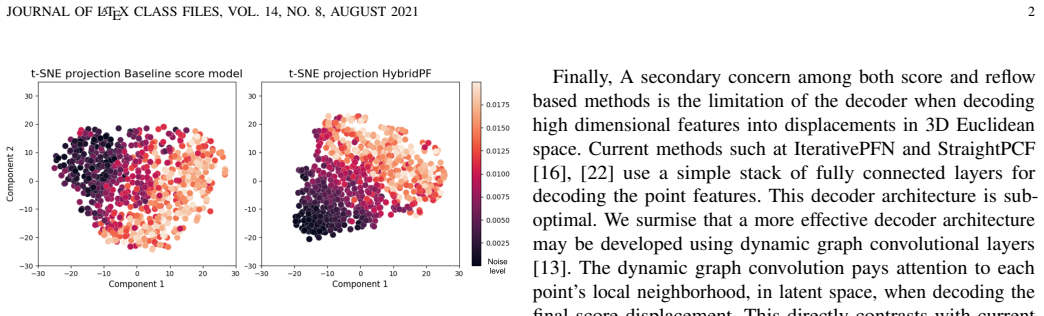
- Combining long-range conditioning with the score branch produces better point distributions and fewer clustering artifacts than score-only baselines.
- The dynamic graph convolutional decoder contributes measurable gains over fully connected decoders at equal parameter count, as shown by the HybridPFv1 ablation.
- Inference is faster than IterativePFN and StraightPCF because high noise does not require repeating the entire filtering run; only the step size changes.
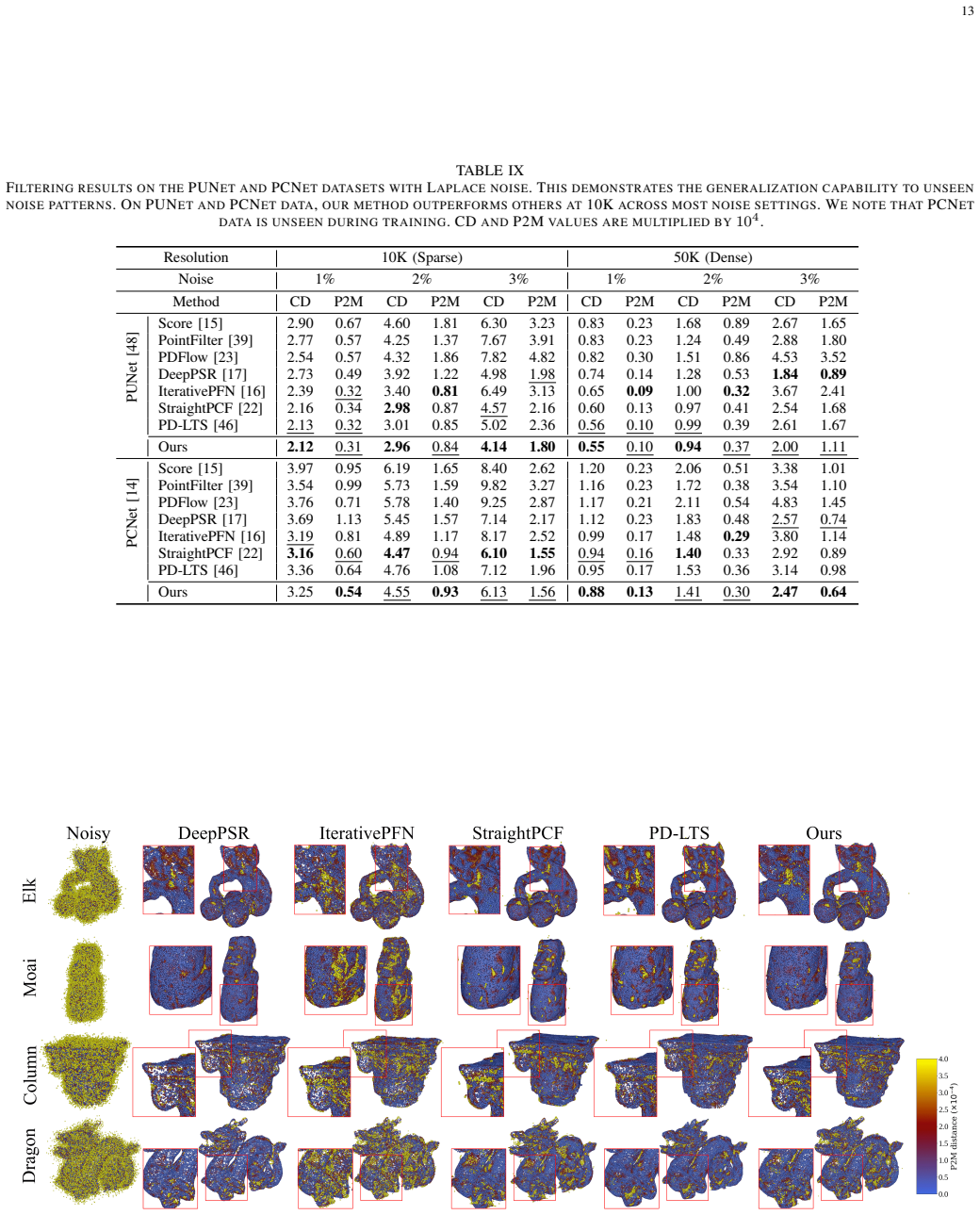
- The method generalizes beyond Gaussian noise, achieving best or second-best results on non-isotropic, uniform, and Laplace noise patterns in the supplementary experiments.
Reading between the lines
- The reported dependence on a hand-set step size for high noise suggests the method's generalization is partly calibration, not purely learned; a natural extension is to predict the displacement scale from the input patch so the noise level need not be known at test time.
- The hybrid flow idea is generic: any trajectory task with a coarse-to-fine map, such as point cloud upsampling or generation, could condition short-range updates on long-range displacement features.
- The paper's logic implies hybrid conditioning should matter most where long-range information is least ambiguous, namely high noise and sparse clouds; the growing ablation gap from 1% to 3% noise is consistent with that hypothesis but is not tested as a separate claim.
- Because the LongModule decoder is discarded at inference, it acts as a training-time regularizer; one could test whether distilling the long-range features alone or removing the decoder entirely changes the final filtering quality.
Editorial analysis
A structured set of objections, weighed in public.
Referee Report
Summary. The paper proposes HybridPF, a point cloud filtering method that combines a ShortModule (score/displacement estimation) and a LongModule (straight-flow displacement estimation), where long-range features from the LongEncoder condition the ShortModule. The authors also replace fully connected decoders with dynamic graph convolutional layers. Training uses a joint EMD-plus-flow loss; at inference, iterative updates with step size alpha are applied. Experiments are reported on PUNet, PCNet, Kinect, and Paris-Rue-Madame data under Gaussian, non-isotropic Gaussian, uniform, and Laplace noise, with the method claimed to achieve state-of-the-art Chamfer distances and competitive Point2Mesh distances at comparable or better runtime. The supplementary material describes ablations and test-time tuning of alpha per noise level and resolution.
Significance. If the reported gains hold under a fixed evaluation protocol, the hybrid conditioning and dynamic graph decoder are useful contributions to point cloud filtering. The paper's ablations are matched in parameter count and show consistent improvements from the LongModule and the Dynamic EdgeConv decoder, and the evaluation breadth across multiple datasets and noise patterns is a strength. The main weakness is that the high-noise state-of-the-art claim depends on test-time alpha selection rather than a fixed or self-calibrating schedule, and no error bars or code are provided. The long-range 'guidance' is also not an independent information source: both modules are trained on the same (x0, x1) pairs and the LongEncoder feature is a deterministic function of x_t. The empirical gains are still meaningful, but the interpretation and the generalization claim need to be qualified.
major comments (3)
- [Sec. IV-B, Eq. (10)-(11), Supplementary Sec. A] The sigma=3% results are obtained with alpha=1.3 at 10K and alpha=1.5 at 50K, while sigma<=2% uses alpha=0.8. Since the ShortModule has no noise-level input and is trained only with sigma_H=2%, the network cannot self-calibrate to 3% noise; the reported high-noise gains are partly an artifact of test-time calibration to the known noise level. The claim that HybridPF 'generalizes well to high noise levels unseen during training' is therefore not established for unknown or misestimated sigma. Please report results with a single alpha, or provide a principled/self-calibrating scaling rule, and include a sensitivity analysis of alpha. If this is not feasible, the generalization claim should be weakened accordingly.
- [Table I and Table IV] Headline differences are small, e.g., PUNet 50K sigma=3% CD 1.27 vs 1.31 for StraightPCF, and PUNet 10K sigma=1% CD is tied with PD-LTS at 1.83. No error bars, per-shape breakdowns, or significance tests are reported. Moreover, the P2M advantage is not uniform: at PUNet 50K sigma=3%, DeepPSR achieves 0.58 vs 0.61 for Ours; at 10K sigma=3%, PD-LTS achieves 1.10 vs 1.11 for Ours. The claim of 'best CD results' is supported, but 'almost all metrics' is overstated. Please provide variance or statistical evidence and qualify the claim accordingly.
- [Sec. III-D and III-E] The conceptual claim that 'long-range information guides short-range scores' is not directly demonstrated. The LongModule and ShortModule are trained on the same (x0, x1) pairs, and the conditioning feature E_L(x_t; phi1) is a deterministic function of the same input x_t; thus the conditioning is a learned feature, not an independent source of information about x1. The ablation does support the empirical benefit of the architecture, but the paper should avoid implying that long-range information is external to the score estimator. In addition, Eq. (10)-(11) set the input noisy patch as x_tilde_0 even though 'the starting time for the filtering process is not known'; this needs clarification because the network is trained on x_t at variable t.
minor comments (5)
- [Abstract / Table III] The abstract claims 'faster inference speed,' but Table III shows PD-LTS at 13.46s vs Ours at 15.56s. Please specify that the improvement is over IterativePFN and StraightPCF rather than all baselines.
- [Eq. (3)] The target (x1 - x_t) is called a score, but the score would be (x1 - x_t)/sigma^2 under Eq. (2). Please clarify the notation or explicitly state that the network predicts a displacement rather than a normalized score.
- [Sec. VI] Typo: 'close to the the original clean points' should read 'close to the original clean points'.
- [Supplementary Sec. A] The supplement labels both the overall section and the first subsection as 'A'. Please renumber to avoid confusion.
- [General] No code or checkpoints are provided. Given the small metric differences that constitute the headline results, releasing code would materially aid verification.
Circularity Check
High-noise state-of-the-art results are partly produced by a test-time fitted step size α, so the 'generalization to unseen high noise' claim reduces in part to calibration; the hybrid-flow core is otherwise independently evaluated.
-
fitted input called prediction
[Supplementary Sec. A ('Discussion on the discretization parameter α and iteration number N'); Eq. (10)-(11); Table I]
"the network overspecializes on the training noise scales, where the maximum noise level is σ = 2% . Therefore, for filtered displacements of point clouds at higher noise, we can simply vary α at test time to scale the inferred displacements. In general, for 0% ≤ σ ≤ 2%, we set α = 0.8 based on empirical results. This procedure is similar to the way in which ScoreDenoise [15] and DeepPSR [17] obtain α. For σ = 3% and 10K resolution, we set α = 1.3. Similarly, at σ = 3% and 50K resolution, we set α = 1.5."
Eq. (11) sets the filtered position as x~1 = x~0 + α Σ_t s(...); α multiplies the whole learned displacement. The supplementary states the network 'overspecializes' on σ≤2% and that one can 'simply vary α at test time' to 1.3 (10K) or 1.5 (50K) for σ=3%. Since the model is trained only at σ_H=2% and has no noise-level input, the σ=3% results in Table I are produced by scaling the output to the known test noise, i.e., a fitted test-time constant is presented as generalization to unseen high noise. The remainder of the method is held-out evaluated against external baselines, so the circularity is partial.
full rationale
The central derivation is not otherwise circular. Eqs. (3), (6)-(9) restate the standard score-matching and rectified-flow objectives; the long-range flow (x1-x0) and short-range score (x1-x_t) are both defined from the same clean/noisy pairs and are algebraically linked by Eq. (6) (x1-x_t = (1-t)(x1-x0)), but this is an acknowledged modeling choice rather than a hidden equivalence of the claimed result to its inputs. The citations of the authors' own IterativePFN [16] and StraightPCF [22] are not load-bearing in a circular sense: the needed equations appear in the paper itself and the comparisons are to externally reported numbers. The one concrete reduction is the test-time α calibration: the high-noise claim is partly forced by choosing α per noise level/resolution. This raises the score to 4 but not higher, because the main empirical contribution (hybrid guidance plus graph decoder, tested at σ=1%,2% and on unseen datasets) retains independent content and would stand even if the σ=3% calibration were removed.
Assumptions & free parameters
free parameters (5)
- alpha (inference step size) =
0.8 for sigma<=2%, 1.3 for sigma=3% 10K, 1.5 for sigma=3% 50K
- lambda (loss weight) =
10.0
- N (number of filtering iterations) =
4
- sigma_H (training noise scale) =
2% of bounding sphere radius
- k (graph neighbors) =
32
assumptions (5)
- domain assumption Reverse SDE score matching (Eq. 2) provides the filtering displacement grad_x log p(x_t) = (x_1 - x_t)/sigma^2.
- domain assumption Intermediate noisy patches satisfy linear interpolation x_t = (1-t)x_0 + t x_1 (Eq. 6).
- domain assumption x_0 and x_1 are independent and identically distributed samples from Pi_0 and Pi_1.
- domain assumption Training on PUNet with isotropic Gaussian noise at sigma_H=2% transfers to unseen noise types (non-isotropic, uniform, Laplace, Kinect, LiDAR).
- domain assumption Dynamic graph convolution (DGCNN [13]) is an effective encoder and decoder backbone for point features.
Cite this review
Pith. "Pith review of Hybrid Long and Short Range Flows for Point Cloud Filtering." pith.science (2026). https://pith.science/paper/62XYEG6F
@misc{pith2026250808542,
  author       = {Pith},
  title        = {Pith review of: Hybrid Long and Short Range Flows for Point Cloud Filtering},
  year         = {2026},
  howpublished = {\url{https://pith.science/paper/62XYEG6F}},
  note         = {Machine review of arXiv:2508.08542}
}
abstract
Point cloud capture processes are error-prone and introduce noisy artifacts that necessitate filtering/denoising. Recent filtering methods often suffer from point clustering or noise retaining issues. In this paper, we propose Hybrid Point Cloud Filtering ($\textbf{HybridPF}$) that considers both short-range and long-range filtering trajectories when removing noise. It is well established that short range scores, given by $\nabla_{x}\log p(x_t)$, may provide the necessary displacements to move noisy points to the underlying clean surface. By contrast, long range velocity flows approximate constant displacements directed from a high noise variant patch $x_0$ towards the corresponding clean surface $x_1$. Here, noisy patches $x_t$ are viewed as intermediate states between the high noise variant and the clean patches. Our intuition is that long range information from velocity flow models can guide the short range scores to align more closely with the clean points. In turn, score models generally provide a quicker convergence to the clean surface. Specifically, we devise two parallel modules, the ShortModule and LongModule, each consisting of an Encoder-Decoder pair to respectively account for short-range scores and long-range flows. We find that short-range scores, guided by long-range features, yield filtered point clouds with good point distributions and convergence near the clean surface. We design a joint loss function to simultaneously train the ShortModule and LongModule, in an end-to-end manner. Finally, we identify a key weakness in current displacement based methods, limitations on the decoder architecture, and propose a dynamic graph convolutional decoder to improve the inference process. Comprehensive experiments demonstrate that our HybridPF achieves state-of-the-art results while enabling faster inference speed.
Figures


Figures from the paper (5 more)


Reference graph
Works this paper leans on
-
[1]
Y . Kim, K. Kwon, and D. Mun, “Mesh-offset-based method to generate a delta volume to support the maintenance of partially damaged parts through 3d printing,” Journal of Mechanical Science and Technology , vol. 35, no. 7, pp. 3131–3143, 2021
work page 2021
-
[2]
Point cloud modeling as a bridge between landscape design and planning,
P. R. W. Urech, M. Dissegna, C. Girot, and A. Grêt-Regamey, “Point cloud modeling as a bridge between landscape design and planning,” Landscape and Urban Planning , vol. 203, p. 103903, 2020
work page 2020
-
[3]
Self-supervised pillar motion learning for autonomous driving,
C. Luo, X. Yang, and A. Yuille, “Self-supervised pillar motion learning for autonomous driving,” in CVPR, 2021, Conference Proceedings
work page 2021
-
[4]
Feature preserving point set surfaces based on non linear kernel regression,
A. C. Öztireli, G. Guennebaud, and M. Gross, “Feature preserving point set surfaces based on non linear kernel regression,” Computer Graphics Forum, vol. 28, 2009
work page 2009
-
[5]
S. Fleishman, I. Drori, and D. Cohen-Or, “Bilateral mesh denoising,” ACM SIGGRAPH 2003 Papers , 2003
work page 2003
-
[6]
Semreg: Semantics constrained point cloud registration,
S. Fung, X. Lu, D. d. S. Edirimuni, W. Pan, X. Liu, and H. Li, “Semreg: Semantics constrained point cloud registration,” in Computer Vision – ECCV 2024. Cham: Springer Nature Switzerland, 2025, pp. 293–310
work page 2024
-
[7]
KITTI-360: A novel dataset and benchmarks for urban scene understanding in 2d and 3d,
Y . Liao, J. Xie, and A. Geiger, “KITTI-360: A novel dataset and benchmarks for urban scene understanding in 2d and 3d,” arXiv preprint arXiv:2109.13410, 2021
arXiv 2021
-
[8]
The bilateral filter for point clouds,
J. Digne and C. D. Franchis, “The bilateral filter for point clouds,” Image Process. Line, vol. 7, pp. 278–287, 2017
work page 2017
Show all 51 references
-
[9]
Point cloud denoising via moving rpca,
E. Mattei and A. Castrodad, “Point cloud denoising via moving rpca,” Computer Graphics Forum, vol. 36, pp. 123–137, 2017
2017
-
[10]
Feature graph learning for 3d point cloud denoising,
W. Hu, X. Gao, G. Cheung, and Z. Guo, “Feature graph learning for 3d point cloud denoising,” IEEE Transactions on Signal Processing , vol. 68, pp. 2841–2856, 2020
2020
-
[11]
Pointnet: Deep learning on point sets for 3d classification and segmentation,
C. Qi, H. Su, K. Mo, and L. Guibas, “Pointnet: Deep learning on point sets for 3d classification and segmentation,” 2017 IEEE Conference on Computer Vision and Pattern Recognition (CVPR) , pp. 77–85, 2017
2017
-
[12]
Pointnet++: Deep hierarchical feature learning on point sets in a metric space,
C. R. Qi, L. Yi, H. Su, and L. J. Guibas, “Pointnet++: Deep hierarchical feature learning on point sets in a metric space,” in Advances in Neural Information Processing Systems, vol. 30. Curran Associates, Inc., 2017, Conference Proceedings
2017
-
[13]
Dynamic graph cnn for learning on point clouds,
Y . Wang, Y . Sun, Z. Liu, S. E. Sarma, M. M. Bronstein, and J. M. Solomon, “Dynamic graph cnn for learning on point clouds,” ACM Transactions on Graphics (TOG) , 2019
2019
-
[14]
Pointcleannet: Learning to denoise and remove outliers from dense point clouds,
M.-J. Rakotosaona, V . L. Barbera, P. Guerrero, N. Mitra, and M. Ovs- janikov, “Pointcleannet: Learning to denoise and remove outliers from dense point clouds,” Computer Graphics Forum, vol. 39, 2020
2020
-
[15]
Score-based point cloud denoising,
S. Luo and W. Hu, “Score-based point cloud denoising,” in Proceedings of the IEEE/CVF International Conference on Computer Vision (ICCV) , October 2021, pp. 4583–4592
2021
-
[16]
Iterativepfn: True iterative point cloud filtering,
D. de Silva Edirimuni, X. Lu, Z. Shao, G. Li, A. Robles-Kelly, and Y . He, “Iterativepfn: True iterative point cloud filtering,” in Proceedings of the IEEE/CVF Conference on Computer Vision and Pattern Recognition (CVPR), 6 2023, pp. 13 530–13 539
2023
-
[17]
Deep point set resampling via gradient fields,
H. Chen, B. Du, S. Luo, and W. Hu, “Deep point set resampling via gradient fields,” IEEE Transactions on Pattern Analysis & Machine Intelligence, vol. 45, pp. 2913–2930, 3 2023
2023
-
[18]
Generative modeling by estimating gradients of the data distribution,
Y . Song and S. Ermon, “Generative modeling by estimating gradients of the data distribution,” in Proceedings of the 33rd International Conference on Neural Information Processing Systems . Curran Associates Inc., 2019, Conference Proceedings
2019
-
[19]
Score-based generative modeling through stochastic differential equations,
Y . Song, J. Sohl-Dickstein, D. P. Kingma, A. Kumar, S. Ermon, and B. Poole, “Score-based generative modeling through stochastic differential equations,” in International Conference on Learning Representations, 2021. [Online]. Available: https://openreview.net/forum? id=PxTIG12RRHS
2021
-
[20]
Flow straight and fast: Learning to generate and transfer data with rectified flow,
X. Liu, C. Gong, and Q. Liu, “Flow straight and fast: Learning to generate and transfer data with rectified flow,” in The Eleventh International Conference on Learning Representations, ICLR 2023, Kigali, Rwanda, May 1-5, 2023 . OpenReview.net, 2023
2023
-
[21]
Fast point cloud generation with straight flows,
L. Wu, D. Wang, C. Gong, X. Liu, Y . Xiong, R. Ranjan, R. Krishnamoor- thi, V . Chandra, and Q. Liu, “Fast point cloud generation with straight flows,” in 2023 IEEE/CVF Conference on Computer Vision and Pattern Recognition (CVPR). IEEE Computer Society, 6 2023, pp. 9445–9454
2023
-
[22]
Straightpcf: Straight point cloud filtering,
D. de Silva Edirimuni, X. Lu, G. Li, L. Wei, A. Robles-Kelly, and H. Li, “Straightpcf: Straight point cloud filtering,” in IEEE/CVF Conference on Computer Vision and Pattern Recognition, CVPR 2024, Seattle, WA, USA, June 16-22, 2024 . IEEE, 2024, pp. 20 721–20 730
2024
-
[23]
Pd-flow: A point cloud denoising framework with normalizing flows,
A. Mao, Z. Du, Y .-H. Wen, J. Xuan, and Y .-J. Liu, “Pd-flow: A point cloud denoising framework with normalizing flows,” in The European Conference on Computer Vision (ECCV) , 2022, Conference Proceedings
2022
-
[24]
The approximation power of moving least-squares,
D. Levin, “The approximation power of moving least-squares,” Math. Comput., vol. 67, pp. 1517–1531, 1998
1998
-
[25]
Computing and rendering point set surfaces,
M. Alexa, J. Behr, D. Cohen-Or, S. Fleishman, D. Levin, and C. T. Silva, “Computing and rendering point set surfaces,” IEEE Trans. Vis. Comput. Graph., vol. 9, pp. 3–15, 2003
2003
-
[26]
Point-sampled cell complexes,
A. Adamson and M. Alexa, “Point-sampled cell complexes,” ACM Trans. Graph., vol. 25, pp. 671–680, 2006
2006
-
[27]
Algebraic point set surfaces,
G. Guennebaud and M. Gross, “Algebraic point set surfaces,” in SIGGRAPH 2007, 2007, Conference Proceedings
2007
-
[28]
Surface reconstruction from unorganized points,
H. Hoppe, T. DeRose, T. Duchamp, J. McDonald, and W. Stuetzle, “Surface reconstruction from unorganized points,” Proceedings of the 19th annual conference on Computer graphics and interactive techniques , 1992
1992
-
[29]
Estimating differential quantities using polynomial fitting of osculating jets,
F. Cazals and M. Pouget, “Estimating differential quantities using polynomial fitting of osculating jets,” Computer Aided Geometric Design , vol. 22, no. 2, pp. 121–146, 2005
2005
-
[30]
Similarity based filtering of point clouds,
J. Digne, “Similarity based filtering of point clouds,” 2012 IEEE Com- puter Society Conference on Computer Vision and Pattern Recognition Workshops, pp. 73–79, 2012
2012
-
[31]
L1-sparse reconstruction of sharp point set surfaces,
H. Avron, A. Sharf, C. Greif, and D. Cohen-Or, “L1-sparse reconstruction of sharp point set surfaces,” ACM Trans. Graph. , vol. 29, pp. 135:1– 135:12, 2010
2010
-
[32]
Denoising point sets via l0 minimization,
Y . Sun, S. Schaefer, and W. Wang, “Denoising point sets via l0 minimization,” Comput. Aided Geom. Des. , vol. 35-36, pp. 2–15, 2015
2015
-
[33]
Low rank matrix approx- imation for 3d geometry filtering,
X. Lu, S. Schaefer, J. Luo, L. Ma, and Y . He, “Low rank matrix approx- imation for 3d geometry filtering,” IEEE transactions on visualization and computer graphics , vol. PP, 2020
2020
-
[34]
Parameterization- free projection for geometry reconstruction,
Y . Lipman, D. Cohen-Or, D. Levin, and H. Tal-Ezer, “Parameterization- free projection for geometry reconstruction,” ACM SIGGRAPH 2007 papers, 2007
2007
-
[35]
Consolidation of unorganized point clouds for surface reconstruction,
H. Huang, D. Li, H. Zhang, U. Ascher, and D. Cohen-Or, “Consolidation of unorganized point clouds for surface reconstruction,” ACM SIGGRAPH Asia 2009 papers , 2009
2009
-
[36]
Continuous projection for fast l1 reconstruction,
R. Preiner, O. Mattausch, M. Arikan, R. Pajarola, and M. Wimmer, “Continuous projection for fast l1 reconstruction,” ACM Transactions on Graphics (TOG), vol. 33, pp. 1 – 13, 2014
2014
-
[37]
Deep feature-preserving normal estimation for point cloud filtering,
D. Lu, X. Lu, Y . Sun, and J. Wang, “Deep feature-preserving normal estimation for point cloud filtering,” Computer-Aided Design, vol. 125, 2020
2020
-
[38]
Pointpronets: Consolidation of point clouds with convolutional neural networks,
R. Roveri, A. C. Öztireli, I. Pandele, and M. Gross, “Pointpronets: Consolidation of point clouds with convolutional neural networks,” Computer Graphics Forum, vol. 37, no. 2, pp. 87–99, 2018
2018
-
[39]
Pointfilter: Point cloud filtering via encoder-decoder modeling,
D. Zhang, X. Lu, H. Qin, and Y . He, “Pointfilter: Point cloud filtering via encoder-decoder modeling,” IEEE Transactions on Visualization and Computer Graphics, vol. 27, pp. 2015–2027, 2021
2015
-
[40]
Contrastive learning for joint normal estimation and point cloud filtering,
D. de Silva Edirimuni, X. Lu, G. Li, and A. Robles-Kelly, “Contrastive learning for joint normal estimation and point cloud filtering,” IEEE Trans. Vis. Comput. Graph. , vol. 30, no. 8, pp. 4527–4541, 2024
2024
-
[41]
Learning graph- convolutional representations for point cloud denoising,
F. Pistilli, G. Fracastoro, D. Valsesia, and E. Magli, “Learning graph- convolutional representations for point cloud denoising,” in Computer Vision – ECCV 2020 . Springer International Publishing, 2020, Conference Proceedings, pp. 103–118. JOURNAL OF LATEX CLASS FILES, VOL. 1...
2020
-
[42]
Differentiable manifold reconstruction for point cloud denoising,
S. Luo and W. Hu, “Differentiable manifold reconstruction for point cloud denoising,” in Proceedings of the 28th ACM International Conference on Multimedia . Association for Computing Machinery, 2020, Conference Proceedings, p. 1330–1338. [Online]. Available: https://doi.org/1...
2020
-
[43]
Learning gradient fields for shape generation,
R. Cai, G. Yang, H. Averbuch-Elor, Z. Hao, S. Belongie, N. Snavely, and B. Hariharan, “Learning gradient fields for shape generation,” in Computer Vision – ECCV 2020. Springer International Publishing, 2020, Conference Proceedings, pp. 364–381
2020
-
[44]
Diffusion probabilistic models for 3d point cloud generation,
S. Luo and W. Hu, “Diffusion probabilistic models for 3d point cloud generation,” in Proceedings of the IEEE/CVF Conference on Computer Vision and Pattern Recognition (CVPR) , 2021, Conference Proceedings, pp. 2837–2845
2021
-
[45]
Repcd-net: Feature-aware recurrent point cloud denoising network,
H. Chen, Z. Wei, X. Li, Y . Xu, M. Wei, and J. Wang, “Repcd-net: Feature-aware recurrent point cloud denoising network,” International Journal of Computer Vision , vol. 130, no. 3, pp. 615–629, 2022
2022
-
[46]
Denoising point clouds in latent space via graph convolution and invertible neural network,
A. Mao, B. Yan, Z. Ma, and Y . He, “Denoising point clouds in latent space via graph convolution and invertible neural network,” in Proceedings of the IEEE/CVF Conference on Computer Vision and Pattern Recognition (CVPR), June 2024, pp. 5768–5777
2024
-
[47]
Accelerating 3d deep learning with pytorch3d,
N. Ravi, J. Reizenstein, D. Novotny, T. Gordon, W.-Y . Lo, J. Johnson, and G. Gkioxari, “Accelerating 3d deep learning with pytorch3d,” ArXiv,
-
[48]
Pu-net: Point cloud upsampling network,
L. Yu, X. Li, C.-W. Fu, D. Cohen-Or, and P.-A. Heng, “Pu-net: Point cloud upsampling network,” in Proceedings of the IEEE Conference on Computer Vision and Pattern Recognition (CVPR) , 2018, Conference Proceedings
2018
-
[49]
Paris-rue- madame database - a 3d mobile laser scanner dataset for benchmarking urban detection, segmentation and classification methods,
A. Serna, B. Marcotegui, F. Goulette, and J.-E. Deschaud, “Paris-rue- madame database - a 3d mobile laser scanner dataset for benchmarking urban detection, segmentation and classification methods,” in ICPRAM, 2014
2014
-
[50]
Mesh denoising via cascaded normal regression,
P.-S. Wang, Y . Liu, and X. Tong, “Mesh denoising via cascaded normal regression,” ACM Trans. Graph., vol. 35, no. 6, p. Article 232, 2016. Dasith de Silva Edirimuni received the BSc degree in Physics from Hardin-Simmons University, Texas, USA in 2013 and the MSc degree in Phy...
2016
-
[2020]
Available: https://arxiv.org/abs/2007.08501
[Online]. Available: https://arxiv.org/abs/2007.08501
2007 arXiv
Reviewed August 5, 2026 · model on record in the stance chip above.
Discussion (0). Sign in to comment.