A Broadband Squeezed Light Source for Table-Top Interferometry
Pith reviewed 2026-05-18 23:01 UTC · model grok-4.3
The pith
A hemilithic OPA generates up to 6.8 dB of squeezed light across a 100 MHz bandwidth for table-top interferometry.
A machine-rendered reading of the paper's core claim, the machinery that carries it, and where it could break.
Core claim
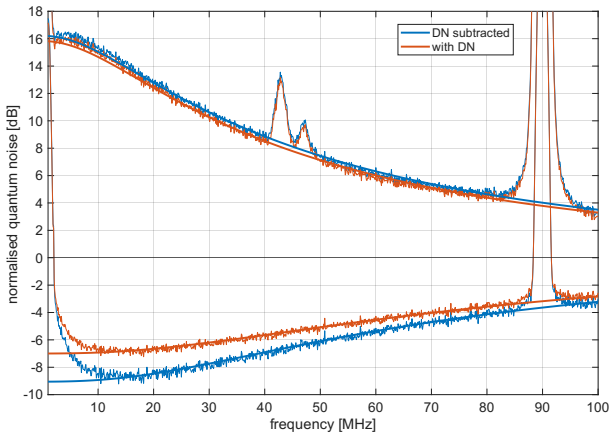
The central claim is that a hemilithic optical parametric amplifier with a 43.6 mm round-trip optical length and 138 MHz linewidth produces broadband squeezed light suitable for long-term table-top use. Balanced homodyne detection directly records up to 6.8 dB of squeezing while maintaining at least 3 dB across the entire 100 MHz measurement bandwidth. After subtracting the dark noise contribution the inferred squeezing reaches 8.6 dB, establishing the device as the broadest-linewidth squeezed source reported for stable operation.
What carries the argument
The hemilithic optical parametric amplifier, a short-cavity nonlinear resonator that sets both the broad 138 MHz linewidth and the stable operating conditions required for continuous interferometer use.
If this is right
- The QUEST interferometers can reach shot-noise reduction of 6 dB inside the OPA linewidth while remaining shot-noise limited from 1 to 200 MHz.
- The 100 MHz bandwidth fully covers the frequency range needed to probe stationary space-time fluctuations in the table-top setup.
- The source supports continuous, stable operation without frequent realignment, enabling extended data runs.
- Balanced homodyne characterization provides an independent verification of squeezing that can be compared with interferometer output.
Where Pith is reading between the lines
- Compact OPA designs of this type could be adapted for other table-top quantum sensors that need broadband noise reduction beyond the QUEST application.
- Performance inside the full power-recycled Michelson system may reveal integration effects not visible in the isolated source characterization.
- Further shortening the cavity could push the linewidth higher while preserving long-term stability for even wider-bandwidth experiments.
Load-bearing premise
Subtracting the dark noise spectrum from the measured homodyne data yields an accurate inference of the true squeezing level without systematic overestimation from unaccounted losses or drifts.
What would settle it
A direct squeezing measurement performed after injecting the source into the operational QUEST interferometers that shows sustained levels falling below 3 dB across the 100 MHz band due to additional losses or instability.
Figures


read the original abstract
We report on the characterisation of one of two broadband squeezed light sources developed for the Quantum Enhanced Space-Time (QUEST) experiment, using balanced homodyne detection. QUEST consists of a pair of co-located, table-top, power-recycled Michelson interferometers designed to probe stationary space-time fluctuations. The interferometers are designed to be shot-noise limited in the frequency range from 1 to 200 MHz, and squeezed light will be employed with the goal to reduce the shot noise by 6 dB at frequencies inside the linewidth of the optical parametric amplifier (OPA). We directly observed up to 6.8 dB of squeezing and maintained at least 3 dB of squeezing across the full 100 MHz measurement bandwidth. After accounting for the dark noise contribution, the inferred squeezing level increased to 8.6 dB. Our squeezed light source is based on a hemilithic OPA with a 43.6 mm round-trip optical length and a linewidth of 138 MHz, making it the broadest-linewidth device to date among those suitable for long-term operation.
Editorial analysis
A structured set of objections, weighed in public.
Referee Report
Summary. The manuscript reports the experimental characterization of a hemilithic optical parametric amplifier (OPA) as a broadband squeezed-light source for the QUEST table-top interferometers. Using balanced homodyne detection, the authors claim direct observation of up to 6.8 dB squeezing with at least 3 dB maintained across the full 100 MHz measurement bandwidth; after dark-noise subtraction the inferred squeezing reaches 8.6 dB. The device has a 43.6 mm round-trip length and 138 MHz linewidth, presented as the broadest such source suitable for long-term operation, with the goal of delivering 6 dB shot-noise reduction inside the OPA linewidth for the 1–200 MHz band.
Significance. If the reported performance is confirmed, the work supplies a practical, high-bandwidth squeezed-light source directly applicable to table-top Michelson interferometers targeting stationary space-time fluctuations. The explicit separation of observed versus inferred squeezing levels and the direct homodyne data constitute a clear experimental contribution; the 138 MHz linewidth claim, if substantiated, would be a useful benchmark for similar devices.
major comments (1)
- [Results on squeezing characterization and dark noise subtraction] The inference of 8.6 dB squeezing after dark-noise subtraction (abstract and results section on homodyne spectra) is load-bearing for the claim that the source meets the 6 dB shot-noise reduction target. The manuscript must explicitly verify that dark noise was recorded under identical local-oscillator power, electronic gain, and frequency response as the signal traces; any unaccounted mismatch or correlation would systematically overestimate the delivered squeezing and weaken the performance guarantee for QUEST.
minor comments (2)
- [Abstract] The abstract states the squeezing values without accompanying uncertainties or error bars; inclusion of statistical and systematic uncertainties on the 6.8 dB, 3 dB, and 8.6 dB figures would improve clarity.
- [Discussion or experimental methods] Long-term stability data (drift of squeezing level over hours or days) are referenced only qualitatively; a brief time-series measurement or Allan deviation would directly support the “long-term operation” suitability claim.
Simulated Author's Rebuttal
We thank the referee for their constructive review and positive assessment of the work. We address the major comment below and have revised the manuscript to incorporate the requested clarification.
read point-by-point responses
-
Referee: The inference of 8.6 dB squeezing after dark-noise subtraction (abstract and results section on homodyne spectra) is load-bearing for the claim that the source meets the 6 dB shot-noise reduction target. The manuscript must explicitly verify that dark noise was recorded under identical local-oscillator power, electronic gain, and frequency response as the signal traces; any unaccounted mismatch or correlation would systematically overestimate the delivered squeezing and weaken the performance guarantee for QUEST.
Authors: We agree that explicit verification of the dark-noise acquisition conditions is essential to support the inferred squeezing levels. In the revised manuscript we have added a dedicated paragraph in the Homodyne Detection section stating that dark-noise spectra were acquired with the local oscillator blocked but with identical electronic gain, frequency response, and acquisition settings as the signal traces. The dark-noise measurement was performed immediately before and after each squeezing spectrum to minimize any temporal drift. We have also included a supplementary figure overlaying the raw, dark-noise-subtracted, and shot-noise traces to allow direct assessment of the correction. These changes ensure the 8.6 dB inferred value is presented with full experimental transparency. revision: yes
Circularity Check
No circularity: pure experimental characterization with no derivations or self-referential claims
full rationale
This paper reports direct experimental measurements of squeezing in a hemilithic OPA using balanced homodyne detection. Observed squeezing reaches 6.8 dB with at least 3 dB across 100 MHz, and an inferred 8.6 dB after standard dark-noise subtraction. The linewidth of 138 MHz is stated from the device parameters and data. No theoretical derivation chain, fitted parameters renamed as predictions, self-citations as load-bearing uniqueness theorems, or ansatzes exist. All claims reduce to empirical spectra and device specifications without reducing to their own inputs by construction. The analysis is self-contained against external benchmarks.
Axiom & Free-Parameter Ledger
Lean theorems connected to this paper
-
IndisputableMonolith/Cost/FunctionalEquation.leanwashburn_uniqueness_aczel unclear?
unclearRelation between the paper passage and the cited Recognition theorem.
We directly observed up to 6.8 dB of squeezing... hemilithic OPA with a 43.6 mm round-trip optical length and a linewidth of 138 MHz
What do these tags mean?
- matches
- The paper's claim is directly supported by a theorem in the formal canon.
- supports
- The theorem supports part of the paper's argument, but the paper may add assumptions or extra steps.
- extends
- The paper goes beyond the formal theorem; the theorem is a base layer rather than the whole result.
- uses
- The paper appears to rely on the theorem as machinery.
- contradicts
- The paper's claim conflicts with a theorem or certificate in the canon.
- unclear
- Pith found a possible connection, but the passage is too broad, indirect, or ambiguous to say the theorem truly supports the claim.
Reference graph
Works this paper leans on
-
[1]
Squeezed states of light and their applications in laser interferometers
R. Schnabel. “Squeezed states of light and their applications in laser interferometers”. In: Physics Reports 684 (2017), pp. 1–51
work page 2017
-
[2]
Strong optomechanical squeezing of light
T. P. Purdy et al. “Strong optomechanical squeezing of light”. In: Physical Review X 3.3 (2013), p. 031012
work page 2013
-
[3]
Broad-band parametric deamplification of quantum noise in an optical fiber
R. M. Shelby et al. “Broad-band parametric deamplification of quantum noise in an optical fiber”. In: Physical Review Letters 57.6 (1986), p. 691
work page 1986
-
[4]
Observation of squeezed states generated by four-wave mixing in an optical cavity
R. E. Slusher et al. “Observation of squeezed states generated by four-wave mixing in an optical cavity”. In: Physical Review Letters 55.22 (1985), p. 2409
work page 1985
-
[5]
Generation of squeezed states by parametric down conversion
L.-A. Wu et al. “Generation of squeezed states by parametric down conversion”. In: Physical Review Letters 57.20 (1986), p. 2520
work page 1986
-
[6]
T. Kashiwazaki et al. “Over-8-dB squeezed light generation by a broadband waveguide optical parametric amplifier toward fault-tolerant ultra-fast quantum computers”. In: Applied Physics Letters 122.23 (2023)
work page 2023
-
[7]
T. Kashiwazaki et al. “Fabrication of low-loss quasi-single-mode PPLN waveguide and its ap- plication to a modularized broadband high-level squeezer”. In: Applied Physics Letters 119.25 (2021)
work page 2021
-
[8]
Broadband amplitude squeezing in a periodically poled KTiOPO 4 waveg- uide
M. Pysher et al. “Broadband amplitude squeezing in a periodically poled KTiOPO 4 waveg- uide”. In: Optics Letters 34.3 (2009), pp. 256–258
work page 2009
-
[9]
Squeezed states of light from an optical parametric oscillator
L.-A. Wu, M. Xiao, and H. Kimble. “Squeezed states of light from an optical parametric oscillator”. In: Journal of the Optical Society of America B 4.10 (1987), pp. 1465–1475
work page 1987
-
[10]
H. Vahlbruch et al. “Detection of 15 dB squeezed states of light and their application for the absolute calibration of photoelectric quantum efficiency”. In: Physical Review Letters 117.11 (2016), p. 110801
work page 2016
-
[11]
Observation of squeezed states with strong photon-number oscillations
M. Mehmet et al. “Observation of squeezed states with strong photon-number oscillations”. In: Physical Review A—Atomic, Molecular, and Optical Physics 81.1 (2010), p. 013814
work page 2010
-
[12]
High-bandwidth squeezed light at 1550 nm from a compact monolithic PPKTP cavity
S. Ast, M. Mehmet, and R. Schnabel. “High-bandwidth squeezed light at 1550 nm from a compact monolithic PPKTP cavity”. In: Optics Express 21.11 (2013), pp. 13572–13579
work page 2013
-
[13]
Directly measured squeeze factors over GHz band- width from monolithic ppKTP resonators
B. Tohermes, S. Verclas, and R. Schnabel. “Directly measured squeeze factors over GHz band- width from monolithic ppKTP resonators”. In: arXiv preprint arXiv:2412.03221 (2024). 11
-
[14]
The GEO 600 squeezed light source
H. Vahlbruch et al. “The GEO 600 squeezed light source”. In: Classical and Quantum Gravity 27.8 (2010), p. 084027
work page 2010
-
[15]
High-efficiency squeezed light generation for gravitational wave detectors
M. Mehmet and H. Vahlbruch. “High-efficiency squeezed light generation for gravitational wave detectors”. In: Classical and Quantum Gravity 36.1 (2018), p. 015014
work page 2018
-
[16]
J. Lough et al. “First demonstration of 6 dB quantum noise reduction in a kilometer scale gravitational wave observatory”. In: Physical Review Letters 126.4 (2021), p. 041102
work page 2021
-
[17]
J. Heinze, B. Willke, and H. Vahlbruch. “Observation of squeezed states of light in higher-order Hermite-Gaussian modes with a quantum noise reduction of up to 10 dB”. In: Physical Review Letters 128.8 (2022), p. 083606
work page 2022
-
[18]
Continuous-wave nonclassical light with gigahertz squeezing bandwidth
S. Ast et al. “Continuous-wave nonclassical light with gigahertz squeezing bandwidth”. In: Optics Letters 37.12 (2012), pp. 2367–2369
work page 2012
-
[19]
Squeezed states of light for future gravitational wave detectors at a wavelength of 1550 nm
F. Meylahn, B. Willke, and H. Vahlbruch. “Squeezed states of light for future gravitational wave detectors at a wavelength of 1550 nm”. In: Physical Review Letters 129.12 (2022), p. 121103
work page 2022
-
[20]
Squeezed light at 1550 nm with a quantum noise reduction of 12.3 dB
M. Mehmet et al. “Squeezed light at 1550 nm with a quantum noise reduction of 12.3 dB”. In: Optics Express 19.25 (2011), pp. 25763–25772
work page 2011
-
[21]
13 dB squeezed vacuum states at 1550 nm from 12 mW external pump power at 775 nm
A. Sch¨ onbeck, F. Thies, and R. Schnabel. “13 dB squeezed vacuum states at 1550 nm from 12 mW external pump power at 775 nm”. In: Optics Letters 43.1 (2017), pp. 110–113
work page 2017
-
[22]
Squeezed light at 2128 nm for future gravitational-wave observato- ries
C. Darsow-Fromm et al. “Squeezed light at 2128 nm for future gravitational-wave observato- ries”. In: Optics Letters 46.23 (2021), pp. 5850–5853
work page 2021
-
[23]
Broadband detection of 18 teeth in an 11-dB squeezing comb
D. Wilken, J. Junker, and M. Heurs. “Broadband detection of 18 teeth in an 11-dB squeezing comb”. In: Physical Review Applied 21.3 (2024), p. 031002
work page 2024
-
[24]
Creation and measurement of broadband squeezed vacuum from a ring optical parametric oscillator
T. Serikawa et al. “Creation and measurement of broadband squeezed vacuum from a ring optical parametric oscillator”. In: Optics Express 24.25 (2016), pp. 28383–28391
work page 2016
-
[25]
Quantum cryptography with squeezed states
M. Hillery. “Quantum cryptography with squeezed states”. In: Physical Review A 61.2 (2000), p. 022309
work page 2000
-
[26]
Continuous variable quantum cryptography
T. C. Ralph. “Continuous variable quantum cryptography”. In: Physical Review A 61.1 (1999), p. 010303
work page 1999
-
[27]
Quantum-enhanced advanced LIGO detectors in the era of gravitational-wave astronomy
M. Tse et al. “Quantum-enhanced advanced LIGO detectors in the era of gravitational-wave astronomy”. In: Physical Review Letters 123.23 (2019), p. 231107
work page 2019
-
[28]
F. Acernese et al. “Increasing the astrophysical reach of the Advanced Virgo detector via the application of squeezed vacuum states of light”. In: Physical Review Letters 123.23 (2019), p. 231108
work page 2019
-
[29]
Quantum-mechanical noise in an interferometer
C. M. Caves. “Quantum-mechanical noise in an interferometer”. In: Physical Review D 23.8 (1981), p. 1693
work page 1981
-
[30]
Squeezing in gravitational wave detectors
S. E. Dwyer, G. L. Mansell, and L. McCuller. “Squeezing in gravitational wave detectors”. In: Galaxies 10.2 (2022), p. 46. 12
work page 2022
-
[31]
An experiment for observing quantum gravity phenomena using twin table-top 3D interferometers
S. M. Vermeulen et al. “An experiment for observing quantum gravity phenomena using twin table-top 3D interferometers”. In: Classical and Quantum Gravity 38.8 (2021), p. 085008
work page 2021
-
[32]
Broadband limits on stochastic length fluctuations from a pair of table-top interferometers
A. Patra et al. “Broadband limits on stochastic length fluctuations from a pair of table-top interferometers”. In: arXiv preprint arXiv:2410.09175 (2024)
-
[33]
The squeezed light source for the Advanced Virgo detector in the observation run O3
M. Mehmet and H. Vahlbruch. “The squeezed light source for the Advanced Virgo detector in the observation run O3”. In: Galaxies 8.4 (2020), p. 79
work page 2020
-
[34]
Coherent control of vacuum squeezing in the gravitational-wave detection band
H. Vahlbruch et al. “Coherent control of vacuum squeezing in the gravitational-wave detection band”. In: Physical Review Letters 97.1 (2006), p. 011101
work page 2006
-
[35]
Quasi-phase-matched second harmonic generation: tuning and tolerances
M. M. Fejer et al. “Quasi-phase-matched second harmonic generation: tuning and tolerances”. In: IEEE Journal of Quantum Electronics 28.11 (2002), pp. 2631–2654
work page 2002
-
[36]
Laser phase and frequency stabilization using an optical resonator
R. W. Drever et al. “Laser phase and frequency stabilization using an optical resonator”. In: Applied Physics B 31 (1983), pp. 97–105
work page 1983
-
[37]
Purification and Distillation of Continuous Variable Entanglement
B. Hage. “Purification and Distillation of Continuous Variable Entanglement”. PhD thesis. Leibniz Universit¨ at Hannover, 2010
work page 2010
-
[38]
T. Eberle. “Realization of finite-size quantum key distribution based on Einstein-Podolsky- Rosen entangled light”. PhD thesis. Leibniz Universit¨ at Hannover, 2013
work page 2013
-
[39]
W. Griffiths. “Enhancing the QUEST experiment with a coin sized Output Mode Cleaner for improved sensitivity to Quantum Gravity signatures”. PhD thesis. Cardiff University, 2023
work page 2023
-
[40]
Electro-optic control of quantum measurements
B. Buchler. “Electro-optic control of quantum measurements”. PhD thesis. Australian National University, 2001
work page 2001
-
[41]
Atomic spectroscopy with squeezed light for sensitivity beyond the vacuum-state limit
E. Polzik, J. Carri, and H. Kimble. “Atomic spectroscopy with squeezed light for sensitivity beyond the vacuum-state limit”. In: Applied Physics B 55.3 (1992), pp. 279–290
work page 1992
-
[42]
Squeezing in the audio gravitational wave detection band
K. McKenzie. “Squeezing in the audio gravitational wave detection band”. PhD thesis. Aus- tralian National University, 2008
work page 2008
-
[43]
Squeezing at 946nm with periodically poled KTiOPO4
T. Aoki, G. Takahashi, and A. Furusawa. “Squeezing at 946nm with periodically poled KTiOPO4”. In: Optics Express 14.15 (2006), pp. 6930–6935
work page 2006
-
[44]
Electronic noise in optical homodyne tomography
J. Appel et al. “Electronic noise in optical homodyne tomography”. In: Physical Review A—Atomic, Molecular, and Optical Physics 75.3 (2007), p. 035802
work page 2007
-
[45]
Squeezed light for gravitational wave astronomy
H. Vahlbruch. “Squeezed light for gravitational wave astronomy”. PhD thesis. Leibniz Univer- sit¨ at Hannover, 2008
work page 2008
-
[46]
A high-frequency squeezing comb-generation, detection & characterisation
D. M. Wilken. “A high-frequency squeezing comb-generation, detection & characterisation”. PhD thesis. Leibniz Universit¨ at Hannover, 2024. 13
work page 2024
discussion (0)
Sign in with ORCID, Apple, or X to comment. Anyone can read and Pith papers without signing in.