DSER: Spectral Epipolar Representation for Efficient Light Field Depth Estimation
Pith reviewed 2026-05-18 23:40 UTC · model grok-4.3
The pith
Spectral regularization on epipolar planes constrains disparity estimation for dense light field depth maps.
A machine-rendered reading of the paper's core claim, the machinery that carries it, and where it could break.
Core claim
DSER models frequency-consistent EPI structure to constrain correspondence estimation and couples this prior with a hybrid inference pipeline that combines least squares gradient initialization, plane-sweeping cost aggregation, and multiscale EPI refinement. An occlusion-aware directed random walk further propagates reliable disparity along edge-consistent paths, improving boundary sharpness and weak-texture stability.
What carries the argument
Deep Spectral Epipolar Representation (DSER), which imposes spectral regularization on epipolar plane images to enforce frequency-consistent structure as a constraint on disparity estimation.
If this is right
- Correspondence search becomes constrained by frequency consistency rather than exhaustive matching, lowering overall computation.
- Boundary sharpness and stability in textureless areas improve through the directed random walk along edge-consistent paths.
- The hybrid pipeline yields depth maps whose structural consistency exceeds that of representative classical and hybrid methods on both synthetic benchmarks and real captures.
- The spectral prior acts as an inductive bias that supports scalable, noise-robust reconstruction under the stated imaging challenges.
Where Pith is reading between the lines
- The same frequency-consistency prior could be tested on light fields captured with even fewer angular samples to measure how far the constraint remains effective.
- Integration of the spectral term into fully learned end-to-end networks might further reduce the need for explicit plane sweeping and random-walk stages.
- Because the method relies on epipolar geometry, it could be examined for transfer to other multi-view tasks that share the same ray geometry, such as light-field novel-view synthesis.
Load-bearing premise
Frequency-consistent structure in epipolar plane images supplies a reliable constraint on correspondence even when angular sampling is sparse, occlusions are present, and texture is weak.
What would settle it
Depth maps produced by DSER that show larger boundary errors or structural inconsistencies than the classical baselines on the same occluded or textureless regions of benchmark light field datasets.
Figures



read the original abstract
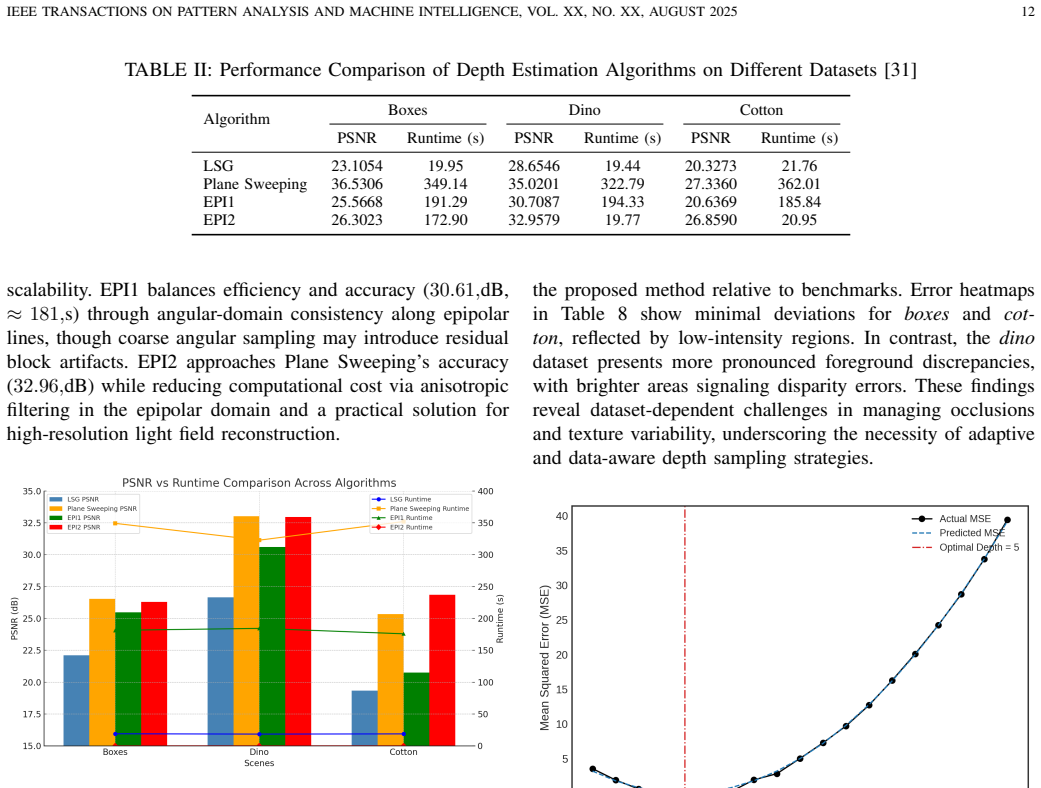
Dense light field depth estimation remains challenging due to sparse angular sampling, occlusion boundaries, textureless regions, and the cost of exhaustive multi-view matching. We propose \emph{Deep Spectral Epipolar Representation} (DSER), a geometry-aware framework that introduces spectral regularization in the epipolar domain for dense disparity reconstruction. DSER models frequency-consistent EPI structure to constrain correspondence estimation and couples this prior with a hybrid inference pipeline that combines least squares gradient initialization, plane-sweeping cost aggregation, and multiscale EPI refinement. An occlusion-aware directed random walk further propagates reliable disparity along edge-consistent paths, improving boundary sharpness and weak-texture stability. Experiments on benchmark and real-world light field datasets show that DSER achieves a strong accuracy-efficiency trade-off, producing more structurally consistent depth maps than representative classical and hybrid baselines. These results establish spectral epipolar regularization as an effective inductive bias for scalable and noise-robust light field depth estimation.
Editorial analysis
A structured set of objections, weighed in public.
Referee Report
Summary. The manuscript introduces DSER (Deep Spectral Epipolar Representation), a geometry-aware framework for dense light field depth estimation. It models frequency-consistent structure in epipolar plane images (EPIs) via spectral regularization to constrain correspondence estimation under sparse angular sampling. This prior is integrated into a hybrid pipeline that includes least-squares gradient initialization, plane-sweeping cost aggregation, multiscale EPI refinement, and an occlusion-aware directed random walk for disparity propagation along edge-consistent paths. Experiments on benchmark and real-world light field datasets are reported to demonstrate a favorable accuracy-efficiency trade-off and structurally consistent depth maps relative to classical and hybrid baselines.
Significance. If the empirical support holds, the work could establish spectral epipolar regularization as a practical inductive bias for handling occlusions and textureless regions in light-field depth estimation while maintaining computational efficiency. The hybrid classical-deep design may offer advantages for scalable applications where exhaustive multi-view matching is prohibitive.
major comments (1)
- [Experiments / Ablation studies] The central claim attributes improved structural consistency and the accuracy-efficiency trade-off specifically to modeling frequency-consistent EPI structure as a constraint on correspondence estimation. However, the pipeline also incorporates least-squares gradient initialization, plane-sweeping cost aggregation, multiscale EPI refinement, and occlusion-aware directed random walk propagation. No ablation experiments are described that remove only the spectral regularization term while retaining the remainder of the hybrid pipeline; without such controls it remains unclear whether the claimed inductive bias is load-bearing or whether gains derive primarily from the classical components.
minor comments (1)
- [Abstract] The abstract states performance improvements without supplying any quantitative metrics, dataset identifiers, or error statistics, which delays assessment of the strength of the empirical claims.
Simulated Author's Rebuttal
We thank the referee for the constructive feedback on our manuscript. We address the major comment point by point below and will incorporate revisions where appropriate to strengthen the presentation of our contributions.
read point-by-point responses
-
Referee: [Experiments / Ablation studies] The central claim attributes improved structural consistency and the accuracy-efficiency trade-off specifically to modeling frequency-consistent EPI structure as a constraint on correspondence estimation. However, the pipeline also incorporates least-squares gradient initialization, plane-sweeping cost aggregation, multiscale EPI refinement, and occlusion-aware directed random walk propagation. No ablation experiments are described that remove only the spectral regularization term while retaining the remainder of the hybrid pipeline; without such controls it remains unclear whether the claimed inductive bias is load-bearing or whether gains derive primarily from the classical components.
Authors: We acknowledge the value of a controlled ablation that isolates the spectral regularization term while holding the rest of the hybrid pipeline fixed. Our current experiments demonstrate that DSER outperforms representative classical and hybrid baselines that lack spectral epipolar modeling, and the manuscript positions the frequency-consistent EPI prior as the key novel inductive bias integrated into the multiscale refinement stage. Nevertheless, we agree that an explicit within-pipeline ablation would provide clearer evidence of its contribution to structural consistency and the observed accuracy-efficiency trade-off. In the revised manuscript we will add such experiments, for example by reporting results for a DSER variant that disables the spectral regularization during multiscale EPI refinement while retaining least-squares gradient initialization, plane-sweeping aggregation, and the occlusion-aware random walk. revision: yes
Circularity Check
No significant circularity; spectral prior introduced as independent constraint
full rationale
The provided abstract and description present DSER as modeling frequency-consistent EPI structure to constrain correspondence, then coupling it with a separate hybrid pipeline of least-squares initialization, plane-sweeping aggregation, multiscale refinement, and occlusion-aware random walk. No equations, derivations, or self-citations appear in the given text that reduce any claimed prediction or result to a fitted parameter defined by the method itself or to a self-referential loop. The frequency-consistent EPI structure is described as an added inductive bias rather than a tautology or renamed input. Central claims rest on experimental comparisons to baselines rather than internal reductions. This matches the default expectation that most papers lack circularity when no specific self-definitional or fitted-input reduction can be exhibited by direct quote.
Axiom & Free-Parameter Ledger
Lean theorems connected to this paper
-
IndisputableMonolith/Cost/FunctionalEquation.leanwashburn_uniqueness_aczel unclear?
unclearRelation between the paper passage and the cited Recognition theorem.
DSER models frequency-consistent EPI structure to constrain correspondence estimation and couples this prior with a hybrid inference pipeline that combines least squares gradient initialization, plane-sweeping cost aggregation, and multiscale EPI refinement.
-
IndisputableMonolith/Foundation/AlexanderDuality.leanalexander_duality_circle_linking unclear?
unclearRelation between the paper passage and the cited Recognition theorem.
An occlusion-aware directed random walk further propagates reliable disparity along edge-consistent paths
What do these tags mean?
- matches
- The paper's claim is directly supported by a theorem in the formal canon.
- supports
- The theorem supports part of the paper's argument, but the paper may add assumptions or extra steps.
- extends
- The paper goes beyond the formal theorem; the theorem is a base layer rather than the whole result.
- uses
- The paper appears to rely on the theorem as machinery.
- contradicts
- The paper's claim conflicts with a theorem or certificate in the canon.
- unclear
- Pith found a possible connection, but the passage is too broad, indirect, or ambiguous to say the theorem truly supports the claim.
Reference graph
Works this paper leans on
-
[1]
Towards multimodal depth estimation from light fields.arXiv preprint arXiv:2203.16542, 2022
Leistner, T.; Mackowiak, R.; Ardizzone, L.; Köthe, U.; Rother, C. Towards multimodal depth estimation from light fields.arXiv preprint arXiv:2203.16542, 2022. Available at: https://arxiv.org/pdf/2203.16542
-
[2]
Jin, J.; Hou, J. Occlusion-aware Unsupervised Learning of Depth from 4-D Light Fields.arXiv preprint arXiv:2106.03043, 2021. Available at: https://arxiv.org/pdf/2106.03043
- [4]
- [5]
-
[6]
Petrovai, A.; Nedevschi, S. MonoDVPS: A Self-Supervised Monocular Depth Estimation Approach to Depth-aware Video Panoptic Segmenta- tion.arXiv preprint arXiv:2210.07577, 2022. Available at: https://arxiv. org/pdf/2210.07577
-
[7]
Fast and Efficient Depth Map Estimation from Light Fields
Anisimov, Y .; Stricker, D. Fast and Efficient Depth Map Estimation from Light Fields. In:2017 International Conference on 3D Vision (3DV),
work page 2017
-
[9]
Schröppel, P.; Bechtold, J.; Amiranashvili, A.; Brox, T. A benchmark and a baseline for robust multi-view depth estimation.arXiv preprint arXiv:2209.06681, 2022. Available at: https://arxiv.org/pdf/2209.06681
-
[10]
Scene reconstruction from high spatio-angular resolution light fields.ACM Trans
Kim, C.; Zimmer, H.; Pritch, Y .; Sorkine-Hornung, A.; Gross, M.; Sorkine, O. Scene reconstruction from high spatio-angular resolution light fields.ACM Trans. Graph.2013,32(4), 73:1–73:12. DOI: 10.1145/ 2461912.2461926
-
[11]
Yucer, K.; Sorkine-Hornung, A.; Wang, O.; Sorkine-Hornung, O. Ef- ficient 3D object segmentation from densely sampled light fields with applications to 3D reconstruction.ACM Trans. Graph.2016,35(3), 22. DOI: 10.1145/2876504
-
[12]
Light-field-depth-estimation network based on epipolar geometry and image segmentation.J
Zhang, Z.; Chen, J. Light-field-depth-estimation network based on epipolar geometry and image segmentation.J. Opt. Soc. Am. A2020, 37(7), 1236–1244. DOI: 10.1364/JOSAA.388555
-
[13]
Gao, M.; Deng, H.; Xiang, S.; Wu, J.; He, Z. EPI Light Field Depth Estimation Based on a Directional Relationship Model and Multiview point Attention Mechanism.Sensors2022,22(16), 6291. DOI: 10.3390/ s22166291
-
[14]
Zhang, S.; et al. A Light Field Depth Estimation Algorithm Considering Blur Features and Prior Knowledge of Planar Geometric Structures. Appl. Sci.2025,15(3), 1447. DOI: 10.3390/app15031447
-
[15]
Kong, Y .; Liu, Y .; Huang, H.; Lin, C.-W.; Yang, M.-H. SSegDep: A simple yet effective baseline for self-supervised semantic segmentation with depth.arXiv preprint arXiv:2308.12937, 2023. Available at: https: //arxiv.org/abs/2308.12937
-
[16]
In: IEEE/CVF Conference on Computer Vision and Pattern Recognition (CVPR), pp
Cheng, B.; et al. Panoptic-DeepLab: A simple, strong, and fast baseline for bottom-up panoptic segmentation. In:Proc. IEEE/CVF Conference on Computer Vision and Pattern Recognition (CVPR), 2020; pp 12475– 12485. DOI: 10.1109/CVPR42600.2020.01249
-
[17]
Towards agricultural autonomy: crop row detection under varying field conditions using deep learning
de Silva, R.; Cielniak, G.; Gao, J. Towards agricultural autonomy: crop row detection under varying field conditions using deep learning. arXiv preprint arXiv:2109.08247, 2021. Available at: https://arxiv.org/ pdf/2109.08247
-
[18]
Cakir, S.; et al. Semantic Segmentation for Autonomous Driving: Model Evaluation, Dataset Generation, Perspective Comparison, and Real-Time Capability.arXiv preprint arXiv:2207.12939, 2022. Available at: https: //arxiv.org/pdf/2207.12939
-
[19]
R., A.; Sinha, N. SSEGEP: Small SEGment Emphasized Performance Evaluation Metric for Medical Image Segmentation.arXiv preprint arXiv:2109.03435, 2021. Available at: https://arxiv.org/pdf/2109.03435
-
[20]
Nasrollahi, M.; Moeslund, T. B. Super-resolution: a comprehensive survey.Mach. Vis. Appl.2014,25(6), 1423–1468. DOI: 10.1007/ s00138-014-0623-4
work page 2014
-
[21]
Anisimov, A.; Stricker, D. Fast and Efficient Depth Map Estimation from Light Fields. In:2017 International Conference on 3D Vision (3DV), 2017; pp 337–346. DOI: 10.1109/3DV .2017.00046
work page doi:10.1109/3dv 2017
-
[22]
Unsupervised Light Field Depth Estimation with Occlusion Handling.IEEE Trans
Jin, J.; Hou, J.; Dai, K. Unsupervised Light Field Depth Estimation with Occlusion Handling.IEEE Trans. Image Process.2021,30, 5981–5994. DOI: 10.1109/TIP.2021.3090866
-
[23]
Learning Depth from Light Field Images Using Spatial-angular Consistency.IEEE Trans
Li, H.; Fu, Y .; Wu, J. Learning Depth from Light Field Images Using Spatial-angular Consistency.IEEE Trans. Circuits Syst. Video Technol. 2021,31(7), 2540–2552. DOI: 10.1109/TCSVT.2020.3028286
-
[24]
Sohn, K. A.; Choi, J. Y .; Kim, H. J. Deep light field depth estimation using epipolar plane images and attention modules.Sensors2022,22(2),
-
[25]
DOI: 10.3390/s22020557
-
[26]
Wang, J.; Zhang, L.; Qiao, Y . Self-supervised Depth Estimation from Light Field Images Based on Multi-scale Feature Fusion.IEEE Access 2022,10, 11064–11075. DOI: 10.1109/ACCESS.2022.3143497
-
[27]
Light field depth estimation via graph convolutional networks.Pattern Recognit
Guo, F.; Wang, Y .; Liu, S. Light field depth estimation via graph convolutional networks.Pattern Recognit. Lett.2021,153, 59–65. DOI: 10.1016/j.patrec.2021.07.017
-
[28]
Zhang, Y .; Liu, X.; Wang, Y . Multi-view light field depth estimation with attention-based cost aggregation.Neurocomputing2022,499, 52–
-
[29]
DOI: 10.1016/j.neucom.2022.03.019
-
[30]
End-to-end Light Field Depth Estimation with Hierarchical Feature Fusion.IEEE Trans
Liu, Q.; et al. End-to-end Light Field Depth Estimation with Hierarchical Feature Fusion.IEEE Trans. Image Process.2021,30, 5249–5262. DOI: 10.1109/TIP.2021.3073389
-
[31]
Efficient light field depth estimation via stereo matching and geometric constraints.Signal Process
Zhang, H.; Wu, X.; Shen, Y . Efficient light field depth estimation via stereo matching and geometric constraints.Signal Process. Image Commun.2020,88, 115950. DOI: 10.1016/j.image.2020.115950
-
[32]
Unsupervised depth estimation of light fields with 3D convolutional neural networks.IEEE Trans
Ma, L.; Li, W.; Wu, H. Unsupervised depth estimation of light fields with 3D convolutional neural networks.IEEE Trans. Multimedia2020, 22(4), 1008–1020. DOI: 10.1109/TMM.2019.2934903
-
[33]
Li, C.; Luo, Y .; Zhang, Z. Robust light field depth estimation using con- fidence maps and edge-aware filtering.IEEE Access2021,9, 123456– 123466. DOI: 10.1109/ACCESS.2021.3059187
-
[34]
Deep learning based light field depth estimation: A survey.IEEE Trans
Chen, F.; Liu, Y .; Zhao, G. Deep learning based light field depth estimation: A survey.IEEE Trans. Neural Netw. Learn. Syst.2022,33(2), 734–748. DOI: 10.1109/TNNLS.2021.3060738
-
[35]
Comparing the Robustness of Different Depth Map Algorithms
Lin, F.-Y .; Cheng, W.; Banh, L. Comparing the Robustness of Different Depth Map Algorithms. EE 367 and EE 368 Joint Project Report, Stanford University, 2019. Available at: https://stanford.edu/class/ee367/ Winter2019/
work page 2019
-
[36]
Mannam, V ., Howard, S., 2023. Small training dataset convolutional neu- ral networks for application-specific super-resolution microscopy. Jour- nal of Biomedical Optics 28.. https://doi.org/10.1117/1.jbo.28.3.036501
-
[37]
Sparse-to-dense coarse-to-fine depth estimation for colonoscopy,
R. Liu, Z. Liu, J. Lu, et al. "Sparse-to-dense coarse-to-fine depth estimation for colonoscopy," Computers in Biology and Medicine, vol. 160, p. 106983, 2023. doi: 10.1016/j.compbiomed.2023.106983
discussion (0)
Sign in with ORCID, Apple, or X to comment. Anyone can read and Pith papers without signing in.