REVIEW 3 major objections 7 minor 31 references
MechaFormer: Sequence Learning for Kinematic Mechanism Design Automation
T0 review · 3 major / 7 minor · reviewed 2026-08-15 · deepseek-v4-flash
Pith's one-line read MechaFormer reframes mechanism design as sequence translation and, with a local-optimization seeding step, cuts path-matching error far below earlier methods.
desk verdict A genuinely new DSL-plus-Transformer formulation for linkage synthesis, with a real but fixable weakness in the claimed SOTA comparison against prior work. read the letter →
The pith
A machine-rendered reading of the paper's core claim, the machinery that carries it, and where it could break.
The reading
What carries the argument
The load-bearing object is the mechanism domain-specific language: a strict token grammar that serializes a mechanism as one topology token followed by quantized coordinate tokens for each free joint, with ground joints normalized to (0,0) and (1,0). This DSL turns a mixed discrete-continuous inverse problem into next-token prediction over a 232-token vocabulary, while canonical normalization removes translation, rotation, and scale so the model learns relative geometry. The normalization also makes rotational sampling cheap: rotate the input curve by eight 45-degree increments, decode each rotated curve, and inverse-rotate the winning mechanism. The Transformer encoder-decoder acts as the translator, and each topology's connectivity graph is stored externally to guarantee kinematic feasibility.
What would settle it
Run MechaFormer and the earlier beta-VAE baseline on the identical 1,000 validation curves with the same normalization and the same DTW and Chamfer code; if the baseline's mean bidirectional Chamfer distance is no larger than 0.077, the paper's state-of-the-art claim fails.
Extended reading notes
Core claim
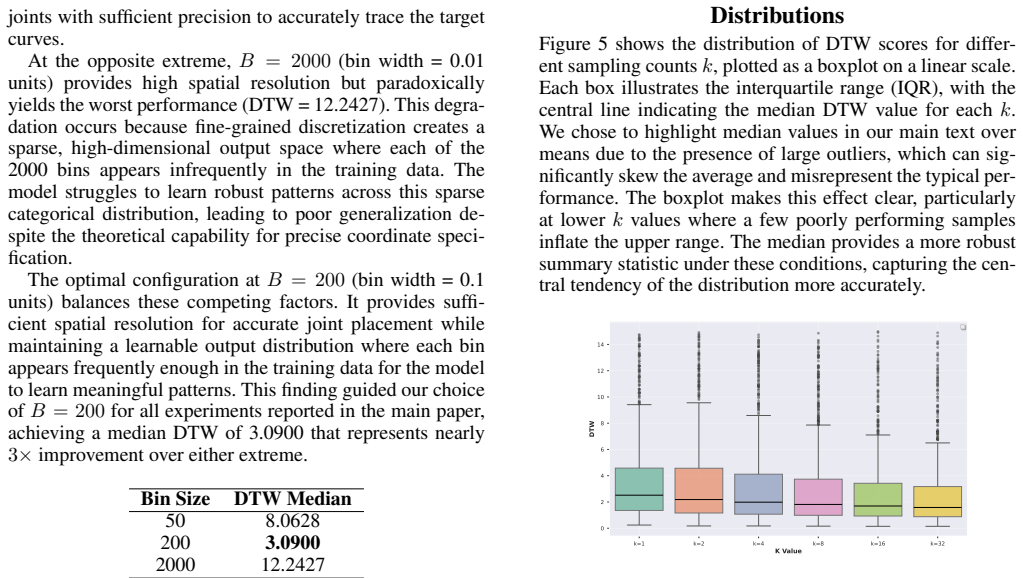
The paper's central claim is that mechanism synthesis can be solved by learning the conditional distribution of mechanism definitions given a target curve, rather than by solving the mixed-integer, non-convex optimization problem directly. A single Transformer encoder–decoder, trained on 846,480 valid mechanisms, learns to emit a domain-specific language whose first token fixes the topology and whose remaining tokens fix quantized joint coordinates; because topology is a single categorical choice, every generated design is kinematically valid by construction. The measured consequences are monotonic gains from Best@k sampling (median DTW falls from 3.09 at k=1 to 1.61 at k=32), improved accuracy from rotating the input curve in eight 45-degree steps, and, when the best sample is handed to L-BFGS-B, errors roughly 16 to 23 times smaller than optimizing from random starts. The paper therefore claims that the hard part of mechanism design is not the continuous refinement but the initialization, and that a sequence model can supply that initialization.
Load-bearing premise
The state-of-the-art comparison assumes that the 1,000 validation curves and the earlier study's reported error numbers come from comparable subsets of the same dataset with identical normalization, an assumption the paper itself flags as uncertain.
Editorial extensions
If this is right
- At k=32, generating and selecting the best of 32 candidates lowers median DTW from 3.09 to 1.61 while keeping more than 99% of designs kinematically feasible, so designers can trade compute for accuracy simply by sampling more.
- Rotating the input curve in eight 45-degree steps before decoding, then inverse-rotating the result, recovers an orientation the canonical frame would otherwise hide, cutting median DTW to 1.83.
- Prefix-constraining the decoder to each of the 24 topology tokens lets a designer enumerate the best linkage family for a curve, at the cost of a lower 86.7% success rate.
- Seeding L-BFGS-B with the model's best output reaches a median DTW of 0.887 at k=32 and a mean Chamfer distance of 0.077, an order-of-magnitude improvement over random-start optimization with comparable function evaluations.
- Because topology is a single token from a fixed library, every generated design is valid by construction, but the model cannot invent new topologies; the paper treats this as an accepted trade-off.
Reading between the lines
- The same conditional-sequence formulation should transfer to any structured design problem with a cheap forward simulator and a discrete-continuous parameter space, including spatial linkages, compliant mechanisms, or assembly layouts.
- Adding richer topology families would amount to adding tokens and retraining; the 24-type library is the current novelty ceiling, not an architectural one.
- Rotational sampling could be extended from eight fixed 45-degree increments to continuous orientation search or to translation sampling, which the paper leaves open; the canonical frame makes each orientation a one-dimensional sweep.
- One testable prediction is that the Best@k median-DTW curve flattens along a predictable sampling law on a fixed validation set; measuring that curve would tell practitioners when additional samples stop paying.
Signed reviews
Editorial analysis
A structured set of objections, weighed in public.
Referee Report
Summary. MechaFormer recasts planar kinematic path synthesis as conditional sequence generation: a target curve is fitted with 64 B-spline control points, encoded by a Transformer encoder-decoder, and decoded into a DSL string that names one of 24 mechanism topologies and quantized joint coordinates. The model is trained on 846,480 filtered samples from the Nurizada et al. (2025) dataset and evaluated on 1,000 validation curves. The paper reports that Best@k sampling, rotational sampling, and topology sampling improve median DTW, and that seeding L-BFGS-B with model outputs yields median DTW 0.887 and mean Chamfer distance 0.077, compared with a claimed prior best of 0.135. Diversity and optimization-trajectory analyses are also included.
Significance. The contribution is significant if the results are confirmed: it provides a clean sequence-modeling formulation of mechanism synthesis, a reusable DSL, and evidence that model-seeded local optimization sharply outperforms random-start optimization. The paper deserves credit for evaluating on held-out validation curves rather than training data, for including a KNN retrieval baseline that checks memorization, and for making the sampling and hybrid workflow concrete. The principal caveat is that the headline state-of-the-art comparison with prior work is not protocol-controlled, so the quantitative margin is currently provisional.
major comments (3)
- [Comparison to Prior Work, Table 2] The headline claim that MechaFormer is state of the art in path-matching accuracy is not supported by a controlled comparison. The manuscript explicitly states in 'Comparison to Prior Work' that 'direct comparison has limitations as the specific sample selections may differ,' and the prior µCD=0.135 and ηDTW=2.441 numbers come from evaluations whose normalization (Eq. 6), Chamfer sampling density, and curve subsets are not shown to match the authors' protocol. Because this is the central quantitative claim, please either re-run the prior methods on the identical 1,000 curves with the identical metric code, or revise the claim so it is explicitly limited to the authors' evaluation subset and describe the prior numbers as indicative rather than competitive.
- [Experiments; Appendix: Temperature Sampling and Coordinate Discretization Ablation] The final reported numbers appear to be selected on the same 1,000 validation curves used to choose hyperparameters. Appendix Table 6 selects T=0.1 using average best DTW on validation data, and Appendix Table 5 selects B=200 using median DTW on 10 samples; if these come from the same pool as Table 2, the Table 2 results are a selected-validation report rather than a fresh test evaluation. Please reserve a separate test split that is never used for temperature, bin size, or other choices and report both validation and test numbers, or state explicitly which reported numbers are tuned.
- [Table 2, Table 3, Optimization Analysis] No confidence intervals, bootstrap estimates, or significance tests are reported for any of the central comparisons. The DTW distributions are heavy-tailed (means ± std in Table 2 have standard deviations several times the mean), so differences such as 1.605 vs 2.441 or 0.123 vs 0.119 cannot be assessed without uncertainty quantification. The optimization analysis in Table 3 uses only 10 samples and reports a '20x quality gap' with a median final DTW of 0.51 but a standard deviation of 4.33; this claim should be weakened or supported with a larger sample and paired statistics.
minor comments (7)
- [Appendix, Table 4 vs. Dataset and Training] Appendix Table 4 lists the learning-rate schedule as ReduceLROnPlateau, while the main text says the model is trained with a cosine schedule and warm-up; please reconcile this inconsistency.
- [References] The reference 'Hartenberg and Danavit (1964)' should be 'Hartenberg and Denavit (1964)'; please check all author names for spelling and consistency.
- [Table 2 caption] The caption says 'All methods used identical hyperparameters,' but the L-BFGS-B baseline and the hybrid method use different maxfun settings (100 in Table 2, 2000 in Table 3); specify which hyperparameters are shared and which differ.
- [Table 3 caption] The column header 'maxfun' appears to count runs reaching the evaluation cap rather than the maxfun parameter; rename the column to avoid confusion.
- [Eq. (6)] Eq. (6) calls σ_RMS_i the 'Root Mean Squared variance'; clarify whether the denominator is an RMS deviation or a standard deviation.
- [Experiments] It is not stated whether the 1,000 evaluation curves are drawn from the 83,499 held-out validation mechanisms or from a separate set; please clarify the relationship between the validation split and the evaluation curves.
- [Appendix: Implementation Details] The appendix says complete training and inference code are publicly available, but no repository or URL is given in the manuscript; please add a link for reproducibility.
Circularity Check
No circular derivation; the SOTA comparison relies on an explicit comparability caveat rather than a fitted reduction.
full rationale
MechaFormer's derivation chain is a supervised sequence-to-sequence fit: the model is trained on (curve, mechanism) pairs generated by deterministic forward kinematics, and all reported accuracy numbers are computed on held-out validation curves with standard DTW and Chamfer metrics. The central results (Best@k, rotational sampling, topology sampling, and the hybrid L-BFGS-B initialization) are measured against the same simulator and are not defined in terms of the fitted parameters; the DTW oracle used to select among k samples is an explicit sampling strategy, not a training target or estimated constant. The one flagged limitation is the comparison to prior work, where the paper states in 'Comparison to Prior Work' that 'direct comparison has limitations as the specific sample selections may differ.' That is an unverified comparability assumption about evaluation subsets and normalization, not a circular reduction: the paper's own µCD and DTW numbers are computed independently, and the prior numbers are external. Similarly, choosing B=200 and T=0.1 on the validation set is standard hyperparameter selection and does not make the reported predictions equivalent to their inputs. Self-citations (Bolanos et al. 2023; Ataei et al. 2025; Cheong et al. 2025; Etesam et al. 2025) are motivational or methodological context and none are load-bearing for the central claim. No equation in the paper reduces by construction to a fitted quantity, and no 'prediction' is a renamed fit. The paper is therefore not circular, though its state-of-the-art claim carries a comparability risk that the authors themselves acknowledge.
Assumptions & free parameters
free parameters (6)
- B-spline control point count =
64
- Coordinate bin count =
200 (range [-10, 10])
- Sampling temperature =
0.1
- Dataset filter threshold =
20,000 minimum instances per topology
- Rotation count for rotational sampling =
8 (45 degree steps)
- Trust region delta for L-BFGS-B =
max(0.5, 0.5*|x0_i|)
assumptions (5)
- domain assumption Forward kinematics simulator Phi is deterministic and yields the coupler curve C = Phi(M)
- domain assumption The public dataset by Nurizada et al. contains correct mechanism-curve pairs
- standard math DTW with the normalization in Eq. (6) is a valid path-matching error measure
- domain assumption The 24 topology types are kinematically valid and sufficient for practical design
- standard math L-BFGS-B converges to a local optimum within the trust region
Cite this review
Pith. "Pith review of MechaFormer: Sequence Learning for Kinematic Mechanism Design Automation." pith.science (2026). https://pith.science/paper/PDGXW56F
@misc{pith2026250809005,
  author       = {Pith},
  title        = {Pith review of: MechaFormer: Sequence Learning for Kinematic Mechanism Design Automation},
  year         = {2026},
  howpublished = {\url{https://pith.science/paper/PDGXW56F}},
  note         = {Machine review of arXiv:2508.09005}
}
read the original abstract
Designing mechanical mechanisms to trace specific paths is a classic yet notoriously difficult engineering problem, characterized by a vast and complex search space of discrete topologies and continuous parameters. We introduce MechaFormer, a Transformer-based model that tackles this challenge by treating mechanism design as a conditional sequence generation task. Our model learns to translate a target curve into a domain-specific language (DSL) string, simultaneously determining the mechanism's topology and geometric parameters in a single, unified process. MechaFormer significantly outperforms existing baselines, achieving state-of-the-art path-matching accuracy and generating a wide diversity of novel and valid designs. We demonstrate a suite of sampling strategies that can dramatically improve solution quality and offer designers valuable flexibility. Furthermore, we show that the high-quality outputs from MechaFormer serve as excellent starting points for traditional optimizers, creating a hybrid approach that finds superior solutions with remarkable efficiency.
Figures


Figures from the paper (4 more)



Reference graph
Works this paper leans on
-
[1]
, " * write output.state after.block = add.period write newline
ENTRY address archivePrefix author booktitle chapter edition editor eid eprint howpublished institution isbn journal key month note number organization pages publisher school series title type volume year label extra.label sort.label short.list INTEGERS output.state before.all mid.sentence after.sentence after.block FUNCTION init.state.consts #0 'before.a...
-
[2]
write newline
" write newline "" before.all 'output.state := FUNCTION n.dashify 't := "" t empty not t #1 #1 substring "-" = t #1 #2 substring "--" = not "--" * t #2 global.max substring 't := t #1 #1 substring "-" = "-" * t #2 global.max substring 't := while if t #1 #1 substring * t #2 global.max substring 't := if while FUNCTION word.in bbl.in capitalize " " * FUNCT...
-
[3]
Acharyya, S.; and Mandal, M. 2009. Performance of EAs for four-bar linkage synthesis. Mechanism and Machine Theory, 44(9): 1784--1794
work page 2009
-
[4]
Angeles, J. 2003. Fundamentals of robotic mechanical systems: theory, methods, and algorithms. Springer
work page 2003
-
[5]
Ataei, M.; Cheong, H.; Jun, J.; Matejka, J.; Tessier, A.; and Fitzmaurice, G. 2025. Transformer-Based Interfaces for Mechanical Assembly Design: A Gear Train Case Study. arXiv preprint arXiv:2504.08633
work page Pith review arXiv 2025
-
[6]
Bolanos, D.; Varela, K.; Sargent, B.; Stephen, M. A.; Howell, L. L.; and Magleby, S. P. 2023. Selecting and optimizing origami flasher pattern configurations for finite-thickness deployable space arrays. Journal of Mechanical Design, 145(2): 023301
work page 2023
-
[7]
Cabrera, J.; Simon, A.; and Prado, M. 2002. Optimal synthesis of mechanisms with genetic algorithms. Mechanism and machine theory, 37(10): 1165--1177
work page 2002
-
[8]
e-SimFT: Alignment of Generative Models with Simulation Feedback for Pareto-Front Design Exploration
Cheong, H.; Ataei, M.; Khasahmadi, A. H.; and Jayaraman, P. K. 2025. e-simft: Alignment of generative models with simulation feedback for pareto-front design exploration. arXiv preprint arXiv:2502.02628
work page Pith review arXiv 2025
Show all 31 references
-
[9]
Ebrahimi, S.; and Payvandy, P. 2015. Efficient constrained synthesis of path generating four-bar mechanisms based on the heuristic optimization algorithms. Mechanism and Machine Theory, 85: 189--204
2015
-
[10]
Etesam, Y.; Cheong, H.; Ataei, M.; and Jayaraman, P. K. 2025. Deep generative model for mechanical system configuration design. Proceedings of the AAAI Conference on Artificial Intelligence, 39(16): 16496--16504
2025
-
[11]
B.; Tucker, C.; and Cagan, J
Fogelson, M. B.; Tucker, C.; and Cagan, J. 2023. GCP-HOLO: Generating high-order linkage graphs for path synthesis. Journal of Mechanical Design, 145(7): 073303
2023
-
[12]
Gogu, G. 2005. Chebychev--Gr \"u bler--Kutzbach's criterion for mobility calculation of multi-loop mechanisms revisited via theory of linear transformations. European Journal of Mechanics-A/Solids, 24(3): 427--441
2005
-
[13]
Han, X.; Zhao, P.; Zhao, X.; and Zi, B. 2025. Review on machine learning-based approaches for the kinematic analysis and synthesis of mechanisms. Frontiers of Mechanical Engineering, 20(2): 11
2025
-
[14]
Hartenberg, R.; and Danavit, J. 1964. Kinematic synthesis of linkages. New York: McGraw-Hill
1964
-
[15]
Heyrani Nobari, A.; Srivastava, A.; Gutfreund, D.; and Ahmed, F. 2022. Links: A dataset of a hundred million planar linkage mechanisms for data-driven kinematic design. In International Design Engineering Technical Conferences and Computers and Information in Engineering Confe...
2022
-
[16]
Lin, W.-Y. 2010. A GA--DE hybrid evolutionary algorithm for path synthesis of four-bar linkage. Mechanism and Machine Theory, 45(8): 1096--1107
2010
-
[17]
Ma, O.; and Angeles, J. 1988. Performance evaluation of path-generating planar, spherical and spatial four-bar linkages. Mechanism and machine theory, 23(4): 257--268
1988
-
[18]
Mariappan, J.; and Krishnamurty, S. 1996. A generalized exact gradient method for mechanism synthesis. Mechanism and Machine Theory, 31(4): 413--421
1996
-
[19]
R.; and Ning, A
Martins, J. R.; and Ning, A. 2021. Engineering design optimization. Cambridge University Press
2021
-
[20]
Mazuz, E.; Shtar, G.; Shapira, B.; and Rokach, L. 2023. Molecule generation using transformers and policy gradient reinforcement learning. Scientific Reports, 13(1): 8799
2023
-
[21]
H.; Srivastava, A.; Gutfreund, D.; Xu, K.; and Ahmed, F
Nobari, A. H.; Srivastava, A.; Gutfreund, D.; Xu, K.; and Ahmed, F. 2024. Link: Learning joint representations of design and performance spaces through contrastive learning for mechanism synthesis. arXiv preprint arXiv:2405.20592
2024 arXiv
-
[22]
L.; and Han, J
Norton, R. L.; and Han, J. 2007. Design of machinery, volume 4. McGraw-Hill Science/Engineering/Math
2007
-
[23]
Nurizada, A.; Dhaipule, R.; Lyu, Z.; and Purwar, A. 2025. A dataset of 3M single-DOF planar 4-, 6-, and 8-bar linkage mechanisms with open and closed coupler curves for machine learning-driven path synthesis. Journal of Mechanical Design, 147(4): 041702
2025
-
[24]
Nurizada, A.; Lyu, Z.; and Purwar, A. 2025. Path generative model based on conditional -variational auto encoder for four-bar mechanism design. Journal of Mechanisms and Robotics, 17(6): 061004
2025
-
[25]
Pan, Z.; Liu, M.; Gao, X.; and Manocha, D. 2023. Joint search of optimal topology and trajectory for planar linkages. The International Journal of Robotics Research, 42(4-5): 176--195
2023
-
[26]
Primrose, E.; Freudenstein, F.; and Sandor, G. 1964. Finite Burmester theory in plane kinematics. Journal of Applied Mechanics, 31(4): 683--693
1964
-
[27]
Sancibrian, R.; Viadero, F.; Garc a, P.; and Fern \'a ndez, A. 2004. Gradient-based optimization of path synthesis problems in planar mechanisms. Mechanism and machine theory, 39(8): 839--856
2004
-
[28]
Sonntag, S.; Br \"u njes, V.; Luttmer, J.; Corves, B.; and Nagarajah, A. 2024. Machine learning applications for the synthesis of planar mechanisms—a comprehensive methodical literature review. In International Design Engineering Technical Conferences and Computers and Informa...
2024
-
[29]
Tavenard, R.; Faouzi, J.; Vandewiele, G.; Divo, F.; Androz, G.; Holtz, C.; Payne, M.; Yurchak, R.; Ru wurm, M.; Kolar, K.; and Woods, E. 2020. Tslearn, A Machine Learning Toolkit for Time Series Data. Journal of Machine Learning Research, 21(118): 1--6
2020
-
[30]
N.; Kaiser, L
Vaswani, A.; Shazeer, N.; Parmar, N.; Uszkoreit, J.; Jones, L.; Gomez, A. N.; Kaiser, L. u.; and Polosukhin, I. 2017. Attention is All you Need. In Guyon, I.; Luxburg, U. V.; Bengio, S.; Wallach, H.; Fergus, R.; Vishwanathan, S.; and Garnett, R., eds., Advances in Neural Infor...
2017
-
[31]
Wang, Y.; Wang, W.; Joty, S.; and Hoi, S. C. 2021. Codet5: Identifier-aware unified pre-trained encoder-decoder models for code understanding and generation. arXiv preprint arXiv:2109.00859
2021 arXiv
Reviewed August 15, 2026 · model on record in the stance chip above.
Discussion (0). Continue with ORCID to comment.