Direct Measurement of Electron Heating in Electron-Only Reconnection in a Laboratory Mini-Magnetosphere
Pith reviewed 2026-05-18 22:42 UTC · model grok-4.3
The pith
Significant electron heating is directly measured in the electron diffusion region of electron-only magnetic reconnection in a laboratory mini-magnetosphere.
A machine-rendered reading of the paper's core claim, the machinery that carries it, and where it could break.
Core claim
In the laboratory mini-magnetosphere, electron-only reconnection is driven at the boundary between the background and dipole magnetic fields. Thomson scattering measurements directly show that electrons are heated from an initial 1.8 eV to 9.5 eV inside the electron diffusion region. This heating accounts for a 40% conversion of Poynting flux into electron enthalpy flux. Particle-in-cell simulations are used to interpret the underlying heating mechanisms.
What carries the argument
Non-collective Thomson scattering diagnostic that measures the electron velocity distribution to determine temperature and density across the reconnection region.
If this is right
- Electron heating can occur efficiently even in the absence of ion-scale dynamics.
- 40% of the electromagnetic energy flux is converted into electron thermal energy in this regime.
- The laboratory setup reproduces conditions relevant to electron-only reconnection observed in space.
- Simulations indicate specific mechanisms responsible for the observed temperature increase.
Where Pith is reading between the lines
- This laboratory result supports the idea that electron-only reconnection contributes to electron heating in astrophysical environments such as the solar wind or planetary magnetospheres.
- Similar mini-magnetosphere experiments could be used to study how reconnection affects overall plasma transport and energy budgets.
- Future work might examine whether the heating efficiency changes with varying plasma beta or magnetic field strength.
Load-bearing premise
That the probed location is unambiguously inside the electron diffusion region and that the Thomson scattering signal reflects only the local electron population without significant contamination from other plasma processes.
What would settle it
Finding no temperature increase or a much smaller energy conversion fraction when repeating the Thomson scattering measurements at the same identified location in the diffusion region would falsify the reported heating.
Figures


read the original abstract
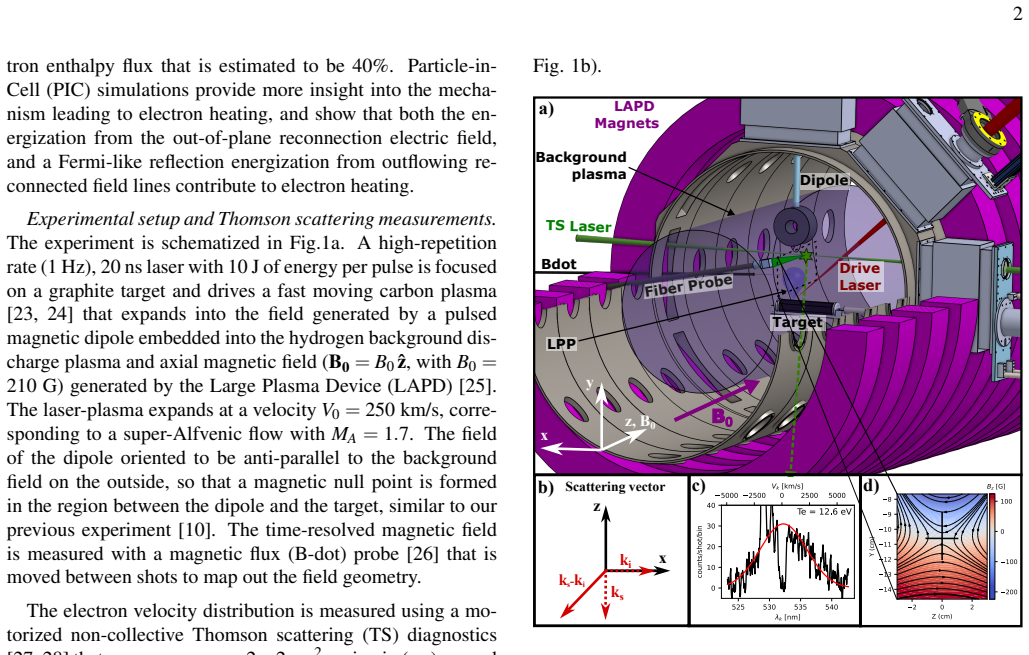
We report on the experimental observation of electron heating in electron-only magnetic reconnection in laser-driven laboratory mini-magnetospheres on the Large Plasma Device (LAPD) at the University of California, Los Angeles. In this experiment, a fast-flowing plasma impacts a pulsed magnetic dipole embedded within LAPD's magnetized ambient plasma, creating an ion-scale magnetosphere and driving electron-only magnetic reconnection between the background and dipole field lines. The electron velocity distribution is measured across the reconnection region using non-collective Thomson scattering, enabling determination of electron temperature and density. Significant electron heating is observed in the electron diffusion region, increasing from an initial temperature of 1.8 eV to 9.5 eV, corresponding to a 40\% conversion of Poynting flux into electron enthalpy flux. Particle-in-cell simulations that provide insights into the heating mechanisms are also presented.
Editorial analysis
A structured set of objections, weighed in public.
Referee Report
Summary. The paper reports the experimental observation of electron heating during electron-only magnetic reconnection in a laser-driven laboratory mini-magnetosphere on the LAPD. A fast-flowing plasma interacts with a pulsed magnetic dipole to drive reconnection between background and dipole field lines. Non-collective Thomson scattering is used to measure the electron velocity distribution, yielding an increase in electron temperature from 1.8 eV to 9.5 eV within the electron diffusion region that corresponds to a 40% conversion of Poynting flux into electron enthalpy flux. Particle-in-cell simulations are included to provide insight into the underlying heating mechanisms.
Significance. If the spatial registration of the Thomson scattering volume to the true electron diffusion region and the absence of spectral contamination can be rigorously demonstrated, the result would constitute a valuable direct laboratory measurement of electron heating and energy conversion in electron-only reconnection. Such quantitative data are scarce and could help constrain models of electron energization relevant to space and astrophysical plasmas. The controlled LAPD environment and use of Thomson scattering for local Te and ne measurements are particular strengths that enable falsifiable comparisons with theory.
major comments (3)
- [Abstract and §4] Abstract and §4 (Results): The headline values of 1.8 eV to 9.5 eV and the 40% Poynting-to-enthalpy conversion are presented without reported uncertainties, error bars, or a description of data exclusion criteria. Because these numbers are central to the claim of significant heating, the lack of quantitative error analysis undermines the ability to assess whether the observed jump exceeds measurement uncertainty or background variability.
- [§3 and §4] §3 (Thomson Scattering Measurements) and §4: The manuscript does not provide a detailed account of how the Thomson scattering volume is spatially registered to the electron diffusion region (e.g., via B-field reversal, electron flow stagnation point, or parallel electric field). If the probed volume is offset by even one ion inertial length or integrates over upstream/downstream plasma, the temperature increase cannot be unambiguously attributed to reconnection heating and the 40% conversion fraction becomes an upper bound rather than a direct measurement.
- [§5] §5 (PIC Simulations): The role of the presented particle-in-cell simulations in supporting the central experimental claim is not specified. It is unclear whether they are used for quantitative validation of the observed temperature jump, for identifying the dominant heating mechanism, or merely for qualitative illustration; without this linkage the simulations do not strengthen the direct-measurement assertion.
minor comments (3)
- Figure captions and axis labels should explicitly state the spatial resolution of the Thomson scattering volume relative to the ion inertial length and the temporal averaging window used for the reported temperatures.
- The manuscript would benefit from a brief comparison table or plot overlaying the measured Te profile with the locations of key reconnection signatures (B reversal, E_parallel) to make the region identification transparent.
- A short discussion of possible non-thermal features or anisotropy in the Thomson spectrum and how they were ruled out would strengthen the claim that the reported Te is uncontaminated.
Simulated Author's Rebuttal
We thank the referee for their careful and constructive review. The comments have helped us strengthen the presentation of uncertainties, spatial registration, and the role of the simulations. We respond to each major comment below and indicate the revisions made.
read point-by-point responses
-
Referee: [Abstract and §4] Abstract and §4 (Results): The headline values of 1.8 eV to 9.5 eV and the 40% Poynting-to-enthalpy conversion are presented without reported uncertainties, error bars, or a description of data exclusion criteria. Because these numbers are central to the claim of significant heating, the lack of quantitative error analysis undermines the ability to assess whether the observed jump exceeds measurement uncertainty or background variability.
Authors: We agree that quantitative uncertainties are necessary to substantiate the reported temperature increase and conversion efficiency. In the revised manuscript we have added error bars to the 1.8 eV and 9.5 eV values and to the 40% conversion fraction; these are derived from the covariance matrix of the Thomson scattering spectral fits together with the shot-to-shot standard deviation. We have also inserted a concise description of the data exclusion criteria (rejection of spectra with signal-to-noise below a stated threshold or with visible laser-induced perturbations) in §4. The abstract has been updated to include the uncertainties. revision: yes
-
Referee: [§3 and §4] §3 (Thomson Scattering Measurements) and §4: The manuscript does not provide a detailed account of how the Thomson scattering volume is spatially registered to the electron diffusion region (e.g., via B-field reversal, electron flow stagnation point, or parallel electric field). If the probed volume is offset by even one ion inertial length or integrates over upstream/downstream plasma, the temperature increase cannot be unambiguously attributed to reconnection heating and the 40% conversion fraction becomes an upper bound rather than a direct measurement.
Authors: We acknowledge that a more explicit registration procedure strengthens the attribution. The revised §3 now contains a step-by-step description of how the Thomson scattering volume is aligned with the electron diffusion region: magnetic-field probe data locate the B-field reversal and the electron flow stagnation point, and the scattering volume is positioned at the center of this interval. An additional schematic (new Figure X) shows the relative locations of the probes, the estimated diffusion-region boundaries, and the scattering volume, confirming that the measurement is taken inside the electron diffusion region rather than an average over upstream or downstream plasma. revision: yes
-
Referee: [§5] §5 (PIC Simulations): The role of the presented particle-in-cell simulations in supporting the central experimental claim is not specified. It is unclear whether they are used for quantitative validation of the observed temperature jump, for identifying the dominant heating mechanism, or merely for qualitative illustration; without this linkage the simulations do not strengthen the direct-measurement assertion.
Authors: The simulations are provided to identify candidate heating mechanisms (parallel electric fields and wave-particle scattering) that are consistent with the observed temperature rise, not to perform a quantitative validation of the exact experimental values. In the revised §5 we have added an explicit statement of this purpose and a short discussion of how the simulated particle orbits and field structures align qualitatively with the experimental conditions, thereby supporting the physical interpretation of the direct Thomson-scattering measurements. revision: yes
Circularity Check
No significant circularity: central results are direct experimental measurements
full rationale
The paper reports direct laboratory measurements of electron temperature and density via non-collective Thomson scattering across the reconnection region in a laser-driven mini-magnetosphere experiment. The key values (initial Te of 1.8 eV rising to 9.5 eV, with 40% Poynting-to-enthalpy conversion) are presented as observed quantities from the probed plasma volume, not as outputs of any self-referential equations, fitted parameters renamed as predictions, or self-citation chains that reduce to the inputs by construction. The identification of the electron diffusion region is tied to experimental setup (B-field reversal and flow stagnation) rather than a mathematical derivation that loops back on itself. Mention of PIC simulations is supplementary for mechanism insight and does not bear the load of the primary observational claim. No load-bearing step matches the enumerated circularity patterns.
Axiom & Free-Parameter Ledger
axioms (1)
- domain assumption Non-collective Thomson scattering accurately determines local electron temperature and density in the reconnection region without significant contamination from ion motion or other effects.
Lean theorems connected to this paper
-
IndisputableMonolith/Foundation/RealityFromDistinction.leanreality_from_one_distinction unclear?
unclearRelation between the paper passage and the cited Recognition theorem.
Significant electron heating is observed in the electron diffusion region, increasing from an initial temperature of 1.8 eV to 9.5 eV, corresponding to a 40% conversion of Poynting flux into electron enthalpy flux.
-
IndisputableMonolith/Cost/FunctionalEquation.leanwashburn_uniqueness_aczel unclear?
unclearRelation between the paper passage and the cited Recognition theorem.
PIC simulations ... both the energization from the out-of-plane reconnection electric field, and a Fermi-like reflection energization from outflowing reconnected field lines contribute to electron heating.
What do these tags mean?
- matches
- The paper's claim is directly supported by a theorem in the formal canon.
- supports
- The theorem supports part of the paper's argument, but the paper may add assumptions or extra steps.
- extends
- The paper goes beyond the formal theorem; the theorem is a base layer rather than the whole result.
- uses
- The paper appears to rely on the theorem as machinery.
- contradicts
- The paper's claim conflicts with a theorem or certificate in the canon.
- unclear
- Pith found a possible connection, but the passage is too broad, indirect, or ambiguous to say the theorem truly supports the claim.
Reference graph
Works this paper leans on
-
[1]
km/s. Since the projection vector is k = −z − x the positive value Vk is most likely as- sociated with a negative electron outflow Vz, since the elec- tron flow in the x direction is expected to be towards the positive x from the negative reconnection current measured, and therefore contribute negatively to Vk. We assume this contribution from the flow al...
- [2]
-
[3]
J. L. Burch, R. B. Torbert, T. D. Phan, L.-J. Chen, T. E. Moore, R. E. Ergun, J. P. Eastwood, D. J. Gershman, P. A. Cassak, M. R. Argall, S. Wang, M. Hesse, C. J. Pollock, B. L. Giles, R. Nakamura, B. H. Mauk, S. A. Fuselier, C. T. Russell, R. J. Strangeway, J. F. Drake, M. A. Shay, Y . V . Khotyaintsev, P.-A. Lindqvist, G. Marklund, F. D. Wilder, D. T. Y...
work page 2016
-
[4]
F. D. Wilder, R. E. Ergun, S. Eriksson, T. D. Phan, J. L. Burch, N. Ahmadi, K. A. Goodrich, D. L. Newman, K. J. Trattner, R. B. Torbert, B. L. Giles, R. J. Strangeway, W. Magnes, P.-A. Lindqvist, and Y .-V . Khotyaintsev, Phys. Rev. Lett.118, 265101 (2017)
work page 2017
-
[5]
T. D. Phan, J. P. Eastwood, M. A. Shay, J. F. Drake, B. U. Ö. Sonnerup, M. Fujimoto, P. A. Cassak, M. Øieroset, J. L. Burch, R. B. Torbert, A. C. Rager, J. C. Dorelli, D. J. Gershman, C. Pollock, P. S. Pyakurel, C. C. Haggerty, Y . Khotyaint- sev, B. Lavraud, Y . Saito, M. Oka, R. E. Ergun, A. Retino, O. Le Contel, M. R. Argall, B. L. Giles, T. E. Moore, ...
work page 2018
-
[6]
P. Sharma Pyakurel, M. A. Shay, T. D. Phan, W. H. Matthaeus, J. F. Drake, J. M. TenBarge, C. C. Haggerty, K. G. Klein, P. A. Cassak, T. N. Parashar, M. Swisdak, and A. Chasapis, Physics of Plasmas 26, 082307 (2019)
work page 2019
-
[7]
H. Y . Man, M. Zhou, Y . Y . Yi, Z. H. Zhong, A. M. Tian, X. H. Deng, Y . Khotyaintsev, C. T. Russell, and B. L. Giles, Geophys- ical Research Letters 47, e2020GL089659 (2020)
work page 2020
-
[8]
P. Shi, P. Srivastav, M. H. Barbhuiya, P. A. Cassak, E. E. Scime, and M. Swisdak, Physical Review Letters 128, 025002 (2022)
work page 2022
-
[9]
P. Shi, E. E. Scime, M. H. Barbhuiya, P. A. Cassak, S. Adhikari, M. Swisdak, and J. E. Stawarz, Physical Review Letters 131, 155101 (2023)
work page 2023
-
[10]
A. Chien, L. Gao, S. Zhang, H. Ji, E. G. Blackman, W. Daughton, A. Stanier, A. Le, F. Guo, R. Follett, H. Chen, G. Fiksel, G. Bleotu, R. C. Cauble, S. N. Chen, A. Fazzini, K. Flippo, O. French, D. H. Froula, J. Fuchs, S. Fujioka, K. Hill, S. Klein, C. Kuranz, P. Nilson, A. Rasmus, and R. Takizawa, Nature Physics 19, 254 (2023)
work page 2023
- [11]
-
[12]
M. Hubbert, C. T. Russell, Y . Qi, S. Lu, J. L. Burch, B. L. Giles, and T. E. Moore, Journal of Geophysical Research: Space Physics 127, e2021JA029584 (2022)
work page 2022
-
[13]
S. Lu, Q. Lu, R. Wang, P. L. Pritchett, M. Hubbert, Y . Qi, K. Huang, X. Li, and C. T. Russell, Geophysical Research Let- ters 49, e2022GL098547 (2022)
work page 2022
-
[14]
R. P. Sawyer, J. S. Halekas, J. W. Bonnell, L. J. Chen, J. McFad- den, K. H. Glassmeier, Y . Harada, and A. Stanier, Geophysical Research Letters 50, e2023GL104733 (2023)
work page 2023
-
[15]
A. Stanier, L. J. Chen, A. Le, J. Halekas, and R. Sawyer, The Astrophysical Journal Letters 963, L11 (2024)
work page 2024
-
[16]
Y . Harada, J. S. Halekas, J. P. McFadden, J. Espley, G. A. Di- Braccio, D. L. Mitchell, C. Mazelle, D. A. Brain, L. Andersson, Y . J. Ma, D. E. Larson, S. Xu, T. Hara, S. Ruhunusiri, R. Livi, and B. M. Jakosky, Journal of Geophysical Research: Space Physics 122, 5114 (2017)
work page 2017
- [17]
-
[18]
J. Wang, J. Yu, X. Xu, J. Cui, J. Cao, Y . Ye, Q. Xu, M. Wang, Z. Zhou, Q. Chang, J. Xu, and X. Wang, Geophysical Research Letters 48, e2021GL095426 (2021)
work page 2021
-
[19]
X. Qiu, Y . Yu, J. Wang, L. Chai, F. Gong, L. Liu, and J. Cao, The Astrophysical Journal 977, 109 (2024)
work page 2024
-
[20]
L. Wang, C. Huang, A. Du, Y . Ge, G. Chen, J. Fan, and J. Qin, Geophysical Research Letters 50, e2023GL104996 (2023)
work page 2023
-
[21]
J. A. Slavin, S. M. Krimigis, M. H. Acuña, B. J. Anderson, D. N. Baker, P. L. Koehn, H. Korth, S. Livi, B. H. Mauk, S. C. Solomon, and T. H. Zurbuchen, Space Science Reviews 131, 133 (2007)
work page 2007
-
[22]
R. W. Ebert, S. A. Fuselier, F. Allegrini, F. Bagenal, S. J. Bolton, G. Clark, J. E. P. Connerney, G. A. DiBraccio, W. S. Kurth, S. Levin, D. J. McComas, J. Montgomery, N. Romanelli, A. H. Sulaiman, J. R. Szalay, P. Valek, and R. J. Wilson, Geophysical Research Letters 49, e2022GL099775 (2022)
work page 2022
- [23]
-
[24]
C. Niemann, W. Gekelman, C. G. Constantin, E. T. Everson, D. B. Schaeffer, S. E. Clark, D. Winske, A. B. Zylstra, P. Pribyl, S. K. P. Tripathi, D. Larson, S. H. Glenzer, and A. S. Bon- darenko, Physics of Plasmas 20, 012108 (2013)
work page 2013
-
[25]
D. B. Schaeffer, A. S. Bondarenko, E. T. Everson, S. E. Clark, C. G. Constantin, and C. Niemann, Journal of Applied Physics 120, 043301 (2016)
work page 2016
-
[26]
W. Gekelman, P. Pribyl, Z. Lucky, S. Vincena, B. V . Comper- nolle, T. A. Carter, and D. Leneman, Review of Scientific In- struments 87, 025105 (2016)
work page 2016
-
[27]
E. T. Everson, P. Pribyl, C. G. Constantin, A. Zylstra, D. Scha- effer, N. L. Kugland, and C. Niemann, Review of Scientific In- struments 80, 113505 (2009)
work page 2009
-
[28]
S. Ghazaryan, M. Kaloyan, W. Gekelman, Z. Lucky, S. Vin- cena, S. K. P. Tripathi, P. Pribyl, and C. Niemann, Review of Scientific Instruments 93, 083514 (2022)
work page 2022
-
[29]
H. Zhang, J. J. Pilgram, C. G. Constantin, L. Rovige, P. V . Heuer, S. Ghazaryan, M. Kaloyan, R. S. Dorst, D. B. Schaeffer, and C. Niemann, Instruments 7, 10.3390/instruments7030025 (2023)
-
[30]
R. A. Fonseca, L. O. Silva, F. S. Tsung, V . K. Decyk, W. Lu, C. Ren, W. B. Mori, S. Deng, S. Lee, T. Katsouleas, and J. C. Adam, in Computational Science — ICCS 2002 (2002) pp. 342– 351
work page 2002
- [31]
- [32]
- [33]
-
[34]
A. Le, J. Egedal, and W. Daughton, Physics of Plasmas 23, 102109 (2016). 6
work page 2016
-
[35]
J. F. Drake, M. Swisdak, H. Che, and M. A. Shay, Nature 443, 553 (2006)
work page 2006
-
[36]
J. T. Dahlin, J. F. Drake, and M. Swisdak, Physics of Plasmas 21, 092304 (2014)
work page 2014
discussion (0)
Sign in with ORCID, Apple, or X to comment. Anyone can read and Pith papers without signing in.