REVIEW 3 major objections 5 minor 31 references
EGGS-PTP: An Expander-Graph Guided Structured Post-training Pruning Method for Large Language Models
T0 review · 3 major / 5 minor · reviewed 2026-08-05 · deepseek-v4-flash
Pith's one-line read EGGS-PTP claims that N:M pruning guided by expander-graph connectivity preserves LLM accuracy better than existing one-shot structured pruning methods.
desk verdict A modest, credible N:M pruning heuristic that consistently beats RIA/Wanda, but the expander-graph theory is a dressed-up min-degree observation and should be treated as motivation, not proof. read the letter →
The pith
A machine-rendered reading of the paper's core claim, the machinery that carries it, and where it could break.
The reading
What carries the argument
The load-bearing mechanism is the bipartite-graph view of a linear layer together with a degree floor. In each low-importance $M \times M$ block the algorithm splits the block into quadrants, sums weight magnitudes along the two diagonals of each quadrant, and keeps the diagonal pair with the larger total; this guarantees every input neuron retains at least $B$ surviving connections. Because each output neuron also keeps exactly $M-N$ connections per pruning group under the N:M mask, every small subset of input or output neurons has a neighborhood larger than itself -- the two-sided expansion property. On top of that floor, RIA-based selection picks the remaining highest-importance weights p
What would settle it
Take LLaMA2-7B at 2:4 sparsity and replace EGGS-PTP's diagonal selection in the connectivity blocks with a random matching that still gives every input channel the same minimum degree, keeping RIA top-selection for the remaining weights. If perplexity stays at 10.32 or close to it, the expander-guided selection is not the active ingredient. A complementary check is to compute the spectral gap of the pruned layer adjacency matrices and see whether accuracy tracks expansion constants across layers.
Extended reading notes
Core claim
The central claim is that a structured pruning mask for a linear layer can be built as a two-sided expander graph without abandoning the N:M sparsity that GPUs can accelerate. The paper models each linear layer as a bipartite graph whose adjacency submatrix is the weight matrix, then applies two complementary selections per pruning group: importance-aware selection keeps the top $M-N$ RIA-scored weights in each row, while connectivity-aware selection applies magnitude-based diagonal selection to the lowest-importance $M \times M$ blocks so every input channel keeps at least one edge. The resulting mask is provably a two-sided $(c, a_I, a_O)$-expander for small channel subsets, and empiricall
Load-bearing premise
The load-bearing premise is that guaranteeing each channel keeps at least B connections -- rather than any measured spectral or information-flow property -- is what preserves accuracy; the paper's expansion proof holds only for channel subsets smaller than B and no experiment isolates the connectivity effect.
Editorial extensions
If this is right
- EGGS-PTP reports lower perplexity than RIA and Wanda on all tested LLaMA models under both 2:4 and 4:8 sparsity, with gains such as 10.32 vs 10.41 on LLaMA2-7B and 20.88 vs 21.47 on LLaMA3-8B.
- Because the mask keeps the N:M structure and requires no retraining, it inherits the measured 1.64x inference speedup on LLaMA2-13B (31.82s vs 52.14s for the dense model).
- On LLaMA-34B zero-shot benchmarks, the pruned model matches or exceeds the dense baseline on several tasks, including BoolQ and RTE under both sparsity patterns.
- The optimal number of connectivity-aware blocks grows with model size, suggesting that larger models can afford more structural protection before importance-aware selection loses its edge.
Reading between the lines
- Not tested in the paper: the expansion guarantee applies only to channel subsets smaller than $B$, a tiny fraction of a layer, so the empirical gains may come from the minimum-degree floor rather than from genuine spectral expansion.
- A clean ablation would replace diagonal selection with any degree-preserving random mask while keeping RIA top-selection; if perplexity stays essentially unchanged, the expander-guided selection is not the active ingredient.
- A natural extension is to measure the spectral gap of the pruned bipartite graphs and correlate it with layer-wise accuracy loss; the paper proves only a degree-based small-set property, not spectral expansion.
- The authors themselves note that a dense 7B model can beat a pruned 13B model, implying the practical value of N:M pruning is mainly hardware cost savings, not accuracy recovery.
Editorial analysis
A structured set of objections, weighed in public.
Referee Report
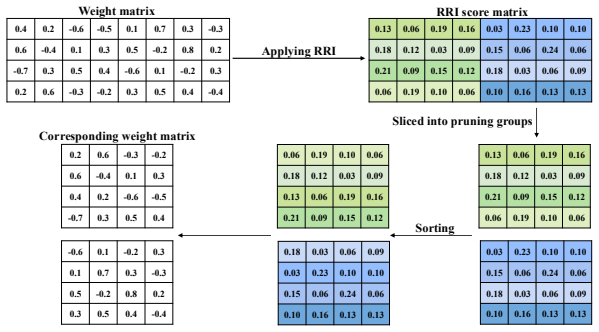
Summary. EGGS-PTP proposes a post-training N:M structured pruning method for LLMs. The method computes RIA scores, permutes input channels via round-robin allocation, computes RRI row importance, partitions each pruning group into row-blocks, and then applies two strategies: a 'connectivity-aware' diagonal selection on the B blocks with lowest aggregated RRI, followed by RIA-based top-weight selection, while all other blocks use RIA-based selection. The paper claims that the resulting pruned linear layers are two-sided expanders (Lemma 1), which is said to preserve information flow. Experiments on LLaMA2-7B/13B, LLaMA3-8B, LLaMA-34B, and LLaMA3.2-1B report consistently lower Wikitext2 perplexity than Magnitude, Wanda, and RIA under 2:4 and 4:8 sparsity, as well as improved zero-shot accuracy on several benchmarks for LLaMA-34B, with a 1.64x runtime speedup.
Significance. If the empirical results hold, the paper offers a modest but consistent practical improvement over existing N:M post-training pruning methods across five model sizes and two sparsity patterns. The comparison to Wanda and RIA is useful, and the runtime analysis confirms the hardware benefit of the structured mask. However, the theoretical contribution is not established: Lemma 1 proves only a minimum-degree property in a negligible size regime, not an expander guarantee that can justify the 'information flow' claims. The paper provides no mechanism-level ablation linking the diagonal-selection structure to the observed gains. The value of the work is therefore as a heuristic with reproducible-looking gains, not as a validated graph-theoretic pruning principle.
major comments (3)
- [Section 6, Lemma 1, Eq. (7)-(10)] The theorem is technically correct but is a restatement of minimum degree, not a meaningful expander guarantee. Eq. (7) follows only from the fact that every input neuron retains at least B connections; no property of the diagonal-selection pattern beyond degree is used. The proof then restricts to subsets of size smaller than B via c < B/F_{\ell-1}. With F_{\ell-1} in the thousands and B in [1,20], the input-side expansion is guaranteed only for subsets of size at most B-1; for 2:4 sparsity with B=2 this covers only singletons. The output side, Eq. (9), is the standard exact degree of an output node. Thus the lemma does not establish expansion for any set of realistic size, and the abstract/introduction claim that expansion 'ensures information flow' is unsupported. Please either prove a constant-fraction expansion property or revise the claims to describe a minimum-connectivity heurist
- [Sections 5.3-5.4, Algorithm 1] The causal role of the expander-inspired construction is not tested. The empirical gains over RIA could come from the added hyperparameter B, from the RRI-based row partitioning, or from the channel permutation, rather than from the diagonal selection per se. I request ablations that isolate the mechanism: (i) EGGS-PTP with B=0, i.e., importance-aware selection on all blocks; (ii) diagonal selection on randomly chosen low-RRI blocks; (iii) random diagonal selection instead of the magnitude-weighted quadrant selection; and (iv) direct measurement of graph properties after pruning, such as actual vertex expansion for subsets of various sizes, the number of corrupted input channels, and average retained degree per input/output neuron. Without such evidence, the paper's central theoretical narrative remains a conjecture.
- [Section 7.1, Eq. (4)] The experimental protocol is under-specified for the free parameters. The value of alpha in Eq. (4) is never stated, and it is not reported whether alpha is taken from RIA or tuned. In addition, '1-fold cross-validation on the validation set' is ambiguous: the exact split between validation and test, and the relationship between the Wikitext2 perplexity test set and the validation set used to select B in [1,20], are not described. Since B can materially change perplexity, the comparison to fixed-hyperparameter baselines needs a clearer protocol, ideally with sensitivity analysis over B and alpha.
minor comments (5)
- [Algorithm 1, line 8] A pruning group has M columns, and the algorithm then divides it into M×M blocks. Clarify whether these blocks are disjoint row partitions of the pruning group and that the same M input columns appear in every block. This is important for verifying the claim that every input neuron retains B connections.
- [Tables 1-2] The numerical formatting is inconsistent and occasionally hard to read (e.g., '4 .88', '2400'). Use monospaced columns and align decimal points.
- [Tables 3-4, Section 7.1] No standard deviations or repeated-run variability are reported. Several differences between EGGS-PTP and RIA are in the 0.1-0.5 perplexity range; reporting variance or at least a small number of seeds would make the 'consistently outperforms' claim more robust.
- [Section 7.3] The statement that pruning 'addresses overfitting' and improves generalization on BoolQ and RTE is presented as a conclusive explanation without supporting evidence. It would be safer to describe this as a possible interpretation.
- [Related works] The paper cites RIA for the channel-permutation and RIA metric, which is appropriate, but it does not clearly state which components are novel relative to RIA and which are inherited. A short comparison table of RIA vs. EGGS-PTP would help.
Circularity Check
Lemma 1's expander guarantee is a min-degree restatement of the algorithm's own construction, but the main empirical comparison is self-contained against external baselines.
-
self definitional
[Section 6, Lemma 1, Eqs. (7)-(9)]
"According to Algorithm 1, the repeated diagonal selection across B blocks in each pruning group ensures that every input neuron vi ∈ I retains at least B connections, yielding: |Γ(T)| ≥ B. (7) Therefore, for any T ⊆ I with |T| < B ... we obtain aI > 1, (8) satisfying Eq. (5)."
The proof's entire content is the algorithm's own construction: Step 1 of connectivity-aware pruning (diagonal selection) is explicitly designed to ensure every input neuron keeps at least B edges, so Eq. (7) restates the selection rule. Restricting to |T|<B forces B>|T|, making aI>1 follow by counting rather than by any expander property; Eq. (9) likewise restates the N:M degree regularity. Thus Lemma 1 reduces to a min-degree guarantee: it shows no input is isolated, but cannot justify 'information flow' for larger subsets (c < B/F_{ℓ-1}, with B≤20 and F in thousands, covers only tiny sets). The expander label is a definitional consequence of the construction, not an external first-principles result.
full rationale
The empirical core of EGGS-PTP is not circular: perplexity and zero-shot results are compared against independent baselines (Magnitude, Wanda, RIA) under identical N:M masks; no parameter is fitted to the test set and then reported as a prediction; and there are no load-bearing self-citations, since RIA and round-robin permutation are attributed to prior external work [30]. The one definitional-overreach step is Lemma 1, where the claimed two-sided expander property is proven almost entirely from the algorithm's own min-degree guarantee. The quoted proof shows |Γ(T)| ≥ B because the algorithm ensures every input neuron keeps at least B connections, then chooses c so small that aI>1 is automatic. This is true but tautological: it does not independently establish robust information flow at the scale of real layers, and the paper provides no direct spectral or information-flow measurement. Because this overclaim does not by itself drive the benchmark numbers, the circularity is minor and localized. Score 2 reflects one definitional step, not a fitted prediction or self-citation chain.
Assumptions & free parameters
free parameters (2)
- B (number of connectivity-aware blocks) =
tuned per model over [1,20] via validation, not reported per model in tables
- alpha (activation strength in RIA) =
not stated
assumptions (4)
- domain assumption Expander graphs with strong connectivity preserve information flow in pruned neural networks.
- domain assumption RIA scores are a valid measure of weight importance for pruning.
- domain assumption Channel permutation based on channel RIA improves pruning by distributing important weights across groups.
- domain assumption N:M sparsity is a suitable pattern for hardware acceleration and a fair constraint for comparison.
Cite this review
Pith. "Pith review of EGGS-PTP: An Expander-Graph Guided Structured Post-training Pruning Method for Large Language Models." pith.science (2026). https://pith.science/paper/DQPAZDPT
@misc{pith2026250809471,
  author       = {Pith},
  title        = {Pith review of: EGGS-PTP: An Expander-Graph Guided Structured Post-training Pruning Method for Large Language Models},
  year         = {2026},
  howpublished = {\url{https://pith.science/paper/DQPAZDPT}},
  note         = {Machine review of arXiv:2508.09471}
}
read the original abstract
As Large Language Models (LLMs) become more widely adopted and scale up in size, the computational and memory challenges involved in deploying these massive foundation models have grown increasingly severe. This underscores the urgent need to develop more efficient model variants. Faced with this challenge, the present work introduces EGGS-PTP: an Expander-Graph Guided Structured Post-training Pruning method. The proposed approach leverages graph theory to guide the design of N:M structured pruning, effectively reducing model size and computational demands. By incorporating concepts from expander graphs, EGGS-PTP ensures information flow within the pruned network, preserving essential model functionality. Extensive numerical experiments demonstrate that EGGS-PTP not only achieves significant acceleration and memory savings due to structured sparsity but also outperforms existing structured pruning techniques in terms of accuracy across various LLMs.
Figures


Figures from the paper (1 more)
Reference graph
Works this paper leans on
-
[1]
Bipartite graphs and their applications, volume 131
Armen S Asratian, Tristan MJ Denley, and Roland Häggkvist. Bipartite graphs and their applications, volume 131. Cambridge university press, 1998
work page 1998
-
[2]
Sparsellm: Towards global pruning for pre-trained language models
Guangji Bai, Yijiang Li, Chen Ling, Kibaek Kim, and Liang Zhao. Sparsellm: Towards global pruning for pre-trained language models. arXiv preprint arXiv:2402.17946, 2024
arXiv 2024
-
[3]
Binarybert: Pushing the limit of bert quantization
Haoli Bai, Wei Zhang, Lu Hou, Lifeng Shang, Jing Jin, Xin Jiang, Qun Liu, Michael Lyu, and Irwin King. Binarybert: Pushing the limit of bert quantization. arXiv preprint arXiv:2012.15701, 2020
arXiv 2012
-
[4]
Abhimanyu Dubey, Abhinav Jauhri, Abhinav Pandey, Abhishek Kadian, Ahmad Al-Dahle, Aiesha Letman, Akhil Mathur, Alan Schelten, Amy Yang, Angela Fan, et al. The llama 3 herd of models. arXiv preprint arXiv:2407.21783, 2024
arXiv 2024
-
[5]
Sparsegpt: Massive language models can be accurately pruned in one-shot
Elias Frantar and Dan Alistarh. Sparsegpt: Massive language models can be accurately pruned in one-shot. In International Conference on Machine Learning, pages 10323–10337. PMLR, 2023
2023
-
[6]
Gptq: Accurate post-training quantization for generative pre-trained transformers
Elias Frantar, Saleh Ashkboos, Torsten Hoefler, and Dan Alistarh. Gptq: Accurate post-training quantization for generative pre-trained transformers. arXiv preprint arXiv:2210.17323, 2022
arXiv 2022
-
[7]
Learning both weights and connections for efficient neural network
Song Han, Jeff Pool, John Tran, and William Dally. Learning both weights and connections for efficient neural network. Advances in neural information processing systems, 28, 2015
2015
-
[8]
Babak Hassibi, David G. Stork, and Gregory J. Wolff. Optimal brain surgeon and general network pruning. In Proceedings of International Conference on Neural Networks (ICNN’88), San Francisco, CA, USA, March 28 - April 1, 1993, pages 293–299. IEEE, 1993. doi: 10.1109/ ICNN.1993.298572
Show all 31 references
-
[9]
Revisiting pruning at initialization through the lens of ramanujan graph
Duc NM Hoang and Shiwei Liu. Revisiting pruning at initialization through the lens of ramanujan graph. ICLR 2023, 2023
2023
-
[10]
Explicit two-sided unique-neighbor expanders
Jun-Ting Hsieh, Theo McKenzie, Sidhanth Mohanty, and Pedro Paredes. Explicit two-sided unique-neighbor expanders. In Proceedings of the 56th Annual ACM Symposium on Theory of Computing, pages 788–799, 2024
2024
-
[11]
Pruning large language models with semi-structural adaptive sparse training
Weiyu Huang, Yuezhou Hu, Guohao Jian, Jun Zhu, and Jianfei Chen. Pruning large language models with semi-structural adaptive sparse training. In Proceedings of the AAAI Conference on Artificial Intelligence, volume 39, pages 24167–24175, 2025
2025
-
[12]
Optimal brain damage
Yann LeCun, John Denker, and Sara Solla. Optimal brain damage. In D. Touretzky, editor, Advances in Neural Information Processing Systems, volume 2. Morgan-Kaufmann, 1989
1989
-
[13]
Snip: Single-shot network pruning based on connection sensitivity
Namhoon Lee, Thalaiyasingam Ajanthan, and Philip HS Torr. Snip: Single-shot network pruning based on connection sensitivity. arXiv preprint arXiv:1810.02340, 2018
2018 arXiv
-
[14]
Awq: Activation-aware weight quantization for on-device llm compression and acceleration
Ji Lin, Jiaming Tang, Haotian Tang, Shang Yang, Wei-Ming Chen, Wei-Chen Wang, Guangxuan Xiao, Xingyu Dang, Chuang Gan, and Song Han. Awq: Activation-aware weight quantization for on-device llm compression and acceleration. Proceedings of Machine Learning and Systems, 6:87–100,...
2024
-
[15]
Sparse training via boosting pruning plasticity with neuroregeneration
Shiwei Liu, Tianlong Chen, Xiaohan Chen, Zahra Atashgahi, Lu Yin, Huanyu Kou, Li Shen, Mykola Pechenizkiy, Zhangyang Wang, and Decebal Constantin Mocanu. Sparse training via boosting pruning plasticity with neuroregeneration. Advances in Neural Information Processing Systems, ...
2021
-
[16]
Alphapruning: Using heavy-tailed self regularization theory for improved layer-wise pruning of large language models
Haiquan Lu, Yefan Zhou, Shiwei Liu, Zhangyang Wang, Michael W Mahoney, and Yaoqing Yang. Alphapruning: Using heavy-tailed self regularization theory for improved layer-wise pruning of large language models. Advances in Neural Information Processing Systems, 37: 9117–9152, 2024
2024
-
[17]
Accelerating sparse deep neural networks, 2021
Asit Mishra, Jorge Albericio Latorre, Jeff Pool, Darko Stosic, Dusan Stosic, Ganesh Venkatesh, Chong Yu, and Paulius Micikevicius. Accelerating sparse deep neural networks, 2021
2021
-
[18]
Scalable training of artificial neural networks with adaptive sparse connectivity inspired by network science
Decebal Constantin Mocanu, Elena Mocanu, Peter Stone, Phuong H Nguyen, Madeleine Gibescu, and Antonio Liotta. Scalable training of artificial neural networks with adaptive sparse connectivity inspired by network science. Nature communications, 9(1):2383, 2018
2018
-
[19]
Nvidia a100 tensor core gpu architecture
NVIDIA. Nvidia a100 tensor core gpu architecture. Technical report, NVIDIA Corporation,
-
[20]
Deep expander networks: Efficient deep networks from graph theory
Ameya Prabhu, Girish Varma, and Anoop Namboodiri. Deep expander networks: Efficient deep networks from graph theory. In Proceedings of the European Conference on Computer Vision (ECCV), pages 20–35, 2018
2018
-
[21]
Movement pruning: Adaptive sparsity by fine-tuning
Victor Sanh, Thomas Wolf, and Alexander Rush. Movement pruning: Adaptive sparsity by fine-tuning. Advances in neural information processing systems, 33:20378–20389, 2020
2020
-
[22]
Spielman
Daniel A. Spielman. Spectral graph theory and its applications. In48th Annual IEEE Symposium on Foundations of Computer Science (FOCS’07), pages 29–38, 2007. doi: 10.1109/FOCS.2007. 56
2007 doi
-
[23]
Zico Kolter
Mingjie Sun, Zhuang Liu, Anna Bair, and J. Zico Kolter. A simple and effective pruning approach for large language models. arXiv preprint arXiv:2306.11695, 2023
2023 arXiv
-
[24]
Llama 2: Open foundation and fine-tuned chat models
Hugo Touvron, Louis Martin, Kevin Stone, Peter Albert, Amjad Almahairi, Yasmine Babaei, Nikolay Bashlykov, Soumya Batra, Prajjwal Bhargava, Shruti Bhosale, et al. Llama 2: Open foundation and fine-tuned chat models. arXiv preprint arXiv:2307.09288, 2023
2023 arXiv
-
[25]
Picking winning tickets before training by preserving gradient flow
Chaoqi Wang, Guodong Zhang, and Roger Grosse. Picking winning tickets before training by preserving gradient flow. arXiv preprint arXiv:2002.07376, 2020
2002 arXiv
-
[26]
Pruning before fine-tuning: A retraining-free compression framework for pre-trained language models
Pingjie Wang, Hongcheng Liu, Yanfeng Wang, and Yu Wang. Pruning before fine-tuning: A retraining-free compression framework for pre-trained language models. In Proceedings of the 2024 Joint International Conference on Computational Linguistics, Language Resources and Evaluatio...
2024
-
[27]
Smoothquant: Accurate and efficient post-training quantization for large language models
Guangxuan Xiao, Ji Lin, Mickael Seznec, Hao Wu, Julien Demouth, and Song Han. Smoothquant: Accurate and efficient post-training quantization for large language models. In International Conference on Machine Learning, pages 38087–38099. PMLR, 2023
2023
-
[28]
Efficientllm: Scalable pruning-aware pretraining for architecture-agnostic edge language models
Xingrun Xing, Zheng Liu, Shitao Xiao, Boyan Gao, Yiming Liang, Wanpeng Zhang, Haokun Lin, Guoqi Li, and Jiajun Zhang. Efficientllm: Scalable pruning-aware pretraining for architecture-agnostic edge language models. arXiv preprint arXiv:2502.06663, 2025
2025 arXiv
-
[29]
Prune once for all: Sparse pre-trained language models
Ofir Zafrir, Ariel Larey, Guy Boudoukh, Haihao Shen, and Moshe Wasserblat. Prune once for all: Sparse pre-trained language models. arXiv preprint arXiv:2111.05754, 2021
2021 arXiv
-
[30]
Plug-and-play: An efficient post-training pruning method for large language models
Yingtao Zhang, Haoli Bai, Haokun Lin, Jialin Zhao, Lu Hou, and Carlo Vittorio Cannistraci. Plug-and-play: An efficient post-training pruning method for large language models. In The Twelfth International Conference on Learning Representations, 2024. 12
2024
-
[2020]
Whitepaper, Accessed: 2025-05-15
URL https://resources.nvidia.com/en-us-tensor-core-gpu . Whitepaper, Accessed: 2025-05-15
2025
Reviewed August 5, 2026 · model on record in the stance chip above.
Discussion (0). Sign in to comment.