REVIEW 4 major objections 4 minor 29 references
Iterative Volume Fusion for Asymmetric Stereo Matching
T0 review · 4 major / 4 minor · reviewed 2026-08-05 · deepseek-v4-flash
Pith's one-line read Asymmetric stereo matching fails mainly because visual asymmetry distorts the cost volume; fusing a deliberately symmetrized correlation volume with a robust concatenation volume in two phases recovers accuracy.
desk verdict A coherent and promising method for asymmetric stereo under known resolution/color degradation, with striking zero-shot gains, but the known-degradation assumption and missing comparisons keep it from being the last word. read the letter →
The pith
A machine-rendered reading of the paper's core claim, the machinery that carries it, and where it could break.
The reading
What carries the argument
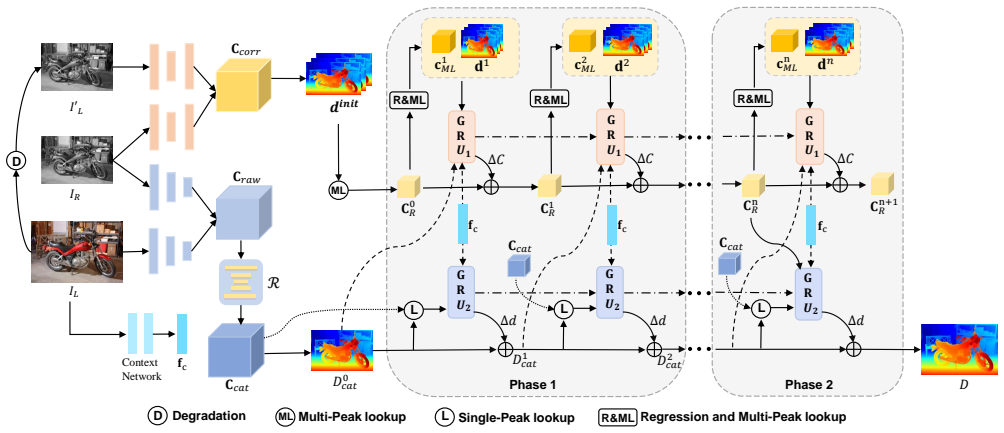
The central object is the pair of cost volumes plus the two-phase gate. The correlation volume $C_{\mathrm{corr}}(d,x,y)=\langle f^{\mathrm{cor}}_l(x,y), f^{\mathrm{cor}}_r(x-d,y)\rangle$ is computed from features of the deliberately degraded left view and the right view, making the pair symmetric; the concatenation volume $C_{\mathrm{cat}}$ uses group-wise concatenation from the original high-quality left and upsampled right and is regularized by a 3D network. Two ConvGRUs (convolutional gated recurrent units) carry the iterative update: GRU 1 refines $C^{i-1}_R$ using multi-peak lookup from the top-$K$ correlation peaks, and GRU 2 updates disparity using a single-peak local cost from $C_{\
What would settle it
Take a pair where the right view is downsampled 4x and converted to grayscale, as in the paper. Compute the Eq. (1) KL divergence of the correlation cost before and after deliberately degrading the left view with the same operator. If the deliberate degradation does not reduce the distortion, or if a variant that fuses GRU 1 from the first iteration matches or beats the two-phase gate on EPE, the central claim fails.
Extended reading notes
Core claim
The paper claims that asymmetric visual quality breaks stereo matching chiefly at the cost volume, and that the two standard cost volumes break in complementary ways. Measuring distribution distortion with KL divergence between the softmax of asymmetric matching costs and the softmax of ideal symmetric costs, the authors find that a correlation volume's costs drift and become multi-peaked under asymmetry, while a concatenation volume stays comparatively stable but loses fine-detail information through 3D downsampling. On this basis IVF-AStereo degrades the high-quality left view to match the degraded right view for correlation, builds the concatenation volume from the original high-quality l
Load-bearing premise
The method assumes the degradation of the lower-quality view is known well enough to create a matching degraded left view; if that synthesized pair is not truly symmetric, the correlation-volume mitigation and the two-phase fusion argument no longer hold.
Editorial extensions
If this is right
- Depth estimation on tele-wide, RCCB, and RCCC camera rigs becomes possible with a single matching network, with no restoration stage before stereo.
- Correlation-only stereo systems can be made more asymmetric-resistant by degrading the high-quality view into symmetry, as the paper's +A variant demonstrates.
- Concatenation-based iterative networks gain fine details by fusing a correlation volume, but only after the correlation branch has been refined first; injecting it from the first iteration is worse.
- The two-phase gate is a reusable recipe for merging a high-variance, detail-rich signal with a lower-variance, coarse signal in iterative disparity refinement.
Reading between the lines
- Not pursued in the paper: the KL-distortion diagnostic could be reused for blur, noise, or cross-spectral mismatch, predicting that any mitigation lowering correlation-cost distortion will lower disparity error.
- Not pursued in the paper: for unknown real-world degradation, the deliberate degradation step could be learned end-to-end before feature extraction instead of being hand-specified.
- Not pursued in the paper: the K=3 multi-peak sweet spot suggests confidence-weighted peak selection might extend the benefit to more peaks.
Editorial analysis
A structured set of objections, weighed in public.
Referee Report
Summary. The paper addresses stereo matching under asymmetric visual properties (e.g., one view downsampled or grayscale-converted), arguing that the primary cause of performance degradation is distortion of the cost volume. It proposes IVF-AStereo, a two-phase iterative network that combines a correlation volume (computed from a deliberately degraded left view, to restore symmetry) and a concatenation volume (computed from the original high-quality left view and upsampled right view). Two GRU branches are used: the first refines the correlation volume with multi-peak lookup, and the second optimizes disparity, first without and then with the refined correlation volume. Experiments on Scene Flow, KITTI, and Middlebury under synthetic right-view degradation report clear gains over existing methods at 4x-8x downsampling, plus ablations of the input alignment, multi-peak group count, and fusion scheme.
Significance. If the claims hold, the paper provides a useful and simple architectural insight: correlation and concatenation cost volumes degrade differently under asymmetric inputs, and deliberately degrading the high-quality view can mitigate correlation-volume distortion. The proposed method achieves strong results under large synthetic resolution/color asymmetry, and the zero-shot Middlebury results are impressive. The work also isolates a concrete and falsifiable design principle (degradation for correlation volume, preservation for concatenation volume) that could transfer to other iterative stereo architectures. However, the significance is currently limited by the reliance on known synthetic degradations and by the absence of comparisons with prior asymmetric-stereo methods; no code is mentioned, so reproducibility is not verifiable from the manuscript.
major comments (4)
- [Section III-A, Figure 2] The empirical study motivating the central claim is under-specified. It is unclear how many KITTI images were used, how the matching costs c_ideal and c_asym were aggregated, and how the percentages in Figure 2(d) were computed and averaged across pixels/images. No confidence intervals or error bars are given. Since the entire architecture is justified by the claim that 'correlation volume consistently favors case (c) whereas concatenation volume exhibits progressively diminished performance,' the reader needs enough detail to evaluate whether this is a robust trend or an anecdotal illustration. Please specify the protocol precisely and ideally report per-image variability.
- [Section III-C.1, Eq. (2)] The proposed correlation-volume mitigation assumes the degradation operator is known exactly: 'IL is deliberately degraded into I_L according to the degradation of IR.' In the experiments the degradation is synthetic (bilinear downsampling plus grayscale conversion), so I'_L can be made perfectly symmetric with IR. For the real tele-wide, RCCB/RCCC, or unknown-degradation systems cited in the Introduction, this operator is not given, and the paper provides no degradation-estimation method and no robustness evaluation under mismatch between assumed and actual degradation. The manuscript's broad framing, that the 'key solution to asymmetric stereo matching' is comprehensive utilization of distorted cost volumes, is therefore only supported for the favorable known-degradation case. Either restrict the claim to this setting or add an experimental protocol with unknown/mismatched degradation.
- [Experiments, Tables I and III] No prior asymmetric-stereo methods are compared. The Related Work discusses Chen et al. (CVPR 2022), Liu et al. (CVPR 2020), and Song et al. (CVPR 2023) as directly addressing asymmetric stereo, but none appear in the quantitative comparisons on Scene Flow or Middlebury. Without these baselines, the claim that the method is 'superior' and 'state-of-the-art' in asymmetric scenarios is not established against the most relevant prior work. Please include comparisons under the same degradation protocol, even if those methods require their own training or adaptation.
- [Table VI] The gain from the proposed two-phase fusion over the 'all iterations' fusion (Scheme 4 vs. Scheme 5) is marginal: EPE is 0.53 in both cases and the >3px metric improves only from 2.62% to 2.59%. The text claims the two-phase scheme 'further enhances the >3px' and 'refining initially poor correlation volume,' but this difference is likely within noise. Report multiple runs with variance, or temper the claim. The same concern applies to Table V, where K=3 differs from K=2 only by 0.01 EPE and 0.03 percentage points in >3px.
minor comments (4)
- [Table II and Section IV-B] The KITTI comparison is not apples-to-apples: 'Ours(A)' is evaluated on asymmetric inputs while the reference methods are evaluated on symmetric inputs. The authors acknowledge this, but the text should state more explicitly that this comparison cannot establish superiority over these methods under the same conditions.
- [Section III-A, Eq. (1)] The notation DD(c_asym) = D_KL(softmax(c_asym) || softmax(c_ideal)) should be defined more carefully: are c_asym and c_ideal the same cost-volume location after alignment/disparity warping? How is the KL divergence computed over the disparity dimension only? Please clarify.
- [General] Minor typos and formatting issues: 'Boldand underlined' in Table I footnote, 'V olume' in references, and inconsistent use of I_L versus I'_L in the text around Section III-C.1.
- [Figure 3] The diagram is dense and the flow of C'_R in Phase 1 vs Phase 2 is hard to follow. A clearer annotation showing which tensors are zeroed in Phase 1 would help the reader map Eq. (10) to the figure.
Circularity Check
No significant circularity: the cost-volume distortion analysis is an external empirical observation, and the architecture choices are ablations, not fitted predictions.
full rationale
The paper's central chain is: (1) measure matching-cost distribution distortion (DD) between ideal and asymmetric inputs using a pretrained IGEV-Stereo; this is an external empirical observation, not defined in terms of the proposed model. (2) From that observation, design separate feature extractors and two cost volumes, deliberately degrading the high-quality left view to match the known degradation of the right view for the correlation volume (Eq. 2). In the synthetic experiments the degradation operator is applied by the experimenter, so I'_L is symmetric with I_R by construction; that is the intended mitigation, not a hidden reuse of the output as input. (3) The two-phase GRU fusion (Eqs. 5-10) is an architectural proposal whose components (multi-peak lookup, concatenation volume) are cited from prior external work. The choice K=3 and the phase-switch schedule are selected by ablation on Scene Flow and then reported on the same benchmark; this is a standard, albeit mild, selection-on-validation issue and does not make the reported result equivalent to the inputs by construction. There are no load-bearing self-citations: the authors cite MC-Stereo, IGEV-Stereo, and other prior work, none authored by Gao/Shen. The limitation that real tele-wide/RCCB systems have unknown degradation operators is a correctness/generality concern, not circularity. Hence no significant circularity.
Assumptions & free parameters
free parameters (2)
- Multi-peak lookup group count K =
3 (selected by ablation, Table V, from {1,2,3,4})
- Two-phase fusion schedule =
Phase 1: C'=0; Phase 2: C'=C_R (Table VI, scheme 5)
assumptions (4)
- domain assumption The KL-divergence-based distribution distortion DD computed with pretrained IGEV-Stereo is a valid proxy for how much asymmetry harms matching.
- domain assumption The right-view degradation operator is known and can be applied to synthesize the degraded left view I'_L.
- domain assumption Decomposition of asymmetry into resolution, bilinear downsampling, and color, grayscale, captures the decisive failure modes of interest.
- domain assumption Bilinear downsampling has an averaging effect that makes correlation distributions multi-peak, motivating multi-peak lookup.
Cite this review
Pith. "Pith review of Iterative Volume Fusion for Asymmetric Stereo Matching." pith.science (2026). https://pith.science/paper/KTAV3BI2
@misc{pith2026250809543,
  author       = {Pith},
  title        = {Pith review of: Iterative Volume Fusion for Asymmetric Stereo Matching},
  year         = {2026},
  howpublished = {\url{https://pith.science/paper/KTAV3BI2}},
  note         = {Machine review of arXiv:2508.09543}
}
read the original abstract
Stereo matching is vital in 3D computer vision, with most algorithms assuming symmetric visual properties between binocular visions. However, the rise of asymmetric multi-camera systems (e.g., tele-wide cameras) challenges this assumption and complicates stereo matching. Visual asymmetry disrupts stereo matching by affecting the crucial cost volume computation. To address this, we explore the matching cost distribution of two established cost volume construction methods in asymmetric stereo. We find that each cost volume experiences distinct information distortion, indicating that both should be comprehensively utilized to solve the issue. Based on this, we propose the two-phase Iterative Volume Fusion network for Asymmetric Stereo matching (IVF-AStereo). Initially, the aggregated concatenation volume refines the correlation volume. Subsequently, both volumes are fused to enhance fine details. Our method excels in asymmetric scenarios and shows robust performance against significant visual asymmetry. Extensive comparative experiments on benchmark datasets, along with ablation studies, confirm the effectiveness of our approach in asymmetric stereo with resolution and color degradation.
Figures


Figures from the paper (1 more)

Reference graph
Works this paper leans on
-
[1]
Correlate-and-Excite: Real-Time Stereo Matching via Guided Cost V olume Excitation
Antyanta Bangunharcana et al. “Correlate-and-Excite: Real-Time Stereo Matching via Guided Cost V olume Excitation”. In: 2021 IEEE/RSJ International Confer- ence on Intelligent Robots and Systems (IROS) . 2021, pp. 3542–3548
work page 2021
-
[2]
Cross-spectral Gated-RGB Stereo Depth Estimation
Samuel Brucker et al. “Cross-spectral Gated-RGB Stereo Depth Estimation”. In: Proceedings of the IEEE/CVF Conference on Computer Vision and Pat- tern Recognition (CVPR) . 2024, pp. 21654–21665
work page 2024
-
[3]
Pyramid Stereo Matching Network
Jia-Ren Chang and Yong-Sheng Chen. “Pyramid Stereo Matching Network”. In: Proceedings of the IEEE/CVF Conference on Computer Vision and Pat- tern Recognition (CVPR) . 2018, pp. 5410–5418
work page 2018
-
[4]
Degradation-Agnostic Correspon- dence From Resolution-Asymmetric Stereo
Xihao Chen et al. “Degradation-Agnostic Correspon- dence From Resolution-Asymmetric Stereo”. In: Pro- ceedings of the IEEE/CVF Conference on Com- puter Vision and Pattern Recognition (CVPR) . 2022, pp. 12962–12971
work page 2022
-
[5]
MoCha-Stereo: Motif Channel Attention Network for Stereo Matching
Ziyang Chen et al. “MoCha-Stereo: Motif Channel Attention Network for Stereo Matching”. In: Proceed- ings of the IEEE/CVF Conference on Computer Vision and Pattern Recognition (CVPR) . 2024, pp. 27768– 27777
work page 2024
-
[6]
ImageNet: A Large-scale Hierarchical Image Database
Jia Deng et al. “ImageNet: A Large-scale Hierarchical Image Database”. In: Proceedings of the IEEE/CVF Conference on Computer Vision and Pattern Recogni- tion (CVPR). 2009, pp. 248–255
work page 2009
-
[7]
Mutual Information as A Stereo Correspondence Measure
Geoffrey Egnal. “Mutual Information as A Stereo Correspondence Measure”. In: (2000)
work page 2000
-
[8]
MC-Stereo: Multi-Peak Lookup and Cascade Search Range for Stereo Matching
Miaojie Feng et al. “MC-Stereo: Multi-Peak Lookup and Cascade Search Range for Stereo Matching”. In: 2024 International Conference on 3D Vision (3DV) (2024), pp. 344–353
work page 2024
Show all 29 references
-
[9]
Are We Ready for Autonomous Driving? The KITTI Vision Benchmark Suite
Andreas Geiger, Philip Lenz, and Raquel Urtasun. “Are We Ready for Autonomous Driving? The KITTI Vision Benchmark Suite”. In: Proceedings of the IEEE Conference on Computer Vision and Pattern Recogni- tion (CVPR). 2012, pp. 3354–3361
2012
-
[10]
Conceptgraphs: Open-vocabulary 3D Scene Graphs for Perception and Planning
Qiao Gu et al. “Conceptgraphs: Open-vocabulary 3D Scene Graphs for Perception and Planning”. In: 2024 IEEE International Conference on Robotics and Au- tomation (ICRA). IEEE. 2024, pp. 5021–5028
2024
-
[11]
Cascade Cost V olume for High- Resolution Multi-View Stereo and Stereo Matching
Xiaodong Gu et al. “Cascade Cost V olume for High- Resolution Multi-View Stereo and Stereo Matching”. In: Proceedings of the IEEE/CVF Conference on Com- puter Vision and Pattern Recognition (CVPR) . 2020, pp. 2492–2501
2020
-
[12]
OpenStereo: A Comprehensive Benchmark for Stereo Matching and Strong Baseline
Xianda Guo et al. “OpenStereo: A Comprehensive Benchmark for Stereo Matching and Strong Baseline”. In: arXiv preprint arXiv:2312.00343 (2023)
2023 arXiv
-
[13]
Group-wise Correlation Stereo Network
Xiaoyang Guo et al. “Group-wise Correlation Stereo Network”. In: Proceedings of the IEEE/CVF Con- ference on Computer Vision and Pattern Recognition (CVPR). 2019, pp. 3273–3282
2019
-
[14]
Robust Stereo Matching Using Adaptive Normalized Cross-Correlation
Yong Seok Heo, Kyong Mu Lee, and Sang Uk Lee. “Robust Stereo Matching Using Adaptive Normalized Cross-Correlation”. In: IEEE Transactions on Pat- tern Analysis and Machine Intelligence 33.4 (2010), pp. 807–822
2010
-
[15]
End-to-End Learning of Geom- etry and Context for Deep Stereo Regression
Alex Kendall et al. “End-to-End Learning of Geom- etry and Context for Deep Stereo Regression”. In: Proceedings of the IEEE International Conference on Computer Vision (ICCV) (2017), pp. 66–75
2017
-
[16]
Practical Stereo Matching via Cas- caded Recurrent Network with Adaptive Correlation
Jiankun Li et al. “Practical Stereo Matching via Cas- caded Recurrent Network with Adaptive Correlation”. In: Proceedings of the IEEE/CVF Conference on Com- puter Vision and Pattern Recognition (CVPR) . 2022, pp. 16263–16272
2022
-
[17]
RAFT- Stereo: Multilevel Recurrent Field Transforms for Stereo Matching
Lahav Lipson, Zachary Teed, and Jia Deng. “RAFT- Stereo: Multilevel Recurrent Field Transforms for Stereo Matching”. In: 2021 International Conference on 3D Vision (3DV) . 2021
2021
-
[18]
Visually Imbalanced Stereo Match- ing
Yicun Liu et al. “Visually Imbalanced Stereo Match- ing”. In: Proceedings of the IEEE/CVF Conference on Computer Vision and Pattern Recognition (CVPR). 2020
2020
-
[19]
A Large Dataset to Train Convolutional Networks for Disparity, Optical Flow, and Scene Flow Estimation
Nikolaus Mayer et al. “A Large Dataset to Train Convolutional Networks for Disparity, Optical Flow, and Scene Flow Estimation”. In: Proceedings of the IEEE Conference on Computer Vision and Pattern Recognition (CVPR). 2016, pp. 4040–4048
2016
-
[20]
Object Scene Flow for Autonomous Vehicles
Moritz Menze and Andreas Geiger. “Object Scene Flow for Autonomous Vehicles”. In: Proceedings of the IEEE Conference on Computer Vision and Pattern Recognition (CVPR). 2015, pp. 3061–3070
2015
-
[21]
High-Resolution Stereo Datasets with Subpixel-Accurate Ground Truth
Daniel Scharstein et al. “High-Resolution Stereo Datasets with Subpixel-Accurate Ground Truth”. In: Pattern Recognition: 36th German Conference, GCPR 2014, M ¨unster, Germany, September 2-5, 2014, Pro- ceedings 36. Springer. 2014, pp. 31–42
2014
-
[22]
Unsupervised Deep Asymmetric Stereo Matching with Spatially-Adaptive Self-Similarity
Taeyong Song, Sunok Kim, and Kwanghoon Sohn. “Unsupervised Deep Asymmetric Stereo Matching with Spatially-Adaptive Self-Similarity”. In: Proceed- ings of the IEEE/CVF Conference on Computer Vision and Pattern Recognition (CVPR) . 2023, pp. 13672– 13680
2023
-
[23]
FADNet: A Fast and Accurate Network for Disparity Estimation
Qiang Wang et al. “FADNet: A Fast and Accurate Network for Disparity Estimation”. In: 2020 IEEE International Conference on Robotics and Automation (ICRA). 2020, pp. 101–107
2020
-
[24]
Panoocc: Unified Occupancy Rep- resentation for Camera-based 3D Panoptic Segmenta- tion
Yuqi Wang et al. “Panoocc: Unified Occupancy Rep- resentation for Camera-based 3D Panoptic Segmenta- tion”. In: Proceedings of the IEEE/CVF Conference on Computer Vision and Pattern Recognition (CVPR). 2024, pp. 17158–17168
2024
-
[25]
DSR: Direct Self-Rectification for Uncalibrated Dual-Lens Cameras
Ruichao Xiao et al. “DSR: Direct Self-Rectification for Uncalibrated Dual-Lens Cameras”. In: 2018 In- ternational Conference on 3D Vision (3DV) . 2018, pp. 561–569
2018
-
[26]
Attention Concatenation V ol- ume for Accurate and Efficient Stereo Matching
Gangwei Xu et al. “Attention Concatenation V ol- ume for Accurate and Efficient Stereo Matching”. In: Proceedings of the IEEE/CVF Conference on Com- puter Vision and Pattern Recognition (CVPR) . 2022, pp. 12981–12990
2022
-
[27]
IGEV++: iterative multi-range geometry encoding volumes for stereo matching
Gangwei Xu et al. “IGEV++: iterative multi-range geometry encoding volumes for stereo matching”. In: arXiv preprint arXiv:2409.00638 (2024)
2024 arXiv
-
[28]
Iterative Geometry Encoding V olume for Stereo Matching
Gangwei Xu et al. “Iterative Geometry Encoding V olume for Stereo Matching”. In: Proceedings of the IEEE/CVF Conference on Computer Vision and Pattern Recognition (CVPR). 2023, pp. 21919–21928
2023
-
[29]
A Vision-Centric Approach for Static Map Element Annotation
Jiaxin Zhang et al. “A Vision-Centric Approach for Static Map Element Annotation”. In: 2024 IEEE In- ternational Conference on Robotics and Automation (ICRA). IEEE. 2024, pp. 15861–15867
2024
Reviewed August 5, 2026 · model on record in the stance chip above.
Discussion (0). Sign in to comment.