Fermion mass ratios from the exceptional Jordan algebra
Pith reviewed 2026-05-21 22:59 UTC · model grok-4.3
The pith
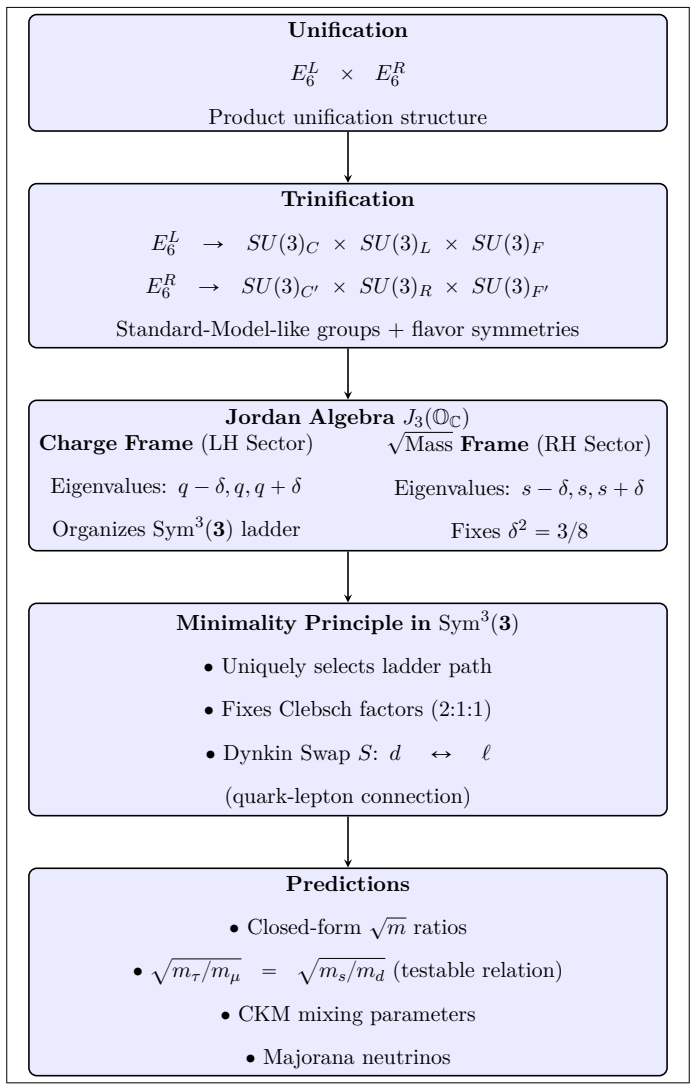
The complexified exceptional Jordan algebra explains the three fermion generations and their mass ratios via its cubic structure.
A machine-rendered reading of the paper's core claim, the machinery that carries it, and where it could break.
Core claim
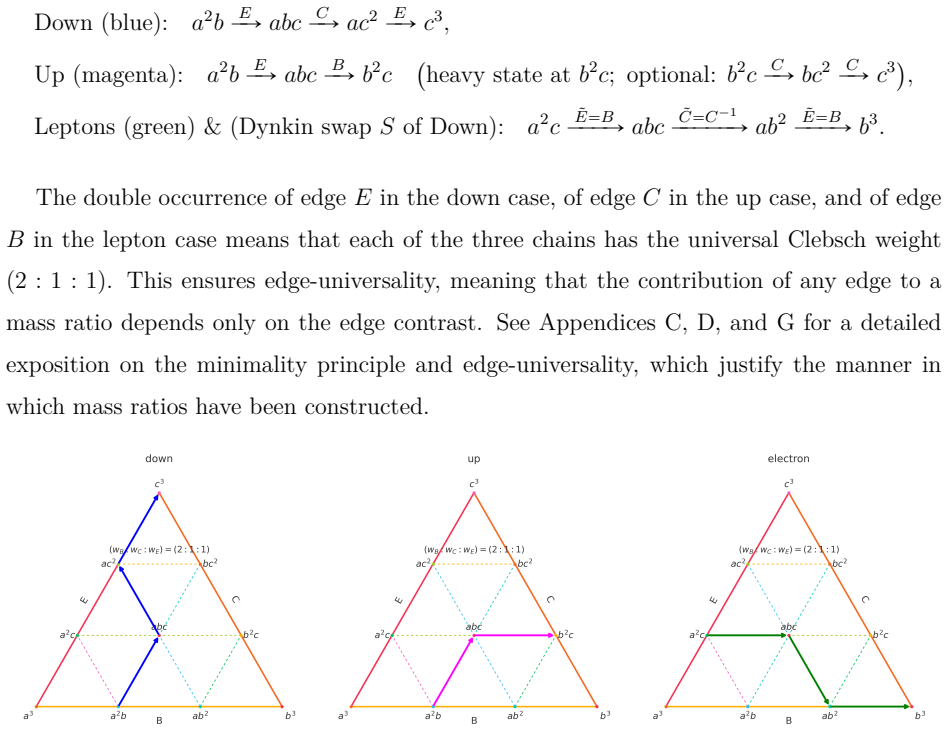
The central claim is that when ⟨X⟩ is Jordan-diagonalised to diag(a,b,c), the induced action X⊙3 on the Sym^3(3) monomial basis is diagonal with eigenvalues a^p b^q c^r, so a fermion identified with the weight state |p,q,r⟩ has √m ∝ a^p b^q c^r and adjacent generations related by an edge move have √m-ratios that depend only on the edge type (c/a, b/a, c/b). This edge universality follows from monomial arithmetic and is fixed by the universal Jordan eigenvalue spectrum (q-δ, q, q+δ) with δ²=3/8 from the cubic on the coassociative slice.
What carries the argument
The diagonal-action theorem that maps the Jordan eigenvalues to the monomial exponents in the symmetric cube representation.
If this is right
- Pre-breaking, the three families are identical by symmetry due to triality.
- The mass spectrum is determined by the Jordan algebra's cubic form rather than arbitrary Yukawa couplings.
- Adjacent generation mass ratios are universal and independent of specific coefficients in the representation.
Where Pith is reading between the lines
- If the identification of the vacuum expectation value holds, the mass hierarchy would have a geometric origin in the Jordan algebra structure.
- This could link to explanations of other standard model parameters using similar algebraic constructions.
Load-bearing premise
The vacuum expectation value belongs to the exceptional Jordan algebra and its Jordan diagonal form directly determines the mass eigenvalues through the cubic action on the symmetric cube.
What would settle it
A mismatch between the observed square-root mass ratios of fermions and the products a^p b^q c^r for the corresponding weight states in the Sym^3(3) would falsify the proposed mass formula.
Figures


read the original abstract
The origin of the three fermion generations and their highly hierarchical mass spectra remains one of the most profound puzzles in particle physics. We show that the complexified exceptional Jordan algebra $J_{3}(\mathbb{O}_{\mathbb{C}})$, the natural mathematical framework for the exceptional Lie group $E_{6}$, provides a unified explanation for both. The three generations arise from the three off-diagonal Peirce slots of $J_{3}(\mathbb{O}_{\mathbb{C}})$, each carrying an isomorphic $Cl(6,\mathbb C)$ minimal-ideal fiber and permuted cyclically by triality $S_3\subset\mathrm{Out}(\mathrm{Spin}(8))$; pre-breaking, the three families are identical by symmetry. After triality breaking the residual $SU(3)_F$ flavor symmetry organises the three generations of each family as a $\mathrm{Sym}^{3}(\mathbf{3})$ multiplet, the minimal $S_3$-symmetric degree-3 arena consistent with the cubic structure of the Jordan determinant and the unique $E_6$-invariant Yukawa. The mass-ratio formula follows from a one-line diagonal-action theorem: when $\langle X\rangle$ is Jordan-diagonalised to $\mathrm{diag}(a,b,c)$, the induced action $X^{\odot 3}$ on the $\mathrm{Sym}^{3}(\mathbf{3})$ monomial basis is diagonal with eigenvalues $a^pb^qc^r$, so a fermion identified with the weight state $|p,q,r\rangle$ has $\sqrt m\propto a^pb^qc^r$ and adjacent generations related by an edge move have $\sqrt m$-ratios that depend only on the edge type ($c/a$, $b/a$, $c/b$). We refer to this as $\textit{edge universality}$; it is monomial arithmetic, not a Clebsch-Gordan cancellation. The universal Jordan eigenvalue spectrum $(q-\delta, q, q+\delta)$ with $\delta^{2}=3/8$ is fixed by the cubic on the coassociative slice of $J_3(\mathbb O_\mathbb C)$. [abstract truncated]
Editorial analysis
A structured set of objections, weighed in public.
Referee Report
Summary. The paper claims that the complexified exceptional Jordan algebra J₃(𝕆_ℂ) furnishes both the three fermion generations (via off-diagonal Peirce slots and triality) and their mass hierarchy. After triality breaking to SU(3)_F the residual symmetry organises each family as a Sym³(3) multiplet; a Jordan-diagonalised VEV ⟨X⟩ = diag(a,b,c) then acts diagonally on the monomial basis with eigenvalues a^p b^q c^r, so √m ∝ a^p b^q c^r for the weight state |p,q,r⟩. Adjacent generations related by an edge move therefore have √m ratios fixed solely by the edge type (edge universality). The universal spectrum (q-δ, q, q+δ) with δ² = 3/8 is fixed by the cubic Jordan determinant on the coassociative slice.
Significance. If the central identification of the physical Higgs VEV with an element of J₃(𝕆_ℂ) can be justified from E₆ dynamics, the construction supplies a parameter-free algebraic origin for the fermion mass ratios together with a concrete prediction for the spectrum fixed by δ² = 3/8. The one-line diagonal-action theorem on Sym³(3) and the resulting edge-universal ratios are technically clean and falsifiable once the VEV mapping is secured.
major comments (2)
- [Abstract and §3] The load-bearing step that equates the algebraic element X ∈ J₃(𝕆_ℂ) (after triality breaking) with the physical Higgs vacuum expectation value is introduced by matching the cubic structure of the Jordan determinant rather than being derived from the E₆-invariant Yukawa coupling, from minimisation of an E₆-invariant scalar potential, or from spontaneous symmetry breaking dynamics. Without this derivation the eigenvalues a^p b^q c^r cannot be identified with physical √m. (Abstract; §3, paragraph beginning “The mass-ratio formula follows from a one-line diagonal-action theorem”.)
- [§4 (coassociative slice discussion)] The coassociative slice is stated to fix the spectrum (q-δ, q, q+δ) with δ² = 3/8 via the cubic, yet the manuscript does not exhibit the explicit cubic equation restricted to that slice nor demonstrate that the resulting eigenvalues are independent of the choice of slice within the residual SU(3)_F orbit. This step is required to convert the algebraic constraint into a numerical prediction for mass ratios.
minor comments (2)
- [§3] Notation for the Sym³(3) monomial basis and the precise definition of the weight states |p,q,r⟩ should be introduced with an explicit basis table or equation before the diagonal-action theorem is invoked.
- [§5] The manuscript would benefit from a short comparison table of the predicted √m ratios (using the fixed δ² = 3/8) against the observed charged-lepton and quark mass ratios to make the numerical content of the claim immediately visible.
Simulated Author's Rebuttal
We thank the referee for the careful reading and for highlighting the need for stronger justification of the VEV identification and for explicit calculations on the coassociative slice. We respond to each major comment below.
read point-by-point responses
-
Referee: [Abstract and §3] The load-bearing step that equates the algebraic element X ∈ J₃(𝕆_ℂ) (after triality breaking) with the physical Higgs vacuum expectation value is introduced by matching the cubic structure of the Jordan determinant rather than being derived from the E₆-invariant Yukawa coupling, from minimisation of an E₆-invariant scalar potential, or from spontaneous symmetry breaking dynamics. Without this derivation the eigenvalues a^p b^q c^r cannot be identified with physical √m. (Abstract; §3, paragraph beginning “The mass-ratio formula follows from a one-line diagonal-action theorem”.)
Authors: We agree that the identification of ⟨X⟩ with the physical Higgs VEV rests on matching the cubic Jordan determinant (the unique E₆-invariant cubic) rather than on an explicit minimization of an E₆-invariant scalar potential or a full SSB analysis. This structural matching is required for consistency with the E₆-invariant Yukawa term, but we acknowledge that a dynamical derivation is not supplied. In the revised manuscript we will add a paragraph in §3 that spells out this motivation from the E₆ structure and states clearly that a complete dynamical derivation lies beyond the present work. The algebraic mass-ratio results themselves are unaffected. revision: partial
-
Referee: [§4 (coassociative slice discussion)] The coassociative slice is stated to fix the spectrum (q-δ, q, q+δ) with δ² = 3/8 via the cubic, yet the manuscript does not exhibit the explicit cubic equation restricted to that slice nor demonstrate that the resulting eigenvalues are independent of the choice of slice within the residual SU(3)_F orbit. This step is required to convert the algebraic constraint into a numerical prediction for mass ratios.
Authors: We thank the referee for this observation. The explicit restriction of the Jordan cubic to the coassociative slice and the verification that the resulting eigenvalues are independent of the choice of slice inside the SU(3)_F orbit were omitted. In the revised §4 we will display the restricted cubic equation and prove that the spectrum (q-δ, q, q+δ) with δ² = 3/8 is invariant under the residual SU(3)_F action, thereby converting the algebraic constraint into an explicit numerical prediction. revision: yes
- Full dynamical derivation of the Higgs VEV identification from minimization of an E₆-invariant scalar potential
Circularity Check
No significant circularity; algebraic spectrum and action are independently derived
full rationale
The derivation chain is self-contained. The universal spectrum (q-δ, q, q+δ) with δ²=3/8 is fixed internally by the cubic Jordan determinant constraint on the coassociative slice of J3(OC), without reference to observed masses or external fitting. The one-line diagonal-action result—that X⊙3 on the Sym^3(3) monomial basis is diagonal with eigenvalues a^p b^q c^r—is a direct mathematical consequence of Jordan diagonalization, not a redefinition of the target mass ratios. The subsequent identification of weight states |p,q,r⟩ with fermions and the proportionality √m ∝ a^p b^q c^r constitutes a model postulate linking algebra to physics, but does not render the computed edge-universal ratios tautological or equivalent to the inputs by construction. No self-citation load-bearing step, fitted-input prediction, or ansatz smuggling is present in the provided derivation.
Axiom & Free-Parameter Ledger
axioms (3)
- domain assumption The complexified exceptional Jordan algebra J3(OC) is the correct algebraic structure whose automorphism group contains E6 and whose cubic determinant encodes the Yukawa interactions.
- standard math Triality S3 acts by cyclically permuting the three off-diagonal Peirce slots, each carrying an isomorphic Cl(6,C) fiber.
- domain assumption After triality breaking the residual SU(3)F organizes each family as a Sym^3(3) multiplet consistent with the cubic Jordan determinant.
Lean theorems connected to this paper
-
IndisputableMonolith/Cost/FunctionalEquation.leanwashburn_uniqueness_aczel unclear?
unclearRelation between the paper passage and the cited Recognition theorem.
when ⟨X⟩ is Jordan-diagonalised to diag(a,b,c), the induced action X⊙3 on the Sym³(3) monomial basis is diagonal with eigenvalues a^p b^q c^r
-
IndisputableMonolith/Foundation/AlexanderDuality.leanalexander_duality_circle_linking unclear?
unclearRelation between the paper passage and the cited Recognition theorem.
universal Jordan eigenvalue spectrum (q-δ, q, q+δ) with δ²=3/8 fixed by the cubic on the coassociative slice
What do these tags mean?
- matches
- The paper's claim is directly supported by a theorem in the formal canon.
- supports
- The theorem supports part of the paper's argument, but the paper may add assumptions or extra steps.
- extends
- The paper goes beyond the formal theorem; the theorem is a base layer rather than the whole result.
- uses
- The paper appears to rely on the theorem as machinery.
- contradicts
- The paper's claim conflicts with a theorem or certificate in the canon.
- unclear
- Pith found a possible connection, but the passage is too broad, indirect, or ambiguous to say the theorem truly supports the claim.
Forward citations
Cited by 1 Pith paper
-
Experimental predictions of the $E_8 \times \omega E_8$ octonionic unification program : A falsification-oriented catalogue for quantum foundations, particle physics, gravitation, and cosmology
The E8 × ωE8 octonionic program predicts objective spontaneous collapse, a right-handed pre-gravitational gauge sector, specific fermion mass ratios including the 1:4:9 pattern, and relations such as α_s(M_Z)/α_em(0)=...
Reference graph
Works this paper leans on
-
[1]
AJordan–spectral ansatzfor each charged sector: the right–handed flavor matrix XPJ 3pOCqhas the threeJordan eigenvalues tλ1,λ2,λ3u “ ts´δ, s, s`δu, withthe spread fixedby theory, δ2 “ 3 8 (derived below from the characteristic equation; not a free parameter)
-
[2]
Aminimal three–corner chaininSym3p3qwithfixed top–rung Clebsch weights pwE :wB :wCq “ p2 : 1 : 1q, uniquely selected by a minimality principle (stated and proved below). 123
-
[3]
ADynkinZ 2 swap(theA 2 diagram flip) used once to map the down–edge step to the lepton–edge step
-
[4]
Atrace splitfor the three charged sectors fixing the family centersTrXℓ: TrXu : TrXd “1 : 2 : 3. •Outputs (theory predictions)
-
[5]
Six intra–sectoradjacent ?mass ratios (one per edge, all rungs) in closed form; edge universalityimplies adjacent ratios depend only on the chosen edge, not on rung details
-
[6]
A small, definite Koide offset obtained after triality/EW breaking (exact Koide in the triality–symmetric phase)
-
[7]
CKM “root–sum rules”: a geometric Cabibbo phaseφ12 “π{2; the pattern of moduli with one small up–leg tiltεand one mild cross–family normalizationκ23; leading predictions for|Vub|and|V td|{|Vts|
-
[8]
The remainder of this appendix provides the detailed derivations advertised above
In the lepton sector, a maximal Dirac phaseδℓ CP “ ˘π{2at leading order from the same geometric construction. The remainder of this appendix provides the detailed derivations advertised above. G.2 Universal Jordan spreadδ2 “ 3 8 fromJ 3pOCq, and how it feeds theSym3p3qladder a. Octonionic normalisation and the Jordan invariants We work in the complex exce...
-
[9]
Thus,δis not a tunable parameter: its value followsrigidlyfrom the1{8octonionic normalisation and theJ 3pOCq invariants. c. Separation of roles: whatJ 3pOCqfixes vs. whatSym 3 does It is crucial to separate two logically distinct ingredients: (A) Fixed byJ 3pOCq.The eigenvalues (G5) areinputsto everything that follows. They encode the family centres(set b...
-
[10]
Then 3α2 “H IpY0,Y 0q “ 3 8 ñα 2 “ 1 8 ,}x 12}2 “ }x23}2 “ }x13}2 “ 1 8 . Combined with the Lemma, this givesδ2 “ 3 8 . Remark 1.The Lemma is atheorem from theE 6 cubic: on the coassociative slice,δ2 equals the quadratic length1 2 Tr ` Y 2˘ . The Proposition is acalibration: exceptional symmetry (A2ˆG2) provides a natural, unique unit in the Peirce-1direc...
-
[11]
2.ϕreshuffles the weight lattice viapµ1,µ2q ÞÑ pµ2,µ1q
The swap defines an automorphismϕof thesup3qalgebra. 2.ϕreshuffles the weight lattice viapµ1,µ2q ÞÑ pµ2,µ1q
-
[12]
lep- tons) cannot be kept the same between the original and transformed theories
This reshuffling means the assignment of weights to physical particles (quarks vs. lep- tons) cannot be kept the same between the original and transformed theories
-
[13]
The transformationϕtherefore maps a physical description where the down quark is a triplet and the electron is a singlet to an equivalent description where the electron is a triplet and the down quark is a singlet. This reveals a fundamental ambiguity in how we assign particles to weights within a unified theory, an ambiguity that is only resolved by addi...
-
[14]
Working in the orthonormal Schwinger–boson basist|apbqcry : p`q`r“3u, theE 6 trilinear defines a linear mapTX whose reduced3ˆ3matrices (on two 3–rung bases) are, up to one overall reduced constantγ(absorbingy): Bside “ ␣ |a2by,|abcy,|b 2cy ( : Msidepa,b,cq “γ ¨ ˚˚˚˚˝ a ? 2a0 b b b ? 2 0c c ˛ ‹‹‹‹‚ ,(H9) Bcorner “ ␣ |a2by,|abcy,|c 3y ( : Mcornerpa,b,cq “γ ...
-
[15]
The one-loop Coleman-Weinberg potential forXPJ 3pOCqon the coassociative slice is given by: VCWpXq “ 1 64π2 ÿ i p´1qFniM 4 i pXq « logM 2 i pXq µ2 ´Ci ff , where the sum extends over all particle species with field-dependent massesMipXq
-
[16]
The one-loop renormalization group equations in the Machacek-Vaughn form are: βpgq “ dg dlnµ“ ´ g3 16π2 „11 3 C2pGq ´ 2 3TpRf q ´ 1 3TpRsq ȷ , γpλq “1 16π2 “ Aλ2 `Bg 2λ`Cg4‰ , where group-theory factors (C2pGq,TpR f q,TpR sq,A,B,C) are left symbolic for substitution ofE 6 values or other UV completion chains. 154
-
[17]
´b gg3, b g “ 11 3 C2pGq ´ 2 3 ÿ F TpRF q ´ 1 6 ÿ S TpRSq,(I3) 16π2βy “y
The vacuum stability conditions require: VeffpXq ą ´8as|X| Ñ 8, BVeff BX ˇˇˇˇ X“xXy “0, B2Veff BX 2 ˇˇˇˇˇ X“xXy ą0, with the minimal existence condition preservingδ2 “ 3 8 at one loop: βpλq λ ´2γX “Opg 4q, whereγX is the anomalous dimension ofX. I.2 Setup and background field We take V0rXs “ ´κNpXq `µ2 Tr ` X2˘ `λTr ` X2˘2 ,L Y “ytpΨ,Ψ,Xq `h.c. and evalua...
-
[18]
To one loop this reads αpqq `8λΣ˚loooooomoooooon “0at tree ` 1 64π2 BΣ Str ” M4 ´ ln M2 µ2 ´c ¯ı Σ“Σ ˚ “0, which is a single linear relation amongtκ,µ2,λ,y,guat the chosen scaleµ. Because it isone condition, there is a non-empty domain of parameters for whichδ2 “ 3 8 is radiatively stable (explicit examples exist in the body of the paper). 157 k. Existenc...
-
[19]
Introduction to exceptional lie groups and algebras
Pierre Ramond. Introduction to exceptional lie groups and algebras. Preprint CALT-68-577,
-
[20]
Classic early preprint circulating in the community; often cited for linking exceptional groups to particle physics
-
[21]
Dixon.Division Algebras: Octonions, Quaternions, Complex Numbers and the Algebraic Design of Physics
Geoffrey M. Dixon.Division Algebras: Octonions, Quaternions, Complex Numbers and the Algebraic Design of Physics. Springer, 2013. Reprint of the 1994 Kluwer edition
work page 2013
-
[22]
Quark structure and octonions ,
Murat Günaydin and Feza Gürsey. Quark structure and octonions.Journal of Mathematical Physics, 14(11):1651–1667, 1973. doi:10.1063/1.1666240. 159
-
[23]
John C. Baez. The octonions.Bulletin of the American Mathematical Society, 39(2):145–205, 2002
work page 2002
-
[25]
Tevian Dray and Corinne A. Manogue. Octonionic Cayley spinors ande6.Commentationes Mathematicae Universitatis Carolinae, 51(2):193–207, 2010. URLhttp://eudml.org/doc/ 37752
work page 2010
-
[26]
Michel Dubois-Violette and Ivan Todorov. Exceptional quantum algebra for the standard model of particle physics.Nuclear Physics B, 938:751–761, 2019. doi: 10.1016/j.nuclphysb.2018.12.012
-
[27]
Ivan Todorov and Michel Dubois-Violette. Deducing the symmetry of the standard model from the automorphism and structure groups of the exceptional jordan algebra.International Journal of Modern Physics A, 33(20):1850118, 2018. doi:10.1142/S0217751X1850118X
-
[28]
Charge quantization from a number operator.Physics Letters B, 742:195–199,
Cohl Furey. Charge quantization from a number operator.Physics Letters B, 742:195–199,
-
[29]
doi:10.1016/j.physletb.2015.01.023
-
[30]
Cohl Furey.Standard model physics from an algebra?PhD thesis, University of Waterloo, 2016, arXiv:1611.09182
work page internal anchor Pith review Pith/arXiv arXiv 2016
-
[31]
doi:10.1140/epjc/s10052-018-5844-7
Cohl Furey.sup3qc ˆsup2ql ˆup1qy pˆup1qxqas a symmetry of division algebraic ladder oper- ators.European Physical Journal C, 78(5):375, 2018. doi:10.1140/epjc/s10052-018-5844-7
-
[32]
Three generations, two unbroken gauge symmet ries, and one eight- dimensional algebra,
Cohl Furey. Three generations, two unbroken gauge symmetries, and one eight-dimensional algebra.Physics Letters B, 785:84–89, 2018. doi:10.1016/j.physletb.2018.08.032
-
[33]
N. Furey and M.J. Hughes. Three generations and a trio of trialities.Physics Letters B, 865:139473, June 2025. ISSN 0370-2693. doi:10.1016/j.physletb.2025.139473. URLhttp: //dx.doi.org/10.1016/j.physletb.2025.139473
-
[34]
N. Furey. A superalgebra within: representations of lightest standard model particles form a Z5 2-graded algebra, 2025. URLhttps://arxiv.org/abs/2505.07923
work page internal anchor Pith review Pith/arXiv arXiv 2025
-
[35]
Niels G. Gresnigt. Braids, normed division algebras, and standard model symmetries.Physics Letters B, 783:212–221, 2018. doi:10.1016/j.physletb.2018.06.063
-
[36]
Liam Gourlay and Niels Gresnigt. Algebraic realisation of three fermion generations withS3 family and unbroken gauge symmetry fromCℓp8q.Eur. Phys. J. C, 84(10):1129, 2024. doi: 160 10.1140/epjc/s10052-024-13476-0
-
[37]
Modelling three fermion generations with S3 family sym- metry withinCℓp8q
Niels Gresnigt and Liam Gourlay. Modelling three fermion generations with S3 family sym- metry withinCℓp8q. InProceedings of ISQS-28, volume 2912, page 012019, 2024. doi: 10.1088/1742-6596/2912/1/012019
-
[38]
N. G. Gresnigt, L. Gourlay, and A. Varma. Toward a three generation model of standard model fermions based on cayley–dickson sedenions.Phys. Part. Nucl., 54(6):1006–1010, 2023
work page 2023
-
[39]
Liam Gourlay and Niels Gresnigt. Algebraic realisation of three fermion generations with S3 family and unbroken gauge symmetry from Cl(8).Eur. Phys. J. C, 84(10):1129, 2024
work page 2024
-
[40]
Gonçalo M. Quinta. Spacetime grand unified theory.arXiv preprint, 2025. URLhttps: //arxiv.org/abs/2507.11564
work page internal anchor Pith review Pith/arXiv arXiv 2025
- [42]
-
[43]
Tevian Dray, Corinne A. Manogue, and Robert A. Wilson. Octions: An e8 description of the standard model.Journal of Mathematical Physics, 63(8):081703, 2022. doi:10.1063/5.0095484
-
[44]
Manogue, Tevian Dray, and Robert A
Corinne A. Manogue, Tevian Dray, and Robert A. Wilson. An octonionic construction of E8 and the lie algebra magic square.Innovations in Incidence Geometry, 20:611–634, 2023
work page 2023
-
[45]
Tevian Dray, Corinne A. Manogue, and Robert A. Wilson. A new division algebra represen- tation of E6 from E8.Journal of Mathematical Physics, 65(3):031702, 2024
work page 2024
-
[46]
Tevian Dray, Corinne A. Manogue, and Robert A. Wilson. A new division algebra rep- resentation of E7 from E8.Journal of Mathematical Physics, 65(3):031703, 2024. doi: 10.1063/5.0199098
-
[47]
The standard model, the exceptional jordan algebra, and triality.Quantum Reports, 2(4):1–24, 2020
Latham Boyle. The standard model, the exceptional jordan algebra, and triality.Quantum Reports, 2(4):1–24, 2020. doi:10.3390/quantum2040036
-
[48]
The Standard Model, The Exceptional Jordan Al gebra, and Triality,
Latham Boyle. The standard model, the exceptional jordan algebra, and triality.arXiv preprint, 2020. URLhttps://arxiv.org/abs/2006.16265
-
[49]
The Standard Model Algebra - Leptons, Quarks, and Gauge from the Complex Clifford AlgebraCℓ6.Adv
Ovidiu Cristinel Stoica. The Standard Model Algebra - Leptons, Quarks, and Gauge from the Complex Clifford AlgebraCℓ6.Adv. Appl. Clifford Algebras, 28(3):52, 2018. doi: 10.1007/s00006-018-0869-4
-
[50]
Clifford Algebras, Spinors andClp8,8qUnification.arXiv preprint, 5 2021
Matej Pavšič. Clifford Algebras, Spinors andClp8,8qUnification.arXiv preprint, 5 2021. URL https://arxiv.org/abs/2105.11808]. 161
-
[51]
MatejPavšič. Anovelviewonthephysicaloriginofe8.Journal of Physics A: Mathematical and Theoretical, 41(33):332001, July 2008. ISSN 1751-8121. doi:10.1088/1751-8113/41/33/332001. URLhttp://dx.doi.org/10.1088/1751-8113/41/33/332001
-
[52]
Greg Trayling and W E Baylis. A geometric basis for the standard-model gauge group.Journal of Physics A: Mathematical and General, 34(15):3309–3324, April 2001. ISSN 1361-6447. doi: 10.1088/0305-4470/34/15/309. URLhttp://dx.doi.org/10.1088/0305-4470/34/15/309
-
[53]
Anthony Lasenby. Some recent results forsup3qand octonions within the geometric algebra approach to the fundamental forces of nature, 2022. URLhttps://arxiv.org/abs/2202. 06733
work page 2022
-
[54]
Dixon-rosenfeld lines and the standard model.The European Physical Journal C, 83 (9), September 2023
David Chester, Alessio Marrani, Daniele Corradetti, Raymond Aschheim, and Klee Ir- win. Dixon-rosenfeld lines and the standard model.The European Physical Journal C, 83 (9), September 2023. ISSN 1434-6052. doi:10.1140/epjc/s10052-023-12006-8. URLhttp: //dx.doi.org/10.1140/epjc/s10052-023-12006-8
-
[55]
Geometric realization of triality via octonionic vector fields.Symmetry, 17(9):1414, 2025
Álvaro Antón-Sancho. Geometric realization of triality via octonionic vector fields.Symmetry, 17(9):1414, 2025. doi:10.3390/sym17091414
-
[56]
Tejinder P. Singh. Quantum gravity effects in the infrared: a theoretical derivation of the low-energy fine structure constant and mass ratios of elementary particles.European Physical Journal Plus, 137(6):664, 2022
work page 2022
-
[57]
Vivan Bhatt, Rajrupa Mondal, Vatsalya Vaibhav, and Tejinder P. Singh. Majorana neutrinos, exceptional jordan algebra, and mass ratios for charged fermions.Journal of Physics G, 49 (4):045007, 2022
work page 2022
-
[58]
Tejinder P. Singh. Why do elementary particles have such strange mass ratios?—the impor- tance of quantum gravity at low energies.MDPI Physics, 4(3):948–969, 2022
work page 2022
-
[59]
Navas, et al., Review of particle physics, Phys
S. Navas and others (Particle Data Group). Review of particle physics.Physical Review D, 110(3):030001, 2024. doi:10.1103/PhysRevD.110.030001
- [60]
-
[61]
T. A. Springer and F. D. Veldkamp.Octonions, Jordan Algebras and Exceptional Groups, volume 98 ofMonographs in Mathematics. Springer, 2000. doi:10.1007/978-3-662-12622-6. 162
-
[62]
R. Slansky. Group theory for unified model building.Physics Reports, 79(1):1–128, 1981
work page 1981
-
[63]
Murat Günaydin, Karl Koepsell, and Hermann Nicolai. Conformal and quasiconformal real- izations of exceptional lie groups.Communications in Mathematical Physics, 221:57–76, 2001. doi:10.1007/PL00005574
-
[64]
Octonions, exceptional jordan algebra and the role of the groupf 4 in particle physics
Ivan Todorov and Svetla Drenska. Octonions, exceptional jordan algebra and the role of the groupf 4 in particle physics. 2018
work page 2018
-
[65]
Three Loop Beta Functions for the Superstring and Heterotic String,
Murat Günaydin, G. Sierra, and P. K. Townsend. The geometry ofn“2maxwell–einstein supergravity and jordan algebras.Nuclear Physics B, 242:244–268, 1984. doi:10.1016/0550- 3213(84)90142-1
-
[66]
J. F. Adams.Lectures on Exceptional Lie Groups. University of Chicago Press, 1996. ISBN 9780226005263
work page 1996
-
[67]
Tevian Dray and Corinne A. Manogue. The exceptional jordan eigenvalue problem.Interna- tional Journal of Theoretical Physics, 38:2901–2916, 1999. doi:10.1023/A:1026699830361
-
[68]
Kevin McCrimmon.A Taste of Jordan Algebras. Universitext. Springer, New York, 2004
work page 2004
-
[69]
Oxford Mathematical Monographs
Jacques Faraut and Adam Korányi.Analysis on Symmetric Cones. Oxford Mathematical Monographs. Oxford University Press, Oxford, 1994
work page 1994
-
[70]
Nathan Jacobson.Structure and Representations of Jordan Algebras, volume 39 ofAmerican Mathematical Society Colloquium Publications. AMS, Providence, RI, 1968
work page 1968
-
[71]
Manogue and Tevian Dray.The Geometry of the Octonions
Corinne A. Manogue and Tevian Dray.The Geometry of the Octonions. World Scientific, Singapore, 2015
work page 2015
-
[72]
Felix Finster, José M. Isidro, Claudio F. Paganini, and Tejinder P. Singh. Theoretically motivated dark electromagnetism as the origin of relativistic modified newtonian dynamics. Universe, 10(3):123, 2024
work page 2024
-
[73]
Vatsalya Vaibhav and Tejinder P. Singh. Left-right symmetric fermions and sterile neutrinos from complex split biquaternions and bioctonions.Advances in Applied Clifford Algebras, 33 (3):32, 2023
work page 2023
-
[74]
Universal eigenvarieties, triangu line Galois representations, and p-adic Lang- lands functoriality
William Fulton and Joe Harris.Representation Theory: A First Course, volume 129 ofGrad- uate Texts in Mathematics. Springer, New York, 1991. doi:10.1007/978-1-4612-0979-9
-
[75]
Princeton University Press, Princeton, 2008
Predrag Cvitanović.Group Theory: Birdtracks, Lie’s and Exceptional Groups. Princeton University Press, Princeton, 2008. 163
work page 2008
-
[76]
Group Theory for Unified Model Building,
Robert Slansky. Group theory for unified model building.Physics Reports, 79(1):1–128, 1981. doi:10.1016/0370-1573(81)90092-2
-
[77]
Wybourne.Classical Groups for Physicists
Brian G. Wybourne.Classical Groups for Physicists. Wiley, New York, 1974
work page 1974
-
[78]
Nicolas Bourbaki.Lie Groups and Lie Algebras: Chapters 4–6. Elements of Mathematics. Springer, Berlin, 2005
work page 2005
-
[79]
The magic star of exceptional periodicity
Piero Truini, Michael Rios, and Alessio Marrani. The magic star of exceptional periodicity. arXiv preprint, 2017. URLhttps://arxiv.org/abs/1711.07881
-
[80]
Exceptional lie algebras, su(3) and jordan pairs: part
Alessio Marrani and Piero Truini. Exceptional lie algebras, su(3) and jordan pairs: part
-
[81]
zorn-type representations.Journal of Physics A: Mathematical and Theoretical, 47(26): 265202, June 2014. ISSN 1751-8121. doi:10.1088/1751-8113/47/26/265202. URLhttp://dx. doi.org/10.1088/1751-8113/47/26/265202
-
[82]
The Ptolemy project: Toward detecting the cosmic neutrino back- ground
PTOLEMY Collaboration. The Ptolemy project: Toward detecting the cosmic neutrino back- ground. Project white papers and status reports, 2019. URLhttps://ptolemy.lngs.infn. it/
work page 2019
discussion (0)
Sign in with ORCID, Apple, or X to comment. Anyone can read and Pith papers without signing in.