REVIEW 3 major objections 6 minor 3 cited by
Leveraging OS-Level Primitives for Robotic Action Management
T0 review · 3 major / 6 minor · reviewed 2026-08-05 · deepseek-v4-flash
Pith's one-line read A system layer that borrows OS concepts—context switching, exceptions, and replay—can make an unchanged pretrained robot policy generalize to longer repetitive tasks and finish them in fewer steps.
desk verdict A fresh OS-style system for VLA robots with a plausible design, an honest sensitivity study, and empirical claims that are more fragile and more task-specific than the abstract suggests. read the letter →
The pith
A machine-rendered reading of the paper's core claim, the machinery that carries it, and where it could break.
The reading
What carries the argument
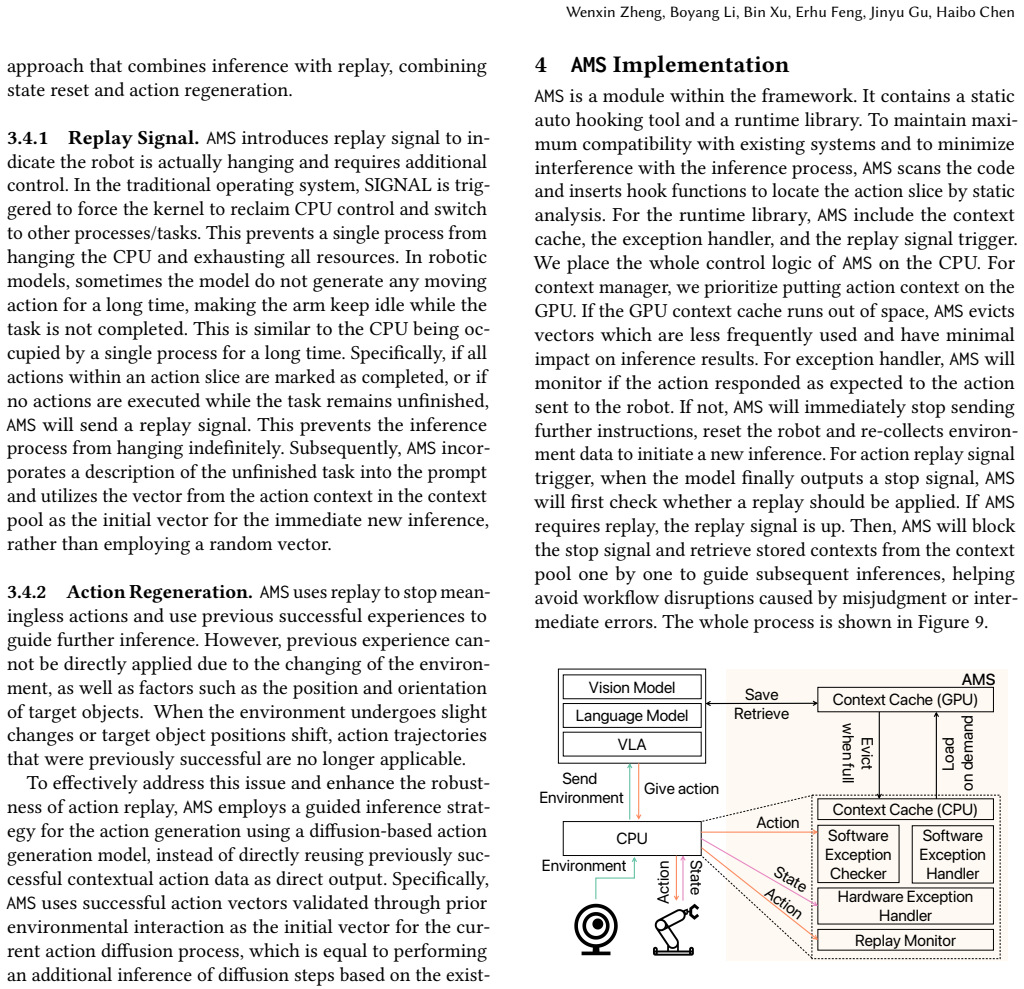
The central object is the action slice—a contiguous block of action steps produced by one model inference—treated as the atomic execution unit, like a thread's time slice. Three OS-inspired primitives operate on it. Action context is a layered pool storing KV caches, diffusion latents, and output embeddings, with two-phase hashing for indexing, reference-counted "virtual actions" for deduplication, and LRU-plus-priority eviction between GPU and CPU memory. Action exception is a CPU-side rule-based detector that divides an action slice into sub-slices, checks whether each action produced an observable effect (e.g., gripper gap exceeds zero, stick angle changes, force sensor reads above zero),
What would settle it
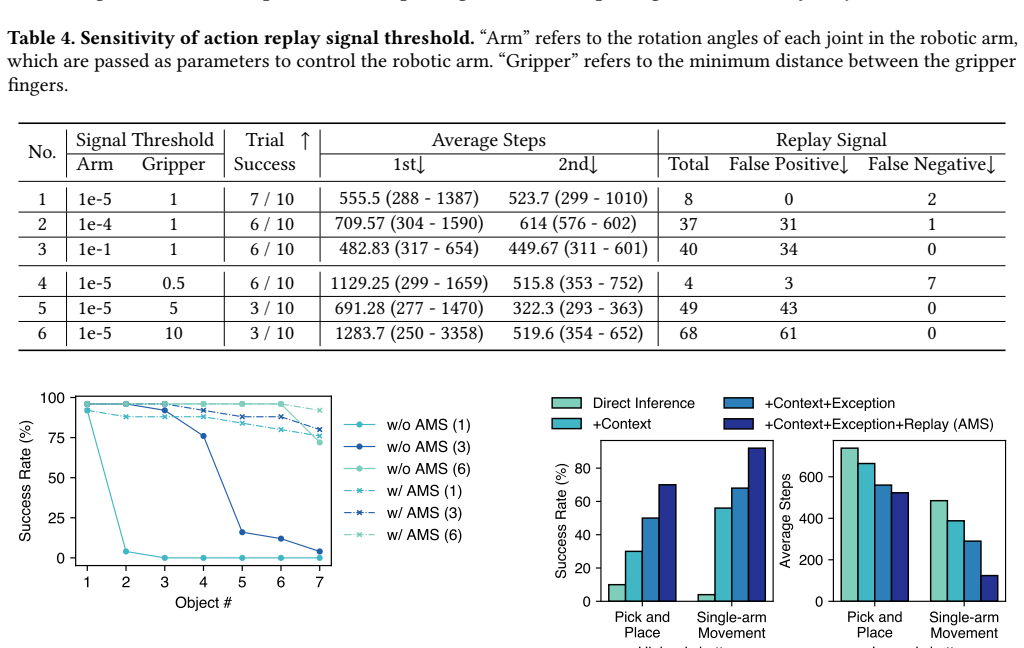
Instrument AMS on a pick-and-place task with deformable objects (for example soft cloth or sponge) where a failed grasp leaves joint angles and gripper gap within normal ranges. If the software-exception firing rate falls to near zero while task failures persist, and the success-rate advantage over direct inference drops from the full-stack level to roughly the context-only improvement reported in the ablation (20% for pick-and-place, 48% for single-arm movement), then the rule-based exception detector is the load-bearing component and its observable-outcome table is the limit of the approach.
Extended reading notes
Core claim
The central claim is that the units of control produced by a VLA model—action slices—behave enough like thread time slices that classical OS primitives transfer directly to robot control. AMS saves and restores intermediate inference state (KV caches, diffusion latents, output embeddings) so that repeated or similar actions skip redundant computation; it splits each action slice into 2-to-5-step sub-slices and asynchronously checks rule-based expected outcomes (gripper gap, joint-angle change, force reading) so that a failed action raises an immediate "action exception" that halts the slice and rolls the arm back to a safe state; and when the model stalls or emits meaningless actions, a repl
Load-bearing premise
The exception mechanism assumes every failed action leaves a measurable trace—gripper gap, joint-angle change, or force reading—within a 2-to-5-step sub-slice; if a failure changes none of those signals, AMS cannot detect it and the error propagates.
Editorial extensions
If this is right
- The same pretrained policy can handle repetition counts beyond its training maximum: AMS with a one-object-trained model matched or beat a six-object fine-tuned model at the seventh object.
- The reported speedups are mostly step reductions, not faster model inference: in real hardware AMS raises actions per second by only about 5%, but cuts steps by 29% to 74%, so the gains persist even when inference speed is not the bottleneck.
- The mechanism is model-agnostic: gains appear with pi0, CogACT, and Octo without changing model weights, so the design can wrap future VLA policies unchanged.
- Action context makes the second execution of a task cheaper than the first (5.7% to 20% fewer steps), implying that repeated or shift-long tasks accumulate benefit over time.
- Simulation results (5x to 12x success-rate gains) are weaker than real-robot results, consistent with the exception mechanism depending on hardware-fault observability.
Reading between the lines
- The scaling bottleneck is the hand-written rule table of expected outcomes; if those rules could be generated automatically, for example by an LLM checking whether an action produced its stated effect, AMS would extend to tasks where such rules are impractical to design by hand.
- The reference-counted virtual-action cache suggests a natural extension to cross-task and cross-robot sharing: if structurally similar actions are hashed and deduplicated across tasks, context learned in one long-horizon job could seed another, going beyond within-task repetition.
- Readers should interpret the headline multipliers with the near-zero baselines in mind: a 7x to 24x improvement is large partly because the direct-inference success rate is very low out of distribution; the absolute rates (about 70% for pick-and-place, 92% for single-arm movement) and the degradation curve are the more informative numbers.
Editorial analysis
A structured set of objections, weighed in public.
Referee Report
Summary. The paper proposes AMS, a system layer for vision-language-action (VLA) robotic policies that borrows three OS primitives: action context (caching and reusing KV caches, diffusion latents, and action trajectories), action exception (CPU-side monitoring of hardware/software conditions with sub-slice checks and rollback), and action replay (re-initializing diffusion from previously successful latents when the model stops producing meaningful actions). The system is implemented for the π0, CogACT, and Octo policies on a JAKA s5 real robot and in SimplerEnv simulation, with direct inference and VLA-Cache as baselines. The central claim is that AMS improves task success rates by 7x–24x and reduces end-to-end execution time by 29%–74% on long-horizon repetitive tasks without retraining the policy.
Significance. If the reported effects hold, the contribution is valuable and orthogonal to model-level improvements: it would show that an unchanged VLA policy can be made substantially more reliable and efficient on repetitive long-horizon tasks purely by system-level mechanisms. The paper correctly evaluates against external environments and external baselines, so the core claim is not definitionally circular. It also provides an ablation (Figure 18) and at least one sensitivity study (Table 4). However, the central empirical magnitudes are currently fragile: the headline success-rate figures have no error bars or trial counts, the largest gain component depends on a hand-written exception table whose coverage is not quantified, and the replay thresholds are free parameters with demonstrated sensitivity. These issues do not invalidate the systems idea, but they do mean the headline ratios are bounds for a narrow, carefully instrumented task class rather than established general results.
major comments (3)
- [§5.2, Figures 14–15; §5.1, Figure 10] The headline claims ('7× to 24×' success-rate improvement, '29% to 74%' time saving) are presented as bars without trial counts, error bars, or statistical tests. The only explicit per-condition n in the paper is n=10 in Table 4. With n=10, 7× can be 7/10 vs 1/10, and 24× can be 24% vs 1%, i.e., a single successful trial separating the conditions. Please report per-condition n, confidence intervals or exact binomial intervals, and, where possible, paired trial results. Also state whether the reported ratios are of success counts or of success percentages.
- [§3.3.1, Table 3 + §5.5.1, Figure 18] The ablation attributes the largest single gain to action exception: for pick-and-place, adding exception raises success by about 40 points (from roughly 30% to 70%). This mechanism rests entirely on the hand-written 'expected outcome' predicates in Table 3 (gripper gap > 0, stick angle change, force sensor > 0). If a failed action produces no measurable delta in the monitored signals within the 2–5-step sub-slice, the exception never fires and the rollback never triggers; the paper itself notes in §6 that using LLMs to automate exception classification is future work. The reported gains are therefore conditional on the designer having pre-enumerated the failure modes of the evaluated task family. Please narrow the generalization claim, quantify the coverage of the exception table, and include a test with injected undetectable failures.
- [§5.5.2, Table 4] Replay-signal thresholds are free parameters, and the sensitivity data show very large variation. For the same two-ball pick-and-place task, success is 7/10 in row 1 but 3/10 in rows 5–6 when the gripper threshold changes from 0.5 to 5 or 10; total average steps vary by more than a factor of three (e.g., 322.3 vs 1283.7 in rows 4 and 6). This is load-bearing because replay is a major source of the generalization gain. The paper does not explain how the thresholds used in the main evaluation (Figures 10–15) were selected or whether they were tuned on the test tasks. Please provide a selection protocol and demonstrate that the headline results are stable across a reasonable threshold range.
minor comments (6)
- [Abstract vs §5.1] The abstract states 'saving end-to-end execution time ranging from 29% to 74%', but §5.1 reports only 7%–15% for the first execution and 29%–74.4% for the second execution, when context reuse is warm. The abstract should state that the larger savings are for repeated executions.
- [Figure 11 caption] The caption reads 'Normalized Action Per Second to Direct Inference. Smaller is better.' If the quantity is normalized actions per second, smaller is worse; if smaller is better, the quantity is likely per-action time. Please correct the label/caption.
- [Figure 3] The claim that accuracy 'dropped significantly to zero' beyond the training repetition count is presented without trial counts or error bars. Please report the number of trials per point and per-condition counts.
- [Figure 8 caption] Typo: 'ankle' should be 'angle'.
- [§3.3.2] Typo: 'AMS follows he concept' should be 'AMS follows the concept'.
- [Figures 12 and 13] The x-axis labels '1 2' are ambiguous. Clarify whether they denote first/second execution, object count, or something else, and make the axis labels self-contained.
Circularity Check
No significant circularity: AMS's gains are measured against external baselines and environments; the exception table and replay thresholds are hand-tuned engineering inputs, not self-defined predictions.
full rationale
The paper's central claims are empirical measurements against external baselines (direct inference, VLA-Cache) in SimplerEnv simulation and on a JAKA s5 physical robot. There is no derivation chain in which a predicted quantity is defined in terms of the inputs: the exception table (Table 3) specifies physical, observable expected outcomes (gripper gap, joint angle change, force reading), not the task-success metric; the success-rate ratios in Figures 14/15/18 are measured outcomes of the complete system. The replay and exception mechanisms are hand-crafted, and Section 6 explicitly concedes that threshold setup and exception classification require human effort and that LLM automation is future work; this is an external-validity limitation, not circularity. No load-bearing self-citations appear: the cited models, baselines, and benchmark environments are independent. The replay threshold sensitivity study (Section 5.5.2) tunes a hyperparameter on a closely related task, which could threaten generality but does not make the evaluated success rate equivalent to the tuning criterion by construction. I can exhibit no equation, definition, or self-citation chain that reduces the reported gains to the paper's own inputs, so the appropriate finding is no circularity.
Assumptions & free parameters
free parameters (5)
- Replay signal threshold, arm joint movement =
1e-5 (Case 1, Table 4)
- Replay signal threshold, gripper movement =
1 (Cases 1-3, Table 4)
- Sub-slice length for software exception checks =
2-5 steps (adaptive)
- Hardware exception thresholds =
not quantified
- Vision KV cache recomputation overhead =
'less than 10%' (asserted)
assumptions (4)
- domain assumption VLA models emit a fixed block of action steps per inference round ('action slice')
- domain assumption In real robots the hardware action rate is the bottleneck, so reducing step count matters more than accelerating inference
- domain assumption Similar environments admit reuse of a previously successful action latent as diffusion initial noise
- ad hoc to paper Every action type has a compact observable expected outcome in joint/gripper state
invented entities (3)
-
Action context pool
-
Virtual action
-
Action atomization
Cite this review
Pith. "Pith review of Leveraging OS-Level Primitives for Robotic Action Management." pith.science (2026). https://pith.science/paper/NE73SSS6
@misc{pith2026250810259,
  author       = {Pith},
  title        = {Pith review of: Leveraging OS-Level Primitives for Robotic Action Management},
  year         = {2026},
  howpublished = {\url{https://pith.science/paper/NE73SSS6}},
  note         = {Machine review of arXiv:2508.10259}
}
read the original abstract
End-to-end imitation learning frameworks (e.g., VLA) are increasingly prominent in robotics, as they enable rapid task transfer by learning directly from perception to control, eliminating the need for complex hand-crafted features. However, even when employing SOTA VLA-based models, they still exhibit limited generalization capabilities and suboptimal action efficiency, due to the constraints imposed by insufficient robotic training datasets. In addition to addressing this problem using model-based approaches, we observe that robotic action slices, which consist of contiguous action steps, exhibit strong analogies to the time slices of threads in traditional operating systems. This insight presents a novel opportunity to tackle the problem at the system level. In this paper, we propose AMS, a robot action management system enhanced with OS-level primitives like exception, context switch and record-and-replay, that improves both execution efficiency and success rates of robotic tasks. AMS first introduces action exception, which facilitates the immediate interruption of robotic actions to prevent error propagation. Secondly, AMS proposes action context, which eliminates redundant computations for VLA-based models, thereby accelerating execution efficiency in robotic actions. Finally, AMS leverages action replay to facilitate repetitive or similar robotic tasks without the need for re-training efforts. We implement AMS in both an emulated environment and on a real robot platform. The evaluation results demonstrate that AMS significantly enhances the model's generalization ability and action efficiency, achieving task success rate improvements ranging from 7x to 24x and saving end-to-end execution time ranging from 29% to 74% compared to existing robotic system without AMS support.
Figures


Figures from the paper (14 more)




Forward citations
Cited by 3 Pith papers
-
KERV: Kinematic-Rectified Speculative Decoding for Embodied VLA Models
KERV integrates kinematic Kalman Filter predictions with speculative decoding in VLA models to achieve 27-37% faster inference while maintaining nearly the same task success rates.
-
PolicyTrim: Boosting Intrinsic Policy Efficiency of Vision-Language-Action Models
PolicyTrim is an RL post-training framework that boosts VLA policy efficiency by 3x chunk utilization and 51.4% fewer steps, yielding up to 5.83x speedup.
-
Escaping the Diversity Trap in Robotic Manipulation via Anchor-Centric Adaptation
Anchor-Centric Adaptation escapes the diversity trap by prioritizing repeated demonstrations at core anchors over broad coverage, yielding higher success rates under fixed data budgets in robotic manipulation.
Reference graph
Works this paper leans on
-
[1]
Adilzhan Adilkhanov, Amir Yelenov, Assylkhan Seitzhanov, Ayan Mazhitov, Azamat Abdikarimov, Danissa Sandykbayeva, Daryn Ken- zhebek, Dinmukhammed Mukashev, Ilyas Umurbekov, Jabrail Chu- makov, et al. 2025. Survey on Vision-Language-Action Models. arXiv preprint arXiv:2502.06851 (2025)
work page Pith review arXiv 2025
-
[2]
Kevin Black, Noah Brown, Danny Driess, Adnan Esmail, Michael Equi, Chelsea Finn, Niccolo Fusai, Lachy Groom, Karol Hausman, Brian Ichter, Szymon Jakubczak, Tim Jones, Liyiming Ke, Sergey Levine, Adrian Li-Bell, Mohith Mothukuri, Suraj Nair, Karl Pertsch, Lucy Xiaoyang Shi, James Tanner, Quan Vuong, Anna Walling, Hao- huan Wang, and Ury Zhilinsky. 2024. 𝜋0...
arXiv 2024
-
[3]
Anthony Brohan, Noah Brown, Justice Carbajal, Yevgen Chebotar, Joseph Dabis, Chelsea Finn, Keerthana Gopalakrishnan, Karol Haus- man, Alex Herzog, Jasmine Hsu, et al. 2022. Rt-1: Robotics transformer for real-world control at scale. arXiv preprint arXiv:2212.06817 (2022)
arXiv 2022
-
[4]
Joao Carvalho, A Le, Piotr Kicki, Dorothea Koert, and Jan Peters
-
[5]
Liang Chen, Haozhe Zhao, Tianyu Liu, Shuai Bai, Junyang Lin, Chang Zhou, and Baobao Chang. 2024. An image is worth 1/2 tokens after layer 2: Plug-and-play inference acceleration for large vision-language models. In European Conference on Computer Vision . Springer, 19–35
work page 2024
-
[6]
Sijin Chen, Xin Chen, Anqi Pang, Xianfang Zeng, Wei Cheng, Yijun Fu, Fukun Yin, Billzb Wang, Jingyi Yu, Gang Yu, et al. 2024. Meshxl: Neural coordinate field for generative 3d foundation models.Advances in Neural Information Processing Systems 37 (2024), 97141–97166
work page 2024
-
[7]
Shizhe Chen, Ricardo Garcia, Cordelia Schmid, and Ivan Laptev. 2023. Polarnet: 3d point clouds for language-guided robotic manipulation. arXiv preprint arXiv:2309.15596 (2023)
arXiv 2023
-
[8]
Cheng Chi, Zhenjia Xu, Siyuan Feng, Eric Cousineau, Yilun Du, Ben- jamin Burchfiel, Russ Tedrake, and Shuran Song. 2023. Diffusion policy: Visuomotor policy learning via action diffusion. The Interna- tional Journal of Robotics Research (2023), 02783649241273668
work page 2023
Show all 81 references
-
[9]
Suhyung Choi, Youngseok Joo, Jun Ki Lee, and Byoung-Tak Zhang
-
[10]
Sharmita Dey. 2025. Redefining Robot Generalization Through Inter- active Intelligence. arXiv preprint arXiv:2502.05963 (2025)
2025 arXiv
-
[11]
Alexey Dosovitskiy, Lucas Beyer, Alexander Kolesnikov, Dirk Weis- senborn, Xiaohua Zhai, Thomas Unterthiner, Mostafa Dehghani, Matthias Minderer, Georg Heigold, Sylvain Gelly, Jakob Uszkoreit, and Neil Houlsby. 2021. An Image is Worth 16x16 Words: Trans- formers for Image Reco...
2021 arXiv
-
[12]
Oluwami Dosunmu-Ogunbi, Aayushi Shrivastava, and Jessy W Grizzle
-
[13]
Danny Driess, Fei Xia, Mehdi SM Sajjadi, Corey Lynch, Aakanksha Chowdhery, Ayzaan Wahid, Jonathan Tompson, Quan Vuong, Tianhe Yu, Wenlong Huang, et al. 2023. Palm-e: An embodied multimodal 13 Wenxin Zheng, Boyang Li, Bin Xu, Erhu Feng, Jinyu Gu, Haibo Chen language model. (2023)
2023
-
[14]
Hao-Shu Fang, Hongjie Fang, Zhenyu Tang, Jirong Liu, Chenxi Wang, Junbo Wang, Haoyi Zhu, and Cewu Lu. 2024. Rh20t: A comprehensive robotic dataset for learning diverse skills in one-shot. In 2024 IEEE International Conference on Robotics and Automation (ICRA) . IEEE, 653–660
2024
-
[15]
In 2024 IEEE/RSJ International Conference on Intelligent Robots and Systems (IROS)
Demonstrating a Robust Walking Algorithm for Underactuated Bipedal Robots in Non-flat, Non-stationary Environments. In 2024 IEEE/RSJ International Conference on Intelligent Robots and Systems (IROS). IEEE, 11210–11217
2024
-
[16]
Dayuan Fu, Keqing He, Yejie Wang, Wentao Hong, Zhuoma Gongque, Weihao Zeng, Wei Wang, Jingang Wang, Xunliang Cai, and Weiran Xu. 2025. AgentRefine: Enhancing Agent Generalization through Refinement Tuning. arXiv preprint arXiv:2501.01702 (2025)
2025 arXiv
-
[17]
Zipeng Fu, Tony Z Zhao, and Chelsea Finn. 2024. Mobile aloha: Learn- ing bimanual mobile manipulation with low-cost whole-body teleop- eration. arXiv preprint arXiv:2401.02117 (2024)
2024 arXiv
-
[18]
Roya Firoozi, Johnathan Tucker, Stephen Tian, Anirudha Majumdar, Jiankai Sun, Weiyu Liu, Yuke Zhu, Shuran Song, Ashish Kapoor, Karol Hausman, et al. 2023. Foundation models in robotics: Applications, challenges, and the future. The International Journal of Robotics Re- search ...
2023
-
[19]
Theophile Gervet, Zhou Xian, Nikolaos Gkanatsios, and Katerina Fragkiadaki. 2023. Act3d: 3d feature field transformers for multi-task robotic manipulation. arXiv preprint arXiv:2306.17817 (2023)
2023 arXiv
-
[20]
Ankit Goyal, Jie Xu, Yijie Guo, Valts Blukis, Yu-Wei Chao, and Dieter Fox. 2023. Rvt: Robotic view transformer for 3d object manipulation. In Conference on Robot Learning . PMLR, 694–710
2023
-
[21]
Abraham George and Amir Barati Farimani. 2023. One act play: Single demonstration behavior cloning with action chunking transformers. arXiv preprint arXiv:2309.10175 (2023)
2023 arXiv
-
[22]
Pierre-Louis Guhur, Shizhe Chen, Ricardo Garcia Pinel, Makarand Tapaswi, Ivan Laptev, and Cordelia Schmid. 2023. Instruction-driven history-aware policies for robotic manipulations. In Conference on Robot Learning. PMLR, 175–187
2023
-
[23]
Yanjiang Guo, Jianke Zhang, Xiaoyu Chen, Xiang Ji, Yen-Jen Wang, Yucheng Hu, and Jianyu Chen. 2025. Improving Vision-Language- Action Model with Online Reinforcement Learning. arXiv preprint arXiv:2501.16664 (2025)
2025 arXiv
-
[24]
Albert Gu and Tri Dao. 2023. Mamba: Linear-time sequence modeling with selective state spaces. arXiv preprint arXiv:2312.00752 (2023)
2023 arXiv
-
[25]
Zhi Hou, Tianyi Zhang, Yuwen Xiong, Haonan Duan, Hengjun Pu, Ronglei Tong, Chengyang Zhao, Xizhou Zhu, Yu Qiao, Jifeng Dai, et al. 2025. Dita: Scaling Diffusion Transformer for Generalist Vision- Language-Action Policy. arXiv preprint arXiv:2503.19757 (2025)
2025 arXiv
-
[26]
Haoxu Huang, Fanqi Lin, Yingdong Hu, Shengjie Wang, and Yang Gao. 2024. Copa: General robotic manipulation through spatial con- straints of parts with foundation models. In2024 IEEE/RSJ International Conference on Intelligent Robots and Systems (IROS) . IEEE, 9488–9495
2024
-
[27]
Huy Ha, Pete Florence, and Shuran Song. 2023. Scaling up and distilling down: Language-guided robot skill acquisition. In Conference on Robot Learning. PMLR, 3766–3777
2023
-
[28]
JAKA. 2025. JAKA Robots. https://www.jaka.com/en/index [Online; accessed 2025-04-18]
2025
-
[29]
Stephen James, Kentaro Wada, Tristan Laidlow, and Andrew J Davi- son. 2022. Coarse-to-fine q-attention: Efficient learning for visual robotic manipulation via discretisation. In Proceedings of the IEEE/CVF Conference on Computer Vision and Pattern Recognition . 13739–13748
2022
-
[30]
Yutaro Ishida, Yuki Noguchi, Takayuki Kanai, Kazuhiro Shintani, and Hiroshi Bito. 2024. Robust Imitation Learning for Mobile Manipulator Focusing on Task-Related Viewpoints and Regions. In 2024 IEEE/RSJ International Conference on Intelligent Robots and Systems (IROS) . IEEE, ...
2024
-
[31]
Michael Janner, Yilun Du, Joshua B Tenenbaum, and Sergey Levine
-
[32]
Kai Jiang and Jiaxing Huang. 2024. A Survey on Vision Autoregressive Model. arXiv preprint arXiv:2411.08666 (2024)
2024 arXiv
-
[33]
Eric Jang, Alex Irpan, Mohi Khansari, Daniel Kappler, Frederik Ebert, Corey Lynch, Sergey Levine, and Chelsea Finn. 2022. Bc-z: Zero-shot task generalization with robotic imitation learning. In Conference on Robot Learning. PMLR, 991–1002
2022
-
[34]
Moo Jin Kim, Chelsea Finn, and Percy Liang. 2025. Fine-tuning vision- language-action models: Optimizing speed and success. arXiv preprint arXiv:2502.19645 (2025)
2025 arXiv
-
[35]
Moo Jin Kim, Karl Pertsch, Siddharth Karamcheti, Ted Xiao, Ashwin Balakrishna, Suraj Nair, Rafael Rafailov, Ethan Foster, Grace Lam, Pannag Sanketi, et al. 2024. Openvla: An open-source vision-language- action model. arXiv preprint arXiv:2406.09246 (2024)
2024 arXiv
-
[36]
Qixiu Li, Yaobo Liang, Zeyu Wang, Lin Luo, Xi Chen, Mozheng Liao, Fangyun Wei, Yu Deng, Sicheng Xu, Yizhong Zhang, et al . 2024. Cogact: A foundational vision-language-action model for synergiz- ing cognition and action in robotic manipulation. arXiv preprint arXiv:2411.19650 (2024)
2024 arXiv
-
[37]
Joohyung Kim, Dhruv C Mathur, Kazuki Shin, and Sean Taylor
-
[38]
Xiang Li, Cristina Mata, Jongwoo Park, Kumara Kahatapitiya, Yoo Sung Jang, Jinghuan Shang, Kanchana Ranasinghe, Ryan Burgert, Mu Cai, Yong Jae Lee, et al. 2024. Llara: Supercharging robot learn- ing data for vision-language policy. arXiv preprint arXiv:2406.20095 (2024)
2024 arXiv
-
[39]
Yinghui Li, Jinze Wu, Xin Liu, Weizhong Guo, and Yufei Xue. 2024. Experience-Learning Inspired Two-Step Reward Method for Efficient Legged Locomotion Learning Towards Natural and Robust Gaits. In 2024 IEEE/RSJ International Conference on Intelligent Robots and Sys- tems (IROS)...
2024
-
[40]
Yunfei Li, Ying Yuan, Jingzhi Cui, Haoran Huan, Wei Fu, Jiaxuan Gao, Zekai Xu, and Yi Wu. 2024. Robot Generating Data for Learning Gen- eralizable Visual Robotic Manipulation. In 2024 IEEE/RSJ International Conference on Intelligent Robots and Systems (IROS) . IEEE, 5813–5820
2024
-
[41]
Ji Lin, Jiaming Tang, Haotian Tang, Shang Yang, Guangxuan Xiao, and Song Han. 2025. AWQ: Activation-aware Weight Quantization for On-Device LLM Compression and Acceleration. GetMobile: Mobile Computing and Communications 28, 4 (2025), 12–17
2025
-
[42]
Xuanlin Li, Kyle Hsu, Jiayuan Gu, Karl Pertsch, Oier Mees, Homer Rich Walke, Chuyuan Fu, Ishikaa Lunawat, Isabel Sieh, Sean Kirmani, Sergey Levine, Jiajun Wu, Chelsea Finn, Hao Su, Quan Vuong, and Ted Xiao. 2024. Evaluating Real-World Robot Manipulation Policies in Simulation....
2024 arXiv
-
[43]
Yueen Ma, Dafeng Chi, Shiguang Wu, Yuecheng Liu, Yuzheng Zhuang, Jianye Hao, and Irwin King. 2024. Actra: Optimized transformer ar- chitecture for vision-language-action models in robot learning. arXiv preprint arXiv:2408.01147 (2024)
2024
-
[44]
Cheng Pan, Kai Junge, and Josie Hughes. 2024. Vision-language-action model and diffusion policy switching enables dexterous control of an anthropomorphic hand. arXiv preprint arXiv:2410.14022 (2024)
2024 arXiv
-
[45]
J Hyeon Park, Wonhyuk Choi, Sunpyo Hong, Hoseong Seo, Joonmo Ahn, Changsu Ha, Heungwoo Han, and Junghyun Kwon. 2024. Hi- erarchical Action Chunking Transformer: Learning Temporal Multi- modality from Demonstrations with Fast Imitation Behavior. In 2024 IEEE/RSJ International C...
2024
-
[46]
Seongmin Park, Hyungmin Kim, Wonseok Jeon, Juyoung Yang, Byeongwook Jeon, Yoonseon Oh, and Jungwook Choi. 2024. Quantization-Aware Imitation-Learning for Resource-Efficient 14 Leveraging OS-Level Primitives for Robotic Action Management Robotic Control. arXiv preprint arXiv:24...
2024 arXiv
-
[47]
Jiaming Liu, Mengzhen Liu, Zhenyu Wang, Lily Lee, Kaichen Zhou, Pengju An, Senqiao Yang, Renrui Zhang, Yandong Guo, and Shang- hang Zhang. 2024. Robomamba: Multimodal state space model for efficient robot reasoning and manipulation. arXiv preprint arXiv:2406.04339 (2024)
2024 arXiv
-
[48]
Alec Radford, Jong Wook Kim, Chris Hallacy, Aditya Ramesh, Gabriel Goh, Sandhini Agarwal, Girish Sastry, Amanda Askell, Pamela Mishkin, Jack Clark, Gretchen Krueger, and Ilya Sutskever. 2021. Learn- ing Transferable Visual Models From Natural Language Supervision. arXiv:2103.0...
2021 arXiv
-
[49]
Gernot Riegler, Ali Osman Ulusoy, and Andreas Geiger. 2017. Octnet: Learning deep 3d representations at high resolutions. In Proceedings of the IEEE conference on computer vision and pattern recognition . 3577– 3586
2017
-
[50]
Trossen Robotics. 2025. Trossen Robotics. https://www. trossenrobotics.com/ [Online; accessed 2025-04-18]
2025
-
[51]
Noah Shinn, Federico Cassano, Ashwin Gopinath, Karthik Narasimhan, and Shunyu Yao. 2023. Reflexion: Language agents with verbal reinforcement learning. Advances in Neural Information Processing Systems 36 (2023), 8634–8652
2023
-
[52]
Karl Pertsch, Kyle Stachowicz, Brian Ichter, Danny Driess, Suraj Nair, Quan Vuong, Oier Mees, Chelsea Finn, and Sergey Levine. 2025. Fast: Efficient action tokenization for vision-language-action models. arXiv preprint arXiv:2501.09747 (2025)
2025 arXiv
-
[53]
Mohit Shridhar, Xingdi Yuan, Marc-Alexandre Côté, Yonatan Bisk, Adam Trischler, and Matthew Hausknecht. 2020. Alfworld: Align- ing text and embodied environments for interactive learning. arXiv preprint arXiv:2010.03768 (2020)
2020 arXiv
-
[54]
Wenxuan Song, Jiayi Chen, Pengxiang Ding, Han Zhao, Wei Zhao, Zhide Zhong, Zongyuan Ge, Jun Ma, and Haoang Li. 2025. Accelerating Vision-Language-Action Model Integrated with Action Chunking via Parallel Decoding. arXiv preprint arXiv:2503.02310 (2025)
2025
-
[55]
Octo Model Team, Dibya Ghosh, Homer Walke, Karl Pertsch, Kevin Black, Oier Mees, Sudeep Dasari, Joey Hejna, Tobias Kreiman, Charles Xu, et al. 2024. Octo: An open-source generalist robot policy. arXiv preprint arXiv:2405.12213 (2024)
2024 arXiv
-
[56]
Chenxi Wang, Hongjie Fang, Hao-Shu Fang, and Cewu Lu. 2024. Rise: 3d perception makes real-world robot imitation simple and effective. In 2024 IEEE/RSJ International Conference on Intelligent Robots and Systems (IROS). IEEE, 2870–2877
2024
-
[57]
Mohit Shridhar, Lucas Manuelli, and Dieter Fox. 2023. Perceiver-actor: A multi-task transformer for robotic manipulation. In Conference on Robot Learning. PMLR, 785–799
2023
-
[58]
Junjie Wen, Yichen Zhu, Jinming Li, Minjie Zhu, Zhibin Tang, Kun Wu, Zhiyuan Xu, Ning Liu, Ran Cheng, Chaomin Shen, et al . 2025. Tinyvla: Towards fast, data-efficient vision-language-action models for robotic manipulation. IEEE Robotics and Automation Letters (2025)
2025
-
[59]
Kun Wu, Chengkai Hou, Jiaming Liu, Zhengping Che, Xiaozhu Ju, Zhuqin Yang, Meng Li, Yinuo Zhao, Zhiyuan Xu, Guang Yang, et al
-
[60]
Zhiheng Xi, Wenxiang Chen, Xin Guo, Wei He, Yiwen Ding, Boyang Hong, Ming Zhang, Junzhe Wang, Senjie Jin, Enyu Zhou, et al. 2025. The rise and potential of large language model based agents: A survey. Science China Information Sciences 68, 2 (2025), 121101
2025
-
[61]
Shenghao Xie, Wenqiang Zu, Mingyang Zhao, Duo Su, Shilong Liu, Ruohua Shi, Guoqi Li, Shanghang Zhang, and Lei Ma. 2024. Towards Unifying Understanding and Generation in the Era of Vision Foun- dation Models: A Survey from the Autoregression Perspective. arXiv preprint arXiv:24...
2024 arXiv
-
[62]
Junjie Wen, Minjie Zhu, Yichen Zhu, Zhibin Tang, Jinming Li, Zhongyi Zhou, Chengmeng Li, Xiaoyu Liu, Yaxin Peng, Chaomin Shen, et al
-
[63]
arXiv preprint arXiv:2412.03293 (2024)
Diffusion-VLA: Scaling Robot Foundation Models via Unified Diffusion and Autoregression. arXiv preprint arXiv:2412.03293 (2024)
2024 arXiv
-
[64]
Xinyu Xu, Yizheng Zhang, Yong-Lu Li, Lei Han, and Cewu Lu. 2024. Humanvla: Towards vision-language directed object rearrangement by physical humanoid. arXiv preprint arXiv:2406.19972 (2024)
2024 arXiv
-
[65]
Yang Yue, Yulin Wang, Bingyi Kang, Yizeng Han, Shenzhi Wang, Shiji Song, Jiashi Feng, and Gao Huang. 2024. Deer-vla: Dynamic inference of multimodal large language models for efficient robot execution. Advances in Neural Information Processing Systems 37 (2024), 56619– 56643
2024
-
[66]
arXiv preprint arXiv:2412.13877 (2024)
Robomind: Benchmark on multi-embodiment intelligence nor- mative data for robot manipulation. arXiv preprint arXiv:2412.13877 (2024)
2024 arXiv
-
[67]
Jianke Zhang, Yanjiang Guo, Yucheng Hu, Xiaoyu Chen, Xiang Zhu, and Jianyu Chen. 2025. UP-VLA: A Unified Understanding and Pre- diction Model for Embodied Agent. arXiv preprint arXiv:2501.18867 (2025)
2025 arXiv
-
[68]
Xinyu Zhang, Yuhan Liu, Haonan Chang, Liam Schramm, and Ab- deslam Boularias. 2025. Autoregressive action sequence learning for robotic manipulation. IEEE Robotics and Automation Letters (2025)
2025
-
[69]
Weimin Xiong, Yifan Song, Xiutian Zhao, Wenhao Wu, Xun Wang, Ke Wang, Cheng Li, Wei Peng, and Sujian Li. 2024. Watch every step! llm agent learning via iterative step-level process refinement. arXiv preprint arXiv:2406.11176 (2024)
2024 arXiv
-
[70]
Siyu Xu, Yunke Wang, Chenghao Xia, Dihao Zhu, Tao Huang, and Chang Xu. 2025. VLA-Cache: Towards Efficient Vision-Language- Action Model via Adaptive Token Caching in Robotic Manipulation. arXiv preprint arXiv:2502.02175 (2025)
2025
-
[71]
Tony Z Zhao, Vikash Kumar, Sergey Levine, and Chelsea Finn. 2023. Learning fine-grained bimanual manipulation with low-cost hardware. arXiv preprint arXiv:2304.13705 (2023)
2023 arXiv
-
[72]
Wangbo Zhao, Jiasheng Tang, Yizeng Han, Yibing Song, Kai Wang, Gao Huang, Fan Wang, and Yang You. 2024. Dynamic tuning towards parameter and inference efficiency for vit adaptation. arXiv preprint arXiv:2403.11808 (2024)
2024 arXiv
-
[73]
Yanjie Ze, Zixuan Chen, Wenhao Wang, Tianyi Chen, Xialin He, Ying Yuan, Xue Bin Peng, and Jiajun Wu. 2024. Generalizable humanoid manipulation with improved 3d diffusion policies. arXiv preprint arXiv:2410.10803 (2024)
2024 arXiv
-
[76]
Yuan Zhang, Chun-Kai Fan, Junpeng Ma, Wenzhao Zheng, Tao Huang, Kuan Cheng, Denis Gudovskiy, Tomoyuki Okuno, Yohei Nakata, Kurt Keutzer, et al. 2024. Sparsevlm: Visual token sparsification for efficient vision-language model inference. arXiv preprint arXiv:2410.04417 (2024)
2024 arXiv
-
[77]
Qingqing Zhao, Yao Lu, Moo Jin Kim, Zipeng Fu, Zhuoyang Zhang, Yecheng Wu, Zhaoshuo Li, Qianli Ma, Song Han, Chelsea Finn, et al
-
[78]
arXiv preprint arXiv:2503.22020 (2025)
CoT-VLA: Visual Chain-of-Thought Reasoning for Vision- Language-Action Models. arXiv preprint arXiv:2503.22020 (2025)
2025 arXiv
-
[81]
Haoyu Zhen, Xiaowen Qiu, Peihao Chen, Jincheng Yang, Xin Yan, Yilun Du, Yining Hong, and Chuang Gan. 2024. 3d-vla: A 3d vision-language-action generative world model. arXiv preprint arXiv:2403.09631 (2024). 15
2024 arXiv
-
[2022]
arXiv preprint arXiv:2205.09991 (2022)
Planning with diffusion for flexible behavior synthesis. arXiv preprint arXiv:2205.09991 (2022)
2022 arXiv
-
[2023]
arXiv preprint arXiv:2302.09655 (2023)
Papras: Plug-and-play robotic arm system. arXiv preprint arXiv:2302.09655 (2023)
2023 arXiv
-
[2024]
Motion planning diffusion: Learning and adapting robot motion planning with diffusion models.arXiv preprint arXiv:2412.19948 (2024)
2024 arXiv
-
[2025]
Mixture of Action Expert Embeddings: Multi-Task ACT. (2025)
2025
Reviewed August 5, 2026 · model on record in the stance chip above.
Discussion (0). Sign in to comment.