REVIEW 5 major objections 5 minor 2 cited by
Flexible Personalized Split Federated Learning for On-Device Fine-Tuning of Foundation Models
T0 review · 5 major / 5 minor · reviewed 2026-08-05 · deepseek-v4-flash
Pith's one-line read FlexP-SFL shows that split federated learning without parameter aggregation can fine-tune foundation models for personalized tasks faster and with comparable or better accuracy than aggregation-based methods.
desk verdict A practical split-FL system for on-device fine-tuning with real speedups; the async shared-layer stability is the main open question. read the letter →
The pith
A machine-rendered reading of the paper's core claim, the machinery that carries it, and where it could break.
The reading
What carries the argument
The core mechanism is the removal of FedAvg-style parameter aggregation in split learning, replaced by asynchronous exchange of activations and gradients only. Supporting machinery includes the flexible layer-partitioning ratio Qn (the fraction of trainable layers kept on the client), which acts as a knob for the personalization-computation trade-off, and the KL-divergence alignment term R(vn_CL, wn_CL) that regularizes client representations against the server's copy of those layers, balancing personalization with generalization. The server-side shared layers are updated from each client's gradients without synchronization, which is what eliminates the straggler effect.
What would settle it
Run FlexP-SFL on a moderately larger model (e.g., a 1B-parameter transformer) with 20 or more clients assigned to distinct tasks, and monitor the server-side shared layers' weights over time; if the server weights oscillate or drift to a representation that only serves a subset of clients, and removing the KL term (λ=0) makes accuracy collapse while increasing λ only slows training without recovering accuracy, the stability premise would be falsified.
Extended reading notes
Core claim
The central claim is that a split federated learning framework for foundation-model fine-tuning can work without any parameter aggregation or client synchronization. FlexP-SFL partitions a model into four parts: private input layers (PL1), flexible client layers (CL), shared server layers (SL), and private output layers (PL2). Clients choose how many CL layers to run locally through a ratio Qn, balancing device memory against personalization quality. The server updates its shared layers asynchronously from gradients received from each client, and a KL-divergence regularizer aligns client CL representations with server-side CL representations to avoid excessive model drift. The paper reports
Load-bearing premise
The shared server-side layers are updated asynchronously from each client's gradients with no aggregation, synchronization, or cross-client coordination beyond a per-client KL term, and the paper assumes these updates remain stable and yield a shared representation that helps all clients; the paper explicitly provides no convergence analysis.
Editorial extensions
If this is right
- If the central claim holds, fine-tuning foundation models on heterogeneous edge devices becomes feasible with memory footprints far smaller than the full model, since clients need only store a few layers.
- The 4.5x wall-clock speedup over SFL suggests that removing aggregation and synchronization can be a general recipe for speeding up collaborative fine-tuning, not just a niche trick.
- The flexible Qn ratio gives a clean and practical way to let devices with very different memory and compute capabilities participate in the same fine-tuning task.
- The KL alignment term demonstrates a lightweight alternative to parameter averaging for knowledge transfer, which could be applied beyond split learning to other federated personalization designs.
- The robustness results (only slight accuracy drop and modest time increase under 50% client dropout) indicate the asynchronous design tolerates unreliable client participation better than synchronous aggregation methods.
Reading between the lines
- The paper leaves open whether the shared server layers remain stable asynchronously at larger model scales or with more clients; one could test this by running FlexP-SFL on models bigger than 355M parameters and checking whether the server-side layers' gradients stay bounded and on-task.
- The KL alignment term effectively turns the server into a distillation teacher; a natural extension is to replace it with stronger regularization or contrastive objectives, which might improve accuracy further while keeping the no-aggregation benefit.
- The no-aggregation idea may also apply to other collaborative paradigms such as vertical split learning or hybrid sharding, where the bottleneck is communication rather than client compute.
- Because the method is deliberately parameter-free in its aggregation step, it could be combined with LoRA-style adapters on the client side to reduce even the activation/gradient payloads, although the paper does not explore this.
Editorial analysis
A structured set of objections, weighed in public.
Referee Report
Summary. The paper proposes FlexP-SFL, a split federated learning framework for personalized fine-tuning of foundation models on resource-constrained devices. Unlike conventional SFL, FlexP-SFL removes parameter aggregation: each client trains a local subset of layers (PL1, CL, PL2) and exchanges only activations and gradients with the server, which updates a shared server-side layer set (SL) asynchronously from the clients' gradients. A flexible layer partitioning ratio Q_n accommodates heterogeneous device capabilities, and a KL-divergence alignment term (Eq. 6) is introduced to balance personalization and generalization. The authors report real-testbed experiments with six clients and multiple BERT/GPT-2 variants on MMLU and MMLU-Pro, comparing against FedAvg, SFL, PFL baselines (Ditto, APFL, FedRep), and recent on-device fine-tuning methods. They claim improved personalized accuracy and large reductions in wall-clock fine-tuning time and communication overhead.
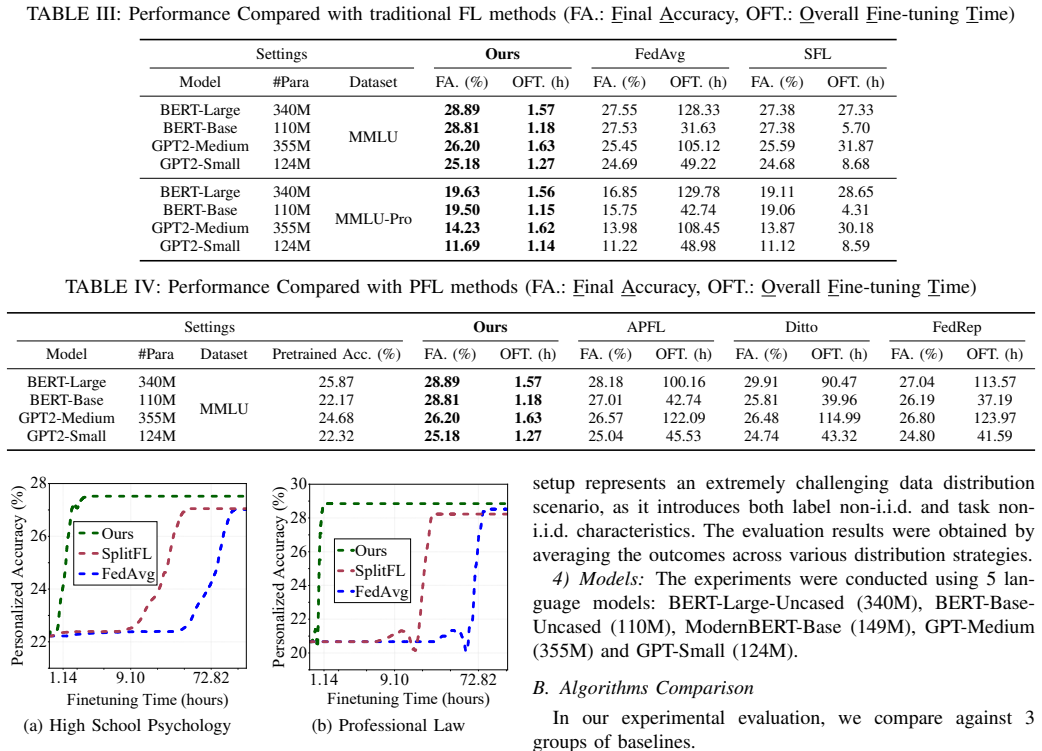
Significance. If validated, the framework addresses a practically important problem—personalized fine-tuning of large models on heterogeneous edge devices—and the open-sourced testbed is a useful contribution. The reported speedups (e.g., 4.5x in Table I, larger in Table III) are plausibly mechanical consequences of removing synchronous aggregation and straggler waits. The paper also compares against a broad set of baselines and includes a robustness study. However, the evidence for the central accuracy claims is limited: the testbed has only six clients, results are single-run with no error bars, and some tables contradict the stated 'consistently outperforms' claim. The stability of asynchronously updated shared server layers is not analyzed, and the paper explicitly disclaims convergence analysis in Footnote 1. These issues must be addressed before the claims can be accepted at face value.
major comments (5)
- [Sec. III-A/E, Eq. (8), Footnote 1] The central novelty is updating the shared server layers w_SL asynchronously from client gradients without aggregation. Footnote 1 explicitly states that no convergence analysis is provided. Since conflicting client gradients may cause oscillation or bias toward recently active clients, the stability of w_SL is load-bearing for the claimed efficiency and accuracy gains. The only evidence is the N=6 testbed with one MMLU task per client and a single run per configuration. I do not expect a full proof in an empirical systems paper, but the claims should be calibrated: report multiple seeds with variance, and ideally a larger-N or higher-heterogeneity sensitivity study, or explicitly state that the results are specific to the tested small-scale regime.
- [Sec. V-B, Table VI] The text states that 'higher values of Q lead to better final personalized accuracy' and that results 'consistently show' this. Table VI contradicts this for BERT-Base/MMLU: Q=0.1 gives 28.85%, Q=0.2 gives 28.33%, and then Q=0.5 gives 31.69%. The non-monotonic intermediate value undermines the stated consistency. Please correct the claim, provide an explanation for the non-monotonicity, or report additional runs to show whether it is noise.
- [Sec. V-A.2, Table IV] The abstract and Section V claim that FlexP-SFL 'outperforms baseline models in personalized fine-tuning efficiency and final accuracy.' Table IV shows that FlexP-SFL is not consistently the most accurate: for BERT-Large/MMLU, Ditto achieves 29.91% vs. 28.89%; for GPT2-Medium/MMLU, Ditto achieves 26.48% and FedRep 26.80% vs. 26.20%. The accuracy advantage over PFL baselines is therefore mixed. Please qualify the claim to 'comparable or better on some settings' and discuss why the method does not dominate on all models.
- [Sec. III-A/D, Eq. (6)] The KL alignment term R(vn_CL, wn_CL) is described as aligning client CL layers with the 'global server-side model' to facilitate knowledge sharing. However, Sec. III-A states that 'only the Server Layers (SL) participate in gradient updates.' If w_CL is never updated, then Eq. (6) regularizes client representations toward a fixed pretrained server copy, not toward a learned global model. This would substantially weaken the claimed cross-client knowledge-sharing mechanism. Please clarify whether w_CL is updated, and if it is not, reframe the role of the alignment term or modify the method so that the alignment target actually reflects global knowledge.
- [Sec. IV-V] Reproducibility and statistical support are insufficient for the empirical claims. The paper does not report learning rates, local epochs, communication rounds, number of samples per client, or how tasks were assigned beyond 'each client was assigned data corresponding to exactly one domain task.' 'The evaluation results were obtained by averaging the outcomes across various distribution strategies' is vague. There are no error bars, confidence intervals, or significance tests; given that many accuracy differences are 1-3 percentage points, they may be within run-to-run noise. Table V also appears to have an error: the ModernBERT-Base row lists exactly the same accuracy (28.89) as the BERT-Large row. Please provide full experimental details and repeated-run statistics.
minor comments (5)
- [Eq. (5)] The definition of Q_n using 'Number of Layers (w \ (wPL1 ∪ wPL2))' is notationally ambiguous because w is a set of parameters, not layers. Clarify that the denominator counts transformer blocks or layers excluded from PL1/PL2.
- [Sec. IV-A.3 and Fig. 6] There is a typo 'FlexP-FSL' in the datasets paragraph. Figure 6 axis labels appear garbled ('1 .149 .107 2.822...'), making the figure difficult to read; please regenerate.
- [Table V] The ModernBERT-Base row reports the same accuracy (28.89) and memory/comm values as the BERT-Large row in Table III/V. Please verify that these numbers are correct for ModernBERT-Base and not copy-paste errors.
- [Sec. V-A.3] The statement that communication throughput is 'approximately 5× activations' size' is unclear. Specify the data types, activation sizes, and which messages are included (z_CL, z_SL, g_PL2, g_SL, z_PL1).
- [Sec. II-D/Table I] Table I labels the comparison as 'SFL (w/ Avg)' vs 'FlexP-SFL (w/o Avg)' but the paper later says FlexP-SFL includes an alignment strategy; clarify whether Table I uses the full FlexP-SFL or a no-alignment variant.
Circularity Check
No significant circularity: FlexP-SFL's design choices are assembled from standard split learning and KL-regularization components, and its claimed gains are measured on a real testbed rather than derived from fitted inputs or self-citations.
full rationale
The paper's central claims are empirical measurements from a real heterogeneous testbed, not quantities derived by construction from the method's own definitions. The method combines existing building blocks: split learning (client/server layer partitioning), omission of parameter aggregation, flexible client-side layer counts, and a KL-divergence alignment term (Eq. 6) inspired by federated knowledge distillation. No equation is defined in terms of the result it is said to predict; for example, the final accuracies in Tables III–V are measured outcomes, not fitted parameters renamed as predictions. The alignment term is introduced as a regularizer and then ablated (Fig. 8b, Table VIII), which is self-consistent validation rather than circularity. The one footnote (Sec. II-D) explicitly disclaims convergence analysis and points to existing related studies [22], [23] only as future-work inspiration, so it is not load-bearing; [22] shares an author but is not invoked to justify the central claim. The preliminary 'w/o Avg' comparison in Table I is also a measurement, not an assumed conclusion. Some internal inconsistencies exist—e.g., Table VI shows BERT-Base accuracy dropping from Q=0.1 to Q=0.2, contradicting the 'consistently' wording of Insight 2—and the absence of convergence analysis for the asynchronously updated shared server layers is a real generalization risk. But these are correctness/robustness concerns, not circularity: the paper does not reduce its claims to its inputs or to an unverified self-citation chain. Therefore the circularity score is 0.
Assumptions & free parameters
free parameters (2)
- KL regularization coefficient λ =
0, 0.25, 0.5 in experiments
- Client layer split ratio Q_n =
0.1, 0.2, 0.5 in ablation; unspecified in main comparisons
assumptions (4)
- domain assumption Shared server layers updated asynchronously from client gradients converge to a useful global representation without parameter aggregation or synchronization.
- domain assumption KL divergence between client CL and server CL output distributions transfers knowledge and prevents model drift.
- domain assumption Split learning preserves privacy of raw data and labels when PL1 and PL2 remain on the client and only activations and gradients are transmitted.
- domain assumption Fine-tuning a foundation model on a single MMLU domain task with limited data improves personalized task accuracy beyond the pretrained model.
Cite this review
Pith. "Pith review of Flexible Personalized Split Federated Learning for On-Device Fine-Tuning of Foundation Models." pith.science (2026). https://pith.science/paper/KNOJCT2E
@misc{pith2026250810349,
  author       = {Pith},
  title        = {Pith review of: Flexible Personalized Split Federated Learning for On-Device Fine-Tuning of Foundation Models},
  year         = {2026},
  howpublished = {\url{https://pith.science/paper/KNOJCT2E}},
  note         = {Machine review of arXiv:2508.10349}
}
read the original abstract
Fine-tuning foundation models is critical for superior performance on personalized downstream tasks, compared to using pre-trained models. Collaborative learning can leverage local clients' datasets for fine-tuning, but limited client data and heterogeneous data distributions hinder effective collaboration. To address the challenge, we propose a flexible personalized federated learning paradigm that enables clients to engage in collaborative learning while maintaining personalized objectives. Given the limited and heterogeneous computational resources available on clients, we introduce \textbf{flexible personalized split federated learning (FlexP-SFL)}. Based on split learning, FlexP-SFL allows each client to train a portion of the model locally while offloading the rest to a server, according to resource constraints. Additionally, we propose an alignment strategy to improve personalized model performance on global data. Experimental results show that FlexP-SFL outperforms baseline models in personalized fine-tuning efficiency and final accuracy.
Figures


Figures from the paper (4 more)



Forward citations
Cited by 2 Pith papers
-
A Survey on Split Learning for LLM Fine-Tuning: Models, Systems, and Privacy Optimizations
A survey that introduces a unified training pipeline and taxonomizes split learning approaches for LLM fine-tuning across model, system, and privacy dimensions.
-
MobileFineTuner: A Mobile-Native Framework for On-Device LLM Fine-Tuning in Real-World Embedded AI Applications
An open-source C++ framework demonstrates full and LoRA fine-tuning of small LLMs on Android phones, but leaves practical end-to-end time and energy costs unmeasured.
Reference graph
Works this paper leans on
-
[1]
Improving language understanding by generative pre-training
Alec Radford, Narasimhan K, Salimans T, and Sutskever I. Improving language understanding by generative pre-training. Technical report, OpenAI Technical Report, 2018
work page 2018
-
[2]
Language models are unsupervised multitask learners
Alec Radford, Jeffrey Wu, Rewon Child, David Luan, Dario Amodei, and Ilya Sutskever. Language models are unsupervised multitask learners. OpenAI blog, 1(8):9, 2019
work page 2019
-
[3]
Bert: Pre-training of deep bidirectional transformers for language un- derstanding
Jacob Devlin, Ming-Wei Chang, Kenton Lee, and Kristina Toutanova. Bert: Pre-training of deep bidirectional transformers for language un- derstanding. arXiv preprint arXiv:1810.04805 , 2018
arXiv 2018
-
[4]
Llama: Open and efficient foundation language models
Hugo Touvron, Thibaut Lavril, Gautier Izacard, Xavier Martinet, Marie- Anne Lachaux, Timoth´ee Lacroix, Baptiste Rozi `ere, Naman Goyal, Eric Hambro, Faisal Azhar, et al. Llama: Open and efficient foundation language models. arXiv preprint arXiv:2302.13971 , 2023
arXiv 2023
-
[5]
Josh Achiam, Steven Adler, Sandhini Agarwal, Lama Ahmad, Ilge Akkaya, Florencia Leoni Aleman, Diogo Almeida, Janko Altenschmidt, Sam Altman, Shyamal Anadkat, et al. Gpt-4 technical report. arXiv preprint arXiv:2303.08774, 2023
arXiv 2023
-
[6]
Gemini 1.5: Unlocking multimodal understanding across millions of tokens of context
Gemini Team, Petko Georgiev, Ving Ian Lei, Ryan Burnell, Libin Bai, Anmol Gulati, Garrett Tanzer, Damien Vincent, Zhufeng Pan, Shibo Wang, et al. Gemini 1.5: Unlocking multimodal understanding across millions of tokens of context. arXiv preprint arXiv:2403.05530 , 2024
arXiv 2024
-
[7]
Aixin Liu, Bei Feng, Bing Xue, Bingxuan Wang, Bochao Wu, Chengda Lu, Chenggang Zhao, Chengqi Deng, Chenyu Zhang, Chong Ruan, et al. Deepseek-v3 technical report. arXiv preprint arXiv:2412.19437 , 2024
arXiv 2024
-
[8]
On the opportunities and risks of foundation models
Rishi Bommasani, Drew A Hudson, Ehsan Adeli, Russ Altman, Simran Arora, Sydney von Arx, Michael S Bernstein, Jeannette Bohg, Antoine Bosselut, Emma Brunskill, et al. On the opportunities and risks of foundation models. arXiv preprint arXiv:2108.07258 , 2021
arXiv 2021
Show all 32 references
-
[9]
Chi Sun, Xipeng Qiu, Yige Xu, and Xuanjing Huang. How to fine-tune bert for text classification? In Chinese computational linguistics: 18th China national conference, CCL 2019, Kunming, China, October 18–20, 2019, proceedings 18 , pages 194–206. Springer, 2019
2019
-
[10]
Communication-efficient learning of deep networks from decentralized data
Brendan McMahan, Eider Moore, Daniel Ramage, Seth Hampson, and Blaise Aguera y Arcas. Communication-efficient learning of deep networks from decentralized data. In Artificial intelligence and statistics, pages 1273–1282. PMLR, 2017
2017
-
[11]
Federated learning: Opportunities and chal- lenges
Priyanka Mary Mammen. Federated learning: Opportunities and chal- lenges. arXiv preprint arXiv:2101.05428 , 2021
2021 arXiv
-
[12]
When foundation model meets federated learning: Motivations, challenges, and future directions
Weiming Zhuang, Chen Chen, and Lingjuan Lyu. When foundation model meets federated learning: Motivations, challenges, and future directions. arXiv preprint arXiv:2306.15546 , 2023
2023 arXiv
-
[13]
Advances and open challenges in federated learning with foundation models
Chao Ren, Han Yu, Hongyi Peng, Xiaoli Tang, Anran Li, Yulan Gao, Alysa Ziying Tan, Bo Zhao, Xiaoxiao Li, Zengxiang Li, et al. Advances and open challenges in federated learning with foundation models. arXiv preprint arXiv:2404.15381, 2024
2024 arXiv
-
[14]
Federated learning with personalization layers
Manoj Ghuhan Arivazhagan, Vinay Aggarwal, Aaditya Kumar Singh, and Sunav Choudhary. Federated learning with personalization layers. arXiv preprint arXiv:1912.00818 , 2019
1912 arXiv
-
[15]
Heterogeneous LoRA for federated fine-tuning of on-device foundation models
Yae Jee Cho, Luyang Liu, Zheng Xu, Aldi Fahrezi, and Gauri Joshi. Heterogeneous LoRA for federated fine-tuning of on-device foundation models. In Yaser Al-Onaizan, Mohit Bansal, and Yun-Nung Chen, editors, Proceedings of the 2024 Conference on Empirical Methods in Natural Lang...
2024
-
[16]
Federated fine-tuning of large language models under heterogeneous tasks and client resources
Jiamu Bai, Daoyuan Chen, Bingchen Qian, Liuyi Yao, and Yaliang Li. Federated fine-tuning of large language models under heterogeneous tasks and client resources. In The Thirty-eighth Annual Conference on Neural Information Processing Systems , 2024
2024
-
[17]
FLoRA: Federated fine-tuning large language models with heterogeneous low-rank adaptations
Ziyao Wang, Zheyu Shen, Yexiao He, Guoheng Sun, Hongyi Wang, Lingjuan Lyu, and Ang Li. FLoRA: Federated fine-tuning large language models with heterogeneous low-rank adaptations. In The Thirty-eighth Annual Conference on Neural Information Processing Systems , 2024
2024
-
[18]
Mobillm: Enabling llm fine-tuning on the mobile device via server assisted side tuning, 2025
Liang Li, Xingke Yang, Wen Wu, Hao Wang, Tomoaki Ohtsuki, Xin Fu, Miao Pan, and Xuemin Shen. Mobillm: Enabling llm fine-tuning on the mobile device via server assisted side tuning, 2025
2025
-
[19]
PocketLLM: Enabling on-device fine-tuning for personalized LLMs
Dan Peng, Zhihui Fu, and Jun Wang. PocketLLM: Enabling on-device fine-tuning for personalized LLMs. In Ivan Habernal, Sepideh Ghana- vati, Abhilasha Ravichander, Vijayanta Jain, Patricia Thaine, Timour Igamberdiev, Niloofar Mireshghallah, and Oluwaseyi Feyisetan, editors, Proc...
2024
-
[20]
Split learning for health: Distributed deep learning without sharing raw patient data
Praneeth Vepakomma, Otkrist Gupta, Tristan Swedish, and Ramesh Raskar. Split learning for health: Distributed deep learning without sharing raw patient data. arXiv preprint arXiv:1812.00564 , 2018
2018 arXiv
-
[21]
Splitfed: When federated learning meets split learning
Chandra Thapa, Pathum Chamikara Mahawaga Arachchige, Seyit Camtepe, and Lichao Sun. Splitfed: When federated learning meets split learning. In Proceedings of the AAAI Conference on Artificial Intelligence, volume 36, pages 8485–8493, 2022
2022
-
[22]
Convergence analysis of split federated learning on heterogeneous data
Pengchao Han, Chao Huang, Geng Tian, Ming Tang, and Xin Liu. Convergence analysis of split federated learning on heterogeneous data. In A. Globerson, L. Mackey, D. Belgrave, A. Fan, U. Paquet, J. Tomczak, and C. Zhang, editors, Advances in Neural Information Processing Systems...
2024
-
[23]
Compressed-VFL: Communication-efficient learning with vertically par- titioned data
Timothy J Castiglia, Anirban Das, Shiqiang Wang, and Stacy Patterson. Compressed-VFL: Communication-efficient learning with vertically par- titioned data. In Kamalika Chaudhuri, Stefanie Jegelka, Le Song, Csaba Szepesvari, Gang Niu, and Sivan Sabato, editors, Proceedings of th...
2022
-
[24]
Towards personalized federated learning
Alysa Ziying Tan, Han Yu, Lizhen Cui, and Qiang Yang. Towards personalized federated learning. IEEE transactions on neural networks and learning systems , 34(12):9587–9603, 2022
2022
-
[25]
End-to-end evaluation of federated learning and split learning for internet of things
Yansong Gao, Minki Kim, Sharif Abuadbba, Yeonjae Kim, Chandra Thapa, Kyuyeon Kim, Seyit A Camtepe, Hyoungshick Kim, and Surya Nepal. End-to-end evaluation of federated learning and split learning for internet of things. arXiv preprint arXiv:2003.13376 , 2020
2003 arXiv
-
[26]
Fedmd: Heterogenous federated learning via model distillation
Daliang Li and Junpu Wang. Fedmd: Heterogenous federated learning via model distillation. arXiv preprint arXiv:1910.03581 , 2019
1910 arXiv
-
[27]
Communication-efficient federated learning via knowledge distil- lation
Chuhan Wu, Fangzhao Wu, Lingjuan Lyu, Yongfeng Huang, and Xing Xie. Communication-efficient federated learning via knowledge distil- lation. Nature communications, 13(1):2032, 2022
-
[28]
Measuring massive multi- task language understanding
Dan Hendrycks, Collin Burns, Steven Basart, Andy Zou, Mantas Mazeika, Dawn Song, and Jacob Steinhardt. Measuring massive multi- task language understanding. arXiv preprint arXiv:2009.03300 , 2020
2009 arXiv
-
[29]
Mmlu-pro: A more robust and challenging multi-task language understanding benchmark
Yubo Wang, Xueguang Ma, Ge Zhang, Yuansheng Ni, Abhranil Chan- dra, Shiguang Guo, Weiming Ren, Aaran Arulraj, Xuan He, Ziyan Jiang, et al. Mmlu-pro: A more robust and challenging multi-task language understanding benchmark. arXiv preprint arXiv:2406.01574 , 2024
2024 arXiv
-
[30]
Ditto: Fair and robust federated learning through personalization
Tian Li, Shengyuan Hu, Ahmad Beirami, and Virginia Smith. Ditto: Fair and robust federated learning through personalization. In International conference on machine learning , pages 6357–6368. PMLR, 2021
2021
-
[31]
Adaptive personalized federated learning
Yuyang Deng, Mohammad Mahdi Kamani, and Mehrdad Mah- davi. Adaptive personalized federated learning. arXiv preprint arXiv:2003.13461, 2020
2003 arXiv
-
[32]
Exploiting shared representations for personalized federated learning
Liam Collins, Hamed Hassani, Aryan Mokhtari, and Sanjay Shakkottai. Exploiting shared representations for personalized federated learning. In Marina Meila and Tong Zhang, editors, Proceedings of the 38th Interna- tional Conference on Machine Learning , volume 139 of Proceeding...
Reviewed August 5, 2026 · model on record in the stance chip above.
Discussion (0). Sign in to comment.