REVIEW 2 major objections 5 minor 21 references
Colored Sandpile
T0 review · 2 major / 5 minor · reviewed 2026-08-05 · deepseek-v4-flash
Pith's one-line read The colored sandpile, in which each color moves along one axis only, is non-abelian and has avalanche exponents τ=1.5 in two dimensions, distinct from earlier sandpile classes.
desk verdict New non-abelian sandpile with one exact result; the universality-class claim is undermined by an underspecified toppling order. read the letter →
The pith
A machine-rendered reading of the paper's core claim, the machinery that carries it, and where it could break.
The reading
What carries the argument
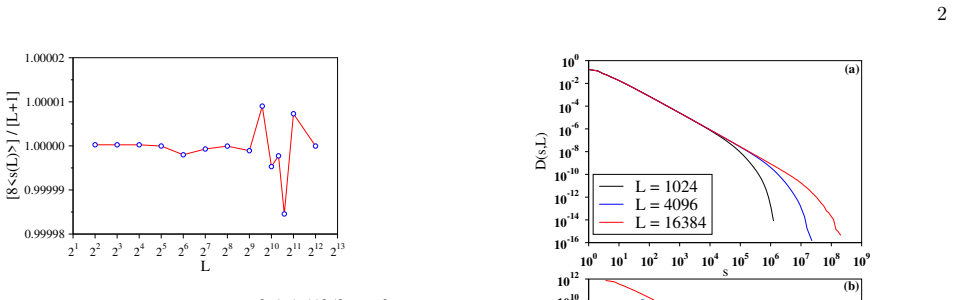
The central mechanism is the color-axis locking rule: a grain of color $\kappa$ is permanently assigned the unit lattice step $\hat{e}_\kappa$, and a toppling removes the bottom $n_c$ grains of an unstable column and sends each one step along its own axis, using a first-in-first-out sequence within the column. This makes toppling order relevant because a site receiving grains from two unstable neighbors inherits a color sequence that depends on which neighbor topples first; hence the dynamics is non-abelian. The exact result $\langle s(L)\rangle=(L+1)/8$ follows from the current identity $j_\kappa(x+\hat{e}_\kappa,y)=j_\kappa(x,y)+1/L^2$, which integrates to a linear per-color current profil
What would settle it
Run the colored sandpile on an $L=4096$ square lattice under a fixed deterministic toppling order, for example always toppling the lowest-index unstable site first, and measure $D(s,L)$. If the same collapse with $\beta=3$, $\alpha=2$, and $\tau\approx1.5$ does not reproduce, or if $\langle s(L)\rangle$ deviates from $(L+1)/8$ in the stationary state, the claim that this is a well-defined universality class independent of update details fails.
Extended reading notes
Core claim
The central claim is that making sand particles distinguishable by color and locking each color's motion to one lattice axis changes the universality class of self-organized criticality. For the square lattice with four colors and threshold $n_c=4$, an avalanche spreads isotropically even though each grain moves along a straight line, because the colors are uniformly mixed. The average avalanche size is derived from a conserved-current argument as $\langle s(L)\rangle=(L+1)/8$ and confirmed numerically to within $0.00002$. The size distribution satisfies the scaling form $D(s,L)L^3 \sim G(s/L^2)$, giving $D(s)\sim s^{-3/2}$; the lifetime distribution satisfies $D(T,L)L^{1.84} \sim G(T/L)$, g
Load-bearing premise
The critical exponents are estimated from finite-size scaling collapses of one update protocol, random-order synchronous toppling, with collapses judged by eye; if a different toppling order changes the stationary state or the scaling, the claimed distinct universality class with $\tau=1.5$ and $\tau_T=1.84$ is not established.
Editorial extensions
If this is right
- If the two-dimensional exponents $\beta=3$, $\alpha=2$, $\tau=3/2$ hold in the infinite-size limit, the colored sandpile constitutes a new universality class of self-organized criticality.
- The exact relation $\langle s(L)\rangle=(L+1)/8$ is established for the stationary state and provides a quantitative benchmark against which any future theory of this model can be tested.
- Because toppling order changes color sequences at receiving sites, the update rule is part of the model's definition; different update rules may produce different stationary states or avalanche statistics.
- The linear per-color density gradient and the non-uniform total density profile imply a color-segregation mechanism in the steady state, which may be relevant to granular heaps of mixed grains.
Reading between the lines
- The non-abelian property means the fixed synchronous update order is not neutral: a deterministic sequential update, such as always toppling the lowest-index unstable site first, could change the stationary color mixture and possibly the exponents. Comparing protocols would separate robust universality from rule-dependent behavior.
- The per-color current identity $j_\kappa(x+\hat{e}_\kappa,y)=j_\kappa(x,y)+1/L^2$ holds for any stationary state, so the exact linear current profile and $\langle s(L)\rangle=(L+1)/8$ should survive alternative updates; the fragile statements are the scaling exponents, not the mean.
- The color-axis locking makes each grain perform straight-line motion, reminiscent of ballistic or directed-walk dynamics. The model may connect to directed percolation or to multi-species branching processes, yielding analytic predictions for $\tau=3/2$ that the paper does not attempt.
- In a real granular heap, color could stand for grain size, shape, or friction coefficient. The predicted density gradients near boundaries suggest measurable segregation in mixtures with direction-biased motion, an experimental extension the paper does not develop.
Editorial analysis
A structured set of objections, weighed in public.
Referee Report
Summary. This paper introduces a 'colored sandpile' on the square lattice in which each grain has one of four colors fixing its direction of motion along a lattice axis. Topplings transfer n_c grains from the bottom of an unstable column to neighboring sites according to their color. The model is explicitly non-abelian. The author derives and numerically verifies the exact stationary mean avalanche size ⟨s(L)⟩=(L+1)/8 (Eq. 1), measures avalanche-size and lifetime distributions for system sizes up to L=16384, and claims a new universality class with exponents τ=1.5 and τ_T=1.84 in two dimensions. One-dimensional and flush-all variants, steady-state density profiles, and density finite-size corrections are also reported.
Significance. If the exponent claims are robust, the model is a genuinely new non-abelian sandpile universality class with a nontrivial steady-state structure. The paper has a notable strength: the exact mean avalanche size follows from a simple conservation/current argument and is verified numerically over a wide range of L (Fig. 2). The explicit identification of the order-dependence of the stable state is also useful. However, the universality-class claim rests on scaling collapses that are judged visually, and the avalanche dynamics are not fully specified because of the non-abelian update issue. The significance is therefore conditional on a more rigorous definition and quantitative collapse analysis.
major comments (2)
- [Definition of the model; Fig. 3; Supp03] The model is non-abelian (the paragraph beginning 'Since the sand particles are colored...' says so explicitly), so avalanche statistics are not well defined until the order in which unstable sites are updated is specified. The main text never states the update rule used to measure D(s,L) in Fig. 3(a,b). The only protocol statement, in Supp03, concerns lifetimes and says unstable sites are 'ordered in a random sequence and then simultaneously toppled', which is ambiguous and is not stated to apply to the size data. Different schedules (random-sequential, FIFO, LIFO, parallel with a random permutation) can produce different stationary color configurations and different avalanche histories. The exact result Eq. (1) is schedule-independent and cannot be used to fix the exponents. Please give a complete algorithmic specification for every simulation and show that the reported τ and τ_T are s
- [Fig. 3(a,b); Supp04] The finite-size scaling collapses are assessed visually from three system sizes (L=1024, 4096, 16384 for sizes and a similar set for lifetimes). No error bars, no quantitative collapse criterion, and no range of α, β consistent with the data are provided. The statement that τ_T=2 is 'ruled out' is based on a visual comparison. Since the claim of a new universality class rests entirely on these collapses, the paper needs a quantitative analysis (e.g., moments, a collapse error functional, or a goodness-of-fit test) and a statement of statistical uncertainty.
minor comments (5)
- [Eq. (1)] The derivation of Eq. (1) is compressed to one sentence. A formal potential/current argument (each toppling moves n_c grains one step; in stationarity the average total distance traveled equals the average distance to exit) would make the exact result fully transparent.
- [Supplements] The paper repeatedly refers to Supp01–Supp08. If these are separate files, they were not part of the manuscript under review; at minimum the algorithmic details in Supp03 and the collapse analysis in Supp04 need to be in the main text or included in the submission.
- [Table I] The text says the f_k values are 'extrapolated using Eqn. 1'; this should be Eqn. (5). The hand-tuned 1/ν values in Table I have no uncertainties or fitting criterion; if these are descriptive fits, say so.
- [Fig. 5(b)] The text says ρ1(x,L) is plotted against x, but the axis label is x/L. Please clarify. For L=128 and 256 to overlap, the abscissa must be x/L.
- [Flush-all version; Supp08] The flush-all version has two different scaling branches (flat small-s region scaled with β=1.105, α=1 and large-s region with β=2.55, α=1.7). Please state whether this is a crossover and define the crossover scale, otherwise the effective τ=1.5 for large sizes is not fully characterized.
Circularity Check
No significant circularity: the exact mean avalanche size follows from a parameter-free conservation argument, and the reported exponents are numerical fits, not predictions derived from the same fitted inputs.
full rationale
The paper's only exact claim, Eq. (1), ⟨s(L)⟩=(L+1)/8, is obtained by a simple counting/potential argument: a dropped particle travels on average (L+1)/2 steps to the boundary, and each toppling moves nc=4 particles one step, so the average number of topplings per added particle is (L+1)/8. This is independent of the non-abelian update order and of any fitted parameter, so it is not circular. The exponents β=3, α=2, τ=1.5 and the lifetime exponents are estimated from finite-size scaling collapses of simulated data; the paper explicitly says 'we have estimated these by simulations' and does not present them as theoretical predictions derived from the same fits. Self-citations (refs 6, 10, 14, 17, 19) are contextual background on sandpile variants and BTW avalanche morphology, not load-bearing premises for the new results. The concern that the non-abelian update protocol is under-specified for the avalanche-size measurements is a reproducibility and statistical-validity issue, not circularity: the exact mean-size result is protocol-independent, and the scaling exponents are fits rather than outputs of a derivation that assumes them. No step in the paper's derivation chain reduces to its own input by construction.
Assumptions & free parameters
free parameters (5)
- 2D avalanche size collapse exponents β=3, α=2 =
β=3, α=2, yielding τ=1.5
- 2D lifetime collapse exponents β_T=1.84, α_T=1 =
τ_T=1.84
- density finite-size exponent 1/ν =
0.503 (nc=2), 0.261 (nc=3), 1.767 (nc=4), 1.036 (nc=5)
- mean lifetime growth exponent =
0.1474
- flush-all avalanche exponents β=2.55, α=1.7 =
τ=1.5
assumptions (4)
- domain assumption A unique stationary state exists for the non-abelian colored sandpile under the specified random-order synchronous update rule.
- domain assumption The finite-size scaling ansatz D(s,L)L^β = G(s/L^α) with G(x) ~ x^{-τ} holds in the asymptotic limit.
- domain assumption Average distance from a uniformly random site to the assigned exit boundary is (L+1)/2, and every particle moves monotonically along its color axis until it leaves.
- domain assumption The measured exponents are independent of the update protocol (random synchronous ordering).
Cite this review
Pith. "Pith review of Colored Sandpile." pith.science (2026). https://pith.science/paper/2ZNBMVGH
@misc{pith2026250810403,
  author       = {Pith},
  title        = {Pith review of: Colored Sandpile},
  year         = {2026},
  howpublished = {\url{https://pith.science/paper/2ZNBMVGH}},
  note         = {Machine review of arXiv:2508.10403}
}
read the original abstract
After the introduction of sandpile model a number of different variants have been studied. In most of these models sand particles are indistinguishable. Here we have painted the sand particles using a few distinct colors, and restrict them to move in linear trajectories only along their assigned lattice axes, one axis reserved for one color. Different colored particles interact among themselves through the toppling of unstable sand columns. Consequently, the avalanches or in general the self-organization processes in the sandpile has no overall preferred direction, though the individual particles execute directed motion. For such non-abelian colored sandpiles the steady states are found to be different and also the avalanche size distributions. This sandpile so defined has a non-trivial spatial structure and belongs to a different universality class of sandpile models. Dynamics of a granular heap with grains of different colors and properties may be described using this sandpile.
Figures


Figures from the paper (2 more)


Reference graph
Works this paper leans on
-
[1]
P. Bak, C. Tang and K. Wiesenfeld, Self- organized criticality: An explanation of 1 /f noise, Phys. Rev. Lett., 59, 381 (1987), https://doi.org/10.1103/PhysRevLett.59.381
-
[2]
S. S. Manna, Two-state model of self-organized crit- icality, J. Phys. A: Math. Gen., 24 , L363 (1991), DOI:10.1088/0305-4470/24/7/009
-
[3]
Dhar, Self-Organized Critical State of Sandpile Au- tomation Models, Phys
D. Dhar, Self-Organized Critical State of Sandpile Au- tomation Models, Phys. Rev. Lett. 64, 2837 (1990), https://doi.org/10.1103/PhysRevLett.64.1613
-
[4]
C. Tang and P. Bak, Critical Exponents and Scaling Relations for Self-Organized Critical Phe- nomena, Phys. Rev. Lett. 60, 2347 (1988), https://doi.org/10.1103/PhysRevLett.60.2347
-
[5]
R. Dickman, A. Vespignani, and S. Zapperi, Self-organized criticality as an absorbing-state phase transition, Phys. Rev. E 57, 5095 (1998), https://doi.org/10.1103/PhysRevE.57.5095
-
[6]
S. S. Manna, Describing self-organized criticality as a continuous phase transition, Phys. Rev. E 111, 024111 (2025), DOI: 10.1103/PhysRevE.111.024111
-
[7]
A. Fey, L. Levine, and D. B. Wilson, Driving Sandpiles to Criticality and Be- yond, Phys. Rev. Lett. 104, 145703 (2010), DOI:https://doi.org/10.1103/PhysRevLett.104.145703
-
[8]
D. Dhar, Some results and a conjecture for Manna’s 6 stochastic sandpile model, Physica A 270, 69 (1999), https://doi.org/10.1016/S0378-4371(99)00149-1
Show all 21 references
-
[9]
H. N. Huynh, G. Pruessner, and L. Y. Chew, The Abelian Manna model on various lattices in one and two dimen- sions, J. Stat. Mech., P09024 (2011), DOI 10.1088/1742- 5468/2011/09/P09024
2011 doi
-
[10]
S. S. Manna, Nonstationary but quasisteady states in self-organized Criticality, Phys. Rev. E. 107, 044113 (2023), https://doi.org/10.1103/PhysRevE.107.044113
2023 doi
-
[11]
Dhar, The Abelian sandpile and related models, Physica A 263, 4 (1999), https://doi.org/10.1016/S0378- 4371(98)00493-2
D. Dhar, The Abelian sandpile and related models, Physica A 263, 4 (1999), https://doi.org/10.1016/S0378- 4371(98)00493-2
1999 doi
-
[12]
N. W. Watkins, G. Pruessner, S. C. Chapman, N. B. Crosby, and H. J. Jensen, 25 Years of Self-organized Crit- icality: Concepts and Controversies, Space Sci Rev, 198, 3 (2016), https://doi.org/10.1007/s11214-015-0155-x
2016 doi
-
[13]
K. J. Wiese, Theory and experiments for disor- dered elastic manifolds, depinning, avalanches, and sandpiles, Rep. Prog. Phys. 85, 086502 (2022), https://doi.org/10.1088/1361-6633/ac4648
2022 doi
-
[14]
S. S. Manna, A. L. Stella, P. Grassberger, and R. Dick- man, Self-organized Criticality, Three Decades Later, Frontiers in Physics, 2022, DOI 10.3389/978-2-88974- 219-6
2022 doi
-
[15]
F. C. Alcaraz, P. Pyatov, and V. Rittenberg, Two- component Abelian sandpile models, Phys. Rev. E, 79, 042102 (2009); 10.1103/PhysRevE.79.042102
2009 doi
- [16]
-
[17]
Karmakar and S
R. Karmakar and S. S. Manna, Particle–hole symme- try in a sandpile model J. Stat. Mech. (2005) L01002; 10.1088/1742-5468/2005/01/L01002
2005 doi
-
[18]
Candellero, S
E. Candellero, S. Ganguly, C. Hoffman, L. Levine, Oil and water: A two-type internal aggregation model, Ann. Probab. 45, 4019 (2017); 10.1214/16-AOP1157
2017 doi
-
[19]
Grassberger and S
P. Grassberger and S. S. Manna, Some more sand- piles, J. Phys. France 51, 1077 (1990), DOI: 10.1051/jphys:0199000510110107700
1990 doi
-
[20]
Dhar and R
D. Dhar and R. Ramaswamy, Exactly solved model of self-organized critical phe- nomena, Phys. Rev. Lett. 63, 1659 (1989); https://doi.org/10.1103/PhysRevLett.63.1659
1989 doi
-
[21]
Paczuski and K
M. Paczuski and K. E. Bassler, Theoretical results for sandpile models of self-organized criticality with multiple topplings, Phys. Rev. E. 62, 5347 (2000); doi.org/10.1103/PhysRevE.62.5347
2000 doi
Reviewed August 5, 2026 · model on record in the stance chip above.
Discussion (0). Continue with ORCID to comment.