REVIEW 3 major objections 4 minor 49 references
Efficient Methods for Accurate Sparse Trajectory Recovery and Map Matching
T0 review · 3 major / 4 minor · reviewed 2026-08-05 · deepseek-v4-flash
Pith's one-line read Sparse GPS trajectories and their road-network routes can be recovered far more accurately and orders of magnitude faster by restricting every prediction to a small candidate set of nearby road segments.
desk verdict Solid engineering with a real efficiency story, but the headline accuracy claim leans on FMM-built ground truth—so the absolute numbers are weaker than the paper lets on. read the letter →
The pith
A machine-rendered reading of the paper's core claim, the machinery that carries it, and where it could break.
The reading
What carries the argument
The load-bearing idea is the candidate segment set: each GPS point is offered only its $k_c$ nearest road segments ($k_c = 10$) as answers, turning network-scale map matching into per-point binary classification. Segment embeddings are initialized from pre-trained road-network embeddings and augmented with directional cosine similarities; a transformer over the GPS sequence supplies point context, refined by attention over the candidates. For recovery, the central mechanism is route-restricted decoding: only the matched route's segments are candidates, a recurrent decoder emits each missing point sequentially, and a classification-plus-regression pair predicts the segment (in route order) an
What would settle it
Build a test set whose true road positions are verified independently of any matcher — high-precision GPS, surveyed routes, or dashcam footage — and compare each method's recovered points and matched segments against those verified positions. If TRMMA and MMA no longer lead on accuracy, or lead by much less than they do against FMM-generated ground truth, the claimed dominance would be an artefact of the evaluation's chosen reference rather than a property of the methods.
Extended reading notes
Core claim
Map matching and trajectory recovery, the paper argues, belong to one pipeline that works best when predictions are restricted to the input's neighbourhood. It first shows empirically that a GPS point's true road segment is almost always among its ten nearest segments, so MMA classifies each point over those candidates, using learned embeddings for points, segments, and directions. TRMMA then recovers missing points only along the matched route: a recurrent decoder picks each missing point's segment among the route segments that follow the last recovered point and regresses its position ratio. On four large urban datasets, both methods achieve the best reported accuracy.
Load-bearing premise
The evaluation's ground truth is created by running one map-matching algorithm, FMM [28], on the dense high-sampling trajectories; every method's accuracy is then measured as distance to FMM's output, so the reported numbers establish agreement with FMM's alignments rather than independently verified road-network positions.
Editorial extensions
If this is right
- Data consumers such as navigation, travel-time estimation, and traffic-flow systems could take sparse GPS logs directly and produce dense, road-aligned trajectories at a fraction of the compute cost, because recovery cost scales with route length, not network size.
- The two-stage design gives the community a modular pipeline: MMA's candidate-set classifier can be improved or replaced without touching TRMMA's decoder, and vice versa.
- The route-order constraint in decoding — a missing point's segment cannot precede the previous point's segment along the route — is a reusable inductive bias for any route-constrained sequence prediction.
- Training-time reductions of roughly one to two orders of magnitude make learned recovery and map matching feasible on millions of trajectories without large GPU clusters.
- The results revive the previously doubted idea that map matching is a sound first stage for trajectory recovery, potentially reunifying two research lines that have developed separately.
Reading between the lines
- The candidate-set strategy should transfer to other network-constrained localization problems — cellular or Wi-Fi positioning, check-in sequences, or transit-card data — whenever the true network element is almost always among a few nearby candidates.
- Because every accuracy number is measured against one matcher's output, the decisive test for absolute quality is a benchmark with independently verified positions; until then, the reported margins are best read as agreement with the reference pipeline.
- An adaptive candidate radius would extend the method to high-noise settings (urban canyons, tunnels): instead of a fixed $k_c = 10$, the candidate-set size could be tuned per point from an estimated GPS error, keeping the speed advantage where noise is low.
- The route-restricted decoding idea could be lifted to other graph sequence-imputation tasks, such as completing partial sensor traces or reconstructing anonymized mobility paths on public-transit graphs.
Editorial analysis
A structured set of objections, weighed in public.
Referee Report
Summary. The paper proposes two related methods for improving low-sampling GPS trajectories on road networks: MMA, a classification-based map-matching method that selects among a small candidate segment set per GPS point, and TRMMA, a trajectory-recovery method that first invokes MMA to obtain a route and then uses a dual-transformer encoder with multitask decoding to insert missing map-matched points at the target sampling rate. The authors report experiments on four large real-world taxi/ride-sharing datasets, claiming that TRMMA and MMA consistently outperform existing trajectory-recovery and map-matching baselines in accuracy, and are orders of magnitude faster in training and inference. The paper includes ablation studies, sparsity-sensitivity analyses, and an implementation link.
Significance. If the empirical claims are reliable, this is a practically valuable contribution: it jointly addresses map matching and trajectory recovery, restricts per-point classification to a small candidate set, and confines recovery to the matched route, which is a sensible way to cut computational cost. The method is clearly described, the proposed architecture is technically reasonable, the code is made available, and the efficiency gains over strong baselines (e.g., RNTrajRec) are large and consistent across datasets. The central risk is not internal inconsistency; it is whether the evaluation ground truth, generated by the FMM baseline itself, is valid for establishing absolute accuracy. The paper would be strengthened substantially by independent ground-truth validation or by explicit reframing of the results as agreement with FMM-derived labels.
major comments (3)
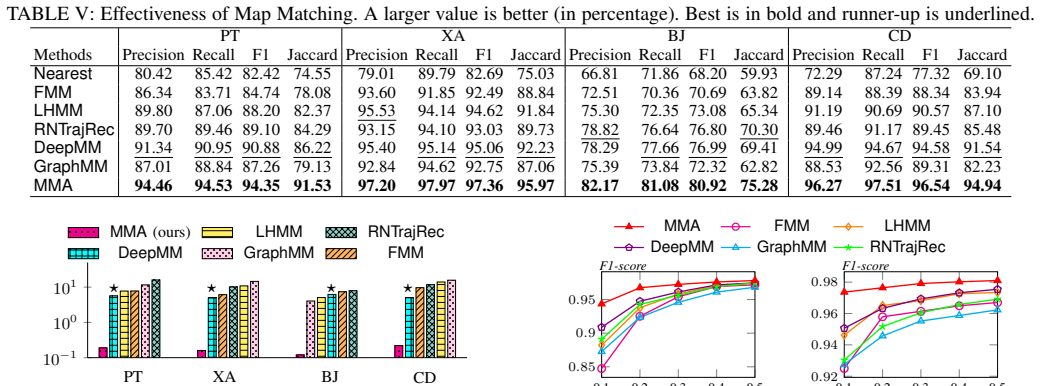
- [Section VI-A and Tables III/V] The ground truth for both trajectory recovery and map matching is generated by FMM [28]: 'we use map matching from [28] to align it with the road network, to get ground-truth route.' FMM is also a baseline in Table V, and all effectiveness metrics in Eq. (22), Table III, and Table V measure agreement with these FMM-derived segments. This means no method can receive credit for being correct where FMM is wrong, and a method can appear more accurate by reproducing FMM's biases. The relative ranking under a fixed label set is meaningful, but the headline claim of 'best result quality' as an absolute statement is under-supported. This is a load-bearing issue because the central empirical claim is accuracy. Please validate on independent ground truth (e.g., manually labeled segments, simulated trajectories with known true routes, or high-accuracy GPS/GNSS references), or at minimum report the
- [Section VI-A, Tables III and V] All effectiveness tables report single-run values with no error bars, confidence intervals, or repeated-seed/spilt statistics. Section VI-A describes one random 40/30/30 split. Some claimed improvements are modest—for example, on PT in Table III, TRMMA's recall is 80.92 vs. 79.52 for RNTrajRec; on BJ in Table V, MMA's precision is 82.17 vs. 78.29 for DeepMM, but this column may actually correspond to recall (see next comment). Without variance estimates or paired significance tests, the robustness and statistical significance of the stated margins cannot be assessed, especially for the smaller improvements. Please provide repeated runs across seeds/data splits, or at least standard deviations and significance tests for the key comparisons.
- [Section VI-A (effectiveness metrics)] The definitions of Recall and Precision appear swapped. The manuscript defines Recall(S, \hat S) = |S \cap \hat S| / |S| and Precision(S, \hat S) = |S \cap \hat S| / |\hat S|. With S as the predicted segments and \hat S as ground truth, standard precision should be |S \cap \hat S| / |S| and standard recall should be |S \cap \hat S| / |\hat S|. As written, the 'Recall' column reports what is normally precision and the 'Precision' column reports what is normally recall. This affects the interpretation of the precision/recall columns in Tables III and V, although F1 and Jaccard are unaffected. Please correct the formulas or the labels.
minor comments (4)
- [Eq. (22)] The metric d(ai, \hat ai) is referred to as 'road network distance' but never formally defined. Specify whether this is shortest-path distance along the road network or Euclidean distance, since this materially affects the MAE/RMSE values.
- [Table II] Typo: 'rea (km2)' should be 'Area (km2)'.
- [Eq. (7)] The summation notation 'Pkc' should be written as a proper sum, e.g., \sum_{k=1}^{k_c}.
- [Section IV-A] Minor typo in text: 'also server as the context' should be 'also serve as the context'.
Circularity Check
No significant circularity; core derivation is self-contained and evaluation concerns are benchmark-validity issues, not circular steps.
full rationale
The paper's central derivation chain is not circular. MMA defines a supervised classification over a candidate segment set (Section IV-A, Definition 8, Eq. 1-10), and TRMMA builds on MMA's route with dual-transformer encoding and multitask decoding (Section V, Eq. 11-21). The predicted outputs—segment choices and position ratios—are not identical by construction to any fitted input or to the labels used for training; the losses in Eq. 10 and Eq. 21 are standard supervised objectives, not tautologies. The use of the authors' prior route-planning method [2] as a subroutine (Line 12 of Algorithm 1 and Section VI-A) is auxiliary and is applied uniformly to all methods requiring route planning, so it does not make the central claim reduce to a self-citation. The only substantive concern is the experimental ground truth: Section VI-A states that FMM [28] is used to generate the ground-truth route and map-matched points, and FMM also appears as a baseline in Table V. This means the reported accuracy measures agreement with FMM-derived labels, so absolute quality claims are only as strong as FMM's correctness. That is a benchmark-validity or correctness-risk issue, not a circular derivation: the paper's methods are not defined in terms of FMM's output, and no equation-level reduction (Eq. X = Eq. Y by construction) is present. Consistent with the requirement to reserve circularity findings for exhibited reductions, the score is 0.
Assumptions & free parameters
free parameters (3)
- candidate set size kc =
10
- loss trade-off lambda =
not reported
- architecture hyperparameters =
d0=64, d1=128, d2=64, d3=256, dh=64, 2/4 layers, 4 heads, lr=1e-3, batch=512
assumptions (3)
- domain assumption The true road segment of a GPS point is among the kc=10 nearest segments by perpendicular distance.
- domain assumption Ground-truth routes and map-matched points are correctly produced by FMM map matching [28] on dense trajectories.
- standard math Road networks and trajectories are modeled as a directed graph and timestamped GPS coordinates with min-max normalization.
Cite this review
Pith. "Pith review of Efficient Methods for Accurate Sparse Trajectory Recovery and Map Matching." pith.science (2026). https://pith.science/paper/5EZQVBRC
@misc{pith2026250810460,
  author       = {Pith},
  title        = {Pith review of: Efficient Methods for Accurate Sparse Trajectory Recovery and Map Matching},
  year         = {2026},
  howpublished = {\url{https://pith.science/paper/5EZQVBRC}},
  note         = {Machine review of arXiv:2508.10460}
}
read the original abstract
Real-world trajectories are often sparse with low-sampling rates (i.e., long intervals between consecutive GPS points) and misaligned with road networks, yet many applications demand high-quality data for optimal performance. To improve data quality with sparse trajectories as input, we systematically study two related research problems: trajectory recovery on road network, which aims to infer missing points to recover high-sampling trajectories, and map matching, which aims to map GPS points to road segments to determine underlying routes. In this paper, we present efficient methods TRMMA and MMA for accurate trajectory recovery and map matching, respectively, where MMA serves as the first step of TRMMA. In MMA, we carefully formulate a classification task to map a GPS point from sparse trajectories to a road segment over a small candidate segment set, rather than the entire road network. We develop techniques in MMA to generate effective embeddings that capture the patterns of GPS data, directional information, and road segments, to accurately align sparse trajectories to routes. For trajectory recovery, TRMMA focuses on the segments in the route returned by MMA to infer missing points with position ratios on road segments, producing high-sampling trajectories efficiently by avoiding evaluation of all road segments. Specifically, in TRMMA, we design a dual-transformer encoding process to cohesively capture latent patterns in trajectories and routes, and an effective decoding technique to sequentially predict the position ratios and road segments of missing points. We conduct extensive experiments to compare TRMMA and MMA with numerous existing methods for trajectory recovery and map matching, respectively, on 4 large real-world datasets. TRMMA and MMA consistently achieve the best result quality, often by a significant margin.
Figures


Figures from the paper (6 more)



Reference graph
Works this paper leans on
-
[28]
Fast map matching, an algorithm integrating hidden markov model with precomputation,
C. Yang and G. Gid ´ofalvi, “Fast map matching, an algorithm integrating hidden markov model with precomputation,” Int. J. Geogr. Inf. Sci. , vol. 32, no. 3, pp. 547–570, 2018
work page 2018
-
[1]
Neuromlr: Robust & reliable route recommendation on road networks,
J. Jain, V . Bagadia, S. Manchanda, and S. Ranu, “Neuromlr: Robust & reliable route recommendation on road networks,” in NeurIPS, 2021, pp. 22 070–22 082
work page 2021
-
[2]
Effective and efficient route planning using historical trajectories on road networks,
W. Tian, J. Shi, S. Luo, H. Li, X. Xie, and Y . Zou, “Effective and efficient route planning using historical trajectories on road networks,” PVLDB, vol. 16, no. 10, pp. 2512–2524, 2023
work page 2023
-
[3]
Effective travel time estimation: When historical trajectories over road networks matter,
H. Yuan, G. Li, Z. Bao, and L. Feng, “Effective travel time estimation: When historical trajectories over road networks matter,” in SIGMOD, 2020, pp. 2135–2149
work page 2020
-
[4]
H. Yuan, G. Li, and Z. Bao, “Route travel time estimation on A road network revisited: Heterogeneity, proximity, periodicity and dynamicity,” PVLDB, vol. 16, no. 3, pp. 393–405, 2022
work page 2022
-
[5]
VRE: A versatile, robust, and economical trajectory data system,
H. Lan, J. Xie, Z. Bao, F. Li, W. Tian, F. Wang, S. Wang, and A. Zhang, “VRE: A versatile, robust, and economical trajectory data system,” PVLDB, vol. 15, no. 12, pp. 3398–3410, 2022
work page 2022
-
[6]
Z. Fang, S. Gong, L. Chen, J. Xu, Y . Gao, and C. S. Jensen, “Ghost: A general framework for high-performance online similarity queries over distributed trajectory streams,” SIGMOD, vol. 1, no. 2, pp. 173:1– 173:25, 2023
work page 2023
-
[7]
Efficient non-learning similar subtrajectory search,
J. Jin, P. Cheng, L. Chen, X. Lin, and W. Zhang, “Efficient non-learning similar subtrajectory search,” PVLDB, vol. 16, no. 11, pp. 3111–3123, 2023
work page 2023
Show all 49 references
-
[8]
MDTP: A multi-source deep traffic prediction framework over spatio-temporal trajectory data,
Z. Fang, L. Pan, L. Chen, Y . Du, and Y . Gao, “MDTP: A multi-source deep traffic prediction framework over spatio-temporal trajectory data,” PVLDB, vol. 14, no. 8, pp. 1289–1297, 2021
2021
-
[9]
Nuhuo: An effective estimation model for traffic speed histogram imputation on A road network,
H. Yuan, G. Cong, and G. Li, “Nuhuo: An effective estimation model for traffic speed histogram imputation on A road network,” PVLDB, vol. 17, no. 7, pp. 1605–1617, 2024
2024
-
[10]
Rntrajrec: Road network enhanced trajectory recovery with spatial-temporal transformer,
Y . Chen, H. Zhang, W. Sun, and B. Zheng, “Rntrajrec: Road network enhanced trajectory recovery with spatial-temporal transformer,” in ICDE, 2023, pp. 829–842
2023
-
[11]
LHMM: A learning enhanced HMM model for cellular trajectory map matching,
W. Shi, J. Xu, J. Fang, P. Chao, A. Liu, and X. Zhou, “LHMM: A learning enhanced HMM model for cellular trajectory map matching,” in ICDE, 2023, pp. 2429–2442
2023
-
[12]
An interactive-voting based map matching algorithm,
J. Yuan, Y . Zheng, C. Zhang, X. Xie, and G. Sun, “An interactive-voting based map matching algorithm,” in MDM, 2010, pp. 43–52
2010
-
[13]
Graphmm: Graph-based vehicular map matching by leveraging trajectory and road correlations,
Y . Liu, Q. Ge, W. Luo, Q. Huang, L. Zou, H. Wang, X. Li, and C. Liu, “Graphmm: Graph-based vehicular map matching by leveraging trajectory and road correlations,” IEEE Trans. Knowl. Data Eng., vol. 36, no. 1, pp. 184–198, 2024
2024
-
[14]
Mtrajrec: Map-constrained trajectory recovery via seq2seq multi-task learning,
H. Ren, S. Ruan, Y . Li, J. Bao, C. Meng, R. Li, and Y . Zheng, “Mtrajrec: Map-constrained trajectory recovery via seq2seq multi-task learning,” in KDD, 2021, pp. 1410–1419
2021
-
[15]
Graph-constrained diffusion for end-to-end path planning,
D. Shi, Y . Tong, Z. Zhou, K. Xu, Z. Wang, and J. Ye, “Graph-constrained diffusion for end-to-end path planning,” in ICLR, 2024
2024
-
[16]
A statistical approach to map matching using road network geometry, topology and vehicular motion constraints,
O. Pink and B. Hummel, “A statistical approach to map matching using road network geometry, topology and vehicular motion constraints,” in ITSC, 2008, pp. 862–867
2008
-
[17]
Hidden markov map matching through noise and sparseness,
P. Newson and J. Krumm, “Hidden markov map matching through noise and sparseness,” in SIGSPATIAL, 2009, pp. 336–343
2009
-
[18]
Dmm: A deep reinforcement learning based map matching framework for cellular data,
Z. Shen, K. Yang, X. Zhao, J. Zou, W. Du, and J. Wu, “Dmm: A deep reinforcement learning based map matching framework for cellular data,” IEEE Trans. Knowl. Data Eng. , vol. 36, no. 10, pp. 5120–5137, 2024
2024
-
[19]
Micro-macro spatial-temporal graph-based encoder-decoder for map-constrained tra- jectory recovery,
T. Wei, Y . Lin, Y . Lin, S. Guo, L. Zhang, and H. Wan, “Micro-macro spatial-temporal graph-based encoder-decoder for map-constrained tra- jectory recovery,” IEEE Trans. Knowl. Data Eng. , vol. 36, no. 11, pp. 6574–6587, 2024
2024
-
[20]
Deep trajectory recovery with fine-grained calibration using kalman filter,
J. Wang, N. Wu, X. Lu, W. X. Zhao, and K. Feng, “Deep trajectory recovery with fine-grained calibration using kalman filter,” IEEE Trans. Knowl. Data Eng. , vol. 33, no. 3, pp. 921–934, 2021
2021
-
[21]
TERI: an effective framework for trajectory recovery with irregular time intervals,
Y . Chen, G. Cong, and C. Anda, “TERI: an effective framework for trajectory recovery with irregular time intervals,” PVLDB, vol. 17, no. 3, pp. 414–426, 2023
2023
-
[22]
A demonstration of KAMEL: A scalable bert-based system for trajectory imputation,
M. Musleh and M. F. Mokbel, “A demonstration of KAMEL: A scalable bert-based system for trajectory imputation,” in SIGMOD, 2023, pp. 191–194
2023
-
[23]
Network-less trajectory imputation,
M. M. Elshrif, K. Isufaj, and M. F. Mokbel, “Network-less trajectory imputation,” in SIGSPATIAL, 2022, pp. 8:1–8:10
2022
-
[24]
Attnmove: History enhanced trajectory recovery via attentional network,
T. Xia, Y . Qi, J. Feng, F. Xu, F. Sun, D. Guo, and Y . Li, “Attnmove: History enhanced trajectory recovery via attentional network,” in AAAI, 2021, pp. 4494–4502
2021
-
[25]
Periodic- move: Shift-aware human mobility recovery with graph neural network,
H. Sun, C. Yang, L. Deng, F. Zhou, F. Huang, and K. Zheng, “Periodic- move: Shift-aware human mobility recovery with graph neural network,” in CIKM, 2021, pp. 1734–1743
2021
-
[26]
Modelling of bi- directional spatio-temporal dependence and users’ dynamic preferences for missing POI check-in identification,
D. Xi, F. Zhuang, Y . Liu, J. Gu, H. Xiong, and Q. He, “Modelling of bi- directional spatio-temporal dependence and users’ dynamic preferences for missing POI check-in identification,” in AAAI, 2019, pp. 5458–5465
2019
-
[27]
Map- matching for low-sampling-rate GPS trajectories,
Y . Lou, C. Zhang, Y . Zheng, X. Xie, W. Wang, and Y . Huang, “Map- matching for low-sampling-rate GPS trajectories,” inSIGSPATIAL, 2009, pp. 352–361
2009
-
[29]
Reducing uncertainty of low-sampling-rate trajectories,
K. Zheng, Y . Zheng, X. Xie, and X. Zhou, “Reducing uncertainty of low-sampling-rate trajectories,” in ICDE, 2012, pp. 1144–1155
2012
-
[30]
Inferring uncertain trajectories from partial observations,
P. Banerjee, S. Ranu, and S. Raghavan, “Inferring uncertain trajectories from partial observations,” in ICDM, 2014, pp. 30–39
2014
-
[31]
Antmapper: An ant colony-based map matching approach for trajectory-based applica- tions,
Y . Gong, E. Chen, X. Zhang, L. M. Ni, and J. Zhang, “Antmapper: An ant colony-based map matching approach for trajectory-based applica- tions,” IEEE Trans. Intell. Transp. Syst. , vol. 19, no. 2, pp. 390–401, 2018
2018
-
[32]
Deepmm: Deep learning based map matching with data augmentation,
J. Feng, Y . Li, K. Zhao, Z. Xu, T. Xia, J. Zhang, and D. Jin, “Deepmm: Deep learning based map matching with data augmentation,” IEEE Trans. Mob. Comput., vol. 21, no. 7, pp. 2372–2384, 2022
2022
-
[33]
L2MM: learning to map matching with deep models for low-quality GPS trajectory data,
L. Jiang, C. Chen, and C. Chen, “L2MM: learning to map matching with deep models for low-quality GPS trajectory data,” ACM Trans. Knowl. Discov. Data, vol. 17, no. 3, pp. 39:1–39:25, 2023
2023
-
[34]
Deep representation learning for trajectory similarity computation,
X. Li, K. Zhao, G. Cong, C. S. Jensen, and W. Wei, “Deep representation learning for trajectory similarity computation,” in ICDE, 2018, pp. 617– 628
2018
-
[35]
Computing trajectory similarity in linear time: A generic seed-guided neural metric learning approach,
D. Yao, G. Cong, C. Zhang, and J. Bi, “Computing trajectory similarity in linear time: A generic seed-guided neural metric learning approach,” in ICDE, 2019, pp. 1358–1369
2019
-
[36]
T3S: effective representation learning for trajectory similarity computation,
P. Yang, H. Wang, Y . Zhang, L. Qin, W. Zhang, and X. Lin, “T3S: effective representation learning for trajectory similarity computation,” in ICDE, 2021, pp. 2183–2188
2021
-
[37]
Trajgat: A graph- based long-term dependency modeling approach for trajectory similarity computation,
D. Yao, H. Hu, L. Du, G. Cong, S. Han, and J. Bi, “Trajgat: A graph- based long-term dependency modeling approach for trajectory similarity computation,” in KDD, 2022, pp. 2275–2285
2022
-
[38]
Contrastive trajectory similarity learning with dual-feature attention,
Y . Chang, J. Qi, Y . Liang, and E. Tanin, “Contrastive trajectory similarity learning with dual-feature attention,” in ICDE, 2023, pp. 2933–2945
2023
-
[39]
Spatio-temporal trajectory similarity learning in road networks,
Z. Fang, Y . Du, X. Zhu, D. Hu, L. Chen, Y . Gao, and C. S. Jensen, “Spatio-temporal trajectory similarity learning in road networks,” in KDD, 2022, pp. 347–356
2022
-
[40]
A graph-based approach for trajectory similarity computation in spatial networks,
P. Han, J. Wang, D. Yao, S. Shang, and X. Zhang, “A graph-based approach for trajectory similarity computation in spatial networks,” in KDD, 2021, pp. 556–564
2021
-
[41]
An analysis of global positioning system standard positioning service performance for 2022,
B. A. Renfro, M. Stein, E. B. Reed, and A. Finn, “An analysis of global positioning system standard positioning service performance for 2022,” Space and Geophysics Laboratory Applied Research Laboratories, The University of Texas at Austin . [Online]. Available: https://www.gp...
2022
-
[42]
STR: A simple and efficient algorithm for r-tree packing,
S. T. Leutenegger, J. M. Edgington, and M. A. L ´opez, “STR: A simple and efficient algorithm for r-tree packing,” in ICDE, 1997, pp. 497–506
1997
-
[43]
node2vec: Scalable feature learning for networks,
A. Grover and J. Leskovec, “node2vec: Scalable feature learning for networks,” in KDD, 2016, pp. 855–864
2016
-
[44]
Deep sparse rectifier neural networks,
X. Glorot, A. Bordes, and Y . Bengio, “Deep sparse rectifier neural networks,” in AISTATS, 2011, pp. 315–323
2011
-
[45]
Attention is all you need,
A. Vaswani, N. Shazeer, N. Parmar, J. Uszkoreit, L. Jones, A. N. Gomez, L. Kaiser, and I. Polosukhin, “Attention is all you need,” in NIPS, 2017, pp. 5998–6008
2017
-
[46]
On the properties of neural machine translation: Encoder-decoder approaches,
K. Cho, B. van Merrienboer, D. Bahdanau, and Y . Bengio, “On the properties of neural machine translation: Encoder-decoder approaches,” in EMNLP, 2014, pp. 103–111
2014
-
[47]
Porto dataset,
“Porto dataset,” https://www.kaggle.com/c/ pkdd-15-predict-taxi-service-trajectory-i/data
-
[48]
DITA: distributed in-memory trajectory analytics,
Z. Shang, G. Li, and Z. Bao, “DITA: distributed in-memory trajectory analytics,” in SIGMOD, 2018, pp. 725–740
2018
-
[49]
Openstreetmap,
“Openstreetmap,” https://www.openstreetmap.org/
Reviewed August 5, 2026 · model on record in the stance chip above.
Discussion (0). Sign in to comment.