Exploring Quantum Annealing for Coarse-Grained Protein Folding
Pith reviewed 2026-05-18 23:00 UTC · model grok-4.3
The pith
Current quantum annealing hardware faces embedding challenges that restrict protein folding applications to proof-of-concept sizes, while exhibiting a scaling advantage over simulated annealing on embedded instances.
A machine-rendered reading of the paper's core claim, the machinery that carries it, and where it could break.
Core claim
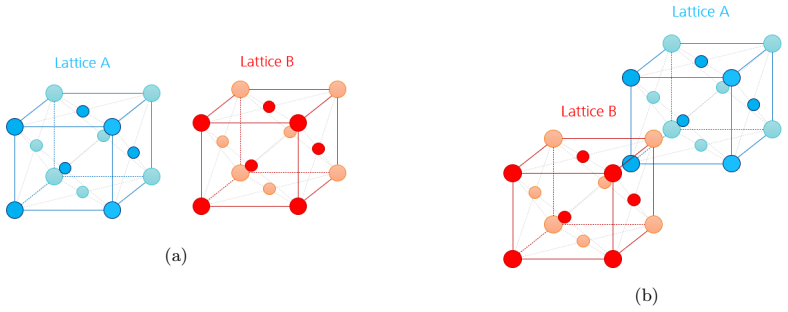
We compare several proposed ab initio protein folding models for quantum computers and introduce a novel encoding of coordinate based models on the tetrahedral lattice based on interleaved grids. Our findings reveal significant variations in model performance, with one model yielding unphysical configurations within the feasible solution space. We conclude that current quantum annealing hardware is not yet suited for tackling problems beyond a proof-of-concept size, primarily due to challenges in the embedding. Nonetheless, we observe a scaling advantage over our in-house simulated annealing implementation, which, however, is only noticeable when comparing performance on the embeddedproblems
What carries the argument
The novel encoding of coordinate-based models on the tetrahedral lattice using interleaved grids, which maps the protein folding problem into a form solvable by quantum annealing hardware.
Load-bearing premise
The scaling advantage observed only on embedded versions of the problems will persist or appear on the original unembedded protein-folding instances once hardware embedding capabilities improve.
What would settle it
Direct performance comparisons of quantum annealing and simulated annealing on the original unembedded protein folding instances using future hardware with lower embedding overhead would test whether the scaling advantage carries over.
Figures








read the original abstract
We explore the potential application of quantum annealing to address the protein structure problem. To this end, we compare several proposed ab initio protein folding models for quantum computers and analyze their scaling and performance for classical and quantum heuristics. Furthermore, we introduce a novel encoding of coordinate based models on the tetrahedral lattice, based on interleaved grids. Our findings reveal significant variations in model performance, with one model yielding unphysical configurations within the feasible solution space. Furthermore, we conclude that current quantum annealing hardware is not yet suited for tackling problems beyond a proof-of-concept size, primarily due to challenges in the embedding. Nonetheless, we observe a scaling advantage over our in-house simulated annealing implementation, which, however, is only noticeable when comparing performance on the embedded problems.
Editorial analysis
A structured set of objections, weighed in public.
Referee Report
Summary. The manuscript explores the application of quantum annealing to coarse-grained ab initio protein folding. It compares several proposed models, introduces a novel coordinate-based encoding on the tetrahedral lattice using interleaved grids, evaluates scaling and performance against classical heuristics including an in-house simulated annealing baseline, reports variations across models (including unphysical configurations in one case), and concludes that current QA hardware is limited to proof-of-concept sizes due to embedding overhead while observing a scaling advantage over SA that is noticeable only on the embedded problem instances.
Significance. If the comparative analysis and novel encoding hold up under scrutiny, the work usefully maps practical challenges of embedding protein-folding QUBOs onto current annealers and documents model-dependent solution quality. The explicit qualification that the scaling advantage appears only on embedded instances is a strength in transparency; extending this to falsifiable predictions about native instances would increase impact for the quantum optimization community.
major comments (2)
- [Abstract and Discussion] Abstract and Discussion: The headline observation of a scaling advantage is restricted to performance on embedded QUBO instances. Because embedding increases variable count and alters connectivity (and therefore changes the effective energy landscape relative to the original coordinate-based formulation), the manuscript should provide a direct comparison of solution quality or scaling between quantum runs on the embedded graph and a classical solver applied to the identical unembedded QUBO; without this, the claim that the advantage will persist or improve once embedding overhead decreases remains an untested extrapolation.
- [Model performance analysis] Model performance analysis: The attribution of unphysical configurations in one model to the encoding (rather than an artifact of the annealing schedule or hardware noise) is stated but not supported by an explicit control experiment, such as running the same unembedded formulation with the in-house SA baseline or a classical exact solver; this distinction is load-bearing for the conclusion that the issue is encoding-specific.
minor comments (2)
- [Methods] Clarify the precise definition and parameter settings of the in-house simulated annealing baseline so that the embedded-problem comparison can be reproduced.
- [Results] Add a short table or paragraph summarizing the variable count and embedding chain length growth for each model as a function of protein chain length.
Simulated Author's Rebuttal
We thank the referee for the constructive and detailed comments on our manuscript. We have revised the text to address the concerns raised while maintaining the integrity of our reported results and conclusions.
read point-by-point responses
-
Referee: [Abstract and Discussion] Abstract and Discussion: The headline observation of a scaling advantage is restricted to performance on embedded QUBO instances. Because embedding increases variable count and alters connectivity (and therefore changes the effective energy landscape relative to the original coordinate-based formulation), the manuscript should provide a direct comparison of solution quality or scaling between quantum runs on the embedded graph and a classical solver applied to the identical unembedded QUBO; without this, the claim that the advantage will persist or improve once embedding overhead decreases remains an untested extrapolation.
Authors: We agree that the reported scaling advantage is observed specifically when comparing quantum annealing results on the embedded instances against our in-house simulated annealing baseline applied to the same embedded QUBOs. This comparison is the relevant one for current hardware, as the annealer must solve the embedded problem. In the revised manuscript we have updated the Abstract and Discussion to remove any implication that the advantage will necessarily persist or improve with reduced embedding overhead. We now explicitly frame the observation as holding under present embedding constraints and note that testing persistence on native instances would require future hardware improvements. A full direct comparison with classical solvers on unembedded QUBOs for the larger instances studied here is computationally prohibitive, but we have added a brief remark on small-instance trends where such checks are feasible. revision: partial
-
Referee: [Model performance analysis] Model performance analysis: The attribution of unphysical configurations in one model to the encoding (rather than an artifact of the annealing schedule or hardware noise) is stated but not supported by an explicit control experiment, such as running the same unembedded formulation with the in-house SA baseline or a classical exact solver; this distinction is load-bearing for the conclusion that the issue is encoding-specific.
Authors: We thank the referee for pointing out the need for clearer support. The unphysical configurations satisfy the penalty terms of the QUBO (i.e., lie inside the feasible space defined by the encoding) yet fail basic geometric checks for valid protein folds; this is therefore a property of the model formulation itself. In the revised manuscript we have added an explicit statement clarifying that these configurations were identified via post-processing against physical validity criteria, independent of the optimization method used to obtain them. We have also noted that the same feasible-space definition applies to any solver operating on that QUBO, thereby reinforcing that the presence of such solutions is encoding-specific rather than an artifact of the quantum annealing schedule or hardware noise. revision: yes
Circularity Check
No significant circularity detected; claims rest on empirical observations with external baseline
full rationale
The paper introduces a novel interleaved-grid encoding for tetrahedral-lattice protein models, runs quantum annealing and an in-house simulated annealing baseline on embedded QUBO instances, and reports observed scaling differences plus hardware limitations. No derivation chain reduces a claimed result to a self-definition, a fitted parameter renamed as a prediction, or a self-citation that renders the central empirical findings tautological. The comparison to the classical heuristic supplies an independent reference point, and all performance statements are explicitly scoped to the embedded instances with stated caveats about embedding overhead.
Axiom & Free-Parameter Ledger
Lean theorems connected to this paper
-
IndisputableMonolith/Foundation/RealityFromDistinction.leanreality_from_one_distinction unclear?
unclearRelation between the paper passage and the cited Recognition theorem.
We explore the potential application of quantum annealing to address the protein structure problem... introduce a novel encoding of coordinate based models on the tetrahedral lattice, based on interleaved grids.
What do these tags mean?
- matches
- The paper's claim is directly supported by a theorem in the formal canon.
- supports
- The theorem supports part of the paper's argument, but the paper may add assumptions or extra steps.
- extends
- The paper goes beyond the formal theorem; the theorem is a base layer rather than the whole result.
- uses
- The paper appears to rely on the theorem as machinery.
- contradicts
- The paper's claim conflicts with a theorem or certificate in the canon.
- unclear
- Pith found a possible connection, but the passage is too broad, indirect, or ambiguous to say the theorem truly supports the claim.
Reference graph
Works this paper leans on
-
[1]
A folding-docking-affinity framework for protein-ligand binding affinity prediction,
M.-H. Wu, Z. Xie, and D. Zhi, “A folding-docking-affinity framework for protein-ligand binding affinity prediction,” Communications Chemistry, vol. 8, no. 1, pp. 1–9, 2025
work page 2025
-
[2]
Principles of protein- protein interactions: what are the preferred ways for proteins to interact?,
O. Keskin, A. Gursoy, B. Ma, and R. Nussinov, “Principles of protein- protein interactions: what are the preferred ways for proteins to interact?,” Chemical reviews, vol. 108, no. 4, pp. 1225–1244, 2008
work page 2008
-
[3]
Highly accurate protein structure prediction with alphafold,
J. Jumper, R. Evans, A. Pritzel, T. Green, M. Figurnov, O. Ronneberger, K. Tunyasuvunakool, R. Bates, A. ˇZ´ ıdek, A. Potapenko, et al. , “Highly accurate protein structure prediction with alphafold,” nature, vol. 596, no. 7873, pp. 583–589, 2021
work page 2021
-
[4]
Accurate prediction of protein structures and interactions using a three-track neural network,
M. Baek, F. DiMaio, I. Anishchenko, J. Dauparas, S. Ovchinnikov, G. R. Lee, J. Wang, Q. Cong, L. N. Kinch, R. D. Schaeffer, et al. , “Accurate prediction of protein structures and interactions using a three-track neural network,” Science, vol. 373, no. 6557, pp. 871–876, 2021
work page 2021
-
[5]
Accurate structure prediction of biomolecular interactions with alphafold 3,
J. Abramson, J. Adler, J. Dunger, R. Evans, T. Green, A. Pritzel, O. Ronneberger, L. Willmore, A. J. Ballard, J. Bambrick, et al. , “Accurate structure prediction of biomolecular interactions with alphafold 3,” Nature, pp. 1–3, 2024
work page 2024
-
[6]
A perspective on protein structure prediction using quantum computers,
H. Doga, B. Raubenolt, F. Cumbo, J. Joshi, F. P. DiFilippo, J. Qin, D. Blankenberg, and O. She- hab, “A perspective on protein structure prediction using quantum computers,” Journal of Chem- ical Theory and Computation , vol. 20, no. 9, pp. 3359–3378, 2024
work page 2024
-
[7]
Current structure predictors are not learning the physics of protein folding,
C. Outeiral, D. A. Nissley, and C. M. Deane, “Current structure predictors are not learning the physics of protein folding,” Bioinformatics, vol. 38, no. 7, pp. 1881–1887, 2022
work page 2022
-
[8]
Noncanonical amino acids in biocatalysis,
Z. Birch-Price, F. J. Hardy, T. M. Lister, A. R. Kohn, and A. P. Green, “Noncanonical amino acids in biocatalysis,” Chemical Reviews, vol. 124, no. 14, pp. 8740–8786, 2024
work page 2024
-
[9]
P. I. Zhuravlev and G. A. Papoian, “Protein functional landscapes, dynamics, allostery: a tortuous path towards a universal theoretical framework,” Quarterly reviews of biophysics , vol. 43, no. 3, pp. 295–332, 2010
work page 2010
-
[10]
Optimized parallel tempering simulations of pro- teins,
S. Trebst, M. Troyer, and U. H. Hansmann, “Optimized parallel tempering simulations of pro- teins,” The Journal of chemical physics , vol. 124, no. 17, 2006
work page 2006
-
[11]
Optimization by simulated annealing,
S. Kirkpatrick, C. D. Gelatt Jr, and M. P. Vecchi, “Optimization by simulated annealing,”science, vol. 220, no. 4598, pp. 671–680, 1983
work page 1983
-
[12]
Replica monte carlo simulation of spin-glasses,
R. H. Swendsen and J.-S. Wang, “Replica monte carlo simulation of spin-glasses,” Physical review letters, vol. 57, no. 21, p. 2607, 1986
work page 1986
-
[13]
General- ized simulated annealing applied to protein folding studies,
F. P. Agostini, D. D. O. Soares-Pinto, M. A. Moret, C. Osthoff, and P. G. Pascutti, “General- ized simulated annealing applied to protein folding studies,” Journal of computational chemistry , vol. 27, no. 11, pp. 1142–1155, 2006
work page 2006
-
[14]
The rosetta all-atom energy function for macromolecular modeling and design,
R. F. Alford, A. Leaver-Fay, J. R. Jeliazkov, M. J. O’Meara, F. P. DiMaio, H. Park, M. V. Shapovalov, P. D. Renfrew, V. K. Mulligan, K. Kappel, et al. , “The rosetta all-atom energy function for macromolecular modeling and design,” Journal of chemical theory and computation , vol. 13, no. 6, pp. 3031–3048, 2017
work page 2017
-
[15]
A numerical implementation of quantum anneal- ing,
D. de Falco, B. Apolloni, and N. Cesa-Bianchi, “A numerical implementation of quantum anneal- ing,” Stochastic Processes, Physics and Geometry , vol. 324, 1988
work page 1988
-
[16]
Quantum annealing for combinatorial optimization: a benchmarking study,
S. Kim, S.-W. Ahn, I.-S. Suh, A. W. Dowling, E. Lee, and T. Luo, “Quantum annealing for combinatorial optimization: a benchmarking study,” npj Quantum Information , vol. 11, no. 1, pp. 1–8, 2025
work page 2025
-
[17]
What is the computational value of finite-range tunneling?,
V. S. Denchev, S. Boixo, S. V. Isakov, N. Ding, R. Babbush, V. Smelyanskiy, J. Martinis, and H. Neven, “What is the computational value of finite-range tunneling?,”Physical Review X, vol. 6, no. 3, p. 031015, 2016. 17
work page 2016
-
[18]
A. Perdomo, C. Truncik, I. Tubert-Brohman, G. Rose, and A. Aspuru-Guzik, “Construction of model hamiltonians for adiabatic quantum computation and its application to finding low-energy conformations of lattice protein models,” Physical Review A—Atomic, Molecular, and Optical Physics, vol. 78, no. 1, p. 012320, 2008
work page 2008
-
[19]
Finding low- energy conformations of lattice protein models by quantum annealing,
A. Perdomo-Ortiz, N. Dickson, M. Drew-Brook, G. Rose, and A. Aspuru-Guzik, “Finding low- energy conformations of lattice protein models by quantum annealing,” Scientific reports, vol. 2, no. 1, pp. 1–7, 2012
work page 2012
-
[20]
Resource-efficient quantum algorithm for protein folding,
A. Robert, P. K. Barkoutsos, S. Woerner, and I. Tavernelli, “Resource-efficient quantum algorithm for protein folding,” npj Quantum Information , vol. 7, no. 1, p. 38, 2021
work page 2021
-
[21]
R. Babbush, A. Perdomo-Ortiz, B. O’Gorman, W. Macready, and A. Aspuru-Guzik, “Construc- tion of energy functions for lattice heteropolymer models: Efficient encodings for constraint sat- isfaction programming and quantum annealing,” Advances in Chemical Physics: Volume 155 , pp. 201–244, 2014
work page 2014
-
[22]
Coarse-grained lattice protein folding on a quantum annealer
T. Babej, M. Fingerhuth, et al., “Coarse-grained lattice protein folding on a quantum annealer,” arXiv preprint arXiv:1811.00713 , 2018
work page internal anchor Pith review Pith/arXiv arXiv 2018
-
[23]
Folding lattice proteins with quantum annealing,
A. Irb¨ ack, L. Knuthson, S. Mohanty, and C. Peterson, “Folding lattice proteins with quantum annealing,” Physical Review Research, vol. 4, no. 4, p. 043013, 2022
work page 2022
-
[24]
Protein structure prediction with high degrees of freedom in a gate-based quantum com- puter,
J. V. Pamidimukkala, S. Bopardikar, A. Dakshinamoorthy, A. Kannan, K. Dasgupta, and S. Sena- pati, “Protein structure prediction with high degrees of freedom in a gate-based quantum com- puter,” Journal of Chemical Theory and Computation , vol. 20, no. 22, pp. 10223–10234, 2024
work page 2024
-
[25]
Using quantum annealing to design lattice proteins,
A. Irb¨ ack, L. Knuthson, S. Mohanty, and C. Peterson, “Using quantum annealing to design lattice proteins,” Physical Review Research, vol. 6, no. 1, p. 013162, 2024
work page 2024
-
[26]
J. K. Brubaker, K. E. Booth, A. Arakawa, F. Furrer, J. Ghosh, T. Sato, and H. G. Katzgraber, “Quadratic unconstrained binary optimization and constraint programming approaches for lattice- based cyclic peptide docking,” arXiv preprint arXiv:2412.10260 , 2024
-
[27]
Peptide conformational sampling using the quantum approximate optimization algorithm,
S. Boulebnane, X. Lucas, A. Meyder, S. Adaszewski, and A. Montanaro, “Peptide conformational sampling using the quantum approximate optimization algorithm,” npj Quantum Information , vol. 9, no. 1, p. 70, 2023
work page 2023
-
[28]
A Quantum Approximate Optimization Algorithm
E. Farhi, J. Goldstone, and S. Gutmann, “A quantum approximate optimization algorithm,” arXiv preprint arXiv:1411.4028 , 2014
work page internal anchor Pith review Pith/arXiv arXiv 2014
-
[29]
Investigating the potential for a limited quantum speedup on protein lattice problems,
C. Outeiral, G. M. Morris, J. Shi, M. Strahm, S. C. Benjamin, and C. M. Deane, “Investigating the potential for a limited quantum speedup on protein lattice problems,”New Journal of Physics, vol. 23, no. 10, p. 103030, 2021
work page 2021
-
[30]
Resource analysis of quantum al- gorithms for coarse-grained protein folding models,
H. Linn, I. Brundin, L. Garc´ ıa- ´Alvarez, and G. Johansson, “Resource analysis of quantum al- gorithms for coarse-grained protein folding models,” Physical Review Research , vol. 6, no. 3, p. 033112, 2024
work page 2024
-
[31]
On the computational complexity of ising spin glass models,
F. Barahona, “On the computational complexity of ising spin glass models,” Journal of Physics A: Mathematical and General , vol. 15, no. 10, p. 3241, 1982
work page 1982
-
[32]
Reduction of bivalent maximization to the quadratic case.,
I. G. Rosenberg, “Reduction of bivalent maximization to the quadratic case.,” 1975
work page 1975
-
[33]
S. Miyazawa and R. L. Jernigan, “Estimation of effective interresidue contact energies from protein crystal structures: quasi-chemical approximation,” Macromolecules, vol. 18, no. 3, pp. 534–552, 1985
work page 1985
-
[34]
Protein folding in the hydrophobic-hydrophilic (hp) is np-complete,
B. Berger and T. Leighton, “Protein folding in the hydrophobic-hydrophilic (hp) is np-complete,” in Proceedings of the second annual international conference on Computational molecular biology , pp. 30–39, 1998. 18
work page 1998
-
[35]
Equation of state calculations by fast computing machines,
N. Metropolis, A. W. Rosenbluth, M. N. Rosenbluth, A. H. Teller, and E. Teller, “Equation of state calculations by fast computing machines,” The journal of chemical physics , vol. 21, no. 6, pp. 1087–1092, 1953
work page 1953
-
[36]
An efficient simple cooling schedule for simulated annealing,
M. M. Atiqullah, “An efficient simple cooling schedule for simulated annealing,” in Computa- tional Science and Its Applications - ICCSA 2004 (T. Kanade, ed.), vol. 3045 of Lecture Notes in Computer Science, pp. 396–404, Berlin/Heidelberg: Springer Berlin Heidelberg, 2004
work page 2004
-
[37]
Solving the sparse qubo on multiple gpus for simulating a quantum annealer,
T. Imanaga, K. Nakano, R. Yasudo, Y. Ito, Y. Kawamata, R. Katsuki, S. Ozaki, T. Yazane, and K. Hamano, “Solving the sparse qubo on multiple gpus for simulating a quantum annealer,” in 2021 Ninth International Symposium on Computing and Networking (CANDAR) , pp. 19–28, 2021
work page 2021
-
[38]
Parallel graph coloring for manycore architectures,
M. Deveci, E. G. Boman, K. D. Devine, and S. Rajamanickam, “Parallel graph coloring for manycore architectures,” 2016 IEEE International Parallel and Distributed Processing Symposium (IPDPS), pp. 892–901, 2016
work page 2016
-
[39]
Quantum annealing in the transverse ising model,
T. Kadowaki and H. Nishimori, “Quantum annealing in the transverse ising model,” Physical Review E, vol. 58, no. 5, p. 5355, 1998
work page 1998
-
[40]
Theory of quantum annealing of an ising spin glass,
G. E. Santoro, R. Martoˇ n´ ak, E. Tosatti, and R. Car, “Theory of quantum annealing of an ising spin glass,” Science, vol. 295, no. 5564, pp. 2427–2430, 2002
work page 2002
-
[41]
The Complexity of Stoquastic Local Hamiltonian Problems
S. Bravyi, D. P. Divincenzo, R. I. Oliveira, and B. M. Terhal, “The complexity of stoquastic local hamiltonian problems,” arXiv preprint quant-ph/0606140 , 2006
work page internal anchor Pith review Pith/arXiv arXiv 2006
-
[42]
B. Yucesoy, J. Machta, and H. G. Katzgraber, “Correlations between the dynamics of parallel tem- pering and the free-energy landscape in spin glasses,” Physical Review E—Statistical, Nonlinear, and Soft Matter Physics , vol. 87, no. 1, p. 012104, 2013
work page 2013
-
[43]
Seeking quantum speedup through spin glasses: The good, the bad, and the ugly,
H. G. Katzgraber, F. Hamze, Z. Zhu, A. J. Ochoa, and H. Munoz-Bauza, “Seeking quantum speedup through spin glasses: The good, the bad, and the ugly,” Physical Review X, vol. 5, no. 3, p. 031026, 2015
work page 2015
-
[44]
Pyqubo: Python library for mapping combinatorial optimization problems to qubo form,
M. Zaman, K. Tanahashi, and S. Tanaka, “Pyqubo: Python library for mapping combinatorial optimization problems to qubo form,” IEEE Transactions on Computers , vol. 71, no. 4, pp. 838– 850, 2021
work page 2021
-
[45]
Resource efficient gadgets for compiling adi- abatic quantum optimization problems,
R. Babbush, B. O’Gorman, and A. Aspuru-Guzik, “Resource efficient gadgets for compiling adi- abatic quantum optimization problems,” Annalen der Physik , vol. 525, no. 10-11, pp. 877–888, 2013
work page 2013
-
[46]
Minor-embedding in adiabatic quantum computation: I. the parameter setting prob- lem,
V. Choi, “Minor-embedding in adiabatic quantum computation: I. the parameter setting prob- lem,” Quantum Information Processing, vol. 7, pp. 193–209, 2008
work page 2008
-
[47]
A. Gomez-Tejedor, E. Osaba, and E. Villar-Rodriguez, “Addressing the minor-embedding problem in quantum annealing and evaluating state-of-the-art algorithm performance,” arXiv preprint arXiv:2504.13376, 2025
-
[48]
A practical heuristic for finding graph minors
J. Cai, W. G. Macready, and A. Roy, “A practical heuristic for finding graph minors,” arXiv preprint arXiv:1406.2741, 2014
work page internal anchor Pith review Pith/arXiv arXiv 2014
-
[49]
The D-Wave Advantage2 Prototype
C. McGeoch, P. Farre, and K. Boothby, “The D-Wave Advantage2 Prototype.” https://www.dwavequantum.com/media/eixhdtpa/14-1063a-a_the_d-wave_advantage2_ prototype-4.pdf
-
[50]
Zephyr: A next-generation topology for large-scale quantum annealing,
A. D. King, J. Carrasquilla, and et al., “Zephyr: A next-generation topology for large-scale quantum annealing,” arXiv preprint arXiv:2207.14786 , 2022
-
[51]
Analog errors in quantum annealing: doom and hope,
A. Pearson, A. Mishra, I. Hen, and D. A. Lidar, “Analog errors in quantum annealing: doom and hope,” npj Quantum Information , vol. 5, no. 1, p. 107, 2019. 19
work page 2019
-
[52]
Defining and detecting quantum speedup,
T. F. Rønnow, Z. Wang, J. Job, S. Boixo, S. V. Isakov, D. Wecker, J. M. Martinis, D. A. Lidar, and M. Troyer, “Defining and detecting quantum speedup,” science, vol. 345, no. 6195, pp. 420–424, 2014
work page 2014
-
[53]
Efficient partition of integer optimization problems with one-hot encoding,
S. Okada, M. Ohzeki, and S. Taguchi, “Efficient partition of integer optimization problems with one-hot encoding,” Scientific reports, vol. 9, no. 1, p. 13036, 2019
work page 2019
-
[54]
Error-corrected quantum annealing with hundreds of qubits,
K. L. Pudenz, T. Albash, and D. A. Lidar, “Error-corrected quantum annealing with hundreds of qubits,” Nature communications, vol. 5, no. 1, p. 3243, 2014
work page 2014
-
[55]
Modernizing quantum annealing using local searches,
N. Chancellor, “Modernizing quantum annealing using local searches,” New Journal of Physics , vol. 19, no. 2, p. 023024, 2017
work page 2017
-
[56]
Scaling advantage in approximate optimization with quantum annealing,
H. M. Bauza and D. A. Lidar, “Scaling advantage in approximate optimization with quantum annealing,” arXiv preprint arXiv:2401.07184 , 2024
-
[57]
quantum-protein-folding (GitHub repository)
K. J. Sung and L. Bello, “quantum-protein-folding (GitHub repository).” https://github.com/ qiskit-community/quantum-protein-folding?tab=coc-ov-file , 2024. Accessed: 2025-08-14. 20 A Models In this appendix, we give a brief review of the PSP models considered in this work. The review here is by no means meant to be exhaustive. Additional details on the m...
work page 2024
-
[58]
(20) which is only applied to ensure that qubits are not in one of the two states which do not encode a turn. To prohibit the peptide chain from folding back onto itself, an additional energy penalty is implemented utilizing the turn indicators as follows: Hback = NX j=1 (tj +x ∧ tj+1 −x ) + (tj −x ∧ tj+1 +x ) +(tj +y ∧ tj+1 −y ) + (tj −y ∧ tj+1 +y ) +(tj...
discussion (0)
Sign in with ORCID, Apple, or X to comment. Anyone can read and Pith papers without signing in.