Scalable platform for qudit-based quantum computing using polar molecules
Pith reviewed 2026-05-18 22:41 UTC · model grok-4.3
The pith
Polar molecules in optical tweezers enable scalable qudit quantum processors via dipole-dipole gates.
A machine-rendered reading of the paper's core claim, the machinery that carries it, and where it could break.
Core claim
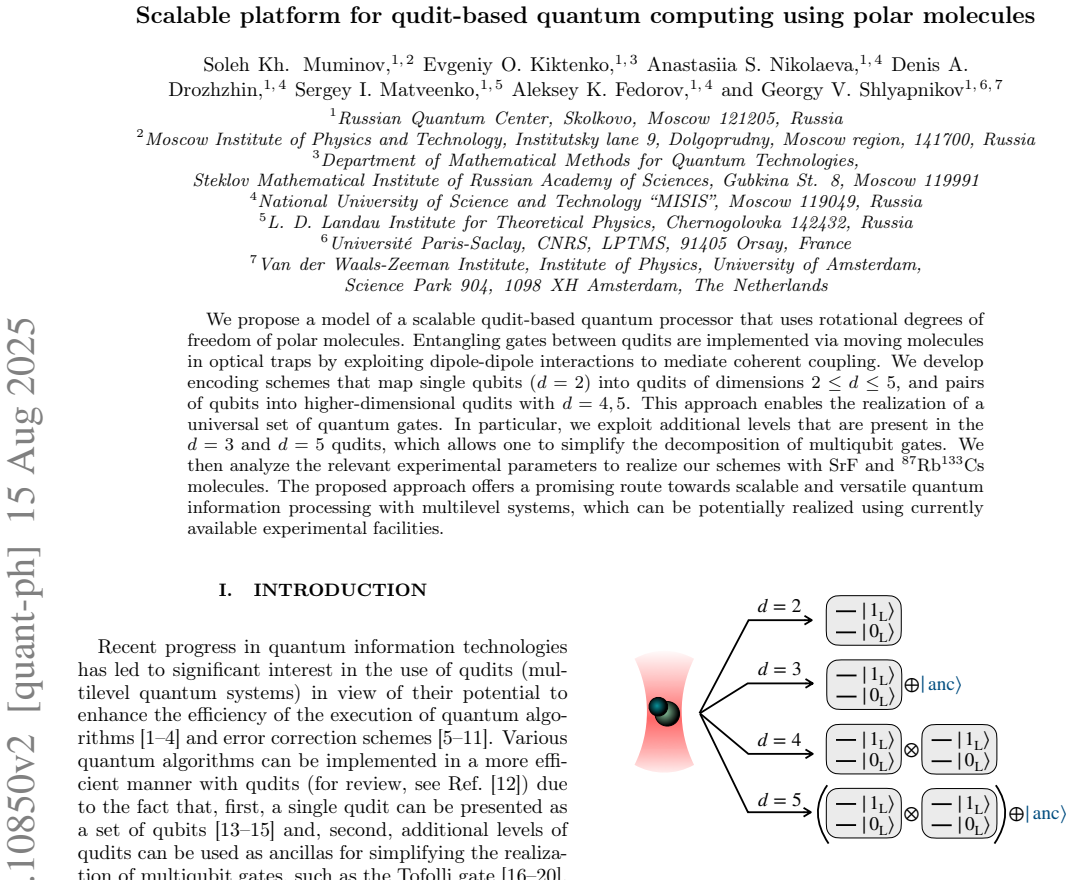
Arrays of polar molecules confined in optical tweezers can serve as a scalable qudit processor in which rotational states encode the qudits, and entangling operations between any pair are realized by adiabatically varying trap separation to activate dipole-dipole coupling; qubit-to-qudit mappings for d from 2 to 5 supply a complete gate set and simplify certain multiqubit decompositions.
What carries the argument
Adiabatic variation of optical-trap separation that turns dipole-dipole interactions on and off between polar molecules to implement entangling gates on their rotational-state qudits.
If this is right
- A universal set of single-qudit and two-qudit gates is available for every dimension from 2 to 5.
- Extra levels in d=3 and d=5 qudits reduce the number of elementary gates needed for multiqubit operations.
- Exponential growth of the total Hilbert space occurs simply by adding more molecules to the array.
- Realistic laser and trap parameters for SrF and NaCs molecules support the required interaction strengths and coherence times.
Where Pith is reading between the lines
- The same trap-merging technique could be combined with existing molecular cooling methods to reach higher gate speeds.
- Encoding choices developed here may transfer directly to other multilevel physical systems such as trapped ions or superconducting circuits.
- Small-scale demonstrations with three to five molecules would provide a direct test of whether the adiabatic gate protocol maintains fidelity as array size grows.
Load-bearing premise
Adiabatically bringing the optical traps together activates controllable dipole-dipole interactions that produce high-fidelity entangling gates without significant decoherence or loss of molecules.
What would settle it
An experiment that measures the fidelity of a two-molecule entangling gate performed by adiabatically merging and separating optical traps and shows error rates low enough for fault-tolerant quantum computation.
Figures


read the original abstract
We propose a scalable qudit-based quantum processor using rotational states of polar molecules. Previously, molecular internal states were used to enlarge Hilbert space, whereas our approach uses optical tweezer arrays to achieve scalable architectures with exponential state-space growth without increasing qudit dimensionality $d$. Entangling gates are implemented by adiabatically bringing traps together to activate dipole-dipole interactions. We develop encoding schemes mapping single qubits into qudits with $2\leq d\leq5$ and pairs of qubits into $d=4,5$ qudits, enabling universal set of quantum gates. Additional levels in $d=3$ and $d=5$ qudits simplify multiqubit gate decompositions. We analyze experimental parameters for SrF and NaCs molecules. This approach provides a promising route to scalable quantum information processing with multilevel systems using existing experimental platforms.
Editorial analysis
A structured set of objections, weighed in public.
Referee Report
Summary. The manuscript presents a proposal for a scalable qudit-based quantum processor utilizing the rotational states of polar molecules confined in optical tweezer arrays. It outlines encoding schemes that map individual qubits to qudits with dimensions ranging from 2 to 5 and pairs of qubits to qudits of dimension 4 or 5, facilitating a universal set of quantum gates. Entangling gates are achieved by adiabatically merging optical traps to engage dipole-dipole interactions. The authors analyze relevant experimental parameters for SrF and NaCs molecules and argue that this method offers a promising approach to scalable quantum information processing with multilevel systems using current experimental setups.
Significance. Should the central assumptions regarding adiabatic control and interaction strengths hold, this work could represent a meaningful contribution to the field of molecular quantum computing. By leveraging spatial scalability in tweezer arrays rather than increasing qudit dimension, it addresses a key challenge in scaling qudit systems. The encoding schemes that reduce the complexity of multiqubit gate decompositions are particularly noteworthy. The analysis of specific molecules like SrF and NaCs grounds the proposal in realistic experimental contexts, potentially inspiring further theoretical and experimental investigations.
major comments (2)
- [Gate implementation] The description of entangling gates via adiabatic trap merging does not include explicit calculations of the adiabatic timescale compared to the trap frequency or estimates of motional excitation and decoherence during the process for SrF and NaCs. This is load-bearing for the claim of high-fidelity gates without significant loss of control, as the center-of-mass motion couples to the internal-state-dependent interactions.
- [Encoding and analysis sections] The manuscript provides no detailed fidelity calculations or error analysis for the proposed gates, leaving the practical viability of the universal gate set and the encoding schemes unverified.
minor comments (1)
- [Abstract] Clarify how the approach achieves exponential state-space growth without increasing d, as this appears to refer to the number of qudits rather than dimensionality per qudit.
Simulated Author's Rebuttal
We thank the referee for their careful reading of our manuscript and for the constructive feedback. We address each major comment below and have revised the manuscript to incorporate additional details and clarifications where possible.
read point-by-point responses
-
Referee: [Gate implementation] The description of entangling gates via adiabatic trap merging does not include explicit calculations of the adiabatic timescale compared to the trap frequency or estimates of motional excitation and decoherence during the process for SrF and NaCs. This is load-bearing for the claim of high-fidelity gates without significant loss of control, as the center-of-mass motion couples to the internal-state-dependent interactions.
Authors: We appreciate the referee pointing out the need for more quantitative support on this point. The original manuscript provided order-of-magnitude estimates for interaction strengths and gate durations based on published dipole moments and typical tweezer parameters for SrF and NaCs. In the revision we have added explicit estimates of the adiabatic timescale derived from the Landau-Zener condition, comparing the ramp rate to the minimum energy gap during trap merging, and we compare this timescale to reported trap frequencies (∼1–10 kHz). We also include rough estimates of motional excitation probability assuming harmonic confinement and discuss leading decoherence channels (e.g., blackbody radiation and residual electric-field noise). A full numerical treatment of the coupled motional–internal dynamics during the merging process lies outside the scope of the present proposal and would require dedicated simulations; we have noted this limitation and flagged it as future work. revision: partial
-
Referee: [Encoding and analysis sections] The manuscript provides no detailed fidelity calculations or error analysis for the proposed gates, leaving the practical viability of the universal gate set and the encoding schemes unverified.
Authors: We agree that quantitative fidelity estimates would strengthen the presentation. Because the work is a conceptual proposal focused on architecture and encoding, we limited the analysis to analytical gate decompositions and coherence-time comparisons with existing experiments. In the revised manuscript we have added a dedicated paragraph outlining dominant error sources (imperfect adiabaticity, finite coherence times, and laser intensity noise) and have inserted order-of-magnitude infidelity estimates drawn from published molecular tweezer results. We maintain that the proposed encodings reduce the number of elementary gates required for multiqubit operations, which should improve overall fidelity, but we acknowledge that end-to-end numerical simulations of the full gate set remain an important next step not performed here. revision: partial
Circularity Check
No circularity: proposal applies established dipole-dipole and tweezer physics to qudit encoding
full rationale
The manuscript presents a platform proposal that maps qubit encodings into molecular rotational qudits and implements entangling gates via adiabatic trap merging to activate known dipole-dipole couplings. All load-bearing steps invoke standard physical mechanisms (optical tweezers, dipole-dipole interactions, rotational level structure) whose validity is independent of the present work and can be checked against external literature or experiment. No equations reduce a claimed prediction to a fitted input by construction, no uniqueness theorem is imported from the authors' prior papers, and no ansatz is smuggled via self-citation. The analysis of SrF and NaCs parameters is an application rather than a self-referential derivation, leaving the central claims self-contained against external benchmarks.
Axiom & Free-Parameter Ledger
axioms (1)
- domain assumption Adiabatic movement of traps activates dipole-dipole interactions suitable for entangling gates without prohibitive decoherence
Reference graph
Works this paper leans on
-
[1]
A. Muthukrishnan and C. R. Stroud Jr, Physical review A 62, 052309 (2000)
work page 2000
-
[2]
S. D. Bartlett, H. de Guise, and B. C. Sanders, Phys. Rev. A 65, 052316 (2002)
work page 2002
- [3]
-
[4]
V. Parasa and M. Perkowski, in2011 41st IEEE Inter- national Symposium on Multiple-Valued Logic(2011), pp. 224–229
work page 2011
-
[5]
E. T. Campbell, H. Anwar, and D. E. Browne, Physical Review X 2, 041021 (2012)
work page 2012
-
[6]
G. Duclos-Cianci and D. Poulin, Physical Review A—Atomic, Molecular, and Optical Physics87, 062338 (2013)
work page 2013
-
[7]
E. T. Campbell, Physical review letters 113, 230501 (2014)
work page 2014
- [8]
-
[9]
R. S. Andrist, J. R. Wootton, and H. G. Katzgraber, Physical Review A91, 042331 (2015)
work page 2015
-
[10]
F. H. Watson, E. T. Campbell, H. Anwar, and D. E. Browne, Physical Review A92, 022312 (2015)
work page 2015
-
[11]
A. Krishna and J.-P. Tillich, Physical review letters123, 070507 (2019)
work page 2019
-
[12]
E. O. Kiktenko, A. S. Nikolaeva, and A. K. Fedorov, Reviews of Modern Physics97, 021003 (2025)
work page 2025
-
[13]
A. D. Greentree, S. G. Schirmer, F. Green, L. C. L. Hol- lenberg, A. R. Hamilton, and R. G. Clark, Phys. Rev. Lett. 92, 097901 (2004), URL https://link.aps.org/ doi/10.1103/PhysRevLett.92.097901
-
[14]
E. O. Kiktenko, A. K. Fedorov, O. V. Man’ko, and V. I. Man’ko, Phys. Rev. A91, 042312 (2015), URL https: //link.aps.org/doi/10.1103/PhysRevA.91.042312
-
[15]
E. Kiktenko, A. Fedorov, A. Strakhov, and V. Man’ko, Physics Letters A 379, 1409 (2015), ISSN 0375- 9601, URL https://www.sciencedirect.com/science/ article/pii/S0375960115002753
work page 2015
-
[16]
T. C. Ralph, K. J. Resch, and A. Gilchrist, Phys. Rev. A 75, 022313 (2007), URLhttps://link.aps.org/doi/ 10.1103/PhysRevA.75.022313
-
[17]
A. Fedorov, L. Steffen, M. Baur, M. P. da Silva, and A. Wallraff, Nature481, 170 (2012), URLhttps://doi. org/10.1038/nature10713
-
[18]
L. B. Nguyen, N. Goss, K. Siva, Y. Kim, E. Younis, B. Qing, A. Hashim, D. I. Santiago, and I. Siddiqi, Na- ture Communications 15, 7117 (2024)
work page 2024
-
[19]
E. O. Kiktenko, A. S. Nikolaeva, P. Xu, G. V. Shlyap- nikov, and A. K. Fedorov, Physical Review A 101, 022304 (2020)
work page 2020
-
[20]
A. S. Nikolaeva, I. V. Zalivako, A. S. Borisenko, N. V. Semenin, K. P. Galstyan, A. E. Korolkov, E. O. Kik- tenko, K. Y. Khabarova, I. A. Semerikov, A. K. Fe- dorov, et al., Phys. Rev. Lett.135, 060601 (2025), URL https://link.aps.org/doi/10.1103/p1z9-6w93
-
[21]
Noisy intermediate- scale quantum algorithms,
K. Bharti, A. Cervera-Lierta, T. H. Kyaw, T. Haug, S. Alperin-Lea, A. Anand, M. Degroote, H. Heimonen, J. S. Kottmann, T. Menke, et al., Rev. Mod. Phys. 94, 015004 (2022), URL https://link.aps.org/doi/ 10.1103/RevModPhys.94.015004
- [22]
-
[23]
N. Goss, A. Morvan, B. Marinelli, B. K. Mitchell, L. B. Nguyen, R. K. Naik, L. Chen, C. Jünger, J. M. Kreike- baum, D. I. Santiago, et al., Nature communications13, 7481 (2022)
work page 2022
-
[24]
Y. Sung, A. Vepsäläinen, J. Braumüller, F. Yan, J. I.-J. Wang, M. Kjaergaard, R. Winik, P. Krantz, A. Bengts- son, A. J. Melville, et al., Nature communications 12, 8 967 (2021)
work page 2021
-
[25]
M. Ringbauer, M. Meth, L. Postler, R. Stricker, R. Blatt, P. Schindler, and T. Monz, Nature Physics 18, 1053 (2022)
work page 2022
-
[26]
I. V. Zalivako and et al., Quantum Reports 7 (2025), ISSN 2624-960X, URL https://www.mdpi.com/ 2624-960X/7/2/19
work page 2025
-
[27]
Y. Fu, W. Liu, X. Ye, Y. Wang, C. Zhang, C.-K. Duan, X.Rong, andJ.Du, PhysicalReviewLetters 129, 100501 (2022)
work page 2022
-
[28]
H. Zhou, H. Gao, N. T. Leitao, O. Makarova, I. Cong, A. M. Douglas, L. S. Martin, and M. D. Lukin, Physical Review X 14, 031017 (2024)
work page 2024
-
[29]
I. Fernández de Fuentes, T. Botzem, M. A. Johnson, A. Vaartjes, S. Asaad, V. Mourik, F. E. Hudson, K. M. Itoh, B. C. Johnson, A. M. Jakob, et al., Nature commu- nications 15, 1380 (2024)
work page 2024
-
[30]
D. González-Cuadra, T. V. Zache, J. Carrasco, B. Kraus, and P. Zoller, Phys. Rev. Lett. 129, 160501 (2022), URL https://link.aps.org/doi/10. 1103/PhysRevLett.129.160501
work page 2022
- [31]
-
[32]
K.-K. Ni, S. Ospelkaus, M. De Miranda, A. Pe’Er, B. Neyenhuis, J. Zirbel, S. Kotochigova, P. Julienne, D. Jin, and J. Ye, science322, 231 (2008)
work page 2008
-
[33]
J. Deiglmayr, A. Grochola, M. Repp, K. Mörtlbauer, C. Glück, J. Lange, O. Dulieu, R. Wester, and M. Wei- demüller, Physical review letters101, 133004 (2008)
work page 2008
-
[34]
S. Ospelkaus, K.-K. Ni, D. Wang, M. De Miranda, B. Neyenhuis, G. Quéméner, P. Julienne, J. Bohn, D. Jin, and J. Ye, Science327, 853 (2010)
work page 2010
-
[35]
K.-K. Ni, S. Ospelkaus, D. Wang, G. Quéméner, B.Neyenhuis, M.DeMiranda, J.Bohn, J.Ye, andD.Jin, Nature 464, 1324 (2010)
work page 2010
-
[36]
M. De Miranda, A. Chotia, B. Neyenhuis, D. Wang, G. Quéméner, S. Ospelkaus, J. Bohn, J. Ye, and D. Jin, Nature Physics 7, 502 (2011)
work page 2011
-
[37]
L. D. Carr, D. DeMille, R. V. Krems, and J. Ye, New Journal of Physics11, 055049 (2009)
work page 2009
-
[38]
DeMille, Physical Review Letters88, 067901 (2002)
D. DeMille, Physical Review Letters88, 067901 (2002)
work page 2002
-
[39]
P.D.Gregory, J.A.Blackmore, S.L.Bromley, J.M.Hut- son, and S. L. Cornish, Nature Physics17, 1149 (2021)
work page 2021
-
[40]
L. R. Picard, A. J. Park, G. E. Patenotte, S. Gebretsad- kan, D. Wellnitz, A. M. Rey, and K.-K. Ni, Nature637, 821 (2025)
work page 2025
-
[41]
K.-K. Ni, T. Rosenband, and D. D. Grimes, Chemical science 9, 6830 (2018)
work page 2018
-
[42]
Y. Bao, S. S. Yu, L. Anderegg, E. Chae, W. Ketterle, K.-K. Ni, and J. M. Doyle, Science382, 1138 (2023)
work page 2023
- [43]
-
[44]
E. R. Hudson, H. Lewandowski, B. C. Sawyer, and J. Ye, Physical review letters96, 143004 (2006)
work page 2006
-
[45]
T. Zelevinsky, S. Kotochigova, and J. Ye, Physical review letters 100, 043201 (2008)
work page 2008
-
[46]
D. DeMille, S. Sainis, J. Sage, T. Bergeman, S. Ko- tochigova, and E. Tiesinga, Physical review letters100, 043202 (2008)
work page 2008
- [47]
-
[48]
A. C. Vutha, O. K. Baker, W. C. Campbell, D. DeMille, J. M. Doyle, G. Gabrielse, Y. V. Gurevich, and M. A. Jansen, inAPS Division of Atomic, Molecular and Opti- cal Physics Meeting Abstracts(2008), vol. 39, pp. OPC– 50
work page 2008
- [49]
-
[50]
F. Herrera, Y. Cao, S. Kais, and K. B. Whaley, New Journal of Physics16, 075001 (2014)
work page 2014
-
[51]
E. S. Shuman, J. F. Barry, and D. DeMille, Nature467, 820 (2010)
work page 2010
-
[52]
L. Anderegg, L. W. Cheuk, Y. Bao, S. Burchesky, W. Ketterle, K.-K. Ni, and J. M. Doyle, Science 365, 1156 (2019)
work page 2019
-
[53]
D. K. Ruttley, A. Guttridge, S. Spence, R. C. Bird, C. R. Le Sueur, J. M. Hutson, and S. L. Cornish, Physical Re- view Letters 130, 223401 (2023)
work page 2023
-
[54]
F. Luis, P. J. Alonso, O. Roubeau, V. Velasco, D. Zueco, D. Aguilà, J. I. Martínez, L. A. Barrios, and G. Aromí, Communications Chemistry 3, 176 (2020)
work page 2020
-
[55]
A. Hernández-Antón, F. Luis, and A. Castro, Opti- mal control of spin qudits subject to decoherence us- ing amplitude-and-frequency-constrained pulses (2024), 2403.15785, URL https://arxiv.org/abs/2403.15785
-
[56]
L. D. Landau and E. M. Lifshitz,Quantum mechanics: non-relativistic theory, vol. 3 (Elsevier, 2013)
work page 2013
-
[57]
W.Ernst, J.Kändler, S.Kindt, andT.Törring, Chemical physics letters 113, 351 (1985)
work page 1985
-
[58]
Y. Hao, L. F. Pašteka, L. Visscher, P. Aggarwal, H. L. Bethlem, A. Boeschoten, A. Borschevsky, M. Denis, K. Esajas, S. Hoekstra, et al., The Journal of chemical physics 151 (2019)
work page 2019
-
[59]
P. K. Molony, P. D. Gregory, Z. Ji, B. Lu, M. P. Köp- pinger, C. R. Le Sueur, C. L. Blackley, J. M. Hutson, and S. L. Cornish, Physical review letters113, 255301 (2014)
work page 2014
-
[60]
S. Burchesky, L. Anderegg, Y. Bao, S. S. Yu, E. Chae, W. Ketterle, K.-K. Ni, and J. M. Doyle, Physical Review Letters 127, 123202 (2021)
work page 2021
- [61]
-
[62]
J. A. Blackmore, R. Sawant, P. D. Gregory, S. L. Brom- ley, J. Aldegunde, J. M. Hutson, and S. L. Cornish, Phys- ical Review A102, 053316 (2020)
work page 2020
-
[63]
F. Seeßelberg, X.-Y. Luo, M. Li, R. Bause, S. Ko- tochigova, I. Bloch, and C. Gohle, Physical Review Let- ters 121, 253401 (2018)
work page 2018
-
[64]
J. Lin, J. He, X. Ye, and D. Wang, Physical Review A 103, 023332 (2021)
work page 2021
-
[65]
B. Neyenhuis, B. Yan, S. Moses, J. Covey, A. Chotia, A. Petrov, S. Kotochigova, J. Ye, and D. Jin, Physical review letters 109, 230403 (2012)
work page 2012
-
[66]
C. P. Williams and C. P. Williams, Explorations in quan- tum computing pp. 51–122 (2011)
work page 2011
-
[67]
A. S. Nikolaeva, E. O. Kiktenko, and A. K. Fedorov, Physical review A105, 032621 (2022)
work page 2022
-
[68]
A. S. Nikolaeva, E. O. Kiktenko, and A. K. Fedorov, EPJ Quantum Technology11, 1 (2024)
work page 2024
discussion (0)
Sign in with ORCID, Apple, or X to comment. Anyone can read and Pith papers without signing in.