Exceptional flat bands in bipartite non-Hermitian lattices
Pith reviewed 2026-05-18 22:39 UTC · model grok-4.3
The pith
Non-Hermitian bipartite lattices support flat bands when one sublattice has higher degeneracy in its momentum-independent eigenvalue than the other.
A machine-rendered reading of the paper's core claim, the machinery that carries it, and where it could break.
Core claim
In bipartite non-Hermitian lattices, flat bands arise whenever one sublattice hosts a momentum-independent eigenvalue whose degeneracy exceeds that of the partner sublattice. At exceptional points the dispersive bands coalesce into exceptional flat bands that persist beyond the singularities, featuring biorthogonal eigenmodes that span both sublattices and whose energies and lifetimes are tunable by sublattice chemical potentials and non-reciprocal couplings.
What carries the argument
Sublattice degeneracy mismatch for a momentum-independent eigenvalue
Load-bearing premise
A momentum-independent eigenvalue on one sublattice remains exactly constant and keeps a strictly higher degeneracy than its partner even after arbitrary non-Hermitian perturbations are added.
What would settle it
Adding non-Hermitian couplings that render the higher-degeneracy eigenvalue momentum-dependent should eliminate the flat bands.
Figures


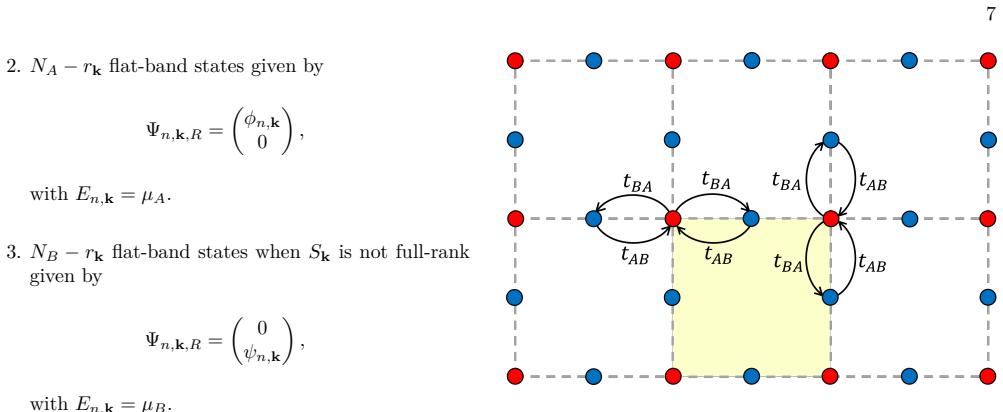
read the original abstract
Flat bands, in which kinetic energy is quenched and quantum states become macroscopically degenerate, host a rich variety of correlated and topological phases, from unconventional superconductors to fractional Chern insulators. In Hermitian lattices, their formation mechanisms are now well understood, but whether such states persist, and acquire new features in non-Hermitian (NH) { crystals}, relevant to open and driven systems, has remained an open question. Here we show that the Hermitian principle for flat-band formation in bipartite lattices, based on a sublattice degeneracy mismatch, extends directly to the NH regime: whenever one sublattice hosts a momentum-independent eigenvalue with degeneracy exceeding that of its partner on the other sublattice, flat bands arise regardless of gain, loss, or complex couplings. Strikingly, at exceptional points, dispersive bands coalesce to form \emph{exceptional flat bands} (EFBs) that persist beyond these singularities, exhibiting biorthogonal eigenmodes spanning both sublattices, with energies and lifetimes tunable via sublattice asymmetry and non-reciprocal couplings. This general framework unifies Hermitian and NH flat-band constructions, and reveals dispersionless states with no closed-system analogue, as is the case of a bipartite lattice with imbalanced but constant sublattice chemical potentials. The proposed construction is applicable to synthetic platforms, from classical metamaterials, where flat bands can be directly emulated, to quantum-engineered systems such as photonic crystals and ultracold atom arrays, which should host correlated and topological phases emerging from such EFBs.
Editorial analysis
A structured set of objections, weighed in public.
Referee Report
Summary. The manuscript claims that the Hermitian principle for flat-band formation in bipartite lattices—based on a sublattice degeneracy mismatch—extends directly to the non-Hermitian regime. Whenever one sublattice hosts a momentum-independent eigenvalue whose degeneracy exceeds that of its partner, flat bands arise regardless of gain, loss, or complex couplings. The work further identifies exceptional flat bands (EFBs) that form at exceptional points, persist beyond them, and exhibit biorthogonal eigenmodes spanning both sublattices with tunable energies and lifetimes via sublattice asymmetry and non-reciprocal couplings. The construction is presented as unifying Hermitian and NH cases and applicable to synthetic platforms.
Significance. If the central extension holds, the result provides a parameter-free counting argument that unifies flat-band constructions across Hermitian and non-Hermitian settings and identifies dispersionless states without closed-system analogues (e.g., imbalanced constant sublattice chemical potentials). This could guide design of flat bands in open systems such as photonic crystals and metamaterials, with potential for correlated or topological phases.
major comments (1)
- [General framework / derivation following abstract] The load-bearing assumption that a momentum-independent eigenvalue on the majority sublattice remains exactly k-independent (and retains its algebraic multiplicity) after arbitrary non-Hermitian perturbations is not demonstrated for general block forms. In a general NH bipartite Hamiltonian the off-diagonal blocks carry complex momentum dependence; their product with the inverse of the minority block can feed k-dependent corrections back into the effective equation for the majority eigenvalue, shifting the root or reducing multiplicity. The manuscript must supply the explicit characteristic equation or block-diagonalization step showing that this feedback vanishes for arbitrary gain/loss and complex couplings (see the paragraph beginning 'Here we show' and the subsequent general-framework section).
minor comments (2)
- [Abstract] The abstract uses the abbreviation 'NH { crystals}' with an apparent formatting artifact; this should be rendered consistently as 'non-Hermitian crystals' or defined on first use.
- [Discussion of exceptional points] The claim that EFBs 'persist beyond these singularities' would benefit from an explicit statement of the parameter range or analytic continuation used to establish persistence.
Simulated Author's Rebuttal
We thank the referee for their thorough review and constructive criticism. We address the major comment below and have revised the manuscript to include the requested explicit derivation.
read point-by-point responses
-
Referee: The load-bearing assumption that a momentum-independent eigenvalue on the majority sublattice remains exactly k-independent (and retains its algebraic multiplicity) after arbitrary non-Hermitian perturbations is not demonstrated for general block forms. In a general NH bipartite Hamiltonian the off-diagonal blocks carry complex momentum dependence; their product with the inverse of the minority block can feed k-dependent corrections back into the effective equation for the majority eigenvalue, shifting the root or reducing multiplicity. The manuscript must supply the explicit characteristic equation or block-diagonalization step showing that this feedback vanishes for arbitrary gain/loss and complex couplings (see the paragraph beginning 'Here we show' and the subsequent general-framework section).
Authors: We thank the referee for this precise observation on the general framework. The bipartite NH Hamiltonian is taken with a momentum-independent block on the majority sublattice by construction (constant chemical potential), so the candidate flat-band energy λ coincides with a zero block in (H − λI). Consider the block form H(k) = [[ε I_{N1}, T(k)], [T'(k), δ I_{N2}]] with N1 > N2 and δ = ε2 − ε. Setting λ = ε yields the shifted operator [[0, T(k)], [T'(k), δ I]]. The eigenvalue equation then decouples into T(k) v2 = 0 and T'(k) v1 + δ v2 = 0. For generic complex T(k) of size N1 × N2 the rank is N2, so dim ker T(k) ≥ N1 − N2 independently of k. Each such v2 lies in the image of the underdetermined map T'(k) (N2 × N1), which is surjective for generic couplings; hence a solution v1 always exists. The resulting kernel dimension is therefore at least N1 − N2 for every k, with no k-dependent shift or loss of multiplicity. Because the majority block is identically zero, the Schur complement involving the inverse of the minority block is never formed and no feedback term appears. This argument uses only linear algebra and holds for arbitrary complex, non-reciprocal T(k) and T'(k). We have inserted the full block-diagonalization, the characteristic-equation reduction, and the kernel-dimension count into the revised general-framework section. revision: yes
Circularity Check
No circularity: generalization rests on independent counting argument
full rationale
The paper's central claim extends the Hermitian sublattice-degeneracy-mismatch principle to the non-Hermitian regime by asserting that a momentum-independent eigenvalue on one sublattice, when its degeneracy exceeds that of the partner sublattice, produces flat bands irrespective of gain/loss or complex couplings. This counting argument is presented directly in the abstract without reduction to a fitted parameter, self-citation chain, or ansatz smuggled from prior work. No equations are shown that define the flat-band condition in terms of itself or rename a known result; the derivation remains self-contained and does not collapse to its inputs by construction. The skeptic concern addresses validity under general perturbations rather than logical circularity.
Axiom & Free-Parameter Ledger
axioms (1)
- domain assumption The eigenvalue on one sublattice is momentum-independent and its degeneracy exceeds that of the partner sublattice.
Lean theorems connected to this paper
-
IndisputableMonolith/Foundation/AlexanderDuality.leanalexander_duality_circle_linking unclear?
unclearRelation between the paper passage and the cited Recognition theorem.
whenever one sublattice hosts a momentum-independent eigenvalue with degeneracy exceeding that of its partner on the other sublattice, flat bands arise regardless of gain, loss, or complex couplings
-
IndisputableMonolith/Cost/FunctionalEquation.leanwashburn_uniqueness_aczel unclear?
unclearRelation between the paper passage and the cited Recognition theorem.
Hk = (Ak Sk; S†k Bk) ... If Ak hosts a momentum-independent eigenvalue ϵa with degeneracy na > NB
What do these tags mean?
- matches
- The paper's claim is directly supported by a theorem in the formal canon.
- supports
- The theorem supports part of the paper's argument, but the paper may add assumptions or extra steps.
- extends
- The paper goes beyond the formal theorem; the theorem is a base layer rather than the whole result.
- uses
- The paper appears to rely on the theorem as machinery.
- contradicts
- The paper's claim conflicts with a theorem or certificate in the canon.
- unclear
- Pith found a possible connection, but the passage is too broad, indirect, or ambiguous to say the theorem truly supports the claim.
Forward citations
Cited by 2 Pith papers
-
Multiple Bulk-Boundary Correspondences and Anomalous Modes in a Non-Hermitian Creutz Ladder
A non-Hermitian Creutz ladder with gain-loss and nonreciprocity hosts multiple bulk-boundary correspondences, anomalous skin modes, and symmetry-protected topological zero modes detectable via winding numbers and Z2 i...
-
Multiple Bulk-Boundary Correspondences and Anomalous Modes in a Non-Hermitian Creutz Ladder
A non-Hermitian Creutz ladder with gain-loss and nonreciprocity exhibits multiple bulk-boundary correspondences and anomalous skin modes, with a hybrid spectral winding encoding localization of counterintuitive bulk modes.
Reference graph
Works this paper leans on
-
[1]
2rk dispersive states given by Ψ± n,k,R = 1√ 2 √ 1−α2 ( ±√1 +αϕn,k√1−αψn,k ) , with E± n,k =± √ 1−α2ϵn,k
-
[2]
NA−rk zero-modes given by the non-null kernel of S† k, as Ψn,k,R = (ϕn,k 0 ) , with En,k = 0
-
[3]
Here, weassumenormalizationofthesingulareigenstates ψ† n,kψn,k =ϕ† n,kϕn,k = 1
NB−rk zero-modes that arise whenSk is not full- rank, i.e.rk <N B, given by Ψn,k,R = ( 0 ψn,k ) , with En,k = 0. Here, weassumenormalizationofthesingulareigenstates ψ† n,kψn,k =ϕ† n,kϕn,k = 1. This is shown in Eqs. (5) and (6) in the main text. Remarkably, the flat-band states retain the same form as in the Hermitian case [37], and the NH contribution onl...
-
[4]
2rk dispersive states given by Ψ± n,k,R = 1√ (δµ±∆ k)2 + (1−α2)ϵ2 n,k ( (δµ±∆ k)ϕn,k (1−α)ϵn,kψn,k ) , with E± n,k = ¯µ±∆ k. 7
-
[5]
NA−rk flat-band states given by Ψn,k,R = (ϕn,k 0 ) , with En,k =µA
-
[6]
NB−rk flat-band states whenSk is not full-rank given by Ψn,k,R = ( 0 ψn,k ) , with En,k =µB. Here the standard flat-band states that depend only on the sublattice imbalanceNA−NB̸= 0 retain exactly their Hermitian form. By contrast, the dispersive sec- tor acquires a non-trivialα-dependence which, together with its momentum dependence, yields a richer patt...
-
[7]
E. J. Bergholtz and Z. Liu, Topological flat band models and fractional chern insulators, International Journal of Modern Physics B27, 1330017 (2013)
work page 2013
-
[8]
S. A. Parameswaran, R. Roy, and S. L. Sondhi, Frac- tional quantum hall physics in topological flat bands, Comptes Rendus Physique 14, 816 (2013), topological insulators / Isolants topologiques
work page 2013
-
[9]
T. T. Heikkilä and G. E. Volovik, Flat bands as a route to high-temperature superconductivity in graphite, in Basic Physics of Functionalized Graphite (Springer,
-
[10]
G. E. Volovik, Graphite, graphene, and the flat band superconductivity, JETP Letters107, 516 (2018)
work page 2018
- [11]
-
[12]
Y. Cao, V. Fatemi, A. Demir, S. Fang, S. L. Tomarken, J. Y. Luo, J. D. Sanchez-Yamagishi, K. Watanabe, T. Taniguchi, E. Kaxiras, et al., Correlated insulator behaviour at half-filling in magic-angle graphene super- lattices, Nature 556, 80 (2018)
work page 2018
-
[13]
Y. Cao, V. Fatemi, S. Fang, K. Watanabe, T.Taniguchi, E. Kaxiras, and P. Jarillo-Herrero, Unconventional su- perconductivity in magic-angle graphene superlattices, Nature 556, 43 (2018)
work page 2018
-
[14]
Y. Cao, D. Rodan-Legrain, J. M. Park, N. F. Q. Yuan, K. Watanabe, T. Taniguchi, R. M. Fernandes, L. Fu, andP.Jarillo-Herrero,Nematicityandcompetingorders in superconducting magic-angle graphene, Science372, 264 (2021)
work page 2021
-
[15]
Y. Xie, A. T. Pierce, J. M. Park, D. E. Parker, E. Kha- laf, P. Ledwith, Y. Cao, S. H. Lee, S. Chen, P. R. For- rester, et al., Fractional chern insulators in magic-angle twisted bilayer graphene, Nature600, 439 (2021)
work page 2021
-
[16]
J. M. Park, Y. Cao, K. Watanabe, T. Taniguchi, and P. Jarillo-Herrero, Flavour hund’s coupling, chern gaps and charge diffusivity in moiré graphene, Nature592, 43 (2021). 9
work page 2021
-
[17]
I. Das, X. Lu, J. Herzog-Arbeitman, Z.-D. Song, K. Watanabe, T. Taniguchi, B. A. Bernevig, and D. K. Efetov, Symmetry-broken chern insulators and rashba-like landau-level crossings in magic-angle bilayer graphene, Nature Physics17, 710 (2021)
work page 2021
-
[18]
Y. Choi, H. Kim, Y. Peng, A. Thomson, C. Lewandowski, R. Polski, Y. Zhang, H. S. Arora, K. Watanabe, T. Taniguchi,et al., Correlation-driven topological phases in magic-angle twisted bilayer graphene, Nature 589, 536 (2021)
work page 2021
-
[19]
M. Sánchez Sánchez, I. Díaz, J. González, and T. Stauber, Nematic versus kekulé phases in twisted bi- layer graphene under hydrostatic pressure, Phys. Rev. Lett. 133, 266603 (2024)
work page 2024
-
[20]
E. Suárez Morell, J. D. Correa, P. Vargas, M. Pacheco, and Z. Barticevic, Flat bands in slightly twisted bilayer graphene: Tight-binding calculations, Phys. Rev. B82, 121407 (2010)
work page 2010
-
[21]
R. Bistritzer and A. H. MacDonald, Moiré bands in twisted double-layer graphene, Proceedings of the Na- tional Academy of Sciences108, 12233 (2011)
work page 2011
-
[22]
J. M. B. Lopes dos Santos, N. M. R. Peres, and A. H. Castro Neto, Graphene bilayer with a twist: Electronic structure, Phys. Rev. Lett.99, 256802 (2007)
work page 2007
-
[23]
J. Kang and O. Vafek, Symmetry, maximally localized wannier states, and a low-energy model for twisted bi- layer graphene narrow bands, Phys. Rev. X8, 031088 (2018)
work page 2018
-
[24]
H. C. Po, L. Zou, T. Senthil, and A. Vishwanath, Faith- ful tight-binding models and fragile topology of magic- angle bilayer graphene, Phys. Rev. B99, 195455 (2019)
work page 2019
-
[25]
M. P. Shores, E. A. Nytko, B. M. Bartlett, and D. G. Nocera, A structurally perfect s= 1/2 kagomé antiferro- magnet, Journal of the american chemical society127, 13462 (2005)
work page 2005
-
[26]
P. Mendels and F. Bert, Quantum kagome antiferro- magnet zncu3(oh)6cl2, Journal of the Physical Society of Japan 79, 011001 (2010)
work page 2010
-
[27]
T.-H. Han, J. S. Helton, S. Chu, D. G. Nocera, J. A. Rodriguez-Rivera, C. Broholm, and Y. S. Lee, Fraction- alized excitations in the spin-liquid state of a kagome- lattice antiferromagnet, Nature492, 406 (2012)
work page 2012
- [28]
-
[29]
S. Lisi, X. Lu, T. Benschop, T. A. de Jong, P. Stepanov, J. R. Duran, F. Margot, I. Cucchi, E. Cappelli, A. Hunter, et al., Observation of flat bands in twisted bilayer graphene, Nature Physics17, 189 (2021)
work page 2021
-
[30]
I. Hase, Y. Higashi, H. Eisaki, and K. Kawashima, New three-dimensional flat band candidate materials pb2as2o7 and pb2sn2o7, Scientific Reports 14, 26532 (2024)
work page 2024
- [31]
-
[32]
S. Kajiwara, Y. Urade, Y. Nakata, T. Nakanishi, and M. Kitano, Observation of a nonradiative flat band for spoof surface plasmons in a metallic lieb lattice, Phys. Rev. B 93, 075126 (2016)
work page 2016
-
[33]
H. Wang, B. Yang, W. Xu, Y. Fan, Q. Guo, Z. Zhu, and C. T. Chan, Highly degenerate photonic flat bands arising from complete graph configurations, Phys. Rev. A 100, 043841 (2019)
work page 2019
- [34]
-
[35]
R. A. Vicencio, C. Cantillano, L. Morales-Inostroza, B. Real, C. Mejía-Cortés, S. Weimann, A. Szameit, and M. I. Molina, Observation of localized states in lieb pho- tonic lattices, Phys. Rev. Lett.114, 245503 (2015)
work page 2015
- [36]
-
[37]
S. Mukherjee, A. Spracklen, D. Choudhury, N. Gold- man, P. Öhberg, E. Andersson, and R. R. Thomson, Observation of a localized flat-band state in a photonic lieb lattice, Phys. Rev. Lett.114, 245504 (2015)
work page 2015
-
[38]
Y.-C. He, F. Grusdt, A. Kaufman, M. Greiner, and A. Vishwanath, Realizing and adiabatically preparing bosonic integer and fractional quantum hall states in optical lattices, Phys. Rev. B96, 201103 (2017)
work page 2017
-
[39]
N. R. Cooper, J. Dalibard, and I. B. Spielman, Topo- logical bands for ultracold atoms, Rev. Mod. Phys.91, 015005 (2019)
work page 2019
-
[40]
C. Zeng, Y.-R. Shi, Y.-Y. Mao, F.-F. Wu, Y.-J. Xie, T. Yuan, H.-N. Dai, and Y.-A. Chen, Observation of flat-band localized state in a one-dimensional diamond momentum lattice of ultracold atoms, Chinese Physics B 33, 010303 (2023)
work page 2023
-
[41]
W. Sui, W. Han, Z. V. Han, Z. Meng, and J. Zhang, Topologically nontrivial and trivial flat bands via weak and strong interlayer coupling in twisted bilayer honey- comb optical lattices for ultracold atoms, Phys. Rev. A 111, 063306 (2025)
work page 2025
-
[42]
D.-S. Ma, Y. Xu, C. S. Chiu, N. Regnault, A. A. Houck, Z. Song, and B. A. Bernevig, Spin-orbit-induced topo- logical flat bands in line and split graphs of bipartite lattices, Phys. Rev. Lett.125, 266403 (2020)
work page 2020
-
[43]
D. Călugăru, A. Chew, L. Elcoro, Y. Xu, N. Regnault, Z.-D. Song, and B. A. Bernevig, General construction and topological classification of crystalline flat bands, Nature Physics 18, 185 (2022)
work page 2022
-
[44]
Y. Hwang, J.-W. Rhim, and B.-J. Yang, General con- struction of flat bands with and without band crossings based on wave function singularity, Phys. Rev. B104, 085144 (2021)
work page 2021
- [45]
- [46]
-
[47]
Ramezani, Non-hermiticity-induced flat band, Phys
H. Ramezani, Non-hermiticity-induced flat band, Phys. Rev. A 96, 011802 (2017)
work page 2017
-
[48]
A. A. Zyuzin and A. Y. Zyuzin, Flat band in disorder- driven non-hermitian weyl semimetals, Phys. Rev. B97, 041203 (2018)
work page 2018
-
[49]
S. M. Zhang and L. Jin, Flat band in two-dimensional non-hermitian optical lattices, Phys. Rev. A 100, 043808 (2019)
work page 2019
-
[50]
Jin, Flat band induced by the interplay of synthetic magnetic flux and non-hermiticity, Phys
L. Jin, Flat band induced by the interplay of synthetic magnetic flux and non-hermiticity, Phys. Rev. A 99, 10 033810 (2019)
work page 2019
-
[51]
W. Maimaiti and A. Andreanov, Non-hermitian flat- band generator in one dimension, Phys. Rev. B 104, 035115 (2021)
work page 2021
-
[52]
L. Ding, Z. Lin, S. Ke, B. Wang, and P. Lu, Non- hermitian flat bands in rhombic microring resonator ar- rays, Opt. Express29, 24373 (2021)
work page 2021
-
[53]
S. Talkington and M. Claassen, Dissipation-induced flat bands, Phys. Rev. B106, L161109 (2022)
work page 2022
- [54]
-
[55]
I. Amelio and N. Goldman, Lasing in non-hermitian flat bands: Quantum geometry, coherence, and the fate of kardar-parisi-zhang physics, Phys. Rev. Lett. 132, 186902 (2024)
work page 2024
-
[56]
A. Banerjee, A. Bandyopadhyay, R. Sarkar, and A. Narayan, Non-hermitian topology and flat bands via an exact real-space decimation scheme, Phys. Rev. B 110, 085431 (2024)
work page 2024
-
[57]
C. A. Leong and B. Roy, Non-hermitian catalysis of density-wave orders on euclidean and hyperbolic lattices (2025), arXiv:2501.18591 [cond-mat.str-el]
work page internal anchor Pith review Pith/arXiv arXiv 2025
-
[58]
Z. Gong, Y. Ashida, K. Kawabata, K. Takasan, S. Hi- gashikawa, and M. Ueda, Topological Phases of Non- Hermitian Systems, Phys. Rev. X8, 031079 (2018)
work page 2018
-
[59]
L. E. F. Foa Torres, Perspective on topological states of non-hermitian lattices, Journal of Physics: Materials3, 014002 (2019)
work page 2019
-
[60]
E. J. Bergholtz, J. C. Budich, and F. K. Kunst, Excep- tional topology of non-hermitian systems, Rev. Mod. Phys. 93, 015005 (2021)
work page 2021
-
[61]
W. D. Heiss, The physics of exceptional points, Journal of Physics A: Mathematical and Theoretical45, 444016 (2012)
work page 2012
-
[62]
W. Hu, H. Wang, P. P. Shum, and Y. D. Chong, Ex- ceptional points in a non-hermitian topological pump, Phys. Rev. B95, 184306 (2017)
work page 2017
-
[63]
V. M. Martinez Alvarez, J. E. Barrios Vargas, and L. E. F. Foa Torres, Non-hermitian robust edge states in one dimension: Anomalous localization and eigenspace condensation at exceptional points, Phys. Rev. B 97, 121401 (2018)
work page 2018
-
[64]
K. Kawabata, T. Bessho, and M. Sato, Classification of exceptional points and non-hermitian topological semimetals, Phys. Rev. Lett.123, 066405 (2019)
work page 2019
-
[65]
V. Kozii and L. Fu, Non-Hermitian topological theory of finite-lifetime quasiparticles: Prediction of bulk Fermi arc due to exceptional point, Phys. Rev. B109, 235139 (2024)
work page 2024
-
[66]
V. Juričić and B. Roy, Yukawa-Lorentz symmetry in non-Hermitian Dirac materials, Communications Physics 7, 169 (2024)
work page 2024
-
[67]
X.-J. Yu, Z. Pan, L. Xu, and Z.-X. Li, Non-hermitian strongly interacting dirac fermions, Phys. Rev. Lett. 132, 116503 (2024)
work page 2024
-
[68]
S. A. Murshed and B. Roy, Quantum electrodynamics of non-Hermitian Dirac fermions, Journal of High Energy Physics 2024, 1 (2024)
work page 2024
-
[69]
S. A. Murshed and B. Roy, Yukawa-Lorentz sym- metry of interacting non-Hermitian birefringent Dirac fermions, SciPost Phys.18, 073 (2025)
work page 2025
-
[70]
S. Pino-Alarcón and V. Juričić, Yukawa-lorentz symme- try of tilted non-hermitian dirac semimetals at quantum criticality, Phys. Rev. B111, 195126 (2025)
work page 2025
-
[71]
J. P. Esparza and V. Juričić, Exceptional magic angles in non-hermitian twisted bilayer graphene, Phys. Rev. Lett. 134, 226602 (2025)
work page 2025
-
[72]
Huang, Exceptional topology in non-hermitian twisted bilayer graphene, Phys
Y. Huang, Exceptional topology in non-hermitian twisted bilayer graphene, Phys. Rev. B 111, 085120 (2025)
work page 2025
-
[73]
Jin, Topological phases and edge states in a non- hermitian trimerized optical lattice, Phys
L. Jin, Topological phases and edge states in a non- hermitian trimerized optical lattice, Phys. Rev. A96, 032103 (2017)
work page 2017
-
[74]
X. Zhou, S. K. Gupta, Z. Huang, Z. Yan, P. Zhan, Z. Chen, M. Lu, and Z. Wang, Optical lat- tices with higher-order exceptional points by non- hermitian coupling, Applied Physics Letters 113, https://doi.org/10.1063/1.5043279 (2018)
-
[75]
M. Pan, H. Zhao, P. Miao, S. Longhi, and L. Feng, Photonic zero mode in a non-hermitian photonic lattice, Nature communications 9, 1308 (2018)
work page 2018
-
[76]
W. Song, W. Sun, C. Chen, Q. Song, S. Xiao, S. Zhu, and T. Li, Breakup and recovery of topological zero modes in finite non-hermitian optical lattices, Phys. Rev. Lett. 123, 165701 (2019)
work page 2019
- [77]
-
[78]
L. Li, C. H. Lee, and J. Gong, Topological switch for non-hermitian skin effect in cold-atom systems with loss, Phys. Rev. Lett.124, 250402 (2020)
work page 2020
-
[79]
L. Zhou, H. Li, W. Yi, and X. Cui, Engineering non- hermitian skin effect with band topology in ultracold gases, Communications Physics5, 252 (2022)
work page 2022
- [80]
discussion (0)
Sign in with ORCID, Apple, or X to comment. Anyone can read and Pith papers without signing in.