REVIEW 4 major objections 6 minor 43 references
Personalized Face Super-Resolution with Identity Decoupling and Fitting
T0 review · 4 major / 6 minor · reviewed 2026-08-05 · deepseek-v4-flash
Pith's one-line read Fitting a learnable identity embedding from a few same-identity photos lets a diffusion face super-resolution model restore ID-consistent faces at 8x and 16x upscaling, where existing methods hallucinate identities.
desk verdict Unfair baseline comparison undermines the headline SOTA numbers, but the decoupling idea and ablations are legitimate and worth refereeing. read the letter →
The pith
A machine-rendered reading of the paper's core claim, the machinery that carries it, and where it could break.
The reading
What carries the argument
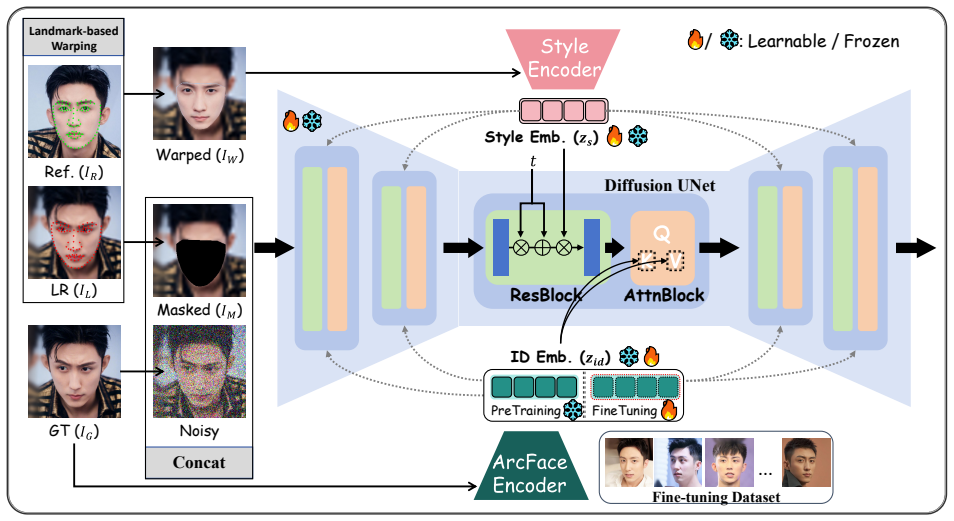
The central mechanism is identity decoupling and fitting: during pretraining, the masked low-resolution image, a style embedding from a warped reference, and a ground-truth identity embedding are combined as diffusion conditions; during fine-tuning, a single learnable identity embedding is optimized from a few same-identity photos while all other parameters stay frozen. The style embedding is injected through adaptive group normalization and the identity embedding through cross-attention, which together force the U-Net to rely on the identity code rather than on imperfect warping or residual low-res cues.
What would settle it
Evaluate IDFSR on a standard face super-resolution benchmark where the test set provides no same-identity reference images, only the degraded input; if IDS and PSNR drop to the level of reference-free baselines, the claimed contributions are entirely attributable to the fine-tuning stage rather than to the decoupled pretraining.
Extended reading notes
Core claim
IDFSR establishes that identity information can be explicitly decoupled from appearance and style in a diffusion U-Net. The method masks the facial region of the low-resolution input to remove unreliable identity cues, injects a style embedding from a landmark-warped same-identity reference via adaptive group normalization, and injects a ground-truth identity embedding from ArcFace via cross-attention during pretraining. In the fine-tuning stage, all network parameters are frozen and only a learnable identity embedding is optimized on a few images of the target identity. The paper reports that this fine-tuned embedding yields state-of-the-art identity consistency (e.g., IDS 0.2242 at 8x, 0.3
Load-bearing premise
The method assumes that at test time a few high-quality, same-identity photographs are available to fit the identity embedding; without this per-identity personalization step, the reported identity-consistency and pixel-level gains are not reproduced.
Editorial extensions
If this is right
- If the claim holds, reference-based face restoration can be turned into a personalized pipeline: a short per-identity fine-tuning from a handful of photos yields large identity-consistency gains at extreme scales.
- The decoupled design implies that precise pixel alignment between reference and low-resolution input is not strictly necessary, since the identity embedding, not the warped texture, carries the identity information.
- The reported ~15% pixel-level improvement from fine-tuning suggests that generic pretrained models underuse identity information, and a small learned token can capture fine-grained per-person attributes.
- The cross-ID transfer experiment indicates the fitted identity embedding is a manipulable, identity-specific code, which could be reused for attribute editing or other identity-conditioned generation tasks.
Reading between the lines
- The method's strong test-time dependence on same-identity reference photos means its headline gains apply to a personalized setting, not to single-image face super-resolution; an obvious extension is to train a predictor that produces the identity embedding directly from the low-res input, but the paper's own ablation suggests the explicit fitting is what drives the improvement.
- The pretraining/testing embedding discrepancy (ground-truth embeddings vs reference embeddings) means the model may be learning a general identity prior during pretraining; a direct test would be to measure performance when reference embeddings are replaced with embeddings from a different person and observe how much attribute leakage occurs.
- The warping analysis shows robustness to misalignment, but the method still needs a same-identity reference image at all; applying this approach to truly unconstrained real-world facial photos, where pose and lighting vary widely, would require combining it with robust face alignment and reference selection.
Editorial analysis
A structured set of objections, weighed in public.
Referee Report
Summary. The paper proposes IDFSR, a two-stage diffusion-based face super-resolution method for extreme (8x and 16x) upscaling. In pretraining, the facial region of the LR image is masked, a warped reference image provides a style embedding, and a GT-image ArcFace embedding provides an ID condition. In a fine-tuning stage, the U-Net and style encoder are frozen and a per-identity learnable embedding is fitted on a small set of same-identity images. The paper reports state-of-the-art results on CelebRef-HQ, especially for ID consistency, and supports the design with ablations, cross-ID experiments, and attribute/verification analyses.
Significance. If the claimed results hold under a fair protocol, the paper would make a useful contribution: the mask-and-warp design and the explicit ID-decoupling idea are plausible, and the cross-ID and style-editing experiments are informative. The paper also includes a clear ablation study that tests each component. However, the headline quantitative claim is currently confounded by an asymmetric evaluation protocol: Ours(FT) receives additional same-identity test-time data that baseline methods do not receive, so the reported SOTA margins in Table 1 do not isolate the proposed architecture. The training/test embedding mismatch is acknowledged in the text, and no personalized baseline such as the cited MyStyle is included. The central claim is defensible only after the protocol is corrected or the claims are reframed as a personalized-FSR comparison.
major comments (4)
- [Experimental Setting and Table 1] Table 1 compares Ours(FT) against CodeFormer, PGDiff, DR2, DifFace, ASFFNet, and DMDNet, but Ours(FT) is produced by fine-tuning a learnable ID embedding on a 'small set of target ID images' from the same identity before evaluation, while the baselines receive no such per-identity adaptation. Figure 4 also states that reference-based baselines use only 'a single ID randomly selected as the reference image.' The large IDS improvement (0.2242 vs 0.3169 at 8x; 0.3625 vs 0.5227 at 16x) and the claimed ~15% pixel-level gain may therefore reflect access to additional same-identity training data rather than the proposed ID-decoupling/fitting architecture. This is the central SOTA claim, so the comparison must be made fair: add a personalized baseline (e.g., MyStyle) with equivalent per-identity adaptation, or restrict the SOTA claim to Ours(PT) and report Ours(FT) separately as a personalized s
- [Quantitative Comparisons] The paper explicitly acknowledges a discrepancy between training and testing for the pretrained model: GT ID embeddings are used during pretraining, while reference ID embeddings are used during testing. This means the Ours(PT) numbers in Table 1 are not a clean evaluation of the proposed architecture under the stated test-time conditions, and Ours(FT) replaces the reference embedding with a fitted embedding. The paper should quantify the effect of this mismatch, e.g., by reporting Ours(PT) with GT test embeddings as an upper bound, and by ablating the test-time reference embedding quality. Without this, the reader cannot separate the contribution of the ID-decoupling mechanism from the contribution of having access to GT-like identity information at training time.
- [The Impact of Reference Image Quantity] Figure 7 shows that fine-tuning performance improves monotonically as the number of same-identity reference images increases and only saturates around five images. This directly supports the concern that the Ours(FT) advantage in Table 1 is at least partly attributable to the quantity of test-identity data available during fine-tuning, not solely to the architectural design. The authors should either control for the number of reference images across all methods or provide an ablation in which baselines receive the same number of same-identity reference images (e.g., through a simple reference-based adaptation) to isolate the proposed fitting mechanism.
- [Face Verification and Attribute Analysis] Table 2 reports ID verification accuracy and attribute consistency, but the evaluation protocol again uses Ours(FT) with fine-tuned identity embeddings while baselines are not personalized. The IDV improvement (89.6% vs 73.0% for DifFace) may partly inherit from the per-identity fitting stage. Moreover, Table 2 is titled 'qualitative comparison' but contains quantitative numbers; more importantly, no confidence intervals or significance tests are reported, so the 89.6% vs 73.0% gap is not established as statistically meaningful. This table should be clearly labeled as a personalized-setting evaluation and should include a non-personalized variant of IDFSR for comparison.
minor comments (6)
- [Introduction] The Introduction claims 'a significant performance improvement of 20%' while Section 'Quantitative Comparisons' says 'fine-tuning improves pixel-level consistency metrics by approximately 15%.' These numbers should be reconciled and the metric and comparison baseline specified.
- [Table 2 caption] The caption says 'The qualitative comparison' but Table 2 is quantitative. It should say 'quantitative comparison.'
- [References] The DMDNet reference (Zhao et al. 2023) points to a fish-detection paper, not to the decoupled multi-scale discriminant model for face restoration described in the text. The citation appears incorrect and should be replaced with the appropriate face-restoration DMDNet reference.
- [Datasets] The dataset 'CelebText' is mentioned as a video dataset, but no citation or description is given. Please add a reference or clarify whether this is CelebV-Text or another dataset.
- [Experimental Setting] The number of fine-tuning images per identity is not specified explicitly ('a small set,' 'each sampled ID is equally divided'). Given that Figure 7 shows performance depends strongly on this number, the exact protocol should be stated precisely.
- [Ablation Study] Figure 8 reports normalized metrics without a table of raw numbers or error bars. Given that the component analysis is an important supporting result, the authors should provide the underlying numeric values.
Circularity Check
Ours(FT) SOTA claim is forced by per-identity fine-tuning: identity is supplied via an optimized ID embedding, so ID consistency measures the fit rather than prediction from the LR image.
-
fitted input called prediction
[Methodology 'Pretraining and Finetuning'; Experimental Setting; Table 1 'Quantitative Comparisons']
"In the finetuning stage, we freeze the diffusion network θ and the style encoder Es, and replace zid with a trainable embedding vector. This vector is then optimized using a small number of same-identity samples, under the same training objective, enabling personalized and accurate ID control. ... Specifically, fine-tuning improves pixel-level consistency metrics by approximately 15%, significantly boosts ID consistency, and surpasses other methods while maintaining high visual fidelity."
The vector zid is optimized on images of the same test identity before evaluation, and IDS is then measured between the SR face and the GT face of that identity. The identity information is therefore injected as an input condition (the fitted embedding) rather than recovered from the LR image. The claimed improvements and SOTA results are thus statistically forced by the per-identity fine-tuning data, which the baselines do not receive; the comparison does not isolate the proposed architecture's super-resolution ability.
full rationale
The paper's central quantitative claim—that personalized fine-tuning yields SOTA ID consistency and pixel-level gains—reduces to the per-identity fitting protocol. The fine-tuning stage explicitly optimizes a learnable ID embedding on a small set of same-identity samples; the same identities are then used in the test set, and IDS compares the SR image with the GT image via DeepFace. This is the fitted-input-called-prediction pattern: the model is given the test identity through zid, so high ID consistency is a measure of the fit, not a prediction from the LR face. The comparison is also unequal because Ours(FT) receives additional same-identity images while baselines such as CodeFormer, PGDiff, DR2, DifFace, DMDNet, and ASFFNet are evaluated without per-identity adaptation; MyStyle, a cited personalized prior, is not included as a baseline. I found no load-bearing self-citation or imported uniqueness theorem; the paper's self-citations are background/related-work only, and the architecture's components are independently ablated. The pretraining/test mismatch (GT embeddings during training vs reference embeddings at test) is honestly acknowledged, and the pretrained model alone is compared on fairer terms. However, the headline SOTA result for Ours(FT) is partially circular because the claimed ID improvement is by construction a result of fitting the identity embedding to the test subjects. Score 6 reflects this partial circularity; it is not 8 or 10 because the method is explicitly a personalized fine-tuning framework and the non-finetuned model provides an independent architectural contribution.
Assumptions & free parameters
free parameters (2)
- per-identity ID embedding vector (fine-tuned) =
learned vector, initialized from a reference image and optimized per identity
- number of reference images for fine-tuning =
about 5 per identity
assumptions (4)
- domain assumption The pretrained ArcFace encoder provides a faithful and complete identity code when decoded by the diffusion network.
- domain assumption DiffAE-style style/ID decoupling generalizes from FFHQ pretraining to face super-resolution under masking and warping.
- domain assumption Imperfect landmark-based warping acts as benign augmentation and still supplies useful style guidance.
- domain assumption The denoising MSE objective captures ID and perceptual fidelity after conditioning on style and identity embeddings.
invented entities (1)
-
fine-tuned per-identity ID embedding vector
independent evidence
Cite this review
Pith. "Pith review of Personalized Face Super-Resolution with Identity Decoupling and Fitting." pith.science (2026). https://pith.science/paper/LHK6EZDR
@misc{pith2026250810937,
  author       = {Pith},
  title        = {Pith review of: Personalized Face Super-Resolution with Identity Decoupling and Fitting},
  year         = {2026},
  howpublished = {\url{https://pith.science/paper/LHK6EZDR}},
  note         = {Machine review of arXiv:2508.10937}
}
abstract
In recent years, face super-resolution (FSR) methods have achieved remarkable progress, generally maintaining high image fidelity and identity (ID) consistency under standard settings. However, in extreme degradation scenarios (e.g., scale $> 8\times$), critical attributes and ID information are often severely lost in the input image, making it difficult for conventional models to reconstruct realistic and ID-consistent faces. Existing methods tend to generate hallucinated faces under such conditions, producing restored images lacking authentic ID constraints. To address this challenge, we propose a novel FSR method with Identity Decoupling and Fitting (IDFSR), designed to enhance ID restoration under large scaling factors while mitigating hallucination effects. Our approach involves three key designs: 1) \textbf{Masking} the facial region in the low-resolution (LR) image to eliminate unreliable ID cues; 2) \textbf{Warping} a reference image to align with the LR input, providing style guidance; 3) Leveraging \textbf{ID embeddings} extracted from ground truth (GT) images for fine-grained ID modeling and personalized adaptation. We first pretrain a diffusion-based model to explicitly decouple style and ID by forcing it to reconstruct masked LR face regions using both style and identity embeddings. Subsequently, we freeze most network parameters and perform lightweight fine-tuning of the ID embedding using a small set of target ID images. This embedding encodes fine-grained facial attributes and precise ID information, significantly improving both ID consistency and perceptual quality. Extensive quantitative evaluations and visual comparisons demonstrate that the proposed IDFSR substantially outperforms existing approaches under extreme degradation, particularly achieving superior performance on ID consistency.
Figures


Figures from the paper (4 more)


Reference graph
Works this paper leans on
-
[1]
, " * write output.state after.block = add.period write newline
ENTRY address archivePrefix author booktitle chapter edition editor eid eprint howpublished institution isbn journal key month note number organization pages publisher school series title type volume year label extra.label sort.label short.list INTEGERS output.state before.all mid.sentence after.sentence after.block FUNCTION init.state.consts #0 'before.a...
-
[2]
write newline
" write newline "" before.all 'output.state := FUNCTION n.dashify 't := "" t empty not t #1 #1 substring "-" = t #1 #2 substring "--" = not "--" * t #2 global.max substring 't := t #1 #1 substring "-" = "-" * t #2 global.max substring 't := while if t #1 #1 substring * t #2 global.max substring 't := if while FUNCTION word.in bbl.in capitalize " " * FUNCT...
-
[3]
Alekseev, A. K.; and Navon, I. M. 2001. The analysis of an ill-posed problem using multi-scale resolution and second-order adjoint techniques. Computer Methods in Applied Mechanics and Engineering, 190(15-17): 1937--1953
work page 2001
-
[4]
Bulat, A.; and Tzimiropoulos, G. 2018. Super-fan: Integrated facial landmark localization and super-resolution of real-world low resolution faces in arbitrary poses with gans. In Proceedings of the IEEE conference on computer vision and pattern recognition, 109--117
work page 2018
-
[5]
Chen, J.; Chen, J.; Wang, Z.; Liang, C.; and Lin, C.-W. 2020. Identity-aware face super-resolution for low-resolution face recognition. IEEE Signal Processing Letters, 27: 645--649
work page 2020
-
[6]
Chen, Y.; Tai, Y.; Liu, X.; Shen, C.; and Yang, J. 2018. Fsrnet: End-to-end learning face super-resolution with facial priors. In Proceedings of the IEEE conference on computer vision and pattern recognition, 2492--2501
work page 2018
-
[7]
J.; Xu, D.; Zhang, Y.; Wang, Z.; Forsyth, D.; Krishnan, G.; Wu, Y.; and Wang, J
Chong, M. J.; Xu, D.; Zhang, Y.; Wang, Z.; Forsyth, D.; Krishnan, G.; Wu, Y.; and Wang, J. 2025. Copy or Not? Reference-Based Face Image Restoration with Fine Details. In 2025 IEEE/CVF Winter Conference on Applications of Computer Vision (WACV), 9660--9669. IEEE
work page 2025
-
[8]
Dai, T.; Cai, J.; Zhang, Y.; Xia, S.-T.; and Zhang, L. 2019. Second-order attention network for single image super-resolution. In Proceedings of the IEEE/CVF conference on computer vision and pattern recognition, 11065--11074
work page 2019
Show all 43 references
-
[9]
Dai, T.; Wang, J.; Guo, H.; Li, J.; Wang, J.; and Zhu, Z. 2024. FreqFormer: Frequency-aware transformer for lightweight image super-resolution. In Proceedings of the International Joint Conference on Artificial Intelligence, 731--739
2024
-
[10]
Deng, J.; Guo, J.; Ververas, E.; Kotsia, I.; and Zafeiriou, S. 2020. Retinaface: Single-shot multi-level face localisation in the wild. In Proceedings of the IEEE/CVF conference on computer vision and pattern recognition, 5203--5212
2020
-
[11]
Deng, J.; Guo, J.; Xue, N.; and Zafeiriou, S. 2019. Arcface: Additive angular margin loss for deep face recognition. In Proceedings of the IEEE/CVF conference on computer vision and pattern recognition, 4690--4699
2019
-
[12]
Dhariwal, P.; and Nichol, A. 2021. Diffusion models beat gans on image synthesis. Advances in neural information processing systems, 34: 8780--8794
2021
-
[13]
Dogan, B.; Gu, S.; and Timofte, R. 2019. Exemplar guided face image super-resolution without facial landmarks. In Proceedings of the IEEE/CVF conference on computer vision and pattern recognition workshops, 0--0
2019
-
[14]
Guo, H.; Guo, Y.; Zha, Y.; Zhang, Y.; Li, W.; Dai, T.; Xia, S.-T.; and Li, Y. 2025. Mambairv2: Attentive state space restoration. In Proceedings of the Computer Vision and Pattern Recognition Conference, 28124--28133
2025
-
[15]
Guo, H.; Li, J.; Dai, T.; Ouyang, Z.; Ren, X.; and Xia, S.-T. 2024. Mambair: A simple baseline for image restoration with state-space model. In European conference on computer vision, 222--241. Springer
2024
-
[16]
He, J.; Shi, W.; Chen, K.; Fu, L.; and Dong, C. 2022. Gcfsr: a generative and controllable face super resolution method without facial and gan priors. In Proceedings of the IEEE/CVF conference on computer vision and pattern recognition, 1889--1898
2022
-
[17]
Heusel, M.; Ramsauer, H.; Unterthiner, T.; Nessler, B.; and Hochreiter, S. 2017. Gans trained by a two time-scale update rule converge to a local nash equilibrium. Advances in neural information processing systems, 30
2017
-
[18]
Ho, J.; Jain, A.; and Abbeel, P. 2020. Denoising diffusion probabilistic models. Advances in neural information processing systems, 33: 6840--6851
2020
-
[19]
Huang, H.; He, R.; Sun, Z.; and Tan, T. 2017. Wavelet-srnet: A wavelet-based cnn for multi-scale face super resolution. In Proceedings of the IEEE international conference on computer vision, 1689--1697
2017
-
[20]
Jiang, J.; Wang, C.; Liu, X.; and Ma, J. 2021. Deep learning-based face super-resolution: A survey. ACM Computing Surveys (CSUR), 55(1): 1--36
2021
-
[21]
Karras, T.; Laine, S.; and Aila, T. 2019. A style-based generator architecture for generative adversarial networks. In Proceedings of the IEEE/CVF conference on computer vision and pattern recognition, 4401--4410
2019
-
[22]
Ke, J.; Wang, Q.; Wang, Y.; Milanfar, P.; and Yang, F. 2021. Musiq: Multi-scale image quality transformer. In Proceedings of the IEEE/CVF international conference on computer vision, 5148--5157
2021
-
[23]
Li, H.; Yang, Y.; Chang, M.; Chen, S.; Feng, H.; Xu, Z.; Li, Q.; and Chen, Y. 2022. Srdiff: Single image super-resolution with diffusion probabilistic models. Neurocomputing, 479: 47--59
2022
-
[24]
Li, X.; Li, W.; Ren, D.; Zhang, H.; Wang, M.; and Zuo, W. 2020. Enhanced blind face restoration with multi-exemplar images and adaptive spatial feature fusion. In Proceedings of the IEEE/CVF Conference on Computer Vision and Pattern Recognition, 2706--2715
2020
-
[25]
Li, X.; Liu, M.; Ye, Y.; Zuo, W.; Lin, L.; and Yang, R. 2018. Learning warped guidance for blind face restoration. In Proceedings of the European conference on computer vision (ECCV), 272--289
2018
-
[26]
Nitzan, Y.; Aberman, K.; He, Q.; Liba, O.; Yarom, M.; Gandelsman, Y.; Mosseri, I.; Pritch, Y.; and Cohen-Or, D. 2022. Mystyle: A personalized generative prior. ACM Transactions on Graphics (TOG), 41(6): 1--10
2022
-
[27]
Preechakul, K.; Chatthee, N.; Wizadwongsa, S.; and Suwajanakorn, S. 2022. Diffusion autoencoders: Toward a meaningful and decodable representation. In Proceedings of the IEEE/CVF conference on computer vision and pattern recognition, 10619--10629
2022
-
[28]
Rombach, R.; Blattmann, A.; Lorenz, D.; Esser, P.; and Ommer, B. 2022. High-resolution image synthesis with latent diffusion models. In Proceedings of the IEEE/CVF conference on computer vision and pattern recognition, 10684--10695
2022
-
[29]
J.; and Norouzi, M
Saharia, C.; Ho, J.; Chan, W.; Salimans, T.; Fleet, D. J.; and Norouzi, M. 2022. Image super-resolution via iterative refinement. IEEE transactions on pattern analysis and machine intelligence, 45(4): 4713--4726
2022
-
[30]
I.; and Ozpinar, A
Serengil, S. I.; and Ozpinar, A. 2020. Lightface: A hybrid deep face recognition framework. In 2020 innovations in intelligent systems and applications conference (ASYU), 1--5. IEEE
2020
-
[31]
Tao, K.; Gu, J.; Zhang, Y.; Wang, X.; and Cheng, N. 2024. Overcoming false illusions in real-world face restoration with multi-modal guided diffusion model. arXiv preprint arXiv:2410.04161
2024 arXiv
-
[32]
S.; Arya, K.; Rajput, S
Tomar, A. S.; Arya, K.; Rajput, S. S.; and Rodriguez, C. R. 2023. Comprehensive survey of face super-resolution techniques. Digital Image Enhancement and Reconstruction, 213--233
2023
-
[33]
C.; and Loy, C
Wang, J.; Chan, K. C.; and Loy, C. C. 2023. Exploring clip for assessing the look and feel of images. In Proceedings of the AAAI conference on artificial intelligence, volume 37, 2555--2563
2023
-
[34]
Wang, Z.; Zhang, Z.; Zhang, X.; Zheng, H.; Zhou, M.; Zhang, Y.; and Wang, Y. 2023. Dr2: Diffusion-based robust degradation remover for blind face restoration. In Proceedings of the IEEE/CVF Conference on Computer Vision and Pattern Recognition, 1704--1713
2023
-
[35]
Wu, Y.; and He, K. 2018. Group normalization. In Proceedings of the European conference on computer vision (ECCV), 3--19
2018
-
[36]
Yang, J.; Dai, T.; Zhu, Y.; Li, N.; Li, J.; and Xia, S.-T. 2025. Diffusion Prior Interpolation for Flexibility Real-World Face Super-Resolution. In Proceedings of the AAAI Conference on Artificial Intelligence, volume 39, 9211--9219
2025
-
[37]
Yang, P.; Zhou, S.; Tao, Q.; and Loy, C. C. 2023. PGDiff: Guiding diffusion models for versatile face restoration via partial guidance. Advances in Neural Information Processing Systems, 36: 32194--32214
2023
-
[38]
Yue, Z.; and Loy, C. C. 2024. Difface: Blind face restoration with diffused error contraction. IEEE Transactions on Pattern Analysis and Machine Intelligence
2024
-
[39]
A.; Shechtman, E.; and Wang, O
Zhang, R.; Isola, P.; Efros, A. A.; Shechtman, E.; and Wang, O. 2018 a . The unreasonable effectiveness of deep features as a perceptual metric. In Proceedings of the IEEE conference on computer vision and pattern recognition, 586--595
2018
-
[40]
Zhang, Y.; Li, K.; Li, K.; Wang, L.; Zhong, B.; and Fu, Y. 2018 b . Image super-resolution using very deep residual channel attention networks. In Proceedings of the European conference on computer vision (ECCV), 286--301
2018
-
[41]
Zhang, Y.; Wu, Y.; and Chen, L. 2020. MSFSR: A multi-stage face super-resolution with accurate facial representation via enhanced facial boundaries. In Proceedings of the IEEE/CVF conference on computer vision and pattern recognition workshops, 504--505
2020
-
[42]
Zhao, T.; Zhang, G.; Zhong, P.; and Shen, Z. 2023. DMDnet: A decoupled multi-scale discriminant model for cross-domain fish detection. Biosystems Engineering, 234: 32--45
2023
-
[43]
Zhou, S.; Chan, K.; Li, C.; and Loy, C. C. 2022. Towards robust blind face restoration with codebook lookup transformer. Advances in Neural Information Processing Systems, 35: 30599--30611
2022
Reviewed August 5, 2026 · model on record in the stance chip above.
Discussion (0). Sign in to comment.