REVIEW 5 major objections 6 minor 80 references
Hybrid-Hierarchical Fashion Graph Attention Network for Compatibility-Oriented and Personalized Outfit Recommendation
T0 review · 5 major / 6 minor · reviewed 2026-08-15 · deepseek-v4-flash
Pith's one-line read FGAT jointly models outfit compatibility and personalized taste on a three-tier fashion graph, and reports gains over strong baselines on the POG dataset.
desk verdict A real but incremental extension of HFGN that overclaims on NDCG; the architecture and compatibility results are solid, but Table IV undercuts the ranking claim. read the letter →
The pith
A machine-rendered reading of the paper's core claim, the machinery that carries it, and where it could break.
The reading
What carries the argument
The load-bearing mechanism is self-attention message passing over the three-level user-outfit-item graph, with the item-to-item attention matrix initialized by category co-occurrence weights computed from training outfits. The transformation matrix in the attention coefficient is initialized with these weights, so items from categories that frequently appear together start with stronger compatibility signals before learning begins. Propagation proceeds item-to-item, then item-to-outfit, then outfit-to-user, with multi-head attention and element-wise products that let compatible neighbors contribute more, and a multi-view attention module scores each item's importance and compatibility across several semantic views to produce the final outfit compatibility score.
What would settle it
Take FGAT and replace the category co-occurrence initialization of the item-to-item attention weights with random or uniform weights, keeping everything else fixed; if the reported gains over HFGN survive, the co-occurrence prior is not the driver. A second check: hold out all outfit pairs containing an unseen category combination and ask whether FGAT still ranks the true complementary item above the three distractors in the fill-in-the-blank task; if accuracy collapses on those pairs, the model is memorizing co-occurrence statistics rather than learning compatibility.
Extended reading notes
Core claim
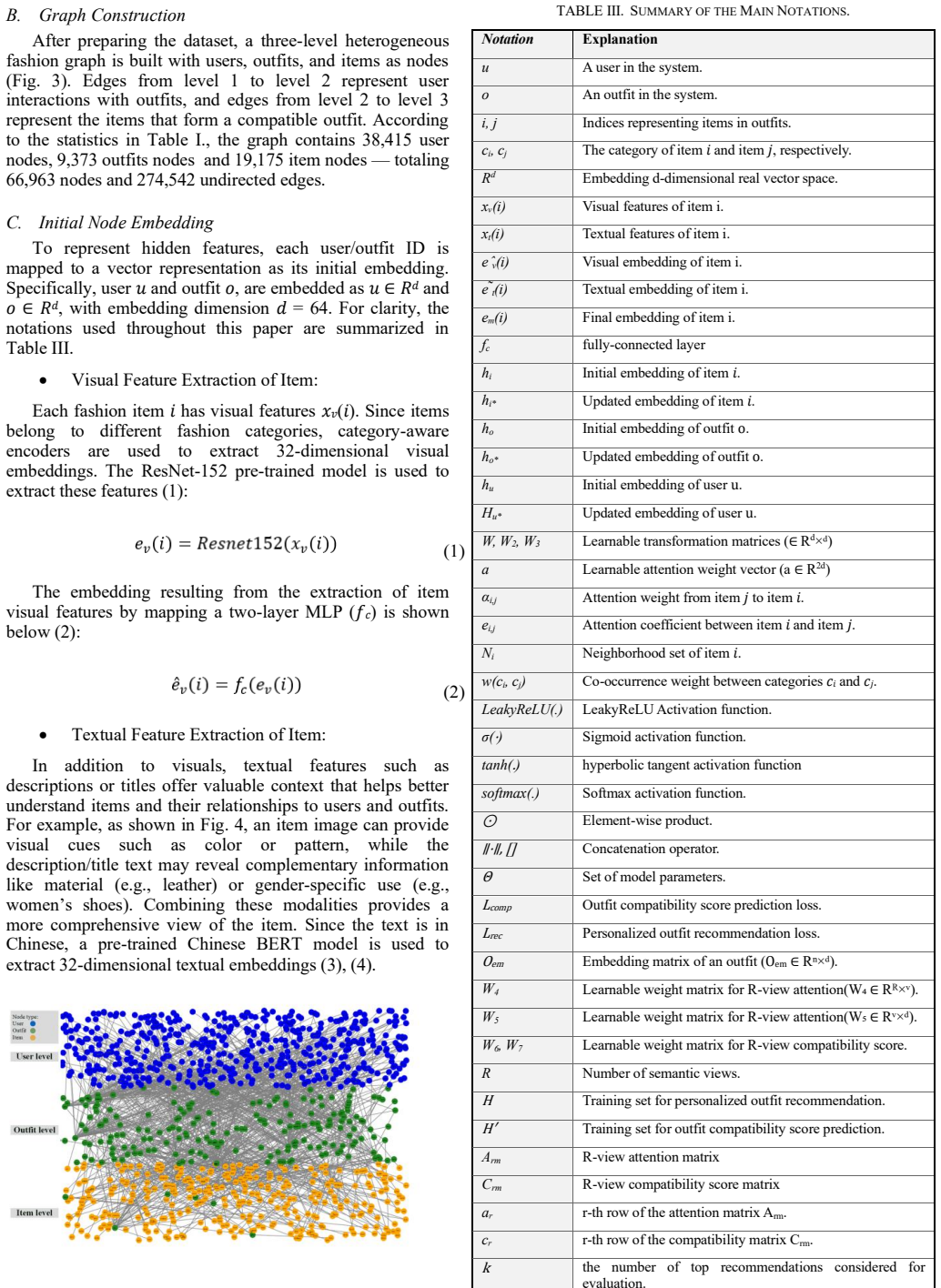
The central discovery is that a hierarchical fashion graph with attention can carry both compatibility and personalization at once, instead of treating them as separate tasks. Item embeddings start from pre-trained visual features and pre-trained Chinese textual features projected into a common 64-dimensional space; an item-to-item attention layer, initialized from category co-occurrence counts, propagates compatibility; item-to-outfit and outfit-to-user attention layers fold style and history into outfit and user embeddings; and a multi-view compatibility scorer reads the resulting item embeddings to judge whole outfits. The authors report HR@10 of 0.4286 versus HFGN's 0.2833, Precision@10 of 0.4424 versus 0.3390, NDCG@10 of 0.1340 versus 0.1241, and compatibility accuracy of 0.8956 versus 0.8797 on the POG dataset.
Load-bearing premise
The model assumes that how often two clothing categories appear together in the training outfits is a reliable signal of whether those categories, and the specific items inside them, are compatible, and that initializing the attention mechanism with these counts helps rather than biases the learned embeddings.
Editorial extensions
If this is right
- Joint training on both losses lets one set of embeddings serve both outfit compatibility and personalized ranking, so improving one task need not come at the expense of the other.
- Textual features from item titles carry complementary signals such as material, gender, and occasion, so adding them should help most on categories where images alone are ambiguous.
- Category co-occurrence priors give the attention mechanism a sensible starting point, which should matter most in small-data regimes and for cold-start items whose categories are well represented.
- Because the framework currently propagates only first-order paths, extending it to higher-order user-outfit-item paths is a direct next step that the paper leaves open.
Reading between the lines
- Editorial extension: if the co-occurrence prior is the main source of gain, the same category-level weight matrix could be reused as a transfer signal for entirely new items, since the prior is computed over categories rather than individual item embeddings.
- Editorial extension: the multi-view attention module is effectively a small interpretable component, and its learned view weights could be read out to tell users why an outfit matches, which the paper does not explore.
- Editorial extension: the large HR@10 gap over HFGN combined with a modest NDCG@10 gap suggests the improvement is concentrated in whether the right outfit appears in the top ten, not in fine-grained ranking order; a position-aware analysis would test that reading.
- Editorial extension: a natural stress test is to ablate the textual branch only; if the pre-trained textual features account for most of the gain, future work could concentrate on stronger text encoders rather than on graph depth.
Signed reviews
Editorial analysis
A structured set of objections, weighed in public.
Referee Report
Summary. The paper proposes FGAT, a hierarchical three-level graph attention network for fashion outfit recommendation on the POG dataset. The model propagates information over user–outfit–item graphs, initializes item-item attention from category co-occurrence statistics, fuses ResNet visual features with BERT textual features, and jointly optimizes BPR losses for personalized outfit recommendation and outfit compatibility scoring. The authors report gains over HFGN across HR@10, Recall@10, Precision@10, NDCG@10, Accuracy, and AUC, and claim state-of-the-art performance.
Significance. If validated, the architecture would be a plausible contribution: it unifies compatibility and personalization in one end-to-end framework, uses a legitimate category co-occurrence prior (computed from training data, not circular), and ships a concrete evaluation on a real-world dataset (POG). The multimodal fusion and R-view compatibility scoring are reasonable design choices. However, the paper's load-bearing claim of outperforming state-of-the-art baselines is contradicted by its own Table IV on NDCG@10, and the evaluation protocol has inconsistencies and lacks statistical controls. As written, the central claim is not supported by the evidence.
major comments (5)
- [Abstract, Section I, Section IV.F, Table IV] The claim that FGAT 'outperforms strong baselines such as HFGN, achieving notable improvements in ... NDCG' is internally contradicted by Table IV. FGAT's NDCG@10 is 0.1340, while Hg-PDC achieves 0.3532, LightGCN 0.2882, BPR 0.2633, and BCDSVD++ 0.1666; FGAT only beats HFGN (0.1241), by 0.0099. The abstract and introduction overstate the NDCG result, and Section IV.F itself limits the NDCG claim to an improvement over HFGN. This is a load-bearing inconsistency in the headline result.
- [Section III.A and Section IV.B] The data split is described inconsistently. Section III.A states '80% of each user’s interactions are used for training, 10% of that training set is used for validation, and the remaining 20% is used for testing', which is arithmetically ambiguous (10% of 80% is 8%, leaving 12%, not 20%). Section IV.B states '80% for training, 10% for validation, and 10% for testing'. The precise protocol must be stated unambiguously, including how the 1,647 test outfits and 3,126 test items in Table II are selected relative to the recommendation-task split, because the reported metrics are not reproducible otherwise.
- [Section IV.F, Table IV] The comparison against baselines is not demonstrably controlled. Table IV has numerous missing entries (e.g., DTNM lacks HR@10, Try-On-CM lacks NDCG@10, Precision@10, and Recall@10, RankBPR only reports Recall@10), and the text refers to a 'last column' of Table IV that does not exist in the printed table. Without a common experimental protocol, identical negative sampling, and fair hyperparameter tuning for every baseline, the relative ranking in Table IV cannot be interpreted. The authors should either re-run all baselines under the exact same setup or explicitly report the source and conditions of each baseline number.
- [Section IV.E and Section IV.F, Tables IV–VI] No error bars, standard deviations, or significance tests are reported. Several claimed improvements are small in absolute terms (e.g., NDCG@10 from 0.1241 to 0.1340, Accuracy from 0.8797 to 0.8956, AUC from 0.875 to 0.8974), and with a single run it is impossible to distinguish genuine gains from optimization noise. The authors should report multiple seeds with mean and variance, and, where appropriate, paired significance tests.
- [Section IV.D and Section IV.H] The compatibility evaluation protocol is underspecified. The FLTB task description says one item is masked and three items are randomly selected from other outfits, but it does not specify whether the negative candidates are sampled from the same category, how many random seeds are used, or how Accuracy and AUC are computed from this procedure. The paper also claims accuracy is used 'when compatible and incompatible classes are balanced', but no class-balance analysis is provided for the FLTB test set.
minor comments (6)
- [Section III.C] Equations (1) through (5) appear as blank placeholders in the manuscript, so the visual and textual feature extraction formulas are missing.
- [Section V] The first two bullets in the future-work list are identical: 'Incorporating time-aware and dynamic user-item interactions...' is duplicated.
- [Section IV.F] The phrase 'suggesting more prices results' appears to be a typo; it should likely be 'precise results' or similar.
- [Section III.D] The attention weight symbol is rendered inconsistently as '∝i,j' in the text but should be the Greek alpha 'αi,j' consistent with Table III.
- [Table II and Section III.A] The text says '1,647 unused/unappeared items in training set are selected as negative samples for the test set', but Table II reports 1,647 test outfits and 3,126 test items; the relationship between these numbers should be clarified.
- [Section I and V] The claim that the model is 'efficient and scalable' is not supported by any complexity analysis or runtime comparison, especially given the stated scalability limitations in the Conclusion.
Circularity Check
No significant circularity: FGAT's claimed predictions are learned on held-out data, and the category co-occurrence prior is a legitimate training-derived feature rather than a fitted target.
full rationale
The paper's derivation chain does not reduce to its own inputs. The item-item attention initialization in Eqs. (6)-(10) uses category co-occurrence counts computed from the training outfits; this is a legitimate feature/prior rather than a fitted label, and the reported HR@10, Precision@10, Recall@10, NDCG@10, AUC, and Accuracy are evaluated on a held-out test split (Sections III.A and IV.B), so no metric is forced by construction. The compatibility score in Eqs. (22)-(24) is trained with BPR against positive training outfits and randomly generated negatives, making it a learned function rather than a restatement of co-occurrence statistics. The two self-citations in the related-work section ([14], [31]) are contextual and are not load-bearing for the FGAT architecture or for its claimed improvements; no uniqueness theorem or ansatz is imported from the authors' own prior work. The internal inconsistency between the split descriptions in Section III.A and Section IV.B, and the fact that Table IV only shows NDCG improvement over HFGN while other baselines score higher on NDCG, are correctness and verifiability concerns rather than circularity concerns. No self-definitional, fitted-input-called-prediction, self-citation-reduction, or renaming step can be exhibited from the manuscript text.
Assumptions & free parameters
free parameters (3)
- Number of semantic views R =
6
- Number of attention heads =
4
- Embedding dimension d =
64
assumptions (4)
- domain assumption Category co-occurrence is a reliable proxy for fashion compatibility
- domain assumption Pretrained ResNet-152 and Chinese BERT provide adequate visual and textual representations for fashion items
- domain assumption BPR ranking loss accurately captures user preference and outfit compatibility
- ad hoc to paper First-order graph propagation is sufficient to capture user preferences and compatibility
Cite this review
Pith. "Pith review of Hybrid-Hierarchical Fashion Graph Attention Network for Compatibility-Oriented and Personalized Outfit Recommendation." pith.science (2026). https://pith.science/paper/7Q6FMYIP
@misc{pith2026250811105,
  author       = {Pith},
  title        = {Pith review of: Hybrid-Hierarchical Fashion Graph Attention Network for Compatibility-Oriented and Personalized Outfit Recommendation},
  year         = {2026},
  howpublished = {\url{https://pith.science/paper/7Q6FMYIP}},
  note         = {Machine review of arXiv:2508.11105}
}
read the original abstract
The rapid expansion of the fashion industry and the growing variety of products have made it increasingly challenging for users to identify compatible items on e-commerce platforms. Effective fashion recommendation systems are therefore crucial for filtering irrelevant options and suggesting suitable ones. However, simultaneously addressing outfit compatibility and personalized recommendations remains a significant challenge, as these aspects are typically treated independently in existing studies, thereby overlooking the complex interactions between items and user preferences. This research introduces a new framework named FGAT, which leverages a hierarchical graph representation together with graph attention mechanisms to address this problem. The framework constructs a three-tier graph of users, outfits, and items, integrating visual and textual features to jointly model outfit compatibility and user preferences. By dynamically weighting node importance during representation propagation, the graph attention mechanism captures key interactions and produces precise embeddings for both user preferences and outfit compatibility. Evaluated on the POG dataset, FGAT outperforms strong baselines such as HFGN, achieving notable improvements in accuracy, precision, HR, recall, and NDCG. These results demonstrate that combining multimodal visual and textual features with a hierarchical graph structure and attention mechanisms significantly enhances the effectiveness and efficiency of personalized fashion recommendation systems.
Figures


Figures from the paper (10 more)



Reference graph
Works this paper leans on
-
[1]
Recommendation Systems For E-commerce Systems An Overview,
F. T. Abdul Hussien, A. M. S. Rahma, and H. B. Abdul Wahab, “Recommendation Systems For E-commerce Systems An Overview,” J. Phys. Conf. Ser., vol. 1897, no. 1, p. 012024, May 2021, doi: 10.1088/1742-6596/1897/1/012024
-
[2]
Learning Visual Clothing Style with Heterogeneous Dyadic Co - Occurrences,
A. Veit, B. Kovacs, S. Bell, J. McAuley, K. Bala, and S. Belongie, “Learning Visual Clothing Style with Heterogeneous Dyadic Co - Occurrences,” in 2015 IEEE International Conference on Computer Vision (ICCV), Santiago, Chile: IEEE, Dec. 2015, pp. 4642 –4650. doi: 10.1109/ICCV.2015.527
-
[3]
Multimodal Compatibility Modeling via Exploring the Consistent and Complementary Correlations,
W. Guan, H. Wen, X. Song, C. -H. Yeh, X. Chang, and L. Nie, “Multimodal Compatibility Modeling via Exploring the Consistent and Complementary Correlations,” in Proceedings of the 29th ACM International Conference on Multimedia, Virtual Event China: ACM, Oct. 2021, pp. 2299–2307. doi: 10.1145/3474085.3475392
arXiv 2021
-
[4]
A decision tree based recommender system,
A. Gershman, A. Meisels, K.-H. Lüke, L. Rokach, A. Schclar, and A. Sturm, “A decision tree based recommender system,” presented at the 10th International Conferenceon Innovative Internet Community Systems (I2CS) – Jubilee Edition 2010 –, Gesellschaft für Informatik e.V., 2010, pp. 170 –179. Accessed: Aug. 02, 2024. [Online]. Available: https://dl.gi.de/ha...
work page 2010
-
[5]
Semi -Supervised Classification with Graph Convolutional Networks,
T. N. Kipf and M. Welling, “Semi -Supervised Classification with Graph Convolutional Networks,” Feb. 22, 2017, arXiv: arXiv:1609.02907. doi: 10.48550/arXiv.1609.02907
-
[6]
Inductive Representation Learning on Large Graphs,
W. Hamilton, Z. Ying, and J. Leskovec, “Inductive Representation Learning on Large Graphs,” in Advances in Neural Information Processing Systems, Curran Associates, Inc., 2017. Accessed: Aug. 14 01, 2024. [Online]. Available: https://proceedings.neurips.cc/paper/2017/hash/5dd9db5e033da9c6fb 5ba83c7a7ebea9-Abstract.html
work page 2017
-
[7]
FashionViL: Fashion-Focused Vision-and-Language Representation Learning,
X. Han, L. Yu, X. Zhu, L. Zhang, Y. -Z. Song, and T. Xiang, “FashionViL: Fashion-Focused Vision-and-Language Representation Learning,” in Computer Vision – ECCV 2022, S. Avidan, G. Brostow, M. Cissé, G. M. Farinella, and T. Hassner, Eds., Cham: Springer Nature Switzerland, 2022, pp. 634–651. doi: 10.1007/978-3- 031-19833-5_37
doi:10.1007/978-3- 2022
-
[8]
GraRep: Learning Graph Representations with Global Structural Information,
S. Cao, W. Lu, and Q. Xu, “GraRep: Learning Graph Representations with Global Structural Information,” in Proceedings of the 24th ACM International on Conference on Information and Knowledge Management, Melbourne Australia: ACM, Oct. 2015, pp. 891 –900. doi: 10.1145/2806416.2806512
arXiv 2015
Show all 80 references
-
[9]
Hierarchical Neural Networks (HNN): Using TensorFlow to build HNN,
R. Fontenot, J. Lazarus, P. Rudick, and A. Sgambellone, “Hierarchical Neural Networks (HNN): Using TensorFlow to build HNN,” SMU Data Sci. Rev., vol. 6, no. 2, Sep. 2022, [Online]. Available: https://scholar.smu.edu/datasciencereview/vol6/iss2/4
2022
-
[10]
Hierarchical Fashion Graph Network for Personalized Outfit Recommendation,
X. Li, X. Wang, X. He, L. Chen, J. Xiao, and T. -S. Chua, “Hierarchical Fashion Graph Network for Personalized Outfit Recommendation,” May 26, 2020, arXiv: arXiv:2005.12566. Accessed: Feb. 01, 2024. [Online]. Available: http://arxiv.org/abs/2005.12566
2020 arXiv
-
[11]
Dressing as a Whole: Outfit Compatibility Learning Based on Node -wise Graph Neural Networks,
Z. Cui, Z. Li, S. Wu, X. -Y. Zhang, and L. Wang, “Dressing as a Whole: Outfit Compatibility Learning Based on Node -wise Graph Neural Networks,” in The World Wide Web Conference, in WWW ’19. New York, NY, USA: Association for Computing Machinery, May 2019, pp. 307–317. doi: 10...
2019
-
[12]
Learning Binary Code for Personalized Fashion Recommendation,
Z. Lu, Y. Hu, Y. Jiang, Y. Chen, and B. Zeng, “Learning Binary Code for Personalized Fashion Recommendation,” presented at the Proceedings of the IEEE/CVF Conference on Computer Vision and Pattern Recognition, 2019, pp. 10562 –10570. Accessed: Aug. 19,
2019
-
[13]
Marcus, Graph Theory, vol
D. Marcus, Graph Theory, vol. 53. in AMS/MAA Textbooks, vol. 53. Providence, Rhode Island: American Mathematical Society, 2020. doi: 10.1090/text/053
2020 doi
-
[14]
Sentiment -Driven Community Detection in a Network of Perfume Preferences,
K. Kalashi, S. Saed, and B. Teimourpour, “Sentiment -Driven Community Detection in a Network of Perfume Preferences,” Oct. 28, 2024, arXiv: arXiv:2410.19177. doi: 10.48550/arXiv.2410.19177
2024 doi
-
[15]
Graph Representation Learning and Its Applications: A Survey,
V. T. Hoang, H.-J. Jeon, E.-S. You, Y. Yoon, S. Jung, and O. -J. Lee, “Graph Representation Learning and Its Applications: A Survey,” Sensors, vol. 23, no. 8, Art. no. 8, Jan. 2023, doi: 10.3390/s23084168
2023 doi
-
[16]
DeepWalk: Online Learning of Social Representations,
B. Perozzi, R. Al -Rfou, and S. Skiena, “DeepWalk: Online Learning of Social Representations,” in Proceedings of the 20th ACM SIGKDD international conference on Knowledge discovery and data mining, Aug. 2014, pp. 701–710. doi: 10.1145/2623330.2623732
2014
-
[17]
Asymmetric Transitivity Preserving Graph Embedding,
M. Ou, P. Cui, J. Pei, Z. Zhang, and W. Zhu, “Asymmetric Transitivity Preserving Graph Embedding,” in Proceedings of the 22nd ACM SIGKDD International Conference on Knowledge Discovery and Data Mining, San Francisco California USA: ACM, Aug. 2016, pp. 1105–1114. doi: 10.1145/2...
2016
-
[18]
GrAR: A novel framework for Graph Alignment based on Relativity concept,
M. A. Soltanshahi, B. Teimourpour, T. Khatibi, and H. Zare, “GrAR: A novel framework for Graph Alignment based on Relativity concept,” Expert Syst. Appl., vol. 187, p. 115908, Jan. 2022, doi: 10.1016/j.eswa.2021.115908
2022
-
[19]
A Comprehensive Survey on Graph Neural Networks,
Z. Wu, S. Pan, F. Chen, G. Long, C. Zhang, and P. S. Yu, “A Comprehensive Survey on Graph Neural Networks,” IEEE Trans. Neural Netw. Learn. Syst., vol. 32, no. 1, pp. 4 –24, Jan. 2021, doi: 10.1109/TNNLS.2020.2978386
2021
-
[20]
Neural Graph Collaborative Filtering,
X. Wang, X. He, M. Wang, F. Feng, and T. -S. Chua, “Neural Graph Collaborative Filtering,” in Proceedings of the 42nd International ACM SIGIR Conference on Research and Development in Information Retrieval, Jul. 2019, pp. 165 –174. doi: 10.1145/3331184.3331267
2019
-
[21]
Graph Attention Networks,
P. Veličković, G. Cucurull, A. Casanova, A. Romero, P. Liò, and Y. Bengio, “Graph Attention Networks,” Feb. 04, 2018, arXiv: arXiv:1710.10903. Accessed: Aug. 01, 2024. [Online]. Available: http://arxiv.org/abs/1710.10903
2018 arXiv
-
[22]
Attribute -aware heterogeneous graph network for fashion compatibility prediction,
Z. Zhou, View Profile, Z. Su, View Profile, R. Wang, and View Profile, “Attribute -aware heterogeneous graph network for fashion compatibility prediction,” Neurocomputing, vol. 495, no. C, pp. 62 – 74, Jul. 2022, doi: 10.1016/j.neucom.2022.04.121
2022 doi
-
[23]
Fashion Recommendation Systems, Models and Methods: A Review,
S. Chakraborty, Md. S. Hoque, N. Rahman Jeem, M. C. Biswas, D. Bardhan, and E. Lobaton, “Fashion Recommendation Systems, Models and Methods: A Review,” Informatics, vol. 8, no. 3, p. 49, Jul. 2021, doi: 10.3390/informatics8030049
2021 doi
-
[25]
Leveraging Two Types of Global Graph for Sequential Fashion Recommendation,
Y. Ding, Y. Ma, W. K. Wong, and T. -S. Chua, “Leveraging Two Types of Global Graph for Sequential Fashion Recommendation,” in Proceedings of the 2021 International Conference on Multimedia Retrieval, Aug. 2021, pp. 73–81. doi: 10.1145/3460426.3463638
2021
-
[26]
Deep Learning-Based Recommendation System: Systematic Review and Classification,
C. Li, I. Ishak, H. Ibrahim, M. Zolkepli, F. Sidi, and C. Li, “Deep Learning-Based Recommendation System: Systematic Review and Classification,” IEEE Access, vol. 11, pp. 113790–113835, 2023, doi: 10.1109/ACCESS.2023.3323353
2023
-
[27]
Outfit compatibility model using fully connected self-adjusting graph neural network,
H. Liu, L. Li, N. Yu, K. Ma, T. Peng, and X. Hu, “Outfit compatibility model using fully connected self-adjusting graph neural network,” Vis. Comput., vol. 40, no. 11, pp. 8331 –8343, Nov. 2024, doi: 10.1007/s00371-023-03238-6
2024 doi
-
[28]
Graph representation learning: a survey,
F. Chen, Y. -C. Wang, B. Wang, and C. -C. J. Kuo, “Graph representation learning: a survey,” APSIPA Trans. Signal Inf. Process., vol. 9, no. 1, 2020, doi: 10.1017/ATSIP.2020.13
2020 doi
- [29]
-
[30]
Analysis of Clothing Image Classification Models: A Comparison Study between Traditional Machine Learning and Deep Learning Models,
J. Xu, Y. Wei, A. Wang, H. Zhao, and D. Lefloch, “Analysis of Clothing Image Classification Models: A Comparison Study between Traditional Machine Learning and Deep Learning Models,” Fibres Text. East. Eur., vol. 30, no. 5, pp. 66 –78, Oct. 2022, doi: 10.2478/ftee-2022-0046
2022 doi
-
[31]
An Efficient Multiple Convolutional Neural Network Model (MCNN-14) for Fashion Image Classification,
S. Saed, B. Teimourpour, K. Kalashi, and M. A. Soltanshahi, “An Efficient Multiple Convolutional Neural Network Model (MCNN-14) for Fashion Image Classification,” in 2024 10th International Conference on Web Research (ICWR), Apr. 2024, pp. 13 –21. doi: 10.1109/ICWR61162.2024.10533341
2024
- [32]
-
[33]
ImageNet Classification with Deep Convolutional Neural Networks,
A. Krizhevsky, I. Sutskever, and G. E. Hinton, “ImageNet Classification with Deep Convolutional Neural Networks,” in Advances in Neural Information Processing Systems, Curran Associates, Inc., 2012. Accessed: Aug. 17, 2024. [Online]. Available: https://proceedings.neurips.cc/p...
2012
-
[34]
Deep Residual Learning for Image Recognition,
K. He, X. Zhang, S. Ren, and J. Sun, “Deep Residual Learning for Image Recognition,” presented at the Proceedings of the IEEE Conference on Computer Vision and Pattern Recognition, 2016, pp. 770–778. Accessed: Aug. 17, 2024. [Online]. Available: https://openaccess.thecvf.com/c...
2016
-
[35]
DeepFashion: Powering Robust Clothes Recognition and Retrieval With Rich Annotations,
Z. Liu, P. Luo, S. Qiu, X. Wang, and X. Tang, “DeepFashion: Powering Robust Clothes Recognition and Retrieval With Rich Annotations,” presented at the Proceedings of the IEEE Conference on Computer Vision and Pattern Recognition, 2016, pp. 1096 –1104. Accessed: Aug. 17, 2024. ...
2016
-
[36]
Personalized Fashion Recommendations for Diverse Body Shapes with Contrastive Multimodal Cross-Attention Network,
MaJianghong, SunHuiyue, YangDezhao, and ZhangHaijun, “Personalized Fashion Recommendations for Diverse Body Shapes with Contrastive Multimodal Cross-Attention Network,” ACM Trans. Intell. Syst. Technol., Jul. 2024, doi: 10.1145/3637217
2024 doi
-
[37]
Heterogeneous -Grained Multi -Modal Graph Network for Outfit Recommendation,
R. Xu, J. Wang, and Y. Li, “Heterogeneous -Grained Multi -Modal Graph Network for Outfit Recommendation,” IEEE Trans. Emerg. Top. Comput. Intell., vol. 8, no. 2, pp. 1788 –1799, Apr. 2024, doi: 10.1109/TETCI.2024.3358190
2024
-
[38]
Study of AI - Driven Fashion Recommender Systems,
S. Shirkhani, H. Mokayed, R. Saini, and H. Y. Chai, “Study of AI - Driven Fashion Recommender Systems,” SN Comput. Sci., vol. 4, no. 5, p. 514, Jul. 2023, doi: 10.1007/s42979-023-01932-9
2023 doi
-
[39]
Learning Type -Aware Embeddings for Fashion Compatibility,
M. I. Vasileva, B. A. Plummer, K. Dusad, S. Rajpal, R. Kumar, and D. Forsyth, “Learning Type -Aware Embeddings for Fashion Compatibility,” presented at the Proceedings of the European Conference on Computer Vision (ECCV), 2018, pp. 390 –405. Accessed: Aug. 17, 2024. [Online]. ...
2018
-
[40]
Dress Style Recommendation Based on Female Body Shapes,
W. Zong, “Dress Style Recommendation Based on Female Body Shapes,” Aug. 2022, Accessed: Aug. 17, 2024. [Online]. Available: https://hdl.handle.net/1813/112171
2022
-
[41]
Affective Image Content Analysis: Two Decades Review and New Perspectives,
S. Zhao et al., “Affective Image Content Analysis: Two Decades Review and New Perspectives,” IEEE Trans. Pattern Anal. Mach. Intell., vol. 44, no. 10, pp. 6729 –6751, Oct. 2022, doi: 10.1109/TPAMI.2021.3094362
2022
-
[42]
Recommender systems for sustainability: overview and research issues,
A. Felfernig et al., “Recommender systems for sustainability: overview and research issues,” Front. Big Data, vol. 6, Oct. 2023, doi: 10.3389/fdata.2023.1284511
2023
-
[43]
Term -weighting approaches in automatic text retrieval,
G. Salton and C. Buckley, “Term -weighting approaches in automatic text retrieval,” Inf. Process. Manag., vol. 24, no. 5, pp. 513 –523, Jan. 1988, doi: 10.1016/0306-4573(88)90021-0
1988 doi
- [44]
- [45]
-
[46]
BERT: Pre - training of Deep Bidirectional Transformers for Language Understanding,
J. Devlin, M. -W. Chang, K. Lee, and K. Toutanova, “BERT: Pre - training of Deep Bidirectional Transformers for Language Understanding,” May 24, 2019, arXiv: arXiv:1810.04805. doi: 10.48550/arXiv.1810.04805
- [47]
-
[48]
BERT4Rec: Sequential Recommendation with Bidirectional Encoder Representations from Transformer,
F. Sun et al., “BERT4Rec: Sequential Recommendation with Bidirectional Encoder Representations from Transformer,” in Proceedings of the 28th ACM International Conference on Information and Knowledge Management, Beijing China: ACM, Nov. 2019, pp. 1441–1450. doi: 10.1145/3357384.3357895
2019
- [49]
-
[50]
Neural Collaborative Filtering,
X. He, L. Liao, H. Zhang, L. Nie, X. Hu, and T. -S. Chua, “Neural Collaborative Filtering,” in Proceedings of the 26th International Conference on World Wide Web, in WWW ’17. Republic and Canton of Geneva, CHE: International World Wide Web Conferences Steering Committee, Apr. ...
2017
-
[51]
Context -Aware Visual Compatibility Prediction,
G. Cucurull, P. Taslakian, and D. Vazquez, “Context -Aware Visual Compatibility Prediction,” presented at the Proceedings of the IEEE/CVF Conference on Computer Vision and Pattern Recognition, 2019, pp. 12617 –12626. Accessed: Aug. 19, 2024. [Online]. Available: https://openac...
2019
- [52]
-
[53]
OutfitTransformer: Learning Outfit Representations for Fashion Recommendation,
R. Sarkar et al., “OutfitTransformer: Learning Outfit Representations for Fashion Recommendation,” in 2023 IEEE/CVF Winter Conference on Applications of Computer Vision (WACV), Waikoloa, HI, USA: IEEE, Jan. 2023, pp. 3590 –3598. doi: 10.1109/WACV56688.2023.00359
2023
-
[54]
POG: Personalized Outfit Generation for Fashion Recommendation at Alibaba iFashion,
W. Chen et al., “POG: Personalized Outfit Generation for Fashion Recommendation at Alibaba iFashion,” in Proceedings of the 25th ACM SIGKDD International Conference on Knowledge Discovery & Data Mining, in KDD ’19. New York, NY, USA: Association for Computing Machinery, Jul. 2...
2019
-
[55]
Partially Supervised Compatibility Modeling,
W. Guan et al., “Partially Supervised Compatibility Modeling,” IEEE Trans. Image Process., vol. 31, pp. 4733 –4745, 2022, doi: 10.1109/TIP.2022.3187290
2022
-
[56]
N -GCN: Multi- scale Graph Convolution for Semi -supervised Node Classification,
S. Abu-El-Haija, A. Kapoor, B. Perozzi, and J. Lee, “N -GCN: Multi- scale Graph Convolution for Semi -supervised Node Classification,” in Proceedings of The 35th Uncertainty in Artificial Intelligence Conference, PMLR, Aug. 2020, pp. 841 –851. Accessed: Aug. 19,
2020
-
[57]
Graph Neural News Recommendation with Unsupervised Preference Disentanglement,
L. Hu et al., “Graph Neural News Recommendation with Unsupervised Preference Disentanglement,” in Proceedings of the 58th Annual Meeting of the Association for Computational Linguistics, D. Jurafsky, J. Chai, N. Schluter, and J. Tetreault, Eds., Online: Association for Computa...
2020 doi
-
[58]
Available: https://proceedings.mlr.press/v115/abu-el- haija20a.html
[Online]. Available: https://proceedings.mlr.press/v115/abu-el- haija20a.html
- [59]
-
[60]
Bi- directional Heterogeneous Graph Hashing towards Efficient Outfit Recommendation,
W. Guan, X. Song, H. Zhang, M. Liu, C. -H. Yeh, and X. Chang, “Bi- directional Heterogeneous Graph Hashing towards Efficient Outfit Recommendation,” in Proceedings of the 30th ACM International Conference on Multimedia, in MM ’22. New York, NY, USA: Association for Computing M...
2022
-
[61]
VBPR: Visual Bayesian Personalized Ranking from Implicit Feedback,
R. He and J. McAuley, “VBPR: Visual Bayesian Personalized Ranking from Implicit Feedback,” Proc. AAAI Conf. Artif. Intell., vol. 30, no. 1, Art. no. 1, Feb. 2016, doi: 10.1609/aaai.v30i1.9973
2016 doi
-
[62]
Heterogeneous Graph Neural Network for Fashion Outfit Compatibility Prediction,
Mingming L., Qingming G., Ya Z., and Xiankang Y., “Heterogeneous Graph Neural Network for Fashion Outfit Compatibility Prediction,” J. Comput. -Aided Des. Comput. Graph., vol. 36, no. 9, pp. 1351 – 1361, 2024, doi: 10.3724/SP.J.1089.2024.19974
2024
-
[63]
Fashion Compatibility Modeling through a Multi -modal Try -on-guided Scheme,
X. Dong, J. Wu, X. Song, H. Dai, and L. Nie, “Fashion Compatibility Modeling through a Multi -modal Try -on-guided Scheme,” in Proceedings of the 43rd International ACM SIGIR Conference on Research and Development in Information Retrieval, in SIGIR ’20. New York, NY, USA: Asso...
2020
-
[64]
PAI - BPR: Personalized Outfit Recommendation Scheme with Attribute - wise Interpretability,
D. Sagar, J. Garg, P. Kansal, S. Bhalla, R. R. Shah, and Y. Yu, “PAI - BPR: Personalized Outfit Recommendation Scheme with Attribute - wise Interpretability,” in 2020 IEEE Sixth International Conference on Multimedia Big Data (BigMM), Sep. 2020, pp. 221 –230. doi: 10.1109/BigM...
2020
-
[65]
Collaborative Fashion Recommendation: A Functional Tensor Factorization Approach,
Y. Hu, X. Yi, and L. S. Davis, “Collaborative Fashion Recommendation: A Functional Tensor Factorization Approach,” in Proceedings of the 23rd ACM international conference on Multimedia, in MM ’15. New York, NY, USA: Association for Computing Machinery, Oct. 2015, pp. 129 –138....
2015
-
[66]
Modality-Oriented Graph Learning Toward Outfit Compatibility Modeling,
X. Song, S. -T. Fang, X. Chen, Y. Wei, Z. Zhao, and L. Nie, “Modality-Oriented Graph Learning Toward Outfit Compatibility Modeling,” IEEE Trans. Multimed., vol. 25, pp. 856 –867, 2023, doi: 10.1109/TMM.2021.3134164
2023
-
[67]
Personalized Fashion Compatibility Modeling via Metapath -guided Heterogeneous Graph Learning,
W. Guan, F. Jiao, X. Song, H. Wen, C. -H. Yeh, and X. Chang, “Personalized Fashion Compatibility Modeling via Metapath -guided Heterogeneous Graph Learning,” in Proceedings of the 45th International ACM SIGIR Conference on Research and Development in Information Retrieval, in ...
2022
-
[68]
GP -BPR: Personalized Compatibility Modeling for Clothing Matching,
X. Song, X. Han, Y. Li, J. Chen, X. -S. Xu, and L. Nie, “GP -BPR: Personalized Compatibility Modeling for Clothing Matching,” in Proceedings of the 27th ACM International Conference on Multimedia, in MM ’19. New York, NY, USA: Association for Computing Machinery, Oct. 2019, pp...
2019
-
[69]
MCCP: multi -modal fashion compatibility and conditional preference model for personalized clothing recommendation,
Y. Wang, L. Liu, X. Fu, and L. Liu, “MCCP: multi -modal fashion compatibility and conditional preference model for personalized clothing recommendation,” Multimed. Tools Appl., vol. 83, no. 4, pp. 9621–9645, Jan. 2024, doi: 10.1007/s11042-023-15659-5
2024 doi
-
[70]
Personalized Outfit Compatibility Prediction Using Outfit Graph Network,
B. S. Vivek, G. Bhattacharya, J. Gubbi, B. L. V, A. Pal, and P. Balamuralidhar, “Personalized Outfit Compatibility Prediction Using Outfit Graph Network,” in 2023 International Joint Conference on Neural Networks (IJCNN), Gold Coast, Australia: IEEE, Jun. 2023, pp. 1–8. doi: 1...
2023
-
[71]
Personalized clothing recommendation fusing the 4 - season color system and users’ biological characteristics,
X. Su et al., “Personalized clothing recommendation fusing the 4 - season color system and users’ biological characteristics,” Multimed. Tools Appl., vol. 83, no. 5, pp. 12597 –12625, Feb. 2024, doi: 10.1007/s11042-023-16014-4
2024 doi
-
[72]
Hierarchical Multimodal Graph Learning for Outfit Compatibility Modelling,
R. Xu, J. Wang, M. Li, J. Xu, and Y. Li, “Hierarchical Multimodal Graph Learning for Outfit Compatibility Modelling,” IEEE Trans. Emerg. Top. Comput. Intell., vol. 8, no. 6, pp. 4130–4142, Dec. 2024, doi: 10.1109/TETCI.2024.3386774
2024
- [73]
-
[74]
PFRS: Personalized Fashion Recommendation System Using EfficientNet,
A. Shoeb, M. H. Ali, Md. M. Ali, and M. S. Qaseem, “PFRS: Personalized Fashion Recommendation System Using EfficientNet,” in 2024 International Conference on Innovation and Intelligence for Informatics, Computing, and Technologies (3ICT), Nov. 2024, pp. 337–344. doi: 10.1109/3...
2024
-
[75]
Leveraging meta-path and co -attention to model consumer preference stability in fashion recommendations,
Y.-H. Hu, T.-H. Liu, K. Chen, and F. -C. Yeh, “Leveraging meta-path and co -attention to model consumer preference stability in fashion recommendations,” Decis. Support Syst., vol. 194, p. 114455, Jul. 2025, doi: 10.1016/j.dss.2025.114455
2025
-
[76]
Discrepancy Learning Guided Hierarchical Fusion Network for Multi-modal Recommendation,
Y. Dang, Z. Pan, X. Zhang, W. Chen, F. Cai, and H. Chen, “Discrepancy Learning Guided Hierarchical Fusion Network for Multi-modal Recommendation,” Knowl. -Based Syst., vol. 317, p. 113496, May 2025, doi: 10.1016/j.knosys.2025.113496
2025
-
[77]
Hashing -Based Efficient Outfit Recommendation,
W. Guan, X. Song, D. Zhou, and L. Nie, “Hashing -Based Efficient Outfit Recommendation,” in Advanced Multimodal Compatibility Modeling and Recommendation, W. Guan, X. Song, D. Zhou, and L. Nie, Eds., Cham: Springer Nature Switzerland, 2025, pp. 103 –122. doi: 10.1007/978-3-031...
2025 doi
-
[78]
StePO -Rec: Towards Personalized Outfit Styling Assistant via Knowledge -Guided Multi -Step Reasoning,
Y. Bi, Y. Gao, and H. Wang, “StePO -Rec: Towards Personalized Outfit Styling Assistant via Knowledge -Guided Multi -Step Reasoning,” Apr. 14, 2025, arXiv: arXiv:2504.09915. doi: 10.48550/arXiv.2504.09915
- [79]
- [80]
-
[2024]
Available: https://openaccess.thecvf.com/content_CVPR_2019/html/Lu_Learnin g_Binary_Code_for_Personalized_Fashion_Recommendation_CVPR _2019_paper.html
[Online]. Available: https://openaccess.thecvf.com/content_CVPR_2019/html/Lu_Learnin g_Binary_Code_for_Personalized_Fashion_Recommendation_CVPR _2019_paper.html
Reviewed August 15, 2026 · model on record in the stance chip above.
Discussion (0). Continue with ORCID to comment.