REVIEW 4 major objections 7 minor 1 cited by
VFM-Guided Semi-Supervised Detection Transformer under Source-Free Constraints for Remote Sensing Object Detection
T0 review · 4 major / 7 minor · reviewed 2026-08-05 · deepseek-v4-flash
Pith's one-line read With 5% labels, VFM-guided detector hits 77.5% mAP
desk verdict VG-DETR is a solid empirical combination for semi-supervised source-free remote sensing detection, but the load-bearing coordinate-alignment assumption between VFM and augmented student features needs to be pinned down before the gains are credible. read the letter →
The pith
A machine-rendered reading of the paper's core claim, the machinery that carries it, and where it could break.
The reading
What carries the argument
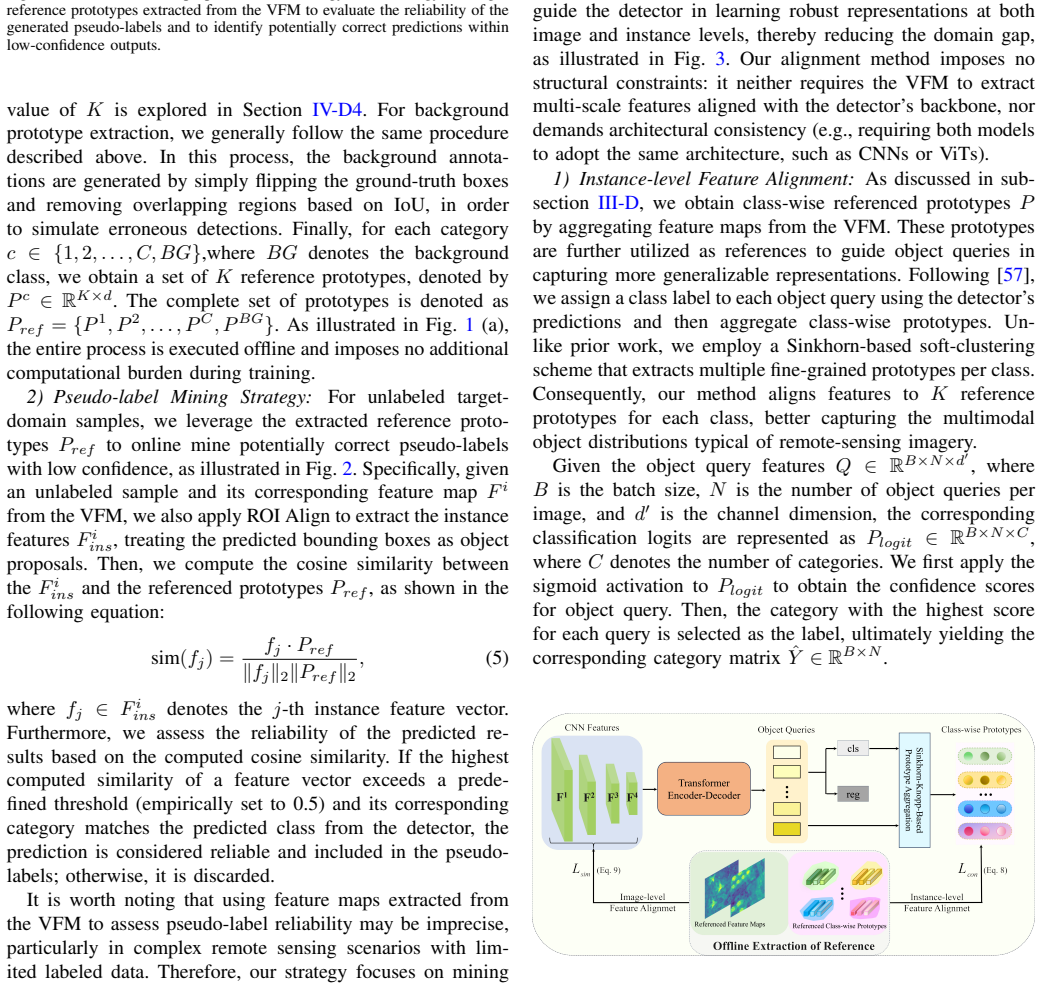
The central object is the offline-extracted DINOv2 feature map set $F^i$ and the class-wise reference prototypes $P^{\text{ref}}$ derived from labeled boxes by K-means, used as an external judge of pseudo-label reliability and a semantic anchor for alignment. The VPM strategy applies a dual threshold: predictions with confidence between a lower bound and a dynamic upper bound are kept when their VFM instance feature's cosine similarity with the matching prototype exceeds 0.5. The DVA module performs Sinkhorn-based soft clustering of object queries into $K$ fine-grained prototypes per class, with a contrastive loss $L_{\text{con}}$ pulling them toward the VFM prototypes, and an image-level co
What would settle it
Run VG-DETR with an augmentation pipeline that includes random flips and crops and compare against a version with geometric augmentations disabled or with an explicit inverse warp applied before the similarity losses in Eq. 8 and Eq. 9. If the mAP gain over the fixed-threshold baseline vanishes, the VFM guidance relied on implicit coordinate alignment rather than semantic robustness. A more direct measurement: compute the mean cosine similarity in Eq. 9 under both augmented and unaugmented inputs; near-zero similarity under augmentation would falsify the alignment premise.
Extended reading notes
Core claim
On the paper's own terms, VG-DETR establishes that a frozen vision foundation model can act as a free-lunch external supervisor for source-free remote sensing detection, provided a small labeled subset of the target domain is available. The VPM strategy takes pseudo-labels whose confidence falls in a 'grey zone' between a lower and an upper threshold, extracts their instance features from precomputed DINOv2 feature maps, and keeps them only if cosine similarity to class-wise reference prototypes (built by K-means from labeled objects and synthesized background boxes) exceeds 0.5 and matches the detector's predicted class. The DVA module additionally aligns detector representations to DINOv2
Load-bearing premise
The method assumes that features from the frozen model, computed once on original images, line up spatially with the detector's features computed on strongly augmented images, even though the paper never specifies how pseudo-labels or student features are mapped back to the original coordinates under random flips and crops.
Editorial extensions
If this is right
- Remote sensing users can adapt a source-trained detector to a new sensor or modality with only 1-10% labeled target images and no access to source data, while keeping training stable.
- Because VFM features are extracted offline and stored on disk, the frozen foundation model adds no runtime cost during inference or detector training.
- External semantic priors from foundation models can supplement or replace confidence-based pseudo-label filtering in self-training, improving both pseudo-label quality and quantity.
- The semi-supervised source-free protocol itself (1%, 5%, 10% labeled target data) becomes a practical evaluation benchmark, since pure source-free training is shown to collapse in remote sensing.
- The method generalizes across different vision foundation models: the paper reports DINOv3 matching or slightly exceeding DINOv2 results across the three scenarios.
Reading between the lines
- If the coordinate-alignment assumption between original-image VFM features and strongly augmented student features fails under random flips and crops, the VPM similarity scores and image-level loss would act on misaligned features; a direct test is to run the same method with and without such geometric augmentation.
- The prototype-based mining could be sharpened by using per-category component counts rather than a single global K, since storage tanks, ships, and aircraft likely have different intra-class appearance spreads.
- The offline-feature recipe may extend to test-time adaptation or continual domain shifts, where reference prototypes could be refreshed as new unlabeled target data arrive without retraining.
- Because the alignment losses operate on features rather than box coordinates, porting VG-DETR to oriented object detection may only require changing the box encoding while keeping the VFM guidance intact.
Editorial analysis
A structured set of objections, weighed in public.
Referee Report
Summary. The paper proposes VG-DETR, a semi-supervised source-free object detection method for remote sensing imagery, built on DINO with a mean-teacher self-training branch and an additional supervised branch using a small labeled target subset. Two main contributions are introduced: (1) VPM, which uses offline DINOv2 features and class-wise prototypes to re-evaluate low-confidence pseudo-labels, and (2) DVA, which aligns detector object-query features to VFM prototypes through Sinkhorn-based soft clustering and contrastive learning, and aligns backbone feature maps to VFM feature maps via cosine similarity. Experiments are reported on three adaptation scenarios (xView→DOTA, SRSD→DIOR, HRRSD→SSDD) under 1%, 5%, and 10% labeled target data, with the headline result of 77.5% mAP50 at 5% labels on xView→DOTA.
Significance. If the reported gains are reproducible, the paper would demonstrate a practical way to exploit frozen vision foundation models in a source-free semi-supervised detection setting, with potential benefits in pseudo-label quality and training stability. The release of code, the breadth of comparisons against UDA, SFOD, and SSOD methods, and the ablations of thresholds and prototype counts are concrete strengths. However, the central empirical claims are weakened by an unspecified spatial-correspondence assumption and by the absence of repeated-run statistics; several reported gains are small relative to what single-run comparisons can support.
major comments (4)
- [Section IV-B; Tables I-III] The method assumes spatial correspondence between VFM features extracted offline from original, unaugmented images and detector features produced on strongly augmented inputs, but no inverse augmentation or coordinate mapping is specified. Eq. (9) computes a cosine-similarity loss between the VFM feature map F_i of the original image and the student feature map F_s, while Eq. (5) and ROI Align in the VPM strategy use predicted boxes against F_i. If the strong augmentation applied to the student includes random flip, crop, or resize, the spatial locations in F_s and the predicted boxes will not coincide with F_i unless boxes and feature maps are inverse-warped to the original coordinate frame. The text only states "When spatial locations are aligned" (Section III-C), which is an assumption rather than a procedure. Please specify the exact augmentation policy, how pseudo-label boxes are tr
- [Section IV-D1; Table IV] All quantitative results appear to come from a single training run; no seeds, error bars, or statistical significance tests are reported. Some of the headline comparisons are very close, e.g., SRSD→DIOR at 5% labeled data gives 65.9 vs. 65.4 for Semi-DETR, and HRRSD→SSDD at 1% gives 61.4 vs. 61.2. In a journal submission, these margins need to be supported by mean and standard deviation over at least three seeds, especially for the main tables and the component ablations.
- [Section III-F; Eq. (10); Tables V-VI] The instance-level DVA component alone slightly degrades performance relative to the mean-teacher baseline (74.5 vs. 74.6 mAP with +MT), yet instance-level DVA is included in the final system. The text acknowledges that instance-level alignment is ineffective in isolation, but the additive attribution is unclear because the combination VPM + instance-level DVA is not reported. Please provide an ablation that separates VPM and each DVA level, and justify retaining an individually harmful component on the basis of its interaction with VPM and image-level alignment.
- [Section III-F; Eq. (10); Tables V-VI] The loss weights λ_con and λ_sim are fixed at 0.1 and 1.0 without any sensitivity study, and the threshold tables are internally inconsistent: Table V reports 75.6 mAP for the fixed threshold of 0.4, while Table VI reports 76.7 mAP for "w/o VPM strategy" at a low threshold of 0.4, suggesting different underlying configurations. Please clarify the exact baselines used in Tables V and VI and report a sensitivity analysis for the two loss weights, since these weights control the DVA contribution.
minor comments (7)
- [Section III-F] The text says the total loss combines "the detection loss (Eq. 2)", but Eq. (2) is the EMA parameter update; the detection loss is defined in Eq. (1). Please correct the cross-reference.
- [Section III-B] Reference [13] for EMA is cited as a cognitive appraisal model, not the standard exponential moving average formulation used in mean-teacher training. Please replace this reference.
- [Section III-D1] Typo: "indstance features" should be "instance features".
- [Section III-E1] Typo: "sinkkhorn-knopp" should be "Sinkhorn-Knopp".
- [Section IV-D4] Typo: "wpeakens" should be "weakens".
- [Section IV-D1] The text refers to "the proposed VFA"; this appears to be a typo for "DVA".
- [Section IV-E2] The pseudo-label visualization is qualitative only. Reporting precision/recall of mined pseudo-labels or the number of recovered boxes would strengthen the claim that VPM improves quality and quantity.
Circularity Check
No significant circularity; the central claims are empirical and self-contained, with only minor non-load-bearing self-citations and an unverified spatial-alignment assumption.
full rationale
VG-DETR's claims are empirical: it trains a detector under a semi-supervised source-free pipeline and reports mAP on held-out target validation sets. The two novel components, VPM and DVA, are training losses and pseudo-label filters, not derivations. The VPM reference prototypes are extracted from the labeled portion of the target set and used as an external semantic reference to mine low-confidence detections; this is a legitimate use of the labeled subset, not a restatement of the final mAP. The DVA losses (Eqs. 8-9) align detector features to a frozen DINOv2's features; again this is an external, parameter-free teacher, and the reported improvements are measured against ground-truth boxes not used in these losses. The self-citations to [33] (dynamic threshold) and [57] (query-label assignment) are to published, peer-reviewed methods used as components; they are not invoked as uniqueness theorems or as the sole justification for the central result. The paper's own caveat in Sec III-C ('When spatial locations are aligned') flags a genuine missing piece—the inverse augmentation mapping between original-image VFM features and strongly-augmented student features is not specified—but this is a correctness/implementability concern, not circularity, because no equation reduces the output to an input. The lower-threshold and prototype-count ablations are tuned on the validation set, which is a fair-comparison concern, not circularity. Overall, no load-bearing step reduces to its own inputs.
Assumptions & free parameters
free parameters (5)
- K (number of prototype components per class) =
4
- Lower confidence threshold for VPM mining =
0.3
- VFM cosine-similarity reliability threshold =
0.5
- Lambda_con (contrastive loss weight) =
0.1
- Lambda_sim (image-alignment loss weight) =
1.0
assumptions (4)
- domain assumption DINOv2 features provide useful semantic priors for remote sensing imagery.
- domain assumption A small fraction (1%, 5%, 10%) of target-domain labels is available in practice.
- domain assumption Mean-teacher self-training with a supervised branch prevents training collapse.
- ad hoc to paper Spatial alignment between original-image VFM features and detector features is maintained under the augmentation policy.
Cite this review
Pith. "Pith review of VFM-Guided Semi-Supervised Detection Transformer under Source-Free Constraints for Remote Sensing Object Detection." pith.science (2026). https://pith.science/paper/O7LRIFG5
@misc{pith2026250811167,
  author       = {Pith},
  title        = {Pith review of: VFM-Guided Semi-Supervised Detection Transformer under Source-Free Constraints for Remote Sensing Object Detection},
  year         = {2026},
  howpublished = {\url{https://pith.science/paper/O7LRIFG5}},
  note         = {Machine review of arXiv:2508.11167}
}
read the original abstract
Unsupervised domain adaptation methods have been widely explored to bridge domain gaps. However, in real-world remote-sensing scenarios, privacy and transmission constraints often preclude access to source domain data, which limits their practical applicability. Recently, Source-Free Object Detection (SFOD) has emerged as a promising alternative, aiming at cross-domain adaptation without relying on source data, primarily through a self-training paradigm. Despite its potential, SFOD frequently suffers from training collapse caused by noisy pseudo-labels, especially in remote sensing imagery with dense objects and complex backgrounds. Considering that limited target domain annotations are often feasible in practice, we propose a Vision foundation-Guided DEtection TRansformer (VG-DETR), built upon a semi-supervised framework for SFOD in remote sensing images. VG-DETR integrates a Vision Foundation Model (VFM) into the training pipeline in a "free lunch" manner, leveraging a small amount of labeled target data to mitigate pseudo-label noise while improving the detector's feature-extraction capability. Specifically, we introduce a VFM-guided pseudo-label mining strategy that leverages the VFM's semantic priors to further assess the reliability of the generated pseudo-labels. By recovering potentially correct predictions from low-confidence outputs, our strategy improves pseudo-label quality and quantity. In addition, a dual-level VFM-guided alignment method is proposed, which aligns detector features with VFM embeddings at both the instance and image levels. Through contrastive learning among fine-grained prototypes and similarity matching between feature maps, this dual-level alignment further enhances the robustness of feature representations against domain gaps. Extensive experiments demonstrate that VG-DETR achieves superior performance in source-free remote sensing detection tasks.
Figures


Figures from the paper (3 more)


Forward citations
Cited by 1 Pith paper
-
MobQA: A Benchmark Dataset for Semantic Understanding of Human Mobility Data through Question Answering
LLMs handle factual lookups on mobility trajectories well but perform far worse on reasoning and explanation questions in the new 5,800-pair MobQA benchmark.
Reference graph
Works this paper leans on
-
[1]
Domain adaptive faster r-cnn for object detection in the wild,
Y . Chen, W. Li, C. Sakaridis, D. Dai, and L. Van Gool, “Domain adaptive faster r-cnn for object detection in the wild,” in Proceedings of the IEEE/CVF Conference on Computer Vision and Pattern Recognition , 2018, pp. 3339–3348
work page 2018
-
[2]
Aqt: Adversarial query transformers for domain adaptive object detection,
W.-J. Huang, Y .-L. Lu, S.-Y . Lin, Y . Xie, and Y .-Y . Lin, “Aqt: Adversarial query transformers for domain adaptive object detection,” inProceedings of the International Joint Conference on Artificial Intelligence, 2022, pp. 972–979
work page 2022
-
[3]
Fada: Feature aligned domain adaptive object detection in remote sensing imagery,
T. Xu, X. Sun, W. Diao, L. Zhao, K. Fu, and H. Wang, “Fada: Feature aligned domain adaptive object detection in remote sensing imagery,” IEEE Transactions on Geoscience and Remote Sensing , vol. 60, pp. 1– 16, 2022
work page 2022
-
[4]
A free lunch for unsupervised domain adaptive object detection without source data,
X. Li, W. Chen, D. Xie, S. Yang, P. Yuan, S. Pu, and Y . Zhuang, “A free lunch for unsupervised domain adaptive object detection without source data,” in Proceedings of the AAAI Conference on Artificial Intelligence , vol. 35, no. 10, 2021, pp. 8474–8481
work page 2021
-
[5]
Multi-prototype guided source-free domain adaptive object detection for autonomous driving,
S. Zhang, L. Zhang, G. Li, P. Li, and Z. Liu, “Multi-prototype guided source-free domain adaptive object detection for autonomous driving,” IEEE Transactions on Intelligent Vehicles, vol. 9, no. 1, pp. 1589–1601, 2023
work page 2023
-
[6]
Source-free domain adaptive object detection in remote sensing images,
W. Liu, J. Liu, X. Su, H. Nie, and B. Luo, “Source-free domain adaptive object detection in remote sensing images,” arXiv preprint arXiv:2401.17916, 2024
arXiv 2024
-
[7]
Arbitrary style transfer in real-time with adaptive instance normalization,
X. Huang and S. Belongie, “Arbitrary style transfer in real-time with adaptive instance normalization,” in Proceedings of the IEEE/CVF International Conference on Computer Vision , 2017, pp. 1501–1510
work page 2017
-
[8]
Style-hallucinated dual consistency learning for domain generalized semantic segmenta- tion,
Y . Zhao, Z. Zhong, N. Zhao, N. Sebe, and G. H. Lee, “Style-hallucinated dual consistency learning for domain generalized semantic segmenta- tion,” in Proceedings of the European Conference on Computer Vision . Springer, 2022, pp. 535–552
work page 2022
Show all 69 references
-
[9]
Adversarial source generation for source-free domain adaptation,
C. Cui, F. Meng, C. Zhang, Z. Liu, L. Zhu, S. Gong, and X. Lin, “Adversarial source generation for source-free domain adaptation,”IEEE Transactions on Circuits and Systems for Video Technology , vol. 34, no. 6, pp. 4887–4898, 2024
2024
-
[10]
H 2 fa r-cnn: Holistic and hierarchical feature alignment for cross-domain weakly supervised object detection,
Y . Xu, Y . Sun, Z. Yang, J. Miao, and Y . Yang, “H 2 fa r-cnn: Holistic and hierarchical feature alignment for cross-domain weakly supervised object detection,” in Proceedings of the IEEE/CVF Conference on Computer Vision and Pattern Recognition , 2022, pp. 14 329–14 339
2022
-
[11]
Fsda-detr: Few- shot domain adaptive object detection transformer in remote sensing imagery,
B. Yang, J. Han, X. Hou, D. Zhou, W. Liu, and F. Bi, “Fsda-detr: Few- shot domain adaptive object detection transformer in remote sensing imagery,” IEEE Transactions on Geoscience and Remote Sensing , 2025. 14
2025
-
[12]
Unbiased teacher for semi-supervised object detection,
Y .-C. Liu, C.-M. Ma, Z. He, C.-W. Kuo, K. Chen, P. Zhang, B. Wu, Z. Kira, and P. Vajda, “Unbiased teacher for semi-supervised object detection,” in Proceedings of the International Conference on Learning Representations, 2021
2021
-
[13]
Ema: A process model of appraisal dynamics,
S. C. Marsella and J. Gratch, “Ema: A process model of appraisal dynamics,” Cognitive Systems Research , vol. 10, no. 1, p. 70–90, Mar 2009
2009
-
[14]
Periodically exchange teacher-student for source-free object detection,
Q. Liu, L. Lin, Z. Shen, and Z. Yang, “Periodically exchange teacher-student for source-free object detection,” in Proceedings of the IEEE/CVF International Conference on Computer Vision , 2023, pp. 6414–6424
2023
-
[15]
Dynamic retraining-updating mean teacher for source-free object detection,
T. L. B. Khanh, H.-H. Nguyen, L. H. Pham, D. N.-N. Tran, and J. W. Jeon, “Dynamic retraining-updating mean teacher for source-free object detection,” in Proceedings of the European Conference on Computer Vision. Springer, 2024, pp. 328–344
2024
-
[16]
Dinov2: Learning robust visual features without supervision,
M. Oquab, T. Darcet, T. Moutakanni, H. V o, M. Szafraniec, V . Khalidov, P. Fernandez, D. Haziza, F. Massa, A. El-Nouby et al. , “Dinov2: Learning robust visual features without supervision,” arXiv preprint arXiv:2304.07193, 2023
2023 arXiv
-
[17]
Segment anything,
A. Kirillov, E. Mintun, N. Ravi, H. Mao, C. Rolland, L. Gustafson, T. Xiao, S. Whitehead, A. C. Berg, W.-Y . Loet al., “Segment anything,” in Proceedings of the IEEE/CVF International Conference on Computer Vision, 2023, pp. 4015–4026
2023
-
[18]
Grounding dino: Marrying dino with grounded pre- training for open-set object detection,
S. Liu, Z. Zeng, T. Ren, F. Li, H. Zhang, J. Yang, Q. Jiang, C. Li, J. Yang, H. Su et al. , “Grounding dino: Marrying dino with grounded pre- training for open-set object detection,” in Proceedings of the European Conference on Computer Vision . Springer, 2024, pp. 38–55
2024
-
[19]
Remoteclip: A vision language foundation model for remote sensing,
F. Liu, D. Chen, Z. Guan, X. Zhou, J. Zhu, Q. Ye, L. Fu, and J. Zhou, “Remoteclip: A vision language foundation model for remote sensing,” IEEE Transactions on Geoscience and Remote Sensing , vol. 62, pp. 1– 16, 2024
2024
-
[20]
Some methods for classification and analysis of multi- variate observations,
J. MacQueen, “Some methods for classification and analysis of multi- variate observations,” in Proceedings of the Fifth Berkeley Symposium on Mathematical Statistics and Probability, Volume 1: Statistics , vol. 5. University of California press, 1967, pp. 281–298
1967
-
[21]
Sinkhorn distances: Lightspeed computation of optimal transport,
M. Cuturi, “Sinkhorn distances: Lightspeed computation of optimal transport,” Advances in Neural Information Processing Systems , vol. 26, 2013
2013
-
[22]
xview: Objects in context in overhead imagery,
D. Lam, R. Kuzma, K. McGee, S. Dooley, M. Laielli, M. Klaric, Y . Bulatov, and B. McCord, “xview: Objects in context in overhead imagery,” arXiv preprint arXiv:1802.07856 , 2018
2018 arXiv
-
[23]
Dota: A large-scale dataset for object detection in aerial images,
G.-S. Xia, X. Bai, J. Ding, Z. Zhu, S. Belongie, J. Luo, M. Datcu, M. Pelillo, and L. Zhang, “Dota: A large-scale dataset for object detection in aerial images,” in Proceedings of the IEEE/CVF Conference on Computer Vision and Pattern Recognition , 2018, pp. 3974–3983
2018
-
[24]
Object detection in optical remote sensing images: A survey and a new benchmark,
K. Li, G. Wan, G. Cheng, L. Meng, and J. Han, “Object detection in optical remote sensing images: A survey and a new benchmark,” ISPRS Journal of Photogrammetry and Remote Sensing , p. 296–307, Jan 2020
2020
-
[25]
Hierarchical and robust convolutional neural network for very high-resolution remote sensing object detection,
Y . Zhang, Y . Yuan, Y . Feng, and X. Lu, “Hierarchical and robust convolutional neural network for very high-resolution remote sensing object detection,” IEEE Transactions on Geoscience and Remote Sens- ing, vol. 57, no. 8, pp. 5535–5548, 2019
2019
-
[26]
Ship detection in sar images based on an improved faster r-cnn,
J. Li, C. Qu, and J. Shao, “Ship detection in sar images based on an improved faster r-cnn,” in Proceedings of the 2017 SAR in Big Data Era: Models, Methods and Applications . IEEE, 2017, pp. 1–6
2017
-
[27]
Faster r-cnn: Towards real-time object detection with region proposal networks,
S. Ren, K. He, R. Girshick, and J. Sun, “Faster r-cnn: Towards real-time object detection with region proposal networks,” IEEE Transactions on Pattern Analysis and Machine Intelligence , vol. 39, no. 6, pp. 1137– 1149, 2017
2017
-
[28]
End-to-end object detection with transformers,
N. Carion, F. Massa, G. Synnaeve, N. Usunier, A. Kirillov, and S. Zagoruyko, “End-to-end object detection with transformers,” in Proceedings of the European Conference on Computer Vision. Springer, 2020, pp. 213–229
2020
-
[29]
Exploring sequence feature alignment for domain adaptive detection transformers,
W. Wang, Y . Cao, J. Zhang, F. He, Z.-J. Zha, Y . Wen, and D. Tao, “Exploring sequence feature alignment for domain adaptive detection transformers,” in Proceedings of the ACM International Conference on Multimedia, 2021, pp. 1730–1738
2021
-
[30]
Da- detr: Domain adaptive detection transformer with information fusion,
J. Zhang, J. Huang, Z. Luo, G. Zhang, X. Zhang, and S. Lu, “Da- detr: Domain adaptive detection transformer with information fusion,” in Proceedings of the IEEE/CVF Conference on Computer Vision and Pattern Recognition, 2023, pp. 23 787–23 798
2023
-
[31]
Focal loss for dense object detection,
T.-Y . Lin, P. Goyal, R. Girshick, K. He, and P. Doll ´ar, “Focal loss for dense object detection,” in Proceedings of the IEEE/CVF International Conference on Computer Vision , 2017, pp. 2980–2988
2017
-
[32]
Dualda-net: Dual-head rectification for cross-domain object detection of remote sensing,
Y . Zhu, X. Sun, W. Diao, H. Wei, and K. Fu, “Dualda-net: Dual-head rectification for cross-domain object detection of remote sensing,” IEEE Transactions on Geoscience and Remote Sensing , vol. 61, pp. 1–16, 2023
2023
-
[33]
Remote sensing teacher: Cross-domain detection transformer with learnable frequency- enhanced feature alignment in remote sensing imagery,
J. Han, W. Yang, Y . Wang, L. Chen, and Z. Luo, “Remote sensing teacher: Cross-domain detection transformer with learnable frequency- enhanced feature alignment in remote sensing imagery,” IEEE Trans- actions on Geoscience and Remote Sensing , vol. 62, no. 5619814, pp. 1–14, 2024
2024
-
[34]
Balanced teacher for source-free ob- ject detection,
J. Deng, W. Li, and L. Duan, “Balanced teacher for source-free ob- ject detection,” IEEE Transactions on Circuits and Systems for Video Technology, 2024
2024
-
[35]
Dense learning based semi-supervised object detection,
B. Chen, P. Li, X. Chen, B. Wang, L. Zhang, and X.-S. Hua, “Dense learning based semi-supervised object detection,” in Proceedings of the IEEE/CVF Conference on Computer Vision and Pattern Recognition , 2022, pp. 4815–4824
2022
-
[36]
Dense teacher: Dense pseudo-labels for semi-supervised object detection,
H. Zhou, Z. Ge, S. Liu, W. Mao, Z. Li, H. Yu, and J. Sun, “Dense teacher: Dense pseudo-labels for semi-supervised object detection,” in Proceedings of the European Conference on Computer Vision. Springer, 2022, pp. 35–50
2022
-
[37]
Efficient non-maximum suppression,
A. Neubeck and L. Van Gool, “Efficient non-maximum suppression,” in Proceedings of the International Conference on Pattern Recognition , 2006, pp. 850–855
2006
-
[38]
End-to-end semi-supervised object detection with soft teacher,
M. Xu, Z. Zhang, H. Hu, J. Wang, L. Wang, F. Wei, X. Bai, and Z. Liu, “End-to-end semi-supervised object detection with soft teacher,” in Proceedings of the IEEE/CVF International Conference on Computer Vision, 2021, pp. 3060–3069
2021
-
[39]
Dual teacher: Improv- ing the reliability of pseudo labels for semi-supervised oriented object detection,
Z. Fang, J. Ren, J. Zheng, R. Chen, and H. Zhao, “Dual teacher: Improv- ing the reliability of pseudo labels for semi-supervised oriented object detection,” IEEE Transactions on Geoscience and Remote Sensing, 2024
2024
-
[40]
Minimizing sample redundancy for label-efficient object detection in aerial images,
R. Zhang, C. Xu, H. Zhu, F. Xu, W. Yang, H. Zhang, and G.-S. Xia, “Minimizing sample redundancy for label-efficient object detection in aerial images,” IEEE Transactions on Geoscience and Remote Sensing , vol. 63, pp. 1–14, 2025
2025
-
[41]
Omni-detr: Omni-supervised object detection with transformers,
P. Wang, Z. Cai, H. Yang, G. Swaminathan, N. Vasconcelos, B. Schiele, and S. Soatto, “Omni-detr: Omni-supervised object detection with transformers,” in Proceedings of the IEEE/CVF Conference on Computer Vision and Pattern Recognition , 2022, pp. 9367–9376
2022
-
[42]
Semi-detr: Semi-supervised object detection with detection transformers,
J. Zhang, X. Lin, W. Zhang, K. Wang, X. Tan, J. Han, E. Ding, J. Wang, and G. Li, “Semi-detr: Semi-supervised object detection with detection transformers,” in Proceedings of the IEEE/CVF Conference on Computer Vision and Pattern Recognition , 2023, pp. 23 809–23 818
2023
-
[43]
Sparse semi-detr: sparse learnable queries for semi-supervised object detection,
T. Shehzadi, K. A. Hashmi, D. Stricker, and M. Z. Afzal, “Sparse semi-detr: sparse learnable queries for semi-supervised object detection,” in Proceedings of the IEEE/CVF Conference on Computer Vision and Pattern Recognition, 2024, pp. 5840–5850
2024
-
[44]
Detect everything with few examples,
X. Zhang, Y . Liu, Y . Wang, and A. Boularias, “Detect everything with few examples,” arXiv preprint arXiv:2309.12969 , 2023
2023 arXiv
-
[45]
Cross-domain few-shot object detection via enhanced open-set object detector,
Y . Fu, Y . Wang, Y . Pan, L. Huai, X. Qiu, Z. Shangguan, T. Liu, Y . Fu, L. Van Gool, and X. Jiang, “Cross-domain few-shot object detection via enhanced open-set object detector,” in Proceedings of the European Conference on Computer Vision . Springer, 2024, pp. 247–264
2024
-
[46]
Large self-supervised models bridge the gap in domain adaptive object detection,
M.-A. Lavoie, A. Mahmoud, and S. L. Waslander, “Large self-supervised models bridge the gap in domain adaptive object detection,” in Pro- ceedings of the IEEE/CVF Conference on Computer Vision and Pattern Recognition, 2025, pp. 4692–4702
2025
-
[47]
Frozen- detr: Enhancing detr with image understanding from frozen foundation models,
S. Fu, J. Yan, Q. Yang, X. Wei, X. Xie, and W.-S. Zheng, “Frozen- detr: Enhancing detr with image understanding from frozen foundation models,” arXiv preprint arXiv:2410.19635 , 2024
2024 arXiv
-
[48]
Good: Towards domain generalized oriented object detection,
Q. Bi, B. Zhou, J. Yi, W. Ji, H. Zhan, and G.-S. Xia, “Good: Towards domain generalized oriented object detection,” ISPRS Journal of Pho- togrammetry and Remote Sensing , vol. 223, pp. 207–220, 2025
2025
-
[49]
Learning transferable visual models from natural language supervision,
A. Radford, J. W. Kim, C. Hallacy, A. Ramesh, G. Goh, S. Agarwal, G. Sastry, A. Askell, P. Mishkin, J. Clark et al., “Learning transferable visual models from natural language supervision,” in Proceedings of the International Conference on Machine Learning, pages=8748–8763, ye...
2021
-
[50]
Dino: Detr with improved denoising anchor boxes for end-to- end object detection,
H. Zhang, F. Li, S. Liu, L. Zhang, H. Su, J. Zhu, L. M. Ni, and H.-Y . Shum, “Dino: Detr with improved denoising anchor boxes for end-to- end object detection,” in Proceedings of the International Conference on Learning Representations , 2023
2023
-
[51]
An image is worth 16x16 words: Transformers for image recognition at scale,
A. Dosovitskiy, L. Beyer, A. Kolesnikov, D. Weissenborn, X. Zhai, T. Unterthiner, M. Dehghani, M. Minderer, G. Heigold, S. Gelly, J. Uszkoreit, and N. Houlsby, “An image is worth 16x16 words: Transformers for image recognition at scale,” in Proceedings of the International Con...
2021
-
[52]
Exploring robust features for few-shot object detection in satellite 15 imagery,
X. Bou, G. Facciolo, R. G. V on Gioi, J.-M. Morel, and T. Ehret, “Exploring robust features for few-shot object detection in satellite 15 imagery,” in Proceedings of the IEEE/CVF Conference on Computer Vision and Pattern Recognition , 2024, pp. 430–439
2024
-
[53]
Segment any change,
Z. Zheng, Y . Zhong, L. Zhang, and S. Ermon, “Segment any change,” Advances in Neural Information Processing Systems , vol. 37, pp. 81 204–81 224, 2024
2024
-
[54]
Evaluating general purpose vision foundation models for medical image analysis: An experimental study of dinov2 on radiology benchmarks,
M. Baharoon, W. Qureshi, J. Ouyang, Y . Xu, A. Aljouie, and W. Peng, “Evaluating general purpose vision foundation models for medical image analysis: An experimental study of dinov2 on radiology benchmarks,” arXiv preprint arXiv:2312.02366 , 2023
2023 arXiv
-
[55]
Dino-reg: General purpose image encoder for training-free multi-modal deformable medical image registration,
X. Song, X. Xu, and P. Yan, “Dino-reg: General purpose image encoder for training-free multi-modal deformable medical image registration,” in International Conference on Medical Image Computing and Computer- Assisted Intervention. Springer, 2024, pp. 608–617
2024
-
[56]
Mask r-cnn,
K. He, G. Gkioxari, P. Doll ´ar, and R. Girshick, “Mask r-cnn,” in Proceedings of the IEEE/CVF International Conference on Computer Vision, 2017, pp. 2961–2969
2017
-
[57]
Datr: Unsupervised domain adaptive detection transformer with dataset-level adaptation and prototypical alignment,
L. Chen, J. Han, and Y . Wang, “Datr: Unsupervised domain adaptive detection transformer with dataset-level adaptation and prototypical alignment,” IEEE Transactions on Image Processing , vol. 34, pp. 982– 994, 2025
2025
-
[58]
Every pixel matters: Center-aware feature alignment for domain adaptive object detector,
C. Hsu, Y .-H. Tsai, Y .-Y . Lin, and M.-H. Yang, “Every pixel matters: Center-aware feature alignment for domain adaptive object detector,” in Proceedings of the European Conference on Computer Vision, 2020, pp. 733–748
2020
-
[59]
Instance relation graph guided source- free domain adaptive object detection,
V . VS, P. Oza, and V . M. Patel, “Instance relation graph guided source- free domain adaptive object detection,” in Proceedings of the IEEE/CVF Conference on Computer Vision and Pattern Recognition , 2023, pp. 3520–3530
2023
-
[60]
Enhanc- ing source-free domain adaptive object detection with low-confidence pseudo label distillation,
I. Yoon, H. Kwon, J. Kim, J. Park, H. Jang, and K. Sohn, “Enhanc- ing source-free domain adaptive object detection with low-confidence pseudo label distillation,” in Proceedings of the European Conference on Computer Vision . Springer, 2024, pp. 337–353
2024
-
[61]
Unbiased teacher v2: Semi-supervised object detection for anchor-free and anchor-based detectors,
Y .-C. Liu, C.-Y . Ma, and Z. Kira, “Unbiased teacher v2: Semi-supervised object detection for anchor-free and anchor-based detectors,” in Pro- ceedings of the IEEE/CVF Conference on Computer Vision and Pattern Recognition, 2022, pp. 9819–9828
2022
-
[62]
Multi-clue consistency learning to bridge gaps between general and oriented object in semi-supervised detection,
C. Wang, C. Xu, X. Li, Y . Li, X. Guo, Z. Gu, and Z. Cui, “Multi-clue consistency learning to bridge gaps between general and oriented object in semi-supervised detection,” in Proceedings of the AAAI Conference on Artificial Intelligence , vol. 39, no. 7, 2025, pp. 7582–7590
2025
-
[63]
Rareplanes: Synthetic data takes flight,
J. Shermeyer, T. Hossler, A. V . Etten, D. Hogan, R. Lewis, and D. Kim, “Rareplanes: Synthetic data takes flight,” in Proceedings of the IEEE Winter Conference on Applications of Computer Vision , Jan 2021. [Online]. Available: http://dx.doi.org/10.1109/wacv48630.2021.00025
2021
-
[64]
Unsupervised domain adaptation for remote- sensing vehicle detection using domain-specific channel recalibration,
W. Liu, J. Liu, and B. Luo, “Unsupervised domain adaptation for remote- sensing vehicle detection using domain-specific channel recalibration,” IEEE Geoscience and Remote Sensing Letters , vol. 20, pp. 1–5, 2023
2023
-
[65]
Hierarchical similarity alignment for domain adaptive ship detection in sar images,
J. Zhang, S. Li, Y . Dong, B. Pan, and Z. Shi, “Hierarchical similarity alignment for domain adaptive ship detection in sar images,” IEEE Transactions on Geoscience and Remote Sensing , vol. 60, pp. 1–11, 2022
2022
-
[66]
Fsda-detr: Few- shot domain-adaptive object detection transformer in remote sensing im- agery,
B. Yang, J. Han, X. Hou, D. Zhou, W. Liu, and F. Bi, “Fsda-detr: Few- shot domain-adaptive object detection transformer in remote sensing im- agery,” IEEE Transactions on Geoscience and Remote Sensing , vol. 63, pp. 1–16, 2025
2025
-
[67]
Ima- genet: A large-scale hierarchical image database,
J. Deng, W. Dong, R. Socher, L.-J. Li, K. Li, and L. Fei-Fei, “Ima- genet: A large-scale hierarchical image database,” in Proceedings of the IEEE/CVF Conference on Computer Vision and Pattern Recognition , 2009, pp. 248–255
2009
-
[68]
Adam: A method for stochastic optimization,
D. Kingma and J. Ba, “Adam: A method for stochastic optimization,” arXiv preprint arXiv:1412.6980 , 2014
2014 arXiv
-
[69]
Sim ´eoni, H
O. Sim ´eoni, H. V . V o, M. Seitzer, F. Baldassarre, M. Oquab, C. Jose, V . Khalidov, M. Szafraniec, S. Yi, M. Ramamonjisoa et al., “Dinov3,” arXiv preprint arXiv:2508.10104 , 2025
2025 arXiv
Reviewed August 5, 2026 · model on record in the stance chip above.
Discussion (0). Sign in to comment.