REVIEW 3 major objections 5 minor 46 references
LKFMixer: Exploring Large Kernel Feature For Efficient Image Super-Resolution
T0 review · 3 major / 5 minor · reviewed 2026-08-05 · deepseek-v4-flash
Pith's one-line read LKFMixer is a pure CNN that uses a decomposed 31x31 depth-wise kernel on a fraction of channels to approximate self-attention's non-local power, and reports state-of-the-art lightweight super-resolution results with faster inference than tr
desk verdict Useful efficient-SR architecture with strong ablations, but the SOTA claim rests on a comparison table that is missing the closest prior work and contains at least one implausible number. read the letter →
The pith
A machine-rendered reading of the paper's core claim, the machinery that carries it, and where it could break.
The reading
What carries the argument
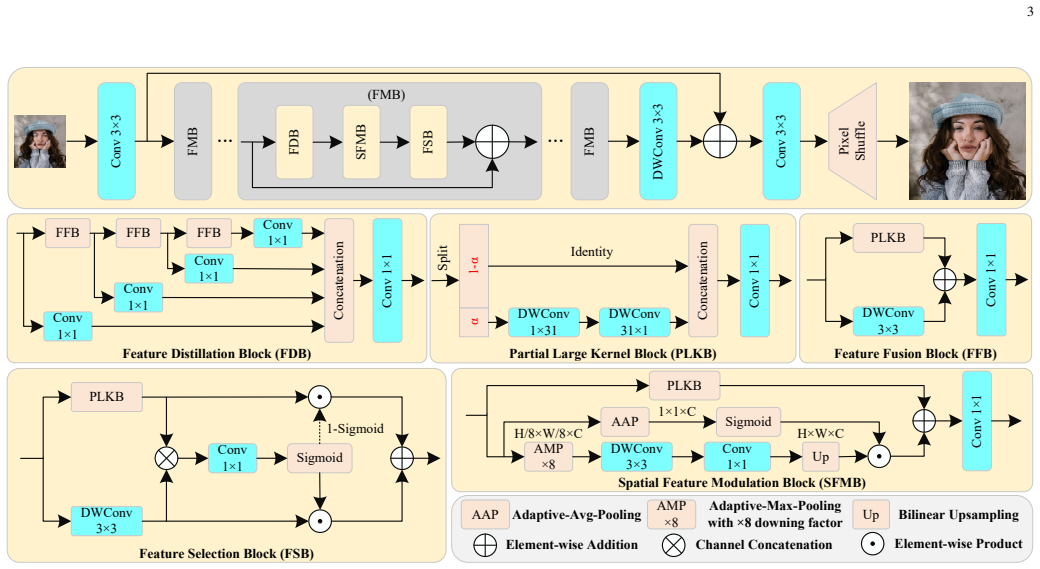
The partial large kernel block (PLKB): a $31\times31$ depth-wise convolution, replaced by two serial strip convolutions ($1\times31$ then $31\times1$) and executed on the first quarter of the channels, with the rest passed through identity; a $1\times1$ convolution then fuses the branches. This is the mechanism that makes a large receptive field cheap. The feature distillation block stacks three feature fusion blocks, each summing local $3\times3$ and PLKB features before a $1\times1$ fusion, while the spatial feature modulation block and feature selection block reweight spatial/channel and local/non-local information. The paper uses local attribution maps and effective receptive field measu
What would settle it
Recompute Table I by running each published baseline with the paper's training patches, loss, iteration count, and benchmark evaluation; a directly checkable anomaly is the SeemoRe-L BSD100 x2 entry of 34.35 dB, which sits about 2 dB above every neighboring value and would, if confirmed, change the comparison's interpretation.
Extended reading notes
Core claim
On its own terms, the paper's claim is that coordinate decomposition plus partial-channel convolution makes a $31\times31$ depth-wise kernel affordable inside a lightweight SR network, and that this kernel gives the CNN a receptive field large enough to approximate the non-local information that self-attention provides. The architecture wraps this partial large kernel block (PLKB) in a feature distillation block that fuses local ($3\times3$) and non-local features, a spatial feature modulation block that injects low-frequency spatial and channel attention, and a feature selection block that learns complementary weights between local and non-local branches. Across three model sizes the family
Load-bearing premise
The load-bearing premise is that the table of baseline results was produced under the same training and evaluation protocol as the proposed models; if the baseline PSNR values are not comparable, the claimed outperformance is not established.
Editorial extensions
If this is right
- If the reported comparisons hold, lightweight SR can reach transformer-level reconstruction quality without attention modules, since PLKB provides most of the non-local benefit at a fraction of the cost.
- Large-kernel CNN design becomes a practical choice for resource-constrained SR: kernel size can grow from 3 to 31 with almost no parameter growth because the cost is controlled by strip decomposition and partial channels.
- The feature selection block's complementary weighting is a reusable recipe for balancing local and non-local features in other image restoration networks.
- The local-attribution-map and effective-receptive-field evidence implies that architectural non-locality can be measured and optimized directly, not only inferred from PSNR.
- The family of three model sizes gives practitioners a direct complexity-performance menu, with the largest model staying near the parameter count of transformer baselines while running faster.
Reading between the lines
- The same PLKB-plus-feature-selection design should transfer to other restoration tasks where long-range context matters, such as deblurring or demosaicking, but the paper does not test this.
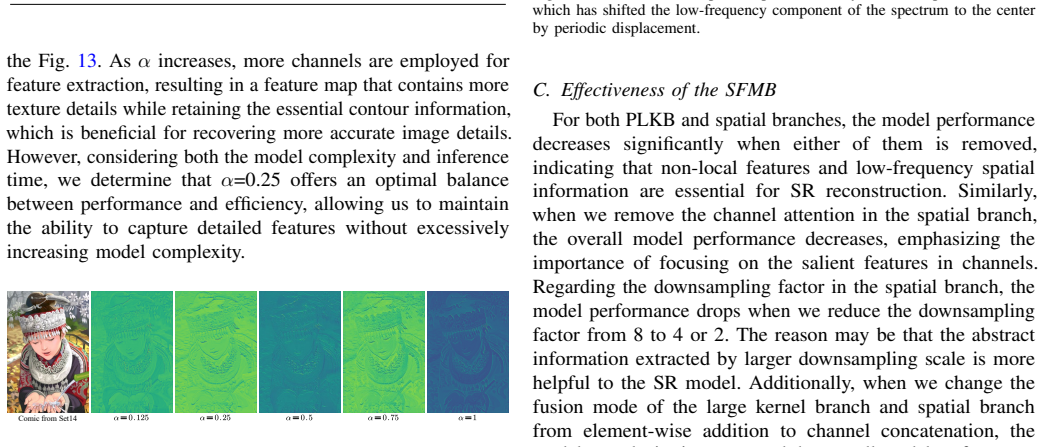
- The paper leaves open why performance peaks at kernel size 31 and falls at 41; a natural test is to vary kernel size on a different backbone or dataset to see whether the peak is a property of large kernels or of this network's capacity and frequency balance.
- If the reported 5x speed advantage reproduces on edge hardware, large-kernel CNN super-resolution may become the default for real-time deployment; the paper's timings are on a single desktop GPU.
- The decomposed strip kernel is claimed to preserve receptive field while cutting parameters and time; comparing diffusion indices on a broader set of images than the few shown would make that claim easier to assess.
Editorial analysis
A structured set of objections, weighed in public.
Referee Report
Summary. The paper proposes LKFMixer, a pure CNN family for efficient image super-resolution. The core idea is to replace the expensive 31×31 depthwise convolution with a coordinate-decomposed pair of stripe convolutions (1×31 and 31×1) applied to only a fraction α=0.25 of the channels, in the spirit of partial convolution. This is packaged into a Partial Large Kernel Block (PLKB), combined with 3×3 local features in a Feature Fusion Block, and embedded in a Feature Distillation Block. Two additional modules, SFMB and FSB, modulate spatial/channel features and adaptively weight local vs. non-local branches. The authors report three configurations (T/B/L) and claim state-of-the-art SR performance with much faster inference than transformer-based lightweight models, e.g., 0.6 dB over SwinIR-light on Manga109 ×4 while being about 5× faster. The manuscript includes extensive ablations, LAM/ERF analyses, feature-map visualizations, and a code link.
Significance. If the claims hold, the contribution is valuable: it provides a concrete CNN design that approaches transformer-level SR quality in the lightweight regime at substantially lower latency, and it systematically studies the effect of large kernel size in a partial-convolution framework. The ablation study is thorough, covering kernel size, channel split factor, module removal, and replacement of PLKB with window self-attention; the LAM/ERF and feature-map analyses are a useful addition. The paper also honestly states limitations in Section VI (e.g., no kernels larger than 41, and no full explanation of the performance drop at K=41). However, the headline SOTA claim is currently only as reliable as Table I, and that table has a clear transcription problem and omits the closest prior method, PLKCN. The contribution can become acceptable after the comparison is corrected and completed.
major comments (3)
- [Table I (Section IV.C)] The BSD100 ×2 entry for SeemoRe-L is listed as 34.35 dB, while every other ×2 BSD100 value in the table is between 32.1 and 32.4 dB and SeemoRe-L's own Set14 ×2 value is 34.01 dB. The BSD100 value should almost certainly be ≈32.35 dB. This matters because some claimed advantages over strong baselines are as small as 0.04 dB (e.g., LKFMixer-L over SeemoRe-L on Manga109 ×4 in the same table), so one transcription error is enough to change a ranking. Please correct this entry and audit all baseline numbers against the original papers.
- [Section IV.C, Table I (cf. ref. [4])] PLKCN [4] is the most directly comparable prior work: it also uses partial convolution with large kernels for efficient super-resolution. It is cited in the Introduction but never appears in Table I, Table II, or the ablations. Without this comparison, the claim that LKFMixer 'outperform[s] other state-of-the-art methods' is not tested against the closest baseline. Please add PLKCN to the quantitative and efficiency comparisons, or provide a substantive justification for its exclusion.
- [Abstract and Table I] The abstract claims that the LKFMixer family 'outperform[s] other state-of-the-art methods', but Table I shows that LKFMixer-T is not best on several rows. For example, on Manga109 ×4 LKFMixer-T reaches 30.76 dB, while SeemoRe-T and SMFANet reach 30.82 dB, BSRN 30.84 dB, and VapSR 30.86 dB. The defensible claim is that LKFMixer-B and LKFMixer-L are typically best and LKFMixer-T is competitive. Please qualify the claim and state how many of the table entries support each direction of the comparison.
minor comments (5)
- [Fig. 4] The caption uses 'EFR' while the text and Section IV.C use 'ERF'. Please standardize the acronym.
- [Eq. (8) and Section V.D] The text after Eq. (8) refers to the 'input and output of SFB', and Section V.D is titled 'Effectiveness of the SFB'. The block name is FSB; please correct these typos.
- [Table I and Table IV] The naming of CAMixerSR is inconsistent: Table I (×4) lists 'CAMixerSR', while the text and Table IV use 'CAMixerSR-light'. Please use a single consistent name and clarify which configuration is being compared.
- [Tables I and II] Please clarify the measurement conventions. Table I reports Flops for recovering a 1280×720 HR image, while Table II uses a 512×512 input; the parameter counts also vary across scales (e.g., LKFMixer-L: 906K at ×2 vs 927K at ×4). State explicitly whether parameters include the upsampler and whether the same hardware/protocol was used for all speed measurements.
- [Section IV.C] No error bars or multiple-seed results are reported. Given that several advantages are 0.04–0.08 dB, please state whether these are single-run results and note that differences at that margin may not be statistically significant.
Circularity Check
No significant circularity: SOTA claim rests on external benchmarks, not on fitted inputs or self-citation; baseline transcription issue is a correctness risk, not circularity.
full rationale
The paper's central claim—that LKFMixer outperforms SOTA lightweight SR models—is an empirical claim supported by training on DIV2K/Flickr2K and evaluating on the standard benchmark test sets (Set5, Set14, BSD100, Urban100, Manga109). No core result is derived from the paper's own equations: Eqs. (1)–(8) define the architecture (PLKB, FFB, SFMB, FSB), and the reported PSNR/SSIM values are measurements of trained models, not quantities computed from fitted parameters. Hyperparameters such as kernel size (31) and channel split factor α=0.25 are selected via ablations (Tables V and VI) against the same benchmarks; this is model selection, not a fitted input renamed as a prediction, because the reported generalization numbers are still model outputs on held-out test data. The receptive-field analyses (LAM/ERF, Figs. 3–4) are descriptive of the trained model, not predictions derived from a fit. The paper contains one incidental self-citation (RFANet [18], where the present corresponding author Y. Tang is also an author) in the related-work description of ESA/CCA; this citation is not load-bearing for any claim in the paper and does not inject a self-defined result. The most serious concern is the reliability of Table I's baseline numbers—notably the implausible SeemoRe-L BSD100 ×2 entry of 34.35 dB compared to neighboring values near 32.2 dB—but a transcription/comparison error is a correctness risk, not circularity, since the comparison protocol is external and falsifiable. The limitations section candidly states that the performance decline at kernel size 41 'has not been fully analyzed', further indicating no post-hoc self-justification. Overall, the derivation chain is self-contained: architecture choices are validated by ablations, and the SOTA claim is an independent benchmark evaluation.
Assumptions & free parameters
free parameters (4)
- Large kernel size K =
31
- Channel split factor alpha =
0.25
- SFMB downsampling factor =
8
- Model widths and depths =
{40,48,64} channels, {6,8,12} blocks for T/B/L
assumptions (4)
- domain assumption Bicubic downsampling is the degradation model for training and evaluation
- domain assumption PSNR/SSIM on the Y channel are accepted quality metrics
- domain assumption Training on DIV2K+Flickr2K generalizes to benchmark test sets
- standard math Adam optimization with 1000K iterations reaches a stable optimum
Cite this review
Pith. "Pith review of LKFMixer: Exploring Large Kernel Feature For Efficient Image Super-Resolution." pith.science (2026). https://pith.science/paper/VIHFDHWQ
@misc{pith2026250811391,
  author       = {Pith},
  title        = {Pith review of: LKFMixer: Exploring Large Kernel Feature For Efficient Image Super-Resolution},
  year         = {2026},
  howpublished = {\url{https://pith.science/paper/VIHFDHWQ}},
  note         = {Machine review of arXiv:2508.11391}
}
abstract
The success of self-attention (SA) in Transformer demonstrates the importance of non-local information to image super-resolution (SR), but the huge computing power required makes it difficult to implement lightweight models. To solve this problem, we propose a pure convolutional neural network (CNN) model, LKFMixer, which utilizes large convolutional kernel to simulate the ability of self-attention to capture non-local features. Specifically, we increase the kernel size to 31 to obtain the larger receptive field as possible, and reduce the parameters and computations by coordinate decomposition. Meanwhile, a spatial feature modulation block (SFMB) is designed to enhance the focus of feature information on both spatial and channel dimension. In addition, by introducing feature selection block (FSB), the model can adaptively adjust the weights between local features and non-local features. Extensive experiments show that the proposed LKFMixer family outperform other state-of-the-art (SOTA) methods in terms of SR performance and reconstruction quality. In particular, compared with SwinIR-light on Manga109 dataset, LKFMixer-L achieves 0.6dB PSNR improvement at $\times$4 scale, while the inference speed is $\times$5 times faster. The code is available at https://github.com/Supereeeee/LKFMixer.
Figures


Figures from the paper (11 more)



Reference graph
Works this paper leans on
-
[4]
Partial large kernel cnns for efficient super- resolution,
D. Lee, S. Yun, and Y . Ro, “Partial large kernel cnns for efficient super- resolution,” arXiv preprint arXiv:2404.11848 , 2024
arXiv 2024
-
[1]
Deep residual learning for image recognition,
K. He, X. Zhang, S. Ren, and J. Sun, “Deep residual learning for image recognition,” in 2016 IEEE Conference on Computer Vision and Pattern Recognition (CVPR), 2016, pp. 770–778
2016
-
[2]
Enhanced deep residual networks for single image super-resolution,
B. Lim, S. Son, H. Kim, S. Nah, and K. Mu Lee, “Enhanced deep residual networks for single image super-resolution,” in Proceedings of the IEEE conference on computer vision and pattern recognition workshops, 2017, pp. 136–144
2017
-
[3]
The ninth ntire 2024 efficient super-resolution challenge report,
B. Ren, Y . Li, N. Mehta, R. Timofte, H. Yu, C. Wan, Y . Hong, B. Han, Z. Wu, Y . Zou et al., “The ninth ntire 2024 efficient super-resolution challenge report,” in Proceedings of the IEEE/CVF Conference on Computer Vision and Pattern Recognition , 2024, pp. 6595–6631
2024
-
[5]
An image is worth 16x16 words: Transformers for image recognition at scale,
A. Dosovitskiy, L. Beyer, A. Kolesnikov, D. Weissenborn, X. Zhai, T. Unterthiner, M. Dehghani, M. Minderer, G. Heigold, S. Gelly, J. Uszkoreit, and N. Houlsby, “An image is worth 16x16 words: Transformers for image recognition at scale,” ICLR, 2021
2021
-
[6]
A convnet for the 2020s,
Z. Liu, H. Mao, C.-Y . Wu, C. Feichtenhofer, T. Darrell, and S. Xie, “A convnet for the 2020s,” in Proceedings of the IEEE/CVF conference on computer vision and pattern recognition , 2022, pp. 11 976–11 986
2022
-
[7]
Scaling up your kernels to 31x31: Revisiting large kernel design in cnns,
X. Ding, X. Zhang, J. Han, and G. Ding, “Scaling up your kernels to 31x31: Revisiting large kernel design in cnns,” in Proceedings of the IEEE/CVF conference on computer vision and pattern recognition , 2022, pp. 11 963–11 975
2022
-
[8]
Single image super- resolution with lightweight multi-scale dilated attention network,
X. Song, X. Pang, L. Zhang, X. Lu, and X. Hei, “Single image super- resolution with lightweight multi-scale dilated attention network,” Applied Soft Computing, p. 112569, 2024
work page 2024
Show all 46 references
-
[9]
Visual attention network,
M.-H. Guo, C.-Z. Lu, Z.-N. Liu, M.-M. Cheng, and S.-M. Hu, “Visual attention network,” Computational Visual Media , vol. 9, no. 4, pp. 733– 752, 2023
2023
-
[10]
Run, don’t walk: chasing higher flops for faster neural networks,
J. Chen, S.-h. Kao, H. He, W. Zhuo, S. Wen, C.-H. Lee, and S.-H. G. Chan, “Run, don’t walk: chasing higher flops for faster neural networks,” in Proceedings of the IEEE/CVF conference on computer vision and pattern recognition, 2023, pp. 12 021–12 031
2023
-
[11]
Learning a deep convolutional network for image super-resolution,
C. Dong, C. C. Loy, K. He, and X. Tang, “Learning a deep convolutional network for image super-resolution,” in Computer Vision–ECCV 2014: 13th European Conference, Zurich, Switzerland, September 6-12, 2014, Proceedings, Part IV 13 . Springer, 2014, pp. 184–199
2014
-
[12]
Xception: Deep learning with depthwise separable convolu- tions,
F. Chollet, “Xception: Deep learning with depthwise separable convolu- tions,” in Proceedings of the IEEE conference on computer vision and pattern recognition, 2017, pp. 1251–1258
2017
-
[13]
Rethinking depthwise separable convolu- tions: How intra-kernel correlations lead to improved mobilenets,
D. Haase and M. Amthor, “Rethinking depthwise separable convolu- tions: How intra-kernel correlations lead to improved mobilenets,” in Proceedings of the IEEE/CVF conference on computer vision and pattern recognition, 2020, pp. 14 600–14 609
2020
-
[14]
Lightweight image super- resolution with information multi-distillation network,
Z. Hui, X. Gao, Y . Yang, and X. Wang, “Lightweight image super- resolution with information multi-distillation network,” in Proceedings of the 27th acm international conference on multimedia , 2019, pp. 2024– 2032
2019
-
[15]
Residual feature distillation network for lightweight image super-resolution,
J. Liu, J. Tang, and G. Wu, “Residual feature distillation network for lightweight image super-resolution,” in Computer vision–ECCV 2020 workshops: Glasgow, UK, August 23–28, 2020, proceedings, part III 16 . Springer, 2020, pp. 41–55
2020
-
[16]
Blueprint separable residual network for efficient image super-resolution,
Z. Li, Y . Liu, X. Chen, H. Cai, J. Gu, Y . Qiao, and C. Dong, “Blueprint separable residual network for efficient image super-resolution,” in Proceedings of the IEEE/CVF conference on computer vision and pattern recognition, 2022, pp. 833–843
2022
-
[17]
Reparameterized residual feature network for lightweight image super-resolution,
W. Deng, H. Yuan, L. Deng, and Z. Lu, “Reparameterized residual feature network for lightweight image super-resolution,” in Proceedings of the IEEE/CVF conference on computer vision and pattern recognition , 2023, pp. 1712–1721
2023
-
[18]
Residual feature aggregation network for image super-resolution,
J. Liu, W. Zhang, Y . Tang, J. Tang, and G. Wu, “Residual feature aggregation network for image super-resolution,” in Proceedings of the IEEE/CVF conference on computer vision and pattern recognition , 2020, pp. 2359–2368
2020
-
[19]
Swinir: Image restoration using swin transformer,
J. Liang, J. Cao, G. Sun, K. Zhang, L. Van Gool, and R. Timofte, “Swinir: Image restoration using swin transformer,” in Proceedings of the IEEE/CVF international conference on computer vision , 2021, pp. 1833–1844
2021
-
[20]
Efficient long-range attention network for image super-resolution,
X. Zhang, H. Zeng, S. Guo, and L. Zhang, “Efficient long-range attention network for image super-resolution,” in European conference on computer vision. Springer, 2022, pp. 649–667
2022
-
[21]
Srformer: Permuted self-attention for single image super-resolution,
Y . Zhou, Z. Li, C.-L. Guo, S. Bai, M.-M. Cheng, and Q. Hou, “Srformer: Permuted self-attention for single image super-resolution,” in Proceedings of the IEEE/CVF International Conference on Computer Vision , 2023, pp. 12 780–12 791
2023
-
[22]
Camixersr: Only details need more
Y . Wang, Y . Liu, S. Zhao, J. Li, and L. Zhang, “Camixersr: Only details need more” attention”,” in Proceedings of the IEEE/CVF Conference on Computer Vision and Pattern Recognition , 2024, pp. 25 837–25 846
2024
-
[23]
Pelk: Parameter- efficient large kernel convnets with peripheral convolution,
H. Chen, X. Chu, Y . Ren, X. Zhao, and K. Huang, “Pelk: Parameter- efficient large kernel convnets with peripheral convolution,” in Proceed- ings of the IEEE/CVF Conference on Computer Vision and Pattern Recognition, 2024, pp. 5557–5567
2024
-
[24]
Real-time single image and video super- resolution using an efficient sub-pixel convolutional neural network,
W. Shi, J. Caballero, F. Husz ´ar, J. Totz, A. P. Aitken, R. Bishop, D. Rueckert, and Z. Wang, “Real-time single image and video super- resolution using an efficient sub-pixel convolutional neural network,” in Proceedings of the IEEE conference on computer vision and pattern r...
2016
-
[25]
Efficient image super-resolution using pixel attention,
H. Zhao, X. Kong, J. He, Y . Qiao, and C. Dong, “Efficient image super-resolution using pixel attention,” in Computer Vision–ECCV 2020 Workshops: Glasgow, UK, August 23–28, 2020, Proceedings, Part III 16 . Springer, 2020, pp. 56–72
2020
-
[26]
Spatially-adaptive feature modulation for efficient image super-resolution,
L. Sun, J. Dong, J. Tang, and J. Pan, “Spatially-adaptive feature modulation for efficient image super-resolution,” in Proceedings of the IEEE/CVF International Conference on Computer Vision , 2023, pp. 13 190–13 199
2023
-
[27]
Multi-scale attention network for single image super-resolution,
Y . Wang, Y . Li, G. Wang, and X. Liu, “Multi-scale attention network for single image super-resolution,” in Proceedings of the IEEE/CVF Conference on Computer Vision and Pattern Recognition , 2024, pp. 5950–5960
2024
-
[28]
Smfanet: A lightweight self-modulation feature aggregation network for efficient image super- resolution,
M. Zheng, L. Sun, J. Dong, and J. Pan, “Smfanet: A lightweight self-modulation feature aggregation network for efficient image super- resolution,” in ECCV, 2024
2024
-
[29]
See more details: Efficient image super-resolution by experts mining,
E. Zamfir, Z. Wu, N. Mehta, Y . Zhang, and R. Timofte, “See more details: Efficient image super-resolution by experts mining,” in Forty-first International Conference on Machine Learning , 2024
2024
-
[30]
Shufflemixer: An efficient convnet for image super-resolution,
L. Sun, J. Pan, and J. Tang, “Shufflemixer: An efficient convnet for image super-resolution,” Advances in Neural Information Processing Systems, vol. 35, pp. 17 314–17 326, 2022
2022
-
[31]
Efficient image super-resolution using vast-receptive-field attention,
L. Zhou, H. Cai, J. Gu, Z. Li, Y . Liu, X. Chen, Y . Qiao, and C. Dong, “Efficient image super-resolution using vast-receptive-field attention,” in European conference on computer vision . Springer, 2022, pp. 256–272
2022
-
[32]
Large kernel distillation network for efficient single image super-resolution,
C. Xie, X. Zhang, L. Li, H. Meng, T. Zhang, T. Li, and X. Zhao, “Large kernel distillation network for efficient single image super-resolution,” in Proceedings of the IEEE/CVF Conference on Computer Vision and Pattern Recognition, 2023, pp. 1283–1292
2023
-
[33]
Transforming image super- resolution: A convformer-based efficient approach,
G. Wu, J. Jiang, J. Jiang, and X. Liu, “Transforming image super- resolution: A convformer-based efficient approach,” IEEE Transactions on Image Processing , 2024
2024
-
[34]
Osffnet: Omni-stage feature fusion network for lightweight image super-resolution,
Y . Wang and T. Zhang, “Osffnet: Omni-stage feature fusion network for lightweight image super-resolution,” in Proceedings of the AAAI Conference on Artificial Intelligence , vol. 38, no. 6, 2024, pp. 5660– 5668
2024
-
[35]
Mambair: A simple baseline for image restoration with state-space model,
H. Guo, J. Li, T. Dai, Z. Ouyang, X. Ren, and S.-T. Xia, “Mambair: A simple baseline for image restoration with state-space model,” in European conference on computer vision . Springer, 2024, pp. 222–241
2024
-
[36]
Ntire 2017 challenge on single image super-resolution: Dataset and study,
E. Agustsson and R. Timofte, “Ntire 2017 challenge on single image super-resolution: Dataset and study,” in Proceedings of the IEEE conference on computer vision and pattern recognition workshops , 2017, pp. 126–135. 11
2017
-
[37]
Low- complexity single-image super-resolution based on nonnegative neighbor embedding,
M. Bevilacqua, A. Roumy, C. Guillemot, and M.-L. A. Morel, “Low- complexity single-image super-resolution based on nonnegative neighbor embedding,” in British Machine Vision Conference (BMVC) , 2012
2012
-
[38]
On single image scale-up using sparse-representations,
R. Zeyde, M. Elad, and M. Protter, “On single image scale-up using sparse-representations,” in Curves and Surfaces: 7th International Conference, Avignon, France, June 24-30, 2010, Revised Selected Papers
2010
-
[39]
Springer, 2012, pp. 711–730
2012
-
[40]
A database of human segmented natural images and its application to evaluating segmentation algorithms and measuring ecological statistics,
D. Martin, C. Fowlkes, D. Tal, and J. Malik, “A database of human segmented natural images and its application to evaluating segmentation algorithms and measuring ecological statistics,” in Proceedings eighth IEEE international conference on computer vision. ICCV 2001 , vol. 2...
2001
-
[41]
Single image super-resolution from transformed self-exemplars,
J.-B. Huang, A. Singh, and N. Ahuja, “Single image super-resolution from transformed self-exemplars,” in Proceedings of the IEEE conference on computer vision and pattern recognition , 2015, pp. 5197–5206
2015
-
[42]
Sketch-based manga retrieval using manga109 dataset,
Y . Matsui, K. Ito, Y . Aramaki, A. Fujimoto, T. Ogawa, T. Yamasaki, and K. Aizawa, “Sketch-based manga retrieval using manga109 dataset,” Multimedia tools and applications , vol. 76, pp. 21 811–21 838, 2017
2017
-
[43]
Adam: A method for stochastic optimization,
D. P. Kingma, “Adam: A method for stochastic optimization,” arXiv preprint arXiv:1412.6980, 2014
2014 arXiv
-
[44]
Interpreting super-resolution networks with local attribution maps,
J. Gu and C. Dong, “Interpreting super-resolution networks with local attribution maps,” in Proceedings of the IEEE/CVF Conference on Computer Vision and Pattern Recognition , 2021, pp. 9199–9208
2021
-
[45]
Esrgan: enhanced super-resolution generative adversarial networks,
X. Wang, K. Yu, S. Wu, J. Gu, Y . Liu, C. Dong, Y . Qiao, and C. Change Loy, “Esrgan: enhanced super-resolution generative adversarial networks,” in Proceedings of the European conference on computer vision (ECCV) workshops, 2018, pp. 0–0
2018
-
[46]
The unreasonable effectiveness of deep features as a perceptual metric,
R. Zhang, P. Isola, A. A. Efros, E. Shechtman, and O. Wang, “The unreasonable effectiveness of deep features as a perceptual metric,” in Proceedings of the IEEE conference on computer vision and pattern recognition, 2018, pp. 586–595
2018
Reviewed August 5, 2026 · model on record in the stance chip above.
Discussion (0). Sign in to comment.