REVIEW 5 major objections 4 minor 45 references
Humanoid Motion Scripting with Postural Synergies
T0 review · 5 major / 4 minor · reviewed 2026-08-15 · deepseek-v4-flash
Pith's one-line read Three principal postural synergies, extracted from momentum-segmented joint velocities, reconstruct eight dance genres above 90% fidelity and make text-driven humanoid motion smoother.
desk verdict A clean, training-free synergy pipeline that is genuinely novel in its combination, but the headline numbers rest on in-sample analysis and an uncontrolled MotionGPT baseline. read the letter →
The pith
A machine-rendered reading of the paper's core claim, the machinery that carries it, and where it could break.
The reading
What carries the argument
The load-bearing object is the postural synergy basis. Within each momentum-segmented movement, PCA of joint-velocity trajectories produces principal directions $\dot{q}_i$, and the first three span a subspace in which a segment's velocity is approximated by $\dot{q}(t) \approx \sum_{i=1}^3 a_i(t) \dot{q}_i$; full poses are recovered by integrating from a reference pose $q_0$. The second mechanism is the torso null-space projection, $\hat{\dot{q}}_{\text{GPT}|t} = S S^{\mathsf{T}} N_t \dot{q}_{\text{GPT}}$, which keeps generated velocity inside the synergy subspace while removing torso motion, so that posture and task commands stay compatible. SynSculptor exposes the synergy coefficients as adjustable parameters, turning whole-body motion editing into a small set of slider values.
What would settle it
Recompute the PCA on one half of the captured segments and measure reconstruction error on the other half, including held-out subjects and held-out dance styles; the central claim fails if the 3-D basis explains substantially less variance, or if projecting held-out text-to-motion outputs no longer reduces the foot-sliding ratio below the raw output's.
Extended reading notes
Core claim
The central discovery is that postural synergies—a reference pose plus the top three PCA velocity modes of momentum-segmented motion—form a sufficient vocabulary for human-like humanoid motion. The paper establishes this by compressing captured motion into this 3-D subspace, by showing that random coefficient draws in the subspace reproduce the original momentum and kinetic-energy profiles, and by showing that constraining a text-to-motion model's outputs to the subspace with a torso null-space projection improves contact realism and reduces power demand. The underlying hypothesis is that human movement exhibits structured variability: whole-body coordination is governed by a low-dimensional set of synergies, and stylistic differences appear as reweighting of secondary and tertiary components.
Load-bearing premise
The argument assumes that the motion-capture data used to build the synergy basis represents the range of motions a humanoid will be asked to produce, since the reported fidelity and improvement numbers are computed on those same trials rather than on held-out motions.
Editorial extensions
If this is right
- A fixed 3-D synergy basis can compress and re-synthesize a broad set of free-space motions above 90% reconstruction fidelity, so full-body motion can be edited through a handful of coefficients.
- Text-to-motion outputs can be made more humanoid without retraining by projecting them into a precomputed synergy subspace; the reported reductions in foot sliding and mechanical power mean the projection acts as a cheap physical-plausibility filter.
- Because dance genres occupy different regions of the same synergy space, style can be shifted by reweighting secondary and tertiary components rather than by changing the task controller.
- Synergies extracted once from captured motion can be stored in a compact library and reused to compose movements never explicitly demonstrated.
Reading between the lines
- The paper does not test this, but the same null-space projection could be applied to other generative motion models as a post-processing layer, making low-dimensional synergy filtering a general contact-realism prior rather than a property of one transformer.
- The momentum-threshold definition of a 'move' suggests a testable decomposition: if the threshold transfers across subjects, speeds, and body proportions, it could serve as a universal primitive boundary for humanoid motion libraries.
- Because the variance and improvement numbers are computed on the same trials used to fit the PCA, the decisive next check is held-out evaluation; the paper's own genre analysis hints that Irish dance and Hip-Hop may need richer bases than Ballet and Lyrical.
- If synergy coefficients indeed decouple style from kinematics, then interpolating between two dancers' coefficient vectors should produce a smooth, recognizable style morph—an experiment that would directly validate the editor's central interface.
Signed reviews
Editorial analysis
A structured set of objections, weighed in public.
Referee Report
Summary. SynSculptor maps human motion-capture data onto a simulated humanoid via operational space control, segments joint-velocity trajectories by momentum changes, fits a per-segment PCA basis, and uses the resulting three-dimensional synergy subspace for a motion editor and for projecting MotionGPT outputs into a human-like motion space. The paper reports in-sample variance explained, an energetic reconstruction comparison, a human-vs-robot power comparison, and foot-sliding/power reductions for MotionGPT outputs. It claims that a fixed 3-D synergy basis suffices for high-fidelity, style-conditioned, training-free humanoid motion scripting.
Significance. If the generalization claims were established, SynSculptor would provide a practical low-dimensional interface for humanoid motion authoring and a simple inductive bias for text-to-motion models. The paper's concrete strengths are the real-time 1 kHz operational-space mapping pipeline, the released code/data/videos, and the synergy-slider interface, which are reproducible system contributions. The conclusion is explicit about not enforcing contact stability, which is appropriately candid. However, the quantitative support for the headline claims is thin and partly circular: variance-explained and reconstruction metrics are in-sample, the energetic comparison uses random samples rather than projected inputs, and the human-vs-robot power comparison is not a controlled measurement. The significance is therefore conditional on substantially stronger validation.
major comments (5)
- [IV.C, Eq. (6)] All synergy-fidelity numbers are in-sample: the PCA basis is fit to the same eight-genre/single-dancer and 20-subject trials on which variance explained is then reported. No leave-one-genre-out, leave-one-subject-out, or pose-level reconstruction error (e.g., mean joint-angle RMSE) is presented, so the conclusion that synergies "can be reused to generate new motions without task-specific retraining" (Section V) is unsupported as stated. Please add held-out evaluations and report per-joint reconstruction error in addition to variance explained.
- [IV.D, Eq. (6), Fig. 6] The Monte Carlo energetic "reconstruction" draws 100 random coefficient vectors in the fitted 3-D subspace rather than projecting the original trajectory onto the basis; comparing these random samples with the original ΔP and ΔKE therefore does not measure reconstruction fidelity. The roughly 32% reduction in mean ΔKE is exactly what discarding high-variance components would be expected to produce and is evidence of information loss, not of dynamics preservation. A faithful reconstruction experiment should project original velocities onto the basis, integrate, and report pose and energy errors.
- [IV.A, Eq. (8), Fig. 3] The 3.3× human-vs-robot efficiency comparison is not a controlled measurement: it compares OpenSim muscle-power sums with OpenSai joint torque×velocity sums, uses different models, and explicitly disregards contact forces in tasks dominated by ground contact (jumping, walking in place, squats). The claim that this result "confirms" physical realism is not supported by the presented evidence. Please either remove the efficiency claim or rerun with matching contact-aware, model-matched dynamics and report per-trial statistics.
- [IV.E, Eqs. (11)-(12)] The projection \hat{q}_{GPT|t} = S S^T N_t \dot{q}_{GPT} does not, as written, ensure that the result lies in the torso null space unless the columns of S are already torso-null; applying S S^T to a torso-null vector can reintroduce torso components. The experiment also lacks a non-synergy control (e.g., pure null-space projection or low-pass filtering) and reports no statistical significance, confidence intervals, or effect sizes, so the 20-35% foot-sliding and 54% power reductions are not adequately supported.
- [III.B, Eq. (5), Fig. 6] The segmentation threshold ΔP_th = 0.75 and the choice of three principal components are ad hoc, and no sensitivity analysis is provided for either. Moreover, the primary reconstruction-fidelity metrics in Figure 6 are momentum deviation ΔP and kinetic-energy deviation ΔKE, i.e., the same momentum signal used to define the segments; part of the reported match is therefore built into the experimental design rather than being an independent test.
minor comments (4)
- [Eq. (11)] The null-space projection should be written N_t = I - J_t^+ J_t with an explicit pseudoinverse; the current notation I - J_t J_t is dimensionally ambiguous.
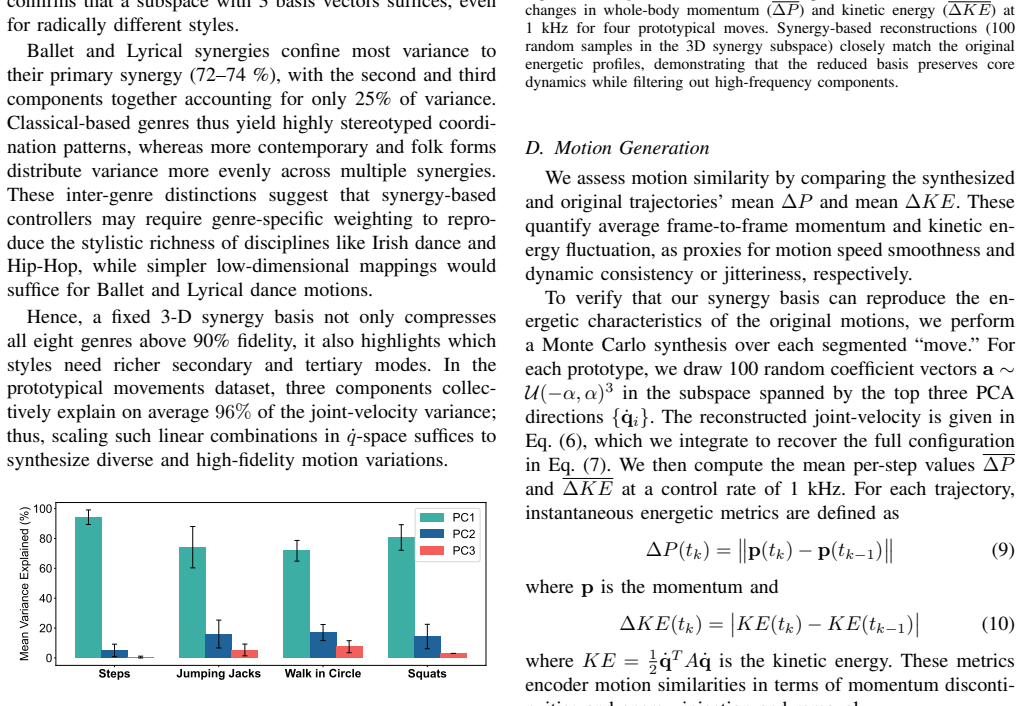
- [Figures 4 and 5] The error bars are not defined: it should be stated whether they represent variation across subjects, segments, or cycles, and the number of segments per motion should be reported.
- [IV.C] The text reports that the first three components capture on average 64.3%, 19.3%, and 8.3% of variance, which sums to 92.0%, yet the following paragraph states 96% for prototypical movements; please clarify which dataset each number refers to.
- [Eq. (6)] The statement that synergy coefficients default to constant singular values is unclear, since the reconstruction formula uses time-varying coefficients a_i(t); specify how a_i(t) is computed for reconstruction versus exposed as editing sliders.
Circularity Check
Central 3-D synergy sufficiency rests on in-sample PCA and momentum-based reconstruction; the prediction reduces to the fit.
-
fitted input called prediction
[Section IV.C, Fig. 5; also Section III.B Eq. (6)]
"Across all eight dance genres, within data from a single dancer, the first three principal components capture on average 64.3%, 19.3%, and 8.3% of total variance, respectively (Figure 5). This confirms that a subspace with 3 basis vectors suffices, even for radically different styles."
The PCA basis is fit to the same eight-genre dataset on which variance explained is then reported. PCA maximizes in-sample variance by construction, so the high cumulative variance (90%+ fidelity) is a mathematical consequence of the fitting procedure, not evidence of generalization. The conclusion that synergies 'can be reused to generate new motions without task-specific retraining' (Section V) extrapolates this in-sample fit to unseen styles/subjects without any held-out evaluation.
-
self definitional
[Section III.B Eq. (5) and Section IV.D Eqs. (9)-(10), Fig. 6]
"A new motion primitive is initialized whenever a significant momentum change is detected: ∥p(t_i)− p(t_{i−1})∥> ∆P_th ... We assess motion similarity by comparing the synthesized and original trajectories’ mean ∆P and mean ∆KE."
The segmentation criterion (momentum-change threshold) and the primary fidelity metric (mean ΔP) are the same quantity: the norm of frame-to-frame momentum difference. The synergy basis is built from segments defined by momentum discontinuities and then evaluated on how well it reproduces momentum discontinuities in those same segments, so part of the reported match is built into the design. The Monte Carlo reconstruction (100 random coefficients) is also performed in the same fitted 3-D subspace and compared against the original in-sample trajectories, so the 'core dynamics preserved' conclusion is an in-sample property rather than a prediction.
full rationale
The paper's headline claim—that a fixed 3-D postural-synergy basis captures over 90% fidelity across eight dance genres and 96% of joint-velocity variance—is supported exclusively by in-sample PCA. The basis is fit to the very same trials on which variance explained and reconstruction error are measured (Sections IV.C and IV.B). Since PCA maximizes variance on the training set by construction, high cumulative in-sample variance is expected and does not establish that the synergies generalize to unseen subjects, styles, or downstream generative outputs. The energetic-reconstruction experiment (Section IV.D) likewise draws random coefficients in the fitted subspace and compares to the original in-sample trajectories; the reported match and ~32% reduction in ΔKE are consequences of projecting onto a low-variance subspace, not independent evidence of dynamic fidelity. Furthermore, the segmentation criterion (Eq. 5) and the primary fidelity metric ΔP (Eq. 9) are both momentum-change quantities, so the evaluation is partially aligned with the construction. The MotionGPT projection experiment (Section IV.E) does provide an out-of-sample comparison, but it does not rescue the sufficiency claim. No held-out subjects, leave-one-genre-out, or pose-level reconstruction error is reported. The paper is therefore not circular in the sense of deriving equations from definitions, but the central generalization claim reduces to an in-sample fit, warranting a partial-circularity score of 6.
Assumptions & free parameters
free parameters (4)
- Momentum segmentation threshold =
Delta_P_th = 0.75
- Number of principal components =
k = 3
- Monte Carlo coefficient bound =
not specified
- Synergy coefficient defaults =
singular values of PCA
assumptions (5)
- standard math Dynamically-consistent operational space control
- domain assumption Floating-base simulation without contact forces is a valid proxy for power comparison
- domain assumption PCA of joint velocity trajectories captures postural synergies
- domain assumption The HPR4c humanoid has sufficient kinematic compatibility with the marker skeleton
- domain assumption MotionGPT raw outputs are a meaningful baseline for humanoid motion
Cite this review
Pith. "Pith review of Humanoid Motion Scripting with Postural Synergies." pith.science (2026). https://pith.science/paper/3DPMLXN4
@misc{pith2026250812184,
  author       = {Pith},
  title        = {Pith review of: Humanoid Motion Scripting with Postural Synergies},
  year         = {2026},
  howpublished = {\url{https://pith.science/paper/3DPMLXN4}},
  note         = {Machine review of arXiv:2508.12184}
}
read the original abstract
Generating sequences of human-like motions for humanoid robots presents challenges in collecting and analyzing reference human motions, synthesizing new motions based on these reference motions, and mapping the generated motion onto humanoid robots. To address these issues, we introduce SynSculptor, a humanoid motion analysis and editing framework that leverages postural synergies for training-free human-like motion scripting. To analyze human motion, we collect 3+ hours of motion capture data across 20 individuals where a real-time operational space controller mimics human motion on a simulated humanoid robot. The major postural synergies are extracted using principal component analysis (PCA) for velocity trajectories segmented by changes in robot momentum, constructing a style-conditioned synergy library for free-space motion generation. To evaluate generated motions using the synergy library, the foot-sliding ratio and proposed metrics for motion smoothness involving total momentum and kinetic energy deviations are computed for each generated motion, and compared with reference motions. Finally, we leverage the synergies with a motion-language transformer, where the humanoid, during execution of motion tasks with its end-effectors, adapts its posture based on the chosen synergy. Supplementary material, code, and videos are available at https://rhea-mal.github.io/humanoidsynergies.io.
Figures


Figures from the paper (4 more)



Reference graph
Works this paper leans on
-
[1]
Adapting human motion for the control of a humanoid robot,
N.S. Pollard, J.K. Hodgins, M.J. Riley, and C.G. Atkeson, “Adapting human motion for the control of a humanoid robot,” Proceedings of the IEEE International Conference on Robotics and Automation, May 2002
work page 2002
-
[2]
Naksuk, N., Lee, C. G., Rietdyk, S. (2005, December). Whole-body human-to-humanoid motion transfer. In 5th IEEE-RAS International Conference on Humanoid Robots, 2005. (pp. 104-109). IEEE
work page 2005
-
[3]
J., Narsipura Sreenivasa, M., Laumond, J
Montecillo-Puente, F. J., Narsipura Sreenivasa, M., Laumond, J. P. (2010). On real-time whole-body human to humanoid motion transfer
work page 2010
-
[4]
Arduengo, M., Arduengo, A., Colom ´e, A., Lobo-Prat, J., Torras, C. (2021, July). Human to robot whole-body motion transfer. In 2020 IEEE-RAS 20th International Conference on Humanoid Robots (Hu- manoids) (pp. 299-305). IEEE
work page 2021
-
[5]
Riley, M., Ude, A., Atkeson, C. G. (2000, April). Methods for motion generation and interaction with a humanoid robot: Case studies of dancing and catching. In Proc. 2000 Workshop on Interactive Robotics and Entertainment (pp. 35-42)
work page 2000
-
[6]
Shi, Q., Ying, W., Lv, L., & Xie, J. (2020). Deep reinforcement learning- based attitude motion control for humanoid robots with stability con- straints. Industrial Robot: the international journal of robotics research and application, 47(3), 335-347
work page 2020
-
[7]
Hester, T., Quinlan, M., & Stone, P. (2010, May). Generalized model learning for reinforcement learning on a humanoid robot. In 2010 IEEE International Conference on Robotics and Automation (pp. 2369-2374). IEEE
work page 2010
-
[8]
He, T., Luo, Z., Xiao, W., Zhang, C., Kitani, K., Liu, C., & Shi, G. (2024, October). Learning human-to-humanoid real-time whole-body teleoperation. In 2024 IEEE/RSJ International Conference on Intelligent Robots and Systems (IROS) (pp. 8944-8951). IEEE
work page 2024
Show all 45 references
-
[9]
H., Tirumala, D., Humplik, J
Haarnoja, T., Moran, B., Lever, G., Huang, S. H., Tirumala, D., Humplik, J. & Heess, N. (2024). Learning agile soccer skills for a bipedal robot with deep reinforcement learning. Science Robotics, 9(89), eadi8022
2024
-
[10]
Constraint- consistent task-oriented whole-body robot formulation: Task, pos- ture, constraints, multiple contacts, and balance
Khatib O, Jorda M, Park J, Sentis L, Chung S-Y . Constraint- consistent task-oriented whole-body robot formulation: Task, pos- ture, constraints, multiple contacts, and balance. The Interna- tional Journal of Robotics Research. 2022;41(13-14):1079-1098. doi:10.1177/02783649221120029
2022 doi
-
[11]
Ma, L., Meng, Z., Liu, T., Li, Y ., Song, R., Zhang, W., & Huang, S. (2025). StyleLoco: Generative Adversarial Distillation for Natural Humanoid Robot Locomotion. arXiv preprint arXiv:2503.15082
2025 arXiv
-
[12]
A., Wiedebach, G., Cesare, K., Bishop, J., Knoop, E., & B ¨acher, M
Hopkins, M. A., Wiedebach, G., Cesare, K., Bishop, J., Knoop, E., & B ¨acher, M. (2024). Interactive design of stylized walking gaits for robotic characters. ACM Transactions on Graphics (ToG), 43(4), 1-16
2024
-
[13]
G., & Pac- chierotti, C
Fernandez-Fernandez, R., Łukawski, B., Victores, J. G., & Pac- chierotti, C. (2023). Transferring human emotions to robot motions using Neural Policy Style Transfer. Cognitive Systems Research, 82, 101121
2023
-
[14]
Cheng, X., Ji, Y ., Chen, J., Yang, R., Yang, G., & Wang, X. (2024). Expressive whole-body control for humanoid robots. arXiv preprint arXiv:2402.16796
2024 arXiv
-
[15]
Katyara, F
S. Katyara, F. Ficuciello, D. G. Caldwell, B. Siciliano and F. Chen, ”Leveraging Kernelized Synergies on Shared Subspace for Precision Grasping and Dexterous Manipulation”, IEEE Transactions on Cogni- tive and Developmental Systems, pp. 1-13, 2021
2021
-
[16]
arXiv preprint arXiv:1811.11711, 2018
Merel, J., Hasenclever, L., Galashov, A., Ahuja, A., Pham, V ., Wayne, G., and Heess, N.: Neural probabilistic motor primitives for humanoid control. arXiv preprint arXiv:1811.11711, 2018
2018 arXiv
-
[17]
IEEE Transactions on Robotics, vol
Nenchev, D.N., and Iizuka, R.: Emergent Humanoid Robot Motion Synergies Derived From the Momentum Equilibrium Principle and the Distribution of Momentum. IEEE Transactions on Robotics, vol. 38, no. 1, pp. 536–555, 2022
2022
-
[18]
Santello, M
M. Santello, M. Flanders and J. F. Soechting, ”Postural Hand Synergies for Tool Use”, The Journal of Neuroscience, vol. 18, no. 23, pp. 10105- 10115, 1998
1998
-
[19]
A. Leo, G. Handjaras, M. Bianchi, H. Marino, M. Gabiccini, A. Guidi, et al., ”A synergy-based hand control is encoded in human motor cortical areas”, eLife, vol. 5, pp. e13420, 2016
2016
-
[20]
A. A. C. Thomik, S. Fenske and A. A. Faisal, ”Towards Sparse Coding of Natural Movements for Neuroprosthetics and Brain – Machine Inter- faces”, International IEEE EMBS Conference on Neural Engineering, pp. 938-941, April 2015
2015
-
[21]
Brown and H
C. Brown and H. Asada, ”Inter-Finger Coordination and Postural Synergies in Robot Hands Via Mechanical Implementation of Principal Components Analysis”, IEEE/RSJ Int. Conf. on Intelligent Robots and Systems, pp. 2877-2882, 2007
2007
-
[22]
M. G. Catalano, G. Grioli, A. Serio, E. Farnioli, C. Piazza and A. Bicchi, ”Adaptive Synergies for a Humanoid Robot Hand”, IEEERAS Int. Conf. on Humanoid Robots, pp. 7-14, 2012
2012
-
[23]
J. B. Rosmarin and H. H. Asada, ”Synergistic Design of a Humanoid Hand with Hybrid DC motor-SMA Array Actuators Embedded in the Palm”, IEEE Int. Conf. on Robotics and Automation, pp. 773-778, 2008
2008
-
[24]
Bicchi, A., Gabiccini, M., & Santello, M. (2011). Modelling natural and artificial hands with synergies. Philosophical Transactions of the Royal Society B: Biological Sciences, 366(1581), 3153-3161
2011
-
[25]
Romero, T
J. Romero, T. Feix, C. H. Ek, H. Kjellstr ¨om and D. Kragic, ”Extract- ing Postural Synergies for Robotic Grasping”, IEEE Transactions on Robotics, vol. 29, no. 6, pp. 1342-1352, 2013
2013
-
[26]
Konnaris, A
C. Konnaris, A. A. C. Thomik and A. A. Faisal, ”Sparse Eigenmotions Derived from Daily Life Kinematics Implemented on a Dextrous Robotic Hand”, IEEE International Conference on Biomedical Robotics and Biomechatronics, pp. 1358-1363, 2016
2016
-
[27]
A., Ivanov, S
Moiseev, S. A., Ivanov, S. M., & Gorodnichev, R. M. (2022). The mo- tor synergies’ organization features at different levels of motor control during high coordinated human’s movement. Journal of Evolutionary Biochemistry and Physiology, 58(2), 610-622
2022
-
[28]
J., & Maass, W
Hauser, H., Neumann, G., Ijspeert, A. J., & Maass, W. (2007, November). Biologically inspired kinematic synergies provide a new paradigm for balance control of humanoid robots. In 2007 7th IEEE- RAS International Conference on Humanoid Robots (pp. 73-80). IEEE
2007
-
[29]
K., & Chattopadhyay, P
Gupta, S. K., & Chattopadhyay, P. (2021). Gait recognition in the presence of co-variate conditions. Neurocomputing, 454, 76-87
2021
-
[30]
A., Sharma, A., Rai, V ., Sie, A., Preechayasomboon, P., & Rombokas, E
Boe, D., Portnova-Fahreeva, A. A., Sharma, A., Rai, V ., Sie, A., Preechayasomboon, P., & Rombokas, E. (2021). Dimensionality reduc- tion of human gait for prosthetic control. Frontiers in Bioengineering and Biotechnology, 9, 724626
2021
-
[31]
Brambilla, C., Atzori, M., M ¨uller, H., d’Avella, A., & Scano, A. (2023). Spatial and temporal muscle synergies provide a dual char- acterization of low-dimensional and intermittent control of upper-limb movements. Neuroscience, 514, 100-122
2023
-
[32]
J., & Lee, J
Shin, H. J., & Lee, J. (2006). Motion synthesis and editing in low- dimensional spaces. Computer Animation and Virtual Worlds, 17(3-4), 219-227
2006
-
[33]
(2004, November)
Nakaoka, S., Nakazawa, A., & Ikeuchi, K. (2004, November). An efficient method for composing whole body motions of a humanoid robot. In Proceedings of the Tenth International Conference on Virtual Systems and Multimedia (VSMM) (pp. 1142-1151)
2004
-
[34]
& Yamaguchi, J
Kuroki, Y ., Blank, B., Mikami, T., Mayeux, P., Miyamoto, A., Playter, R. & Yamaguchi, J. I. (2003, October). Motion creating system for a small biped entertainment robot. In Proceedings 2003 IEEE/RSJ International Conference on Intelligent Robots and Systems (IROS 2003)(Cat. ...
2003
-
[35]
(2020, May)
Lu, Q., Liu, Y ., & Mi, H. (2020, May). MotionFlow: Time-axis- based multiple robots expressive motion programming. In Proceedings of the 3rd International Conference on Computer Science and Software Engineering (pp. 145-149)
2020
-
[36]
J., Chao, J
Tsai, M. J., Chao, J. H., & Yang, T. W. (2014, August). Construction of a general motion editing system for human body and humanoid robots. In International Design Engineering Technical Conferences and Computers and Information in Engineering Conference (V ol. 46285, p. V01AT0...
2014
-
[37]
Pierris, G. F. (2009). Soccer skills for humanoid robots (Doctoral dissertation, Diploma thesis, Technical University of Crete, Chania, Greece)
2009
-
[38]
Khatib, O. (2003). A unified approach for motion and force control of robot manipulators: The operational space formulation. IEEE Journal on Robotics and Automation, 3(1), 43-53
2003
-
[39]
Russakow, J., Khatib, O., & Rock, S. M. (1995, May). Extended operational space formulation for serial-to-parallel chain (branching) manipulators. In Proceedings of 1995 IEEE international conference on robotics and automation (V ol. 1, pp. 1056-1061). IEEE
1995
-
[40]
Making feasible walking motion of humanoid robots from human motion capture data,
A. Dasgupta and Y . Nakamura, “Making feasible walking motion of humanoid robots from human motion capture data,” Proceedings for the 1999 IEEE International Conference on Robotics and Automation, pp. 1044 – 1049, May 1999
1999
-
[41]
A hierarchical approach to interactive motion editing for human-like figures,
J. Lee and S.Y . Shin, “A hierarchical approach to interactive motion editing for human-like figures,” In Proceedings of SIGGRAPH 99, pp. 39–48, 1999
1999
-
[42]
L., et al
Delp, S. L., et al. (2007). OpenSim: Open-source software to create and analyze dynamic simulations of movement. IEEE Transactions on Biomedical Engineering, 55(11), 1940–1950
2007
-
[43]
IEEE Transactions on Biomedical Engineering, vol
Rajagopal, A., et al.: Full-Body Musculoskeletal Model for Muscle- Driven Simulation of Human Gait. IEEE Transactions on Biomedical Engineering, vol. 63, no. 10, pp. 2068–2079, 2016
2016
-
[44]
Jiang, B., Chen, X., Liu, W., Yu, J., Yu, G., & Chen, T. (2023). Motiongpt: Human motion as a foreign language. Advances in Neural Information Processing Systems, 36, 20067-20079
2023
-
[45]
B., & van de Panne, M
Cohan, S., Tevet, G., Reda, D., Peng, X. B., & van de Panne, M. (2024, July). Flexible motion in-betweening with diffusion models. In ACM SIGGRAPH 2024 Conference Papers (pp. 1-9)
2024
Reviewed August 15, 2026 · model on record in the stance chip above.
Discussion (0). Continue with ORCID to comment.