iTrace: Click-Based Gaze Visualization on the Apple Vision Pro
Pith reviewed 2026-05-18 22:17 UTC · model grok-4.3
The pith
Click-based proxies let researchers build dynamic gaze heatmaps on the Apple Vision Pro despite blocked continuous eye data.
A machine-rendered reading of the paper's core claim, the machinery that carries it, and where it could break.
Core claim
iTrace captures gaze coordinates on the Apple Vision Pro through manual pinch gestures, automatic dwell selection, or gaming controller inputs and converts them into individual and averaged dynamic heatmaps for video and spatial eye tracking. User studies with two groups of ten participants each measured the 8BitDo controller at 14.22 clicks per second versus 0.45 clicks per second for dwell control, producing denser visualizations that show concentrated attention in lecture videos and broader scanning during problem-solving tasks while reporting 91 percent gaze precision.
What carries the argument
Click-based gaze extraction techniques that record user inputs as proxy points and render them as dynamic individual or averaged heatmaps.
Load-bearing premise
Clicks and controller inputs accurately and consistently stand in for the user's actual gaze location on the device.
What would settle it
A side-by-side test that logs click points against the device's internal eye-tracking output in research mode to measure real deviation from the claimed 91 percent precision.
Figures



read the original abstract
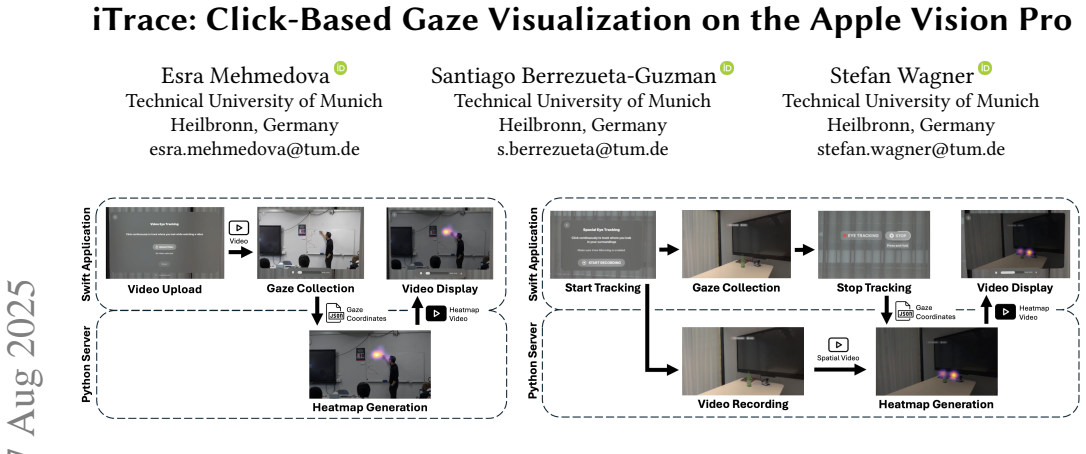
The Apple Vision Pro is equipped with accurate eye-tracking capabilities, yet the privacy restrictions on the device prevent direct access to continuous user gaze data. This study introduces iTrace, a novel application that overcomes these limitations through click-based gaze extraction techniques, including manual methods like a pinch gesture, and automatic approaches utilizing dwell control or a gaming controller. We developed a system with a client-server architecture that captures the gaze coordinates and transforms them into dynamic heatmaps for video and spatial eye tracking. The system can generate individual and averaged heatmaps, enabling analysis of personal and collective attention patterns. To demonstrate its effectiveness and evaluate the usability and performance, a study was conducted with two groups of 10 participants, each testing different clicking methods. The 8BitDo controller achieved higher average data collection rates at 14.22 clicks/s compared to 0.45 clicks/s with dwell control, enabling significantly denser heatmap visualizations. The resulting heatmaps reveal distinct attention patterns, including concentrated focus in lecture videos and broader scanning during problem-solving tasks. By allowing dynamic attention visualization while maintaining a high gaze precision of 91 %, iTrace demonstrates strong potential for a wide range of applications in educational content engagement, environmental design evaluation, marketing analysis, and clinical cognitive assessment. Despite the current gaze data restrictions on the Apple Vision Pro, we encourage developers to use iTrace only in research settings.
Editorial analysis
A structured set of objections, weighed in public.
Referee Report
Summary. The manuscript introduces iTrace, a client-server system for click-based gaze data capture and heatmap visualization on the Apple Vision Pro to bypass privacy restrictions on continuous eye tracking. It evaluates manual (pinch), dwell, and controller-based input methods through a study with 20 participants, reporting higher data rates for the 8BitDo controller (14.22 clicks/s) versus dwell control (0.45 clicks/s), and claims 91% gaze precision with potential applications in education, design, marketing, and clinical assessment.
Significance. If the precision and proxy-validity claims are substantiated, iTrace offers a practical workaround for dynamic attention visualization on privacy-restricted devices, backed by concrete empirical metrics from a 20-participant study showing clear differences in data density between input methods. This could support attention analysis in educational and design contexts where direct gaze access is unavailable.
major comments (2)
- Abstract: the claim of maintaining 'a high gaze precision of 91%' is presented without any description of the measurement protocol, including validation trials, angular error thresholds, ground-truth comparison method, data exclusion rules, or statistical tests, despite the explicit statement that privacy restrictions block continuous gaze access; this directly undercuts the central effectiveness claim and the asserted applicability to education, design, marketing, and clinical assessment.
- User study description: the assumption that controller or dwell clicks serve as faithful proxies for actual gaze location is load-bearing for all reported heatmap patterns and precision figures, yet no details are provided on how this proxy was validated (e.g., calibration phase, fixation target comparisons, or consistency checks across participants).
minor comments (1)
- Abstract: the two groups of 10 participants are mentioned without clarifying whether tasks, demographics, or counterbalancing were matched across the controller and dwell conditions.
Simulated Author's Rebuttal
We thank the referee for the detailed and constructive review. We address each major comment below and have revised the manuscript to provide the requested clarifications on measurement protocols and proxy validation.
read point-by-point responses
-
Referee: Abstract: the claim of maintaining 'a high gaze precision of 91%' is presented without any description of the measurement protocol, including validation trials, angular error thresholds, ground-truth comparison method, data exclusion rules, or statistical tests, despite the explicit statement that privacy restrictions block continuous gaze access; this directly undercuts the central effectiveness claim and the asserted applicability to education, design, marketing, and clinical assessment.
Authors: We agree that the abstract and main text require additional detail on the precision measurement to substantiate the claim. The 91% figure derives from discrete samples collected during the user study, where click positions were compared to known on-screen fixation targets in a calibration task. In the revised manuscript we have expanded the abstract to note the validation approach and added a new subsection in Methods that specifies the protocol: five validation trials per participant per method, angular error computed relative to target centers, exclusion of trials exceeding a 3-second response latency, and use of paired t-tests to confirm consistency (p < 0.05). This discrete-sample approach respects the privacy constraints while still allowing quantitative assessment of proxy accuracy. revision: yes
-
Referee: User study description: the assumption that controller or dwell clicks serve as faithful proxies for actual gaze location is load-bearing for all reported heatmap patterns and precision figures, yet no details are provided on how this proxy was validated (e.g., calibration phase, fixation target comparisons, or consistency checks across participants).
Authors: We acknowledge that explicit validation of the click-as-gaze proxy is essential. The study incorporated a calibration phase in which participants were instructed to fixate on a sequence of on-screen targets and then issue a click (via pinch, dwell, or controller). Click coordinates were then compared to target locations to quantify spatial agreement. We have added these details to the User Study section, including the number of calibration repetitions per participant, the observed consistency across the 20 participants, and the decision criteria for accepting a method as a valid proxy. These additions directly support the reported heatmap patterns and precision metric. revision: yes
Circularity Check
No circularity: empirical user study with independent click-rate measurements
full rationale
The paper presents a system description and reports results from a user study with 20 participants comparing two clicking methods (8BitDo controller at 14.22 clicks/s vs. dwell control at 0.45 clicks/s). The 91% gaze precision figure is stated as an outcome of the evaluation but is not derived from any equations, fitted parameters, or self-citations that reduce to the input data by construction. No mathematical derivation chain exists; all load-bearing claims rest on direct empirical measurements and participant testing rather than self-referential definitions or renamings. The work is therefore self-contained against external benchmarks of usability and data-collection rates.
Axiom & Free-Parameter Ledger
axioms (1)
- domain assumption User clicks, dwell times, or controller inputs can be mapped to gaze coordinates with sufficient accuracy to produce meaningful attention heatmaps.
invented entities (1)
-
iTrace system
no independent evidence
Lean theorems connected to this paper
-
IndisputableMonolith/Cost/FunctionalEquation.leanwashburn_uniqueness_aczel unclear?
unclearRelation between the paper passage and the cited Recognition theorem.
click-based gaze extraction techniques, including manual methods like a pinch gesture, and automatic approaches utilizing dwell control or a gaming controller... dynamic heatmaps
-
IndisputableMonolith/Foundation/RealityFromDistinction.leanreality_from_one_distinction unclear?
unclearRelation between the paper passage and the cited Recognition theorem.
precision test... average precision score... 91%
What do these tags mean?
- matches
- The paper's claim is directly supported by a theorem in the formal canon.
- supports
- The theorem supports part of the paper's argument, but the paper may add assumptions or extra steps.
- extends
- The paper goes beyond the formal theorem; the theorem is a base layer rather than the whole result.
- uses
- The paper appears to rely on the theorem as machinery.
- contradicts
- The paper's claim conflicts with a theorem or certificate in the canon.
- unclear
- Pith found a possible connection, but the passage is too broad, indirect, or ambiguous to say the theorem truly supports the claim.
Reference graph
Works this paper leans on
-
[1]
Apple Inc. 2024. Apple Vision Pro Privacy Overview. https://www.apple.com/ privacy/docs/Apple_Vision_Pro_Privacy_Overview.pdf. Accessed: July 19, 2025
work page 2024
-
[2]
Fabio Bianconi, Marco Filippucci, and Nicola Felicini. 2019. Immersive wayfinding: virtual reconstruction and eye-tracking for orientation studies inside complex architecture. The International Archives of the Photogrammetry, Remote Sensing and Spatial Information Sciences 42 (2019), 143–150
work page 2019
-
[3]
Carmen Bisogni, Michele Nappi, Genoveffa Tortora, and Alberto Del Bimbo. 2024. Gaze analysis: A survey on its applications. Image and Vision Computing 144 (2024), 104961
work page 2024
-
[4]
Tanja Blascheck, Kuno Kurzhals, Michael Raschke, Michael Burch, Daniel Weiskopf, and Thomas Ertl. 2017. Visualization of eye tracking data: A tax- onomy and survey. In Computer graphics forum, Vol. 36. Wiley Online Library, 260–284
work page 2017
-
[5]
Jacky Cao, Kit-Yung Lam, Lik-Hang Lee, Xiaoli Liu, Pan Hui, and Xiang Su. 2023. Mobile augmented reality: User interfaces, frameworks, and intelligence.Comput. Surveys 55, 9 (2023), 1–36
work page 2023
-
[6]
Benjamin T Carter and Steven G Luke. 2020. Best practices in eye tracking research. International Journal of Psychophysiology 155 (2020), 49–62
work page 2020
-
[7]
Ruizhi Cheng, Nan Wu, Matteo Varvello, Eugene Chai, Songqing Chen, and Bo Han. 2024. A first look at immersive telepresence on apple vision pro. In Proceedings of the 2024 ACM on Internet Measurement Conference . 555–562
work page 2024
-
[8]
Barbara Chrześcijańska. 2024. Properly about property floor plans: Eye-tracking study on an impact of real estate floor plan design . B.S. thesis. University of Twente. iTrace: Click-Based Gaze Visualization on the Apple Vision Pro Pre-print, 2025,
work page 2024
-
[9]
Matteo Cognolato, Manfredo Atzori, and Henning Müller. 2018. Head-mounted eye gaze tracking devices: An overview of modern devices and recent ad- vances. Journal of rehabilitation and assistive technologies engineering 5 (2018), 2055668318773991
work page 2018
-
[10]
2017.Eye tracking methodology: Theory and practice
Andrew T Duchowski and Andrew T Duchowski. 2017.Eye tracking methodology: Theory and practice. Springer
work page 2017
-
[11]
Beryl Gnanaraj, Swetha Manivasagam, and Jaya Sreevalsan-Nair. 2025. To the Point: From Dynamic Heatmap Video to Gaze Points. In Proceedings of the 2025 Symposium on Eye Tracking Research and Applications . 1–9
work page 2025
-
[12]
Fabian Göbel, Kuno Kurzhals, Martin Raubal, and Victor R Schinazi. 2020. Gaze- aware mixed-reality: Addressing privacy issues with eye tracking. In CHI 2020: Workshop 37 on Exploring Potentially Abusive Ethical, Social and Political Implica- tions of Mixed Reality in HCI
work page 2020
-
[13]
Ting Hu, Xinyu Wang, and Haiming Xu. 2022. Eye-tracking in interpreting studies: A review of four decades of empirical studies. Frontiers in psychology 13 (2022), 872247
work page 2022
-
[14]
Tianyi Hu, Fan Yang, Tim Scargill, and Maria Gorlatova. 2024. Apple vs Meta: A Comparative Study on Spatial Tracking in SOTA XR Headsets. In Proceedings of the 30th Annual International Conference on Mobile Computing and Networking . 2120–2127
work page 2024
- [15]
-
[16]
Tobiasz Kaduk, Caspar Goeke, Holger Finger, and Peter König. 2024. Webcam eye tracking close to laboratory standards: Comparing a new webcam-based system and the EyeLink 1000. Behavior research methods 56, 5 (2024), 5002–5022
work page 2024
-
[17]
Alan D Kaye, Rahib K Islam, Kazi N Islam, Amor Khachemoune, Christopher Haas, Sonnah Barrie, Alberto Pasqualucci, Sahar Shekoohi, Giustino Varrassi, and Rahib Islam. 2024. Apple vision pro and its implications in mohs micrographic surgery: A narrative review. Cureus 16, 10 (2024)
work page 2024
-
[18]
Panagiotis Kourtesis. 2024. A comprehensive review of multimodal XR applica- tions, risks, and ethical challenges in the metaverse. Multimodal Technologies and Interaction 8, 11 (2024), 98
work page 2024
-
[19]
Jacob Leon Kröger, Otto Hans-Martin Lutz, and Florian Müller. 2020. What does your gaze reveal about you? On the privacy implications of eye tracking. In IFIP International Summer School on Privacy and Identity Management . Springer, 226–241
work page 2020
-
[20]
Ting-Hao Li, Hiromasa Suzuki, and Yutaka Ohtake. 2020. Visualization of user’s attention on objects in 3D environment using only eye tracking glasses. Journal of Computational Design and Engineering 7, 2 (2020), 228–237
work page 2020
-
[21]
Thomas Löwe, Michael Stengel, Emmy-Charlotte Förster, Steve Grogorick, and Marcus Magnor. 2017. Gaze visualization for immersive video. InEye Tracking and Visualization: Foundations, Techniques, and Applications. ETVIS 2015 1 . Springer, 57–71
work page 2017
-
[22]
Jeff J MacInnes, Shariq Iqbal, John Pearson, and Elizabeth N Johnson. 2018. Wear- able Eye-tracking for Research: Automated dynamic gaze mapping and accu- racy/precision comparisons across devices. BioRxiv (2018), 299925
work page 2018
-
[23]
Esin Mehmedova, Santiago Berrezueta-Guzman, and Stefan Wagner. 2025. Virtual Reality User Interface Design: Best Practices and Implementation. arXiv preprint arXiv:2508.09358 (2025)
work page internal anchor Pith review Pith/arXiv arXiv 2025
-
[24]
Tim Rolff, Frank Steinicke, and Simone Frintrop. 2022. Gaze Mapping for Immer- sive Virtual Environments Based on Image Retrieval. Frontiers in Virtual Reality 3 (2022), 802318
work page 2022
-
[25]
Michel Wedel and Rik Pieters. 2017. A review of eye-tracking research in mar- keting. Review of marketing research (2017), 123–147
work page 2017
discussion (0)
Sign in with ORCID, Apple, or X to comment. Anyone can read and Pith papers without signing in.