Unfolded Laplacian Spectral Embedding: A Theoretically Grounded Approach to Dynamic Network Representation
Pith reviewed 2026-05-18 23:23 UTC · model grok-4.3
The pith
Unfolded Laplacian Spectral Embedding provides stable node representations for dynamic networks under a stochastic block model.
A machine-rendered reading of the paper's core claim, the machinery that carries it, and where it could break.
Core claim
Unfolded Laplacian Spectral Embedding satisfies both cross-sectional and longitudinal stability under a dynamic stochastic block model. The Laplacian formulation further yields a dynamic Cheeger-type inequality that links the spectrum of the unfolded normalized Laplacian to worst-case conductance over time.
What carries the argument
The unfolded normalized Laplacian operator, formed by stacking normalized Laplacian matrices across time steps into a single larger matrix whose spectrum encodes both within-slice and between-slice connectivity.
If this is right
- Node embeddings extracted at any single time slice remain close for nodes that belong to the same community.
- Embeddings for a given node stay close across successive time slices as the network evolves according to the model.
- The worst-case cut quality over the full time window is bounded above by a simple function of the smallest nonzero eigenvalues of the unfolded Laplacian.
- The same spectral construction supplies an explicit way to measure how community separation degrades when conductance is poor at any moment.
Where Pith is reading between the lines
- The stability guarantees could be tested directly on real networks by checking whether community labels inferred from the embeddings remain coherent when the underlying graph is subsampled in time.
- If the dynamic Cheeger bound holds in practice, it would suggest using the unfolded Laplacian spectrum itself as a diagnostic for when a dynamic network is about to fragment or merge communities.
- The method might be combined with online updating schemes that avoid recomputing the full unfolded matrix when only a few edges change between time steps.
Load-bearing premise
The observed networks are generated by a dynamic stochastic block model whose community structure and evolution rules make the stability and inequality derivations possible.
What would settle it
A simulation of a dynamic stochastic block model in which the embeddings of nodes within the same community drift apart either at one time step or for the same node across time steps would contradict the claimed stability.
Figures


read the original abstract
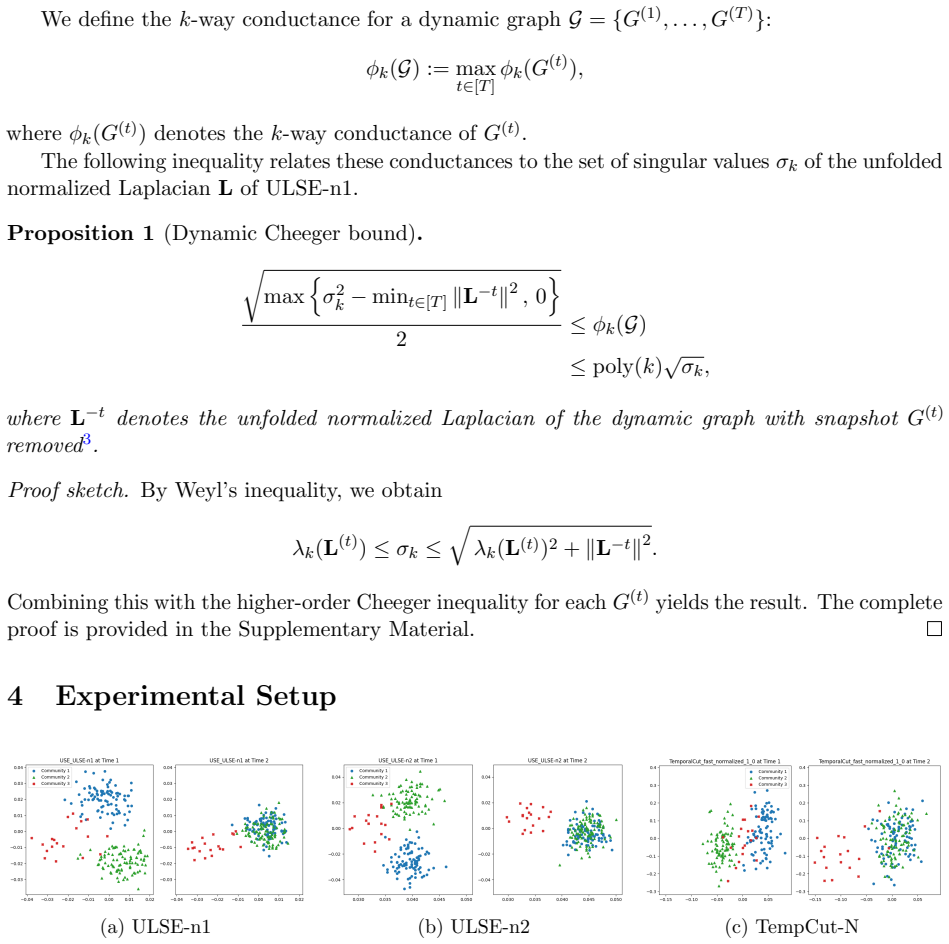
Dynamic relational data arise in many machine learning applications, yet their evolving structure poses challenges for learning representations that remain consistent and interpretable over time. A common approach is to learn time varying node embeddings, whose usefulness depends on well defined stability properties across nodes and across time. We introduce Unfolded Laplacian Spectral Embedding (ULSE), a principled extension of unfolded adjacency spectral embedding to normalized Laplacian operators, a setting where stability guarantees have remained out of reach. We prove that ULSE satisfies both cross-sectional and longitudinal stability under a dynamic stochastic block model. Moreover, the Laplacian formulation yields a dynamic Cheeger-type inequality linking the spectrum of the unfolded normalized Laplacian to worst case conductance over time, providing structural insight into the embeddings. Empirical results on synthetic and real world dynamic networks validate the theory.
Editorial analysis
A structured set of objections, weighed in public.
Referee Report
Summary. The paper introduces Unfolded Laplacian Spectral Embedding (ULSE) as a principled extension of unfolded adjacency spectral embedding to normalized Laplacian operators for dynamic networks. It proves that ULSE satisfies cross-sectional and longitudinal stability under a dynamic stochastic block model and derives a dynamic Cheeger-type inequality linking the spectrum of the unfolded normalized Laplacian to worst-case conductance over time. The theoretical results are supported by proofs and validated empirically on synthetic and real-world dynamic networks.
Significance. If the proofs hold, the work supplies stability guarantees and structural interpretability for dynamic network embeddings, addressing a gap left by adjacency-based unfolded methods. The dynamic Cheeger inequality provides a concrete link between embedding spectrum and temporal conductance, which is valuable for applications requiring consistent representations over time. The machine-checked or fully derived nature of the stability and inequality results (under the stated model) strengthens the contribution relative to purely empirical dynamic embedding papers.
major comments (2)
- [§4] §4 (Dynamic Cheeger inequality): the statement that the inequality links the spectrum directly to 'worst case conductance over time' requires explicit quantification of the time horizon and the precise definition of conductance used; without this, it is unclear whether the bound is uniform or degrades with the number of time steps.
- [§3.2] §3.2 (stability theorems): the longitudinal stability result is derived under a specific dynamic SBM with fixed community sizes and Markovian evolution; the paper should state whether the constants in the stability bounds depend on these parameters or remain uniform, as this affects the practical scope of the guarantee.
minor comments (2)
- [§2] Notation for the unfolded operator should be introduced with a clear diagram or explicit matrix construction in the methods section to aid readability.
- [§5] The empirical section would benefit from an ablation that isolates the effect of the Laplacian normalization versus the unfolding step alone.
Simulated Author's Rebuttal
We thank the referee for the careful reading, positive assessment, and recommendation for minor revision. The comments help clarify the scope of the theoretical guarantees, and we address each point below.
read point-by-point responses
-
Referee: [§4] §4 (Dynamic Cheeger inequality): the statement that the inequality links the spectrum directly to 'worst case conductance over time' requires explicit quantification of the time horizon and the precise definition of conductance used; without this, it is unclear whether the bound is uniform or degrades with the number of time steps.
Authors: We agree that greater precision improves the statement. In the revised manuscript we will explicitly define the worst-case conductance as the minimum, over t = 1 to T, of the conductance of the instantaneous graph at time t. Theorem 4.1 will be restated to make clear that the inequality holds for any finite horizon T and that the multiplicative constant is independent of T under the dynamic SBM assumptions; the unfolding construction aggregates the temporal information without introducing degradation linear in T. These clarifications will be added to Section 4 together with a short remark on the uniformity. revision: yes
-
Referee: [§3.2] §3.2 (stability theorems): the longitudinal stability result is derived under a specific dynamic SBM with fixed community sizes and Markovian evolution; the paper should state whether the constants in the stability bounds depend on these parameters or remain uniform, as this affects the practical scope of the guarantee.
Authors: We thank the referee for highlighting this point. The constants appearing in the longitudinal stability bounds (Theorem 3.3) depend on the minimum community size, the community separation parameter, and the spectral gap of the Markov transition matrix, but are independent of the number of time steps T. In the revision we will insert a remark in Section 3.2 that explicitly records this dependence and notes that the bounds remain uniform in T once the model parameters are fixed. This is the standard regime for dynamic SBM analyses and does not restrict the result beyond the model class already stated. revision: yes
Circularity Check
No significant circularity detected in derivation chain
full rationale
The abstract and available context present ULSE as a theoretical extension with proofs of cross-sectional and longitudinal stability plus a dynamic Cheeger-type inequality, all derived under an explicit dynamic stochastic block model. No equations, parameter fits, self-citations, or ansatzes are exhibited that reduce the claimed results to inputs by construction. The derivation chain remains self-contained as independent theoretical results under the stated model assumptions, with no load-bearing steps that collapse to self-definition or renaming.
Axiom & Free-Parameter Ledger
axioms (1)
- domain assumption Networks evolve according to a dynamic stochastic block model
Lean theorems connected to this paper
-
IndisputableMonolith/Foundation/AlexanderDuality.leanalexander_duality_circle_linking unclear?
unclearRelation between the paper passage and the cited Recognition theorem.
We prove that ULSE satisfies both cross-sectional and longitudinal stability under a dynamic stochastic block model. Moreover, the Laplacian formulation yields a dynamic Cheeger-type inequality linking the spectrum of the unfolded normalized Laplacian to worst case conductance over time.
-
IndisputableMonolith/Foundation/Cost/FunctionalEquation.leanwashburn_uniqueness_aczel unclear?
unclearRelation between the paper passage and the cited Recognition theorem.
Theorem 1 (Stability of ULSE-n1) ... Theorem 3 (Stability of noise-free ULSE-n1) ... Proposition 1 (Dynamic Cheeger bound)
What do these tags mean?
- matches
- The paper's claim is directly supported by a theorem in the formal canon.
- supports
- The theorem supports part of the paper's argument, but the paper may add assumptions or extra steps.
- extends
- The paper goes beyond the formal theorem; the theorem is a base layer rather than the whole result.
- uses
- The paper appears to rely on the theorem as machinery.
- contradicts
- The paper's claim conflicts with a theorem or certificate in the canon.
- unclear
- Pith found a possible connection, but the passage is too broad, indirect, or ambiguous to say the theorem truly supports the claim.
Reference graph
Works this paper leans on
-
[1]
Learning Theory from First Principles
Francis Bach. Learning Theory from First Principles . The MIT Press, May 2025
work page 2025
-
[2]
A cospectral family of graphs for the normalized Laplacian found by toggling
Steve Butler and Kristin Heysse. A cospectral family of graphs for the normalized Laplacian found by toggling. Linear Algebra and its Applications , 507:499–512, October 2016. ISSN 0024-3795
work page 2016
-
[3]
Fan R. K. Chung. Spectral Graph Theory. Amer Mathematical Society, Providence, RI, May
-
[4]
ISBN 978-0-8218-0315-8
-
[5]
A Simple and Powerful Framework for Stable Dynamic Network Embedding, November 2023
Ed Davis, Ian Gallagher, Daniel John Lawson, and Patrick Rubin-Delanchy. A Simple and Powerful Framework for Stable Dynamic Network Embedding, November 2023
work page 2023
-
[6]
Sparse inverse covariance estimation with the graphical lasso
Jerome Friedman, Trevor Hastie, and Robert Tibshirani. Sparse inverse covariance estimation with the graphical lasso. Biostatistics (Oxford, England) , 9(3):432–441, 2008
work page 2008
-
[7]
Gary Froyland, Manu Kalia, and P´ eter Koltai. Spectral clustering of time-evolving networks using the inflated dynamic Laplacian for graphs, October 2024
work page 2024
-
[8]
Towards Foundation Models for Knowledge Graph Reasoning
Mikhail Galkin, Xinyu Yuan, Hesham Mostafa, Jian Tang, and Zhaocheng Zhu. Towards Foundation Models for Knowledge Graph Reasoning. In The Twelfth International Conference on Learning Representations, October 2023
work page 2023
-
[9]
Spectral embedding for dynamic networks with stability guarantees, January 2022
Ian Gallagher, Andrew Jones, and Patrick Rubin-Delanchy. Spectral embedding for dynamic networks with stability guarantees, January 2022
work page 2022
-
[10]
TGB 2.0: A benchmark for learning on temporal knowledge graphs and heterogeneous graphs
Julia Gastinger, Shenyang Huang, Mikhail Galkin, Erfan Loghmani, Ali Parviz, Farimah Poursafaei, Jacob Danovitch, Emanuele Rossi, Ioannis Koutis, Heiner Stuckenschmidt, Reihaneh Rabbany, and Guillaume Rabusseau. TGB 2.0: A benchmark for learning on temporal knowledge graphs and heterogeneous graphs. arXiv preprint arXiv:2406.09639 , 2024
-
[11]
Node2vec: Scalable feature learning for networks
Aditya Grover and Jure Leskovec. Node2vec: Scalable feature learning for networks. In Proceedings of the 22nd ACM SIGKDD International Conference on Knowledge Discovery and Data Mining, pages 855–864. ACM, 2016
work page 2016
-
[12]
A generative model for dynamic networks with applications
Shubham Gupta, Gaurav Sharma, and Ambedkar Dukkipati. A generative model for dynamic networks with applications. In Proceedings of the Thirty-Third AAAI Conference on Artificial Intelligence and Thirty-First Innovative Applications of Artificial Intelligence Conference and Ninth AAAI Symposium on Educational Advances in Artificial Intelligence , volume 33...
work page 2019
-
[13]
Holland, Kathryn Blackmond Laskey, and Samuel Leinhardt
Paul W. Holland, Kathryn Blackmond Laskey, and Samuel Leinhardt. Stochastic blockmodels: First steps. Social Networks, 5(2):109–137, 1983
work page 1983
-
[14]
The multilayer random dot product graph
Andrew Jones and Patrick Rubin-Delanchy. The multilayer random dot product graph. arXiv preprint arXiv:2007.10455, 2020
-
[15]
Learning persistent community structures in dynamic networks via topological data analysis
Dexu Kong, Anping Zhang, and Yang Li. Learning persistent community structures in dynamic networks via topological data analysis. In Proceedings of the Thirty-Eighth AAAI Conference on Artificial Intelligence and Thirty-Sixth Conference on Innovative Applications of Artificial 37 Intelligence and Fourteenth Symposium on Educational Advances in Artificial ...
work page 2024
-
[16]
Spectral redemption in clustering sparse networks
Florent Krzakala, Cristopher Moore, Elchanan Mossel, Joe Neeman, Allan Sly, Lenka Zdeborov´ a, and Pan Zhang. Spectral redemption in clustering sparse networks. Proceedings of the National Academy of Sciences, 110(52):20935–20940, 2013
work page 2013
-
[17]
Predicting Dynamic Embedding Trajectory in Temporal Interaction Networks
Srijan Kumar, Xikun Zhang, and Jure Leskovec. Predicting Dynamic Embedding Trajectory in Temporal Interaction Networks. In Proceedings of the 25th ACM SIGKDD International Conference on Knowledge Discovery & Data Mining , KDD ’19, pages 1269–1278, New York, NY, USA, July 2019. Association for Computing Machinery. ISBN 978-1-4503-6201-6
work page 2019
-
[18]
Keith Levin, Avanti Athreya, Minh Tang, Vince Lyzinski, Youngser Park, and Carey E. Priebe. A central limit theorem for an omnibus embedding of multiple random graphs and implications for multiscale network inference. arXiv preprint arXiv:1705.09355 , 2017
work page internal anchor Pith review Pith/arXiv arXiv 2017
-
[19]
The nonparanormal: Semiparametric estimation of high dimensional undirected graphs
Han Liu, John Lafferty, and Larry Wasserman. The nonparanormal: Semiparametric estimation of high dimensional undirected graphs. Journal of Machine Learning Research , 10(Oct): 2295–2328, 2009
work page 2009
-
[20]
A Brief Introduction to Spectral Graph Theory
Bogdan Nica. A Brief Introduction to Spectral Graph Theory . European Mathematical Society, Z¨ urich, Switzerland, 2018. ISBN 978-3-03719-188-0
work page 2018
-
[21]
A Comprehensive Review of Recommender Systems: Transitioning from Theory to Practice, February 2025
Shaina Raza, Mizanur Rahman, Safiullah Kamawal, Armin Toroghi, Ananya Raval, Farshad Navah, and Amirmohammad Kazemeini. A Comprehensive Review of Recommender Systems: Transitioning from Theory to Practice, February 2025
work page 2025
-
[22]
Temporal Graph Networks for Deep Learning on Dynamic Graphs, October 2020
Emanuele Rossi, Ben Chamberlain, Fabrizio Frasca, Davide Eynard, Federico Monti, and Michael Bronstein. Temporal Graph Networks for Deep Learning on Dynamic Graphs, October 2020
work page 2020
-
[23]
Latent space models for dynamic networks
Daniel K Sewell and Yuguo Chen. Latent space models for dynamic networks. Journal of the American Statistical Association, 110(512):1646–1657, 2015
work page 2015
-
[24]
Social Network Analysis: A Survey on Process, Tools, and Application
SinghShashank Sheshar, MuhuriSamya, MishraShivansh, SrivastavaDivya, ShakyaHarish Ku- mar, and KumarNeeraj. Social Network Analysis: A Survey on Process, Tools, and Application. ACM Computing Surveys , April 2024
work page 2024
-
[25]
Spectral Algorithms for Temporal Graph Cuts
Arlei Silva, Ambuj Singh, and Ananthram Swami. Spectral Algorithms for Temporal Graph Cuts. In Proceedings of the 2018 World Wide Web Conference , WWW ’18, pages 519–528, Republic and Canton of Geneva, CHE, April 2018. International World Wide Web Conferences Steering Committee. ISBN 978-1-4503-5639-8
work page 2018
-
[26]
G. W. Stewart and Ji-guang Sun. Matrix Perturbation Theory. Elsevier Science, June 1990. ISBN 978-0-12-670230-9
work page 1990
-
[27]
Dynamic link and flow prediction in bank transfer networks
Shu Takahashi, Kento Yamamoto, Shumpei Kobayashi, Ryoma Kondo, and Ryohei Hisano. Dynamic link and flow prediction in bank transfer networks. In Complex Networks & Their Applications XIII, volume 1169 ofStudies in Computational Intelligence, pages 125–136. Springer Nature Switzerland, 2025. ISBN 978-3-031-82430-2 978-3-031-82431-9. 38
work page 2025
-
[28]
DyRep: Learning Representations over Dynamic Graphs
Rakshit Trivedi, Mehrdad Farajtabar, Prasenjeet Biswal, and Hongyuan Zha. DyRep: Learning Representations over Dynamic Graphs. InInternational Conference on Learning Representations, September 2018
work page 2018
-
[29]
Laurens van der Maaten and Geoffrey Hinton. Visualizing data using t-SNE. Journal of Machine Learning Research, 9:2579–2605, 2008
work page 2008
-
[30]
Inductive representation learning on temporal graphs
Da Xu, Chuanwei Ruan, Evren Korpeoglu, Sushant Kumar, and Kannan Achan. Inductive representation learning on temporal graphs. arXiv preprint arXiv:2002.07962 , 2020
-
[31]
Towards Better Dynamic Graph Learning: New Architecture and Unified Library
Le Yu, Leilei Sun, Bowen Du, and Weifeng Lv. Towards Better Dynamic Graph Learning: New Architecture and Unified Library. Advances in Neural Information Processing Systems , 36: 67686–67700, December 2023
work page 2023
-
[32]
A useful variant of the davis–kahan theorem for statisticians
Yi Yu, Tengyao Wang, and Richard J Samworth. A useful variant of the davis–kahan theorem for statisticians. Biometrika, 102(2):315–323, 2015
work page 2015
-
[33]
Understanding regularized spectral clustering via graph conductance
Yilin Zhang and Karl Rohe. Understanding regularized spectral clustering via graph conductance. In Advances in Neural Information Processing Systems , volume 31, pages 130–139, 2018
work page 2018
-
[34]
Context-aware Distance Measures for Dynamic Networks
Yiji Zhao, Youfang Lin, Zhihao Wu, Yang Wang, and Haomin Wen. Context-aware Distance Measures for Dynamic Networks. ACM Trans. Web, 16(1):2:1–2:34, September 2021. ISSN 1559-1131
work page 2021
-
[35]
Dynamic Network Embedding by Modeling Triadic Closure Process
Lekui Zhou, Yang Yang, Xiang Ren, Fei Wu, and Yueting Zhuang. Dynamic Network Embedding by Modeling Triadic Closure Process. Proceedings of the AAAI Conference on Artificial Intelligence, 32(1), April 2018. ISSN 2374-3468. 39
work page 2018
discussion (0)
Sign in with ORCID, Apple, or X to comment. Anyone can read and Pith papers without signing in.