Quantum Walk on a Line with Absorbing Boundaries
Pith reviewed 2026-05-18 22:10 UTC · model grok-4.3
The pith
In the large-N limit, absorption probabilities at the boundaries of a coined quantum walk on a line depend only on the coin parameter and the polar angle of the initial coin state.
A machine-rendered reading of the paper's core claim, the machinery that carries it, and where it could break.
Core claim
For a two-state coined quantum walk on the line segment from -N to N with absorbing sinks at the endpoints, the absorption probability at each boundary, taken in the limit of large N, is given by a closed expression involving only the coin parameter and the polar angle of the initial coin state when the initial position k is held fixed. When k is instead kept a fixed distance delta from one absorber, the expression is modified by a correction term that decays exponentially with delta. These formulas are obtained by elaborating the 2003 Konno framework and are confirmed by matching to exact numerics for finite N.
What carries the argument
Closed formulas for boundary absorption probabilities in the large-N limit, derived by decomposing the initial state into the eigenbasis of the fixed coin operator.
If this is right
- Absorption at the two ends becomes independent of starting position once the walker is far from both boundaries.
- The formulas permit direct calculation of absorption ratios without evolving the full quantum walk.
- An exponential correction appears when the walker begins near one boundary, quantifying the influence of proximity.
- The results recover the known behavior for symmetric coins and unbiased initial states as special cases.
Where Pith is reading between the lines
- Coin parameters could be chosen to bias absorption toward one boundary with high probability even in the infinite-line limit.
- The same large-N analysis may extend to quantum walks on other one-dimensional graphs that terminate in absorbers.
- The exponential correction suggests that local boundary effects remain detectable at distances that grow only logarithmically with system size.
Load-bearing premise
The coin operator remains fixed and time-independent while the large-N limit is taken with the initial position either independent of N or held at fixed distance delta from one boundary.
What would settle it
Numerical computation of the exact absorption probabilities for successively larger N that deviates systematically from the predicted closed formulas beyond statistical fluctuations.
Figures


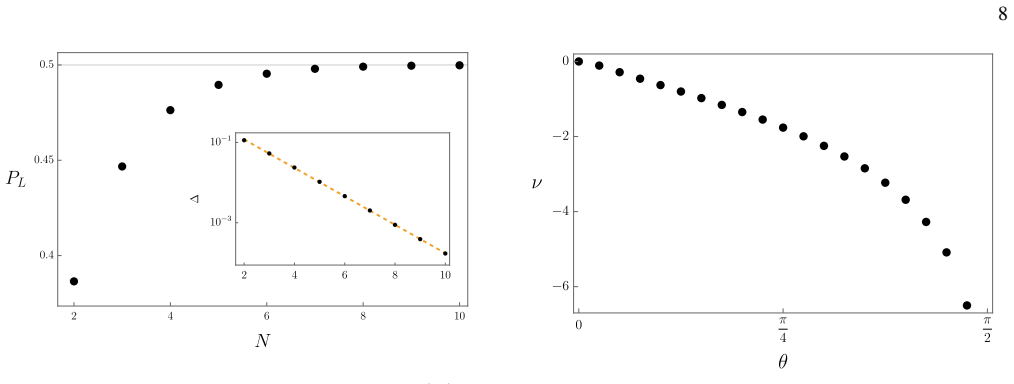
read the original abstract
Absorption of two-state coined quantum walks on a finite line with two sinks located at $N$ and $-N$ is investigated. Elaborating on the results of Konno et al., J. Phys. A: Math. Gen. 36 241 (2003), we derive closed formulas for the absorption probabilities at the boundaries in the limit of large system size $N$. Two limiting cases are considered, with the starting position $k$ being independent of $N$, or kept at a constant distance $\delta$ from one of absorbers. In the first scenario, the absorption probability is determined only by the coin parameter and polar angle of the initial coin state decomposed into the eigenbasis of the coin operator. In the second case, a correction depending exponentially on $\delta$ is introduced. Finally, we perform an extensive numerical investigation for small system size $N$, showing excellent agreement between numerical and analytical results.
Editorial analysis
A structured set of objections, weighed in public.
Referee Report
Summary. The paper investigates absorption of two-state coined quantum walks on a finite line with absorbing boundaries at ±N. Building on Konno et al. (2003), closed formulas are derived for the absorption probabilities in the large-N limit. Two cases are considered: initial position k fixed (independent of N) or at fixed distance δ from one boundary. In the fixed-k case the probability depends only on the coin parameter and the polar angle of the initial coin state in the eigenbasis of the coin operator; the fixed-δ case includes an exponentially decaying correction in δ. Extensive numerical checks for small N are reported to agree well with the analytic expressions.
Significance. If the large-N derivations hold, the work supplies exact, parameter-reduced expressions for absorption probabilities that clarify the role of coin operators and initial states in quantum-walk transport. This extends the 2003 framework with concrete limiting formulas and could inform quantum-search or transport studies. The numerical agreement for small systems is a positive supporting element, though the asymptotic claims carry the main weight.
major comments (2)
- [Derivation of large-N limit for fixed k] § on the first limiting case (fixed k, N→∞): the derivation of the k-independent absorption probability by summing boundary flux over all t assumes that contributions from the distant boundary vanish after the limit is taken. The finite-N propagator contains phase factors that oscillate with N; without an explicit dominated-convergence argument, stationary-phase estimate, or bound showing that cross terms average to zero uniformly in the sum, the claimed independence of k is not guaranteed. This step is load-bearing for the central closed-formula claim.
- [Derivation of large-N limit for fixed δ] The second limiting case (fixed δ) similarly invokes an evanescent-branch correction whose prefactor rests on the same interchange of limit and summation; an explicit error estimate for the remainder would be required to confirm the exponential dependence.
minor comments (3)
- [Abstract] The abstract states 'excellent agreement' for small N but does not specify the range of N, the number of trials, or the quantitative measure (e.g., maximum absolute deviation).
- [Introduction] A concise recap of the key recurrence relations from Konno et al. (2003) would help readers who are not already familiar with that work.
- [Numerical results section] Figure captions should explicitly label which curves or points represent the analytic formulas versus the numerical data.
Simulated Author's Rebuttal
We thank the referee for the careful reading of our manuscript and the constructive comments. We respond to each major comment below.
read point-by-point responses
-
Referee: [Derivation of large-N limit for fixed k] § on the first limiting case (fixed k, N→∞): the derivation of the k-independent absorption probability by summing boundary flux over all t assumes that contributions from the distant boundary vanish after the limit is taken. The finite-N propagator contains phase factors that oscillate with N; without an explicit dominated-convergence argument, stationary-phase estimate, or bound showing that cross terms average to zero uniformly in the sum, the claimed independence of k is not guaranteed. This step is load-bearing for the central closed-formula claim.
Authors: We thank the referee for pointing out this important technical point. The derivation proceeds from the explicit expression for the finite-N propagator (built from the eigenmodes of the coined walk) and takes the N→∞ limit inside the infinite-time sum for the absorption probability at each boundary. Because the walk spreads ballistically, any amplitude that reaches the distant boundary must travel a distance ∼N; the corresponding phase factors e^{iϕN} with ϕ away from stationary points produce rapid oscillations. We will add an explicit stationary-phase estimate in the revised manuscript that bounds the contribution of these cross terms by O(1/N) uniformly in the summation index t, thereby justifying the interchange of limit and sum and confirming that the result is indeed independent of the fixed starting position k. revision: yes
-
Referee: [Derivation of large-N limit for fixed δ] The second limiting case (fixed δ) similarly invokes an evanescent-branch correction whose prefactor rests on the same interchange of limit and summation; an explicit error estimate for the remainder would be required to confirm the exponential dependence.
Authors: We agree that a quantitative error bound strengthens the argument. In this regime the second boundary lies at distance ∼N, so its influence is carried by the propagating modes whose amplitude at the near boundary is exponentially small in N. The leading correction arises solely from the evanescent branch localized at the near boundary and decays as r^δ with |r|<1. We will insert a rigorous remainder estimate obtained by splitting the propagator into propagating and evanescent parts and applying the same stationary-phase bound to the propagating contribution, showing that the error after taking N→∞ is O(e^{-cN}) for some c>0, which is negligible compared with the O(r^δ) term. revision: yes
Circularity Check
No circularity: closed formulas derived by extending external Konno et al. recurrence relations
full rationale
The paper explicitly starts from the recurrence relations and eigenbasis analysis in the external reference Konno et al. (2003) and extends them to absorbing boundaries at ±N. Closed-form absorption probabilities in the N→∞ limit (for fixed k or fixed δ) are obtained analytically via decomposition of the initial coin state into coin-operator eigenstates, without introducing fitted parameters, self-definitions, or load-bearing self-citations. The resulting expressions depend only on the coin parameter and polar angle (or an exponential correction in δ), and are cross-checked by direct numerical simulation on small N. Because the foundational relations are imported from independent prior work and the large-N limit is performed on the propagator without reducing the target probabilities to the inputs by construction, the derivation chain remains non-circular.
Axiom & Free-Parameter Ledger
free parameters (1)
- coin parameter
axioms (2)
- domain assumption The quantum walk evolves unitarily according to the standard coined shift-and-coin operator on the integer line until absorption at the boundaries.
- domain assumption The large-N limit exists and can be taken while holding either the starting site k fixed or the distance δ to one boundary fixed.
Lean theorems connected to this paper
-
IndisputableMonolith/Foundation/RealityFromDistinction.leanreality_from_one_distinction unclear?
unclearRelation between the paper passage and the cited Recognition theorem.
We derive closed formulas for the absorption probabilities at the boundaries in the limit of large system size N... decomposition into the eigenbasis of the coin operator
-
IndisputableMonolith/Cost/FunctionalEquation.leanwashburn_uniqueness_aczel unclear?
unclearRelation between the paper passage and the cited Recognition theorem.
C1, C2, C3 expressed as integrals involving Chebyshev polynomials T_{2N-1}(c(ϕ))
What do these tags mean?
- matches
- The paper's claim is directly supported by a theorem in the formal canon.
- supports
- The theorem supports part of the paper's argument, but the paper may add assumptions or extra steps.
- extends
- The paper goes beyond the formal theorem; the theorem is a base layer rather than the whole result.
- uses
- The paper appears to rely on the theorem as machinery.
- contradicts
- The paper's claim conflicts with a theorem or certificate in the canon.
- unclear
- Pith found a possible connection, but the passage is too broad, indirect, or ambiguous to say the theorem truly supports the claim.
Reference graph
Works this paper leans on
-
[1]
The inset displays the difference ∆(N) = 1 2 − PL(N) on a logarithmic scale. The dashed line corresponds to the exponential fit ∆(N) ≈ exp(µ + νN ), with µ .= 0.878 and ν .= −1.762. In Figure 4 we consider N = 2 and sample the initial states of the Hadamard walk (51) by choosing ρ = √p = j/50, j = 0, . . .50, while keeping β = 0. The plot shows numericall...
-
[2]
National Centre on HPC, Big Data and Quan- tum Computing
With increasing N the difference from the asymptotic value (56) drops rapidly. 7 FIG. 3. Numerically calculated absorption probability PL(N) for the Hadamard walk ( θ = π 4 ) as a function of N. The initial state corresponds to ρ = 1√ 2 and β = 0. The inset shows the difference ∆ = PL − PL(N) from the asymptotic value (56) on a logarithmic scale. FIG. 4. ...
-
[3]
Y . Aharonov, L. Davidovich, and N. Zagury, Quantum random walks, Phys. Rev. A 48, 1687 (1993)
work page 1993
-
[4]
D. A. Meyer, From quantum cellular automata to quantum lat- tice gases, J. Stat. Phys. 85, 551 (1996)
work page 1996
-
[5]
E. Farhi and S. Gutmann, Quantum computation and decision trees, Phys. Rev. A 58, 915 (1998)
work page 1998
-
[6]
Ambainis, Quantum walks and their algorithmic applica- tions, Int
A. Ambainis, Quantum walks and their algorithmic applica- tions, Int. J. Quantum Inform. 1, 507 (2003)
work page 2003
- [7]
-
[8]
O. M ¨ulken, V . Pernice, and A. Blumen, Quantum transport on small-world networks: A continuous-time quantum walk ap- proach, Phys. Rev. E 76, 051125 (2007)
work page 2007
-
[9]
O. M ¨ulken, A. Blumen, T. Amthor, C. Giese, M. Reetz-Lamour, and M. Weidem¨uller, Survival probabilities in coherent exciton transfer with trapping, Phys. Rev. Lett. 99, 090601 (2007)
work page 2007
-
[10]
O. M ¨ulken and A. Blumen, Continuous-time quantum walks: Models for coherent transport on complex networks, Phys. Rep. 502, 37 (2011)
work page 2011
-
[11]
M. ˇStefaˇn´ak, J. Novotn´y, and I. Jex, Percolation assisted excita- tion transport in discrete-time quantum walks, New J. Phys.18, 023040 (2016)
work page 2016
-
[12]
J. Mare ˇs, J. Novotn´y, and I. Jex, Percolated quantum walks with a general shift operator: From trapping to transport, Phys. Rev. A 99, 042129 (2019)
work page 2019
-
[13]
J. Mare ˇs, J. Novotn´y, M. ˇStefaˇn´ak, and I. Jex, A counterintuitive role of geometry in transport by quantum walks, Phys. Rev. A 101, 032113 (2020)
work page 2020
-
[14]
J. Mare ˇs, J. Novotn ´y, and I. Jex, Quantum walk transport on carbon nanotube structures, Phys. Lett. A 384, 126302 (2020)
work page 2020
-
[15]
J. Mare ˇs, J. Novotn´y, M. ˇStefaˇn´ak, and I. Jex, Key graph proper- ties affecting transport efficiency of flip-flop grover percolated quantum walks, Phys. Rev. A 105, 062417 (2022)
work page 2022
-
[16]
A. M. Childs and J. Goldstone, Spatial search by quantum walk, Phy. Rev. A70, 022314 (2004)
work page 2004
- [17]
-
[18]
V . Potoˇcek, A. G ´abris, T. Kiss, and I. Jex, Optimized quantum random-walk search algorithms on the hypercube, Phys. Rev. A 79, 012325 (2009)
work page 2009
-
[19]
D. Reitzner, M. Hillery, E. Feldman, and V . Bu ˇzek, Quantum searches on highly symmetric graphs, Phys. Rev. A 79, 012323 (2009)
work page 2009
-
[20]
N. B. Lovett, M. Everitt, M. Trevers, D. Mosby, D. Stockton, and V . Kendon, Spatial search using the discrete time quantum walk, Nat. Comp. 11, 23 (2012)
work page 2012
-
[21]
J. Janmark, D. A. Meyer, and T. G. Wong, Global symmetry is unnecessary for fast quantum search, Phys. Rev. Lett. 112, 210502 (2014)
work page 2014
-
[22]
D. A. Meyer and T. G. Wong, Connectivity is a poor indicator of fast quantum search, Phys. Rev. Lett. 114, 110503 (2015)
work page 2015
-
[23]
S. Chakraborty, L. Novo, A. Ambainis, and Y . Omar, Spatial search by quantum walk is optimal for almost all graphs, Phys. Rev. Lett. 116, 100501 (2016)
work page 2016
-
[24]
S. Chakraborty, L. Novo, and J. Roland, Optimality of spatial search via continuous-time quantum walks, Phys. Rev. A 102, 032214 (2020)
work page 2020
-
[25]
S. Chakraborty, L. Novo, and J. Roland, Finding a marked node on any graph via continuous-time quantum walks, Phys. Rev. A 102, 022227 (2020)
work page 2020
-
[26]
A. Ambainis, A. Gilyen, S. Jeffery, and M. Kokainis, Quadratic Speedup for Finding Marked Vertices by Quantum Walks, in Proceedings of the 52nd Annual Acm Sigact Symposium on Theory of Computing (stoc ’20)(Assoc Computing Machinery,
- [27]
- [28]
-
[29]
A. M. Childs, Universal computation by quantum walk, Phys. Rev. Lett. 102, 180501 (2009)
work page 2009
-
[30]
N. B. Lovett, S. Cooper, M. Everitt, M. Trevers, and V . Kendon, Universal quantum computation using the discrete-time quan- tum walk, Phys. Rev. A 81, 042330 (2010)
work page 2010
-
[31]
A. M. Childs, D. Gosset, and Z. Webb, Universal computation by multiparticle quantum walk, Science 339, 791 (2013)
work page 2013
-
[32]
Kempe, Discrete quantum walks hit exponentially faster, Probab
J. Kempe, Discrete quantum walks hit exponentially faster, Probab. Theory Relat. Fields 133, 215 (2005)
work page 2005
-
[33]
H. Krovi and T. Brun, Hitting time for quantum walks on the hypercube, Phys. Rev. A 73, 032341 (2006)
work page 2006
-
[34]
H. Krovi and T. A. Brun, Quantum walks with infinite hitting times, Phys. Rev. A 74, 042334 (2006)
work page 2006
- [35]
-
[36]
Q. Wang, S. Ren, R. Yin, K. Ziegler, E. Barkai, and S. Tornow, First hitting times on a quantum computer: Tracking vs. lo- cal monitoring, topological effects, and dark states, Entropy26, 869 (2024)
work page 2024
-
[37]
H. Friedman, D. A. Kessler, and E. Barkai, Quantum walks: The first detected passage time problem, Phys. Rev. E 95, 032141 (2017)
work page 2017
- [38]
-
[39]
Q. Liu, R. Yin, K. Ziegler, and E. Barkai, Quantum walks: The mean first detected transition time, Phys. Rev. Res. 2, 033113 (2020)
work page 2020
-
[40]
F. A. Gr ¨unbaum, L. Vel ´azquez, A. H. Werner, and R. F. Werner, Recurrence for discrete time unitary evolutions, Com- mun. Math. Phys. 320, 543 (2013)
work page 2013
-
[41]
J. Bourgain, F. A. Gr ¨unbaum, L. Velazquez, and J. Wilkening, Quantum recurrence of a subspace and operator-valued schur functions, Commun. Math. Phys. 329, 1031 (2014)
work page 2014
-
[42]
S. L. Carvalho, L. F. Guidi, and C. F. Lardizabal, Site recur- rence of open and unitary quantum walks on the line, Quantum Inform. Process. 16, 17 (2017)
work page 2017
-
[43]
F. A. Gr ¨unbaum and L. Vel ´azquez, A generalization of schur functions: Applications to nevanlinna functions, orthogonal polynomials, random walks and unitary and open quantum walks, Advances Math. 326, 352 (2018)
work page 2018
-
[44]
F. A. Grunbaum, C. F. Lardizabal, and L. Velazquez, Quantum markov chains: Recurrence, schur functions and splitting rules, Ann. Henri Poincar´e 21, 189 (2020)
work page 2020
-
[45]
T. S. Jacq and C. F. Lardizabal, Homogeneous open quantum walks on the line: Criteria for site recurrence and absorption, Quantum Inform. Comput. 21, 37 (2021)
work page 2021
-
[46]
ˇStefaˇn´ak, Monitored recurrence of a one-parameter family of three-state quantum walks, Phys
M. ˇStefaˇn´ak, Monitored recurrence of a one-parameter family of three-state quantum walks, Phys. Scr. 98, 064001 (2023). 10
work page 2023
-
[47]
M. ˇStefaˇn´ak, V . Potoˇcek, I. Yalcinkaya, A. G ´abris, and I. Jex, Recurrence in discrete-time quantum stochastic walks (2025), arXiv:2501.08674 [quant-ph]
-
[48]
E. Bach, S. Coppersmith, M. P. Goldschen, R. Joynt, and J. Wa- trous, One-dimensional quantum walks with absorbing bound- aries, J. Comput. Sys, Scie. 69, 562 (2004)
work page 2004
-
[49]
T. Yamasaki, H. Kobayashi, and H. Imai, Analysis of absorbing times of quantum walks, Phys. Rev. A 68, 012302 (2003)
work page 2003
- [50]
-
[51]
M. ˇStefaˇn´ak, S. M. Barnett, B. Koll´ar, T. Kiss, and I. Jex, Direc- tional correlations in quantum walks with two particles, New J. Phys. 13, 033029 (2011)
work page 2011
-
[52]
M. ˇStefaˇn´ak, I. Bezd ˇekov´a, and I. Jex, Limit distributions of three-state quantum walks: The role of coin eigenstates, Phys. Rev. A 90, 012342 (2014)
work page 2014
-
[53]
I. Bezd ˇekov´a, M. ˇStefaˇn´ak, and I. Jex, Suitable bases for quan- tum walks with wigner coins, Phys. Rev. A 92, 022347 (2015)
work page 2015
-
[54]
M. ˇStefaˇn´ak and I. Jex, Persistence of unvisited sites in quantum walks on a line, Phys. Rev. A 93, 032321 (2016)
work page 2016
-
[55]
B. Tregenna, W. Flanagan, R. Maile, and V . Kendon, Control- ling discrete quantum walks: coins and initial states, New J. Phys. 5, 83 (2003)
work page 2003
-
[56]
K. G. Sandeep, K. Thomas, and D. Lajos, Unitary equivalence of quantum walks, Phys. Lett. A 379, 100 (2015)
work page 2015
-
[57]
T. Miyazaki, M. Katori, and N. Konno, Wigner formula of ro- tation matrices and quantum walks, Phys. Rev. A 76, 012332 (2007)
work page 2007
-
[58]
A. Kempf and R. Portugal, Group velocity of discrete-time quantum walks, Phys. Rev. A 79, 052317 (2009)
work page 2009
- [59]
-
[60]
N. Inui, N. Konno, and E. Segawa, One-dimensional three-state quantum walk, Phys. Rev. E 72, 056112 (2005)
work page 2005
-
[61]
T. Nitsche, O. Maloyer, A. Schreiber, A. Gabris, I. Jex, and C. Silberhorn, Quantum walks with dynamical control: Graph engineering, initial state preparation, and state transfer, New J. Phys. 18, 063017 (2016)
work page 2016
-
[62]
T. Nitsche, S. Barkhofen, R. Kruse, L. Sansoni, M. ˇStefaˇn´ak, A. G´abris, V . Potoˇcek, T. Kiss, I. Jex, and C. Silberhorn, Prob- ing measurement-induced effects in quantum walks via recur- rence, Sci. Adv. 4, eaar6444 (2018)
work page 2018
discussion (0)
Sign in with ORCID, Apple, or X to comment. Anyone can read and Pith papers without signing in.