REVIEW 4 major objections 4 minor 32 references
Benchmarking spike source localization algorithms in high density probes
T0 review · 4 major / 4 minor · reviewed 2026-08-05 · deepseek-v4-flash
Pith's one-line read A ground-truth benchmark of three neuron-localization algorithms finds that the simple center-of-mass heuristic, though less accurate in ideal conditions, stays most accurate as electrodes decay.
desk verdict Useful first benchmark of spike localization under electrode decay, but the headline robustness claim rests on a narrow decay model and the manuscript has a few internal cracks. read the letter →
The pith
A machine-rendered reading of the paper's core claim, the machinery that carries it, and where it could break.
The reading
What carries the argument
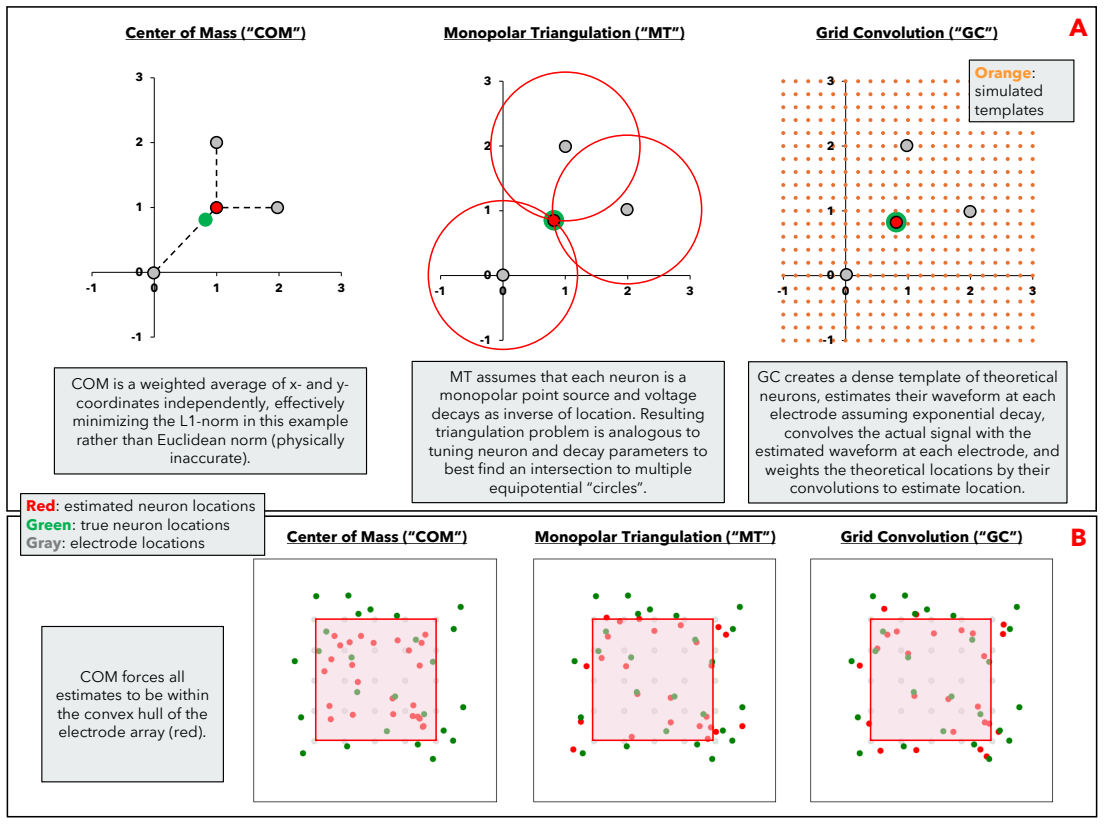
The argument is carried by three named localization algorithms compared under a common degradation protocol. COM estimates a spike's position as the peak-to-peak amplitude-weighted average of electrode positions, which is fast and simple but confined to the convex hull of the array. MT assumes a monopolar point source with voltage decaying as inverse distance and fits the location by least squares. GC builds a dense grid of theoretical templates with exponential signal decay and weights each grid position by the convolution between measured and theoretical waveforms. The degradation protocol replaces the recorded signal at a randomly chosen fraction of electrodes with Gaussian noise, and per
What would settle it
Record from a chronically implanted high-density probe for months while monitoring electrode impedance, and compare localization accuracy against patch-clamp ground truth for neurons near electrodes that degrade gradually (rising impedance) rather than failing outright. If monopolar triangulation matches or beats center of mass under that natural decay pattern, the paper's central claim about long-term suitability fails; if COM still wins, the claim is confirmed outside the random-death simulation.
Extended reading notes
Core claim
The central discovery is an accuracy–robustness tradeoff among the three algorithms, measured against biological ground truth rather than theoretical appeal. On a simulated dataset with known neuron positions, grid convolution and monopolar triangulation beat center of mass on accuracy and RMSE in clean conditions, consistent with their more realistic physical models. On the noisy experimental dataset, however, center of mass and grid convolution outperform monopolar triangulation—and under simulated electrode decay, center of mass retains its accuracy while monopolar triangulation degrades sharply, producing overfit estimates for spike events. The paper reads this as evidence that the simpl
Load-bearing premise
The robustness ranking depends on the assumption that electrode decay is faithfully represented by replacing the signal at a randomly selected fraction of electrodes with Gaussian noise; if real electrode degradation follows a different pattern, the observed advantage of the simple heuristic could be an artifact of that simulation.
Editorial extensions
If this is right
- For chronic implants, where electrodes fail progressively, the simple COM and the grid-based GC should be preferred over MT for tracking neurons across days or months.
- MT's overfitting under electrode loss is mainly a single-spike problem, so template-level localization is safer than spike-level localization when using MT on degraded arrays.
- COM's speed, combined with its stability, makes it practical for real-time spike sorting on embedded or low-power devices.
- Drift estimates computed from COM or GC locations will be less contaminated by electrode-loss artifacts than those from MT.
- Future localization algorithms should be evaluated not only on clean accuracy but on the same decay-robustness axis, since real arrays always age.
Reading between the lines
- If real electrode aging is gradual impedance rise or correlated multi-electrode failure rather than random single-electrode death, the COM-versus-MT ranking is not guaranteed; the paper's decay model is the assumption most worth testing.
- A hybrid strategy—use MT or GC while the array is healthy and switch to COM as electrode loss crosses a threshold—could combine ideal-condition accuracy with long-term stability.
- The same ground-truth benchmark could be extended to probe drift and tissue micromotion, since the paper names drift monitoring as a downstream use but does not test localization under active drift.
- The near-linear geometry of Neuropixels may amplify COM's advantage; on a square 2D array with denser coverage the accuracy gap in clean conditions could matter more in practice.
Signed reviews
Editorial analysis
A structured set of objections, weighed in public.
Referee Report
Summary. The paper presents a benchmark of three spike source localization algorithms—center of mass (COM), monopolar triangulation (MT), and grid convolution (GC)—using two ground-truth datasets: a simulated MEArec dataset with known neuron positions, and the experimental SPE-1 dataset combining patch-clamp and Neuropixels recordings. The authors evaluate localization accuracy, runtime, and robustness under ideal conditions and under simulated electrode decay, where an increasing fraction of electrode signals is replaced with Gaussian noise. The main finding is that MT and GC are more accurate than COM in ideal simulated conditions, but COM (and to a lesser extent GC) is more robust to electrode decay, leading the authors to conclude that simple heuristics such as COM are more suitable for long-term neural recordings. The paper also provides a public code repository and a framework for future benchmarking.
Significance. If the central claim holds, this is a useful contribution to a nascent field: it provides the first ground-truth comparison of these widely used localization algorithms using both a biophysical simulator and a paired patch-clamp/Neuropixels dataset. The open code and use of public datasets are strengths that support reproducibility. However, the headline conclusion about long-term suitability depends heavily on the realism of the electrode-decay model and on the representativeness of the selected experimental subset, both of which are currently not sufficiently validated. The paper is therefore potentially significant, but the strength of the claim exceeds what the evidence currently supports.
major comments (4)
- [Benchmarking results against decay (Figs. 3–4)] The electrode-decay model is implemented by replacing the signals of a randomly selected fraction of electrodes with Gaussian noise. This is a binary, abrupt, spatially uncorrelated failure model. Real chronic electrode degradation in vivo is typically gradual (e.g., rising impedance, reduced gain) and can be spatially clustered or correlated. The central abstract claim that COM is 'more suitable for long-term neural recordings' rests on this simulation. No validation against real chronic recordings is provided, and the choice of model is not neutral: binary dropout removes constraints from MT's optimization, potentially explaining MT's overfitting, while COM's shrinkage toward the convex hull of the remaining electrodes remains centered under random dropout. The authors should either validate the decay model against empirical chronic-recording data or substantially soften the long-term
- [Methods, Experimental Dataset] The paper states that the SPE-1 dataset contains 43 paired recordings but that only 11 pairs were selected 'with the strongest signal quality and confidence of patch-clamp and MEA pairing.' No objective or pre-specified criteria are given for this selection. Since the experimental results (Fig. 2D and Fig. 4) are based entirely on these 11 pairs, the selection could bias the comparison, especially if pairing confidence correlates with signal-to-noise ratio or neuron depth. The manuscript should report the total number of available pairs, the criteria used, and ideally show that the main conclusions are robust to including more pairs or a more inclusive subset.
- [Results, 'Benchmarking results in absence of electrode decay' vs. Fig. 2 caption] There is a direct internal contradiction in the statistical reporting. The Fig. 2 caption states that 'all metrics exhibited significant differences (p < 0.05),' while the text states that 'No significant differences were found in template accuracy across algorithms (one-way ANOVA p = 0.0409; all pairwise comparisons p >0.05).' If the ANOVA is significant but pairwise comparisons are not, the caption should not claim that all metrics differed significantly. This inconsistency undermines the reader's ability to trust the statistical summaries and must be corrected.
- [Figs. 3–4 and decay robustness] Even under the chosen binary dropout model, the decay-robustness results are reported only as bar/error-bar plots without any statistical tests. The text states that 'COM and GC are more robust against electrode decay than MT,' but no ANOVA, paired comparison, or confidence interval is provided across decay levels. Given that the central long-term-recording claim is based on these data, the authors should provide quantitative statistical support, e.g., repeated-measures comparisons across decay levels, rather than relying on visual trends.
minor comments (4)
- [Materials and methods, Simulated Dataset] The probe layout is described as 'spaced 30nm apart.' This should presumably be 30 µm (micrometers), not 30 nm. Please correct.
- [Eq. for Monopolar Triangulation] The loss function is written as Li = Σ_j (ptp_ij − V_ij), with the text stating that the location is estimated 'usually via least squares.' The least-squares objective should involve the square of the residual, i.e., Σ_j (ptp_ij − V_ij)^2. Please clarify whether the implementation uses squared residuals or absolute residuals, as this affects the algorithm's behavior.
- [Eq. for Grid Convolution] The equation τ_kj(t) = e^{(p_k − p_i)^2/(2σ^2)} w_k(t) appears to contain a typo: the exponent should likely involve the distance between the theoretical template position p_k and the electrode position p_j, not a spike position p_i. Please define all symbols and correct the equation.
- [Abstract and Discussion] The abstract describes 'simple heuristics' as demonstrating superior robustness, but the results identify COM and, in some cases, GC as robust. GC is not a simple heuristic; it is a grid-based template method. Please align the language with the actual algorithms tested.
Circularity Check
No significant circularity: the benchmark uses external ground truth and reports observed comparisons; no prediction reduces to a fitted input.
full rationale
The paper's claims are empirical benchmarking results. The localization algorithms (COM, MT, GC) are standard methods applied to spike waveforms; the ground truth locations come from an external biophysical simulator (MEArec) and from an independent patch-clamp/Neuropixels dataset (SPE-1). The accuracy, RMSE, runtime, and robustness metrics are computed directly from these comparisons. There is no fitted parameter that is later renamed as a prediction, and no equation in the paper defines an output in terms of the quantity it claims to predict. The electrode-decay experiments replace a random fraction of electrodes with Gaussian noise; this is a simulation assumption, not a circular step, because the robustness ranking is an observed result of that assumed model rather than a consequence of the paper's own definitions. The paper does contain several self-citations (e.g., refs. 6, 7, 15, 18), but these support background statements about flexible probes and prior spike-sorting work; they are not load-bearing for the central benchmarking conclusion. No uniqueness theorem or ansatz is imported from the authors' prior work to force a particular algorithm choice. Therefore, no specific circular step can be exhibited, and the appropriate finding is no significant circularity.
Assumptions & free parameters
free parameters (3)
- Accuracy tolerance =
30 µm (simulated), 80 µm (experimental)
- Electrode decay levels =
0,16,36,56,76,96% (simulated); 0,30,60,90% (experimental)
- Simulated dataset size and layout =
10 neurons, 25 probes (5x5, 30 µm spacing)
assumptions (5)
- domain assumption The MEArec simulator with the chosen templates produces biophysically realistic extracellular signals.
- domain assumption Electrode decay can be modeled by replacing electrode signals with Gaussian noise.
- domain assumption The SPE-1 patch-clamp recordings provide reliable ground truth spike trains and approximate neuron locations.
- domain assumption Voltage amplitude decays as inverse of distance (MT) or exponentially (GC).
- domain assumption The selected 11 SPE-1 recordings with strongest signal quality are representative of typical recordings.
Cite this review
Pith. "Pith review of Benchmarking spike source localization algorithms in high density probes." pith.science (2026). https://pith.science/paper/DYTY6OQD
@misc{pith2026250813451,
  author       = {Pith},
  title        = {Pith review of: Benchmarking spike source localization algorithms in high density probes},
  year         = {2026},
  howpublished = {\url{https://pith.science/paper/DYTY6OQD}},
  note         = {Machine review of arXiv:2508.13451}
}
read the original abstract
Estimating neuron location from extracellular recordings is essential for developing advanced brain-machine interfaces. Accurate neuron localization improves spike sorting, which involves detecting action potentials and assigning them to individual neurons. It also helps monitor probe drift, which affects long-term probe reliability. Although several localization algorithms are currently in use, the field is nascent and arguments for using one algorithm over another are largely theoretical or based on visual analysis of clustering results. We present a first-of-its-kind benchmarking of commonly used neuron localization algorithms. We tested these algorithms using two ground truth datasets: a biophysically realistic simulated dataset, and experimental data combining patch-clamp and Neuropixels probes. We systematically evaluate the accuracy, robustness, and runtime of these algorithms in ideal conditions and long-term recording conditions with electrode decay. Our findings highlight significant performance differences; while more complex and physically realistic models perform better in ideal situations, simple heuristics demonstrate superior robustness to noise and electrode degradation in experimental datasets, making them more suitable for long-term neural recordings. This work provides a framework for assessing localization algorithms and developing robust, biologically grounded algorithms to advance the development of brain-machine interfaces.
Figures


Figures from the paper (1 more)

Reference graph
Works this paper leans on
-
[1]
Tracking neurons across days with high-density probes
van Beest EH, Bimbard C, Fabre JMJ, et al. Tracking neurons across days with high-density probes. Nat Methods. 2025;22:778–787. doi:10.1038/s41592-024-02440-1
-
[2]
Tracking neural activity from the same cells during the entire adult life of mice
Zhao S, Tang X, Tian W, et al. Tracking neural activity from the same cells during the entire adult life of mice. Nat Neurosci. 2023;26:696–710. doi:10.1038/s41593-023-01267-x. September 4, 2025 11/13
- [3]
-
[4]
Pachitariu M, Sridhar S, Pennington J, et al. Spike sorting with Kilosort4. Nat Methods. 2024;21:914–921. doi:10.1038/s41592-024-02232-7
-
[5]
Garcia S, Windolf C, Boussard J, Dichter B, Buccino AP, Yger P. A modular implementation to handle and benchmark drift correction for high-density extracellular recordings. eNeuro. 2024;11(2). doi:10.1523/ENEURO.0229-23.2023
-
[6]
He Y, Marin-Llobet A, Sheng H, Liu R, Liu J. End-to-end multimodal deep learning for real-time decoding of months-long neural activity from the same cells. bioRxiv. 2024. doi:10.1101/2024-10
-
[7]
Lin Z, Marin-Llobet A, et al. Spike sorting AI agent. bioRxiv. 2025. doi:10.1101/2025.02.11.637754
-
[8]
Three-dimensional spike localization and improved motion correction for neuropixels recordings
Boussard J, Varol E, Dong Lee H, Dethe N, Paninski L. Three-dimensional spike localization and improved motion correction for neuropixels recordings. Adv Neural Inf Process Syst. 2021;34:22095–22105
work page 2021
Show all 32 references
-
[9]
SpikeInterface, a unified framework for spike sorting
Garcia S, Buccino AP, Hurwitz C, et al. SpikeInterface, a unified framework for spike sorting. eLife. 2022;11:e72140. doi:10.7554/eLife.72140
2022 doi
-
[10]
Months-long tracking of neuronal ensembles spanning multiple brain areas with ultra-flexible tentacle electrodes
Yasar TB, Gombkoto P, Vyssotski AL, et al. Months-long tracking of neuronal ensembles spanning multiple brain areas with ultra-flexible tentacle electrodes. Nat Commun. 2024;15:4822. doi:10.1038/s41467-024-49226-9
2024 doi
-
[11]
Flexible neural interfaces for brain implants-the pursuit of thinness and high density
Araki T, Bongartz LM, Kaiju T, et al. Flexible neural interfaces for brain implants-the pursuit of thinness and high density. Flex Print Electron. 2020;5:043002. doi:10.1088/2058-8585/abc3ca
2020 doi
-
[12]
Neural tissue-microelectrode interaction: brain micromotion, electrical impedance, and flexible microelectrode insertion
Sharafkhani N, Kouzani AZ, Adams SD, et al. Neural tissue-microelectrode interaction: brain micromotion, electrical impedance, and flexible microelectrode insertion. J Neurosci Methods. 2022;365:109388. doi:10.1016/j.jneumeth.2021.109388
2022
-
[13]
Acute in vivo recording with a generic parylene microelectrode array implanted with dip-coating method into the rat brain
Xu H, Scholten K, Jiang W, Ortigoza-Diaz JL, Lu Z, et al. Acute in vivo recording with a generic parylene microelectrode array implanted with dip-coating method into the rat brain. IEEE Eng Med Biol Soc Annu Int Conf. 2022;2022:214–217
2022
-
[14]
Brain implantation of soft bioelectronics via embryonic development
Sheng H, Liu R, Li Q, et al. Brain implantation of soft bioelectronics via embryonic development. Nature. 2025;642:954–964. doi:10.1038/s41586-025-09106-8
2025 doi
-
[15]
In vivo neural stimulation and recording using flexible bioelectronics
Liu R, Zhang X, Sheng H, Liu J. In vivo neural stimulation and recording using flexible bioelectronics. IEEE Int Electron Devices Meet. 2024;2024:1–4. doi:10.1109/IEDM50854.2024.10873414
2024
-
[16]
Flexible brain–computer interfaces
Tang X, Shen H, Zhao S, et al. Flexible brain–computer interfaces. Nat Electron. 2023;6:109–118. doi:10.1038/s41928-022-00913-9
2023 doi
-
[17]
Flexible and smart electronics for single-cell resolved brain–machine interfaces
Lee AJ, Wang W, Liu J. Flexible and smart electronics for single-cell resolved brain–machine interfaces. Appl Phys Rev. 2023;10(1):011314. doi:10.1063/5.0115879
2023 doi
-
[18]
Plastic-elastomer heterostructure for robust flexible brain-computer interfaces
Lin X, Zhang X, et al. Plastic-elastomer heterostructure for robust flexible brain-computer interfaces. bioRxiv. 2025. doi:10.1101/2025.04.29.651325. September 4, 2025 12/13
2025 doi
-
[19]
Realigning representational drift in mouse visual cortex by flexible brain–machine interfaces
Zhao S, Shen H, et al. Realigning representational drift in mouse visual cortex by flexible brain–machine interfaces. bioRxiv. 2024. doi:10.1101/2024.05.23.595627
2024 doi
-
[20]
MEArec: A fast and customizable testbench simulator for ground-truth extracellular spiking activity
Buccino AP, Einevoll GT. MEArec: A fast and customizable testbench simulator for ground-truth extracellular spiking activity. Neuroinform. 2021;19:185–204. doi:10.1007/s12021-020-09467-7
2021 doi
-
[21]
Recording from the same neuron with high-density CMOS probes and patch-clamp: a ground-truth dataset and an experiment in collaboration
Marques-Smith A, et al. Recording from the same neuron with high-density CMOS probes and patch-clamp: a ground-truth dataset and an experiment in collaboration. bioRxiv. 2020. doi:10.1101/370080
2020 doi
-
[22]
Spike source localization with tetrodes
Chelaru MI, Jog MS. Spike source localization with tetrodes. J Neurosci Methods. 2005;142(2):305–315. doi:10.1016/j.jneumeth.2004.09.007
2005 doi
-
[23]
Three-dimensional localization of neurons in cortical tetrode recordings
Mechler F, Victor JD, Ohiorhenuan I, Schmid AM, Hu Q. Three-dimensional localization of neurons in cortical tetrode recordings. J Neurophysiol. 2011;106(2):828–848. doi:10.1152/jn.00515.2010
2011
-
[24]
An unsupervised real-time spike sorting system based on optimized OSort
Wu Y, Li BZ, Wang L, et al. An unsupervised real-time spike sorting system based on optimized OSort. J Neural Eng. 2023;20(6). doi:10.1088/1741-2552/ad0d15
2023 doi
-
[25]
RT-Sort: An action potential propagation-based algorithm for real-time spike detection and sorting with millisecond latencies
van der Molen T, Lim M, Bartram J, et al. RT-Sort: An action potential propagation-based algorithm for real-time spike detection and sorting with millisecond latencies. PLoS One. 2024;19(12):e0312438. doi:10.1371/journal.pone.0312438
2024 doi
-
[26]
The 3D position estimation of neurons in the hippocampus based on the multi-site multi-unit recordings with silicon tetrodes
Hirabayashi T, Miyashita Y, Naya Y. The 3D position estimation of neurons in the hippocampus based on the multi-site multi-unit recordings with silicon tetrodes. J Neurosci Methods. 2004;135(1–2):151–159. doi:10.1016/j.jneumeth.2003.12.003
2004 doi
-
[27]
On the origin of the extracellular action potential waveform: A modeling study
Gold C, Henze DA, Koch C, Buzs´ aki G. On the origin of the extracellular action potential waveform: A modeling study. J Neurophysiol. 2006;95(5):3113–3128. doi:10.1152/jn.00979.2005
2006
-
[28]
A two-stage fuzzy logic approach for wireless LAN indoor positioning
Teuber A, Eissfeller B, Pany T. A two-stage fuzzy logic approach for wireless LAN indoor positioning. IEEE/ION Position Loc Navig Symp. 2006:730–738. doi:10.1109/PLANS.2006.1650667
2006 arXiv
-
[29]
Providing location services within a radio cellular network using ellipse propagation model
Zhou J, Chu KMK, Ng JKY. Providing location services within a radio cellular network using ellipse propagation model. Int Conf Adv Inf Netw Appl. 2005:559–564. doi:10.1109/AINA.2005.286
2005 doi
-
[30]
Survey of wireless indoor positioning techniques and systems
Liu H, Darabi H, Banerjee P, Liu J. Survey of wireless indoor positioning techniques and systems. IEEE Trans Syst Man Cybern C Appl Rev. 2007;37(6):1067–1080. doi:10.1109/TSMCC.2007.905750
2007
-
[31]
Estimating distances via received signal strength and connectivity in wireless sensor networks
Miao Q, Huang B, Jia B. Estimating distances via received signal strength and connectivity in wireless sensor networks. Wirel Netw. 2020;26:971–982. doi:10.1007/s11276-018-1843-8
2020 doi
-
[32]
Received signal strength-based indoor localization using hierarchical classification
Zhang C, Qin N, Xue Y, Yang L. Received signal strength-based indoor localization using hierarchical classification. Sensors (Basel). 2020;20(4):1067. doi:10.3390/s20041067. September 4, 2025 13/13
2020 doi
Reviewed August 5, 2026 · model on record in the stance chip above.
Discussion (0). Continue with ORCID to comment.