REVIEW 3 major objections 5 minor 1 cited by
Sketch3DVE: Sketch-based 3D-Aware Scene Video Editing
T0 review · 3 major / 5 minor · reviewed 2026-08-15 · deepseek-v4-flash
Pith's one-line read The paper claims that a single first-frame sketch, mask, and text prompt can drive structural video edits that stay locked to the original camera motion, because the edit is lifted into a depth-aligned point cloud and re-rendered under…
desk verdict Solid systems contribution for sketch-based 3D-aware video editing, but the core geometric-consistency claim for newly inserted content is underevidenced because the depth of new objects is monocular and the evaluation never directly tests it. read the letter →
The pith
A machine-rendered reading of the paper's core claim, the machinery that carries it, and where it could break.
The reading
What carries the argument
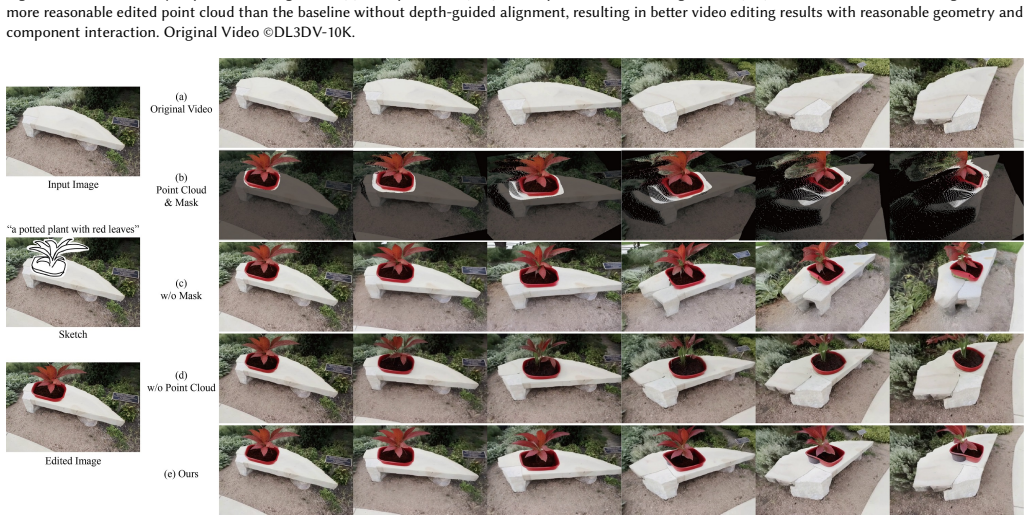
The load-bearing object is a depth-aligned edited point cloud. The edited first-frame depth map $\hat{D}^{\mathrm{edit}}$ is rescaled and shifted by coefficients $(s,t)$ fitted with least squares, $\min_{s,t}\sum_i ((s\hat{d}_i+t)-d_i)^2$, over pixels in the unedited mask region, so the new geometry shares the original scene's scale and position. Those coefficients are used to merge edited and original depth, then back-projection under the first camera gives the edited point cloud, which is rendered from every recovered camera pose to guide novel views. The companion mechanism is a 3D-aware mask: the mask drawn on frame one is extruded along camera rays into a shallow cylindrical mesh whose front surface uses the merged pre- and post-edit depth, and rendering that mesh with the recovered cameras produces the mask sequence that tells the diffusion model exactly where to write new content. The final synthesizer is a conditional control branch on a video diffusion transformer, initialized to add no signal at first, that takes the point-cloud renderings, the masked original video, and the edited first frame as conditions.
What would settle it
Take a synthetic video with known camera trajectory and a known inserted object; run the method with a deliberately corrupted stereo estimate for one frame or with a sequence outside the stereo estimator's training distribution, and check whether the rendered edited-region masks drift from the ground-truth projected object by more than a few pixels. Alternatively, reconstruct the first-frame depth from a video pair where the estimator is known to fail, and observe whether the edited output's unedited-region PSNR drops below the method's reported range.
Extended reading notes
Core claim
The paper's central claim is that sparse 2D user input—one sketch, one mask, one text prompt on the first frame—can be translated into a video edit that stays consistent with the original camera path, even when the camera rotates or zooms substantially. The operative mechanism is a point cloud edit: after an image editor modifies the first frame, the edited frame is lifted to 3D by back-projecting a depth map that has been aligned to the original scene's depth through a scale-and-shift fit over the unedited pixels. This edited point cloud is then rendered from every input camera pose, the same fitted depth is used to build a 3D mask that is rendered into per-frame 2D masks, and a video diffusion model inpaints the masked edited regions while keeping the visible original video as a condition. On the paper's own quantitative and user evaluations, this yields the best temporal consistency and unedited-region preservation among the compared approaches, and the ablations attribute that to the depth alignment, the 3D-aware masks, and the point-cloud rendering condition.
Load-bearing premise
Everything depends on the stereo reconstruction being right: if the dense stereo step returns a wrong point cloud or wrong cameras for the input video, the edited point cloud, the propagated masks, and the final edited frames inherit that error and show artifacts.
Editorial extensions
If this is right
- A single first-frame sketch and mask become enough to insert, remove, replace, or reshape an object in a clip with large camera rotations or zooms.
- Unedited regions stay close to the original video because the diffusion model is conditioned on the original frames with edited regions masked, so preservation is built into the pipeline rather than left to chance.
- The method generalizes to any first-frame editor: mask-based inpainting and color-stroke editing plug into the same geometric propagation machinery.
- From a single image, the same point-cloud rendering plus diffusion model can also generate camera-controllable videos, so editing and generation share one geometry-conditioned backend.
- The ablations indicate that dropping any of the three components—depth alignment, the 3D-aware mask, or point-cloud rendering—degrades reconstruction, so all three are needed for the claimed behavior.
Reading between the lines
- Editorial inference: because depth alignment only needs correspondences in unedited regions, the same geometry machinery should work with any first-frame editor, not just the sketch-based one.
- Editorial inference: the supplement's robustness numbers imply the diffusion model absorbs moderate depth errors, so the practical bottleneck is the stereo front-end's failure modes rather than the alignment math.
- Editorial inference: if 360-degree training data were added, the method's own limitation on full rotations would likely relax, because the point-cloud guidance itself does not assume a bounded viewing cone.
- Editorial inference: the method's static-scene assumption suggests a natural next step: separating camera motion from transient object motion so that videos with both large viewpoint changes and dynamic objects become editable.
Signed reviews
Editorial analysis
A structured set of objections, weighed in public.
Referee Report
Summary. Sketch3DVE addresses the task of structurally editing scene videos with substantial viewpoint changes. The user provides a sketch, a first-frame mask, and a text prompt; an image editor (MagicQuill) produces an edited first frame. The method estimates a point cloud and camera parameters for the input video with DUSt3R, computes a depth map for the edited first frame (by feeding the edited frame to DUSt3R as a duplicated pair), aligns that depth to the original first-frame depth via a least-squares scale/shift fit on unedited pixels (Eq. 1), merges the aligned edited depth with the original depth according to the mask (Eq. 2), back-projects to an edited point cloud (Eq. 3), propagates the user mask through a 3D cylindrical mesh to all frames, and finally regenerates the video with a CogVideoX-based control network (Eq. 4) using the point cloud rendering, the masked original video, and the edited first frame as conditions. Training is self-supervised on reconstruction from DL3DV and RealEstate clips. The paper reports comparisons against AnyV2V, I2VEdit, ViewExtrapolator, and ViewCrafter, plus ablations, a user study, and supplemental robustness experiments for depth noise.
Significance. The paper targets an important open problem: local, structural video editing with large camera motion. The proposed solution is a coherent three-stage pipeline (geometry extraction, depth-aligned point cloud editing, 3D-aware mask propagation plus conditional video diffusion), and the authors make a credible case that the combination is superior to the compared methods in the shown examples. The approach is not circular: the video model is trained self-supervised on reconstruction, and the depth scale/shift fit is an alignment calibration rather than a fitted target. The authors provide a thorough supplemental package, including robustness tests to depth distortion, failure cases on 360-degree rotations, and sketch-style variation. However, the central claim about viewpoint-consistent editing of newly introduced content rests on a depth estimate for the edited regions that is a monocular prediction (DUSt3R applied to a duplicated image pair), and the current evaluation does not isolate this load-bearing step with ground-truth geometry.
major comments (3)
- [Sec. 3.2, Eqs. (1)-(3)] The edited point cloud P_edit is produced from a depth map D_edit that is obtained by running DUSt3R on the edited first frame duplicated as a pair, so the depth of newly inserted or replaced content is a monocular hallucination rather than a multi-view measurement. The alignment in Eq. (1) only fits a global scale s and shift t on unedited pixels; it cannot correct per-pixel depth errors for the new content. If the hallucinated depth places the new object at the wrong depth or scale, rendering P_edit with the recovered cameras {C_i} produces parallax that disagrees with the original scene, and the conditions in Eq. (4) contain contradictory evidence (the mask says 'edit here' while the point-cloud render shows original foreground). The evaluations in Table 2 and the supplemental robustness test (Supplemental Table 1) never exercise this failure mode: the ablation uses the original first frame as the 'edited' image, and the robustness test perturbs already-correct depth with uniform noise or shift. Please add experiments that measure the predicted depth of genuinely novel content against ground truth (e.g., rendering an inserted synthetic 3D object into a real video), or at least a quantitative failure analysis over a larger set of insertions, to substantiate the central viewpoint-consistency claim.
- [Sec. 4.2, Table 1] The quantitative comparison is computed on 20 examples 'randomly select[ed] from all our editing cases', which is a self-selected test set whose composition is not described; no error bars are reported, and the PSNR is measured only in unedited regions. The one-sided metric therefore does not assess the fidelity of the edited content, which is the main differentiator of the method. The reconstruction ablations in Table 2 (and the supplemental video generation comparison in Supplemental Table 2) measure the ability to reconstruct the original video, which is a different task from inserting or replacing content. To support the claim that new edited components are view-consistent and high-quality, the paper needs a fixed, publicly described test set and metrics on edited regions (e.g., LPIPS or a geometry-aware metric against a synthetic reference), with confidence intervals across examples.
- [Sec. 3.4 and Supplemental Sec. 4] The control network is trained only with self-supervised reconstruction examples in which the input first frame is the original frame and the point cloud is the correct one for that frame. At inference, the edited point cloud is the output of the heuristic alignment in Eqs. (1)-(3), whose errors are structured (e.g., an object placed at a globally biased depth, or a compressed depth range). The supplemental robustness test (Supplemental Table 1) perturbs correct depth with 20% uniform noise or a uniform shift; it does not replicate the correlated, spatially structured errors DUSt3R produces for novel content. I recommend augmenting the training or at least the evaluation with simulated structured errors of the type the method will encounter, so that the robustness claim is matched to the actual failure distribution.
minor comments (5)
- [Eq. (2)] Eq. (2) as rendered applies the same mask M to both depth terms; presumably the first term should use the complement (1-M). Please clarify the notation.
- [Abstract] The homepage URL in the abstract contains a duplicated protocol: 'http://http://geometrylearning.com/Sketch3DVE/'.
- [Sec. 4.2] The abbreviation 'ViewExtra' is introduced without spelling out the full name 'ViewExtrapolator' at first use; please use consistent naming throughout.
- [Sec. 3.3] The 3D mask construction is only fully described in the supplemental material; a short summary with the key back-projection steps in the main text would help the reader follow Fig. 2 without jumping to the supplement.
- [Table 1] No error bars or significance tests are reported for the automatic metrics or the user study; a simple standard deviation across examples would help assess whether the reported advantages are meaningful.
Circularity Check
No significant circularity: the pipeline is a self-contained conditional video-editing system, and the depth alignment in Eq. (1) is a calibration step rather than a fitted target claim.
full rationale
The paper's derivation chain is not circular. The edited first frame is produced by an external image-editing model (MagicQuill), and the 3D geometry of the input video is estimated by an external dense-stereo model (DUSt3R). Eq. (1) solves for a scale and shift that align the edited depth map to the original depth map using only unedited-region correspondences; Eq. (2) then blends the aligned edited depth into the original depth, and Eq. (3) back-projects to obtain an edited point cloud. The resulting point cloud is rendered and fed as a condition to a video diffusion model. The central output, a realistic edited video, is therefore not defined as the fitted coefficients of Eq. (1); it is produced by a learned generative model conditioned on multiple inputs, and it is evaluated against external baselines, reconstruction metrics on DL3DV/RealEstate, and a human user study. The DUSt3R sensitivity noted in Section 6 is an empirical limitation that the authors explicitly disclose, and the supplemental robustness test perturbs depth maps to measure tolerance; this is a correctness/robustness concern, not circularity. The self-citations in the related-work section (e.g., DeepFaceVideoEditing, SketchDream) are contextual and not load-bearing for the central claim. No equation reduces to its own input, no fitted parameter is renamed as a prediction, and no author-imposed uniqueness theorem is invoked. The monocular-depth concern raised by a skeptic is a genuine limitation about unknown novel-content geometry, but the authors do not claim to derive that geometry from the input video; they inherit it from DUSt3R and state that failure can cause artifacts. That is an acknowledged dependency, not circular reasoning.
Assumptions & free parameters
free parameters (3)
- Depth alignment scale s =
Least-squares per editing example (Eq. 1)
- Depth alignment shift t =
Least-squares per editing example (Eq. 1)
- Mask dilation offset =
0.02 (default)
assumptions (4)
- domain assumption Input scenes are mostly static with only slight object motion (stated in Sec 1 and Sec 3).
- domain assumption DUSt3R provides sufficiently accurate point clouds and camera parameters (Sec 3.2).
- domain assumption The first-frame image edit preserves correspondence in unedited regions (Sec 3.2).
- domain assumption The self-supervised training on DL3DV and RealEstate transfers to user edits at test time (Sec 3.4).
Cite this review
Pith. "Pith review of Sketch3DVE: Sketch-based 3D-Aware Scene Video Editing." pith.science (2026). https://pith.science/paper/EJNPXHQQ
@misc{pith2026250813797,
  author       = {Pith},
  title        = {Pith review of: Sketch3DVE: Sketch-based 3D-Aware Scene Video Editing},
  year         = {2026},
  howpublished = {\url{https://pith.science/paper/EJNPXHQQ}},
  note         = {Machine review of arXiv:2508.13797}
}
read the original abstract
Recent video editing methods achieve attractive results in style transfer or appearance modification. However, editing the structural content of 3D scenes in videos remains challenging, particularly when dealing with significant viewpoint changes, such as large camera rotations or zooms. Key challenges include generating novel view content that remains consistent with the original video, preserving unedited regions, and translating sparse 2D inputs into realistic 3D video outputs. To address these issues, we propose Sketch3DVE, a sketch-based 3D-aware video editing method to enable detailed local manipulation of videos with significant viewpoint changes. To solve the challenge posed by sparse inputs, we employ image editing methods to generate edited results for the first frame, which are then propagated to the remaining frames of the video. We utilize sketching as an interaction tool for precise geometry control, while other mask-based image editing methods are also supported. To handle viewpoint changes, we perform a detailed analysis and manipulation of the 3D information in the video. Specifically, we utilize a dense stereo method to estimate a point cloud and the camera parameters of the input video. We then propose a point cloud editing approach that uses depth maps to represent the 3D geometry of newly edited components, aligning them effectively with the original 3D scene. To seamlessly merge the newly edited content with the original video while preserving the features of unedited regions, we introduce a 3D-aware mask propagation strategy and employ a video diffusion model to produce realistic edited videos. Extensive experiments demonstrate the superiority of Sketch3DVE in video editing. Homepage and code: http://http://geometrylearning.com/Sketch3DVE/
Figures


Figures from the paper (16 more)






Forward citations
Cited by 1 Pith paper
-
Elementary Monte Carlo model of the anisotropic recrystallization and antiripening under intensive stirring and high supersaturations
A simplified Monte Carlo model shows that anisotropic athermal detachment under stirring makes crystal ensembles elongate into fibers while total surface energy increases.
Reference graph
Works this paper leans on
-
[3]
DL3DV-10K: A Large-Scale Scene Dataset for Deep Learning- based 3D Vision. In IEEE Conf. Comput. Vis. Pattern Recog. 22160–22169. Kunhao Liu, Ling Shao, and Shijian Lu. 2024a. Novel View Extrapolation with Video Diffusion Priors. CoRR abs/2411.14208 (2024). Zichen Liu, Yue Yu, Hao Ouyang, Qiuyu Wang, Ka Leong Cheng, Wen Wang, Zhiheng Liu, Qifeng Chen, and ...
arXiv 2024
-
[4]
arXiv preprint arXiv:2408.06072 (2024)
CogVideoX: Text-to-Video Diffusion Models with An Expert Transformer. arXiv preprint arXiv:2408.06072 (2024). Wangbo Yu, Jinbo Xing, Li Yuan, Wenbo Hu, Xiaoyu Li, Zhipeng Huang, Xiangjun Gao, Tien-Tsin Wong, Ying Shan, and Yonghong Tian
arXiv 2024
-
[5]
ViewCrafter: Taming Video Diffusion Models for High-/f_idelity Novel View Synthesis. CoRR abs/2409.02048 (2024). Lvmin Zhang, Anyi Rao, and Maneesh Agrawala
arXiv 2024
-
[6]
The image editing method, Magic/Q_uill [Liu et al
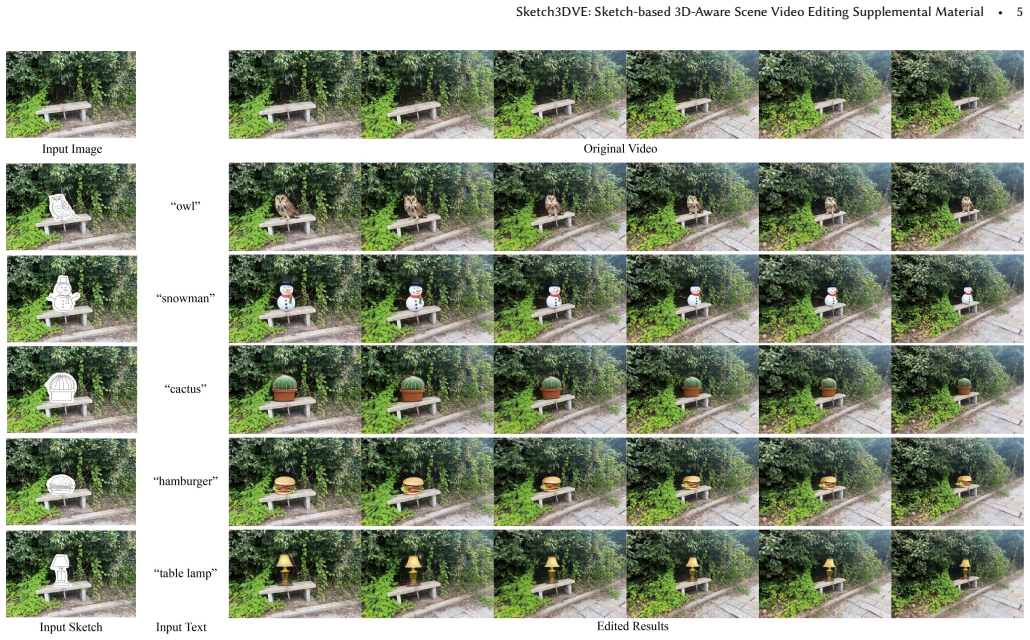
Editing results of the same sketch with different drawing styles. The image editing method, Magic/Q_uill [Liu et al . 2024b] effectively handles varying stroke widths and drawing styles. The edited operations are consistently propagated across video frames. Original Video ©DL3DV-10K. SIGGRAPH Conference Papers ’25, August 10–14, 2025, Vancouver, BC, Canada....
work page 2025
-
[7]
The comparison with existing methods, including AnyV2V [Ku et al . 2024], I2VEdit [Ouyang et al . 2024], ViewExtrapolation [Liu et al . 2024a] (shorted as ViewExtra), and ViewCra/f_ter [Yu et al . 2024]. Unlike these approaches, which have noticeable artifacts in edited objects or inadvertently alter unedited regions when significantly changing view point...
work page 2024
-
[8]
Editing results using sketches from various categories in the TU-Berlin dataset. On the le/f_t, the original images, texts, and sketches are shown, while the right side displays the original and edited video frames. Our method generates realistic video edits across a range of categories, including animals, plants, food, and daily objects. Original Video ©...
work page 2025
-
[9]
Given input images, users can control the camera trajectory to generate 3D scene videos
The application of image-to-video generation and editing. Given input images, users can control the camera trajectory to generate 3D scene videos. The local regions can further be edited based on sketches. Input Image ©Anastasia Belousova, ©Abdulla Nadeem, ©Tirachard Kumtanom. SIGGRAPH Conference Papers ’25, August 10–14, 2025, Vancouver, BC, Canada
work page 2025
-
[11]
The comparison with existing methods, including AnyV2V [Ku et al . 2024], I2VEdit [Ouyang et al . 2024], ViewExtrapolation [Liu et al . 2024a] (shorted as ViewExtra), and ViewCra/f_ter [Yu et al . 2024], for dynamic examples. Our method generates realistic water flowing results, while other approaches generate fuzzy details or unreasonable transition. Ori...
work page 2024
Show all 12 references
-
[65]
Sketch3DVE: Sketch-based 3D-Aware Scene Video Editing Supplemental Material • 5 Fig
SIGGRAPH Conference Papers ’25, August 10–14, 2025, Vancouver, BC, Canada. Sketch3DVE: Sketch-based 3D-Aware Scene Video Editing Supplemental Material • 5 Fig
2025
-
[2012]
How do humans sketch objects? ACM Trans. Graph. 31, 4 (2012), 1–10. Alexander Kirillov, Eric Mintun, Nikhila Ravi, Hanzi Mao, Chloé Rolland, Laura Gustafson, Tete Xiao, Spencer Whitehead, Alexander C. Berg, Wan-Yen Lo, Pi- otr Dollár, and Ross B. Girshick
2012
-
[2018]
ACM Trans
Stereo magni/f_ication: learning view synthesis using multiplane images. ACM Trans. Graph. 37, 4 (2018),
2018
-
[2024]
arXiv preprint arXiv:2403.14468 (2024)
AnyV2V: A Tuning-Free Framework For Any Video-to-Video Editing Tasks. arXiv preprint arXiv:2403.14468 (2024). Lu Ling, Yichen Sheng, Zhi Tu, Wentian Zhao, Cheng Xin, Kun Wan, Lantao Yu, Qianyu Guo, Zixun Yu, Yawen Lu, Xuanmao Li, Xingpeng Sun, Rohan Ashok, Aniruddha Mukherjee,...
2024 arXiv
Reviewed August 15, 2026 · model on record in the stance chip above.
Discussion (0). Continue with ORCID to comment.