REVIEW 3 major objections 5 minor 22 references
Fast, low noise CCD systems for future strategic x-ray missions
T0 review · 3 major / 5 minor · reviewed 2026-08-05 · deepseek-v4-flash
Pith's one-line read CCD and ASIC readout chain meets AXIS speed and noise needs
desk verdict Solid hardware paper with a real but fixable metrology gap: the bias scan optimizes ADU noise without a gain calibration, so the headline 2.31 e- number and the AXIS-readiness claim need a supporting measurement before they're taken at face value. read the letter →
The pith
A machine-rendered reading of the paper's core claim, the machinery that carries it, and where it could break.
The reading
What carries the argument
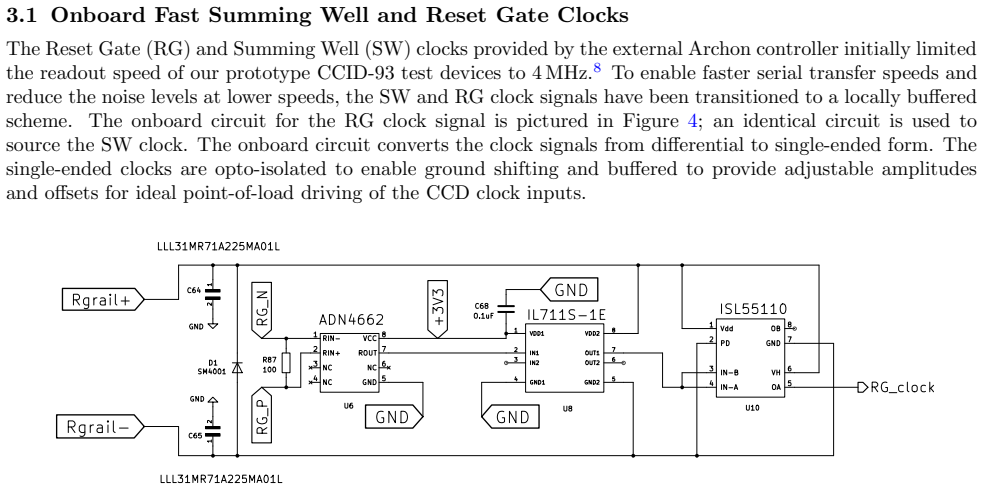
The paper's central machinery is the integrated readout chain: (1) the MIT-LL CCID-93 CCD, whose single-layer polysilicon gate structure needs small clock swings and whose two-stage pJFET/nMOSFET output provides high conversion gain; (2) the Stanford MCRC V1.0 ASIC, an 8-channel analog readout chip with selectable voltage/current input, user-selectable gain of 8 or 16 V/V, and differential output buffering; (3) locally buffered, opto-isolated summing-well and reset-gate clock drivers with RC snubber termination, which sit close to the CCD and recover about 20% of the usable waveform samples; and (4) an automated four-dimensional scan over RGH, RGL, OG, and RD that uses the overscan-region st
What would settle it
Read the same detector at the optimized 173 K bias but at 5 MPixels/s, and measure the Fe-55 FWHM and electron noise with a calibrated conversion gain; if the 5 MPixels/s FWHM or read noise exceeds the AXIS requirement, the claim that the system achieves the required speed and noise together fails. Also, a photon-transfer curve at each of the four scanned bias points would show whether the minimum-ADU-noise bias is truly the minimum-electron-noise bias.
Extended reading notes
Core claim
The central result is that the combination of an MIT-LL single-polysilicon CCID-93 CCD, the Stanford MCRC V1.0 readout ASIC, locally buffered fast summing-well and reset-gate clock drivers, and automated reset-gate/output-gate/reset-drain bias optimization delivers the speed and noise expected of a next-generation X-ray imager: serial readout up to 5 MPixels/s and, at 173 K and 2 MPixels/s, a read noise of 2.31 e- with 121 eV FWHM at the 5.9 keV Mn K-alpha line. The locally buffered clocks recover roughly 20% of the usable waveform samples and lower noise at all speeds, while the bias scan finds operating points that reduce noise by up to 18% at warmer temperatures (243 K) compared with defa
Load-bearing premise
The quoted noise numbers rest on the assumption that the overscan-region scatter in raw digital units tracks true electron read noise at every bias setting, with no direct conversion-gain calibration, so the bias that minimizes ADU noise is assumed to be the best operating point for spectroscopy.
Editorial extensions
If this is right
- The same readout approach should scale to the full AXIS focal-plane detector, the 1440x1440, 16-output CCID-100, using two MCRC ASICs in parallel to reach 5-20 frames/s.
- Because the optimal reset-gate voltages shift with temperature, each output channel of a multi-output detector must be biased individually at its operating temperature to keep noise low.
- The automated bias scan can replace manual tuning for these detectors; a 400-point, four-parameter scan takes about 45 minutes, making per-channel optimization practical.
- The roughly 20% recovery of usable waveform samples from the onboard clock drivers is what enables 5 MPixels/s serial transfer without the ringing penalty seen with external drivers.
- Higher frame rates at low noise would reduce pile-up from bright sources and suppress particle background for faint diffuse sources, the two scientific drivers for AXIS.
Reading between the lines
- If the ADU-to-electron conversion gain is not constant across the scanned bias grid, the minimum-ADU operating point may not be the minimum-electron-noise point; a photon-transfer measurement at each grid point would test this directly.
- The temperature-dependent optimal biases hint at a physical model for reset-gate threshold or reset-feedthrough changes that, once understood, could let future systems predict optimal biases from temperature instead of scanning.
- The same automated scan could be used during ground calibration of a flight instrument to track long-term bias drift, or to re-derive biases if the focal plane temperature changes over a mission.
- Because the scan is fully automated, it could in principle be extended to other detector types with similar output-stage bias nodes, not only the MIT-LL CCID series.
Editorial analysis
A structured set of objections, weighed in public.
Referee Report
Summary. The paper reports the development and characterization of a fast, low-noise CCD readout chain intended for the AXIS mission: an MIT-LL CCID-93 CCD, a Stanford MCRC V1.0 readout ASIC, integrated fast summing-well and reset-gate clock drivers, and an automated scan over the RG, OG, and RD bias voltages. At a 2 Mpixels/s serial transfer rate and 173 K, using the optimized bias point, the authors quote a read noise of 2.31 e- and a FWHM of 121 eV at 5.9 keV. The onboard clock circuitry enables serial transfer rates up to 5 Mpixels/s, where the best reported (pre-optimization) noise is 3.84 e-. The bias-scan algorithm minimizes the standard deviation of a 50-column overscan region in ADU over a four-dimensional grid. The central claim is that the combination of detector, ASIC, clock drivers, and bias optimization achieves the speed and noise performance required for AXIS.
Significance. If the quantitative claims hold, this is a valuable engineering milestone: it demonstrates an ASIC-based, low-power, low-footprint readout chain for fast X-ray CCDs and a practical automated procedure for tuning multiple output-stage biases, which would be useful for populating 16 channels of the CCID-100. The paper is measurement-focused and provides statistical uncertainties on the reported noise and FWHM values. The main advertised advances—5 Mpixels/s clocking and an automated multi-dimensional bias optimization—are real hardware contributions. However, the numerical result that is central to the mission-readiness claim (2.31 e-, 121 eV at high speed) is not yet fully supported because the ADU-to-electron conversion is not calibrated and the speed and low-noise results are not demonstrated simultaneously. The significance of the paper as a mission-enabling demonstration is therefore conditional on additional measurements.
major comments (3)
- [§4, Tables 2 and 3] The conversion from overscan ADU scatter to electrons is never described. Section 4 states that the scan assumes the ADU-to-electron relationship is 'relatively well behaved over the range of parameters under test,' but no gain calibration (e.g., Fe-55 peak centroid vs. known charge, or a charge-injection transfer curve) is reported. All noise values in electrons therefore rest on an unstated conversion factor. The paper's own Table 3 tests the assumption: at 173 K, the optimized bias lowers the reported noise from 2.39 to 2.31 e- but increases the Fe-55 FWHM from 118.5 to 120.8 eV. If conversion gain varies across the RGH/RGL/OG/RD grid, an ADU-noise minimum can select a low-gain operating point rather than a low-charge-noise one. Without a per-point gain measurement, the 2.31 e- value and the claimed advantage of the optimization over the default bias are not established.
- [§5, Table 2, Summary] The abstract and Summary claim that the 'level of performance required of the AXIS mission can be achieved,' but this appears to combine results obtained at different operating points. The 2.31 e- noise and 121 eV FWHM are measured at 2 Mpixels/s, while the 5 Mpixels/s capability is characterized separately. Table 2 shows that at 5 MHz the best noise is 3.84 e- (FWHM 125.8 eV), and the table note says those values were obtained 'prior to performing a bias parameter optimization.' No optimized FWHM or spectrum at 5 Mpixels/s is reported. The paper should state the quantitative AXIS requirement and demonstrate or explicitly bound the simultaneous speed/noise performance rather than pairing the fastest speed with the lowest noise from different configurations.
- [§4, Table 3] The optimization criterion is the overscan standard deviation in ADU, not the spectral energy resolution. At 173 K the optimized bias reduces the reported read noise by 0.08 e- but worsens the FWHM from 118.5 ± 1.7 eV to 120.8 ± 1.9 eV. While the FWHM change is modest and comparable to its uncertainty, the sign of the change is opposite to the noise trend, so the ADU-optimal point is not shown to deliver better spectral performance at the temperature used for the headline result. The authors should either report the Fe-55 FWHM at the optimized point as the primary metric, or justify why a 0.08 e- noise decrease is preferred over a 2.3 eV resolution degradation.
minor comments (5)
- [Author affiliations] Typo: 'Massachusets Institute of Technology' should be 'Massachusetts Institute of Technology.'
- [Tables 1-3] Table headers contain a stray space: 'T emp (K)' should be 'Temp (K)'. Also, the notation for pixel rate is inconsistent: 'MPixels/s' and 'Mpixels/s' are both used.
- [Figure 6 and Appendix A] The triangle plots would benefit from a color scale and a description of the contour color/white-space mapping. The text mentions 'gaps in the contours' where noise was unphysically small, but without axis labels and color bars it is difficult for the reader to compare the four temperatures.
- [§3.1] The phrase '∼20% recovery of the baseline and signal samples' is unclear: what is meant by 'recovery'—additional usable samples, improved settling, or something else? Please define.
- [Abstract and §4] The abstract says 'simultaneous optimization of the output gate (OG), reset gate (RG), and reset drain (RD) biases,' but Section 4 scans four parameters (RGH, RGL, OG, RD). Since RG has high and low states, please clarify the terminology consistently.
Circularity Check
No significant circularity: the paper reports direct hardware measurements and an empirical bias-optimization procedure; self-citations provide background but do not carry the central claim.
full rationale
The paper's central claims are measured performance numbers for a CCD/ASIC readout system, not derived predictions. The bias-scan algorithm in Section 4 minimizes the standard deviation of the overscan region in ADU over a grid of RGH/RGL/OG/RD values; this is an optimization procedure rather than a prediction, and the resulting noise and FWHM values in Tables 2 and 3 and Figure 9 are measured at the selected operating points. The reported 'read noise 2.31 e-' and FWHM 121 eV at 173 K come from actual Fe-55 spectra and overscan statistics, not from fitting a parameter to a target result and then re-predicting that same result. The paper's self-citations to prior MCRC and CCID development describe the hardware and previous characterization, but the performance claims in this paper are generated by the present measurements, not imported from those citations. No uniqueness theorem, ansatz, or renamed known result is invoked as load-bearing evidence. The potential concern about ADU-to-electron conversion gain being uncalibrated is a measurement-validity issue, not a circularity: the paper does not define read noise in terms of a fitted gain that is then used to predict the same read noise. Similarly, the slight worsening of FWHM at 173 K with optimized bias (Table 3) is an empirical inconsistency, not a circular step. The work is self-contained as an experimental characterization paper.
Assumptions & free parameters
free parameters (5)
- RGH (reset gate high voltage) =
5.5 V at 173 K; 5.5-6.0 V across temperatures
- RGL (reset gate low voltage) =
2.0 V at 173 K; 1.0-2.0 V across temperatures
- OG (output gate voltage) =
0.5 V at 173 K; 0.2-0.5 V across temperatures
- RD (reset drain voltage) =
7.0 V at 173 K; 7.0-7.6 V across temperatures
- ADU-to-electron conversion gain =
not stated
assumptions (4)
- domain assumption Overscan-region standard deviation reflects only read noise because thermal leakage there is negligible.
- domain assumption The ADU-to-electron relationship is well behaved over the scanned bias range.
- domain assumption Minimizing read noise in ADU also optimizes spectral energy resolution.
- domain assumption Performance measured on the small-format CCID-93 transfers to the full-scale CCID-100 with 16 output channels.
Cite this review
Pith. "Pith review of Fast, low noise CCD systems for future strategic x-ray missions." pith.science (2026). https://pith.science/paper/B7Y6G4T4
@misc{pith2026250814174,
  author       = {Pith},
  title        = {Pith review of: Fast, low noise CCD systems for future strategic x-ray missions},
  year         = {2026},
  howpublished = {\url{https://pith.science/paper/B7Y6G4T4}},
  note         = {Machine review of arXiv:2508.14174}
}
read the original abstract
Future strategic X-ray missions, such as the Advanced X-ray Imaging Satellite (AXIS) and those targeted by the Great Observatories Maturation Program (GOMaP), require fast, low-noise X-ray imaging spectrometers. To achieve the speed and noise capabilities required by such programs, the X-ray Astronomy and Observational Cosmology (XOC) Group at Stanford, in collaboration with the MIT Kavli Institute (MKI) and MIT Lincoln Laboratory (MIT-LL), is developing readout systems that leverage the high speed, low noise, and low power consumption of application-specific integrated circuit (ASIC) devices. Here, we report the energy resolution and noise performance achieved using MIT-LL AXIS prototype charge-coupled device (CCD) detectors in conjunction with Stanford-developed Multi-Channel Readout Chip (MCRC) ASICs. Additionally, we present a new sampling method for simultaneous optimization of the output gate (OG), reset gate (RG), and reset drain (RD) biases which, in combination with new integrated fast summing well (SW) and RG clock operation modes, enables the data rates required of future X-ray telescopes.
Figures


Figures from the paper (9 more)




Reference graph
Works this paper leans on
-
[1]
Overview of the advanced x-ray imaging satellite (AXIS),
Reynolds, C. S., Kara, E. A., Mushotzky, R. F., Ptak, A., Koss, M. J., Williams, B. J., Allen, S. W., Bauer, F. E., Bautz, M., Bogadhee, A., Burdge, K. B., Cappelluti, N., Cenko, B., Chartas, G., Chan, K.-W., Corrales, L., Daylan, T., Falcone, A. D., Foord, A., Grant, C. E., Habouzit, M., Haggard, D., Herrmann, S., Hodges-Kluck, E., Kargaltsev, O., King, ...
work page 2023
-
[2]
Bai, Y., Bajaj, J., Beletic, J. W., Farris, M. C., Joshi, A., Lauxtermann, S., Petersen, A., and Williams, G., “Teledyne Imaging Sensors: Silicon CMOS imaging technologies for x-ray, UV, visible, and near infrared,” in [High Energy, Optical, and Infrared Detectors for Astronomy III], Dorn, D. A. and Holland, A. D., eds., Society of Photo-Optical Instrumen...
work page 2008
-
[3]
Recent X-ray hybrid CMOS detector developments and measurements,
Hull, S. V., Falcone, A. D., Burrows, D. N., Wages, M., Chattopadhyay, T., McQuaide, M., Bray, E., and Kern, M., “Recent X-ray hybrid CMOS detector developments and measurements,” in [ UV, X-Ray, and Gamma-Ray Space Instrumentation for Astronomy XX], Siegmund, O. H., ed., 10397, 1039704, Interna- tional Society for Optics and Photonics, SPIE (2017)
work page 2017
-
[4]
Characterization of a 256 × 256 pixel DEPFET detector for the WFI of Athena,
Treberspurg, W., Andritschke, R., Behrens, A., Bonholzer, M., Emberger, V., Hauser, G., Lechner, P., Meidinger, N., and M¨ uller-Seidlitz, J., “Characterization of a 256 × 256 pixel DEPFET detector for the WFI of Athena,” Nuclear Instruments and Methods in Physics Research A958, 162555 (Apr. 2020)
work page 2020
-
[5]
The Wide Field Imager instrument for Athena,
Meidinger, N., Barbera, M., Emberger, V., F¨ urmetz, M., Manhart, M., M¨ uller-Seidlitz, J., Nandra, K., Plattner, M., Rau, A., and Treberspurg, W., “The Wide Field Imager instrument for Athena,” in [ Society of Photo-Optical Instrumentation Engineers (SPIE) Conference Series], Siegmund, O. H., ed., Society of Photo-Optical Instrumentation Engineers (SPIE...
work page 2017
-
[6]
X-ray hybrid cmos detectors: Recent development and characterization progress,
Chattopadhyay, T., Falcone, A. D., Burrows, D. N., Hull, S., Bray, E., Wages, M., McQuaide, M., Bun- tic, L., Crum, R., O’Dell, J., and Anderson, T., “X-ray hybrid cmos detectors: Recent development and characterization progress,” in [ Space Telescopes and Instrumentation 2018: Ultraviolet to Gamma Ray], Proc.SPIE 10709 (2018)
work page 2018
-
[7]
Fast, low-noise image sensor technology for strategic x-ray astrophysics missions,
Bautz, M. W., Miller, E. D., Prigozhin, G. Y., LaMarr, B. J., Malonis, A., Foster, R., Grant, C. E., Schneider, B., Leitz, C., Donlon, K., Prigozhin, I., Lambert, R., Cooper, M., Herrmann, S. C., Orel, P., Chattopadhyay, T., Morris, R. G., Wilkins, D. R., Stueber, H. R., Poliszczuk, A., and Allen, S. W., “Fast, low-noise image sensor technology for strate...
work page 2024
-
[8]
Chattopadhyay, T., Herrmann, S., Orel, P., Morris, R. G., Prigozhin, G., Malonis, A., Foster, R., Craig, D., Burke, B. E., Allen, S. W., and Bautz, M. W., “Development and characterization of a fast and low noise readout for the next generation x-ray charge-coupled devices,” Journal of Astronomical Telescopes, Instruments, and Systems8, 026005 (Apr. 2022)
work page 2022
Show all 22 references
-
[9]
Toward fast low-noise low-power digital CCDs for Lynx and other high-energy astrophysics missions,
Bautz, M., Foster, R., LaMarr, B., Malonis, A., Prigozhin, G., Miller, E., Grant, C. E., Burke, B., Cooper, M., Craig, D., Leitz, C., Schuette, D., and Suntharalingam, V., “Toward fast low-noise low-power digital CCDs for Lynx and other high-energy astrophysics missions,” in [...
2018
-
[10]
Toward fast, low-noise charge-coupled devices for Lynx,
Bautz, M. W., Burke, B. E., Cooper, M., Craig, D., Foster, R. F., Grant, C. E., LaMarr, B. J., Leitz, C., Malonis, A., Miller, E. D., Prigozhin, G., Schuette, D., Suntharalingam, V., and Thayer, C., “Toward fast, low-noise charge-coupled devices for Lynx,” Journal of Astronomi...
2019
-
[11]
Progress toward fast, low-noise, low-power CCDs for Lynx and other high-energy astrophysics missions,
Bautz, M., Burke, B., Cooper, M., Craig, D., Donlon, K., Foster, R., Grant, C. E., LaMarr, B., Leitz, C., Malonis, A., Miller, E., Prigozhin, G., Thayer, C., Allen, S., Herrmann, S., Chattopadhyay, T., and Morris, R. G., “Progress toward fast, low-noise, low-power CCDs for Lyn...
2020
-
[12]
Charge transfer effects in a CCD with a single polysilicon gate structure,
Prigozhin, G., Burke, B., Cooper, M., Donlon, K., Leitz, C., Foster, R., LaMarr, B., Malonis, A., and Bautz, M., “Charge transfer effects in a CCD with a single polysilicon gate structure,” in [ X-Ray, Optical, and Infrared Detectors for Astronomy IX], Holland, A. D. and Belet...
2020
-
[13]
First results on SiSeRO devices: a new x-ray detector for scientific instrumentation,
Chattopadhyay, T., Herrmann, S., Burke, B. E., Donlon, K., Prigozhin, G., Morris, G., Orel, P., Cooper, M., Malonis, A., Wilkins, D. R., Suntharalingam, V., Allen, S. W., Bautz, M. W., and Leitz, C., “First results on SiSeRO devices: a new x-ray detector for scientific instrum...
2022
-
[14]
Single electron sensitive readout (SiSeRO) x-ray detectors: technological progress and characterization,
Chattopadhyay, T., Herrmann, S., Orel, P., Morris, R. G., Wilkins, D. R., Allen, S. W., Prigozhin, G., LaMarr, B., Malonis, A., Foster, R., Bautz, M. W., Donlon, K., Cooper, M., and Leitz, C., “Single electron sensitive readout (SiSeRO) x-ray detectors: technological progress ...
2022
-
[15]
Improved noise performance from the next- generation buried-channel p-MOSFET SiSeROs,
Chattopadhyay, T., Herrmann, S., Kaplan, M., Orel, P., Donlon, K., Prigozhin, G., Morris, G., Cooper, M., Malonis, A., Allen, S. W., Bautz, M. W., and Leitz, C., “Improved noise performance from the next- generation buried-channel p-MOSFET SiSeROs,” Journal of Astronomical Tel...
2023
-
[16]
Demonstrating sub-electron noise performance in Single electron Sensitive Readout (SiSeRO) devices,
Chattopadhyay, T., Herrmann, S. C., Orel, P., Donlon, K., Allen, S. W., Bautz, M. W., Cantrall, B. J., Cooper, M. J., LaMarr, B. J., Leitz, C. W., Miller, E. D., Morris, G. R., Prigozhin, G. Y., Prigozhin, I., Stueber, H. R., and Wilkins, D. R., “Demonstrating sub-electron noi...
2024
-
[17]
Development and testing of integrated readout electronics for next generation SiSeRO (Single electron Sensitive Read Out) devices,
Chattopadhyay, T., Stueber, H. R., Pan, A. Y., Herrmann, S. C., Orel, P., Donlon, K., Allen, S. W., Bautz, M. W., Cooper, M., Grant, C. E., LaMarr, B. J., Leitz, C. W., Malonis, A., Miller, E. D., Morris, G., Prigozhin, G. Y., Prigozhin, I., Poliszczuk, A., Warner, K., and Wil...
2025
-
[18]
The high-speed x-ray camera on AXIS,
Miller, E. D., Bautz, M. W., Grant, C. E., Foster, R., LaMarr, B., Malonis, A., Prigozhin, G., Schneider, B., Leitz, C., Herrmann, S., Allen, S. W., Chattopadhyay, T., Orel, P., Morris, G. R., Stueber, H., Falcone, A. D., Ptak, A., and Reynolds, C., “The high-speed x-ray camer...
2023
-
[19]
MCRC V1: development of integrated readout electronics for next generation x-ray CCD detectors for future satellite observatories,
Herrmann, S., Wong, J., Chattopadhyay, T., Morris, R. G., Burke, B., Prigozhin, G., Cooper, M., Craig, D., Donlon, K., Foster, R., Malonis, A., Bautz, M., and Allen, S., “MCRC V1: development of integrated readout electronics for next generation x-ray CCD detectors for future ...
2020
-
[20]
X-ray speed reading with the MCRC: a low noise CCD readout ASIC enabling readout speeds of 5 Mpixel/s/channel,
Orel, P., Herrmann, S., Chattopadhyay, T., Morris, G. R., Allen, S. W., Prigozhin, G. Y., Foster, R., Malonis, A., Bautz, M. W., Cooper, M. J., and Donlon, K., “X-ray speed reading with the MCRC: a low noise CCD readout ASIC enabling readout speeds of 5 Mpixel/s/channel,” in [...
2022
-
[21]
X-ray speed reading with the MCRC: prototype success and next generation upgrades,
Orel, P., Herrmann, S., Chattopadhyay, T., Morris, G. R., Stueber, H., Pan, A., Allen, S. W., Wilkins, D., Prigozhin, G. Y., LaMarr, B., Foster, R., Malonis, A., Bautz, M. W., Cooper, M. J., and Donlon, K., “X-ray speed reading with the MCRC: prototype success and next generat...
2024
-
[22]
The XOC x-ray beamline: probing colder, quieter, and softer,
Stueber, H. R., Chattopadhyay, T., Herrmann, S. C., Orel, P., Gebre, T., Joshi, A., Allen, S. W., Morris, G., and Poliszczuk, A., “The XOC x-ray beamline: probing colder, quieter, and softer,” in [ X-Ray, Optical, and Infrared Detectors for Astronomy XI], Holland, A. D. and Mi...
2024
Reviewed August 5, 2026 · model on record in the stance chip above.
Discussion (0). Continue with ORCID to comment.