Fragmentation of the IAR along the chains boldsymbol{N=50} and boldsymbol{Z=50}
Pith reviewed 2026-05-18 22:22 UTC · model grok-4.3
The pith
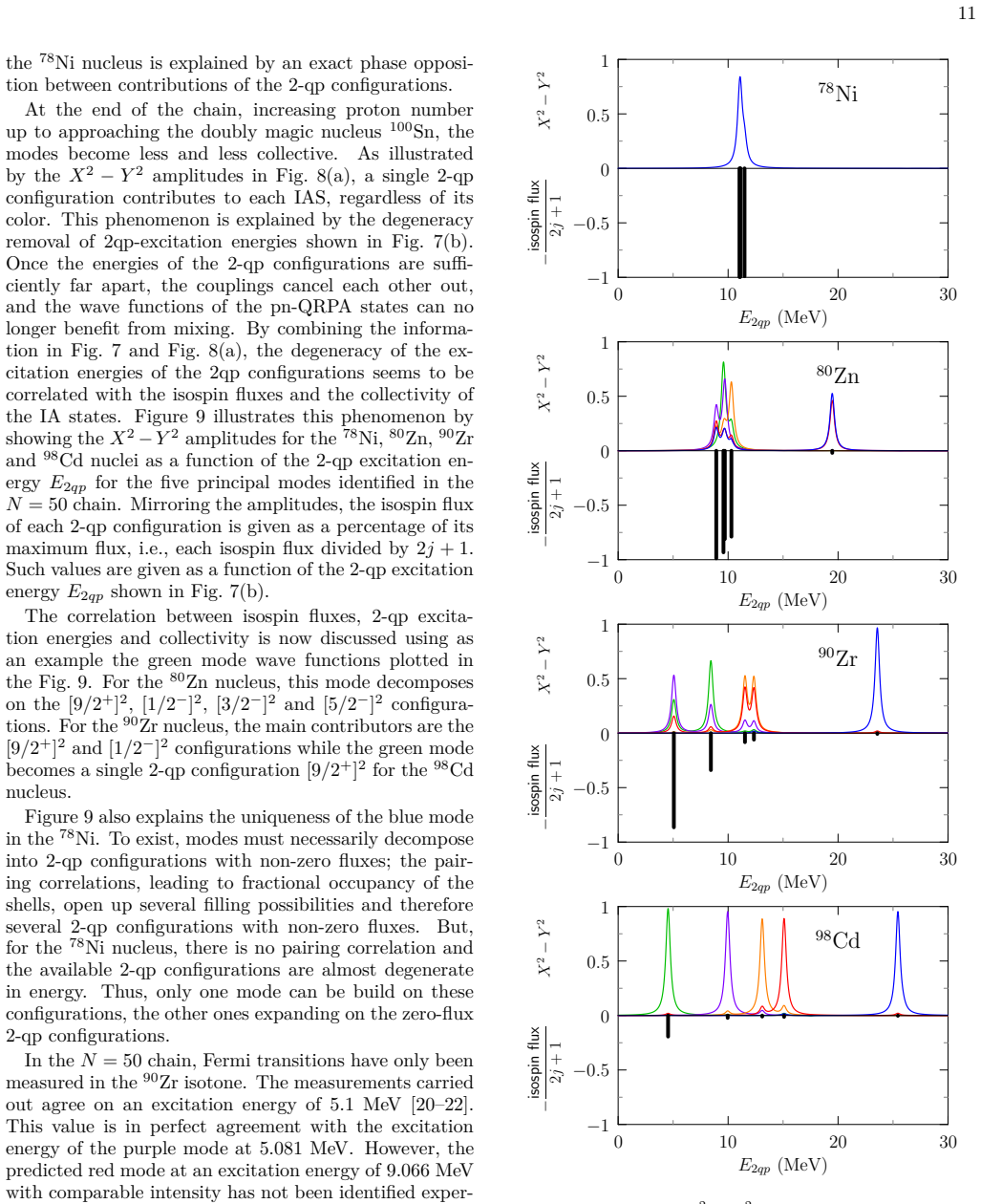
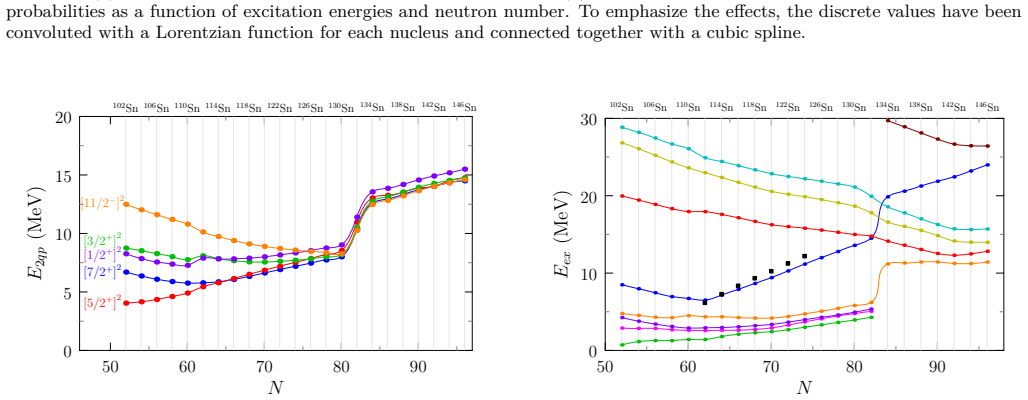
Fragmentation of Fermi strength along the N=50 and Z=50 chains arises from fractional shell occupations produced by nuclear pairing.
A machine-rendered reading of the paper's core claim, the machinery that carries it, and where it could break.
Core claim
Hartree-Fock-Bogoliubov calculations with the Gogny D1M interaction supply energies and occupation probabilities of nucleon orbitals. Isobaric analog resonances are then obtained via charge-exchange QRPA built on those ground states. The Fermi transition mechanism is carried by collective modes in the final nucleus. The fragmentation of the Fermi strength follows from the fractional occupation of nucleon shells, which is a direct consequence of nuclear pairing.
What carries the argument
Fractional occupation probabilities of nucleon shells generated by pairing correlations inside the HFB ground state, which distribute the Fermi strength across multiple QRPA states.
If this is right
- The identical fragmentation mechanism operates along the full Z=50 isotopic chain.
- Fermi transitions proceed through collective modes excited in the daughter nucleus.
- The QRPA built on the HFB ground states reproduces the spreading without additional spreading mechanisms.
Where Pith is reading between the lines
- The result implies that pairing-induced fractional occupations should control analog strength distributions in other near-closed-shell chains with small deformation.
- Precision beta-decay or charge-exchange measurements could test whether the predicted occupation fractions match the observed strength ratios.
- If the mechanism holds, models that assume fully occupied or empty shells would systematically underestimate the width of isobaric analog resonances near magic numbers.
Load-bearing premise
The mean-field pairing captured by HFB with the Gogny force fully accounts for the fragmentation without needing continuum coupling, higher-order correlations, or deformation effects beyond the mean field.
What would settle it
An experimental measurement of Fermi strength distributions along the N=50 chain that deviates systematically from the pattern predicted by the calculated occupation probabilities would falsify the central claim.
Figures






read the original abstract
We study Isobaric Analog Resonances in even-even nuclei along the $ N=50 $ isotonic chain. First, Hartree-Fock-Bogoliubov calculations, using the Gogny D1M effective interaction, have been performed to provide energies and occupation probabilities of nucleon orbitals. The Isobaric Analog Resonances are calculated with the charge exchange QRPA approach on top of then HFB calculations. Fermi transition mechanism is interpreted with the existence of collective modes in the final nucleus. The fragmentation of the Fermi Strength results from the fractional occupation of nucleon shells, a direct consequence of nuclear pairing. The theoretical Fermi transition probabilities along the isotopic chain $ Z=50 $ are also analyzed and confirm our conclusions.
Editorial analysis
A structured set of objections, weighed in public.
Referee Report
Summary. The manuscript studies Isobaric Analog Resonances (IAR) along the N=50 isotonic chain and Z=50 isotopic chain in even-even nuclei. Hartree-Fock-Bogoliubov (HFB) calculations with the Gogny D1M interaction are used to obtain single-particle energies and occupation probabilities; charge-exchange QRPA is then applied on these HFB ground states to compute the IAR. The central claim is that the observed fragmentation of the Fermi strength is a direct consequence of the fractional nucleon-shell occupations induced by nuclear pairing, with the Fermi transitions interpreted via collective modes in the daughter nucleus.
Significance. If the central interpretation holds after validation, the work would provide a microscopic, pairing-based explanation for IAR fragmentation in medium-mass nuclei near closed shells, potentially aiding the interpretation of charge-exchange reactions and beta-decay studies. The use of a parameter-free Gogny D1M interaction and the consistent HFB+QRPA framework across two chains are strengths that allow direct comparison of occupation effects without additional fitting.
major comments (3)
- [Abstract] Abstract and results section: The assertion that Fermi-strength fragmentation 'results from the fractional occupation of nucleon shells, a direct consequence of nuclear pairing' is presented without accompanying numerical spectra, strength distributions, or explicit correlation plots between HFB occupation probabilities and QRPA transition strengths. This leaves the load-bearing causal link unverified in the presented material.
- [Methodology] Methodology and discussion: The charge-exchange QRPA is formulated on discrete HFB states and does not incorporate explicit continuum coupling. For nuclei in the chains where the IAR lies above particle-emission thresholds, coupling to open decay channels can generate additional spreading widths and strength redistribution; without tests isolating this effect from pairing-induced occupations, the attribution of fragmentation exclusively to fractional occupations remains incomplete.
- [Results] Results: No sum-rule checks (e.g., Ikeda sum rule for Fermi transitions) or direct comparisons to experimental IAR widths or centroids are reported. Such benchmarks are necessary to confirm that the QRPA fragmentation reproduces observed features rather than arising from basis truncation or residual-interaction details.
minor comments (2)
- [Methodology] Notation for the QRPA amplitudes and transition operators should be defined explicitly in the methods section to allow reproduction of the Fermi matrix elements.
- [Results] Figure captions for strength distributions should include the specific nuclei shown and the energy range relative to particle thresholds.
Simulated Author's Rebuttal
We thank the referee for the careful reading of the manuscript and the constructive comments. We address each major comment below and indicate the revisions we will make to strengthen the presentation.
read point-by-point responses
-
Referee: [Abstract] Abstract and results section: The assertion that Fermi-strength fragmentation 'results from the fractional occupation of nucleon shells, a direct consequence of nuclear pairing' is presented without accompanying numerical spectra, strength distributions, or explicit correlation plots between HFB occupation probabilities and QRPA transition strengths. This leaves the load-bearing causal link unverified in the presented material.
Authors: The results section presents the QRPA Fermi strength distributions for the N=50 and Z=50 chains, which exhibit the fragmentation. These are obtained directly from the HFB ground states whose occupation probabilities are reported in the methodology. The connection is made through the consistent HFB+QRPA framework in which fractional occupations due to pairing generate multiple collective modes. To render the causal link more explicit, we will add correlation plots between the HFB occupation probabilities and the QRPA transition strengths in the revised manuscript. revision: yes
-
Referee: [Methodology] Methodology and discussion: The charge-exchange QRPA is formulated on discrete HFB states and does not incorporate explicit continuum coupling. For nuclei in the chains where the IAR lies above particle-emission thresholds, coupling to open decay channels can generate additional spreading widths and strength redistribution; without tests isolating this effect from pairing-induced occupations, the attribution of fragmentation exclusively to fractional occupations remains incomplete.
Authors: We agree that the present QRPA implementation uses discrete HFB states and omits explicit continuum coupling. This is a common approximation for medium-mass nuclei. The fragmentation pattern we obtain originates from the pairing-induced fractional occupations already present in the HFB ground state; continuum coupling would primarily add spreading widths rather than alter the underlying mode structure. We will expand the discussion section to clarify this point and to note the limitation of the discrete approach. Explicit continuum calculations lie outside the scope of the current consistent HFB+QRPA study with the Gogny D1M force. revision: partial
-
Referee: [Results] Results: No sum-rule checks (e.g., Ikeda sum rule for Fermi transitions) or direct comparisons to experimental IAR widths or centroids are reported. Such benchmarks are necessary to confirm that the QRPA fragmentation reproduces observed features rather than arising from basis truncation or residual-interaction details.
Authors: The charge-exchange QRPA built on the same Gogny interaction preserves the Ikeda sum rule for Fermi transitions by construction. We will add an explicit numerical verification of the sum rule in the revised results section. For experimental benchmarks, we have emphasized systematic trends along the two chains; we will incorporate available experimental IAR centroid and width data from the literature to provide direct comparisons where possible. revision: yes
Circularity Check
No significant circularity in derivation chain
full rationale
The paper computes HFB ground states with Gogny D1M to obtain orbital energies and occupation probabilities, then applies charge-exchange QRPA to generate IAR positions and Fermi strength distributions. The fragmentation is obtained as an output of these calculations and interpreted as arising from the pairing-induced fractional occupations already present in the HFB solutions. This constitutes a standard model prediction rather than a self-definitional loop, a fitted quantity renamed as a prediction, or a result forced by self-citation. No uniqueness theorems, ansatze smuggled via prior work, or renaming of known empirical patterns are used to justify the central claim. The framework is self-contained and externally falsifiable against experimental IAR data.
Axiom & Free-Parameter Ledger
axioms (2)
- domain assumption Hartree-Fock-Bogoliubov with the Gogny D1M force yields reliable single-particle energies and occupation probabilities for even-even nuclei near N=50 and Z=50.
- domain assumption Charge-exchange QRPA on the HFB ground state adequately describes the Fermi component of the Isobaric Analog Resonances.
Lean theorems connected to this paper
-
IndisputableMonolith/Cost/FunctionalEquation.leanwashburn_uniqueness_aczel unclear?
unclearRelation between the paper passage and the cited Recognition theorem.
The fragmentation of the Fermi Strength results from the fractional occupation of nucleon shells, a direct consequence of nuclear pairing.
-
IndisputableMonolith/Foundation/RealityFromDistinction.leanreality_from_one_distinction unclear?
unclearRelation between the paper passage and the cited Recognition theorem.
HFB calculations... pn-QRPA approach on top of the HFB calculations
What do these tags mean?
- matches
- The paper's claim is directly supported by a theorem in the formal canon.
- supports
- The theorem supports part of the paper's argument, but the paper may add assumptions or extra steps.
- extends
- The paper goes beyond the formal theorem; the theorem is a base layer rather than the whole result.
- uses
- The paper appears to rely on the theorem as machinery.
- contradicts
- The paper's claim conflicts with a theorem or certificate in the canon.
- unclear
- Pith found a possible connection, but the passage is too broad, indirect, or ambiguous to say the theorem truly supports the claim.
Reference graph
Works this paper leans on
-
[1]
(1) So, HFB solutions are protons and neutrons quasi- particle orbitals
Single particle orbitals Once the HFB equations have been solved, the cre- ationandannihilationquasiparticleoperators{ η+,η}are expressed as Bogoliubov transformations of the creation and annihilation HO operators {c+,c} : ( η η+ ) = ( U∗−V∗ V U )( c c+ ) . (1) So, HFB solutions are protons and neutrons quasi- particle orbitals. For the spherical shape, e...
-
[2]
Binding energy and Qβ Using HFB binding energies, the energy balanceQβof charge exchange reaction can be defined as: Qβ±=±mp∓mn−me +B ( A ZXN ) −B ( A Z∓1YN±1 ) , (2) where B are the binding energy of the initial nucleus A ZXN and the final one A Z∓1YN±1. The quantitiesmp,mn andme are respectively the mass of proton, neutron and electron knowing that we n...
-
[3]
8 1 MF(β−)/ (N −Z) (MeV −1) 20 30 40 50 Z 72Ti 74Cr 76Fe 78Ni 80Zn 82Ge 84Se 86Kr 88Sr 90Zr 92Mo 94Ru 96Pd 98Cd (a) 0 10 20 30 40Eex (MeV) 30 40 50 Z 10−3 10−2 10−1 100 MF(β−)/ (N −Z) (MeV −1) 22 (b) FIG. 5. (a) Relative heights of Fermi peaks for theN = 50 chain. (b) Two-dimensional map of the Fermi peaks as function of their excitation energy positions ...
-
[4]
9% 78Ni neutron proton 1/ 2+ 7/ 2− 3/ 2−5/ 2−1/ 2− 9/ 2+ 1/ 2+ 7/ 2− 3/ 2−5/ 2− 1/ 2− 9/ 2+ µ n µ p
00 43. 9% 78Ni neutron proton 1/ 2+ 7/ 2− 3/ 2−5/ 2−1/ 2− 9/ 2+ 1/ 2+ 7/ 2− 3/ 2−5/ 2− 1/ 2− 9/ 2+ µ n µ p
-
[5]
88 25. 2% 19. 3% 80Zn neutron proton 1/ 2+ 7/ 2− 3/ 2−5/ 2− 1/ 2− 9/ 2+ 1/ 2+ 7/ 2− 5/ 2−3/ 2− 1/ 2− 9/ 2+ µ n µ p
-
[6]
6% 90Zr neutron proton 1/ 2+ 7/ 2− 5/ 2− 3/ 2−1/ 2− 9/ 2+ 1/ 2+ 7/ 2− 5/ 2− 3/ 2−1/ 2− 9/ 2+ µ n µ p
-
[7]
9% 98Cd neutron proton FIG. 6. Representations of the HF single particle shells for the nuclei78Ni, 80Zn, 90Zr and 98Cd. The thickness of the thick colored line of each shell represents its occupation determined by the HFB calculation. The arrows illustrate the passage of the particle towards the nucleonic shells of the samejπ. The number in black on the ...
-
[8]
8 1 (X − Y ) τ+/ √ N − Z (MeV−1/2) 20 30 40 50 Z 72Ti 74Cr 76Fe 78Ni 80Zn 82Ge 84Se 86Kr 88Sr 90Zr 92Mo94Ru 96Pd 98Cd blue mode (b) 0 0.2 0.4 0.6 0.8 1 X 2 − Y 2 30 40 50 Z 78Ni 80Zn 82Ge 84Se 86Kr 88Sr 90Zr 92Mo 94Ru 96Pd 98Cd [9/2+]2 [1/2−]2 [3/2−]2 [5/2−]2 [7/2−]2 (a) −1 −0. 8 −0. 6 −0. 4 −0. 2 0
-
[9]
8 1 (X − Y ) τ+/ √ N − Z (MeV−1/2) 30 40 50 Z 78Ni 80Zn 82Ge 84Se 86Kr 88Sr 90Zr 92Mo 94Ru 96Pd 98Cd red mode (b) 0 0.2 0.4 0.6 0.8 1 X 2 − Y 2 30 40 50 Z 78Ni 80Zn 82Ge 84Se 86Kr 88Sr 90Zr 92Mo 94Ru 96Pd 98Cd [9/2+]2 [1/2−]2 [3/2−]2 [5/2−]2 [7/2−]2 (a) −1 −0. 8 −0. 6 −0. 4 −0. 2 0
-
[10]
8 1 (X − Y ) τ+/ √ N − Z (MeV−1/2) 30 40 50 Z 78Ni 80Zn 82Ge 84Se 86Kr 88Sr 90Zr 92Mo 94Ru 96Pd 98Cd orange mode (b) 0 0.2 0.4 0.6 0.8 1 X 2 − Y 2 30 40 50 Z 78Ni 80Zn 82Ge 84Se 86Kr 88Sr 90Zr 92Mo 94Ru 96Pd 98Cd [9/2+]2 [1/2−]2 [3/2−]2 [5/2−]2 [7/2−]2 (a) −1 −0. 8 −0. 6 −0. 4 −0. 2 0
-
[11]
8 1 (X − Y ) τ+/ √ N − Z (MeV−1/2) 30 40 50 Z 78Ni 80Zn 82Ge 84Se 86Kr 88Sr 90Zr 92Mo 94Ru 96Pd 98Cd purple mode (b) 0 0.2 0.4 0.6 0.8 1 X 2 − Y 2 30 40 50 Z 78Ni 80Zn 82Ge 84Se 86Kr 88Sr 90Zr 92Mo 94Ru 96Pd 98Cd [9/2+]2 [1/2−]2 [3/2−]2 [5/2−]2 [7/2−]2 (a) −1 −0. 8 −0. 6 −0. 4 −0. 2 0
-
[12]
8 1 (X − Y ) τ+/ √ N − Z (MeV−1/2) 30 40 50 Z 78Ni 80Zn 82Ge 84Se 86Kr 88Sr 90Zr 92Mo 94Ru 96Pd 98Cd green mode (b) FIG. 8. (a)X 2−Y 2 2-qp amplitudes and (b)(X−Y )τ+ contributions as function of proton number. Thecolor title indicated the color of the mode that is described. The colors of the curves are in coherence with the Fig. 7 namely yellow for[1/2+...
-
[13]
8 1 MF(β−)/ (N −Z) (MeV −1) 50 60 70 80 90 N 102Sn 106Sn 110Sn 114Sn 118Sn 122Sn 126Sn 130Sn 134Sn 138Sn 142Sn 146Sn (a) 0 10 20 30 40Eex (MeV) 50 60 70 80 90 N 10−3 10−2 10−1 MF(β−)/ (N −Z) (MeV −1) (b) FIG. 11. (a) Normalized Fermi peak heights for theZ = 50 chain. (b) Two-dimensional map of normalised Fermi transition probabilities as a function of exc...
-
[14]
As already illuistrated by Fig
Details of F ermi Strength for the N = 50 chain Figure 14 shows the set of normalized strengths, MF(β−)/(N −Z), for the even nuclei of the chain N = 50. As already illuistrated by Fig. 4, the Fermi strength functions of these nuclei almost all break down into several peaks. To interpret the origin of this frag- mentation, the nature of each peak is analys...
-
[15]
On this figure, all modes have been identified with the procedure explained in the previous section
Details of F ermi Strength for the Z = 50 chain Figure 15 shows the set of normalized strengths, MF(β−)/(N−Z), fortheevennucleiofthechain Z = 50. On this figure, all modes have been identified with the procedure explained in the previous section. Their re- spective colors have nothing to do with those of the pre- vious section, since the 2-qp configuratio...
-
[16]
J. D. Anderson and C. Wong, Evidence for charge inde- pendence in medium weight nuclei, Phys. Rev. Lett.7, 250 (1961)
work page 1961
-
[17]
H. Behrens and W. Büring,Electron Radial Wave Func- tions and Nuclear Beta-decay (Clarendon Press, 1982). 16 0 0.2 0.4 0.6 0.8 1 MF N −Z (MeV−1) 0 10 20 30 40 Eex (MeV) 72Ti 0 0.2 0.4 0.6 0.8 1 MF N −Z (MeV−1) 0 10 20 30 40 Eex (MeV) 74Cr 0 0.2 0.4 0.6 0.8 1 MF N −Z (MeV−1) 0 10 20 30 40 Eex (MeV) 76Fe 0 0.2 0.4 0.6 0.8 1 MF N −Z (MeV−1) 0 10 20 30 Eex (M...
work page 1982
-
[18]
S. Goriely, S. Hilaire, M. Girod, and S. Péru, First gogny- hartree-fock-bogoliubov nuclear mass model, Phys. Rev. Lett. 102, 242501 (2009)
work page 2009
-
[19]
J. A. Halbleib and R. A. Sorensen, Gamow-teller beta decay in heavy spherical nuclei and the unlike particle- hole rpa, Nuclear Physics A98, 542 (1967)
work page 1967
-
[20]
J. Krumlinde and P. Möller, Calculation of gamow-teller β-strengthfunctionsintherubidiumregionintherpaap- proximation with nilsson-model wave functions, Nuclear Physics A 417, 419 (1984)
work page 1984
- [21]
- [22]
- [23]
-
[24]
J. Toivanen and J. Suhonen, Renormalized proton- neutron quasiparticle random-phase approximation and its application to double beta decay, Phys. Rev. Lett.75, 410 (1995)
work page 1995
-
[25]
P. Sarriguren, E. Moya de Guerra, A. Escuderos, and A.Carrizo, βdecayandshapeisomerismin 74Kr,Nuclear Physics A 635, 55 (1998)
work page 1998
- [26]
-
[27]
D.Vretenar, N.Paar, T.Nikšić,andP.Ring,Spin-isospin resonances and the neutron skin of nuclei, Phys. Rev. Lett. 91, 262502 (2003)
work page 2003
-
[28]
N. Paar, T. Nikšić, D. Vretenar, and P. Ring, Quasiparti- cle random phase approximation based on the relativistic hartree-bogoliubov model. ii. nuclear spin and isospin ex- citations, Phys. Rev. C69, 054303 (2004)
work page 2004
-
[29]
S. Fracasso and G. Colò, Fully self-consistent charge- exchange quasiparticle random-phase approximation and its application to isobaric analog resonances, Phys. Rev. C 72, 064310 (2005)
work page 2005
- [30]
-
[31]
F. Minato and C. L. Bai, Impact of tensor force onβ decay of magic and semimagic nuclei, Phys. Rev. Lett. 110, 122501 (2013)
work page 2013
-
[32]
K. Yoshida, Spin–isospin response of deformed neutron- rich nuclei in a self-consistent skyrme energy-density- functional approach, Progress of Theoretical and Exper- imental Physics 2013, 113D02 (2013)
work page 2013
-
[33]
M. T. Mustonen and J. Engel, Large-scale calcula- tions of the double-βdecay of 76Ge, 130Te, 136Xe, and 17 0 0.2 0.4 0.6 0.8 1 MF N −Z (MeV−1) 0 10 20 30 Eex (MeV) 102Sn 0 0.2 0.4 0.6 0.8 1 MF N −Z (MeV−1) 0 10 20 30 Eex (MeV) 104Sn 0 0.2 0.4 0.6 0.8 1 MF N −Z (MeV−1) 0 10 20 30 Eex (MeV) 106Sn 0 0.2 0.4 0.6 0.8 1 MF N −Z (MeV−1) 0 10 20 30 Eex (MeV) 108S...
work page 2013
-
[34]
M. Martini, S. Péru, and S. Goriely, Gamow-teller strength in deformed nuclei within the self-consistent charge-exchange quasiparticle random-phase approxima- tion with the gogny force, Phys. Rev. C 89, 044306 (2014)
work page 2014
-
[35]
D. E. Bainum, J. Rapaport, C. D. Goodman, D. J. Horen, C. C. Foster, M. B. Greenfield, and C. A. Gould- ing, Observation of giant particle-hole resonances in 90Zr(p,n )90Nb, Phys. Rev. Lett.44, 1751 (1980)
work page 1980
-
[36]
J. Jänecke, F. Becchetti, A. van den Berg, G. Berg, G. Brouwer, M. Greenfield, M. Harakeh, M. Hofstee, A. Nadasen, D. Roberts, R. Sawafta, J. Schippers, E. Stephenson, D. Stewart, and S. van der Werf, Non- spin-flip (3He, t) charge-exchange and isobaric analog states of actinide nuclei studied atθ= 0◦, E(3He) = 76 MeV and 200 MeV, Nuclear Physics A526, 1 (1991)
work page 1991
-
[37]
T. Wakasa, H. Sakai, H. Okamura, H. Otsu, S. Fujita, S. Ishida, N. Sakamoto, T. Uesaka, Y. Satou, M. B. Greenfield, and K. Hatanaka, Gamow-teller strength of 90Nb in the continuum studied via multipole decomposi- tion analysis of the90Zr(p,n ) reaction at 295MeV, Phys. 18 Rev. C 55, 2909 (1997)
work page 1997
-
[38]
E. V. Chimanski, E. J. In, S. Péru, A. Thapa, W. Younes, and J. E. Escher, Coupling between collective modes in the deformed 98Zr nucleus: Insights from consistent HFB + QRPA calculations with the gogny interaction, Phys. Rev. C111, 054314 (2025)
work page 2025
-
[39]
K. Pham, J. Jänecke, D. A. Roberts, M. N. Harakeh, G. P. A. Berg, S. Chang, J. Liu, E. J. Stephenson, B. F. Davis, H. Akimune, and M. Fujiwara, Fragmentation and splitting of gamow-teller resonances inSn(3He,t )Sb charge-exchange reactions, A = 112−124, Phys. Rev. C 51, 526 (1995)
work page 1995
-
[40]
S. Peru and M. Martini, Mean field based calculations with the gogny force: Some theoretical tools to explore the nuclear structure, Eur. Phys. J. A50, 88 (2014)
work page 2014
-
[41]
M. Martini, S. Péru, S. Hilaire, S. Goriely, and F. Lechaftois, Large-scale deformed quasiparticle random-phase approximation calculations of the γ-ray strength function using the gogny force, Phys. Rev. C 94, 014304 (2016)
work page 2016
-
[42]
version available at http://www.nndc.bnl.gov/ensarchivals/
From ensdf database as of july 31, 2025. version available at http://www.nndc.bnl.gov/ensarchivals/
work page 2025
-
[43]
Suhonen,From Nucleons to Nucleus (Springer, Berlin, 2007)
J. Suhonen,From Nucleons to Nucleus (Springer, Berlin, 2007)
work page 2007
-
[44]
M.T.Mustonen, M.Aunola,andJ.Suhonen,Theoretical description of the fourth-forbidden non-uniqueβdecays of 113Cd and 115In, Phys. Rev. C73, 054301 (2006)
work page 2006
-
[45]
T. Marketin, L. Huther, and G. Martínez-Pinedo, Large- scale evaluation ofβ-decay rates ofr-process nuclei with the inclusion of first-forbidden transitions, Phys. Rev. C 93, 025805 (2016)
work page 2016
-
[46]
M. Haaranen, J. Kotila, and J. Suhonen, Spectrum-shape method and the next-to-leading-order terms of the β- decay shape factor, Phys. Rev. C95, 024327 (2017)
work page 2017
-
[47]
G. De Gregorio, R. Mancino, L. Coraggio, and N. Itaco, Forbiddenβdecays within the realistic shell model, Phys. Rev. C 110, 014324 (2024)
work page 2024
- [48]
-
[49]
E. M. Ney, J. Engel, T. Li, and N. Schunck, Global de- scription ofβ−decay with the axially deformed skyrme finite-amplitude method: Extension to odd-mass and odd-odd nuclei, Phys. Rev. C102, 034326 (2020)
work page 2020
-
[50]
S. Péru and M. Martini, Mean field based calculations with the gogny force: Some theoretical tools to explore the nuclear structure, EUROPEAN PHYSICAL JOUR- NAL A 50, 10.1140/epja/i2014-14088-7 (2014)
discussion (0)
Sign in with ORCID, Apple, or X to comment. Anyone can read and Pith papers without signing in.