REVIEW 4 major objections 5 minor 44 references
Fragment-Wise Interpretability in Graph Neural Networks via Molecule Decomposition and Contribution Analysis
T0 review · 4 major / 5 minor · reviewed 2026-08-05 · deepseek-v4-flash
Pith's one-line read The paper introduces SEAL, a graph neural network whose prediction for a molecule is, by construction, the sum of separate contributions from chemically meaningful fragments, and argues these contributions are faithful explanations because
desk verdict SEAL is a clean, useful fragment-additive GNN with a real claim to novelty and an honest synthetic benchmark; the main gap is that 'causal fragment influence' is asserted rather than tested, and the real-data fidelity protocol flatters SEAL. read the letter →
The pith
A machine-rendered reading of the paper's core claim, the machinery that carries it, and where it could break.
The reading
What carries the argument
The load-bearing object is the fragment-contribution decomposition: molecule, BRICS-style fragments, sum-pooled fragment representations, fragment scores c_i, and prediction as an exact sum. The new layer SEAL-GCN carries the argument: it applies separate weight matrices to same-fragment neighbors (W_intra) and cross-fragment neighbors (W_inter), and an L1 penalty on W_inter forces the model to encode as much signal as possible locally inside fragments. The hyperparameter λ controls the strength of this locality pressure; larger λ means less inter-fragment information flow and, the paper finds, cleaner explanations, at some cost on tasks that genuinely need long-range information.
What would settle it
Build a synthetic task whose ground truth is a known nonlinear interaction between two distant fragments, for example a positive label only when both fragments appear together. If SEAL's explanation quality on positive examples stays near chance (SE close to 0.5) or its prediction accuracy falls far below GIN, then the fragment-additivity premise fails exactly where inter-fragment interactions carry the signal.
Extended reading notes
Core claim
The central claim is that a GNN can be built so that its prediction is literally a sum of fragment-level numbers, and those numbers are the explanation. After message passing, each fragment's atoms are sum-pooled and passed through an MLP to give c_i; the prediction is y-hat = sum of c_i plus a bias. Because there is no graph-level readout that mixes all atoms before the final layer, attributing the prediction to fragments is not a post-hoc guess but a restatement of the model's arithmetic. The architecture, SEAL-GCN, enforces locality by giving intrafragment and interfragment edges separate weights and adding an L1 penalty on interfragment weights; the authors hypothesize that for many chem
Load-bearing premise
The load-bearing premise is that molecular properties, and the networks that predict them, are dominated by fragment-local signals, so suppressing inter-fragment message passing does not destroy prediction accuracy or explanation truth; the boron and largest-ring failures in the paper show places where this premise breaks.
Editorial extensions
If this is right
- For fragment-local properties, explanations are exact by construction: the highlighted fragment scores are the arithmetic components of the predicted value, so no separate explainer is required and there is no approximation step to argue about.
- The model can trade a small amount of accuracy for interpretability: SEAL reaches AUROC 0.85 on hERG and 0.81 on CYP2C9 versus 0.86 for GIN, with substantially better fidelity scores.
- Fragment contributions give chemists a direct handle for hypothesis generation: a predicted property can be decomposed into which fragment adds or subtracts, and those numbers can be ranked, compared across molecules, or used to propose modifications.
- The λ selection protocol, which picks the highest regularizer not significantly worse than the best model by a Wilcoxon signed-rank test, provides a principled way to choose how much locality to enforce on a given task.
- On tasks requiring cross-fragment interactions, the same mechanism predicts where SEAL will fail: the boron and largest-ring synthetic tasks degrade precisely because the ground-truth substructure is spread over larger motifs that the chosen fragmentation cannot cleanly isolate.
Reading between the lines
- The additivity premise is itself testable and marks the paper's implicit boundary: one could construct a benchmark where the true label is a nonlinear function of two distant fragments, and SEAL's explanation quality should collapse; the paper's own boron and largest-ring results point in that direction.
- Because fragment definitions determine what a 'contribution' means, the same architecture with finer or coarser fragmentation would produce different explanations; a chemical-discovery tool built on this idea should probably expose fragmentation as a user choice rather than a fixed preprocessing step.
- The exact-sum head makes SEAL a natural base for counterfactual reasoning, since replacing or removing a fragment changes the prediction by exactly the change in that fragment's contribution; the paper does not pursue this, but it could support a generative optimization loop.
- When the optimal λ is near zero, the task is dominated by long-range interactions and fragment-level reasoning may be inappropriate; SEAL's own regularization search could therefore double as a diagnostic for whether a dataset is fragment-local.
Editorial analysis
A structured set of objections, weighed in public.
Referee Report
Summary. The paper introduces SEAL, a graph neural network for molecular property prediction that decomposes molecules into BRICS fragments, applies a modified GCN layer with separate intra-fragment and inter-fragment weights, and produces predictions as the sum of per-fragment contributions (Eqs. 1–2). An L1 penalty on inter-fragment weights (Eq. 4) is intended to reduce cross-fragment information leakage and make the fragment contributions more local and interpretable. The method is evaluated on the B-XAIC synthetic benchmark, three TDC real-world datasets (hERG, CYP2C9, AqSolDB), and a user study with chemistry experts. The authors report competitive predictive accuracy and claim state-of-the-art explanation fidelity and human-aligned interpretability.
Significance. The idea of making a GNN's prediction an additive sum of fragment-level contributions is attractive: if the contributions are genuinely local and chemically meaningful, SEAL would provide built-in, directly usable fragment explanations without post-hoc explainers. The synthetic benchmark with ground-truth substructures is an appropriate test bed, and the paper is commendably honest about the boron and rings-max failures. The code is released, and the user study, despite its reporting gaps, addresses an important dimension rarely evaluated. However, the paper's central interpretability claim is currently not established: additive decomposition alone does not make the contributions causal or fragment-local, and the headline real-world fidelity comparison uses different masking protocols for SEAL than for the baselines.
major comments (4)
- [Real-world datasets, Metrics; Table 4; Appendix C] The fidelity comparison is protocol-asymmetric. The Metrics text states 'For all models, we mask node features at the input level, ensuring a fair comparison,' yet the SEAL rows in Table 4 exactly match the 'SEAL-mask' rows in Appendix C (e.g., hERG λ=10⁻⁴: 0.63/0.09/0.71/0.07/0.78/0.05 in both Table 4 and Table 14), meaning SEAL is evaluated by zeroing its fragment contributions c_i, not by masking input features. Since the prediction is defined as ŷ = Σ c_i + b (Eq. 2), zeroing c_i is a built-in linear sensitivity operation, which inflates positive fidelity and deflates negative fidelity by construction. The claim that SEAL 'outperforms all other methods in both positive and negative fidelity' on hERG and CYP2C9 is therefore not supported by the current evaluation. The authors should either re-run all methods under the same input-masking protocol or justify contribution masking with ap
- [Fragment Contributions/SEAL-GCN, Eqs. (2)–(4); Tables 1–2, 6–7] The central claim that c_i is a 'causal influence' or fragment-local explanation is not established. Eq. (2) is an algebraic decomposition, not a causal statement. c_i is computed from a fragment representation that is the sum-pooled output of multiple GNN layers, and with nonzero inter-fragment weights W_inter, h_i depends on the entire molecule. The L1 penalty in Eq. (4) does not zero W_inter unless λ is infinite, and the selected λ is small or zero for several tasks (λ=0 for PAINS, λ=10⁻⁴ for hERG and AqSol, λ=10⁻³ for rings-count). The synthetic results show exactly the failure mode: when the ground-truth substructure does not align with the BRICS fragmentation, SEAL's SE drops to 0.34 on rings-max and 0.88 on boron (Table 2). To support the locality/causal reading, the authors should report the actual magnitudes or sparsity of W_inter after training, compare zeroing c_i with removin
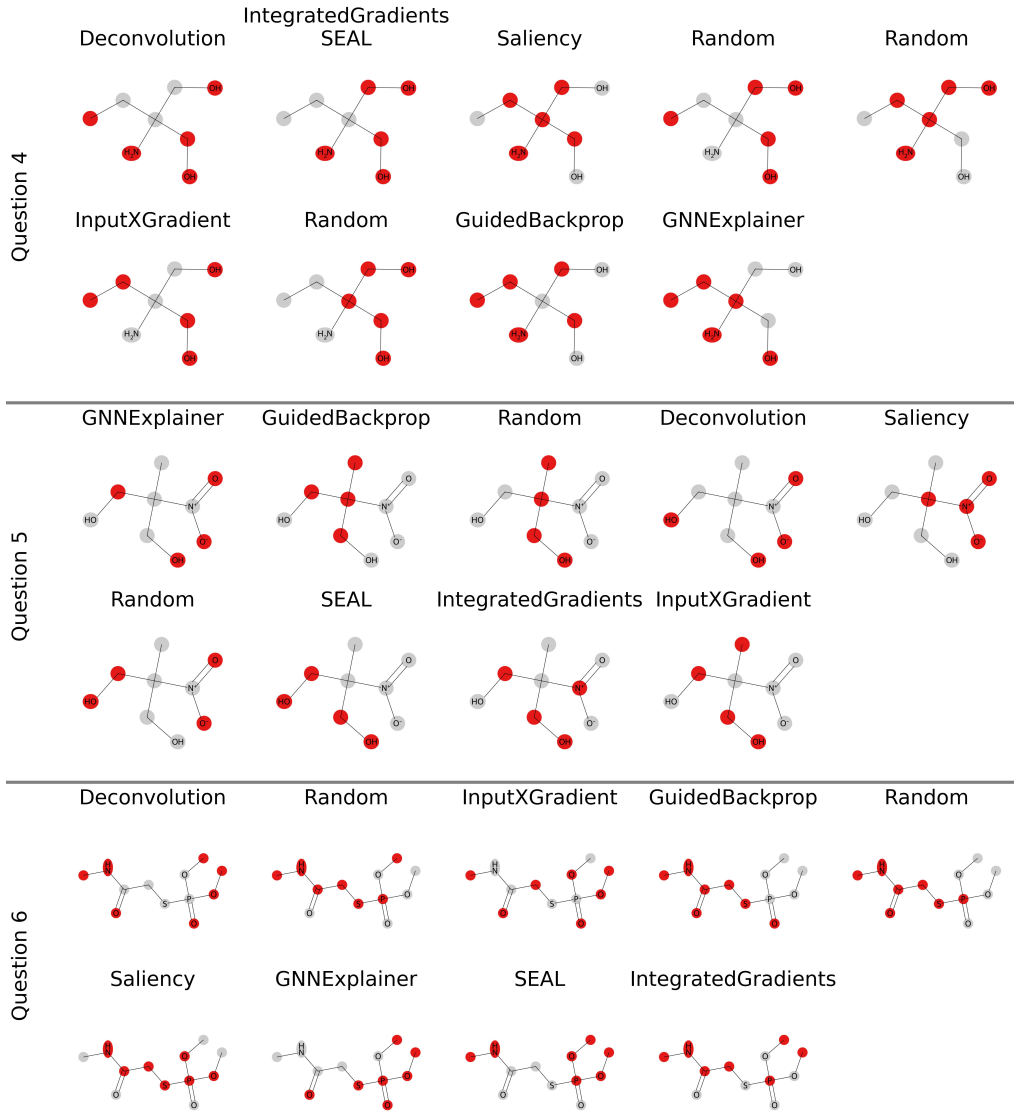
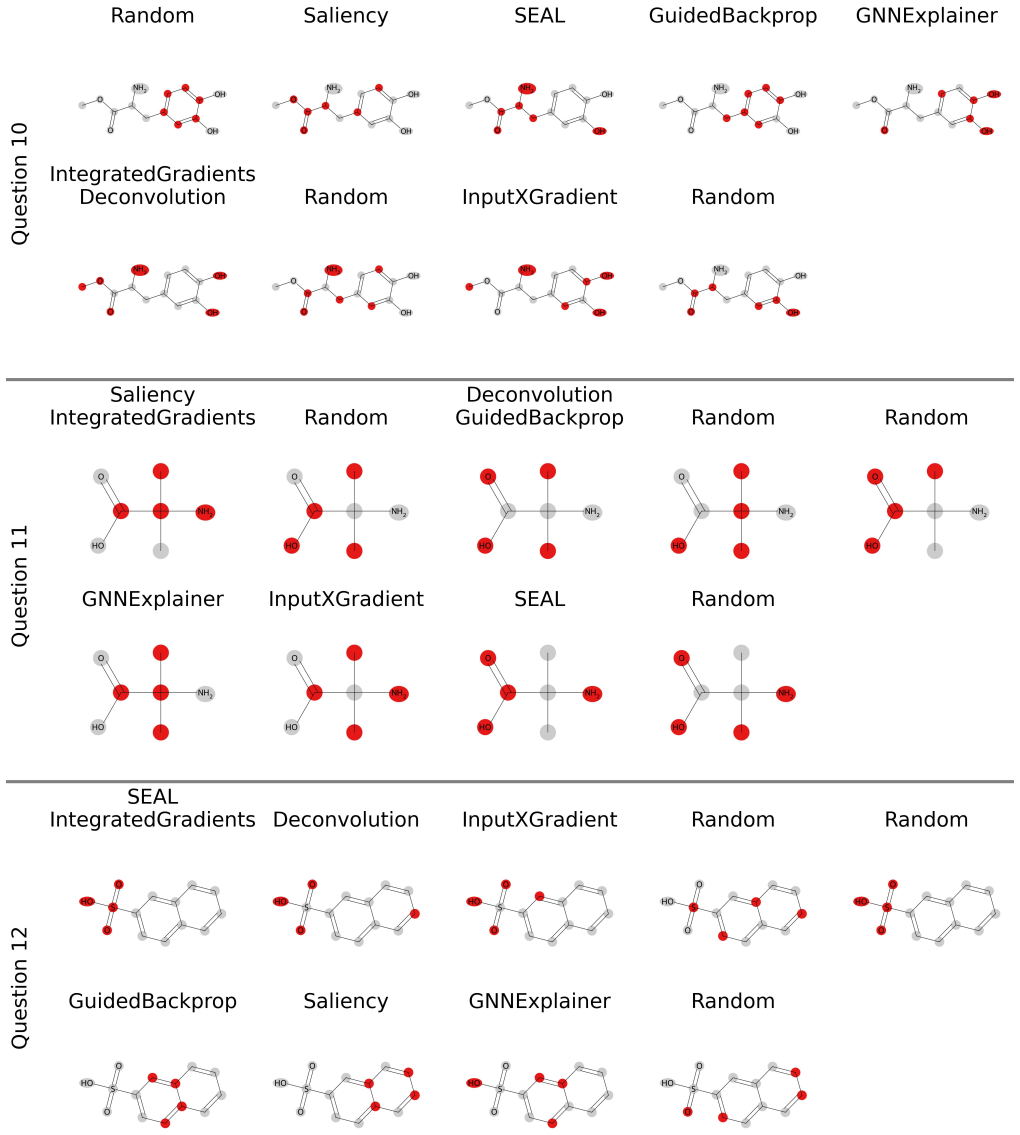
- [User study] The user study is reported without essential experimental detail. The text does not state the number of participants, the total number of votes, or any statistical test comparing SEAL to the other methods. The sentence 'Deconvolution and IntegratedGradients were chosen 5 times, and InputXGradients was selected 3 times' is ambiguous and does not permit the reader to assess whether SEAL's apparent preference is significant or due to chance. For a central claim about 'human-aligned interpretability,' the authors should report participant count, recruitment procedure, per-method vote totals, and a significance test (e.g., per-question or per-participant mixed-effects model).
- [Abstract and Discussion; Table 2] The abstract's claim that SEAL 'outperforms other explainability methods in both quantitative attribution metrics' is too broad given the paper's own results. On the rings-max task, SEAL's SE is 0.34, while GuidedBackprop reaches 0.67 and Saliency 0.55; on boron, SEAL (0.88) is also below several gradient baselines (1.00). The text in the results section acknowledges the boron and rings-max difficulties, but the abstract, introduction, and discussion generalize the outperformance claim. The authors should qualify the claim and report whether the overall advantage is statistically significant across tasks, or restrict the claim to the tasks where SEAL is indeed strong (PAINS, rings-count, indole, X, P).
minor comments (5)
- [Methods, Eq. (1)] The fragment representation is described as sum pooling followed by LayerNorm, but LayerNorm is not shown in Eq. (1); please align the equation with the text.
- [Related Work / Baselines] The baseline list says 'Deconvolution (Mahendran and Vedaldi 2016), (Shrikumar et al. 2016), and Guided Backpropagation' — the Shrikumar method name is missing (likely DeepLIFT).
- [Appendix C] The naming convention for masking strategies ('mask-abs', 'mask', 'abs', 'zero') is confusing and appears to mix 'zeroing features' with 'masking contributions.' Please define each term explicitly and use consistent terminology in the main text.
- [Metrics, real-world datasets] For the regression task (AqSolDB), the fidelity metric is defined only for classification ('proportion of times the predicted class changes'). Table 13 reports numerical values for regression without defining the metric; please provide the regression-specific definition.
- [Figure 2] The 'Baseline' row is not named per task; since different tasks have different best-performing baselines, please identify which method is shown for each column.
Circularity Check
Real-data fidelity claims reduce to the defining equation y-hat = sum c_i + b by construction; independent synthetic and human evaluations keep the paper from being fully circular.
-
self definitional
[Results — real-world datasets, Metrics; Appendix C (ablation on masking strategy); Eq. (2)]
"Unlike standard explainers that only operate on node masks, our model allows for masking specific contribution scores directly at the level of the model's architecture by setting ci = 0 for a given fragment."
Eq. (2) defines the prediction as y-hat = sum_i c_i + b. The fidelity evaluation for SEAL then 'masks' by setting c_i = 0, i.e., deleting terms from the very sum that defines the prediction. Positive fidelity ('mask the most important nodes and check how the prediction has changed') and negative fidelity ('retain the most important nodes and check if the prediction is the same') are therefore algebraic consequences of the additive definition: zeroing a term changes the sum by exactly that term, and retaining the dominant terms leaves the sum nearly unchanged. These numbers do not independently test whether c_i corresponds to a chemically meaningful or counterfactual causal effect, and comparing them with baselines that mask input node features is a protocol mismatch. The headline 'outperfo
full rationale
The paper's central identity (Eq. 2) makes fragment contributions add up to the prediction by definition; the real-data fidelity numbers in Table 4 are computed for SEAL by zeroing those same contributions (Appendix C 'SEAL-mask'), so the high positive and near-zero negative fidelity largely follow from the defining equation, not from external evidence about chemical causality. This is the core circular step. However, the paper also provides independent evidence that is not circular: the synthetic B-XAIC benchmark uses external ground-truth substructures, and SEAL's explanation scores there are falsifiable (e.g., failure on boron and rings-max shows the evaluation can reject the method); the user study with domain experts is an external human judgment independent of the model's additive parameterization. The B-XAIC benchmark is co-authored by one of the present authors, but it is a dataset with pre-defined ground truth rather than a uniqueness theorem imported to force a conclusion, so it does not by itself raise the circularity score. The causal-influence interpretation of c_i is an additional unverified assumption (with lambda = 0 or small values, inter-fragment weights are not zero, so c_i can depend on the whole molecule), but that is a correctness/assumption gap rather than a distinct circular reduction. Overall: one central evaluation metric reduces by construction to the defining equation, giving partial circularity (6), while the synthetic benchmark and user study keep the paper from being entirely self-referential.
Assumptions & free parameters
free parameters (1)
- lambda (inter-fragment weight regularization strength) =
per task/dataset: rings-count 1e-3, rings-max 2, X 2, P 2, B 2, indole 1e-4, PAINS 0, hERG 1e-4, CYP2C9 2, AqSol 1e-4
assumptions (4)
- domain assumption Molecular property predictions can be decomposed into additive, fragment-local contributions; inter-fragment interactions are secondary.
- domain assumption B-XAIC ground-truth labels are a valid gold standard for explanation quality.
- ad hoc to paper Fidelity by masking is a valid and fair proxy for explanation quality across methods.
- standard math Standard GNN and MLP machinery (sum pooling, LayerNorm, MLP readout) preserves the additive decomposition.
invented entities (1)
-
Fragment contribution c_i
independent evidence
Cite this review
Pith. "Pith review of Fragment-Wise Interpretability in Graph Neural Networks via Molecule Decomposition and Contribution Analysis." pith.science (2026). https://pith.science/paper/ZWACN2K2
@misc{pith2026250815015,
  author       = {Pith},
  title        = {Pith review of: Fragment-Wise Interpretability in Graph Neural Networks via Molecule Decomposition and Contribution Analysis},
  year         = {2026},
  howpublished = {\url{https://pith.science/paper/ZWACN2K2}},
  note         = {Machine review of arXiv:2508.15015}
}
read the original abstract
Graph neural networks have demonstrated remarkable success in predicting molecular properties by leveraging the rich structural information encoded in molecular graphs. However, their black-box nature reduces interpretability, which limits trust in their predictions for important applications such as drug discovery and materials design. Furthermore, existing explanation techniques often fail to reliably quantify the contribution of individual atoms or substructures due to the entangled message-passing dynamics. We introduce SEAL (Substructure Explanation via Attribution Learning), a new interpretable graph neural network that attributes model predictions to meaningful molecular subgraphs. SEAL decomposes input graphs into chemically relevant fragments and estimates their causal influence on the output. The strong alignment between fragment contributions and model predictions is achieved by explicitly reducing inter-fragment message passing in our proposed model architecture. Extensive evaluations on synthetic benchmarks and real-world molecular datasets demonstrate that SEAL outperforms other explainability methods in both quantitative attribution metrics and human-aligned interpretability. A user study further confirms that SEAL provides more intuitive and trustworthy explanations to domain experts. By bridging the gap between predictive performance and interpretability, SEAL offers a promising direction for more transparent and actionable molecular modeling.
Figures


Figures from the paper (26 more)








Reference graph
Works this paper leans on
-
[1]
, " * write output.state after.block = add.period write newline
ENTRY address archivePrefix author booktitle chapter edition editor eid eprint howpublished institution isbn journal key month note number organization pages publisher school series title type volume year label extra.label sort.label short.list INTEGERS output.state before.all mid.sentence after.sentence after.block FUNCTION init.state.consts #0 'before.a...
-
[2]
write newline
" write newline "" before.all 'output.state := FUNCTION n.dashify 't := "" t empty not t #1 #1 substring "-" = t #1 #2 substring "--" = not "--" * t #2 global.max substring 't := t #1 #1 substring "-" = "-" * t #2 global.max substring 't := while if t #1 #1 substring * t #2 global.max substring 't := if while FUNCTION word.in bbl.in capitalize " " * FUNCT...
-
[3]
Ba, J. L.; Kiros, J. R.; and Hinton, G. E. 2016. Layer normalization. arXiv preprint arXiv:1607.06450
arXiv 2016
-
[4]
Cao, P.-Y.; He, Y.; Cui, M.-Y.; Zhang, X.-M.; Zhang, Q.; and Zhang, H.-Y. 2024. Group graph: a molecular graph representation with enhanced performance, efficiency and interpretability. Journal of Cheminformatics, 16(1): 133
work page 2024
-
[5]
Degen, J.; Wegscheid-Gerlach, C.; Zaliani, A.; and Rarey, M. 2008. On the art of compiling and using'drug-like'chemical fragment spaces. ChemMedChem, 3(10): 1503
work page 2008
-
[6]
Elton, D. C.; Boukouvalas, Z.; Fuge, M. D.; and Chung, P. W. 2019. Deep learning for molecular design—a review of the state of the art. Molecular Systems Design & Engineering, 4(4): 828--849
work page 2019
-
[7]
Feng, Q.; Liu, N.; Yang, F.; Tang, R.; Du, M.; and Hu, X. 2022. DEGREE : Decomposition Based Explanation for Graph Neural Networks. In International Conference on Learning Representations
work page 2022
-
[8]
Gilmer, J.; Schoenholz, S. S.; Riley, P. F.; Vinyals, O.; and Dahl, G. E. 2020. Message passing neural networks. In Machine learning meets quantum physics, 199--214. Springer
work page 2020
Show all 44 references
-
[9]
Gui, S.; Yuan, H.; Wang, J.; Lao, Q.; Li, K.; and Ji, S. 2023. Flowx: Towards explainable graph neural networks via message flows. IEEE Transactions on Pattern Analysis and Machine Intelligence, 46(7): 4567--4578
2023
-
[10]
Henderson, R.; Clevert, D.-A.; and Montanari, F. 2021. Improving molecular graph neural network explainability with orthonormalization and induced sparsity. In International Conference on Machine Learning, 4203--4213. PMLR
2021
-
[11]
W.; Xiao, C.; Sun, J.; and Zitnik, M
Huang, K.; Fu, T.; Gao, W.; Zhao, Y.; Roohani, Y.; Leskovec, J.; Coley, C. W.; Xiao, C.; Sun, J.; and Zitnik, M. 2021. Therapeutics data commons: Machine learning datasets and tasks for drug discovery and development. arXiv preprint arXiv:2102.09548
2021 arXiv
-
[12]
Karim, A.; Lee, M.; Balle, T.; and Sattar, A. 2021. CardioTox net: a robust predictor for hERG channel blockade based on deep learning meta-feature ensembles. Journal of Cheminformatics, 13(1): 60
2021
-
[13]
Kipf, T. 2016. Semi-Supervised Classification with Graph Convolutional Networks. arXiv preprint arXiv:1609.02907
2016 arXiv
-
[14]
K.; Han, Y.-K.; Kang, J.; Kang, C.-J.; and Son, Y
Lee, S.; Park, H.; Choi, C.; Kim, W.; Kim, K. K.; Han, Y.-K.; Kang, J.; Kang, C.-J.; and Son, Y. 2023. Multi-order graph attention network for water solubility prediction and interpretation. Scientific Reports, 13(1): 957
2023
-
[15]
Mahendran, A.; and Vedaldi, A. 2016. Salient deconvolutional networks. In European conference on computer vision, 120--135. Springer
2016
-
[16]
Maziarka, .; Majchrowski, D.; Danel, T.; Gai \'n ski, P.; Tabor, J.; Podolak, I.; Morkisz, P.; and Jastrz e bski, S. 2024. Relative molecule self-attention transformer. Journal of Cheminformatics, 16(1): 3
2024
-
[17]
Murcko, M. A. 1995. Computational methods to predict binding free energy in ligand-receptor complexes. Journal of medicinal chemistry, 38(26): 4953--4967
1995
-
[18]
A.; and Campillo, N
Ponzoni, I.; P \'a ez Prosper, J. A.; and Campillo, N. E. 2023. Explainable artificial intelligence: A taxonomy and guidelines for its application to drug discovery. Wiley Interdisciplinary Reviews: Computational Molecular Science, 13(6): e1681
2023
-
[19]
Proszewska, M.; Danel, T.; and Rymarczyk, D. 2025. B-XAIC Dataset: Benchmarking Explainable AI for Graph Neural Networks Using Chemical Data. arXiv preprint arXiv:2505.22252
2025 arXiv
-
[20]
Rong, Y.; Bian, Y.; Xu, T.; Xie, W.; Wei, Y.; Huang, W.; and Huang, J. 2020. Self-supervised graph transformer on large-scale molecular data. Advances in neural information processing systems, 33: 12559--12571
2020
-
[21]
Rymarczyk, D.; Dobrowolski, D.; and Danel, T. 2023. ProGReST : Prototypical graph regression soft trees for molecular property prediction. In Proceedings of the 2023 SIAM International Conference on Data Mining (SDM), 379--387. SIAM
2023
-
[22]
Shrikumar, A.; Greenside, P.; Shcherbina, A.; and Kundaje, A. 2016. Not just a black box: Learning important features through propagating activation differences. arXiv preprint arXiv:1605.01713
2016 arXiv
-
[23]
Simonyan, K.; Vedaldi, A.; and Zisserman, A. 2014. Deep Inside Convolutional Networks: Visualising Image Classification Models and Saliency Maps
2014
-
[24]
C.; Khetan, A.; and Er, S
Sorkun, M. C.; Khetan, A.; and Er, S. 2019. AqSolDB, a curated reference set of aqueous solubility and 2D descriptors for a diverse set of compounds. Scientific data, 6(1): 143
2019
-
[25]
T.; Dosovitskiy, A.; Brox, T.; and Riedmiller, M
Springenberg, J. T.; Dosovitskiy, A.; Brox, T.; and Riedmiller, M. 2014. Striving for simplicity: The all convolutional net. arXiv preprint arXiv:1412.6806
2014 arXiv
-
[26]
Sundararajan, M.; Taly, A.; and Yan, Q. 2017. Axiomatic attribution for deep networks. In International conference on machine learning, 3319--3328. PMLR
2017
-
[27]
Talanquer, V. 2022. The complexity of reasoning about and with chemical representations. Jacs Au, 2(12): 2658--2669
2022
-
[28]
Tanaka, A.; Okamoto, H.; and Bersohn, M. 2010. Construction of functional group reactivity database under various reaction conditions automatically extracted from reaction database in a synthesis design system. Journal of chemical information and modeling, 50(3): 327--338
2010
-
[29]
R.; Brackman, E
Tuttle, M. R.; Brackman, E. M.; Sorourifar, F.; Paulson, J.; and Zhang, S. 2023. Predicting the solubility of organic energy storage materials based on functional group identity and substitution pattern. The Journal of Physical Chemistry Letters, 14(5): 1318--1325
2023
-
[30]
P.; Lloyd, D
Veith, H.; Southall, N.; Huang, R.; James, T.; Fayne, D.; Artemenko, N.; Shen, M.; Inglese, J.; Austin, C. P.; Lloyd, D. G.; et al. 2009. Comprehensive characterization of cytochrome P450 isozyme selectivity across chemical libraries. Nature biotechnology, 27(11): 1050--1055
2009
-
[31]
Veli c kovi \'c , P.; Cucurull, G.; Casanova, A.; Romero, A.; Lio, P.; and Bengio, Y. 2017. Graph attention networks. arXiv preprint arXiv:1710.10903
2017 arXiv
-
[32]
von Korff, M.; and Sander, T. 2006. Toxicity-indicating structural patterns. Journal of chemical information and modeling, 46(2): 536--544
2006
-
[33]
Vu, M.; and Thai, M. T. 2020. Pgm-explainer: Probabilistic graphical model explanations for graph neural networks. Advances in neural information processing systems, 33: 12225--12235
2020
-
[34]
Wang, J.; Min, Y.; Li, M.; and Wu, J. 2025. FragFormer: A Fragment-based Representation Learning Framework for Molecular Property Prediction. Transactions on Machine Learning Research
2025
-
[35]
Wieder, O.; Kohlbacher, S.; Kuenemann, M.; Garon, A.; Ducrot, P.; Seidel, T.; and Langer, T. 2020. A compact review of molecular property prediction with graph neural networks. Drug Discovery Today: Technologies, 37: 1--12
2020
-
[36]
Wu, Z.; Wang, J.; Du, H.; Jiang, D.; Kang, Y.; Li, D.; Pan, P.; Deng, Y.; Cao, D.; Hsieh, C.-Y.; et al. 2023. Chemistry-intuitive explanation of graph neural networks for molecular property prediction with substructure masking. Nature communications, 14(1): 2585
2023
-
[37]
Xiong, Z.; Wang, D.; Liu, X.; Zhong, F.; Wan, X.; Li, X.; Li, Z.; Luo, X.; Chen, K.; Jiang, H.; et al. 2019. Pushing the boundaries of molecular representation for drug discovery with the graph attention mechanism. Journal of medicinal chemistry, 63(16): 8749--8760
2019
-
[38]
Xu, K.; Hu, W.; Leskovec, J.; and Jegelka, S. 2018. How powerful are graph neural networks? arXiv preprint arXiv:1810.00826
2018 arXiv
-
[39]
Ying, Z.; Bourgeois, D.; You, J.; Zitnik, M.; and Leskovec, J. 2019. Gnnexplainer: Generating explanations for graph neural networks. Advances in neural information processing systems, 32
2019
-
[40]
Yuan, H.; Yu, H.; Wang, J.; Li, K.; and Ji, S. 2021. On explainability of graph neural networks via subgraph explorations. In International conference on machine learning, 12241--12252. PMLR
2021
-
[41]
Zhang, X.; Xu, Y.; He, W.; Guo, W.; and Cui, L. 2023. A comprehensive review of the oversmoothing in graph neural networks. In CCF Conference on Computer Supported Cooperative Work and Social Computing, 451--465. Springer
2023
-
[42]
Zhang, Z.; Liu, Q.; Wang, H.; Lu, C.; and Lee, C. 2022. Protgnn: Towards self-explaining graph neural networks. In Proceedings of the AAAI conference on artificial intelligence, volume 36, 9127--9135
2022
-
[43]
Zhang, Z.; Liu, Q.; Wang, H.; Lu, C.; and Lee, C.-K. 2021. Motif-based graph self-supervised learning for molecular property prediction. Advances in Neural Information Processing Systems, 34: 15870--15882
2021
-
[44]
Zhou, B.; Khosla, A.; Lapedriza, A.; Oliva, A.; and Torralba, A. 2016. Learning deep features for discriminative localization. In Proceedings of the IEEE conference on computer vision and pattern recognition, 2921--2929
2016
Reviewed August 5, 2026 · model on record in the stance chip above.
Discussion (0). Sign in to comment.