Wide-spectrum security of quantum key distribution
Pith reviewed 2026-05-18 22:42 UTC · model grok-4.3
The pith
QKD systems achieve full optical spectrum safety by characterizing transmittance from 400 to 2300 nm with high sensitivity.
A machine-rendered reading of the paper's core claim, the machinery that carries it, and where it could break.
Core claim
We propose a wide-spectrum security evaluation methodology to achieve full optical spectrum safety for QKD systems. This technique requires transmittance characterisation in a wide spectral band with a high sensitivity. We report a testbench that characterises insertion loss of fiber-optic components in a wide spectral range of 400 to 2300 nm and up to 70 dB dynamic range. To illustrate practical application, we give a full Trojan-horse attack analysis for some typical QKD system configurations and discuss briefly induced-photorefraction and detector-backflash attacks.
What carries the argument
Wide-spectrum transmittance characterisation testbench measuring insertion loss from 400 to 2300 nm with up to 70 dB dynamic range, used to identify exploitable transparency windows.
If this is right
- Typical QKD configurations receive full Trojan-horse attack analysis once wide-spectrum insertion loss data are available.
- QKD systems can be certified against optical attacks that exploit any transparency window in the measured band.
- Induced-photorefraction and detector-backflash attacks can be evaluated using the same transmittance dataset.
- Eavesdroppers are prevented from gaining advantage by choosing attack wavelengths within the characterized spectrum.
Where Pith is reading between the lines
- Deployed QKD networks might require periodic re-testing of components if environmental factors alter transmittance over time.
- Manufacturers could incorporate this testbench into quality control to reduce hidden spectral vulnerabilities before installation.
- The same wide-spectrum approach could extend to other quantum optics protocols that use fiber channels.
Load-bearing premise
Laboratory insertion loss measurements from 400 to 2300 nm are sufficient to capture all relevant attack wavelengths and accurately predict component behavior in deployed QKD systems.
What would settle it
Successful eavesdropping on a characterized QKD system at a wavelength where the testbench reported high insertion loss, or using a wavelength outside the 400-2300 nm band, would show the methodology fails to ensure safety.
Figures




read the original abstract
Implementations of quantum key distribution (QKD) need vulnerability assessment against loopholes in their optical scheme. Most of the optical attacks involve injecting or receiving extraneous light via the communication channel. An eavesdropper can choose her attack wavelengths arbitrarily within the quantum channel passband to maximise the attack performance, exploiting spectral transparency windows of system components. Here we propose a wide-spectrum security evaluation methodology to achieve full optical spectrum safety for QKD systems. This technique requires transmittance characterisation in a wide spectral band with a high sensitivity. We report a testbench that characterises insertion loss of fiber-optic components in a wide spectral range of 400 to 2300 nm and up to 70 dB dynamic range. To illustrate practical application of the proposed methodology, we give a full Trojan-horse attack analysis for some typical QKD system configurations and discuss briefly induced-photorefraction and detector-backflash attacks. Our methodology can be used for certification of QKD systems.
Editorial analysis
A structured set of objections, weighed in public.
Referee Report
Summary. The manuscript proposes a wide-spectrum security evaluation methodology for QKD systems to achieve full optical spectrum safety. It requires transmittance characterization over 400–2300 nm with high sensitivity and reports a testbench achieving up to 70 dB dynamic range for insertion-loss measurements of fiber-optic components. The approach is illustrated via Trojan-horse attack analysis for typical QKD configurations, with brief discussion of induced-photorefraction and detector-backflash attacks; the methodology is positioned for use in QKD certification.
Significance. If the laboratory measurements prove representative of deployed systems, the work provides a concrete, standards-grounded procedure for identifying spectral vulnerabilities that narrow-band checks could miss, strengthening practical security assessment and certification of QKD implementations.
major comments (2)
- [Testbench section] Testbench description (likely §3): the 70 dB dynamic range claim is presented without accompanying calibration procedures, uncertainty budgets, or raw data, which are required to substantiate the high-sensitivity characterization that underpins the wide-spectrum safety methodology.
- [Discussion of deployed systems] Methodology application and discussion (likely §4–5): the central claim that the characterization delivers full optical-spectrum safety for QKD systems rests on the unexamined assumption that lab-measured loss spectra remain valid under deployed conditions; no data or analysis addresses shifts due to temperature drift, mechanical stress, or aging that could open new transparency windows below the 70 dB floor.
minor comments (2)
- [Abstract] The abstract would benefit from explicitly naming the specific QKD configurations used in the Trojan-horse analysis.
- [Methods] Notation for insertion loss and dynamic range should be defined consistently when first introduced.
Simulated Author's Rebuttal
We thank the referee for the constructive and detailed review of our manuscript. We address each major comment below, indicating where revisions will be made to improve clarity and substantiation.
read point-by-point responses
-
Referee: [Testbench section] Testbench description (likely §3): the 70 dB dynamic range claim is presented without accompanying calibration procedures, uncertainty budgets, or raw data, which are required to substantiate the high-sensitivity characterization that underpins the wide-spectrum safety methodology.
Authors: We agree that the manuscript would benefit from additional details to support the reported dynamic range. In the revised version, we will expand the testbench description in §3 to include the calibration procedures employed, an uncertainty budget for the insertion-loss measurements across the 400–2300 nm range, and representative raw data or example spectra demonstrating the achieved sensitivity. These additions will directly substantiate the high-sensitivity characterization central to the proposed methodology. revision: yes
-
Referee: [Discussion of deployed systems] Methodology application and discussion (likely §4–5): the central claim that the characterization delivers full optical-spectrum safety for QKD systems rests on the unexamined assumption that lab-measured loss spectra remain valid under deployed conditions; no data or analysis addresses shifts due to temperature drift, mechanical stress, or aging that could open new transparency windows below the 70 dB floor.
Authors: The referee correctly notes that our discussion does not examine how lab-measured spectra might change under deployed conditions. The manuscript presents a laboratory methodology for identifying spectral vulnerabilities to support security evaluation and certification. We will revise §§4–5 to explicitly clarify that the reported characterizations provide a baseline assessment under controlled conditions, and that full optical-spectrum safety in the field would require additional verification accounting for environmental factors such as temperature drift, mechanical stress, and aging. We will also note that such extended testing is recommended for certification but lies beyond the scope of the current work, which focuses on establishing the wide-spectrum evaluation approach itself. revision: partial
Circularity Check
No significant circularity; experimental methodology is self-contained
full rationale
The manuscript proposes and demonstrates an experimental testbench for wide-spectrum insertion-loss characterization of QKD components (400–2300 nm, up to 70 dB dynamic range) and illustrates its use on Trojan-horse, induced-photorefraction, and detector-backflash attacks. No equations, fitted parameters, or predictions are defined in terms of themselves; the central claim is a practical measurement procedure grounded in standard optical metrology rather than a derivation that reduces to its inputs by construction. No self-citations serve as load-bearing uniqueness theorems, and no ansatzes or renamings of known results are smuggled in. The work therefore remains self-contained against external benchmarks with no circular steps.
Axiom & Free-Parameter Ledger
axioms (1)
- domain assumption Eavesdroppers can select attack wavelengths arbitrarily within the quantum channel passband to exploit spectral transparency windows of system components.
Lean theorems connected to this paper
-
IndisputableMonolith/Cost/FunctionalEquation.leanwashburn_uniqueness_aczel unclear?
unclearRelation between the paper passage and the cited Recognition theorem.
We report a testbench that characterises insertion loss of fiber-optic components in a wide spectral range of 400 to 2300 nm and up to 70 dB dynamic range.
-
IndisputableMonolith/Foundation/ArithmeticFromLogic.leanembed_strictMono_of_one_lt unclear?
unclearRelation between the paper passage and the cited Recognition theorem.
γ(λ) = [F(λ)]² ∏ P_in_i(λ) P_out_i(λ) (Trojan-horse round-trip transmittance)
What do these tags mean?
- matches
- The paper's claim is directly supported by a theorem in the formal canon.
- supports
- The theorem supports part of the paper's argument, but the paper may add assumptions or extra steps.
- extends
- The paper goes beyond the formal theorem; the theorem is a base layer rather than the whole result.
- uses
- The paper appears to rely on the theorem as machinery.
- contradicts
- The paper's claim conflicts with a theorem or certificate in the canon.
- unclear
- Pith found a possible connection, but the passage is too broad, indirect, or ambiguous to say the theorem truly supports the claim.
Forward citations
Cited by 1 Pith paper
-
Reference-Beam Attacks against Twin-Field Quantum Key Distribution using Optical Injection Locking
Experimental demonstration that reference-beam manipulation in OIL-based TF-QKD enables deterministic photon-number increase or decoy-state circumvention, with practical countermeasures proposed.
Reference graph
Works this paper leans on
-
[1]
We test a polarisation-insensitive isolator (Optizone Technology PII-55-P-T-2-11-LL-1)
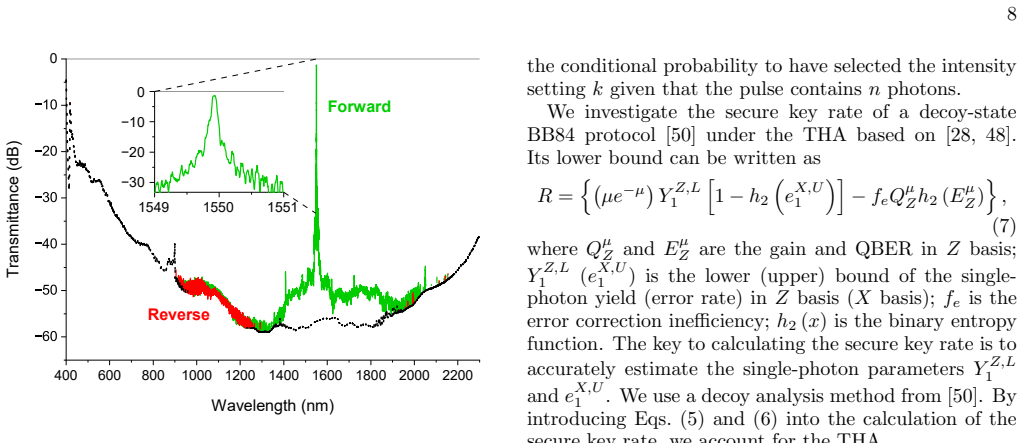
Characterisation of individual components Isolator. We test a polarisation-insensitive isolator (Optizone Technology PII-55-P-T-2-11-LL-1). Its trans- Laser Modulator(s) VOAs Isolators Fiber coil DWDM ComPass Ref Circulator FBG (a) (b) (c) in out 1 2 3 FIG. 5. Source configurations. The fiber coil is used as the broadband physical filter. T...
work page 2000
-
[2]
Planes Complementarios de I+D+I con las Comunidades Au- tonomas
Security evaluation The impact of information leakage from the encod- ing module caused by the THA needs to be quantified. Since the target susceptibility S to THA is assumed to be wavelength-independent and need not be tested, the above measurements are sufficient for protocol security analysis [28]. The targets of the THA are the phase and intensity mod...
work page 2000
-
[3]
C. H. Bennett and G. Brassard, Quantum cryptography: public key distribution and coin tossing, in Proc. Inter- national Conference on Computers, Systems, and Sig- nal Processing (IEEE Press, New York, Bangalore, India,
-
[4]
A. K. Ekert, Quantum Cryptography Based on Bell’s Theorem, Phys. Rev. Lett. 67, 661 (1991)
work page 1991
-
[5]
F. Xu, X. Ma, Q. Zhang, H.-K. Lo, and J.-W. Pan, Se- cure quantum key distribution with realistic devices, Rev. Mod. Phys. 92, 025002 (2020). 12
work page 2020
-
[6]
E. Diamanti, H.-K. Lo, B. Qi, and Z. Yuan, Practical challenges in quantum key distribution, npj Quantum Inf. 2, 16025 (2016)
work page 2016
-
[7]
A. Vakhitov, V. Makarov, and D. R. Hjelme, Large pulse attack as a method of conventional optical eavesdropping in quantum cryptography, J. Mod. Opt. 48, 2023 (2001)
work page 2023
- [8]
-
[9]
V. Makarov, A. Anisimov, and J. Skaar, Effects of de- tector efficiency mismatch on security of quantum cryp- tosystems, Phys. Rev. A74, 022313 (2006), erratum ibid. 78, 019905 (2008)
work page 2006
-
[10]
Makarov, Controlling passively quenched single pho- ton detectors by bright light, New J
V. Makarov, Controlling passively quenched single pho- ton detectors by bright light, New J. Phys. 11, 065003 (2009)
work page 2009
-
[11]
F. Xu, B. Qi, and H.-K. Lo, Experimental demonstration of phase-remapping attack in a practical quantum key distribution system, New J. Phys. 12, 113026 (2010)
work page 2010
-
[12]
L. Lydersen, C. Wiechers, C. Wittmann, D. Elser, J. Skaar, and V. Makarov, Hacking commercial quan- tum cryptography systems by tailored bright illumina- tion, Nat. Photonics 4, 686 (2010)
work page 2010
-
[13]
H.-W. Li, S. Wang, J.-Z. Huang, W. Chen, Z.-Q. Yin, F.-Y. Li, Z. Zhou, D. Liu, Y. Zhang, G.-C. Guo, W.-S. Bao, and Z.-F. Han, Attacking a practical quantum-key- distribution system with wavelength-dependent beam- splitter and multiwavelength sources, Phys. Rev. A 84, 062308 (2011)
work page 2011
-
[14]
N. Jain, E. Anisimova, I. Khan, V. Makarov, C. Mar- quardt, and G. Leuchs, Trojan-horse attacks threaten the security of practical quantum cryptography, New J. Phys. 16, 123030 (2014)
work page 2014
- [15]
-
[16]
A. N. Bugge, S. Sauge, A. M. M. Ghazali, J. Skaar, L. Ly- dersen, and V. Makarov, Laser damage helps the eaves- dropper in quantum cryptography, Phys. Rev. Lett.112, 070503 (2014)
work page 2014
-
[17]
S.-H. Sun, F. Xu, M.-S. Jiang, X.-C. Ma, H.-K. Lo, and L.-M. Liang, Effect of source tampering in the security of quantum cryptography, Phys. Rev. A 92, 022304 (2015)
work page 2015
-
[18]
Y. Shi, J. Z. J. Lim, H. S. Poh, P. K. Tan, P. A. Tan, A. Ling, and C. Kurtsiefer, Breakdown flash at telecom wavelengths in InGaAs avalanche photodiodes, Opt. Ex- press 25, 30388 (2017)
work page 2017
-
[19]
P. V. P. Pinheiro, P. Chaiwongkhot, S. Sajeed, R. T. Horn, J.-P. Bourgoin, T. Jennewein, N. L¨ utkenhaus, and V. Makarov, Eavesdropping and countermeasures for backflash side channel in quantum cryptography, Opt. Express 26, 21020 (2018)
work page 2018
- [20]
-
[21]
K. Wei, W. Zhang, Y.-L. Tang, L. You, and F. Xu, Im- plementation security of quantum key distribution due to polarization-dependent efficiency mismatch, Phys. Rev. A 100, 022325 (2019)
work page 2019
- [22]
-
[23]
H. Tan, W. Li, L. Zhang, K. Wei, and F. Xu, Chip-based quantum key distribution against Trojan-horse attack, Phys. Rev. Appl. 15, 064038 (2021)
work page 2021
-
[24]
A. Ponosova, D. Ruzhitskaya, P. Chaiwongkhot, V. Egorov, V. Makarov, and A. Huang, Protecting fiber- optic quantum key distribution sources against light- injection attacks, PRX Quantum 3, 040307 (2022)
work page 2022
-
[25]
P. Ye, W. Chen, G.-W. Zhang, F.-Y. Lu, F.-X. Wang, G.-Z. Huang, S. Wang, D.-Y. He, Z.-Q. Yin, G.-C. Guo, and Z.-F. Han, Induced-photorefraction attack against quantum key distribution, Phys. Rev. Appl. 19, 054052 (2023)
work page 2023
-
[26]
L. Han, Y. Li, H. Tan, W. Zhang, W. Cai, J. Yin, J. Ren, F. Xu, S. Liao, and C. Peng, Effect of light injection on the security of practical quantum key distribution, Phys. Rev. Appl. 20, 044013 (2023)
work page 2023
- [27]
- [28]
-
[29]
A. Meda, I. P. Degiovanni, A. Tosi, Z. Yuan, G. Brida, and M. Genovese, Quantifying backflash radiation to prevent zero-error attacks in quantum key distribution, Light Sci. Appl. 6, e16261 (2017)
work page 2017
-
[30]
M. Lucamarini, I. Choi, M. B. Ward, J. F. Dynes, Z. L. Yuan, and A. J. Shields, Practical security bounds against the Trojan-horse attack in quantum key distri- bution, Phys. Rev. X 5, 031030 (2015)
work page 2015
-
[31]
N. Jain, B. Stiller, I. Khan, V. Makarov, C. Marquardt, and G. Leuch, Risk analysis of Trojan-horse attacks on practical quantum key distribution systems, IEEE J. Sel. Top. Quantum Electron. 21, 6600710 (2015)
work page 2015
-
[32]
ISO/IEC 23837-2:2023(en). Information security — Se- curity requirements, test and evaluation methods for quantum key distribution — Part 2: Evaluation and test- ing methods, https://www.iso.org/obp/ui/en/#iso: std:iso- iec:23837:-2:ed-1:v1:en , visited 22 Nov 2023
work page 2023
-
[33]
V. Makarov, A. Abrikosov, P. Chaiwongkhot, A. K. Fe- dorov, A. Huang, E. Kiktenko, M. Petrov, A. Ponosova, D. Ruzhitskaya, A. Tayduganov, D. Trefilov, and K. Za- itsev, Preparing a commercial quantum key distribu- tion system for certification against implementation loop- holes, Phys. Rev. Appl. 22, 044076 (2024)
work page 2024
-
[34]
Tomita, Implementation cecurity certification of decoy-BB84 quantum key distribution systems, Adv
A. Tomita, Implementation cecurity certification of decoy-BB84 quantum key distribution systems, Adv. Quantum Technol. 2, 1900005 (2019)
work page 2019
- [35]
-
[36]
Draft ETSI GS QKD 010 V0.4.1 (2021-06). Quantum key distribution (QKD); Implementation security: protection against Trojan horse attacks, https://docbox.etsi.or g/ISG/QKD/Open/GS-QKD-0010_ISTrojan_v0.4.1_Open Area.pdf, visited 16 Mar 2025
work page 2021
- [37]
-
[38]
C. Marquardt, U. Seyfarth, S. Bettendorf, M. Bohmann, A. Buchner, M. Curty, D. Elser, S. Eul, T. Gehring, N. Jain, T. Klocke, M. Reinecke, N. Sieber, R. Ursin, M. Wehling, and H. Weier, Implementation attacks against QKD systems, BSI technical report, https: //www.bsi.bund.de/EN/Service- Navi/Publikatio nen/Studien/QKD-Systems/Implementation_Attacks_ QKD_...
work page 2024
-
[39]
NKT Photonics, SuperK Fianium supercontinuum white light fiber lasers, https://www.nktphotonics.com/pro ducts/supercontinuum-white-light-lasers/superk -fianium/, visited 27 Nov 2023
work page 2023
-
[40]
B. Nasedkin, F. Kiselev, I. Filipov, D. Tolochko, A. Ismagilov, V. Chistiakov, A. Gaidash, A. Tcyp- kin, A. Kozubov, and V. Egorov, Loopholes in the 1500–2100-nm range for quantum-key-distribution com- ponents: prospects for Trojan-horse attacks, Phys. Rev. Appl. 20, 014038 (2023)
work page 2023
-
[41]
NKT Photonics, SuperK Split spectral splitter, https: //www.nktphotonics.com/products/supercontinuum -white-light-lasers/superk-split/ , visited 27 Nov 2023
work page 2023
-
[42]
NKT Photonics, SuperK Connect broadband fiber deliv- ery, https://www.nktphotonics.com/products/supe rcontinuum-white-light-lasers/superk-connect/ , visited 27 Nov 2023
work page 2023
-
[43]
Yokogawa, AQ6374 wide range optical spectrum ana- lyzer, https://tmi.yokogawa.com/solutions/disco ntinued/aq6374-wide-range-optical-spectrum-ana lyzer-350-1750-nm/ , visited 27 Nov 2023
work page 2023
-
[44]
Yokogawa, AQ6375B wide range optical spectrum ana- lyzer, https://tmi.yokogawa.com/solutions/discont inued/aq6375b-optical-spectrum-analyzer/ , visited 27 Nov 2023
work page 2023
-
[45]
Q. Wang, G. Farrell, and T. Freir, Theoretical and exper- imental investigations of macro-bend losses for standard single mode fibers, Opt. Express 13, 4476 (2005)
work page 2005
-
[46]
W. Chen, Z. Chen, Y. Zhang, H. Li, and Y. Lian, Agarose coated macro-bend fiber sensor for relative humidity and temperature measurement at 2 µm, Opt. Fiber Technol. 50, 118 (2019)
work page 2019
-
[47]
M. A. Green and M. J. Keevers, Optical properties of intinsic silicon at 300 K, Prog. Photovolt. Res. Appl. 3, 189 (1995)
work page 1995
-
[48]
M. A. Green, Self-consistent optical parameters of intrin- sic silicon at 300 K including temperature coefficients, Sol. Energy Mater. Sol. Cells 92, 1305 (2008)
work page 2008
-
[49]
S. Kasap and P. Kapper, eds., Springer handbook of elec- tronic and photonic materials (Springer, St¨ urtz GmbH, W¨ urzburg, 2006) p. 54
work page 2006
- [50]
- [51]
-
[52]
X. Ma, B. Qi, Y. Zhao, and H.-K. Lo, Practical decoy state for quantum key distribution, Phys. Rev. A 72, 012326 (2005)
work page 2005
-
[53]
H.-K. Lo, M. Curty, and B. Qi, Measurement-device- independent quantum key distribution, Phys. Rev. Lett. 108, 130503 (2012)
work page 2012
-
[54]
Y.-H. Zhou, Z.-W. Yu, and X.-B. Wang, Making the decoy-state measurement-device-independent quantum key distribution practically useful, Phys. Rev. A 93, 042324 (2016)
work page 2016
-
[55]
W. Wang, F. Xu, and H.-K. Lo, Asymmetric protocols for scalable high-rate measurement-device-independent quantum key distribution networks, Phys. Rev. X 9, 041012 (2019)
work page 2019
-
[56]
F. Xu, M. Curty, B. Qi, and H.-K. Lo, Practical aspects of measurement-device-independent quantum key distri- bution, New J. Phys. 15, 113007 (2013)
work page 2013
-
[57]
R. Kashyap and K. J. Blow, Observation of catastrophic self-propelled self-focusing in optical fibres, Electron. Lett. 24, 47 (1988)
work page 1988
-
[58]
D. D. Davis, S. C. Mettler, and D. J. DiGiovanni, A comparative evaluation of fiber fuse models, Proc. SPIE 2966, 592 (1997)
work page 1997
-
[59]
W. Li, V. Zapatero, H. Tan, K. Wei, H. Min, W.-Y. Liu, X. Jiang, S.-K. Liao, C.-Z. Peng, M. Curty, F. Xu, and J.- W. Pan, Experimental quantum key distribution secure against malicious devices, Phys. Rev. Appl. 15, 034081 (2021)
work page 2021
-
[60]
W. Li, L. Zhang, H. Tan, Y. Lu, S.-K. Liao, J. Huang, H. Li, Z. Wang, H.-K. Mao, B. Yan, Q. Li, Y. Liu, Q. Zhang, C.-Z. Peng, L. You, F. Xu, and J.-W. Pan, High-rate quantum key distribution exceeding 110 Mb s −1, Nat. Photonics 17, 416 (2023)
work page 2023
-
[61]
Y. Cao, Y.-H. Li, K.-X. Yang, Y.-F. Jiang, S.-L. Li, X.- L. Hu, M. Abulizi, C.-L. Li, W. Zhang, Q.-C. Sun, W.- Y. Liu, X. Jiang, S.-K. Liao, J.-G. Ren, H. Li, L. You, Z. Wang, J. Yin, C.-Y. Lu, X.-B. Wang, Q. Zhang, C.-Z. Peng, and J.-W. Pan, Long-distance free-space measurement-device-independent quantum key distribu- tion, Phys. Rev. Lett 125, 260503 (2020)
work page 2020
-
[62]
K. Wei, W. Li, H. Tan, Y. Li, H. Min, W.-J. Zhang, H. Li, L. You, Z. Wang, X. Jiang, T.-Y. Chen, S.-K. Liao, C.-Z. Peng, F. Xu, and J.-W. Pan, High-speed measurement- device-independent quantum key distribution with inte- grated silicon photonics, Phys. Rev. X10, 031030 (2020)
work page 2020
-
[63]
F.-Y. Lu, P. Ye, Z.-H. Wang, S. Wang, Z.-Q. Yin, R. Wang, X.-J. Huang, W. Chen, D.-Y. He, G.-J. Fan- Yuan, G.-C. Guo, and Z.-F. Han, Hacking measurement- device-independent quantum key distribution, Optica10, 520 (2023)
work page 2023
-
[64]
A. Koehler-Sidki, J. Dynes, T. Para¨ ıso, M. Lucamarini, A. W. Sharpe, Z. Yuan, and A. Shields, Backflashes from fast-gated avalanche photodiodes in quantum key distri- bution, Appl. Phys. Lett. 116, 154001 (2020)
work page 2020
-
[65]
S. Molotkov, Trojan horse attacks, decoy state method, and side channels of information leakage in quantum cryptography, J. Exp. Theor. Phys. 130, 809 (2020)
work page 2020
- [66]
- [67]
-
[68]
C. C. W. Lim, M. Curty, N. Walenta, F. Xu, and H. Zbinden, Concise security bounds for practical decoy- state quantum key distribution, Phys. Rev. A89, 022307 (2014)
work page 2014
discussion (0)
Sign in with ORCID, Apple, or X to comment. Anyone can read and Pith papers without signing in.