REVIEW 3 major objections 5 minor 40 references
Interaction of polytropic dark energy in cosmological model: Constraints from observational data
T0 review · 3 major / 5 minor · reviewed 2026-08-05 · deepseek-v4-flash
Pith's one-line read This paper claims that an interacting polytropic dark energy fluid, with a linear coupling to dark matter, fits the combined cosmic expansion data and serves as a viable alternative to ΛCDM for late-time acceleration.
desk verdict The paper's central matter-density solution violates its own conservation equation, invalidating the Hubble parameter and all downstream constraints. read the letter →
The pith
A machine-rendered reading of the paper's core claim, the machinery that carries it, and where it could break.
The reading
What carries the argument
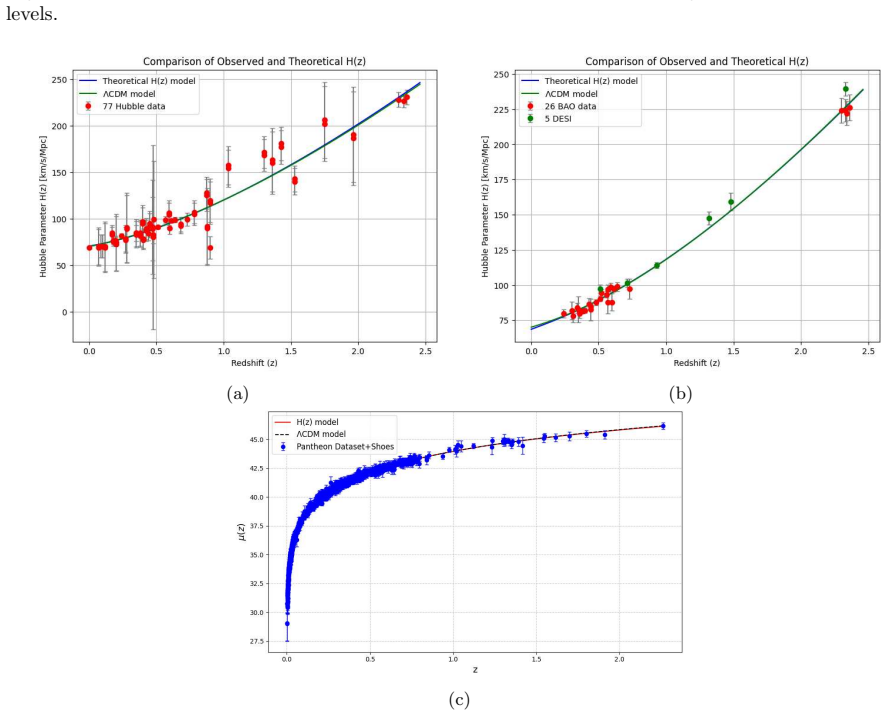
The machinery is the polytropic equation of state p_d = α ρ_d^{1+1/β} together with the linear interaction Q = 3ηHρ_d. The crucial step is the substitution β = 1 − η, which turns the coupled conservation equations into closed-form expressions for ρ_m(z), ρ_d(z), and hence the Hubble parameter H(z) of Eq. (21). That single formula carries the whole analysis: it is fed into chi-square fits against Hubble, BAO, Pantheon+, and DESI DR2 data, and then differentiated to yield the effective pressure, equation-of-state parameter, deceleration parameter, statefinder pair, and cosmic age.
What would settle it
Check the model's own matter conservation equation, Eq. (12), at z = 0 using the published best-fit values. Consistency requires (1 + K)ρ_m0 = −ρ_d0; the fits give (1 + K) ≈ 0.07 (since K ≈ −0.93) and ρ_d0/ρ_m0 = Ω_d0/Ω_m0 ≈ 0.73/0.27 ≈ 2.7, so the identity fails by a large factor. The same check at several redshifts in 0 < z < 2 would settle whether the derived H(z) actually satisfies the coupled equations.
Extended reading notes
Core claim
The paper's central claim is that a dark-energy fluid obeying the polytropic equation of state p_d = α ρ_d^{1+1/β}, coupled to pressureless matter by Q = 3ηHρ_d, yields a closed-form Hubble parameter (Eq. 21) that fits the combined observational data. The best-fit parameters are H0 ≈ 67.8–69.2 km/s/Mpc, Ω_d0 ≈ 0.73, K ≈ −0.9, and η < 0, with the precise η depending on the dataset. With these values the model reproduces the expansion history of ΛCDM, keeps the energy density positive and pressure negative, places the effective equation of state in the quintessence range, and predicts a transition from deceleration to acceleration near z ≈ 0.77 and a present age near 14 Gyr. The paper therefor
Load-bearing premise
The derivation assumes the density formulas it writes solve the coupled conservation equations at every redshift with nothing left over from the integration; if a leftover term is present, the fitted Hubble law is not actually a solution of the model.
Editorial extensions
If this is right
- If the central claim holds, late-time acceleration can be driven by an interacting polytropic fluid with no cosmological constant, and the coincidence between ρ_d and ρ_m can be adjusted by the coupling strength η.
- The negative η obtained from all three data combinations means energy currently flows from dark energy into dark matter; this direction of transfer is itself testable through galaxy growth-rate measurements.
- The predicted present deceleration parameter q0 ≈ −0.42 to −0.50 and effective equation of state ω_eff ≈ −0.61 to −0.67 put the model firmly in the quintessence class, distinguishing it from phantom dark-energy candidates.
- Because H0 comes out near 68 km/s/Mpc, the model tracks Planck's H0 rather than the higher local value; this makes it a candidate that preserves CMB-calibrated expansion while fitting lower-redshift probes.
Reading between the lines
- A direct follow-up would be to compute the linear growth rate of matter fluctuations from Eq. (21); because the fitted coupling is negative, the growth should deviate from ΛCDM in a way that galaxy clustering surveys could detect independently of the expansion history.
- Since K is defined through α, ρ_d0, and η, the best-fit K implies a specific polytropic constant α; checking that implied constant against independent constraints on the dark-energy equation of state would connect the statistical fit to the fluid interpretation.
- The analytic frame could be extended to a redshift-dependent coupling η(z) or a different polytropic index; the statefinder trajectories approaching the ΛCDM fixed point indicate that late-time, low-redshift data will be where such extensions are most easily distinguished.
Editorial analysis
A structured set of objections, weighed in public.
Referee Report
Summary. The manuscript studies a spatially flat FLRW universe containing pressureless matter and a polytropic dark energy fluid with equation of state p_d = α ρ_d^{1+1/β}, coupled through Q = 3ηHρ_d. After imposing β = 1 - η, the authors derive matter and dark energy densities (Eqs. 17 and 18), form the Hubble parameter (Eq. 21), and fit the parameters H0, Ωd0, η, and K to three joint data combinations (Hubble77+BAO26, Hubble77+Pantheon+, Hubble77+BAO26+DESI DR2) via MCMC. They report best-fit values, show plots of effective energy density, pressure, equation-of-state, deceleration, statefinder, age, and the interaction term, and conclude that the interacting polytropic dark energy model is a viable candidate for late-time cosmic acceleration.
Significance. If the derivation were correct, the paper would provide useful constraints on an analytically tractable interacting polytropic dark energy model, and the use of multiple public cosmological datasets is appropriate. However, the central matter-density solution is not a solution of the modified conservation equation, so the Hubble parameter used in the likelihood is not the model's true Hubble parameter. All parameter constraints and diagnostic conclusions inherit this error. The paper does not currently support its viability claim.
major comments (3)
- [Sec. 3, Eqs. (12), (17), (21)] Eq. (17) does not satisfy the modified conservation equation Eq. (12). Setting g(z) = (1+K)(1+z)^{-3} - K, substituting ρm = ρm0(1+z)^3 g^η and ρd = ρd0 g^{η-1} into Eq. (12) gives -3η(1+K)ρm0 g^{η-1} on the left and 3ηρd0 g^{η-1} on the right, so consistency requires ρd0 = -(1+K)ρm0. This is incompatible with the best fits in Table 1: with Ωd0 ≈ 0.73, ρd0/ρm0 ≈ 2.7, and K ≈ -0.93, so 1+K ≈ 0.07, the relation fails by roughly a factor of 40. Direct integration of Eq. (15) gives ρm = (1+z)^3 [ρm0 + (ρd0/(1+K))(1 - g^η)], with a term that Eq. (17) drops. Thus Eq. (21) is not the Hubble parameter of the interacting model, and the MCMC constraints and all derived diagnostics are invalid. Note also that Eq. (16) is miswritten: d/dz(ρm/(1+z)^3) equals the integrand, not its integral.
- [Secs. 5-8] The diagnostic results are presented as validations, but they are deterministic outputs of Eq. (21) evaluated at the same best-fit parameters used for the fit. The effective EoS, deceleration parameter, density parameters, statefinder pair, and age are algebraic consequences of the fitted H(z); Figures 5-10 and Table 2 therefore restate the fit rather than independently testing the model. These should be presented as derived predictions with appropriate caveats, not as observational confirmation.
- [Sec. 4, BAO likelihood] The BAO likelihood is ambiguous and appears to double-count DESI DR2. The text says the 26 BAO measurements include the most recent DESI DR2 results (Refs. [34-37]), yet one of the joint datasets is labeled 'Hubble77+BAO26+DESI DR2'. If the 26-point BAO sample already contains the DESI DR2 points, then the third dataset enters those points twice, which would bias the reported constraints and make the comparison across dataset combinations unreliable.
minor comments (5)
- [Eq. (16)] As noted above, Eq. (16) incorrectly writes d/dz(ρm/(1+z)^3) as an integral; the integral sign on the right should be removed. This typo accompanies the more serious integration error in Eq. (17).
- [Abstract and Sec. 9] The interaction term is written as Q = 3ηHρ_d in the abstract and throughout the derivation, but Sec. 9 states Q = ηHρ_d. This inconsistency should be fixed.
- [Eq. (7)] The equation-of-state parameter is written ambiguously as ω_eff = ρ_eff / P_eff rather than ω_eff = P_eff / ρ_eff. The later formulas use the standard convention, so the displayed relation should be corrected.
- [Eq. (34)] The pressure expression in Eq. (34) is typeset in a way that obscures its derivation and contains apparent dimensional inconsistencies. A clean, dimensionally correct expression should be provided.
- [General] The condition β = 1 - η is imposed to make the integrals tractable; this is an additional model assumption that reduces the generality of the polytropic EoS. It should be stated explicitly as such in the model setup, not introduced as a mere integration trick.
Circularity Check
Sections 5–7 present deterministic outputs of the fitted H(z) as independent 'validation' of the model; no new data enter these derived diagnostics.
-
fitted input called prediction
[Section 5, subsections 'EoS parameter' and 'Deceleration parameter']
"These observations are in agreement with the current conservation, validating the proposed model. ... The present values of q are found to be negative, indicating our Universe's expansion is currently accelerating."
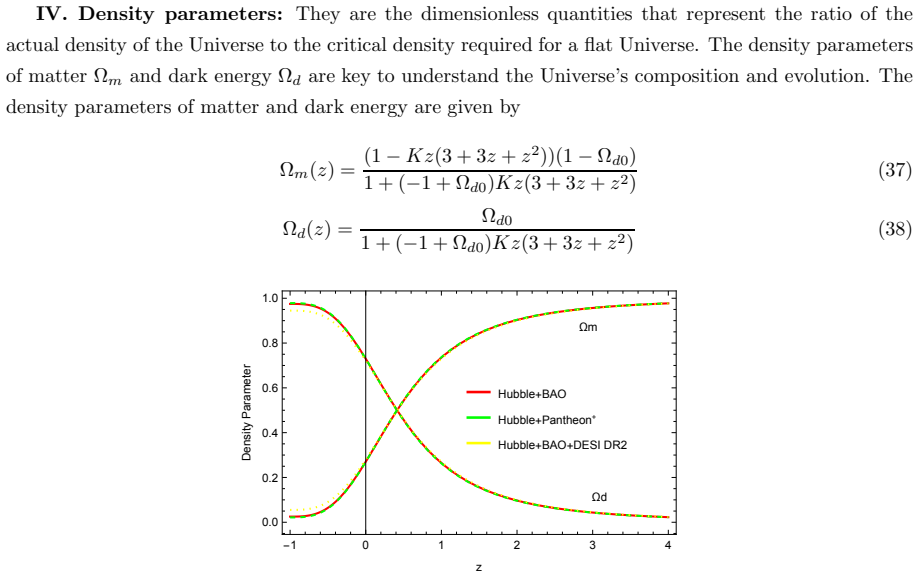
Omega_eff(z), q(z), and the density parameters are explicit functions of the same best-fit H0, Omega_d0, eta, K that were obtained by minimizing chi^2 against the Hubble/BAO/Pantheon data (Eqs. 33-38). They are therefore deterministic outputs of the fitted expansion history, not independent observables. Calling the resulting plots 'validation' presents a restatement of the fit as corroboration, with no additional data or external constraint entering Section 5.
-
fitted input called prediction
[Section 6, 'State-finder diagnostic']
"The evolution of state-finder parameters are given in Figure 8. In all the cases, they approach to the ΛCDM model at the late-time. ... It is found that the present values of r(z) are less than 1 and that of the s(z) is greater than 0, indicating our Universe is in the phase of Quintessence."
The statefinder pair {r,s} is built from H(z) and its derivatives, with H(z) given by Eq. (21) using the same parameters fitted to the same datasets. The trajectory in the r-s plane is thus a rescaled plot of the fitted Hubble function. The 'Quintessence' classification is already encoded in the fitted parameters and does not constitute an independent cosmological test.
1 more flagged steps
-
fitted input called prediction
[Section 7, 'Age of the Universe']
"The validity of the model can be tested by using the age of the Universe. ... The present age of the Universe is given in Table 2. The present values are found to be 14.16, 14.15 and 14.10 respectively ... These values are closed with current age 13.86 Gyr obtained from the ΛCDM model. This closeness ... suggests that our model is observational validated."
A(z) = ∫ dx/((1+x)H(x)) is computed from the same fitted H(z) (Eq. 21) and best-fit parameters used in the MCMC likelihood. No independent age measurement is introduced; the closeness to 13.86 Gyr is a consequence of the fitted expansion history, so invoking it as a 'test' or 'validation' reduces to a restatement of the fit.
full rationale
The paper's central parameter estimation is not circular: H0, Ωd0, η, and K are fitted directly to external Hubble, BAO, and Pantheon+ data through Eq. (21), and the reported best-fit values are empirical constraints. The main circularity is in the presentation of Sections 5–7: quantities such as ω_eff, q, the statefinder pair, and the age of the Universe are all computed from the same fitted H(z) and the same fitted parameters, yet the text repeatedly describes them as validating or testing the model. These are deterministic outputs of the fit rather than independent predictions, so the 'validation' language overstates the evidential content. There is also a self-citation in the data compilation (the BAO list is attributed to the authors' prior [33]), but the underlying measurements are external observations, so this does not constitute load-bearing circularity. The reader's flagged mathematical inconsistency—Eq. (17) does not solve Eq. (15) except under the unphysical condition ρd0 = −(1+K)ρm0—is a serious correctness problem, but it is an integration error rather than a circularity in the sense of this pass, and it is not counted toward the circularity score here.
Assumptions & free parameters
free parameters (4)
- H0 =
69.22, 69.23, 67.77
- Ωd0 =
0.73, 0.73, 0.72
- η =
-0.22, -0.34, -0.02
- K =
-0.93, -0.94, -0.85
assumptions (6)
- standard math FLRW metric and Friedmann equations (3H^2 = ρ_eff, 2Ḣ = -(ρ_eff+p_eff))
- domain assumption Dark matter is pressureless (p_m = 0)
- domain assumption Linear interaction term Q = 3ηHρ_d
- domain assumption Polytropic dark energy EoS p_d = α ρ_d^{1+1/β}
- ad hoc to paper β = 1 - η
- domain assumption Observational datasets and their covariance matrices as published
invented entities (1)
-
Dark energy-dark matter interaction Q = 3ηHρ_d
Cite this review
Pith. "Pith review of Interaction of polytropic dark energy in cosmological model: Constraints from observational data." pith.science (2026). https://pith.science/paper/RPBQZBBL
@misc{pith2026250815187,
  author       = {Pith},
  title        = {Pith review of: Interaction of polytropic dark energy in cosmological model: Constraints from observational data},
  year         = {2026},
  howpublished = {\url{https://pith.science/paper/RPBQZBBL}},
  note         = {Machine review of arXiv:2508.15187}
}
abstract
We investigate an interacting polytropic dark energy (PDE) model characterised by the equation of state $p_{d} = \alpha \rho_{d}^{\,1+\frac{1}{\beta}}$, where the interaction between dark energy and pressureless matter is modelled via a linear coupling term $Q = 3\eta H\rho_{d}$. The background dynamics are formulated by deriving the Hubble parameter in the interacting scenario, and the model parameters are constrained through a Markov Chain Monte Carlo (MCMC) analysis using three joint observational data sets: Hubble77+BAO26, Hubble77+Pantheon$^+$, and Hubble77+BAO26+DESI DR2. The resulting best-fit values of $(H_0, \Omega_{d0}, \eta) $ are $(69.22^{+1.27}_{-1.24},\,0.73^{+0.02}_{-0.02},\,-0.22^{+0.10}_{-0.12})$, $(69.23^{+1.27}_{-1.22},\,0.73^{+0.02}_{-0.02},\,-0.34^{+0.15}_{-0.17})$, and $(67.77^{+1.26}_{-1.24},\,0.73^{+0.02}_{-0.02},\,\\-0.02^{+0.10}_{-0.11})$ respectively for the respective data combinations. Our results indicate a positive energy density and negative pressure over the full redshift range, with the evolution of the equation-of-state parameter and state finder parameters placing the model firmly within the Quintessence regime. The study of the deceleration parameter also reveals a shift from a decelerating to an accelerating cosmic expansion. The estimated present age of the Universe is $14\,\mathrm{Gyr}$, consistent with recent observational data. Furthermore, the sign of $Q$ implies a current energy transfer from dark energy to matter. These findings support the interacting PDE framework as a viable candidate for explaining late-time cosmic acceleration and related large-scale dynamics.
Figures


Figures from the paper (7 more)




Reference graph
Works this paper leans on
-
[1]
Journal of Cosmology 6, 1533–1547 (2010)
Lal, A.K., Joseph, R.G. Journal of Cosmology 6, 1533–1547 (2010)
work page 2010
-
[2]
Misner, C., Thorne, K., Wheeler, J.,Gravitation, (1973)
work page 1973
- [3]
- [4]
- [5]
-
[6]
Aghanim, Planck Collaboration, et al., A&A 641, A6 (2020)
N. Aghanim, Planck Collaboration, et al., A&A 641, A6 (2020)
work page 2020
- [7]
- [8]
Show all 40 references
-
[9]
Perlmutter, M.S
S. Perlmutter, M.S. Turner, M. White, Phys. Rev. Lett. 83, 670 (1999)
1999
-
[10]
Eisenstein et al., Astrophys
D.J. Eisenstein et al., Astrophys. J. 633, 560 (2005)
2005
-
[11]
Samaddar et al., Commun
A. Samaddar et al., Commun. Theor. Phys. 77, 045403 (2025). 16
2025
-
[12]
Joyce, B
A. Joyce, B. Jain, J. Khoury, M. Trodden, Phys. Rep. 568, 1–98 (2015)
2015
-
[13]
Yousaf, K
Z. Yousaf, K. Bamba, M.Z.-U.-H. Bhatti, Phys. Rev. D 93(12), 124048 (2016)
2016
-
[14]
De Felice, S
A. De Felice, S. Tsujikawa, Phys. Rev. D 80, 063516 (2009)
2009
-
[15]
Bertolami, C.G
O. Bertolami, C.G. Boehmer, T. Harko, F.S.N. Lobo, Phys. Rev. D 75, 104016 (2007)
2007
-
[16]
Nojiri, S.D
S. Nojiri, S.D. Odintsov, Phys. Rep. 505, 59–144 (2011)
2011
-
[17]
Samaddar, S
A. Samaddar, S. Surendra Singh, Phys. Dark Univ., 47, 101792 (2025)
2025
-
[18]
Khurshudyan, Astrophys
M. Khurshudyan, Astrophys. Space Sci. 360, 33 (2015)
2015
-
[19]
Samaddar, S
A. Samaddar, S. Surendra Singh, Found Phys., 55, 41 (2025)
2025
-
[20]
Rathore, S
S. Rathore, S. Surendra Singh, Sci. Rep., 13, 3980 (2023)
2023
-
[21]
Harko, F.S.N
T. Harko, F.S.N. Lobo, S. Nojiri, S.D. Odintsov, Phys. Rev. D 84, 024020 (2011)
2011
-
[22]
Chakraborty, Gen
S. Chakraborty, Gen. Relat. Gravit. 45, 2039 (2013)
-
[23]
Samaddar, S
A. Samaddar, S. Surendra Singh, M.K. Alam, Gravit. Cosmol. 30, 462-480 (2024)
2024
-
[24]
Karami et al., Int. J. Theor. Phys., 53, 1248-1262 (2014)
2014
-
[25]
C, 48, 115110 (2024)
Safae Dahmani et al., Chinese Phys. C, 48, 115110 (2024)
2024
-
[26]
Salti et al., Annals of Phys., 407, 166-178 (2019)
M. Salti et al., Annals of Phys., 407, 166-178 (2019)
2019
-
[27]
Bolotin, Y.L., Kostenko, A., Lemets, O.A., Yerokhin, D.A., Int. J. M od. Phys. D 24(03), 1530007 (2015)
2015
-
[28]
Costa, A.A., Xu, X.D., Wang, B., Ferreira, E., Abdalla, E., Phys. Rev . D 89(10), 103531 (2014)
2014
-
[29]
Tamanini, N., Phys. Rev. D 92(4), 043524 (2015)
2015
-
[30]
Chaudhary, A
H. Chaudhary, A. Bouali, et al, Eur. Phys. J. Pluus 138, 816 (2023)
2023
-
[31]
Samaddar, S
A. Samaddar, S. Surendra Singh, General Relativity and Gravit aion, 55, 111 (2023)
2023
-
[32]
Singh, H
J.K. Singh, H. Balhara, Shaily, P. Singh, Astronomy and Computin g 46, 100795 (2024)
2024
-
[33]
Samaddar, S
A. Samaddar, S. Surendra Singh, Phys. of the Dark Universe 47, 101792 (2025)
2025
-
[34]
DESI collaboration, arXiv:2404.03000, 2024
2024 arXiv
-
[35]
Adame, et al., J
A.G. Adame, et al., J. Cosmol. Astropart. Phys. 01, 124 (2025)
2025
-
[36]
Adame, et al., J
A.G. Adame, et al., J. Cosmol. Astropart. Phys. 02, 021 (2025)
2025
- [37]
-
[38]
Roy, Gen
N. Roy, Gen. Rel. Grav. 55, 115 (2023)
2023
-
[39]
Olivares et al., Physical Review D—Particles, Fields, Gravitation , and Cosmology 71, 063523 (2005)
G. Olivares et al., Physical Review D—Particles, Fields, Gravitation , and Cosmology 71, 063523 (2005)
2005
-
[40]
Zimdahl, D
W. Zimdahl, D. Pav /acute.ts1on, Gen. Rel. Grav. 36 1483–1491 (2004). 17
2004
Reviewed August 5, 2026 · model on record in the stance chip above.
Discussion (0). Sign in to comment.