REVIEW 4 major objections 5 minor 36 references
Two gold nanowires phase-match second-harmonic generation to enable cascaded frequency doubling and an AND logic gate.
Reviewed by Pith at T0; open to challenge. T0 means a machine referee read the full paper against a public rubric. the ladder, T0–T4 →
Phase matching between two orthogonal modes in a gold two-wire plasmonic waveguide is achieved by geometric tuning, giving ~15x stronger second-harmonic generation from the antisymmetric mode and enabling cascaded SHG and an AND logic demonstration.
T0 review reviewed 2026-08-05 challenge →
load-bearing objection Phase-matched SHG in a pure-gold TWTL is credible and novel; the cascading and logic claims are not yet supported and need major revision. the 4 major comments →
Phase Matched Plasmonic Transmission Lines for Cascaded Second-Harmonic Generation as a Pathway to Nonlinear Logic Circuits
The pith
A machine-rendered reading of the paper's core claim, the machinery that carries it, and where it could break.
The reading
Core claim
The central claim is that cross-modal phase matching—between the antisymmetric fundamental mode and the symmetric second-harmonic mode—is achievable in an all-gold plasmonic two-wire transmission line by purely geometric design, and that this unlocks efficiency, length, and cascadability. Numerically, the antisymmetric fundamental index falls steeply as the inter-wire gap widens while the symmetric harmonic index stays nearly flat, so the dispersion curves cross near g ≈ 70 nm (w ≈ 130 nm, t = 60 nm). Experimentally, the phase-matched antisymmetric mode produces 15.5× more second-harmonic light than the symmetric mode, conversion efficiency reaches 0.021%, and the harmonic signal grows out t
What carries the argument
The device is a two-wire transmission line: two identical gold nanowires on a SiO2 substrate, with an input link antenna and a single-stub mode detector at the output. It supports a symmetric and an antisymmetric propagating mode selected by the polarization of the incident field. The load-bearing control is the phase-mismatch parameter Δk = (4π/λ_FM)(n_{2ω} − n_ω); adjusting the gap g—with width w as a fine control and thickness t fixed at 60 nm—makes the effective index of the antisymmetric fundamental mode equal to that of the symmetric second-harmonic mode, driving Δk to near zero. That near-zero mismatch is what allows harmonic intensity to accumulate along 18 µm, reverses the conventio
Load-bearing premise
The cascaded-stage demonstration assumes the second-harmonic light from the first waveguide, once coupled into the second waveguide, is in the right mode and has enough coherence to act as the pump for another phase-matched doubling step—but the paper does not specify the second stage's phase-matching geometry or spectrally resolve its output.
What would settle it
Measure the spectrum of the second cascade stage's output. If the second stage truly doubles the 775 nm light from the first stage, a new 387.5 nm component should appear; if only 775 nm remains, the 'cascaded SHG' is not a second nonlinear conversion. A simpler control: replace the second TWTL with a non-phase-matched waveguide of the same length and compare the output spectrum and intensity; a true phase-matched second stage should differ decisively.
If this is right
- All-metal plasmonic waveguides can phase-match frequency doubling without hybrid materials or periodic poling, closing the gap identified for pure-metal geometries.
- Because the symmetric harmonic index is nearly insensitive to gap, the same gap-dominant tuning principle can be applied to other pump wavelengths by re-optimizing width.
- Multiple TWTLs can be arranged in series with the harmonic of one stage seeding the next, enabling multi-stage frequency-conversion chains on a chip.
- A single 18 µm waveguide can encode Boolean AND in the second-harmonic output using polarization-defined inputs, a concrete step toward compact all-optical logic.
- If the phase-matched efficiency holds, the same platform is a candidate for on-chip spontaneous parametric down-conversion, which the authors explicitly propose as a future direction.
Where Pith is reading between the lines
- A decisive test of the cascaded claim is spectral: filtering the second stage's output for a 387.5 nm component would confirm real 4ω generation, rather than transmission of the first stage's 775 nm harmonic.
- The AND gate as demonstrated is set by the input polarization of a single beam; a natural extension is to use two independent beams as the two inputs, which would test whether the nonlinear interaction itself, rather than the polarization encoder, performs the logic.
- Because surface roughness and residual nanoparticles are the stated loss channels, a fabrication-improvement study that compares SH output of identical geometries with different surface quality would directly test how much headroom remains before the 18 µm length saturates.
- The phase-matching condition may be exploitable in reverse: if the antisymmetric/symmetric mode pair is phase matched for SHG, the same pair should also satisfy the momentum condition for spontaneous parametric down-conversion, making the device a candidate for entangled-photon generation.
Editorial analysis
A structured set of objections, weighed in public.
Referee Report
Summary. The paper reports phase-matched second-harmonic generation (SHG) in an all-gold two-wire transmission line (TWTL). By tuning the inter-wire gap and width, the effective index of the antisymmetric fundamental mode at 1550 nm is made equal to that of the symmetric SH mode at 775 nm, yielding a predicted index crossing at g = 70 nm. Experiments show that antisymmetric excitation then produces ~15.5 times more SH signal than symmetric excitation, the SH power scales quadratically with input power, the SH output peaks at the predicted gap, and the SH signal grows with waveguide length up to 18 μm. The paper further claims cascaded SHG in two serially coupled TWTLs and a polarization-controlled AND logic operation in a single 18 μm waveguide.
Significance. If the phase-matching result is fully substantiated, this would be an important advance for all-metal plasmonic nonlinear waveguides, which previously lacked guided, phase-matched SHG without hybrid materials. The design principle—gap tuning of the antisymmetric fundamental to match a symmetric SH mode—is concrete and produces a falsifiable prediction (SHG maximum at g=70 nm) that the experiment confirms. The quadratic power dependence and the reversal of the mode-contrast ratio are also strong supporting evidence. The main weakness is the cascaded-SHG claim: it is not supported by the reported measurements and, as argued below, is likely not even internally consistent with the demonstrated phase-matching condition.
major comments (4)
- [Cascaded SHG and polarization-controlled logic operations, Fig. 5] The cascaded-SHG claim is unsubstantiated. The second stage is described as accepting the stage-1 SH (775 nm, symmetric mode) and undergoing 'an additional SHG process' to produce I2. However, no spectrum or spectral filter is reported for the second stage, so the EMCCD image cannot distinguish 387.5 nm fourth-harmonic light from 775 nm light that simply leaks through the second waveguide. The normalized intensity comparison in Fig. 5C is insensitive to this distinction. Moreover, the phase-matching design (Fig. 2, Table S1) matches the antisymmetric FM at 1550 nm to the symmetric SH at 775 nm; the symmetric 775 nm SH is not the phase-matched pump for the same waveguide geometry at 775 nm. A phase-matching analysis for 775 nm → 387.5 nm in the second TWTL is absent. Thus the title-level claim of 'Cascaded Second-Harmonic Generation' is not supported.
- [Cascaded SHG section, sentence on mode continuity] The authors state 'Because SHG occurs in the symmetric mode, the devices are aligned to maintain mode continuity between stages.' This is internally inconsistent: the phase-matched pump in the first stage is the antisymmetric FM; the generated SH is symmetric. Directly coupling the symmetric SH into a second identical TWTL excites a symmetric pump mode, for which no phase-matching condition has been engineered. The paper should either provide a stage-2 design for phase-matched SHG from the symmetric 775 nm mode, or explicitly weaken the cascading claim.
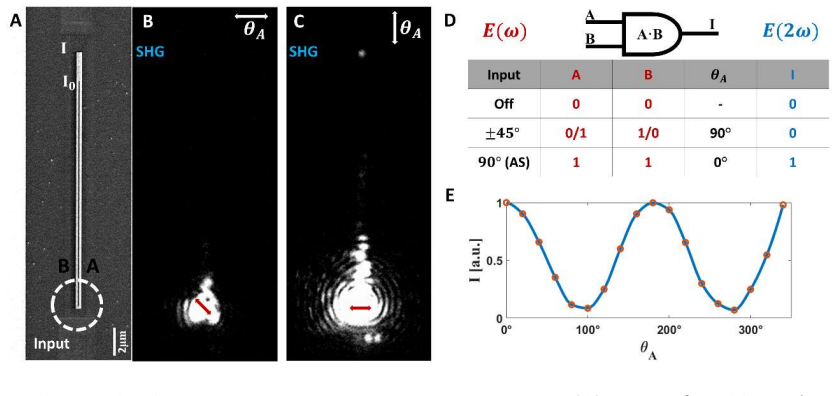
- [Nonlinear plasmonic logic gates, Fig. 6] The AND logic demonstration does not constitute a two-input logic gate in the usual sense. The two inputs A and B are not independent; both are controlled by the polarization of a single excitation beam. The truth table only exercises (1,0)/(0,1) and (1,1) (with (0,0) implied). A genuine AND operation would require independent control of the two nanowire inputs. The claim should be reworded (e.g., 'polarization-controlled AND-like response') or supplemented by independent input modulation.
- [Equation (3), conversion efficiency] Equation (3) is ambiguous and likely in error. As typeset, the equation reads η = N_SH η_out/(N_FM η_in), which is not the standard conversion efficiency; if the intended expression is η = (N_SH/η_out)/(N_FM/η_in), it should be corrected. In either case the factor of 2 from the photon-energy difference between SH and FM is absent. Since the 0.021% efficiency is a headline quantitative result, this calculation must be clarified.
minor comments (5)
- [Experimental validation, efficiency paragraph] The input and output powers are quoted as W/cm² (e.g., '6.73×10⁻¹⁰ W/cm²'), which is an intensity, not a power. Please specify the beam area or correct the units to watts.
- [Throughout, analyzer angle notation] The symbol '𝜃' appears corrupted in the manuscript; please use a standard notation such as θ_analyzer or θ_A throughout.
- [Fig. 1B and Geometric control section] The sentence 'For the antisymmetric mode, a phase difference Δφ=π between the FM and SH waves is observed at a given cross-section, suppressing modal phase overlap' is confusing. Δφ=π describes the field profile of the antisymmetric mode, not the phase mismatch Δk. Please clarify the distinction.
- [Fig. 3C] No error bars or statistical variation are shown for the experimental SH photon counts across gap sizes; the reader cannot assess device-to-device reproducibility from the main text.
- [Fig. 6 and logic truth table] The role of output port I0 is never used in the truth table. Please clarify how I0 and I are defined and why I is used as the Boolean output while I0 is not.
Circularity Check
No significant circularity: the single-waveguide phase-matching result is a genuine simulation-to-experiment prediction; only minor non-load-bearing self-citations are present. The cascaded-SHG claim is under-supported but not circular.
full rationale
The paper's central phase-matching derivation is self-contained. The geometry (gap, width, thickness) is optimized in FDTD/FDE to minimize Δk using Eq. (1); the predicted phase-matched gap (g = 70 nm) is then tested experimentally across devices with varying gaps (Fig. 3C), and the SH signal shows the predicted maximum and a quadratic power dependence (Fig. 3D). No measured quantity is used to set the simulation parameter that is subsequently 'predicted.' The 15.5-fold antisymmetric-over-symmetric contrast is a direct measurement, not a fitted output. The prior TWTL work (ref 21) is cited as a non-phase-matched baseline and for mode definitions; this is a self-citation but it is not load-bearing, since the current experiment independently measures the antisymmetric/symmetric contrast and the phase-matching maximum. Ref 34 is used only for a future-outlook statement. There is therefore no self-definitional, fitted-input-called-prediction, or uniqueness-imported circularity. The one serious weakness is the cascaded-SHG claim (Fig. 5): stage-2 output I2 is not spectrally resolved, no phase-matching/effective-index analysis is given for a 775 nm pump, and no power dependence of I2 is reported, so I2 could in principle be unconverted 775 nm light leaking through the second waveguide; comparing normalized I1 and I2 cannot by itself prove an additional SHG process. That is a missing-control/support problem in the experimental claim, not a circular derivation, and it does not affect the single-waveguide phase-matching result. Score 2 reflects only the minor, non-load-bearing self-citations.
Axiom & Free-Parameter Ledger
free parameters (2)
- TWTL design geometry (gap g, width w, thickness t) =
g=70 nm, w=130 nm, t=60 nm
- Simulated incoupling/outcoupling efficiencies =
η_in=6.024%, η_out=51.6%
axioms (5)
- domain assumption Maxwell's equations with Johnson-Christy gold permittivity accurately describe mode indices and losses in FDTD/FDE simulations.
- domain assumption Gold surface second-order nonlinearity (surface χ^(2)) is the SHG source, with P^(2) ∝ E_in^2.
- domain assumption The detected SH signal is dominated by the guided symmetric mode, not the gap region or residual nanoparticle scattering.
- domain assumption Changing gap and width tunes the antisymmetric FM index while leaving the symmetric SH index nearly constant, allowing a zero crossing.
- ad hoc to paper The first-stage symmetric SH output is sufficiently coherent and mode-matched to act as a pump for a second phase-matched nonlinear stage in the second TWTL.
Cite this review
Pith. "Pith review of Phase Matched Plasmonic Transmission Lines for Cascaded Second-Harmonic Generation as a Pathway to Nonlinear Logic Circuits." pith.science (2026). https://pith.science/paper/DS2WXXI4
@misc{pith2026250815188,
  author       = {Pith},
  title        = {Pith review of: Phase Matched Plasmonic Transmission Lines for Cascaded Second-Harmonic Generation as a Pathway to Nonlinear Logic Circuits},
  year         = {2026},
  howpublished = {\url{https://pith.science/paper/DS2WXXI4}},
  note         = {Machine review of arXiv:2508.15188}
}
abstract
In nonlinear nanophotonics, cascaded second-harmonic generation (SHG) in pure plasmonic waveguides for sequential signal transformation and complex on-chip functionality remains a long-standing challenge. Precise phase matching becomes instrumental to achieve efficient SHG and enable true cascading of nonlinear processes. We experimentally demonstrate phase matching in SHG is achievable in a plasmonic system between two orthogonal modes. Accurate tuning of plasmonic two-wire transmission-line (TWTL) design parameters result in SHG from the antisymmetric excitation mode being approximately 15 times stronger than that from the symmetric excitation mode, greatly raising the conversion efficiency to 0.021%. Simultaneously, phase matching extends our TWTL operational length up to 18${\mu}$m. Based on the improved efficiency and operational length, we demonstrate the feasibility of cascading multiple plasmonic waveguides. We further realize a nonlinear AND logic operation using a single 18${\mu}$m long waveguide. These results underscore the potential of phase matched plasmonic TWTLs for compact, efficient, and scalable nonlinear optical circuitry.
Figures


Reference graph
Works this paper leans on
-
[1]
T. W. Wu, Y. K. Li, L. Ge, L. Feng, Field-programmable photonic nonlinearity. Nat Photonics 19, (2025)
work page 2025
- [2]
-
[3]
C. Li, X. Zhang, J. W. Li, T. Fang, X. W. Dong, The challenges of modern computing and new opportunities for optics. Photonix 2, (2021)
work page 2021
-
[4]
M. Matuszewski, A. Prystupiuk, A. Opala, Role of all-optical neural networks. Phys Rev Appl 21, (2024)
work page 2024
-
[5]
P. Ginzburg, A. V. Krasavin, A. V. Zayats, Cascaded second-order surface plasmon solitons due to intrinsic metal nonlinearity. New J Phys 15, (2013). 8 | P a g e
work page 2013
-
[6]
A. Dutt, A. Mohanty, A. L. Gaeta, M. Lipson, Nonlinear and quantum photonics using integrated optical materials (Vol 9, pg 321, 2024). Nature Reviews Materials 9, 600-600 (2024)
work page 2024
-
[7]
H. Ito, N. Uesugi, H. Inaba, Phase-Matched Guided Optical Second-Harmonic Wave Generation in Oriented Zns Polycrystalline Thin-Film Waveguides. Appl Phys Lett 25, 385- 387 (1974)
work page 1974
-
[8]
Y. Qi, Y. Li, Integrated lithium niobate photonics. Nanophotonics-Berlin 9, 1287-1320 (2020)
work page 2020
-
[9]
H. P. Wagner, S. Wittmann, H. Schmitzer, H. Stanzl, Phase-Matched 2nd-Harmonic Generation Using Thin-Film Znte Optical Wave-Guides. J Appl Phys 77, 3637-3640 (1995)
work page 1995
-
[10]
K. Moutzouris, S. V. Rao, M. Ebrahimzadeh, A. De Rossi, M. Calligaro, V. Ortiz, V. Berger, Second-harmonic generation through optimized modal phase matching in semiconductor waveguides. Appl Phys Lett 83, 620-622 (2003)
work page 2003
-
[11]
A. S. Helmy, P. Abolghasem, J. Stewart Aitchison, B. J. Bijlani, J. Han, B. M. Holmes, D. C. Hutchings, U. Younis, S. J. Wagner, Recent advances in phase matching of second-order nonlinearities in monolithic semiconductor waveguides. Laser Photonics Rev 5, 272-286 (2011)
work page 2011
-
[12]
G. Li, S. Zhang, T. Zentgraf, Nonlinear photonic metasurfaces. Nature Reviews Materials 2, 17010 (2017)
work page 2017
-
[13]
J. Richter, A. Steinbrück, T. Pertsch, A. Tünnermann, R. Grange, Plasmonic Core-Shell Nanowires for Enhanced Second-Harmonic Generation. Plasmonics 8, 115-120 (2013)
work page 2013
-
[14]
M. Celebrano, X. F. Wu, M. Baselli, S. Grossmann, P. Biagioni, A. Locatelli, C. De Angelis, G. Cerullo, R. Osellame, B. Hecht, L. Duò, F. Ciccacci, M. Finazzi, Mode matching in multiresonant plasmonic nanoantennas for enhanced second harmonic generation. Nat Nanotechnol 10, 412-417 (2015)
work page 2015
-
[15]
S. Chervinskii, K. Koskinen, S. Scherbak, M. Kauranen, A. Lipovskii, Nonresonant Local Fields Enhance Second-Harmonic Generation from Metal Nanoislands with Dielectric Cover. Phys Rev Lett 120, (2018)
work page 2018
-
[16]
S. Elkabetz, K. N. Reddy, P. Y. Chen, A. I. Fernandez-Dominguez, Y. Sivan, Optimization of second-harmonic generation from touching plasmonic wires. Phys Rev B 103, (2021)
work page 2021
-
[17]
G. C. Li, D. Y. Lei, M. Qiu, W. Jin, S. Lan, A. V. Zayats, Light-induced symmetry breaking for enhancing second-harmonic generation from an ultrathin plasmonic nanocavity. Nat Commun 12, (2021)
work page 2021
-
[18]
M. Sukharev, O. Roslyak, A. Piryatinski, Second-harmonic generation in nonlinear plasmonic lattices enhanced by quantum emitter gain medium. J Chem Phys 154, (2021)
work page 2021
-
[19]
N. A. Jafari, A. Bahari, Enhancement of second harmonic generation from three layers hybrid dielectric/metal/dielectric nanospheres. Phys Scripta 98, (2023)
work page 2023
-
[20]
A. de Hoogh, A. Opheij, M. Wulf, N. Rotenberg, L. Kuipers, Harmonics Generation by Surface Plasmon Polaritons on Single Nanowires. Acs Photonics 3, 1446-1452 (2016)
work page 2016
-
[21]
T. Y. Chen, J. Obermeier, T. Schumacher, F. C. Lin, J. S. Huang, M. Lippitz, C. B. Huang, Modal Symmetry Controlled Second-Harmonic Generation by Propagating Plasmons. Nano Lett 19, 6424-6428 (2019)
work page 2019
-
[22]
Y. Li, M. Kang, J. J. Shi, K. Wu, S. P. Zhang, H. Xu, Transversely Divergent Second Harmonic Generation by Surface Plasmon Polaritons on Single Metallic Nanowires. Nano Lett 17, 7803-7808 (2017)
work page 2017
-
[23]
J. J. Shi, Y. Li, M. Kang, X. B. He, N. J. Halas, P. Nordlander, S. P. Zhang, H. X. Xu, Efficient Second Harmonic Generation in a Hybrid Plasmonic Waveguide by Mode Interactions. Nano Lett 19, 3838-3845 (2019)
work page 2019
-
[24]
Z. Li, B. Corbett, A. Gocalinska, E. Pelucchi, W. Chen, K. M. Ryan, P. Khan, C. Silien, H. X. Xu, N. Liu, Direct visualization of phase-matched efficient second harmonic and 9 | P a g e broadband sum frequency generation in hybrid plasmonic nanostructures. Light-Sci Appl 9, (2020)
work page 2020
-
[25]
J. J. Shi, X. B. He, W. Chen, Y. Li, M. Kang, Y. J. Cai, H. X. Xu, Remote Dual-Cavity Enhanced Second Harmonic Generation in a Hybrid Plasmonic Waveguide. Nano Lett 22, 688-694 (2022)
work page 2022
-
[26]
Z. Wang, Z. Wang, V. Kalathingal, Y. W. Ho, T. X. Hoang, H. S. Chu, Y. X. Guo, J. C. Viana-Gomes, G. Eda, C. A. Nijhuis, Phase Matching via Plasmonic Modal Dispersion for Third Harmonic Generation. Adv Sci 9, (2022)
work page 2022
- [27]
-
[28]
J. Y. Wang, L. Zhang, M. Qiu, Nonlinear plasmonics: second-harmonic generation and multiphoton photoluminescence. Photonix 4, (2023)
work page 2023
- [29]
-
[30]
H. Wei, Z. X. Wang, X. R. Tian, M. Käll, H. X. Xu, Cascaded logic gates in nanophotonic plasmon networks. Nat Commun 2, (2011)
work page 2011
-
[31]
C. C. Zhang, J. Y. Zhang, J. R. Feng, S. T. Liu, S. J. Ding, L. Ma, Q. Q. Wang, Plasmon- enhanced second harmonic generation of metal nanostructures. Nanoscale 16, 5960-5975 (2024)
work page 2024
-
[32]
Couteau, Spontaneous parametric down-conversion
C. Couteau, Spontaneous parametric down-conversion. Contemp Phys 59, 291-304 (2018)
work page 2018
-
[33]
R. Loudon, The quantum theory of light (Oxford science publications, Oxford University Press, Oxford ; New York, ed. 3rd, 2000), pp. ix, 438 p
work page 2000
-
[34]
P. Y. Wu, W. Q. Lee, C. H. Liu, C. B. Huang, Coherent control of enhanced second- harmonic generation in a plasmonic nanocircuit using a transition metal dichalcogenide monolayer. Nat Commun 15, (2024)
work page 2024
-
[35]
P. B. Johnson, R. W. Christy, Optical Constants of Noble Metals. Phys Rev B 6, 4370-4379 (1972)
work page 1972
-
[36]
X. Qin, W. Y. Sun, Z. H. Zhou, P. Y. Fu, H. Li, Y. Li, Waveguide effective plasmonics with structure dispersion. Nanophotonics-Berlin 11, 1659-1676 (2022). Acknowledgments Funding: This work was supported by the National Science and Technology Council, Taiwan under Grant 113-2221-E-007-066-MY2 (C.-B. H.) J.-S. H. acknowledges the support from DFG via proj...
work page 2022
This paper was first reviewed by deepseek-v4-flash on August 5, 2026.
discussion (0)
Sign in with ORCID, Apple, or X to comment. Anyone can read and Pith papers without signing in.