Darboux's Theorem in p-adic symplectic geometry
Pith reviewed 2026-05-18 22:08 UTC · model grok-4.3
The pith
Any two symplectic forms on a p-adic analytic manifold are locally isomorphic.
A machine-rendered reading of the paper's core claim, the machinery that carries it, and where it could break.
Core claim
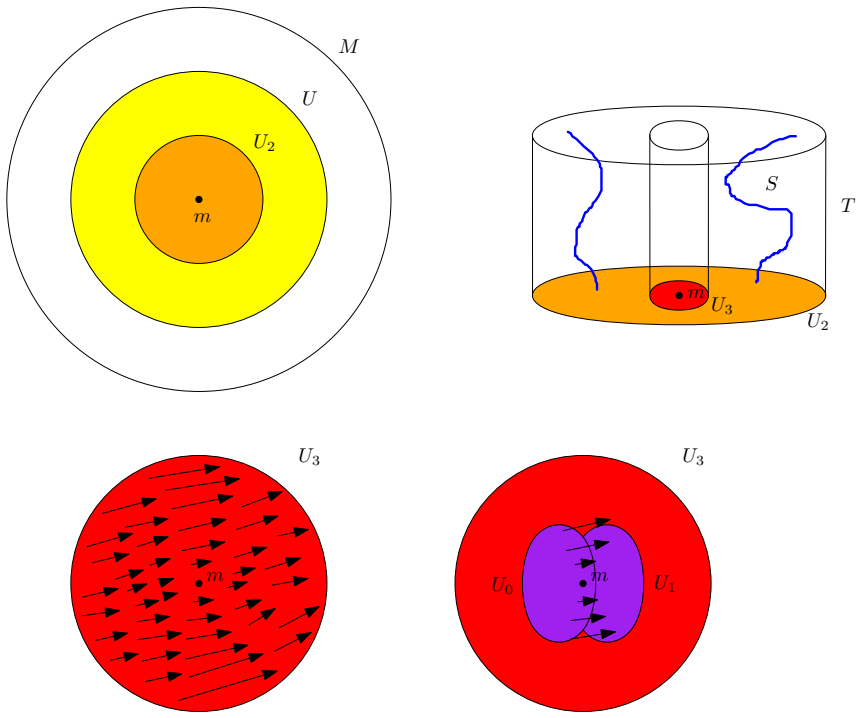
We prove that any two symplectic forms on a p-adic analytic manifold are locally isomorphic. The proof uses a non-Archimedean version of Moser's path method to push one form onto the other by a flow. The central technical step shows that this flow is given by a power series with non-zero radius of convergence, using geometric analytic estimates rather than algebraic arguments alone. As a global consequence, second-countable p-adic analytic symplectic manifolds are classified up to isomorphism by their p-adic volume.
What carries the argument
Non-Archimedean Moser's path method that produces a vector field whose flow is a power series with positive radius of convergence.
If this is right
- The phase space defined by a p-adic manifold is locally standard.
- Attention can be concentrated on the equations defining the dynamics rather than on the space itself.
- Local problems such as the existence of flows or the normalization of singularities in integrable systems can be studied in standard coordinates.
- Second-countable p-adic analytic symplectic manifolds are classified in terms of p-adic volume.
Where Pith is reading between the lines
- Other local normal-form results from symplectic geometry may extend to the p-adic setting if analogous convergence estimates can be established.
- The theorem suggests that p-adic versions of Hamiltonian mechanics could use the same local coordinates as in the real case for small-scale analysis.
- Explicit low-dimensional examples, such as p-adic tori with standard symplectic forms, could be used to compute and verify the actual radius of convergence.
Load-bearing premise
The vector field from the non-Archimedean Moser's method generates a flow that is a power series with positive radius of convergence, relying on geometric analytic estimates.
What would settle it
A concrete p-adic analytic manifold together with two symplectic forms for which no local diffeomorphism equating the forms has coordinate functions given by a power series with positive radius of convergence.
Figures




read the original abstract
We prove a non Archimedean Darboux's Theorem: any two symplectic forms on a $p$-adic analytic manifold are locally isomorphic. Understanding local problems such as the existence of flows or the normalization of singularities in the theory of integrable systems, is essential to understand the physics behind these systems. Our result tells us that the phase space defined by a $p$-adic manifold is locally standard, allowing us to concentrate on the equations defining the dynamics rather than on the space itself. Our proof uses a non Archimedean version of Moser's Path Method to push one symplectic form onto another one by a flow. A central technical contribution of the paper is the proof that the flow is given by a power series with \emph{non zero radius of convergence}, which requires geometric analytic estimates and does not follow from algebraic considerations. As a global application, we derive a classification of second-countable $p$-adic analytic symplectic manifolds in terms of $p$-adic volume, which generalizes a classical theorem of J-P. Serre.
Editorial analysis
A structured set of objections, weighed in public.
Referee Report
Summary. The paper proves a non-Archimedean Darboux theorem asserting that any two symplectic forms on a p-adic analytic manifold are locally isomorphic. The proof adapts Moser's path method to construct a time-dependent vector field whose flow realizes the isomorphism between the forms. A central technical contribution is the demonstration, via geometric analytic estimates rather than purely algebraic arguments, that this flow is given by a power series possessing non-zero radius of convergence. The local result is applied to obtain a classification of second-countable p-adic analytic symplectic manifolds in terms of p-adic volume, generalizing a theorem of Serre.
Significance. If the radius-of-convergence estimates hold, the result supplies a local normal-form theorem in p-adic symplectic geometry that reduces local questions about integrable systems and dynamics to the standard model. The explicit flow construction and the global classification by volume furnish both constructive and topological content that parallels classical statements in real or complex symplectic geometry.
major comments (1)
- The geometric analytic estimates establishing that the time-1 map of the Moser flow is a power series with positive radius of convergence are load-bearing for the local-isomorphism claim. The manuscript must show explicitly that these estimates control the p-adic valuation growth of all higher-order coefficients (i.e., that lim sup |a_k|^{1/k} remains finite in the non-Archimedean norm) arising from the Lie derivatives along the time-dependent vector field; without such control the radius may vanish for some symplectic forms, as noted in the stress-test concern.
minor comments (1)
- The statement of the main theorem should specify the dimension of the manifold and the precise p-adic field (or ring of integers) under consideration.
Simulated Author's Rebuttal
We thank the referee for the careful reading of our manuscript and for emphasizing the centrality of the radius-of-convergence estimates. We address the major comment below and have revised the manuscript to make the control on coefficient growth fully explicit.
read point-by-point responses
-
Referee: The geometric analytic estimates establishing that the time-1 map of the Moser flow is a power series with positive radius of convergence are load-bearing for the local-isomorphism claim. The manuscript must show explicitly that these estimates control the p-adic valuation growth of all higher-order coefficients (i.e., that lim sup |a_k|^{1/k} remains finite in the non-Archimedean norm) arising from the Lie derivatives along the time-dependent vector field; without such control the radius may vanish for some symplectic forms, as noted in the stress-test concern.
Authors: We agree that explicit verification of the growth control is necessary for clarity. The geometric analytic estimates in Section 3 bound the p-adic norms of all iterated Lie derivatives of the symplectic forms along the Moser vector field. These bounds are uniform for analytic forms and directly imply that the coefficients a_k of the time-1 flow satisfy v_p(a_k) >= c k - d for constants c, d > 0, which forces lim sup |a_k|^{1/k} to be finite (in fact bounded by an explicit constant depending only on the radius of the initial forms). We will add a short new lemma (Lemma 3.7) that extracts this lim-sup bound from the existing estimates and confirms the radius remains positive. The stress-test concern does not arise under our hypotheses because the estimates hold uniformly on compact p-adic analytic charts; we have revised the manuscript to include this explicit step. revision: yes
Circularity Check
No circularity: explicit Moser flow construction with independent analytic estimates
full rationale
The derivation proceeds by constructing a time-dependent vector field via the non-Archimedean Moser equation and then proving that its flow is a convergent power series on a p-adic ball. This convergence is established by geometric analytic estimates on the Lie derivatives and higher-order terms, which the paper explicitly states do not follow from algebraic considerations alone. No quantity is defined in terms of the target result, no parameter is fitted to the output, and no load-bearing step reduces to a self-citation or prior ansatz by the same authors. The central claim is therefore an independent existence proof rather than a tautology or renaming.
Axiom & Free-Parameter Ledger
axioms (2)
- domain assumption p-adic analytic manifolds admit a well-defined notion of symplectic form and local coordinates in which the standard form can be written
- domain assumption The non-Archimedean version of Moser's path method is well-defined on p-adic manifolds
Lean theorems connected to this paper
-
IndisputableMonolith/Foundation/RealityFromDistinction.leanreality_from_one_distinction unclear?
unclearRelation between the paper passage and the cited Recognition theorem.
central technical contribution ... proof that the flow is given by a power series with non zero radius of convergence, which requires geometric analytic estimates
-
IndisputableMonolith/Cost/FunctionalEquation.leanwashburn_uniqueness_aczel unclear?
unclearRelation between the paper passage and the cited Recognition theorem.
Theorem A (p-adic analytic Moser’s Path Method) ... d/dt ωt + L_Xt ωt = 0 ... power series converging in M
What do these tags mean?
- matches
- The paper's claim is directly supported by a theorem in the formal canon.
- supports
- The theorem supports part of the paper's argument, but the paper may add assumptions or extra steps.
- extends
- The paper goes beyond the formal theorem; the theorem is a base layer rather than the whole result.
- uses
- The paper appears to rely on the theorem as machinery.
- contradicts
- The paper's claim conflicts with a theorem or certificate in the canon.
- unclear
- Pith found a possible connection, but the passage is too broad, indirect, or ambiguous to say the theorem truly supports the claim.
Reference graph
Works this paper leans on
-
[1]
S. Awodey, ´A. Pelayo, M. A. Warren: Voevodsky’s univalence axiom in homotopy type theory. Notices Amer. Math. Soc.60(9) (2013), 1164–1167
work page 2013
- [2]
- [3]
-
[4]
R. Bott, L. W. Tu:Differential Forms in Algebraic Topology, Springer-Verlag 1982
work page 1982
-
[5]
M. Calabrese, S. Paleari, T. Penati: Darboux’s Theorem, Lie series and the standardization of the Salerno and Ablowitz–Ladik models.Physica D: Nonlinear Phenomena463(2024), 134–163
work page 2024
-
[6]
A. Cannas da Silva:Lectures on Symplectic Geometry.Lecture Notes in Math., 1764, Springer- Verlag, Berlin, 2001
work page 2001
-
[7]
L. Chen, X. Liu, L.-Y. Hung: Bending the Bruhat-Tits tree. Part II. Thep-adic BTZ black hole and local diffeomorphism on the Bruhat-Tits tree.Journal of High Energy Physics(2021), article number 97
work page 2021
-
[8]
L. Crespo, ´A. Pelayo: Thep-adic Jaynes-Cummings model in symplectic geometry.J. Nonlinear Sci.35(2025), article number 66
work page 2025
-
[9]
L. Crespo, ´A. Pelayo:p-adic symplectic geometry of integrable systems and Weierstrass-Williamson theory, preprint, arXiv:2501.14444
-
[10]
L. Crespo, ´A. Pelayo: Rigidity and flexibility inp-adic symplectic geometry, preprint, arXiv:2505.07663
- [11]
-
[12]
G. Darboux: Sur le probl` eme de Pfaff.Bulletin des sciences math´ ematiques et astronomiques 2e s´ erie6(1) (1882), 14–36
-
[13]
M. A. de Gosson: Gaussian quantum states can be disentangled using symplectic rotations.Lect. Math. Phys.111(2021), article 73
work page 2021
-
[14]
B. Dragovich, A. Yu. Khrennikov, S. V. Kozyrev, I. V. Volovich: On p-adic mathematical physics. P-Adic Numbers, Ultrametric Analysis, and Applications1(2009), 1–17
work page 2009
-
[15]
B. Dragovich, A. Yu. Khrennikov, S. V. Kozyrev, I. V. Volovich, E. I. Zelenov:p-adic mathematical physics: the first 30 years.P-Adic Numbers, Ultrametric Analysis, and Applications9(2017), 87– 121
work page 2017
-
[16]
Eliashberg: Recent advances in symplectic flexibility.Bull
Y. Eliashberg: Recent advances in symplectic flexibility.Bull. Amer. Math. Soc.52(1) (2015), 1–26
work page 2015
-
[17]
P. G. O. Freund, M. Olson, Non-archimedean strings.Phys. Lett. B199(2) (1987), 186–190
work page 1987
-
[18]
P. G. O. Freund, E. Witten: Adelic string amplitudes.Phys. Lett. B199(2) (1987), 191–194
work page 1987
-
[19]
A. R. Fuquen-Tibat´ a, H. Garc´ ıa-Compe´ an, W. A. Z´ u˜ niga-Galindo: Euclidean quantum field formu- lation ofp-adic open string amplitudes.Nucl. Phys. B975(2022), 115684
work page 2022
-
[20]
H. Garc´ ıa-Compe´ an, E. Y. L´ opez, Towards non-archimedean superstrings.Nucl. Phys. B984(2022), 115941
work page 2022
-
[21]
P. M. Gartside, A. M. Mohamad: Diversity ofp-adic analytic manifolds.Top. Appl.125(2) (2002), 323–333
work page 2002
-
[22]
Gromov: Pseudo holomorphic curves in symplectic manifolds.Invent
M. Gromov: Pseudo holomorphic curves in symplectic manifolds.Invent. Math.82(2) (1985), 307– 347
work page 1985
- [23]
-
[24]
Z. Hu, S. Hu: Symplectic group and Heisenberg group inp-adic quantum mechanics. Preprint, arXiv:1502.01789
work page internal anchor Pith review Pith/arXiv arXiv
-
[25]
Lee:Introduction to Smooth Manifolds, Graduate Texts in Mathematics, 218, Springer 2012
J. Lee:Introduction to Smooth Manifolds, Graduate Texts in Mathematics, 218, Springer 2012
work page 2012
-
[26]
Lurie: What is...p-adic geometry? Members Colloquium at IAS Princeton, October 9, 2023
J. Lurie: What is...p-adic geometry? Members Colloquium at IAS Princeton, October 9, 2023. Link: https://www.ias.edu/video/what-p-adic-geometry
work page 2023
-
[27]
J. E. Marsden, T. S. Ratiu:Introduction to Mechanics and Symmetry.Texts in Applied Mathemat- ics, 17, Springer 1999
work page 1999
- [28]
-
[29]
Moser: On the volume elements on a manifold.Trans
J. Moser: On the volume elements on a manifold.Trans. Amer. Math. Soc.120(2) (1965), 286–294
work page 1965
- [30]
-
[31]
Pelayo: Hamiltonian and symplectic symmetries: an introduction.Bull
´A. Pelayo: Hamiltonian and symplectic symmetries: an introduction.Bull. Amer. Math. Soc.54(3) (2017), 383–436
work page 2017
-
[32]
´A. Pelayo: Symplectic and inverse spectral geometry of integrable systems: a glimpse and open problems.Top. Appl.339Part A (2023) 108577
work page 2023
- [33]
- [34]
-
[35]
Modern aspects of the cohomological study of varieties
M. Popa: Lecture notes for the course “Modern aspects of the cohomological study of varieties”, Harvard University 2011, https://people.math.harvard.edu/ mpopa/571/index.html
work page 2011
- [36]
-
[37]
Schlenk: Symplectic embedding problems: old and new.Bull
F. Schlenk: Symplectic embedding problems: old and new.Bull. Amer. Math. Soc.55(2) (2018), 139–182
work page 2018
-
[38]
Schneider:p-adic Lie Groups, Springer-Verlag 2011
P. Schneider:p-adic Lie Groups, Springer-Verlag 2011
work page 2011
-
[39]
P. Scholze, J. Weinstein: Berkeley lectures inp-adic geometry. Annals of Mathematics Studies, book 389
-
[40]
J. P. Serre: Classification des vari´ et´ es analytiquesp-adiques compactes.Topology3(1965) 409–412
work page 1965
- [41]
-
[42]
V. S. Vladimirov, I. V. Volovich:p-Adic quantum mechanics.Commun. Math. Phys.123(1989), 659–676
work page 1989
-
[43]
I. V. Volovich:p-Adic strings.Class. Quant. Grav.4(1987), L83–L87
work page 1987
-
[44]
X.-B. Wang, T. Hiroshima, A. Tomita, M. Hayashi: Quantum information with Gaussian states. Phys. Rep.448(1) (2007), 1–111
work page 2007
-
[45]
Weinstein: Symplectic manifolds and their Lagrangian submanifolds.Adv
A. Weinstein: Symplectic manifolds and their Lagrangian submanifolds.Adv. Math.6(3) (1971), 329–346
work page 1971
-
[46]
Weinstein: Symplectic geometry.Bull
A. Weinstein: Symplectic geometry.Bull. Amer. Math. Soc.5(1) (1981), 1–13
work page 1981
-
[47]
Weil:Adeles and Algebraic Groups.IAS Princeton, 1961
A. Weil:Adeles and Algebraic Groups.IAS Princeton, 1961
work page 1961
-
[48]
Zelenov: p-adic Heisenberg group and Maslov index,Comm
E.I. Zelenov: p-adic Heisenberg group and Maslov index,Comm. Math. Phys.155(1993) 489–502. Luis Crespo, Departamento de Matem´aticas, Estad´ıstica y Computaci´on, Universidad de Cantabria, Av. de Los Castros 48, 39005 Santander, Spain Email address:luis.cresporuiz@unican.es ´Alvaro Pelayo, Facultad de Ciencias Matem´aticas, Universidad Complutense de Madr...
work page 1993
discussion (0)
Sign in with ORCID, Apple, or X to comment. Anyone can read and Pith papers without signing in.