REVIEW 4 major objections 5 minor 7 references
Continual Neural Topic Model
T0 review · 4 major / 5 minor · reviewed 2026-08-05 · deepseek-v4-flash
Pith's one-line read CoNTM learns streaming topics without forgetting earlier ones, by carrying a global topic prior updated as a running average of per-time-slice local topics.
desk verdict A plausible online DVAE whose 'without forgetting' claim is neither tested nor supported by its running-average update. read the letter →
The pith
A machine-rendered reading of the paper's core claim, the machinery that carries it, and where it could break.
The reading
What carries the argument
The global topic prior phi_global, updated as phi_global <- (1 - rho_t) phi_global + rho_t phi_local, with rho_t = 1 / (tau0 + t)^kappa. This running average is the only memory of past slices, and the constraint sum_t Delta_phi_local_t = 0 makes the full average of local topics equal the global topics, so the running average approximates a full average in the streaming setting.
What would settle it
Construct a stream with two well-separated topic regimes, train CoNTM on many slices of regime B after seeing only a few slices of regime A, then measure whether topics from regime A still appear in the global topic set by coherence on held-out regime-A documents or by overlap with ground-truth topic-word distributions. If the regime-A topics disappear, the running-average update fails to prevent forgetting.
Extended reading notes
Core claim
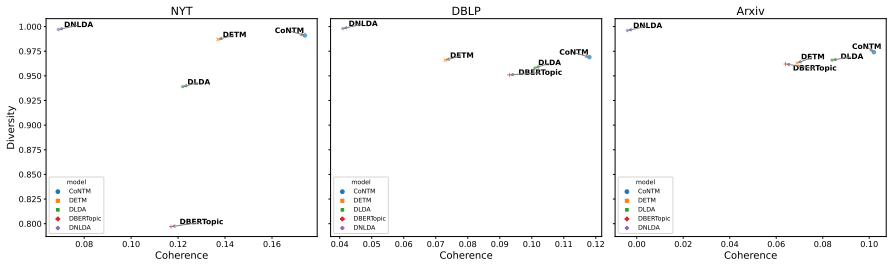
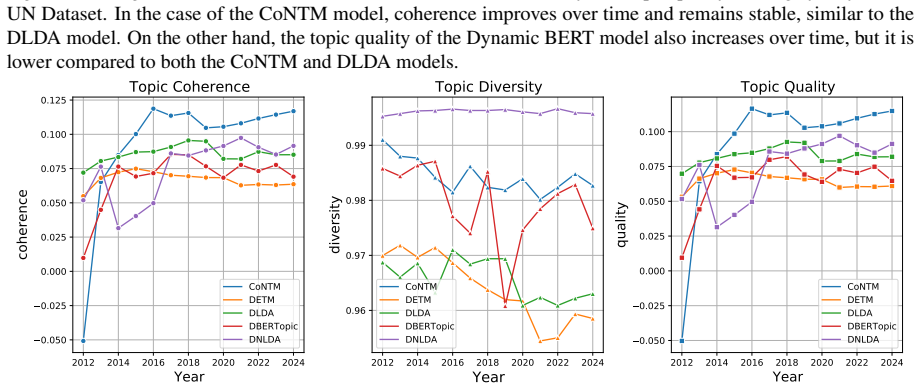
CoNTM models documents as arriving in continuous time slices, with each slice having local topics obtained by adding a small perturbation to a shared set of global topics. The global topics are updated after each slice by a decaying running average of the local topics. The paper claims this simple mechanism is sufficient to preserve previously learned topics while capturing temporal evolution, and reports that CoNTM outperforms DETM, DLDA, Dynamic BERTopic, and DNLDA in topic coherence, topic diversity, and predictive perplexity on corpora such as NYT, UN, Arxiv, and DBLP.
Load-bearing premise
The paper assumes that updating the global topics as a decaying running average of local topics is enough to keep old topics from being overwritten, without replaying old documents or adding any penalty that anchors old topics; this assumption is never directly tested.
Editorial extensions
If this is right
- Topic models can be trained on data streams in real time, updating per time slice, while retaining previously learned topics without storing old documents.
- CoNTM's low predictive perplexity on future slices suggests that a continual topic model can be used for forecasting topic evolution.
- The running-average mechanism gives a simple, parameter-light continual learning recipe for neural topic models, at least when each time slice contains enough documents.
- Topic quality tends to improve over time as global information accumulates, as observed on NYT, UN, and Arxiv, instead of degrading with later slices.
- CoNTM matches or beats the dynamic baselines on topic coherence and diversity on large datasets, without requiring all data upfront.
Reading between the lines
- The paper's claim likely holds best when topics drift smoothly; abrupt regime changes are the stress test, because the running average can in principle be dominated by a later slice.
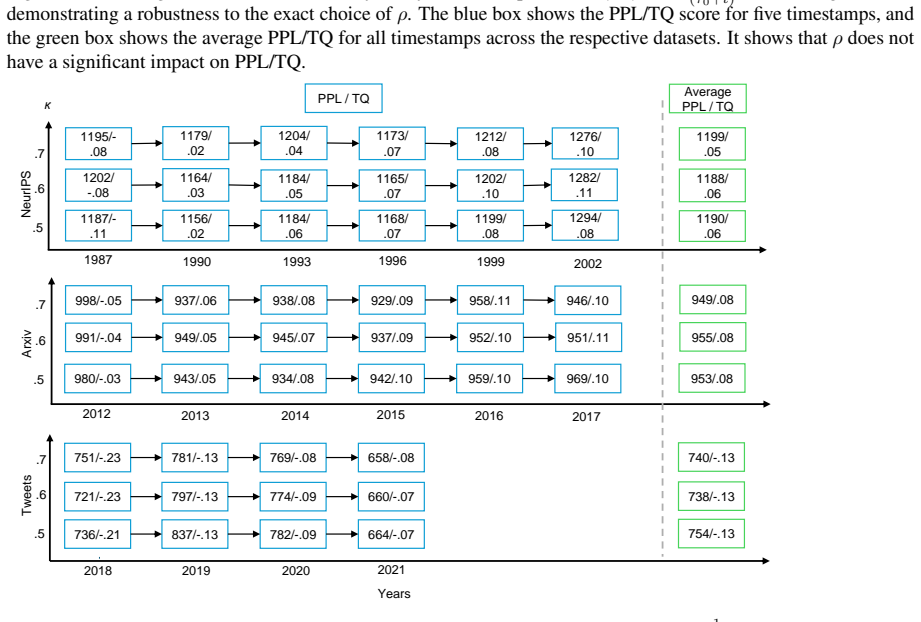
- The rho schedule could be learned or made adaptive per slice; the paper's sensitivity analysis suggests the results are robust to rho, so a learned schedule might improve performance on small or fast-evolving domains.
- A theoretical extension would be to bound forgetting as a function of the total variation of local topics over time; the paper provides the empirical evidence but not such a bound.
- The method could be combined with embedding-based neural topic models; the paper names this as future work, and it would likely improve performance on short-text or small datasets where CoNTM currently struggles.
Editorial analysis
A structured set of objections, weighed in public.
Referee Report
Summary. The paper proposes CoNTM, a Dirichlet-VAE-based topic model that processes documents in time slices. A set of local topics is trained for each slice, and a global topic parameter is maintained as a running average of the local topics (Algorithm 2). The authors claim that this global prior preserves previously learned topics, and they compare CoNTM with DETM, DLDA, Dynamic BERTopic, and DNLDA on six datasets using NPMI topic coherence, topic diversity, topic quality, Temporal Topic Smoothness, and predictive perplexity. The main advertised contribution is continual learning "without forgetting what was previously learned."
Significance. If the central claim were correct, CoNTM would be a simple and inexpensive way to turn a neural topic model into an online, continually learning system, which is a useful and currently underserved capability. The paper also contains a useful breadth of comparisons and sensitivity analyses. However, the no-forgetting claim is neither proved nor tested: the global-update rule is a decaying average that asymptotically discards early slices, and no retention metric appears anywhere in the evaluation. In addition, the reported perplexity results contradict parts of the text. The current manuscript does not establish the advertised contribution, so its significance is substantially reduced.
major comments (4)
- [Abstract, §1, §4.1] The central claim—"without forgetting what was previously learned"—is never evaluated. Section 4.1 defines NPMI, topic diversity, topic quality, TTS, and predictive perplexity, none of which is a retention or forgetting metric. There is no backward-transfer score, no earlier-slice held-out perplexity, and no topic-overlap/retention measure. The qualitative "evolving topic" figures show topics changing over time, not that old topics survive. A model can score well on all reported metrics while overwriting its earlier slices; the paper therefore provides no evidence for the headline contribution.
- [§3.2.3, Algorithm 2, step 10] The global update does not preserve old topics by construction. With ρ_t = 1/(τ0+t)^κ and κ=0.7 (§4.3), the weight of slice 1 in φ_global after T slices is ρ_1 ∏_{s=2}^T (1−ρ_s) ≈ ρ_1 exp(−sum_{s=2}^T (τ0+s)^{-κ}), which decays to zero as T grows. Thus φ_global asymptotically reflects only recent slices. The identity φ_global = (1/T)∑φ_local_t, which motivates the method, requires uniform averaging; the running-average rule drops that property, and the ∑_t Δφ_local_t = 0 constraint is not enforced in Algorithm 2. The paper neither proves retention nor tests it, so the no-forgetting claim is unsupported and in fact contradicted by the update's asymptotic behavior.
- [Appendix L, Table 6; Appendix G, Table 5] The perplexity claims are overstated. Appendix L says CoNTM has the lowest predictive perplexity "in all datasets except Tweets", but Table 6 shows DETM is better on DBLP (823 vs 847). Appendix G shows this is a statistically significant difference in DETM's favor (t=4.170, p=1.96e-4 for a lower-is-better metric), while Tweets (p=0.36) and Arxiv (p=0.41) show no significant difference. Therefore the abstract's "consistently outperformed ... predictive perplexity" is not supported by the reported experiments.
- [§3.2.3 vs Algorithm 2] The derivation of the global topic as the average of local topics depends on the constraint ∑_t Δφ_local_t = 0. Algorithm 2 never imposes this constraint: the Δφ_local_t are optimized independently per slice with gradient steps on that slice's documents only. As a result, the trained model need not satisfy φ_global = (1/T)∑φ_local_t, so the theoretical motivation for the global prior does not apply to the implemented algorithm. This needs to be either fixed by explicit projection/regularization or removed from the derivation.
minor comments (5)
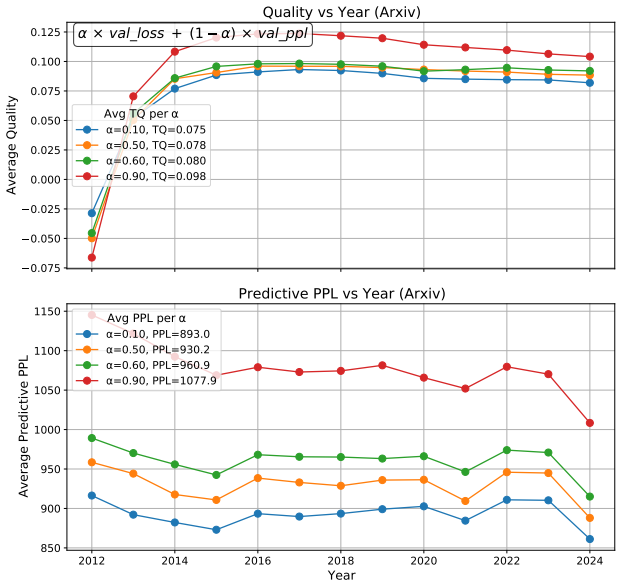
- [Figure 2 and Figure 15 captions] The captions say "top-right corner indicates high topic quality and low predictive perplexity", but the axes show coherence/diversity in Figure 2 and topic quality vs perplexity in Figure 15. In Figure 15 the best region is lower-right, not top-right.
- [§4.3 and Appendix F] Notation is inconsistent: the text says "a τ value of 1", while Algorithm 2 and Appendix F use τ0 (ρ_t = 1/(τ0+t)^κ), and Appendix F grids τ over 1, 3, 64, 256, 1024.
- [Tables 1 and 6 vs Appendix G] Main results are averages of three runs, but the significance test in Appendix G says "twenty different seed values". Reporting standard deviations or confidence intervals for the main tables would be more informative.
- [§4.2 vs Appendix B, Table 3] The text says the DBLP archive includes 168,000 documents, but Table 3 reports 151,232. The inconsistency should be corrected.
- [Table 2, §4.4] The "closest to 0.50 ± 10" criterion used to interpret TTS scores is introduced ad hoc, and the TTS measure comes from the authors' own prior work (Karakkaparambil James et al., 2024). The paper should justify why a TTS near 0.5 is desirable and should note the self-citation.
Circularity Check
No significant circularity: CoNTM's running-average derivation is self-contained; the only self-citation (TTS metric) is minor and not load-bearing.
full rationale
The derivation chain is self-contained. CoNTM is defined in Algorithm 2: each slice's local topics are optimized via a DVAE ELBO, and the global topic set is a running average phi_global = (1-rho_t) phi_global + rho_t phi_local_t with rho_t = 1/(tau0+t)^kappa (Section 3.2.3). Predictive perplexity is a genuine temporal extrapolation: the model trained on slice t is evaluated on documents from slice t+1 (Appendix L). No fitted parameter is renamed as a prediction, and the running-average update is not fitted to the evaluation target. The only self-citation is the Temporal Topic Smoothness metric from Karakkaparambil James et al. (2024), used as an evaluation measure (Section 4.1); it does not enter the model definition, the ELBO, or the update rule, so it is not load-bearing. The paper's central 'without forgetting' claim is an empirical assertion about the running-average update, not a consequence of an equation that defines the target into the model. The manuscript does not report a direct retention/backward-transfer metric, and the Limitations section concedes rapid shifts may be missed; these are correctness/validation concerns, not circularity. No equation in the paper reduces to its own inputs by construction.
Assumptions & free parameters
free parameters (3)
- kappa (κ) =
0.7
- tau0 (τ0) =
1
- number of topics K =
50 (20 in Appendix E)
assumptions (3)
- domain assumption Local topics are an additive perturbation of global topics: phi_local_t = phi_global + Delta_phi_local_t (Section 3.2.3).
- domain assumption The Dirichlet prior z ~ Dirichlet(alpha) with fixed sparsity is appropriate for documents in each time slice (Algorithm 1).
- ad hoc to paper A running average of local topics preserves previously learned topics (Algorithm 2, step 10).
invented entities (1)
-
global topic parameter phi_global
Cite this review
Pith. "Pith review of Continual Neural Topic Model." pith.science (2026). https://pith.science/paper/S7N7VHIN
@misc{pith2026250815612,
  author       = {Pith},
  title        = {Pith review of: Continual Neural Topic Model},
  year         = {2026},
  howpublished = {\url{https://pith.science/paper/S7N7VHIN}},
  note         = {Machine review of arXiv:2508.15612}
}
read the original abstract
In continual learning, our aim is to learn a new task without forgetting what was learned previously. In topic models, this translates to learning new topic models without forgetting previously learned topics. Previous work either considered Dynamic Topic Models (DTMs), which learn the evolution of topics based on the entire training corpus at once, or Online Topic Models, which are updated continuously based on new data but do not have long-term memory. To fill this gap, we propose the Continual Neural Topic Model (CoNTM), which continuously learns topic models at subsequent time steps without forgetting what was previously learned. This is achieved using a global prior distribution that is continuously updated. In our experiments, CoNTM consistently outperformed the dynamic topic model in terms of topic quality and predictive perplexity while being able to capture topic changes online. The analysis reveals that CoNTM can learn more diverse topics and better capture temporal changes than existing methods.
Figures


Figures from the paper (17 more)







Reference graph
Works this paper leans on
-
[5]
In International conference on machine learn- ing, pages 3987–3995
Continual learning through synaptic intelli- gence. In International conference on machine learn- ing, pages 3987–3995. PMLR. Aonan Zhang, Jun Zhu, and Bo Zhang. 2013. Sparse online topic models. In Proceedings of the 22nd international conference on World Wide Web, pages 1489–1500. A Model Settings This section describes the configuration of hyper- param...
work page 2013
-
[10]
This setting plays a pivotal role in determining the variability in topic evolution over time within the DTM framework. The default setting for Dynamic BERTopic was used, and the parameter evolution_tuning was set to true to display the topic evolution. Similarly, the default DNLDA model settings were used, tnd_iterations and lda_iterations being 500. The...
work page 2017
-
[16]
On the Tweets dataset, DBERTopic demon- strates notably high topic quality. This can be due to its use of pre-trained word embeddings, which significantly enhance topic coherence, especially in smaller datasets. The use of pre-trained em- beddings allows DBERTopic to capture semantic relationships more effectively, leading to improved performance in terms...
work page 1997
-
[2003]
Journal of machine Learning research, 3(Jan):993–1022
Latent dirichlet allocation. Journal of machine Learning research, 3(Jan):993–1022. Gerlof Bouma. 2009. Normalized (pointwise) mutual information in collocation extraction. Proceedings of GSCL, 30:31–40. Allaa Boutaleb, Jerome Picault, and Guillaume Gros- jean. 2024. Bertrend: Neural topic modeling for emerging trends detection. arXiv preprint arXiv:2411....
arXiv 2009
-
[2014]
Machine reading tea leaves: Automatically evaluating topic coherence and topic model quality. In Proceedings of the 14th Conference of the Euro- pean Chapter of the Association for Computational Linguistics, pages 530–539. Michael Ley. 2002. The dblp computer science bibliog- raphy: Evolution, research issues, perspectives. In International symposium on s...
arXiv 2002
-
[2017]
Pre-training is a Hot Topic: Contextualized Document Embeddings Improve Topic Coherence
Modeling discrete dynamic topics. In Pro- ceedings of the symposium on applied computing , pages 858–865. Nishant Balepur, Shivam Agarwal, Karthik Venkat Ra- manan, Susik Yoon, Diyi Yang, and Jiawei Han. 2023. Dynamite: Discovering explosive topic evolutions with user guidance. In Findings of the Association for Computational Linguistics: ACL 2023 , pages...
work page Pith review arXiv 2023
-
[2022]
Efficient inference for dynamic topic model- ing with large vocabularies. In Proceedings of the Thirty-Eighth Conference on Uncertainty in Artificial Intelligence, volume 180 of Proceedings of Machine Learning Research, pages 1950–1959. PMLR. Luu Anh Tuan, Darsh Shah, and Regina Barzilay. 2020. Capturing greater context for question generation. In Proceed...
arXiv 1950
Reviewed August 5, 2026 · model on record in the stance chip above.
Discussion (0). Sign in to comment.