Modeling of Far-Field Quantum Coherence by Dielectric Bodies Based on the Volume Integral Equation Method
Pith reviewed 2026-05-18 21:03 UTC · model grok-4.3
The pith
A scattering formulation extracts two-photon far-field correlations for arbitrary lossless dielectrics from classical volume-integral solutions.
A machine-rendered reading of the paper's core claim, the machinery that carries it, and where it could break.
Core claim
The required transfer coefficients are extracted from classical far-field complex amplitudes computed by an FFT-accelerated volume integral equation solver, yielding a compact two-channel transfer relation for the second-order correlation function and time-domain coincidence counts.
What carries the argument
Multi-channel scattering formulation that maps two populated incident channels to two selected far-field detection modes.
If this is right
- Angle-resolved two-photon interference patterns become computable for scatterers of arbitrary shape.
- HOM-dip visibility can be predicted as a direct function of chosen far-field observation angles.
- The same classical amplitudes support both single-photon and two-photon statistics without separate quantum solvers.
- Quantum state engineering with dielectric bodies is possible by optimizing the scatterer geometry for target correlation functions.
Where Pith is reading between the lines
- The method could be inverted to design metasurfaces that produce prescribed angular quantum correlations.
- Extension to absorbing or nonlinear materials would require only replacing the classical solver while keeping the same transfer extraction.
- The approach naturally connects to inverse-design loops for quantum photonic devices that incorporate scattering elements.
Load-bearing premise
The multi-channel scattering map from two incident channels to two far-field detection modes remains valid for arbitrary lossless dielectric scatterers without extra near-field or loss approximations.
What would settle it
Compute the coincidence counts for a dielectric sphere with the numerical solver and compare them directly to the known analytical Hong-Ou-Mandel dip curve; mismatch at any angle would falsify the extraction step.
Figures




read the original abstract
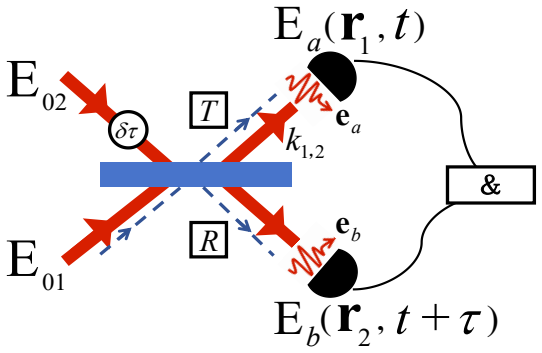
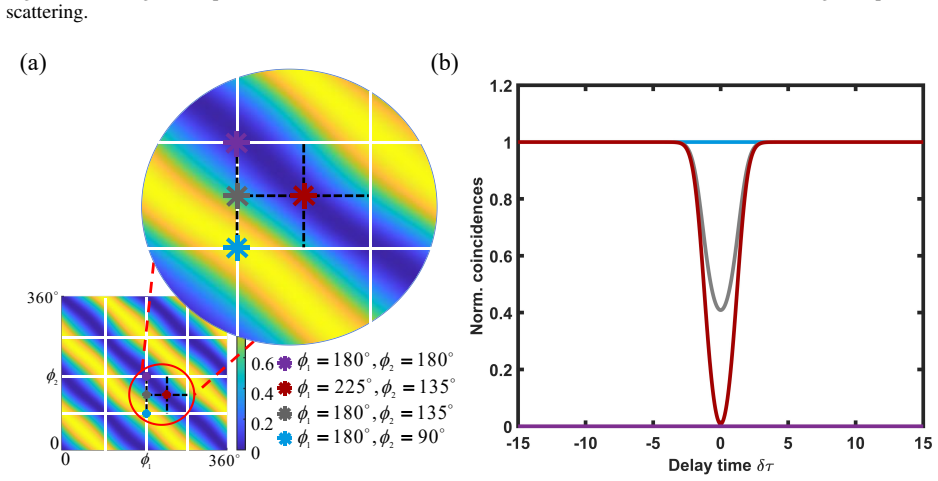
The Hong-Ou-Mandel (HOM) effect is a hallmark of nonclassical two-photon interference. This paper develops a unified theory-numerics framework to compute angle-resolved far-field two-photon correlations from arbitrary lossless dielectric scatterers. We describe the input-output relation using a multi-channel scattering formulation that maps two populated incident channels to two selected far-field detection modes, yielding a compact two-channel transfer relation for second-order correlation function and time-domain coincidence counts. The required transfer coefficients are extracted from classical far-field complex amplitudes computed by an fast Fourier transform-accelerated volume integral equation solver, avoiding perfectly matched layers and near-to-far-field post-processing. The method is validated against analytical results for dielectric spheres and demonstrated on a polarization-converting Pancharatnam-Berry-phase metasurface, revealing strong angular dependence of quantum interference and its direct impact on HOM-dip visibility. The framework provides an efficient and physically transparent tool for structure-dependent quantum-correlation analysis, with potential applications in scatterers-enabled quantum state engineering and quantum inverse design.
Editorial analysis
A structured set of objections, weighed in public.
Referee Report
Summary. The paper develops a unified theory-numerics framework to compute angle-resolved far-field two-photon correlations from arbitrary lossless dielectric scatterers. It uses a multi-channel scattering formulation that maps two populated incident channels to two selected far-field detection modes, yielding a compact two-channel transfer relation for the second-order correlation function and time-domain coincidence counts. Transfer coefficients are extracted from classical far-field complex amplitudes computed by an FFT-accelerated volume integral equation solver. The method is validated against analytic Mie results for dielectric spheres and demonstrated on a polarization-converting Pancharatnam-Berry-phase metasurface, revealing strong angular dependence of quantum interference and its impact on HOM-dip visibility.
Significance. If the central numerical pipeline holds, the work supplies an efficient, parameter-free route to structure-dependent quantum-correlation analysis for lossless scatterers by directly importing classical far-field amplitudes into the two-photon input-output relation. Validation against Mie theory for spheres and the explicit far-field extraction without PMLs or near-to-far post-processing are concrete strengths. The framework is transparent for quantum inverse design and scatterer-enabled state engineering applications.
major comments (1)
- [§3] §3 (multi-channel scattering formulation): the claim that the two-channel truncation remains valid for arbitrary lossless dielectric scatterers without additional near-field corrections is load-bearing for the central claim; a brief derivation or reference showing that the selected far-field modes capture the relevant sub-block of the unitary S-matrix for the demonstrated metasurface would strengthen the argument.
minor comments (2)
- [Figure 4] Figure 4 (metasurface demonstration): the angular dependence of the visibility is shown but the precise definition of the two selected detection modes (e.g., their solid angle or polarization basis) is not stated explicitly in the caption; adding this would improve reproducibility.
- [Eq. (12)] Eq. (12) (second-order correlation): the time-domain coincidence count expression assumes a specific normalization of the incident two-photon state; a short remark on how this normalization is chosen for the sphere validation would clarify comparison with analytic results.
Simulated Author's Rebuttal
We thank the referee for the positive assessment and constructive comment. We address the major comment below and will revise the manuscript to incorporate the requested clarification.
read point-by-point responses
-
Referee: [§3] §3 (multi-channel scattering formulation): the claim that the two-channel truncation remains valid for arbitrary lossless dielectric scatterers without additional near-field corrections is load-bearing for the central claim; a brief derivation or reference showing that the selected far-field modes capture the relevant sub-block of the unitary S-matrix for the demonstrated metasurface would strengthen the argument.
Authors: We thank the referee for this valuable suggestion. For lossless dielectric scatterers the scattering matrix S is unitary by construction, relating all input and output channels (propagating and evanescent). Because the two-photon correlation function is evaluated from far-field amplitudes, only the propagating far-field modes enter the detected signal; evanescent near-field components decay exponentially and do not contribute to the angle-resolved far-field correlations. Consequently, the two-channel transfer relation is precisely the sub-block of S connecting the two chosen incident channels to the two selected far-field detection modes. This projection is standard in far-field multi-port scattering theory and is directly furnished by the classical far-field amplitudes obtained from the FFT-accelerated volume-integral-equation solver. The same truncation reproduces the exact Mie analytic results for spheres, confirming consistency. For the Pancharatnam-Berry-phase metasurface the dominant effect is far-field polarization conversion and angular redistribution, which is captured by the selected modes. We will add a concise derivation of the far-field sub-block extraction together with a reference to multi-port quantum-optical scattering formalism in the revised §3. revision: yes
Circularity Check
No significant circularity
full rationale
The derivation extracts transfer coefficients directly from classical far-field complex amplitudes produced by the FFT-accelerated VIE solver and inserts them into a standard two-channel scattering relation for the second-order correlation function. This is a direct application of linear scattering theory for lossless media, where the far-field amplitudes are the physical inputs rather than outputs of the quantum calculation. The paper validates the pipeline against independent Mie-theory results for spheres and applies it to a metasurface example; no parameter fitting, self-definition, or load-bearing self-citation reduces the reported visibility curves or coincidence counts to the inputs by construction. The central claim therefore remains self-contained against external benchmarks.
Axiom & Free-Parameter Ledger
axioms (2)
- domain assumption The scatterer is lossless and the incident fields are monochromatic plane waves in two populated channels.
- domain assumption Far-field complex amplitudes obtained from the VIE solver can be directly inserted into the quantum correlation function without additional near-to-far-field corrections.
Lean theorems connected to this paper
-
IndisputableMonolith/Cost/FunctionalEquation.leanwashburn_uniqueness_aczel unclear?
unclearRelation between the paper passage and the cited Recognition theorem.
The required transfer coefficients are extracted from classical far-field complex amplitudes computed by an FFT-accelerated volume integral equation solver
-
IndisputableMonolith/Foundation/AbsoluteFloorClosure.leanreality_from_one_distinction unclear?
unclearRelation between the paper passage and the cited Recognition theorem.
yielding a compact two-channel transfer relation for the second-order correlation function
What do these tags mean?
- matches
- The paper's claim is directly supported by a theorem in the formal canon.
- supports
- The theorem supports part of the paper's argument, but the paper may add assumptions or extra steps.
- extends
- The paper goes beyond the formal theorem; the theorem is a base layer rather than the whole result.
- uses
- The paper appears to rely on the theorem as machinery.
- contradicts
- The paper's claim conflicts with a theorem or certificate in the canon.
- unclear
- Pith found a possible connection, but the passage is too broad, indirect, or ambiguous to say the theorem truly supports the claim.
Forward citations
Cited by 1 Pith paper
-
Computational framework for non-Markovian multi-emitter dynamics beyond the single-excitation limit
Presents a Green's function framework for non-Markovian multi-emitter QED in the two-excitation manifold by retaining photonic amplitudes in a hierarchy of coupled equations.
Reference graph
Works this paper leans on
-
[1]
Quantum information processing and quantum optics with circuit quantum electrodynamics
Alexandre Blais, Steven M Girvin, and William D Oliver. Quantum information processing and quantum optics with circuit quantum electrodynamics. Nature Physics, 16(3):247–256, 2020
work page 2020
-
[2]
Quantum computation and quantum information
Michael A Nielsen and Isaac L Chuang. Quantum computation and quantum information. Cambridge university press, 2010
work page 2010
-
[3]
Linear optical quantum computing with photonic qubits
Pieter Kok, William J Munro, Kae Nemoto, Timothy C Ralph, Jonathan P Dowling, and Gerard J Milburn. Linear optical quantum computing with photonic qubits. Reviews of modern physics, 79(1):135–174, 2007
work page 2007
-
[4]
Marlan O Scully and M Suhail Zubairy. Quantum optics. Cambridge university press, 1997
work page 1997
-
[5]
Ho Trung Dung, Ludwig Knöll, and Dirk-Gunnar Welsch. Spontaneous decay in the presence of dispersing and absorbing bodies: General theory and application to a spherical cavity. Physical Review A, 62(5):053804, 2000
work page 2000
-
[6]
Spontaneous decay of an excited atom in an absorbing dielectric
Stefan Scheel, L Knöll, and D-G Welsch. Spontaneous decay of an excited atom in an absorbing dielectric. Physical Review A, 60(5):4094, 1999
work page 1999
-
[7]
Systematic study of spontaneous emission in a two-dimensional arbitrary inhomogeneous environment
Peng-fei Qiao, Wei EI Sha, Wallace CH Choy, and Weng Cho Chew. Systematic study of spontaneous emission in a two-dimensional arbitrary inhomogeneous environment. Physical Review A—Atomic, Molecular, and Optical Physics, 83(4):043824, 2011
work page 2011
-
[8]
Comparison of quantum and classical local-field effects on two-level atoms in a dielectric
Michael E Crenshaw. Comparison of quantum and classical local-field effects on two-level atoms in a dielectric. Physical Review A—Atomic, Molecular, and Optical Physics , 78(5):053827, 2008
work page 2008
-
[9]
Casimir effect from macroscopic quantum electrodynamics
Thomas Gerard Philbin. Casimir effect from macroscopic quantum electrodynamics. New Journal of Physics, 13(6):063026, 2011
work page 2011
-
[10]
Artificial atoms for quantum optics
Rudolf Bratschitsch and Alfred Leitenstorfer. Artificial atoms for quantum optics. Nature materials, 5(11):855– 856, 2006
work page 2006
-
[11]
Roadmap on quantum optical systems
Rainer Dumke, Zehuang Lu, John Close, Nick Robins, Antoine Weis, Manas Mukherjee, Gerhard Birkl, Christoph Hufnagel, Luigi Amico, Malcolm G Boshier, et al. Roadmap on quantum optical systems. Journal of Optics, 18(9):093001, 2016
work page 2016
-
[12]
Metasurface interferometry toward quantum sensors
Philip Georgi, Marcello Massaro, Kai-Hong Luo, Basudeb Sain, Nicola Montaut, Harald Herrmann, Thomas Weiss, Guixin Li, Christine Silberhorn, and Thomas Zentgraf. Metasurface interferometry toward quantum sensors. Light: Science & Applications, 8(1):70, 2019
work page 2019
-
[13]
Quantum information preserving computational electromagnetics
Dong-Yeop Na, Jie Zhu, Weng C Chew, and Fernando L Teixeira. Quantum information preserving computational electromagnetics. Physical Review A, 102(1):013711, 2020
work page 2020
-
[14]
Some selected unsolved problems in classical and quantum electromagnetics
Weng Cho Chew, Boyuan Zhang, and Jie Zhu. Some selected unsolved problems in classical and quantum electromagnetics. Progress In Electromagnetics Research, 180, 2024
work page 2024
-
[15]
Marco Lanzagorta. Quantum radar. Morgan & Claypool Publishers, 2011. 11
work page 2011
-
[16]
Quantum noise radar: superresolution with quantum antennas by accessing spatiotemporal correlations
I Peshko, D Mogilevtsev, I Karuseichyk, A Mikhalychev, AP Nizovtsev, G Ya Slepyan, and A Boag. Quantum noise radar: superresolution with quantum antennas by accessing spatiotemporal correlations. Optics Express, 27(20):29217–29231, 2019
work page 2019
-
[17]
Patrizia Livreri, Bernardo Galvano, Luca Fasolo, Luca Oberto, Emanuele Enrico, et al. Josephson traveling wave parametric amplifier as quantum source of entangled photons for microwave quantum radar applications. ELECTROMAGNETIC WAVES, 179:113–124, 2024
work page 2024
-
[18]
Gregory Ya Slepyan, Svetlana Vlasenko, and Dmitri Mogilevtsev. Quantum antennas. Advanced Quantum Technologies, 3(4):1900120, 2020
work page 2020
- [19]
-
[20]
Quantum physics of simple optical instruments
Ulf Leonhardt. Quantum physics of simple optical instruments. Reports on Progress in Physics, 66(7):1207, 2003
work page 2003
-
[21]
Modes and states in quantum optics
Claude Fabre and Nicolas Treps. Modes and states in quantum optics. Reviews of Modern Physics, 92(3):035005, 2020
work page 2020
-
[22]
Gregory Ya Slepyan, Dmitri Mogilevtsev, Ilay Levie, and Amir Boag. Modeling of multimodal scattering by conducting bodies in quantum optics: The method of characteristic modes.Physical Review Applied, 18(1):014024, 2022
work page 2022
-
[23]
Quantum mechanics made simple: Lecture notes, 2012
Weng Cho Chew. Quantum mechanics made simple: Lecture notes, 2012
work page 2012
-
[24]
Quantum mechanics for scientists and engineers
David AB Miller. Quantum mechanics for scientists and engineers. Cambridge University Press, 2008
work page 2008
-
[25]
Quantum mechanics: fundamentals
Kurt Gottfried. Quantum mechanics: fundamentals. CRC Press, 2018
work page 2018
-
[26]
Quantum light in complex media and its applications
Ohad Lib and Yaron Bromberg. Quantum light in complex media and its applications. Nature Physics, 18(9):986– 993, 2022
work page 2022
-
[27]
Measurement of subpicosecond time intervals between two photons by interference
Chong-Ki Hong, Zhe-Yu Ou, and Leonard Mandel. Measurement of subpicosecond time intervals between two photons by interference. Physical review letters, 59(18):2044, 1987
work page 2044
-
[28]
A quantum description of the beam splitter
Sudhakar Prasad, Marlan O Scully, and Werner Martienssen. A quantum description of the beam splitter. Optics communications, 62(3):139–145, 1987
work page 1987
-
[29]
Mode-selective quantization and multimodal effective models for spherically layered systems
David Dzsotjan, Benjamin Rousseaux, Hans R Jauslin, G Colas des Francs, Christophe Couteau, and Stéphane Guerin. Mode-selective quantization and multimodal effective models for spherically layered systems. Physical Review A, 94(2):023818, 2016
work page 2016
-
[30]
Photons in the presence of parabolic mirrors
R Gutiérrez-Jáuregui and R Jáuregui. Photons in the presence of parabolic mirrors. Physical Review A , 98(4):043808, 2018
work page 2018
-
[31]
Quantum electrodynamics with a nonmoving dielectric sphere: quantizing lorenz–mie scattering
Patrick Maurer, Carlos Gonzalez-Ballestero, and Oriol Romero-Isart. Quantum electrodynamics with a nonmoving dielectric sphere: quantizing lorenz–mie scattering. Journal of the Optical Society of America B, 40(12):3137– 3155, 2023
work page 2023
-
[32]
Ho Trung Dung, Ludwig Knöll, and Dirk-Gunnar Welsch. Three-dimensional quantization of the electromagnetic field in dispersive and absorbing inhomogeneous dielectrics. Physical Review A, 57(5):3931, 1998
work page 1998
-
[33]
Lukas Novotny and Bert Hecht. Principles of nano-optics. Cambridge university press, 2012
work page 2012
-
[34]
Macroscopic quantum electrodynamics-concepts and applications
Stefan Scheel, Stefan Yoshi Buhmann, et al. Macroscopic quantum electrodynamics-concepts and applications. Acta Phys. Slovaca, 58(5):675–809, 2008
work page 2008
-
[35]
A physically motivated quantization of the electromagnetic field
Robert Bennett, Thomas M Barlow, and Almut Beige. A physically motivated quantization of the electromagnetic field. European Journal of Physics, 37(1):014001, 2015
work page 2015
-
[36]
George W Hanson. Aspects of quantum electrodynamics compared to the classical case: Similarity and disparity of quantum and classical electromagnetics. IEEE Antennas and Propagation Magazine, 62(4):16–26, 2020
work page 2020
-
[37]
Quantum electromagnetic finite-difference time-domain solver.Quantum Reports, 2(2):253–265, 2020
Dong-Yeop Na and Weng Cho Chew. Quantum electromagnetic finite-difference time-domain solver.Quantum Reports, 2(2):253–265, 2020
work page 2020
-
[38]
Light quantization for arbitrary scattering systems
Salvatore Savasta, Omar Di Stefano, and Raffaello Girlanda. Light quantization for arbitrary scattering systems. Physical Review A, 65(4):043801, 2002
work page 2002
-
[39]
Kane Yee. Numerical solution of initial boundary value problems involving maxwell’s equations in isotropic media. IEEE Transactions on antennas and propagation, 14(3):302–307, 1966
work page 1966
-
[40]
The finite element method in electromagnetics
Jian-Ming Jin. The finite element method in electromagnetics. John Wiley & Sons, 2015
work page 2015
-
[41]
Allen Taflove and S. Hagness. Computational electrodynamics: the finite-difference time-domain method. 2nd ed, volume 67–106. 2nd ed. Norwood, 06 2000. 12
work page 2000
-
[42]
Modal expansions for resonance scattering phenomena
RJ Garbacz. Modal expansions for resonance scattering phenomena. Proceedings of the IEEE, 53(8):856–864, 2005
work page 2005
-
[43]
A generalized expansion for radiated and scattered fields
Robert Garbacz and R Turpin. A generalized expansion for radiated and scattered fields. IEEE transactions on Antennas and Propagation, 19(3):348–358, 2003
work page 2003
-
[44]
Antenna shape synthesis using characteristic modes
R Garbacz and D Pozar. Antenna shape synthesis using characteristic modes. IEEE Transactions on Antennas and Propagation, 30(3):340–350, 2003
work page 2003
-
[45]
Theory of characteristic modes for conducting bodies
R Harrington and J Mautz. Theory of characteristic modes for conducting bodies. IEEE transactions on antennas and propagation, 19(5):622–628, 1971
work page 1971
-
[46]
Characteristic modes: Theory and applications in antenna engineering
Yikai Chen and Chao-Fu Wang. Characteristic modes: Theory and applications in antenna engineering. John Wiley & Sons, 2015
work page 2015
-
[47]
Computation of characteristic modes for conducting bodies
R Harrington and J Mautz. Computation of characteristic modes for conducting bodies. IEEE Transactions on Antennas and Propagation, 19(5):629–639, 2003
work page 2003
-
[48]
Quantum coherence of light emitted by two single-photon sources in a structured environment
Antoine Canaguier-Durand and Rémi Carminati. Quantum coherence of light emitted by two single-photon sources in a structured environment. Physical Review A, 93(3):033836, 2016
work page 2016
-
[49]
Chengnian Huang and EI Wei. A parallel block preconditioner-based vie-fft algorithm for modeling the electro- magnetic response from nanostructures. IEEE Transactions on Antennas and Propagation, 72(1):1051–1056, 2023
work page 2023
-
[50]
Optical coherence and quantum optics
Leonard Mandel and Emil Wolf. Optical coherence and quantum optics. Cambridge university press, 1995
work page 1995
-
[51]
Interferometry of the intensity fluctuations in light-i
R Hanbury Brown, Richard Quinton Twiss, and givenName surName. Interferometry of the intensity fluctuations in light-i. basic theory: the correlation between photons in coherent beams of radiation. Proceedings of the Royal Society of London. Series A. Mathematical and Physical Sciences, 242(1230):300–324, 1957
work page 1957
-
[52]
The quantum theory of optical coherence
Roy J Glauber. The quantum theory of optical coherence. Physical Review, 130(6):2529, 1963
work page 1963
-
[53]
Photon antibunching in resonance fluorescence
H Jeff Kimble, Mario Dagenais, and Leonard Mandel. Photon antibunching in resonance fluorescence. Physical Review Letters, 39(11):691, 1977
work page 1977
-
[54]
Bunching and antibunching in the fluorescence of semiconductor nanocrystals
Gaetan Messin, Jean-Pierre Hermier, Elisabeth Giacobino, Pierre Desbiolles, and Maxime Dahan. Bunching and antibunching in the fluorescence of semiconductor nanocrystals. Optics Letters, 26(23):1891–1893, 2001
work page 2001
-
[55]
Speckle fluctuations resolve the interdistance between incoherent point sources in complex media
Rémi Carminati, Gabriel Cwilich, Luis S Froufe-Pérez, and JJ Sáenz. Speckle fluctuations resolve the interdistance between incoherent point sources in complex media. Physical Review A, 91(2):023807, 2015
work page 2015
-
[56]
Henk A Van der V orst. Bi-cgstab: A fast and smoothly converging variant of bi-cg for the solution of nonsymmetric linear systems. SIAM Journal on scientific and Statistical Computing, 13(2):631–644, 1992
work page 1992
-
[57]
Metalenses at visible wavelengths: Diffraction-limited focusing and subwavelength resolution imaging
Mohammadreza Khorasaninejad, Wei Ting Chen, Robert C Devlin, Jaewon Oh, Alexander Y Zhu, and Federico Capasso. Metalenses at visible wavelengths: Diffraction-limited focusing and subwavelength resolution imaging. Science, 352(6290):1190–1194, 2016
work page 2016
-
[58]
A broadband achromatic metalens in the visible
Shuming Wang, Pin Chieh Wu, Vin-Cent Su, Yi-Chieh Lai, Mu-Ku Chen, Hsin Yu Kuo, Bo Han Chen, Yu Han Chen, Tzu-Ting Huang, Jung-Hsi Wang, et al. A broadband achromatic metalens in the visible. Nature nanotechnology, 13(3):227–232, 2018
work page 2018
-
[59]
Three-dimensional optical holography using a plasmonic metasurface
Lingling Huang, Xianzhong Chen, Holger Mühlenbernd, Hao Zhang, Shumei Chen, Benfeng Bai, Qiaofeng Tan, Guofan Jin, Kok-Wai Cheah, Cheng-Wei Qiu, et al. Three-dimensional optical holography using a plasmonic metasurface. Nature communications, 4(1):2808, 2013. 13
work page 2013
discussion (0)
Sign in with ORCID, Apple, or X to comment. Anyone can read and Pith papers without signing in.