Enhanced Successive Cancellation List Decoder for Long Polar Codes Targeting Air Interface
Pith reviewed 2026-05-22 12:42 UTC · model grok-4.3
The pith
Bias-enhanced generalized partitioned SCL decoders match standard SCL performance with 67% less memory for long polar codes.
A machine-rendered reading of the paper's core claim, the machinery that carries it, and where it could break.
Core claim
The authors propose bias-enhanced (BE) generalized partitioned SCL (GPSCL) decoders with list size 8 that achieve similar decoding performance to SCL decoders with list size 16, along with a 67% reduction in memory usage. They demonstrate that an accurate bias can be generated from a reduced number of codewords, reducing overhead to n XOR gates. Input-distribution-aware decoding is applied to further reduce complexity. They also theoretically prove that the bias moves the received soft information toward valid polar codewords with high likelihood.
What carries the argument
The bias-enhanced mechanism in generalized partitioned successive cancellation list (GPSCL) decoding, which uses a simple bias addition via XOR gates to approximate the benefits of a larger decoding list.
Load-bearing premise
An accurate bias can be generated under a reduced number of codewords from the list, allowing the overhead reduction while preserving performance.
What would settle it
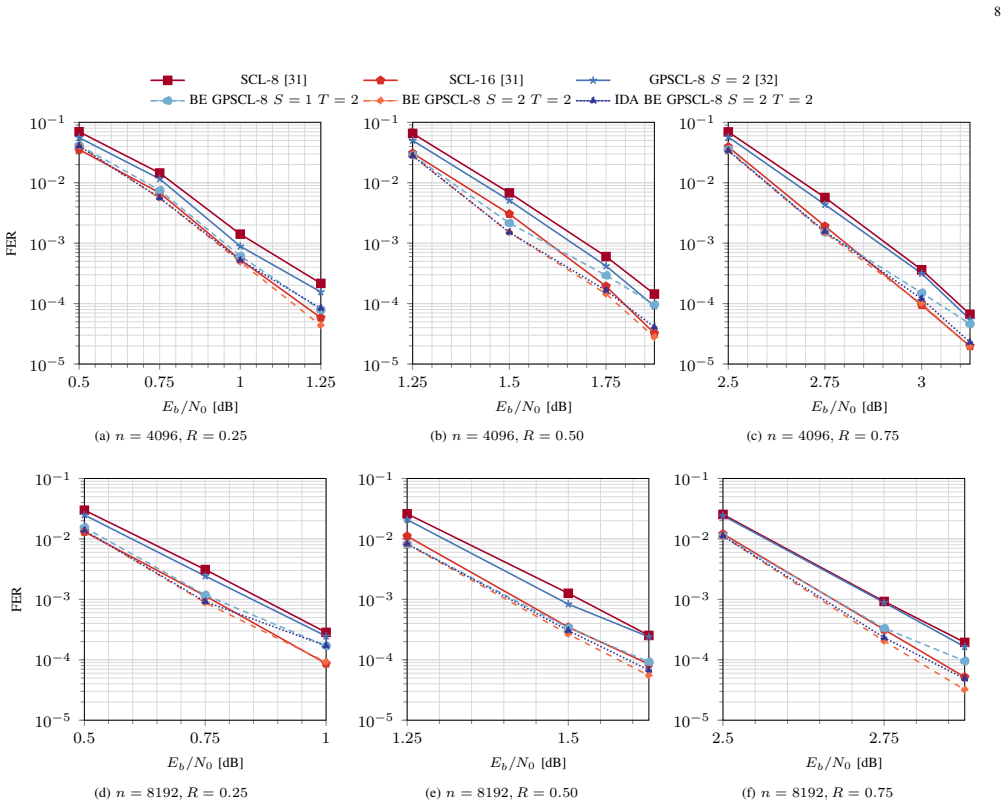
Measuring the bit-error-rate curves for BE GPSCL decoder with list size 8 against standard SCL with list size 16 over AWGN channel for polar code length 8192 at typical air-interface rates would test if performance remains similar.
Figures





read the original abstract
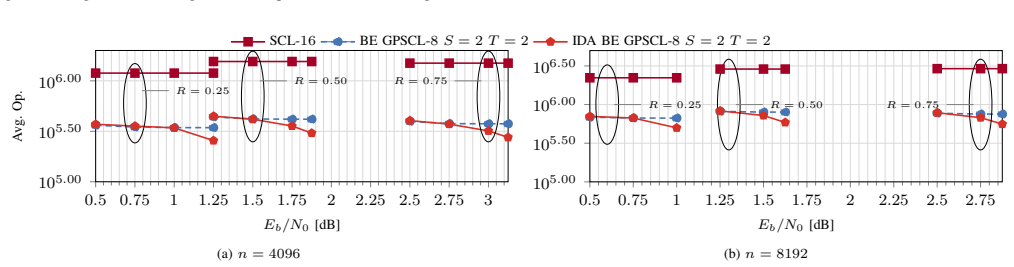
Polar codes are the first codes with a proven capacity-achieving capability, but their decoding faces several challenges, especially under long code lengths. In this paper, we target algorithmic improvements and analyses to enable the implementation of long polar codes (e.g., length 8K bits) by addressing key challenges in memory usage and computational complexity presented by successive cancellation list (SCL) polar decoding. Perturbation-enhanced (PE) SCL decoders with a list size of $L$ reach the decoding performance of the SCL decoder with a list size of $2L$. The proposed bias-enhanced (BE) SCL decoders, which simplify the PE SCL decoder based on insights gained by an ablation study, return similar decoding performance to PE SCL decoders. Also, proposed BE generalized partitioned SCL (GPSCL) decoders with a list size of $8$ have a $67\%$ reduction in the memory usage and similar decoding performance compared to SCL decoders with a list size of $16$, and it demonstrates that an accurate bias can be generated under a reduced number of codewords from the list and reduces the overhead from $\left(L-1\right)n$ XOR gates plus $n$ priority encoders to $n$ XOR gates, where $n$ is the code length. Furthermore, input-distribution-aware (IDA) decoding is applied to BE GPSCL decoders, which shows how an accurate bias is generated under a low-complexity decoder. Up to $5.4\times$ reduction in the computational complexity is achieved compared to SCL decoders with a list size of $16$, and negligible latency overhead is added to the decoding process. The degraded decoding performance is at most $0.05\text{ dB}$ compared to BE GPSCL decoders without IDA decoding. Lastly, we theoretically prove that the bias in the BE SCL decoder moves the received soft information toward valid polar codewords with a high likelihood, and explain the decoding performance gain.
Editorial analysis
A structured set of objections, weighed in public.
Referee Report
Summary. The manuscript proposes perturbation-enhanced (PE) SCL decoders that match the performance of standard SCL with doubled list size, then simplifies them to bias-enhanced (BE) SCL decoders via ablation study. It introduces BE generalized partitioned SCL (GPSCL) decoders for length-8192 polar codes, claiming that list size 8 yields 67% memory reduction and up to 5.4× complexity reduction versus standard SCL list size 16, with at most 0.05 dB degradation; input-distribution-aware (IDA) decoding is added for further gains. A theoretical argument is presented that the bias term steers received soft information toward valid codewords.
Significance. If substantiated, the work supplies concrete algorithmic and architectural advances that could enable practical use of long polar codes in air-interface hardware by cutting memory and gate count while preserving performance. The explicit theoretical analysis of the bias effect and the demonstration of accurate bias generation from a drastically reduced path set are strengths that go beyond pure empirical tuning.
major comments (2)
- [Theoretical Analysis] Theoretical proof section: the proof that bias moves soft information toward valid codewords is developed for standard BE SCL. The central GPSCL claim (67% memory reduction at L=8 with performance within 0.05 dB of L=16 SCL) rests on the same bias remaining accurate when generated from a partitioned list using only n XOR gates. No explicit extension of the proof steps to the partitioned recursion or the reduced bias unit is supplied; small accumulated bias errors over 8192 bits could undermine the claimed equivalence.
- [GPSCL Architecture] § on GPSCL architecture and bias unit: the overhead reduction from (L-1)n XOR gates plus n priority encoders to n XOR gates is justified by the assumption that an accurate bias can still be produced from the reduced number of codewords. This assumption is load-bearing for both the memory and complexity claims yet receives only empirical support; a formal argument or counter-example analysis for the partitioned case is required.
minor comments (3)
- [Simulation Results] Figure captions and axis labels for the BER curves should explicitly state the code length, rate, and channel model used; current presentation makes direct comparison to prior SCL results difficult.
- [Ablation Study] The ablation study that motivates the simplification from PE SCL to BE SCL is referenced but not shown in detail; including the key table or figure would strengthen the justification for the bias-only design.
- [Notation] Notation for the bias term and the partitioned LLR update equations should be unified across sections to avoid ambiguity when the simplified n-XOR unit is introduced.
Simulated Author's Rebuttal
We thank the referee for the constructive comments and for recognizing the potential impact of our work on enabling practical implementations of long polar codes. We address the two major comments point by point below and will incorporate revisions to strengthen the theoretical justification and architectural analysis.
read point-by-point responses
-
Referee: [Theoretical Analysis] Theoretical proof section: the proof that bias moves soft information toward valid codewords is developed for standard BE SCL. The central GPSCL claim (67% memory reduction at L=8 with performance within 0.05 dB of L=16 SCL) rests on the same bias remaining accurate when generated from a partitioned list using only n XOR gates. No explicit extension of the proof steps to the partitioned recursion or the reduced bias unit is supplied; small accumulated bias errors over 8192 bits could undermine the claimed equivalence.
Authors: We agree that the proof is developed for the standard BE SCL decoder and that an explicit extension to the GPSCL case would strengthen the manuscript. The core argument shows that the bias term adjusts path metrics to favor valid codewords by leveraging the recursive structure of polar codes. For GPSCL, the bias is still computed from the highest-likelihood paths retained after partitioning, and our simulations for length-8192 codes confirm that performance remains within 0.05 dB. In the revision we will add a short subsection that sketches the extension: because partitioning preserves the dominant paths at each recursion level and the bias unit aggregates LLRs via XOR operations on these paths, the steering effect toward valid codewords is retained with bounded error accumulation, as the early-stage path selection in polar decoding limits propagation of small inaccuracies. revision: yes
-
Referee: [GPSCL Architecture] § on GPSCL architecture and bias unit: the overhead reduction from (L-1)n XOR gates plus n priority encoders to n XOR gates is justified by the assumption that an accurate bias can still be produced from the reduced number of codewords. This assumption is load-bearing for both the memory and complexity claims yet receives only empirical support; a formal argument or counter-example analysis for the partitioned case is required.
Authors: The referee correctly notes that the complexity and memory claims depend on the accuracy of the bias generated from the reduced path set. The manuscript supports this via extensive simulations showing that the n-XOR bias unit produces an effective bias for L=8 GPSCL. To provide the requested formal support, the revised manuscript will include a brief analytical argument: the generalized partitioning recursively decomposes the code such that the retained paths at each stage are the most probable ones under the channel, and the simplified bias computation using only n XOR gates approximates the full-list bias sufficiently closely because polar code construction concentrates reliability in specific bit positions. We will also add a short discussion of why counter-examples (e.g., pathological path omissions) do not occur for the standard polar constructions and code lengths considered. revision: yes
Circularity Check
No significant circularity; derivation chain is self-contained
full rationale
The paper introduces BE SCL and GPSCL decoder variants with a claimed theoretical proof that bias shifts received soft information toward valid polar codewords, plus empirical claims of 67% memory reduction at L=8 with performance within 0.05 dB of L=16 SCL. The proof is presented as an independent analysis of the bias mechanism rather than a quantity fitted from or defined by the same simulation data used to tune the bias generator. No equations reduce the performance or complexity gains to tautological redefinitions of inputs, and the reduced bias unit (n XOR gates) is justified by explicit architectural simplification rather than by construction from the target result. Self-citations are not load-bearing for the central claims, and the derivation remains externally falsifiable via simulation benchmarks.
Axiom & Free-Parameter Ledger
axioms (1)
- domain assumption Standard successive cancellation list decoding properties for polar codes hold under the proposed perturbations and partitioning.
invented entities (1)
-
bias term in BE SCL
no independent evidence
Lean theorems connected to this paper
-
IndisputableMonolith/Cost/FunctionalEquation.leanwashburn_uniqueness_aczel unclear?
unclearRelation between the paper passage and the cited Recognition theorem.
we theoretically prove that the bias in the BE SCL decoder moves the received soft information toward valid polar codewords with a high likelihood
-
IndisputableMonolith/Foundation/AbsoluteFloorClosure.leanreality_from_one_distinction unclear?
unclearRelation between the paper passage and the cited Recognition theorem.
BE generalized partitioned SCL (GPSCL) decoders with a list size of 8 have a 67% reduction in the memory usage
What do these tags mean?
- matches
- The paper's claim is directly supported by a theorem in the formal canon.
- supports
- The theorem supports part of the paper's argument, but the paper may add assumptions or extra steps.
- extends
- The paper goes beyond the formal theorem; the theorem is a base layer rather than the whole result.
- uses
- The paper appears to rely on the theorem as machinery.
- contradicts
- The paper's claim conflicts with a theorem or certificate in the canon.
- unclear
- Pith found a possible connection, but the passage is too broad, indirect, or ambiguous to say the theorem truly supports the claim.
Reference graph
Works this paper leans on
-
[1]
J. G. Andrews, T. E. Humphreys, and T. Ji, “6G takes shape, ” IEEE BITS the Inf. Theory Mag. , vol. 4, no. 1, pp. 2–24, 2024
work page 2024
-
[2]
Transitio ning to 6G part 1: Radio technologies,
S. Sambhwani, Z. Boos, S. Dalmia, A. Fazeli, B. Gunzelman n, A. Ioffe, M. Narasimha, F. Negro, L. Pillutla, and J. Zhou, “Transitio ning to 6G part 1: Radio technologies,” IEEE Wireless Commun. Mag. , vol. 29, no. 1, pp. 6–8, 2022
work page 2022
-
[3]
6G: The personal tactile int ernet—and open questions for information theory,
G. P . Fettweis and H. Boche, “6G: The personal tactile int ernet—and open questions for information theory,” IEEE BITS the Inf. Theory Mag. , vol. 1, no. 1, pp. 71–82, 2021
work page 2021
-
[4]
An updated research vision of the next genera tion network after several years on the 6G journey,
P . V etter, “An updated research vision of the next genera tion network after several years on the 6G journey,” IEEE BITS the Inf. Theory Mag. , vol. 3, no. 1, pp. 5–13, 2023
work page 2023
-
[5]
Communications in th e 6G era,
H. Viswanathan and P . E. Mogensen, “Communications in th e 6G era,” IEEE Access , vol. 8, pp. 57 063–57 074, 2020
work page 2020
-
[6]
H. Zhang and W. Tong, “Channel coding for 6G extreme conne ctiv- ity—requirements, capabilities, and fundamental tradeof fs,” IEEE BITS the Inf. Theory Mag. , vol. 3, no. 1, pp. 54–66, 2023
work page 2023
-
[7]
6G: A welcome chance to unify channel coding?
M. Geiselhart, F. Krieg, J. Clausius, D. Tandler, and S. t en Brink, “6G: A welcome chance to unify channel coding?” IEEE BITS the Inf. Theory Mag., vol. 3, no. 1, pp. 67–80, 2023
work page 2023
-
[8]
TS 38.212 NR; multiplexing and channel coding V17.1.0,
“TS 38.212 NR; multiplexing and channel coding V17.1.0, ” 3GPP, Technical Specification (TS), Mar. 2022
work page 2022
-
[9]
Design of polar codes i n 5G new radio,
V . Bioglio, C. Condo, and I. Land, “Design of polar codes i n 5G new radio,” IEEE Commun. Surveys Tuts. , vol. 23, no. 1, pp. 29–40, 2021
work page 2021
-
[10]
E. Arikan, “Channel polarization: A method for constru cting capacity- achieving codes for symmetric binary-input memoryless cha nnels,” IEEE Trans. Inf. Theory , vol. 55, no. 7, pp. 3051–3073, 2009
work page 2009
-
[11]
LL R-based successive cancellation list decoding of polar codes,
A. Balatsoukas-Stimming, M. B. Parizi, and A. Burg, “LL R-based successive cancellation list decoding of polar codes,” IEEE Trans. Signal Process., vol. 63, no. 19, pp. 5165–5179, 2015
work page 2015
-
[12]
I. Tal and A. V ardy, “List decoding of polar codes,” IEEE Trans. Inf. Theory, vol. 61, no. 5, pp. 2213–2226, 2015
work page 2015
-
[13]
On metric sorting for successive cancellation list decoding of polar codes,
A. Balatsoukas-Stimming, M. Bastani Parizi, and A. Bur g, “On metric sorting for successive cancellation list decoding of polar codes,” in IEEE International Symposium on Circuits and Systems (ISCAS) , 2015, pp. 1993–1996
work page 2015
-
[14]
Pe rturbation- enhanced SCL decoder for polar codes,
X. Wang, H. Zhang, J. Tong, J. Wang, J. Ma, and W. Tong, “Pe rturbation- enhanced SCL decoder for polar codes,” in IEEE Globecom W orkshops (GC Wkshps) , 2023, pp. 1674–1679
work page 2023
-
[15]
Adaptiv e perturbation enhanced SCL decoder for polar codes,
X. Wang, H. Zhang, J. Tong, J. Wang, and W. Tong, “Adaptiv e perturbation enhanced SCL decoder for polar codes,” arXiv preprint arXiv:2407.03555, 2024
-
[16]
Perform ance analysis of perturbation-enhanced SC decoders,
Z. Liu, L. Y ao, S. Y uan, G. Y an, Z. Ma, and Y . Liu, “Perform ance analysis of perturbation-enhanced SC decoders,” IEEE Commun. Lett. , pp. 1–1, 2025
work page 2025
-
[17]
Bias-enhanced successi ve cancellation list decoder for polar codes,
J. Li, S. Shen, and W. J. Gross, “Bias-enhanced successi ve cancellation list decoder for polar codes,” submitted to 2025 Asilomar Co nference on Signals, Systems, and Computers
work page 2025
-
[18]
A two phase successive cancella tion decoder architecture for polar codes,
A. Pamuk and E. Arıkan, “A two phase successive cancella tion decoder architecture for polar codes,” in IEEE International Symposium on Information Theory , 2013, pp. 957–961
work page 2013
-
[19]
A se mi-parallel successive-cancellation decoder for polar codes,
C. Leroux, A. J. Raymond, G. Sarkis, and W. J. Gross, “A se mi-parallel successive-cancellation decoder for polar codes,” IEEE Trans. Signal Process., vol. 61, no. 2, pp. 289–299, 2013
work page 2013
-
[20]
A scalable 3-phase pol ar decoder,
B. Le Gal, C. Leroux, and C. Jego, “A scalable 3-phase pol ar decoder,” in IEEE International Symposium on Circuits and Systems (ISCA S), 2016, pp. 417–420
work page 2016
-
[21]
A scalable successive-ca ncellation decoder for polar codes,
A. J. Raymond and W. J. Gross, “A scalable successive-ca ncellation decoder for polar codes,” IEEE Trans. Signal Process. , vol. 62, no. 20, pp. 5339–5347, 2014
work page 2014
-
[22]
Successive cancellat ion decoder for very long polar codes,
B. Le Gal, C. Leroux, and C. Jego, “Successive cancellat ion decoder for very long polar codes,” in IEEE International W orkshop on Signal Processing Systems (SiPS) , 2017, pp. 1–6
work page 2017
-
[23]
Fast polar decoders: Algorithm and implementation,
G. Sarkis, P . Giard, A. V ardy, C. Thibeault, and W. J. Gro ss, “Fast polar decoders: Algorithm and implementation,” IEEE J. Sel. Areas Commun. , vol. 32, no. 5, pp. 946–957, 2014
work page 2014
-
[24]
A 5.16Gbps decoder ASIC for polar code in 16nm FinFET,
X. Liu, Q. Zhang, P . Qiu, J. Tong, H. Zhang, C. Zhao, and J. Wang, “A 5.16Gbps decoder ASIC for polar code in 16nm FinFET,” in 15th International Symposium on Wireless Communication System s (ISWCS), 2018, pp. 1–5
work page 2018
-
[25]
Hard-decisi on SCL polar decoder with weighted pruning operation for storage applic ations,
D. Park, D. Kam, S. Y un, J. Choe, and Y . Lee, “Hard-decisi on SCL polar decoder with weighted pruning operation for storage applic ations,” IEEE Trans. Circuits Syst. II , vol. 71, no. 9, pp. 4181–4185, 2024
work page 2024
-
[26]
Low- latency segmented list-pruning software polar list decode r,
Y . Shen, L. Li, J. Y ang, X. Tan, Z. Zhang, X. Y ou, and C. Zha ng, “Low- latency segmented list-pruning software polar list decode r,” IEEE Trans. V eh. Technol., vol. 69, no. 4, pp. 3575–3589, 2020
work page 2020
-
[27]
Beta-expansion: A theo retical framework for fast and recursive construction of polar code s,
G. He, J.-C. Belfiore, I. Land, G. Y ang, X. Liu, Y . Chen, R. Li, J. Wang, Y . Ge, R. Zhang, and W. Tong, “Beta-expansion: A theo retical framework for fast and recursive construction of polar code s,” in IEEE Global Communications Conference (GLOBECOM) , 2017, pp. 1–6
work page 2017
-
[28]
Polar codes: Pri mary concepts and practical decoding algorithms,
K. Niu, K. Chen, J. Lin, and Q. T. Zhang, “Polar codes: Pri mary concepts and practical decoding algorithms,” IEEE Commun. Mag. , vol. 52, no. 7, pp. 192–203, 2014
work page 2014
-
[29]
A simplified su ccessive- cancellation decoder for polar codes,
A. Alamdar-Y azdi and F. R. Kschischang, “A simplified su ccessive- cancellation decoder for polar codes,” IEEE Commun. Lett. , vol. 15, no. 12, pp. 1378–1380, 2011
work page 2011
-
[30]
Fast list decoders for polar codes,
G. Sarkis, P . Giard, A. V ardy, C. Thibeault, and W. J. Gro ss, “Fast list decoders for polar codes,” IEEE J. Sel. Areas Commun. , vol. 34, no. 2, pp. 318–328, 2016
work page 2016
-
[31]
Fast and flexibl e successive- cancellation list decoders for polar codes,
S. A. Hashemi, C. Condo, and W. J. Gross, “Fast and flexibl e successive- cancellation list decoders for polar codes,” IEEE Trans. Signal Process. , vol. 65, no. 21, pp. 5756–5769, 2017
work page 2017
-
[32]
Decoder partitioning: Towards practical l ist decoding of polar codes,
S. A. Hashemi, M. Mondelli, S. H. Hassani, C. Condo, R. L. Urbanke, and W. J. Gross, “Decoder partitioning: Towards practical l ist decoding of polar codes,” IEEE Trans. Commun. , vol. 66, no. 9, pp. 3749–3759, 2018
work page 2018
-
[33]
Partitioned successive-cancellation list de coding of polar codes,
S. A. Hashemi, A. Balatsoukas-Stimming, P . Giard, C. Th ibeault, and W. J. Gross, “Partitioned successive-cancellation list de coding of polar codes,” in IEEE International Conference on Acoustics, Speech and Signal Processing (ICASSP) , 2016, pp. 957–960
work page 2016
-
[34]
Memor y-efficient polar decoders,
S. A. Hashemi, C. Condo, F. Ercan, and W. J. Gross, “Memor y-efficient polar decoders,” IEEE Journal on Emerging and Selected Topics in Circuits and Systems , vol. 7, no. 4, pp. 604–615, 2017
work page 2017
-
[35]
Dynamic p ath activation for energy-efficient list decoding,
L. Johannsen, C. Kestel, T. V ogt, and N. Wehn, “Dynamic p ath activation for energy-efficient list decoding,” in 14th International ITG Conference on Systems, Communications and Coding (SCC) , 2025, pp. 1–6
work page 2025
-
[36]
A configurable successi ve-cancellation list polar decoder using split-tree architecture,
Y . Tao, S.-G. Cho, and Z. Zhang, “A configurable successi ve-cancellation list polar decoder using split-tree architecture,” IEEE J. Solid-State Circuits, vol. 56, no. 2, pp. 612–623, 2021
work page 2021
-
[37]
Input-distribution-aware successive canc ellation list decod- ing of polar codes,
C. Condo, “Input-distribution-aware successive canc ellation list decod- ing of polar codes,” IEEE Commun. Lett. , vol. 25, no. 5, pp. 1510–1514, 2021
work page 2021
-
[38]
Reduced -complexity projection-aggregation list decoder for reed-muller code s,
J. Li, H. Zhou, M. Jalaleddine, and W. J. Gross, “Reduced -complexity projection-aggregation list decoder for reed-muller code s,” IEEE Trans. Commun., vol. 73, no. 3, pp. 1458–1473, 2025
work page 2025
-
[39]
Dec od- ing Reed-Muller codes with successive codeword permutatio ns,
N. Doan, S. A. Hashemi, M. Mondelli, and W. J. Gross, “Dec od- ing Reed-Muller codes with successive codeword permutatio ns,” IEEE Trans. Commun., vol. 70, no. 11, pp. 7134–7145, 2022
work page 2022
-
[40]
Y . Ren, A. T. Kristensen, Y . Shen, A. Balatsoukas-Stimm ing, C. Zhang, and A. Burg, “A sequence repetition node-based successive c ancellation list decoder for 5G polar codes: Algorithm and implementati on,” IEEE Trans. Signal Process. , vol. 70, pp. 5592–5607, 2022
work page 2022
-
[41]
Code based efficient maxi mum- likelihood decoding of short polar codes,
S. Kahraman and M. E. C ¸ elebi, “Code based efficient maxi mum- likelihood decoding of short polar codes,” in IEEE International Sym- posium on Information Theory Proceedings , 2012, pp. 1967–1971
work page 2012
-
[42]
List sphere dec oding of polar codes,
S. A. Hashemi, C. Condo, and W. J. Gross, “List sphere dec oding of polar codes,” in 49th Asilomar Conference on Signals, Systems and Computers, 2015, pp. 1346–1350
work page 2015
-
[43]
A fast polar code list decoder architecture based o n sphere decoding,
——, “A fast polar code list decoder architecture based o n sphere decoding,” IEEE Trans. Circuits Syst. I , vol. 63, no. 12, pp. 2368–2380, 2016
work page 2016
-
[44]
Polar code decoders in Matlab. Accessed on Mar. 26, 2025 . [Online]. Available: https://github.com/Y uY ongRun/PolarCodeDecodersInMatlab
work page 2025
-
[45]
Y . Zhao, Z. Yin, Z. Y ang, Z. Wu, and R. Zhang, “Reliabilit y-design of ordered tree-based single-parity-check decoder for polar codes fast list decoding,” IEEE Trans. Rel. , vol. 72, no. 2, pp. 445–458, 2023
work page 2023
discussion (0)
Sign in with ORCID, Apple, or X to comment. Anyone can read and Pith papers without signing in.