Automated discovery of heralded ballistic graph state generators for fusion-based photonic quantum computation
Pith reviewed 2026-05-18 20:59 UTC · model grok-4.3
The pith
Automated optimization discovers compact photonic circuits for graph states with up to 7.5 times higher success probability than fusion baselines.
A machine-rendered reading of the paper's core claim, the machinery that carries it, and where it could break.
Core claim
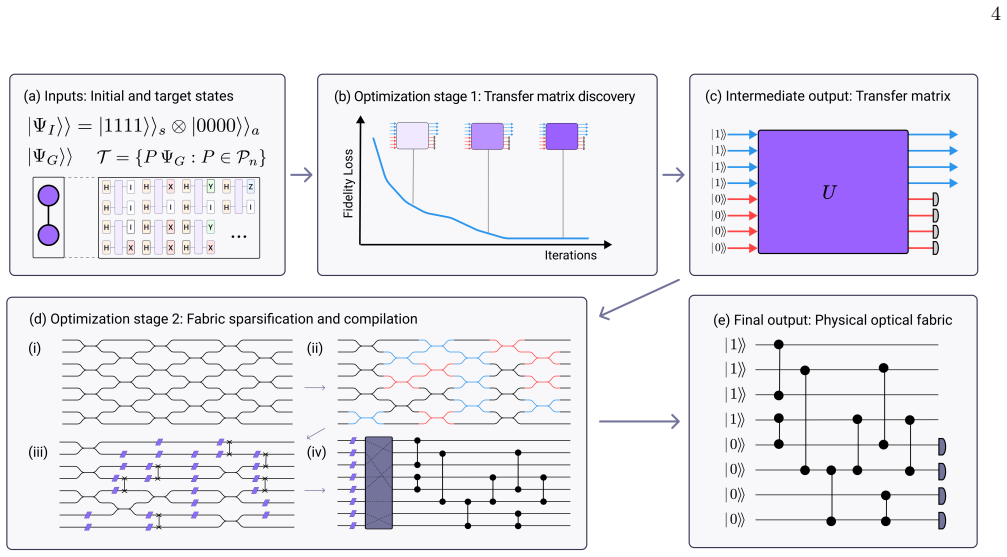
The framework uses polynomial simulation to identify unitaries maximizing success probability for perfect state preparation, followed by a sparsification algorithm that reduces the number of beamsplitters while keeping the same performance, often resulting in circuits with rational coefficients, and this yields improved generators for multiple graph states including new ones for 5 qubits.
What carries the argument
The two-pass optimization procedure consisting of polynomial-based strong simulation for gradient-based search of maximal-success unitaries followed by a novel sparsification algorithm that produces compact circuits with minimal beamsplitter count.
If this is right
- Improved success probabilities make individual resource state generators more viable building blocks in larger FBQC architectures.
- Sparsification often reveals underlying mathematical structure by producing circuits with rational reflection coefficients.
- The approach yields the first known state preparation circuits for certain 5-qubit graph states.
- Outperformance of the fusion baseline reaches up to 4.7 times for 4-qubit states and 7.5 times for 5-qubit states.
Where Pith is reading between the lines
- This automated approach may help design circuits for higher-qubit graph states where manual design becomes intractable.
- The success of sparsification suggests that optimal photonic transformations often have simple algebraic forms that hand design might miss.
- Similar optimization techniques could apply to other challenges in linear optical quantum information processing beyond graph states.
Load-bearing premise
The polynomial-based simulation accurately models the full quantum dynamics of the heralded photonic circuits.
What would settle it
An experiment implementing one of the discovered circuits and measuring a success probability significantly below the simulated value would show the optimization does not reliably identify physically optimal designs.
Figures



read the original abstract
Designing photonic circuits that prepare graph states with high fidelity and success probability is a central challenge in linear optical quantum computing. Existing approaches rely on hand-crafted designs or fusion-based assemblies. In the absence of multiplexing/boosting, both post-selected ballistic circuits and sequential fusion exhibit exponentially decreasing single-shot yields - a fundamental limitation that makes optimizing individual resource state generators particularly important, as these serve as building blocks in larger FBQC architectures. We present a general-purpose optimization framework for automated photonic circuit discovery using a novel polynomial-based simulation approach, enabling efficient strong simulation and gradient-based optimization. Our framework employs a two-pass optimization procedure: the first pass identifies a unitary transformation that prepares the desired state with perfect fidelity and maximal success probability, and the second pass implements a novel sparsification algorithm that reduces this solution to a compact photonic circuit with minimal beamsplitter count while preserving performance. This sparsification procedure often reveals underlying mathematical structure, producing highly simplified circuits with rational reflection coefficients. We demonstrate our approach by discovering optimized circuits for $3$-, $4$-, and $5$-qubit graph states across multiple equivalence classes. For 4-qubit states, our circuits achieve success probabilities of $2.053 \times 10^{-3}$ to $7.813 \times 10^{-3}$, outperforming the fusion baseline by up to $4.7 \times$. For 5-qubit states, we achieve $5.926 \times 10^{-5}$ to $1.157 \times 10^{-3}$, demonstrating up to $7.5 \times$ improvement. These results include the first known state preparation circuits for certain 5-qubit graph states.
Editorial analysis
A structured set of objections, weighed in public.
Referee Report
Summary. The manuscript presents a general-purpose optimization framework for automated discovery of heralded ballistic photonic circuits that prepare graph states. It introduces a polynomial-based strong simulator to enable efficient gradient-based optimization of unitaries that achieve perfect fidelity with maximal success probability, followed by a novel sparsification algorithm that reduces the circuit to a compact form with minimal beamsplitters while preserving performance. The method is demonstrated on 3-, 4-, and 5-qubit graph states across equivalence classes, reporting success probabilities of 2.053×10^{-3} to 7.813×10^{-3} for 4-qubit states (up to 4.7× over fusion baseline) and 5.926×10^{-5} to 1.157×10^{-3} for 5-qubit states (up to 7.5× improvement), including first-known circuits for certain 5-qubit graphs.
Significance. If the polynomial simulator is shown to be accurate, the framework offers a systematic way to improve single-shot yields for resource-state generators in fusion-based photonic quantum computation, where exponential decay in success probability is a key bottleneck. The sparsification step's ability to uncover simplified circuits with rational coefficients is a notable strength that may reveal exploitable mathematical structure. The approach could serve as a tool for discovering previously unknown circuits when scaled.
major comments (2)
- [Polynomial simulation and optimization procedure (likely §3)] The headline numerical improvements (abstract and results section) and the claim of discovering new 5-qubit circuits rest entirely on the accuracy of the polynomial-based simulator for computing heralded success probabilities under post-selection. No validation against exact simulation for small photon numbers, no checks for omitted higher-order terms, and no error analysis or convergence guarantees for the optimization are provided; this directly affects the reliability of the identified unitaries and sparsified circuits.
- [Results section] §4 (results for 5-qubit states): the assertion that certain circuits are the 'first known' requires explicit literature comparison or database search to substantiate, as the novelty claim is load-bearing for the paper's contribution to automated discovery.
minor comments (2)
- [Abstract] Abstract: success probabilities are stated without reported uncertainties, optimization tolerances, or details on how the polynomial model was normalized for the heralded subspace.
- [Methods and figures] Figure captions and methods: clarify the exact polynomial representation, how multi-photon inputs are handled, and the precise form of the post-selection projector used in the simulator.
Simulated Author's Rebuttal
We thank the referee for their detailed and constructive review. The comments highlight important aspects of validation and novelty that we address below. We have revised the manuscript to incorporate additional evidence and clarifications.
read point-by-point responses
-
Referee: [Polynomial simulation and optimization procedure (likely §3)] The headline numerical improvements (abstract and results section) and the claim of discovering new 5-qubit circuits rest entirely on the accuracy of the polynomial-based simulator for computing heralded success probabilities under post-selection. No validation against exact simulation for small photon numbers, no checks for omitted higher-order terms, and no error analysis or convergence guarantees for the optimization are provided; this directly affects the reliability of the identified unitaries and sparsified circuits.
Authors: We agree that explicit validation strengthens the claims. The polynomial simulator is derived directly from the exact expression for linear-optical evolution truncated to the heralded photon subspace; higher-order terms vanish under the post-selection conditions used. In the revised manuscript we have added a new subsection in §3 with direct comparisons to exact QuTiP simulations for 3- and 4-photon cases (maximum absolute error < 10^{-12}), an explicit bound on omitted terms, and optimization convergence diagnostics across multiple random seeds. These additions confirm the reported success probabilities. revision: yes
-
Referee: [Results section] §4 (results for 5-qubit states): the assertion that certain circuits are the 'first known' requires explicit literature comparison or database search to substantiate, as the novelty claim is load-bearing for the paper's contribution to automated discovery.
Authors: We accept that the novelty statement requires supporting evidence. We conducted a targeted literature search covering all major works on photonic graph-state generators and fusion-based resource-state preparation (including Bartolucci et al. and subsequent FBQC papers). No explicit circuits matching the specific 5-qubit graphs we report were identified. The revised §4 now includes a dedicated paragraph summarizing this search and the relevant references, thereby substantiating the claim that these are the first known circuits for those states. revision: yes
Circularity Check
No circularity: success probabilities are optimization outputs, not inputs or self-definitions
full rationale
The paper describes a two-pass optimization that first finds a unitary maximizing heralded success probability at perfect fidelity via a novel polynomial simulator, then sparsifies the circuit. The reported probabilities (e.g., 2.053e-3 to 7.813e-3 for 4-qubit states) are therefore direct computational results of this procedure rather than fitted quantities, self-referential definitions, or quantities imported via self-citation. No load-bearing self-citations, uniqueness theorems from prior author work, or smuggled ansatzes appear in the derivation; the polynomial simulation and sparsification are presented as new contributions whose outputs are independently verifiable against the stated model. The chain is self-contained.
Axiom & Free-Parameter Ledger
axioms (1)
- domain assumption Linear optical elements such as beamsplitters and phase shifters implement unitary transformations on photonic modes that can be simulated via polynomial representations.
Lean theorems connected to this paper
-
IndisputableMonolith/Cost/FunctionalEquation.leanwashburn_uniqueness_aczel unclear?
unclearRelation between the paper passage and the cited Recognition theorem.
We present a general-purpose optimization framework for automated photonic circuit discovery using a novel polynomial-based simulation approach, enabling efficient strong simulation and gradient-based optimization.
-
IndisputableMonolith/Foundation/AlphaCoordinateFixation.leanalpha_pin_under_high_calibration unclear?
unclearRelation between the paper passage and the cited Recognition theorem.
The sparsification procedure often reveals underlying mathematical structure, producing highly simplified circuits with rational reflection coefficients.
What do these tags mean?
- matches
- The paper's claim is directly supported by a theorem in the formal canon.
- supports
- The theorem supports part of the paper's argument, but the paper may add assumptions or extra steps.
- extends
- The paper goes beyond the formal theorem; the theorem is a base layer rather than the whole result.
- uses
- The paper appears to rely on the theorem as machinery.
- contradicts
- The paper's claim conflicts with a theorem or certificate in the canon.
- unclear
- Pith found a possible connection, but the passage is too broad, indirect, or ambiguous to say the theorem truly supports the claim.
Reference graph
Works this paper leans on
-
[1]
For the linear graph state, we discovered two distinct circuits
3 Qubits For 3 qubits, there are 2 distinct connected graphs, both belonging to equivalence class 2. For the linear graph state, we discovered two distinct circuits. The first achieves 1.85% success probability using 11 modes and 6 photons, with 3 ancilla measurement outcomes that herald target states. The second achieves higher success probability of 2.2...
-
[2]
4 Qubits For 4 qubits, there are 6 distinct connected graphs grouped into 2 LC equivalence classes. Equivalence class 3containsthestarandcompletegraphstates, whicharelo- cal Clifford-equivalent to the 4-GHZ state. We discovered a star graph circuit achieving0.46% success probability using 14 modes and 9 photons, with 4 heralded target states. Our best com...
-
[3]
5 Qubits For 5 qubits, there are 21 distinct connected graphs grouped into 4 equivalence classes. Due to the computa- tional complexity of 5-qubit optimizations and the large number of target states, we focused on discovering repre- sentative circuits from each equivalence class. Equivalence class 5 contains the star and fully-complete graph states, which...
-
[4]
Optical component conventions We will consider photonic circuits composed of two elementary optical components: beamsplitters (BS) and phaseshifters (P). Beamsplitters act on two modes and effectuate a SU (2) transformation, whereas phaseshifters simply add a phase to a given mode. The corresponding m-mode transfer matrices are: BS(i, j; θ, ϕT , ϕR) = I +...
-
[5]
Beamsplitter fabric A general photonic circuit consists of beamsplitters and phaseshifters. A beamsplitter fabric refers to a circuit where beamsplitters act only on adjacent modes and are arranged in a regular, lattice-like pattern. Certain fabric patterns are known to beuniversal, meaning they can implement arbitrary unitary transformations using only b...
-
[6]
Photonic circuit compilation While local beamsplitter fabrics are convenient for nu- merical optimization, it is often desirable to compile them into circuits with non-local beamsplitters that may act on arbitrary pairs of modes. This format is advantageous for both analytical interpretation and hardware imple- mentations where connectivity is not limited...
-
[7]
A layer of phaseshifters, one per mode
-
[8]
A layer of SWAPs operations
-
[9]
A layer of non-local beamsplitters. This yields an ordered sequence of circuit instructions, C = [P, S, BS] , (B6) where BS contains only nontrivial and SWAP-inequivalent beamsplitters, meaning that beamsplitter angle is re- stricted: θ /∈ kπ/2, k ∈ Z. The compilation is illustrated in Fig. 1 (d), and repro- duced here in Fig. 10. First, trivial beamsplit...
- [10]
-
[11]
M. A. Nielsen, Physical review letters93, 040503 (2004), 19 publisher: APS
work page 2004
-
[12]
S. Bartolucci, P. Birchall, H. Bombin, H. Cable, C. Daw- son, M. Gimeno-Segovia, E. Johnston, K. Kieling, N. Nick- erson, M. Pant, and others, Nature Communications14, 912 (2023), publisher: Nature Publishing Group UK Lon- don
work page 2023
-
[13]
R. Raussendorf and H. J. Briegel, Physical review letters 86, 5188 (2001), publisher: APS
work page 2001
-
[14]
R. Raussendorf, D. E. Browne, and H. J. Briegel, Physical review A68, 022312 (2003), publisher: APS
work page 2003
-
[15]
H.-S. Zhong, Y. Li, W. Li, L.-C. Peng, Z.-E. Su, Y. Hu, Y.-M. He, X. Ding, W. Zhang, H. Li, L. Zhang, Z. Wang, L. You, X.-L. Wang, X. Jiang, L. Li, Y.-A. Chen, N.-L. Liu, C.-Y. Lu, and J.-W. Pan, Physical Review Letters 121, 250505 (2018-12-21), publisher: American Physical Society
work page 2018
-
[16]
J.-M. Lee, J. Park, J. Bang, Y.-I. Sohn, A. Baldazzi, M. Sanna, S. Azzini, and L. Pavesi, APL Photonics9, 076110 (2024-07-16)
work page 2024
-
[17]
D. E. Browne and T. Rudolph, Physical Review Letters 95, 010501 (2005), publisher: APS
work page 2005
-
[18]
M. Gimeno-Segovia, P. Shadbolt, D. E. Browne, and T. Rudolph, Physical Review Letters115, 020502 (2015)
work page 2015
-
[19]
K. Kieling, T. Rudolph, and J. Eisert, Physical Review Letters 99, 130501 (2007), publisher: APS
work page 2007
-
[20]
M. Pant, D. Towsley, D. Englund, and S. Guha, Nature Communications 10, 1070 (2019-03-06)
work page 2019
-
[21]
Y. L. Lim, A. Beige, and L. C. Kwek, Physical Review Letters 95, 030505 (2005-07-13), publisher: American Physical Society
work page 2005
-
[22]
Boosted fusion gates above the percolation threshold for scalable graph-state generation,
Y.-P. Guo, G.-Y. Zou, X. Ding, Q.-H. Zhang, M.-C. Xu, R.-Z. Liu, J.-Y. Zhao, Z.-X. Ge, L.-C. Peng, K.-M. Xu, Y.-Y. Lou, Z. Ning, L.-J. Wang, H. Wang, Y.-H. Huo, Y.-M. He, C.-Y. Lu, and J.-W. Pan, “Boosted fusion gates above the percolation threshold for scalable graph-state generation,” (2024-12-25), 2412.18882 [quant-ph]
- [23]
-
[24]
S. Bartolucci, P. M. Birchall, M. Gimeno-Segovia, E. John- ston, K. Kieling, M. Pant, T. Rudolph, J. Smith, C. Sparrow, and M. D. Vidrighin, arXiv preprint arXiv:2106.13825 (2021)
-
[25]
S. Stanisic, N. Linden, A. Montanaro, and P. S. Turner, Physical Review A96, 043861 (2017), publisher: APS
work page 2017
-
[26]
F. Gubarev, I. Dyakonov, M. Y. Saygin, G. Struchalin, S. Straupe, and S. Kulik, Physical Review A102, 012604 (2020), publisher: APS
work page 2020
-
[27]
Gubarev, arXiv preprint arXiv:2108.09336 (2021)
F. Gubarev, arXiv preprint arXiv:2108.09336 (2021)
-
[28]
A. Chernikov, S. Sysoev, E. Vashukevich, and T. Y. Gol- ubeva, Physical Review A108, 012609 (2023), publisher: APS
work page 2023
-
[29]
D. B. Uskov, P. Alsing, M. Fanto, L. Kaplan, R. Kim, A. Szep, and A. Smith, Journal of Physics B: Atomic, Molecular and Optical Physics48, 045502 (2015), pub- lisher: IOP Publishing
work page 2015
-
[30]
D. B. Uskov, P. Lougovski, P. M. Alsing, M. L. Fanto, L. Kaplan, and A. M. Smith, Physical Review A91, 062318 (2015), publisher: APS
work page 2015
- [31]
- [32]
-
[33]
C. Ruiz-Gonzalez, S. Arlt, J. Petermann, S. Sayyad, T. Jaouni, E. Karimi, N. Tischler, X. Gu, and M. Krenn, Quantum7, 1204 (2023), publisher: Verein zur Förderung des Open Access Publizierens in den Quan- tenwissenschaften
work page 2023
-
[34]
S. Aaronson and A. Arkhipov, inProceedings of the forty- third annual ACM symposium on Theory of computing (2011) pp. 333–342
work page 2011
-
[35]
L. G. Valiant, Theoretical computer science8, 189 (1979), publisher: Elsevier
work page 1979
-
[36]
N. Heurtel, S. Mansfield, J. Senellart, and B. Valiron, Computer Physics Communications291, 108848 (2023), publisher: Elsevier
work page 2023
-
[37]
N. Heurtel, A. Fyrillas, G. De Gliniasty, R. Le Bihan, S. Malherbe, M. Pailhas, E. Bertasi, B. Bourdoncle, P.- E. Emeriau, R. Mezher, and others, Quantum 7, 931 (2023), publisher: Verein zur Förderung des Open Access Publizierens in den Quantenwissenschaften
work page 2023
-
[38]
Z. Kolarovszki, T. Rybotycki, P. Rakyta, A. Kaposi, B. Poor, S. Joczik, D. T. Nagy, H. Varga, K. H. El-Safty, G. Morse, and others, Quantum9, 1708 (2025), publisher: Verein zur Forderung des Open Access Publizierens in den Quantenwissenschaften
work page 2025
-
[39]
PyTorch: An Imperative Style, High-Performance Deep Learning Library
A. Paszke, arXiv preprint arXiv:1912.01703 (2019)
work page internal anchor Pith review Pith/arXiv arXiv 1912
-
[40]
J. Von Zur Gathen and J. Gerhard,Modern computer algebra (Cambridge university press, 2013)
work page 2013
-
[41]
W. R. Clements, P. C. Humphreys, B. J. Metcalf, W. S. Kolthammer, and I. A. Walmsley, Optica3, 1460 (2016), publisher: Optica Publishing Group
work page 2016
-
[42]
S. A. Fldzhyan, M. Y. Saygin, and S. P. Kulik, Physical Review Research3, 043031 (2021), publisher: APS
work page 2021
-
[43]
M. Hein, J. Eisert, and H. J. Briegel, Physical Review A—Atomic, Molecular, and Optical Physics69, 062311 (2004), publisher: APS
work page 2004
-
[44]
M. Van den Nest, J. Dehaene, and B. De Moor, Physical Review A69, 022316 (2004), publisher: APS
work page 2004
-
[45]
M. Van den Nest, J. Dehaene, and B. De Moor, Physical Review A—Atomic, Molecular, and Optical Physics70, 034302 (2004), publisher: APS
work page 2004
-
[46]
J. J. Rotman,An introduction to the theory of groups, Vol. 148 (Springer Science & Business Media, 2012)
work page 2012
-
[47]
A. A. Hagberg, D. A. Schult, and P. J. Swart, inPro- ceedings of the 7th Python in Science Conference, edited by G. Varoquaux, T. Vaught, and J. Millman (2008) pp. 11 – 15
work page 2008
-
[48]
N. Shervashidze, P. Schweitzer, E. J. Van Leeuwen, K. Mehlhorn, and K. M. Borgwardt, Journal of Machine Learning Research12 (2011)
work page 2011
-
[49]
D. P. Kingma and J. Ba, arXiv preprint arXiv:1412.6980 (2014)
work page internal anchor Pith review Pith/arXiv arXiv 2014
-
[50]
L. N. Smith and N. Topin, inArtificial intelligence and machine learning for multi-domain operations applications, Vol. 11006 (SPIE, 2019) pp. 369–386
work page 2019
-
[51]
SGDR: Stochastic Gradient Descent with Warm Restarts
I. Loshchilov and F. Hutter, arXiv preprint arXiv:1608.03983 (2016)
work page internal anchor Pith review Pith/arXiv arXiv 2016
-
[52]
M. Reck, A. Zeilinger, H. J. Bernstein, and P. Bertani, Physical review letters73, 58 (1994), publisher: APS
work page 1994
-
[53]
Gross, Journal of mathematical physics47 (2006), publisher: AIP Publishing
D. Gross, Journal of mathematical physics47 (2006), publisher: AIP Publishing
work page 2006
discussion (0)
Sign in with ORCID, Apple, or X to comment. Anyone can read and Pith papers without signing in.