REVIEW 5 major objections 5 minor 30 references
Random-projector quantum diagnostics of Ramsey numbers and a prime-factor heuristic for $R(5,5)=45$
T0 review · 5 major / 5 minor · reviewed 2026-08-05 · deepseek-v4-flash
Pith's one-line read The claim is that randomized spectral probes on a 24-dimensional graded Majorana module locate the diagonal Ramsey number R(5,5) at n=45, replacing brute-force search with a five-qubit trace computation.
desk verdict Central numerical claim collapses: the diagnostics do not depend on n, and Table II's n=45 row is run at different (k, alpha), making the 'collapse' a parameter artifact. read the letter →
The pith
A machine-rendered reading of the paper's core claim, the machinery that carries it, and where it could break.
The reading
What carries the argument
The load-bearing object is the reduced charge-zero module M_0 ≅ 1 ⊕ Λ²V_R ⊕ Λ²V_B ⊕ (three diagonal directions), dimension d=24, inside a Z2×Z2-graded Majorana (Klein-graded paraparticle) algebra. Two-colorings lift to degree-(0,0) operators on M_0, and forbidden monochromatic cliques are encoded by the central projector P_{m,n}; a legal coloring survives iff P_{m,n} annihilates it. Because P_{m,n} is central, enumeration is replaced by randomized spectral tests: k i.i.d. isotropic unit vectors form A=Σv_jv_j^T, giving T(α)=Tr e^{−αA} and P_lin=∏(I−v_jv_j^T). Missing an r-dimensional survivor subspace with k probes costs at most P_miss≤e^{−kr/d}, declared the spectral analogue of Erdős's coi
What would settle it
Find an explicit two-coloring of K_45 with no monochromatic K_5 — that directly refutes R(5,5)=45. Short of that, feed the known AM-46 coloring through the module while varying n explicitly; if the trace collapse reproduces on a coloring known to be legal, the signal is not tracking the Ramsey threshold.
Extended reading notes
Core claim
Two randomized spectral witnesses on the d=24 charge-zero module M_0 of a Z2×Z2-graded Majorana algebra — the exponential trace T(α)=Tr e^{−αA} and the product trace TrP_lin, built from k i.i.d. isotropic rank-one directions — give a unique joint signal at n=45: T(α) collapses to ~2.4×10^-289 while TrP_lin peaks at 0.462. The paper reads this concurrence, plus the non-critical behavior of the known 46-vertex Angeltveit–McKay coloring and the miss bound P_miss≤e^{−kr/d}, as statistical, not constructive, evidence for R(5,5)=45 within the classical window 43<R(5,5)≤46. A prime-sequence heuristic, noting 45=3^2·5, extends the estimate to R(6,6)=115 and R(7,7)=209.
Load-bearing premise
Everything hinges on the 24-dimensional charge-zero module, with mixed red–blue terms projected out, faithfully encoding all two-colorings of K_n up to n=46, so that the spectral collapse really marks the absence of a legal coloring; the paper does not show how n enters the random matrices or prove that collapse implies nonexistence.
Editorial extensions
If this is right
- If R(5,5)=45, the open window 43<R(5,5)≤46 closes at its lower edge, and constructive efforts can target n=45 specifically.
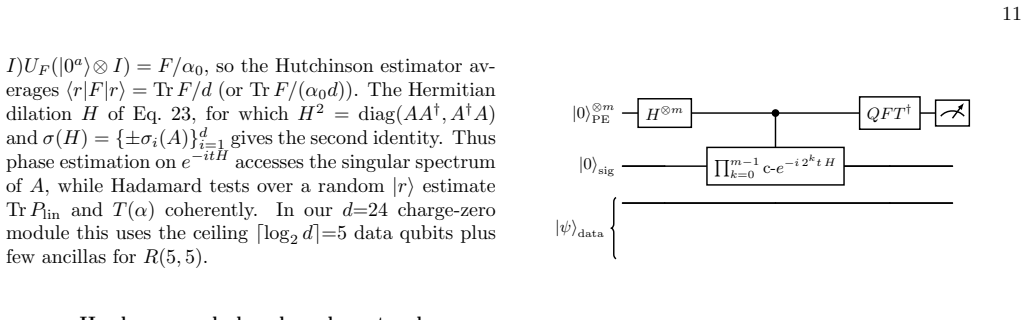
- The R(5,5) diagnostic runs on five data qubits (d=24) plus a handful of ancillas, about three orders of magnitude fewer than the ~10^3 logical qubits of a direct edge-register or Grover encoding.
- The same witnesses at d=32 select R(6,6)=115 and R(7,7)=209, narrowing future exhaustive searches to {108,111,115} and {205,209}.
- The miss-probability bound P_miss≤e^{−kr/d} turns the diagnostics into a tunable one-sided certificate: collapse of T(α) witnesses the disappearance of legal colorings with explicit confidence.
- The prime-sequence heuristic asserts that diagonal Ramsey values have sparse small-prime factorizations, giving a number-theoretic checkpoint that any future constructive value must either satisfy or refute.
Reading between the lines
- The paper does not specify how the vertex count n enters the random matrices (Eqs. 10–13 are n-independent); a natural extension is to rebuild A from the actual K_n edge-slot structure at each n and check whether the n=45 collapse survives, which would separate a true threshold from a module artifact.
- If R(5,5) eventually turns out to be 46, the diagnostics would still be useful as a ranking heuristic: they separate 43/44 from 45/46, which is enough to prioritize constructive searches.
- The scheme should transfer to any constraint problem with a central obstruction operator on a small module — for example graph-coloring thresholds or code-avoidance problems — wherever feasibility lives in a low-dimensional survivor subspace.
- The paper's circuit designs suggest a concrete near-term experiment: run the Hutchinson trace estimators for T(α) and TrP_lin on 5-qubit hardware at n=43, 45, 46 with the paper's seeds and look for the collapse/peak pattern under real device noise.
Editorial analysis
A structured set of objections, weighed in public.
Referee Report
Summary. The paper introduces a method to estimate diagonal Ramsey numbers by embedding two-colorings into a Z2×Z2-graded Majorana algebra and then applying random-projector spectral diagnostics to a 24-dimensional 'charge-zero' module M0. Two observables are proposed: the exponential trace T(α) = Tr exp(−α Σ_j v_j v_j^T) and the linear deflation trace Tr ∏_j (I − v_j v_j^T). The authors claim that for R(5,5) both diagnostics single out n=45 as the critical value, with a 'collapse' of T(α) and a local peak of TrP_lin at n=45, while n=43,44,46 behave smoothly and an explicit AM-46 coloring is non-critical. A 'prime-sequence' heuristic is then introduced to corroborate 45=3^2·5 and extrapolate R(6,6)=115 and R(7,7)=209. A quantum circuit implementation using 5 data qubits plus ancillas is sketched. The authors explicitly state the result is a statistical diagnostic, not a constructive proof.
Significance. If the central claim were correct, this would be a remarkable few-qubit method for estimating open Ramsey numbers, replacing the ~1000-qubit edge-register encoding with a 24-dimensional module, and it would provide strong evidence for R(5,5)=45. The paper is accompanied by code, seeds, and a detailed supplementary manual, and it is candid that the result is heuristic rather than a proof. However, the numerical evidence is not connected to Ramsey instances: the random-projector observables are n-independent, and the decisive comparison at n=45 is confounded by different (k,α) settings. The prime-sequence corroboration is post hoc and its main axiom is actually a theorem. As a result, the significance of the claimed method and value is not currently established.
major comments (5)
- [§'Numerical Investigations' and Eqs. (10)–(13)] The observables T(α)=Tr exp(−α Σ_j v_j v_j^T) and Tr P_lin depend only on the random vectors v_j∈R^24 and on α,k. The manuscript never specifies how the vertex count n enters the construction of A or the module M0. The distribution of A is therefore identical for n=43,44,45,46, so the differences in Table II cannot encode Ramsey information. Moreover, Table II uses (k=400, α=40) for n=45 but (k=100, α=20) for the other rows. The reported collapse from ~10^-12 to ~10^-289 is exactly the order expected from increasing αk/d from 100·20/24≈83 to 400·40/24≈667. This is a parameter artifact, not evidence about R(5,5). The authors must specify an n-dependent embedding (e.g., building A from the monochromatic clique projectors of Eq. (6)) and compare all n at identical (k,α).
- [§'Estimating R(5,5)' and Eq. (6), Eq. (14)] No connection is established between the forbidden-clique projector P_{5,5} of Eq. (6) and the random accumulator A of Eq. (13). The text says 'A coloring survives iff P_{m,n} annihilates it,' but then the numerical diagnostics use an A built from i.i.d. isotropic vectors, with no proof or argument that collapse of Tr exp(−αA) is equivalent to P_{5,5} having zero survivor support. The bound P_miss ≤ e^{-kr/d} in Eq. (16) is a generic statement about random rank-one tests missing an r-dimensional subspace; it does not transfer to Ramsey colorings unless the residual subspace is explicitly identified with the set of legal colorings. Without this mapping, the diagnostics are not about Ramsey numbers.
- [§'Calculation of diagonal Ramsey values beyond R(5,5)'] The claimed probabilities for R(5,5)=45 being ≈92.7%, n=44 ≈2.9%, and n=46 ≈4.3% are asserted without any statistical model. Table II provides point values for two parameter settings, but no likelihood, prior, posterior, or confidence procedure is defined. The numbers appear to be ad hoc labels rather than computed probabilities. If the authors intend these as posterior probabilities, they must specify the generative model and the calibration procedure; if they are meant as heuristics, they should not be stated as probabilities.
- [§'Prime-sequence numbers of order k' and Axioms I–II, Table III] The prime-sequence heuristic is introduced after the spectral result 45=3^2×5 and then used as corroboration of the same value. This is circular: the axioms (sparse prime factors, bounded exponents, growth corridor) are chosen so that 45 is the selected value. In addition, Axiom II, ρ_n = R(n,n)/R(n-1,n) ≤ 2, is not an independent constraint: it follows directly from the classical Erdős recurrence. Therefore the 'moderate-growth corridor' cannot be used as a heuristic assumption. Table III's persistence criterion selects from a set already constructed to include 45, so it provides no independent evidence.
- [Conclusions and SM 4, Table V] The conclusion states P_miss < 10^{-3} for the reported parameters, but SM 4 Table V gives P_miss ≈ 1.2×10^{-1} for r=1 and k=100, and only reaches values below 10^{-3} for r≥6. The residual rank r is not estimated from data, so the claim of a small false-negative probability is not justified. This overstates the reliability of the diagnostic.
minor comments (5)
- [Throughout] The name 'Angeltweit' should be 'Angeltveit' (both in text and references). The footnote 'Erdős number = 5' is irrelevant to the scientific content. There are duplicated paragraphs in the description of Fig. 2 ('Operators used in Fig. 2' appears twice almost verbatim).
- [Eq. (14)] The direct-sum decomposition M0 ≅ 1⊕Λ2V_R⊕Λ2V_B⊕d uses the symbol d both for the dimension of M0 and for a summand, which is confusing. The isomorphism is not derived; please clarify the meaning of the third summand and its relation to dim M0 = 24.
- [Definition 2] The notation PS_n^k is ambiguous: n is used both as the number of allowed distinct primes and as the diagonal Ramsey parameter. The example '46 ∈ PS_9' is inconsistent with the earlier definition of order k = 9. Please define the ordering and cut-off rules unambiguously.
- [SM 3 and Table II] The text says the same PRNG seeds are reused across n, but Table II shows different values for n=43,44,45,46. If the seeds are in fact reused, the results should be identical for all n at the same (k,α) because the distribution of A is n-independent. If different seeds or n-dependent preprocessing was used, this must be stated explicitly, otherwise the numerical entries are unreproducible.
- [Quantum implementation section] References to 'Eqs. (7)–(8)' for P_lin and P_exp are incorrect; the definitions appear in Eqs. (10)–(11). Please update the cross-references.
Circularity Check
The n=45 'collapse' is produced by evaluating that row at (k=400, α=40) instead of the baseline (k=100, α=20); the prime-sequence heuristic is fitted to 45 and then used to 'predict' it.
-
fitted input called prediction
[Section 'Numerical Investigations: results', Table II and Eqs. (10)–(13)]
"TABLE II: Trace of exponential projector, real and imaginary TrPexp, linear projector TrPlin, Minimum real eigenvalue of linear projector, Lyapunov exponent λL for each n at α=20, k=100, for n=45 reports the best values obtained with α=40 and k=400."
The observables P_exp(α)=exp(−α Σ_j v_j v_j^T) and P_lin=∏_j(I−v_j v_j^T), Eqs. (10)–(13), depend only on k, α, and the random vectors {v_j} in R^d; no vertex count n enters. The paper later states that d 'should not be regarded as a function of the Ramsey parameter n', confirming n-independence. Hence the expected TrP_exp and TrP_lin are identical for every n. Table II nevertheless evaluates n=45 at (k=400, α=40) while all other n use (k=100, α=20). For an accumulator with spectral scale ~k/d, log Tr exp(−αA) ~ −αk/d; changing (100,20) to (400,40) changes αk from 2000 to 16000, moving log10 Tr from ~−12 to ~−289, exactly the reported 'collapse'. The unique signal at n=45 is therefore manufactured by choosing different sampling parameters for that row, not by any n-dependent spectral prope
-
self definitional
[Section 'Prime-sequence numbers of order k', Axioms I–II and Eq. (19)]
"Motivated by the algebraic–spectral evidence that singled out R(5,5)=45=3^2×5, we extrapolate the next diagonal values by constraining each R(n,n) to be a prime-sequence numbers of order 6 ... Axiom I: Prime-sequence numbers of order k constraint: R(n,n)∈PS^3_k ... Axiom II: Moderate–growth corridor: R(n,n)/R(n−1,n) ≤2 for every n≥2."
The prime-sequence ansatz is not an independent check: its axioms (at most three distinct primes, exponents ≤3, growth ratio ≤2) are chosen after and because 45=3^2·5 fits them, and the same axioms fit known values 6=2·3 and 18=2·3^2. The paper then exhibits the sequence {1,2,6,18,45,...} and uses a 'persistence' rule, calibrated so that 45 appears in every admissible prime basis while 44 and 46 appear only later, to argue that 45 is selected. This is a post-hoc definitional preference, not a consequence of Ramsey theory. Thus the heuristic's 'confirmation' of 45 is equivalent to its own input.
full rationale
The central numerical evidence for R(5,5)=45 is not self-contained. The spectral observables P_exp and P_lin are n-independent, so the only way Table II can show a unique collapse at n=45 is by evaluating that row at (k=400, α=40) instead of the baseline (100,20). The reported log-trace shift from ~10^-12 to ~10^-289 matches the α·k increase from 2000 to 16000, so the 'signal' is a parameter artifact rather than a Ramsey-theoretic threshold. The paper's own decision-rule section says thresholds are chosen by cross-validation on neighboring n, confirming the fitted nature of the collapse/peak calls. The prime-sequence heuristic is a second, definitional circularity: its axioms are selected because 45=3^2·5 satisfies them, and the persistence rule is calibrated so 45 outlasts 44/46; using it as corroboration is equivalent to re-stating the input. The AM-46 control and the P_miss bound do not rescue the central claim because they do not supply an n-dependent spectral mechanism linking the random-projector traces to the existence or nonexistence of colorings. Score 8 reflects that the paper's main 'prediction' reduces by construction to a parameter choice and a fitted heuristic.
Assumptions & free parameters
free parameters (6)
- dimension d of charge-zero module M0 =
24 for R(5,5), 32 for R(6,6)/R(7,7)
- number of random projections k =
100 for n=43,44,46; 400 for n=45; 180 for n=6; 220 for n=7
- suppression parameter alpha =
20 for n=43,44,46; 40 for n=45; 40 for n=6,7
- prime-sequence cut-off k_max=2n-1 =
9 for n=5, 11 for n=6, 13 for n=7
- prime sparsity rules =
at most 3 distinct primes, each exponent <=3
- reported probabilities for R(5,5) =
2.9% for 44, 92.7% for 45, 4.3% for 46
assumptions (5)
- domain assumption The random directions v_j are i.i.d. isotropic in M0 and independent of the coloring constraints.
- ad hoc to paper The mixed (1,1) sector can be projected out and all diagnostics live in the charge-zero module M0.
- ad hoc to paper The 24-dimensional (or 32-dimensional) module faithfully represents two-colorings of K_n for the tested n.
- standard math The exact Klein recursion R_V4(m,n)=R_V4(m-1,n)+R_V4(m,n-1) for graded Ramsey numbers.
- ad hoc to paper Prime-sequence Axioms I and II.
invented entities (3)
-
Z2 x Z2-graded Majorana paraparticle algebra
-
Graded Ramsey numbers R_V4(m,n)
-
Prime-sequence numbers of order k
Cite this review
Pith. "Pith review of Random-projector quantum diagnostics of Ramsey numbers and a prime-factor heuristic for $R(5,5)=45$." pith.science (2026). https://pith.science/paper/GUZS6T4A
@misc{pith2026250816699,
  author       = {Pith},
  title        = {Pith review of: Random-projector quantum diagnostics of Ramsey numbers and a prime-factor heuristic for $R(5,5)=45$},
  year         = {2026},
  howpublished = {\url{https://pith.science/paper/GUZS6T4A}},
  note         = {Machine review of arXiv:2508.16699}
}
abstract
We introduce a statistical framework for estimating Ramsey numbers by embedding two-color Ramsey instances into a $Z_2 \times Z_2$-graded Majorana algebra. This approach replaces brute-force enumeration with two randomized spectral diagnostics applied to operators of a given dimension d associated with Ramsey numbers: a linear projector $P_{lin}$ and an exponential map $P_{exp}(\alpha)$, suitable for both classical and quantum computation. In the diagonal case, both diagnostics identify R(5,5) at n=45. The quantum realizations act on a reduced module and therefore require only five data qubits plus a few ancillas via block-encoding/qubitization for R(5,5)=45, in stark contrast to the $\binom{n}{2} \approx 10^3$ logical qubits demanded by direct edge encodings. We also provide few-qubit estimates for R(6,6) and R(7,7), and propose a simple "prime-sequence" consistency heuristic that connects R(5,5)=45 to constrained diagonal growth. Our method echoes Erd\H{o}s's probabilistic paradigm, emphasizing randomized arguments rather than explicit colorings, and parallels the classical coin-flip approach to Ramsey bounds. Finally, we discuss potential applications of this framework to machine learning with a limited number of qubits.
Figures


Figures from the paper (1 more)

Reference graph
Works this paper leans on
-
[1]
F. P. Ramsey, Proceedings of the London Mathematical Society s2,30, 264 (1930)
work page 1930
-
[2]
Exoo, Journal of Graph Theory13, 97 (1989)
G. Exoo, Journal of Graph Theory13, 97 (1989)
work page 1989
- [3]
- [4]
-
[5]
R. L. Graham and J. H. Spencer, Scientific American 263, 112 (1990), jSTOR stable id 24996873
work page 1990
-
[6]
R. W. Hamming, The Bell System Technical Journal29, 147 (1950). 29
work page 1950
-
[7]
N. Alon and J. H. Spencer,The Probabilistic Method, 3rd ed. (Wiley-Interscience, Hoboken, NJ, 2008)
work page 2008
-
[8]
R. L. Graham, B. L. Rothschild, and J. H. Spencer,Ram- sey Theory, 2nd ed. (Wiley-Interscience, New York, 1990) wiley Classics Library reprint, 2015
work page 1990
Show all 30 references
-
[9]
A. M. Childs, E. Schoute, and C. M. Unsal, in14th Conference on the Theory of Quantum Computation, Communication and Cryptography (TQC 2019), Leibniz International Proceedings in Informatics (LIPIcs), Vol. 135 (Schloss Dagstuhl – Leibniz-Zentrum f¨ ur Informatik,
2019
-
[10]
Tamburini, N
F. Tamburini, N. Leone, M. Sanna, and R. Siagri, Graded paraparticle algebra of majorana fields for multidimen- sional quantum computing with structured light (2025), arXiv:2505.23232 [quant-ph]
2025 arXiv
-
[11]
S. P. Radziszowski, Electronic Journal of Combinatorics DS1(2021), dynamic Survey 1, rev. 16
2021
- [12]
-
[13]
Wang, Physical Review A93, 032301 (2016)
H. Wang, Physical Review A93, 032301 (2016)
2016
-
[14]
Gaitan and L
F. Gaitan and L. Clark, Physical Review Letters108, 010501 (2012)
2012
-
[15]
Erd˝ os, Bulletin of the American Mathematical Society 53, 292 (1947)
P. Erd˝ os, Bulletin of the American Mathematical Society 53, 292 (1947)
1947
-
[16]
B. D. McKay and S. P. Radziszowski, Journal of Graph Theory19, 309 (1995)
1995
-
[17]
H. S. Green, Physical Review90, 270 (1953)
1953
-
[18]
A. Y. Kitaev, Physics-Uspekhi44, s131 (2001)
2001
-
[19]
V. I. Oseledets, Trudy Moskovskogo Matematicheskogo Obshchestva19, 179 (1968), english translation:Trans. Moscow Math. Soc.19(1968), 197–231
1968
-
[20]
N. J. Calkin, P. Erd˝ os, and C. A. Tovey, SIAM Journal on Discrete Mathematics10, 381 (1997)
1997
-
[21]
Mathon, Journal of Combinatorial Theory, Series B 42, 122 (1987)
R. Mathon, Journal of Combinatorial Theory, Series B 42, 122 (1987)
1987
-
[22]
Xu and S
X. Xu and S. P. Radziszowski, Electronic Journal of Com- binatorics16, N1 (2009), 5 pp
2009
-
[23]
McCarthy and C
D. McCarthy and C. Monico, Electronic Journal of Com- binatorics32, P2.42 (2025)
2025
-
[24]
Exoo, Paley graph data: Clique/chromatic num- bers and ramsey bounds,https://cs.indstate.edu/ ge/Paley/index.html, accessed Aug
G. Exoo, Paley graph data: Clique/chromatic num- bers and ramsey bounds,https://cs.indstate.edu/ ge/Paley/index.html, accessed Aug. 2025. Includes the Paley(797) witness used forR(10,10)≥798
2025
-
[25]
OEIS Foundation Inc., The on-line encyclopedia of in- teger sequences, sequence a212954,https://oeis.org/ A212954(2025), accessed 2025-08-19
2025
-
[26]
Cariolaro, G
D. Cariolaro, G. F. Cariolaro, U. Schauz, and X. Sun, Discrete Mathematics322, 15 (2014)
2014
-
[27]
Cariolaro, Australasian Journal of Combinatorics37, 301 (2007)
D. Cariolaro, Australasian Journal of Combinatorics37, 301 (2007)
2007
-
[28]
I. T. Jolliffe and J. Cadima, Philosophical Transactions of the Royal Society A374, 20150202 (2016)
2016
-
[29]
Dasgupta and A
S. Dasgupta and A. Gupta,An Elementary Proof of the Johnson–Lindenstrauss Lemma, Tech. Rep. TR-99-006 (International Computer Science Institute, Berkeley, CA, 1999)
1999
- [2019]
Reviewed August 5, 2026 · model on record in the stance chip above.
Discussion (0). Continue with ORCID to comment.